
AYUSH License: How to Start Your Business in India
To get an AYUSH licence in India, first decide whether you will manufacture Ayurvedic, Siddha, Unani or homoeopathic medicines, use a third-party manufacturer, sell existing products or operate an AYUSH clinic. Product manufacturing licences are handled by the relevant state or union territory licensing authority. Applications for applicable medicine licences can be processed through the official e-AUSHADHI portal. Your licence, documents and quality requirements depend on the product and business model.
What Is an AYUSH License in India?
An AYUSH licence is a common term for the regulatory approvals that may apply to AYUSH medicines, manufacturing units and related businesses. India does not issue one universal licence that covers every AYUSH activity.
The Ministry of AYUSH oversees the development and promotion of traditional systems of medicine. However, the licensing of Ayurvedic, Siddha and Unani medicines for manufacture and sale is handled by the relevant State or Union Territory Licensing Authority under the Drugs and Cosmetics Act, 1940 and the Drugs Rules, 1945. Homoeopathic medicines have their own provisions under these rules.
The Central Drugs Standard Control Organization (CDSCO) publishes the relevant legal framework, including the provisions for traditional medicines.
You can review the official Drugs and Cosmetics Rules, 1945 and the CDSCO's Traditional Drugs guidance.
Here is the first distinction to understand: a company manufacturing Ayurvedic medicines may need a manufacturing licence and applicable Good Manufacturing Practices (GMP) compliance. A brand that outsources production may need a different licensing arrangement. A retailer or clinic follows a different set of requirements.
Before you spend money on premises, machinery or packaging, identify exactly what your business will do.
Which Types of AYUSH Licences and Business Models Are Available?
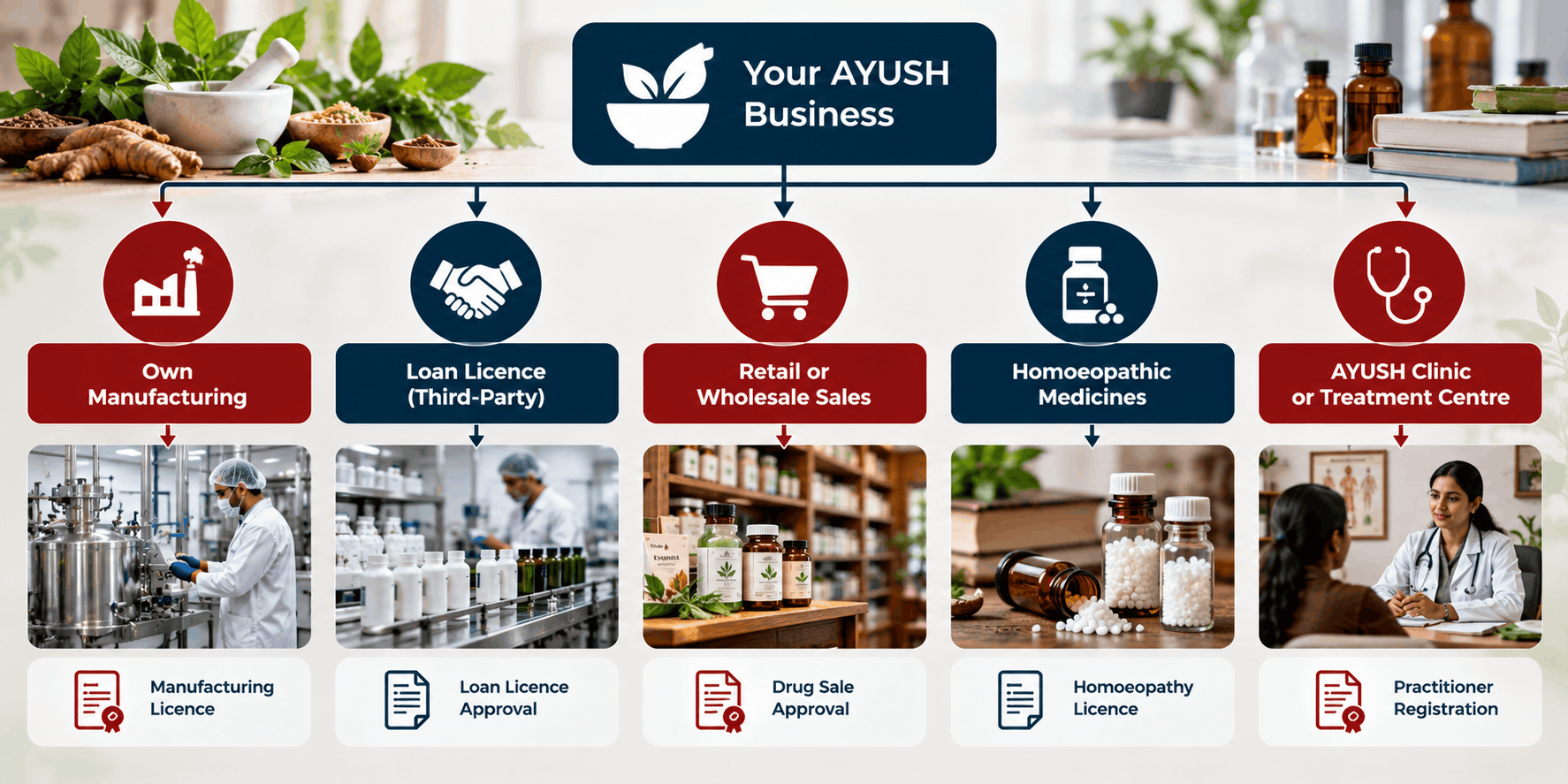
The right licence depends on your activity, product category and the way you arrange production or sales. The following table separates common business models from the approvals they may require.
| Type | Who it suits | Main licence or approval to check | Important point |
|---|---|---|---|
| Own manufacturing unit | Businesses that manufacture medicines in their own facility | Applicable manufacturing licence and GMP compliance | Requires suitable premises, staff, equipment and quality systems |
| Loan licence or third-party manufacturing arrangement | Brands that use an existing licensed manufacturer's facility | Applicable loan licence or other approved licensing arrangement | A private contract alone does not replace regulatory approval |
| Ayurvedic, Siddha or Unani medicines | Manufacturers of ASU medicines | Applicable licence under the Drugs Rules, 1945 | Classical and patent or proprietary medicines have different requirements |
| Homoeopathic medicines | Homoeopathic medicine manufacturers | Applicable licence under the Homoeopathy provisions | Do not automatically use ASU forms for Homoeopathic products |
| Retail or wholesale sales | Shops, distributors and medicine sellers | Applicable state or local AYUSH drug-sale requirements | Requirements differ by state and activity |
| Drug-testing laboratory | Laboratories testing AYUSH medicines or raw materials | Applicable laboratory approval | Testing must follow the relevant standards and licensing conditions |
| AYUSH clinic or treatment centre | Practitioners and businesses providing treatment | Practitioner registration and applicable clinical-establishment or local approvals | A medicine manufacturing licence is not a substitute for clinical registration |
| Herbal cosmetics or wellness products | Brands selling skincare, haircare or wellness products | Product-specific cosmetic, food or other regulatory route | A product is not automatically an AYUSH medicine because it contains herbs |
The official e-AUSHADHI portal provides licensing services and guidance for relevant traditional medicine and homoeopathy activities. The applicable service and form depend on the category and the licensing authority.
1. What is an AYUSH manufacturing licence?
An AYUSH manufacturing licence is relevant when a business manufactures regulated AYUSH medicines for sale or distribution.
For Ayurvedic, Siddha and Unani medicines, the Drugs Rules, 1945, provide for a manufacturing licence in Form 25-D, with the corresponding application in Form 24-D. A manufacturer must meet the applicable requirements for premises, technical staff, manufacturing practices and quality control.
The rules also distinguish between medicines prepared according to authoritative texts and patent or proprietary medicines. The ingredients, formulation, proposed indications and supporting evidence can affect the licence assessment.
You should therefore prepare a product list before applying. Include each medicine's formulation, dosage form, intended use and proposed label. The licensing authority must assess the relevant products and the manufacturing arrangement.
For official requirements, refer to the Drugs Rules, 1945.
2. What is an AYUSH loan licence?
A loan licence can suit a brand owner who wants to sell medicines but does not operate its own manufacturing facility.
Under the relevant ASU provisions, the loan licence application is made in Form 24-E, and the licence is issued in Form 25-E, subject to the applicable rules and approval. The licensing authority assesses the proposed arrangement and the facilities of the existing manufacturer.
For example, suppose you want to launch an Ayurvedic hair oil or a classical herbal formulation under your own brand. You approach a licensed manufacturer with suitable facilities and agree on the formulation, production, quality testing, packaging and supply. You must still establish which licence and product approvals apply to your specific arrangement.
Do not assume that a manufacturer’s licence automatically covers every product or brand owner. Confirm the approved products, manufacturing scope and licensing route with the relevant authority before placing a commercial order.
3. What is the difference between classical and patent or proprietary AYUSH medicine?
A classical medicine is prepared according to a formulation described in the authoritative texts recognised under the applicable law. A patent or proprietary medicine uses permitted ingredients from those texts in a formulation that falls within the relevant legal definition.
The distinction matters because the authority may require different supporting information for the proposed formulation and its indications.
Before developing a new product, prepare:
-
The complete ingredient list and quantities.
-
The authoritative text or formulation reference, where applicable.
-
The proposed dosage form and method of use.
-
The intended indications and label claims.
-
Supporting safety and effectiveness information required for the category.
Rule 158-B of the Drugs Rules, 1945 sets out guidelines for the licensing of Ayurvedic, Siddha and Unani medicines, including requirements concerning safety and evidence of effectiveness. Check the rule and the current state licensing checklist before finalising a formulation.
4. Does a Homoeopathic medicine need the same licence?
No. Homoeopathic medicines follow separate provisions within the Drugs Rules, 1945. The relevant manufacturing provisions include Form 25-C and associated application and licensing requirements.
The exact form depends on the proposed activity and current applicable rules. Do not copy an ASU medicine application checklist and use it for Homoeopathic manufacturing without checking the relevant Homoeopathy provisions and the portal's current service options.
5. Do AYUSH clinics need a medicine manufacturing licence?
A clinic that provides consultation or treatment does not automatically need a manufacturing licence simply because it offers Ayurvedic or other AYUSH services.
Instead, check the practitioner's registration, the rules governing the establishment, local permissions and any clinical-establishment registration that applies in the state or Union Territory. If the clinic also manufactures, repacks or markets its own medicines, those activities need a separate regulatory assessment.
What Are the Eligibility Requirements for an AYUSH Manufacturing Licence?
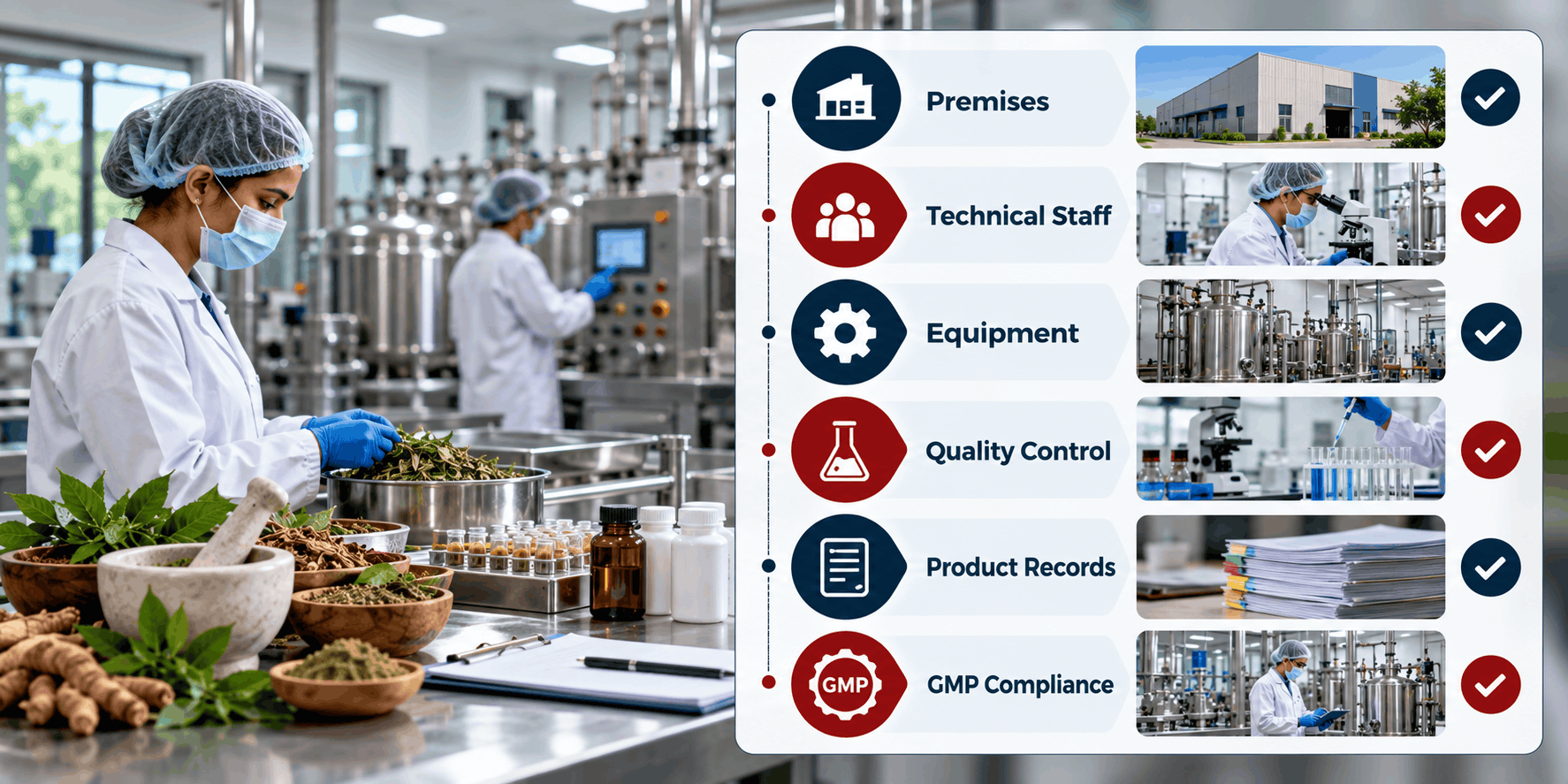
Eligibility depends on the product system, manufacturing activity, premises, technical staff and applicable state requirements. There is no single qualification or premises checklist that applies to every AYUSH business.
For an ASU manufacturing unit, prepare to demonstrate that the proposed facility and staff meet the relevant requirements under the Drugs Rules, 1945, including Schedule T where applicable.
Check these areas before applying:
-
Business identity: Decide whether the applicant will be a proprietorship, partnership, LLP or company.
-
Premises: Secure premises suitable for the proposed manufacturing activities and the applicable layout and hygiene requirements.
-
Technical staff: Identify the competent technical personnel required for production and testing.
-
Manufacturing equipment: Match the equipment and facilities to the dosage forms and products proposed for manufacture.
-
Quality control: Establish the required testing arrangements, records and quality procedures.
-
Product formulation: Prepare the product list, formulae and relevant evidence required for the application.
-
GMP compliance: Review the applicable GMP requirements and arrange the necessary inspection and certification.
If you need to establish the legal entity first, Legal Babu offers support for proprietorship registration, partnership registration, LLP registration and company registration.
The right structure depends on the ownership, investment, risk and plans for growth. Registering a company does not, by itself, authorise it to manufacture or sell medicines.
What Documents Are Required for an AYUSH License?
The exact checklist comes from the relevant licensing authority and application category. The documents below are common preparation items for a manufacturing application, not a guarantee that every state will request precisely the same set.
Business and premises documents
-
Applicant's identity and address details.
-
Business constitution documents, such as the proprietorship declaration, partnership deed or company incorporation records.
-
Proof of ownership or a valid lease for the premises.
-
Site layout and details of manufacturing and storage areas.
-
Details of the proposed manufacturing activities and dosage forms.
-
Required declarations and authorisations signed by the applicant.
Technical and product documents
-
Names and qualifications of the technical staff.
-
Product list and formulation details.
-
Manufacturing process and relevant specifications.
-
Equipment and facility details.
-
Quality-control and testing arrangements.
-
Applicable GMP documents and supporting records.
-
Product labels and other information requested by the licensing authority.
Documents for a loan licence or outsourced manufacturing
You may also need the details and licence information of the existing manufacturer, the proposed manufacturing arrangement, the list of products, and the documents required to establish that the facility can undertake the work.
Prepare the documents in the format required by the relevant authority. An incomplete application can lead to queries or delays, especially when the product list, formulation details, staff information and premises records do not match.
How Do You Apply for an AYUSH License Through e-AUSHADHI?
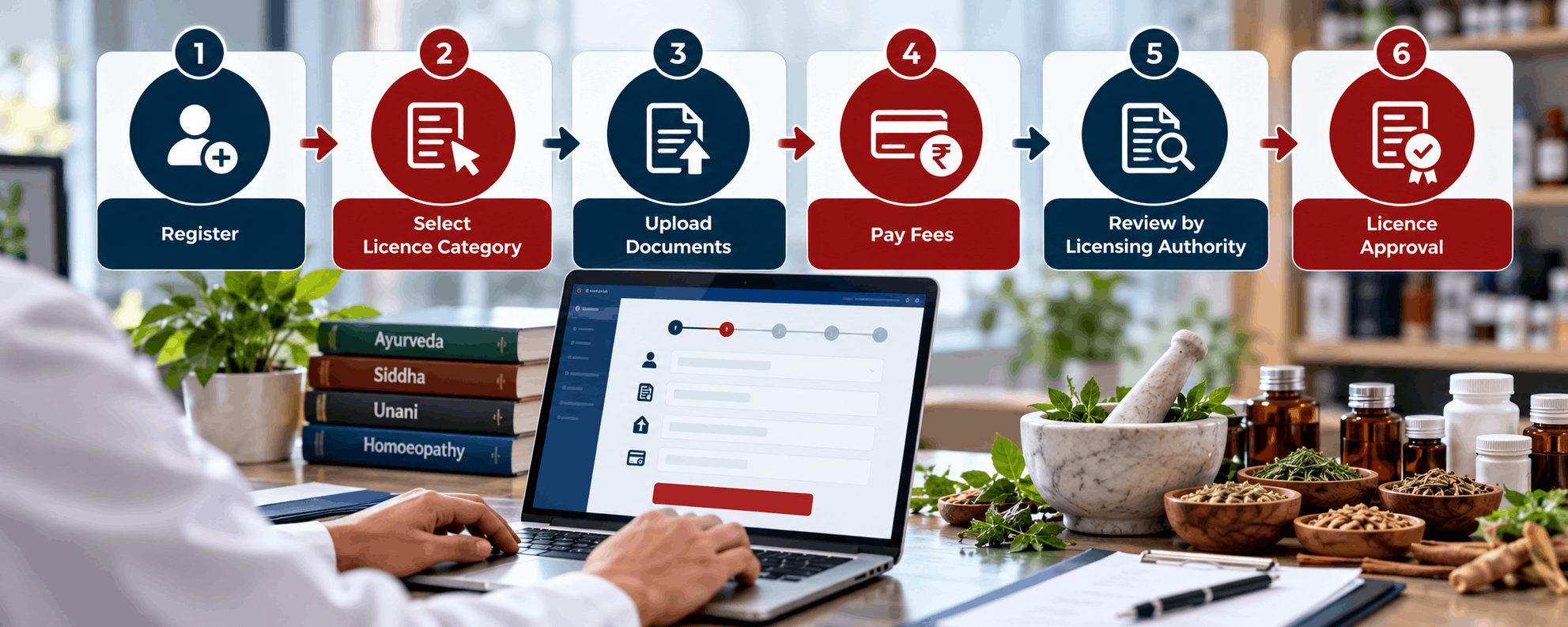
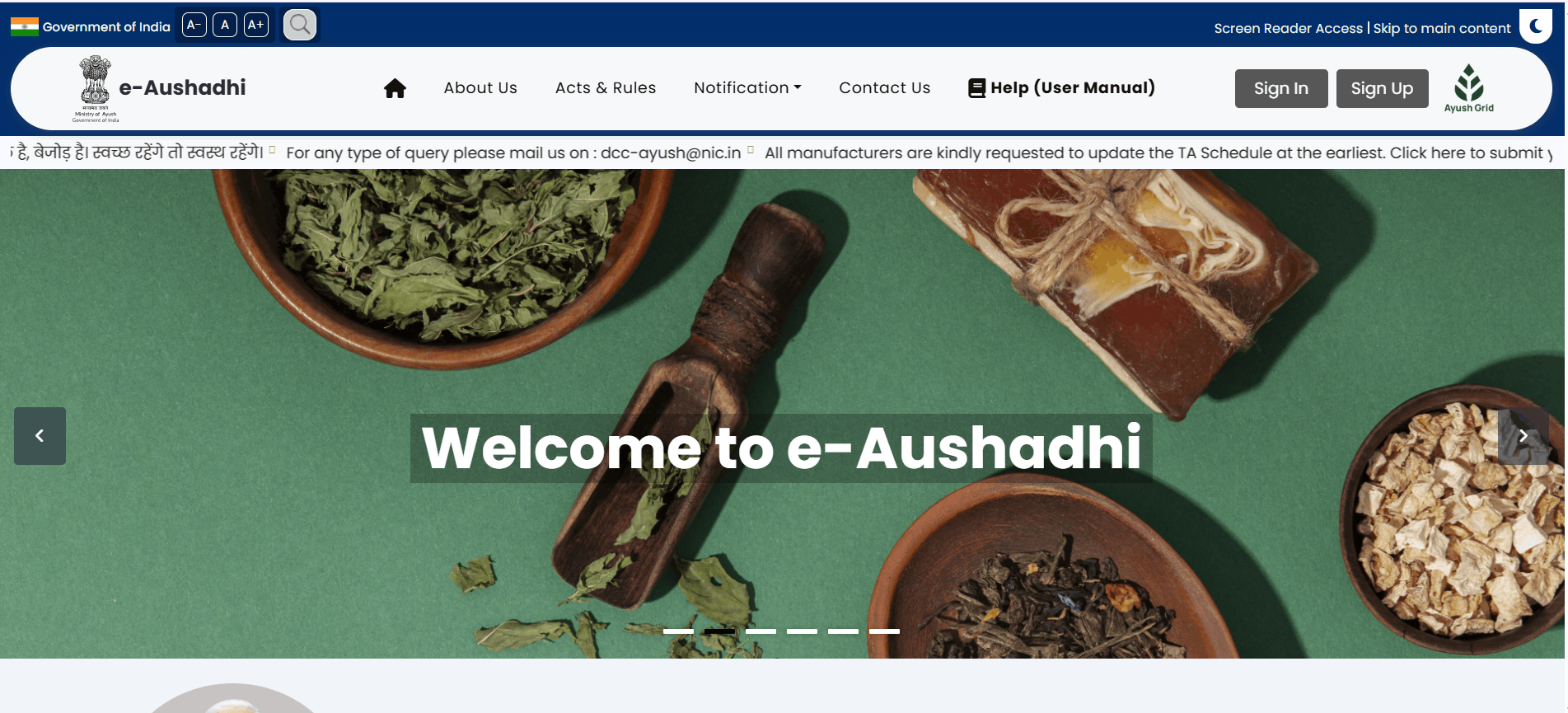
The Ministry of AYUSH's e-AUSHADHI portal provides online services for applicable licensing activities. Its official user manual explains registration and application modules.
The portal's available services and application categories can change. Check the current instructions before filing, especially if you are applying for a new licence or managing an existing approval.
Step 1: Identify the correct licensing authority and product category
Decide whether your products fall under Ayurveda, Siddha, Unani, Sowa-Rigpa or Homoeopathy and identify the applicable licensing route.
The State or Union Territory Licensing Authority is central to the licensing process. Do not assume that the Ministry of AYUSH issues every manufacturing licence directly.
Step 2: Choose the business model
Decide whether you will manufacture in your own facility, use a loan licence arrangement, work with a third-party manufacturer or operate a sales business.
This choice determines which documents and approvals you need. Settle it before signing a manufacturing contract or purchasing equipment.
Step 3: Prepare your premises, staff and product documents
For a manufacturing application, make sure the facility, equipment, technical staff, quality-control arrangements and product details match the applicable requirements.
If you plan to outsource production, confirm the licensing requirements for the brand owner and manufacturer before agreeing to launch dates.
Step 4: Register on the portal
Open the official e-AUSHADHI website and follow the current applicant registration process.
The portal announced a fresh applicant registration process in April 2026 and stated that previous registrations would not be considered for the new system. Follow the live registration instructions and use the official user manual if you need help.
Step 5: Select the relevant application service
Choose the correct fresh licence, loan licence, product-related or other applicable service. The available options depend on the medicine system and licensing category.
Read the application instructions carefully. Do not select a form only because its number appears in an older checklist or a third-party article.
Step 6: Submit the application and supporting documents
Enter the applicant, premises, technical staff and product details accurately. Upload the required documents and pay the prescribed fee using the method specified by the portal or licensing authority.
Keep a copy of the submitted application, fee receipt and supporting records.
Step 7: Respond to queries and prepare for inspection
The authority may review documents, request additional information or inspect the proposed facility. Address any deficiencies and ensure that the premises, equipment, staff and quality arrangements match the application.
Step 8: Obtain approval before starting regulated activity
Do not begin manufacturing or market a product as licensed simply because you submitted an application. Wait for the required licence and product permissions, and confirm the scope of the approval before production or sale.
Important: As of October 2026, the e-AUSHADHI portal lists fresh ASU licence applications and legacy-licence services among its updates. Check the latest portal notice for the specific medicine system and service you need. See the official e-AUSHADHI updates.
What Is GMP, and Is It Mandatory for AYUSH Manufacturing?
Good Manufacturing Practices (GMP) set requirements for how medicines are made, handled and checked. For Ayurvedic, Siddha and Unani manufacturing, Schedule T of the Drugs Rules, 1945 contains the applicable GMP requirements.
The facility must meet the relevant requirements for hygienic premises, equipment, staff, production controls, storage and quality records. The licensing authority assesses compliance under the applicable process.
GMP is not simply a logo or a voluntary marketing badge for a regulated manufacturing unit. A business should confirm the requirements for its licence and product category before production starts.
A practical preparation checklist includes:
-
Appropriate manufacturing and storage areas.
-
Suitable equipment for the approved dosage forms.
-
Written procedures for cleaning, production and quality control.
-
Records for raw materials, batches and finished products.
-
Arrangements for testing and handling quality failures.
-
Staff trained for their assigned work.
-
Procedures for complaints, product recalls and other required actions.
Legal Babu also lists GMP certification support among its business compliance services. Any certification or licence must still be issued or recognised by the competent authority under the applicable rules.
What Other Registrations Might an AYUSH Business Need?
The AYUSH product licence is only one part of setting up the business. Other registrations depend on the legal structure, premises, products and activities.
| Registration or approval | When to check it | What it covers |
|---|---|---|
| Business registration | When forming the business | Legal structure and ownership |
| GST registration | When the applicable GST rules require it | Tax registration and returns |
| Udyam registration | If eligible and useful for the business | MSME recognition |
| Trademark registration | When protecting a brand name or logo | Brand identity protection |
| FSSAI licence or registration | When selling products regulated as food or supplements | Food business compliance |
| Cosmetic manufacturing or import licence | When the product is legally a cosmetic | Cosmetic-specific requirements |
| Local trade or premises approvals | Depending on the location and activity | Applicable municipal or local requirements |
| IEC | When importing or exporting, where required | Import-export identification |
Legal Babu provides GST registration, Udyam registration, trademark registration, FSSAI licensing and cosmetic licence assistance.
If you intend to import or export products, review the applicable requirements and IEC code registration.
Do not choose the licence from the product's marketing description alone. A herbal product may be regulated as a medicine, cosmetic or food depending on its composition, intended use, presentation and applicable law. A product marketed as a health supplement does not automatically qualify for an AYUSH medicine licence.
What Labelling and Advertising Rules Apply to AYUSH Medicines?
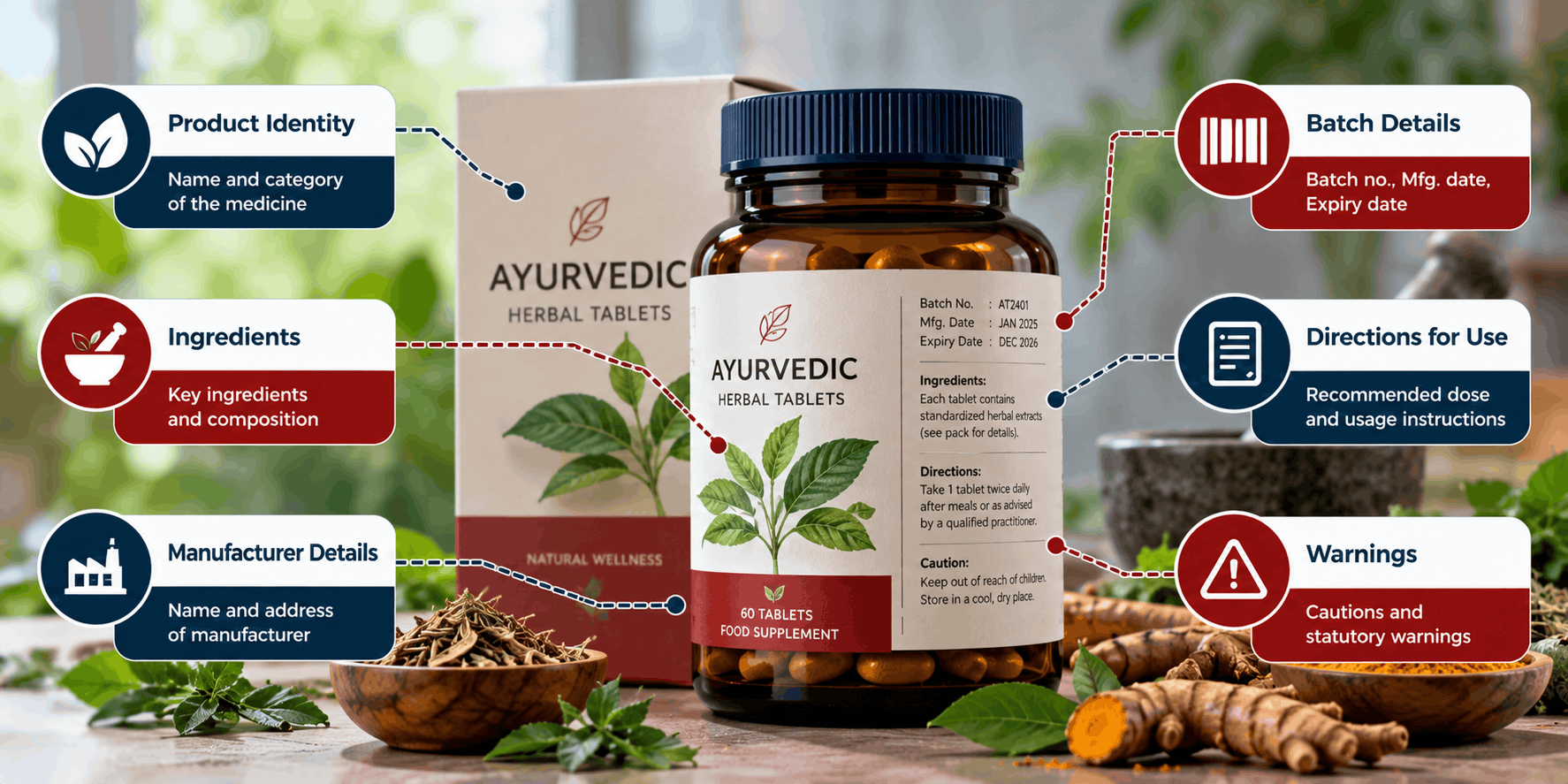
A licensed product must meet the labelling and packaging requirements that apply to its category. Check the product name, ingredients, manufacturer details, batch information, manufacturing and expiry details, directions for use, warnings and other prescribed particulars against the relevant rules.
Certain Ayurvedic, Siddha and Unani medicines containing ingredients listed in Schedule E(1) require the prescribed caution that the medicine should be taken under medical supervision. Check the applicable labelling rule and the formulation before approving the label.
Advertising needs equal care. The Drugs and Magic Remedies (Objectionable Advertisements) Act, 1954 restricts certain drug advertisements and misleading claims. Do not promise miraculous cures, guarantee treatment outcomes or make unsupported medical claims.
The Ministry of AYUSH has issued public warnings about misleading advertisements and has clarified that it does not itself grant the manufacturing licence for every AYUSH medicine. The relevant State or Union Territory Licensing Authority handles the applicable manufacturing licence.
Read the official Drugs and Magic Remedies Act, 1954 and the Ministry's AYUSH drug safety and misleading-advertisement resources.
How Can Legal Babu Help With an AYUSH Business Licence?
Legal Babu can help you prepare the business and documentation side of your project. The competent licensing authority decides whether to grant a licence, and the exact work depends on the service and product category.
Support may include:
-
Helping you select an appropriate business structure through company registration or other entity-registration services.
-
Assisting with relevant business registrations, including GST and Udyam.
-
Helping organise the application checklist and business documents for the applicable licensing route.
-
Supporting brand protection through trademark registration.
-
Helping with related compliance needs, depending on whether the business also handles food, cosmetics or international trade.
-
Assisting with planning through project report preparation, where a business plan or financing proposal is needed.
Legal Babu cannot guarantee an approval or replace the statutory inspection and decision of the licensing authority. Before engaging a consultant, confirm that the service covers your specific medicine category, state, application type and product requirements.
To discuss your requirements, visit Legal Babu's licence and registration services or contact the team.
FAQS
FAQs about AYUSH License in India
-
1. Is an AYUSH License issued by the Central Government or the state government?
The applicable licensing authority depends on the activity and medicine category. For the manufacture of Ayurvedic, Siddha and Unani medicines, the relevant State or Union Territory Licensing Authority grants the manufacturing licence under the applicable rules. Do not assume the Ministry of AYUSH itself issues every product licence.
- 2. Can I launch an Ayurvedic brand without owning a factory?
- 3. Does an AYUSH manufacturing licence cover every product in my brand?
- 4. Can I sell herbal supplements with an AYUSH licence?
- 5. Do I need an AYUSH licence to sell Ayurvedic medicines in a retail shop?
- 6. Is GMP certification the same as an AYUSH manufacturing licence?
- 7. Can I use the same licence for Ayurvedic and Homoeopathic medicines?
- 8. Can I apply for an AYUSH licence before finalising my product formulation?
- 9. Can I advertise that my AYUSH medicine permanently cures a disease?
- 10. Where can I check the current AYUSH licence application process?


