
To get a PESO license in India without avoidable delays, confirm the applicable rule and licence form before you sign a lease, order tanks or start construction. A petrol pump, an LPG cylinder godown and a factory with a bulk gas vessel can each take a different route. The substance, maximum quantity, storage method and planned activity shape the PESO licence requirements. The form determines which PESO license documents you need at each stage of filing.
On 5 June 2026, notified amendments removed the specific no objection certificate provisions under the gas cylinder and pressure vessel rules. Petroleum sites follow their own rules, including a district clearance requirement for many new premises. This guide covers exemptions, drawings, the PESO online application, government fees and PESO license renewal. It also explains when you need prior plan approval and why the grant stage must be complete before you begin the licensed activity.
Who Needs a PESO License in India?
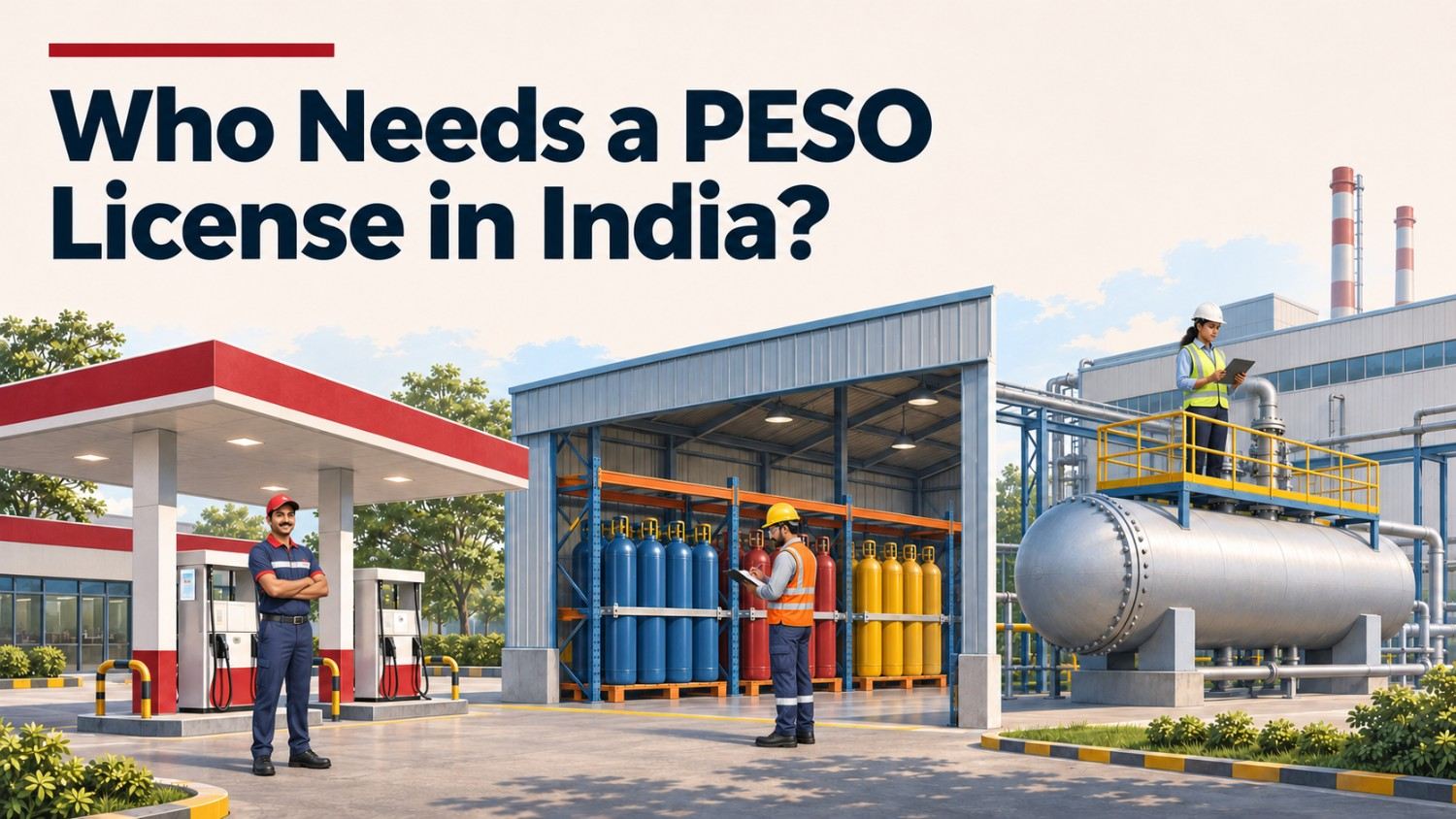
You need the applicable licence when the activity falls under a Petroleum and Explosives Safety Organisation (PESO) licensing provision and no exemption applies. Use the form to check the PESO licence requirements for storage, filling, dispensing, manufacture, transport or import and identify the issuing authority. PESO lists its statutory rules and procedures by regime.
A PESO licence in India can apply to an installation, a vehicle or another specified activity. Equipment approval and a site operating licence serve different purposes. Confirm both where required before commissioning.
|
What you plan to do |
Licensing route to check |
|
Store petrol or diesel in tanks connected to pumps for fuelling vehicles |
Petroleum Rules, 2002, Form XIV. A bulk petroleum installation uses a different route, commonly Form XV. |
|
Store filled gas cylinders or run a cylinder filling facility |
Gas Cylinders Rules, 2016. Form F covers storage and Form E covers filling. Check Form G for a CNG or compressed biogas dispensing station. |
|
Store compressed gas in a bulk pressure vessel |
Static and Mobile Pressure Vessels (Unfired) Rules, 2016, often called SMPV(U) Rules. Check Form LS-1A for storage, LS-1B for automotive LPG or LS-1C for LNG dispensing. |
|
Manufacture, possess or sell fireworks or other regulated explosives |
Explosives Rules, 2008. Match the activity and quantity to the scheduled form and licensing authority. |
|
Handle regulated ammonium nitrate or store calcium carbide |
Check the separate Ammonium Nitrate Rules, 2012, or Calcium Carbide Rules, 1987, as applicable. |
Use the petrol pump business guide to coordinate dealership decisions with the PESO approval process. Check the municipal trade licence route for your outlet separately.
If you supply marine fuel to ships, review the requirements for bunker supplier registration alongside the petroleum permissions applicable to your storage facilities and delivery arrangements.
When can you store petroleum without a licence?
Sections 7 and 8 of the Petroleum Act, 1934 provide quantity-based exemptions. Check the petroleum class, total stock and individual container capacity before relying on them.
|
Petroleum class |
Flash point |
Exempt storage quantity |
Conditions |
|
Class A |
Below 23°C |
Up to 30 litres in total |
The petroleum must be for a purpose other than sale. Keep it in securely stoppered glass, stoneware or metal receptacles. Each glass or stoneware receptacle must hold no more than one litre, and each metal receptacle no more than 25 litres. |
|
Class B |
23°C to below 65°C |
Up to 2,500 litres at one place |
No individual receptacle may exceed 1,000 litres in capacity. A single 2,000-litre tank falls outside this exemption, even if the quantity stored remains below 2,500 litres. |
|
Class C |
65°C to below 93°C |
Up to 45,000 litres at one place |
Storage must comply with the applicable Petroleum Rules. Where unlicensed storage exceeds 5,000 litres, Rule 140 requires a prior report to the Chief Controller before storage begins. |
These limits depend on the product’s verified classification and storage arrangement. Check the supplier’s safety data sheet before selecting the relevant exemption.
The District Authority can issue Form XII for qualifying Class A storage up to 300 litres and Form XIII for Class B storage other than in bulk up to 25,000 litres. Confirm who issues the licence before starting your PESO licence application.
Check the supplier’s safety data sheet before applying these limits to solvents. Use the chemical business licensing guide to identify other controls on that stock. If you sell solvents in retail packs, check the applicable packaged goods labelling rules.
Who Can Apply and What Are the PESO License Requirements?
PESO license requirements depend on the proposed activity, substance, capacity and licence form. For petroleum storage premises, the application must establish who will hold the licence, their legal possession of the site and how the installation will meet the applicable safety conditions.
Who can submit a PESO licence application?
Before filing, confirm the following applicant requirements.
-
Identify the licence holder. Use the applicant’s correct legal name and PAN. Provide the relevant business constitution records, such as a company incorporation certificate or partnership deed, where applicable.
-
Authorise the person signing. The owner, partner, director or another person authorised in writing should sign the application and supporting records as required. Clearly state the signatory’s name and designation.
-
Establish legal possession. Submit the land records and prescribed declarations showing the applicant’s legal possession of the premises. For rented premises, identify the exact portion covered by the possession documents and proposed layout.
-
Document the proposed fuel supply. For a retail outlet, prepare the Oil Marketing Company’s Letter of Intent required by the Form XIV checklist. For a Form XV installation, check the requirement for a supply letter from an OMC or licensed consignor with suitable storage and tanker-filling facilities.
What must the proposed site and equipment satisfy?
The technical review should address these points before the facility is commissioned.
-
Correct activity and capacity. State each petroleum class, proposed tank capacity and intended use consistently across the application, drawings and supporting records.
-
Suitable layout and clearances. For Forms XIV and XV, scaled drawings must show the surrounding area and protected works within 100 metres of the proposed facilities. Check the minimum safety distances separately against the applicable licence conditions.
-
Approved construction. Obtain prior approval where required and construct the facility according to the sanctioned layout. Resolve changes in tank position, capacity or other facilities through the applicable approval procedure.
-
Testing and safety evidence. At the grant stage, provide the tank test certificate under Rule 126 and safety certificate under Rule 130 where applicable. Their tank details and capacities should match the completed installation.
-
Electrical and fire protection. Check the applicable requirements for electrical apparatus in hazardous areas, earthing, bonding and firefighting facilities against the proposed installation.
For a new manufacturing project, assess the applicable IEM filing requirements while planning the facility.
The final amendments published on 5 June 2026 removed Rule 48 from the Gas Cylinders Rules and Rule 47 from the SMPV(U) Rules. The Gazette references are G.S.R. 447(E) and G.S.R. 448(E), respectively. Use the current form for your PESO license application and check fire safety clearance requirements separately. For a Maharashtra site, also check MPCB consent requirements for the proposed activity.
Which PESO License Documents Go With Each Stage?
Prepare the PESO license documents by stage. Submit the proposed layout with the initial PESO license application. Match the test certificates to the tank numbers on the approved drawing.
|
Stage or route |
Documents to prepare |
|
Prior approval for petroleum Forms XIV and XV |
Signed Form IX, scaled site and layout drawings, applicable land possession evidence or undertaking, and the prescribed scrutiny fee. |
|
Grant of petroleum Forms XIV and XV |
The applicable district NOC and endorsed plan, tank test certificate under Rule 126, and certificate of safety under Rule 130, as required by the form and procedure. |
|
Cylinder storage in Form F |
Form C, scaled drawings, legal possession evidence and the applicable fee. For grant, check the as-built drawing against the sanctioned layout and prepare for endorsement. |
|
Pressure vessel storage in Form LS-1A |
Form AS-1, the approved layout and vessel records, including applicable test evidence and the Rule 43 safety certificate for the grant stage. |
The PESO license documents change with the activity. For a petroleum road tanker, the PESO approval process uses Form VII for the application and Form XI for the licence. Attach the type-approved vehicle drawing and fabrication evidence. Use a supplier compliance assessment to check the fabricator’s licences and test records before ordering.
How Does the PESO Approval Process Work Online?
Below are the steps for the approval process:
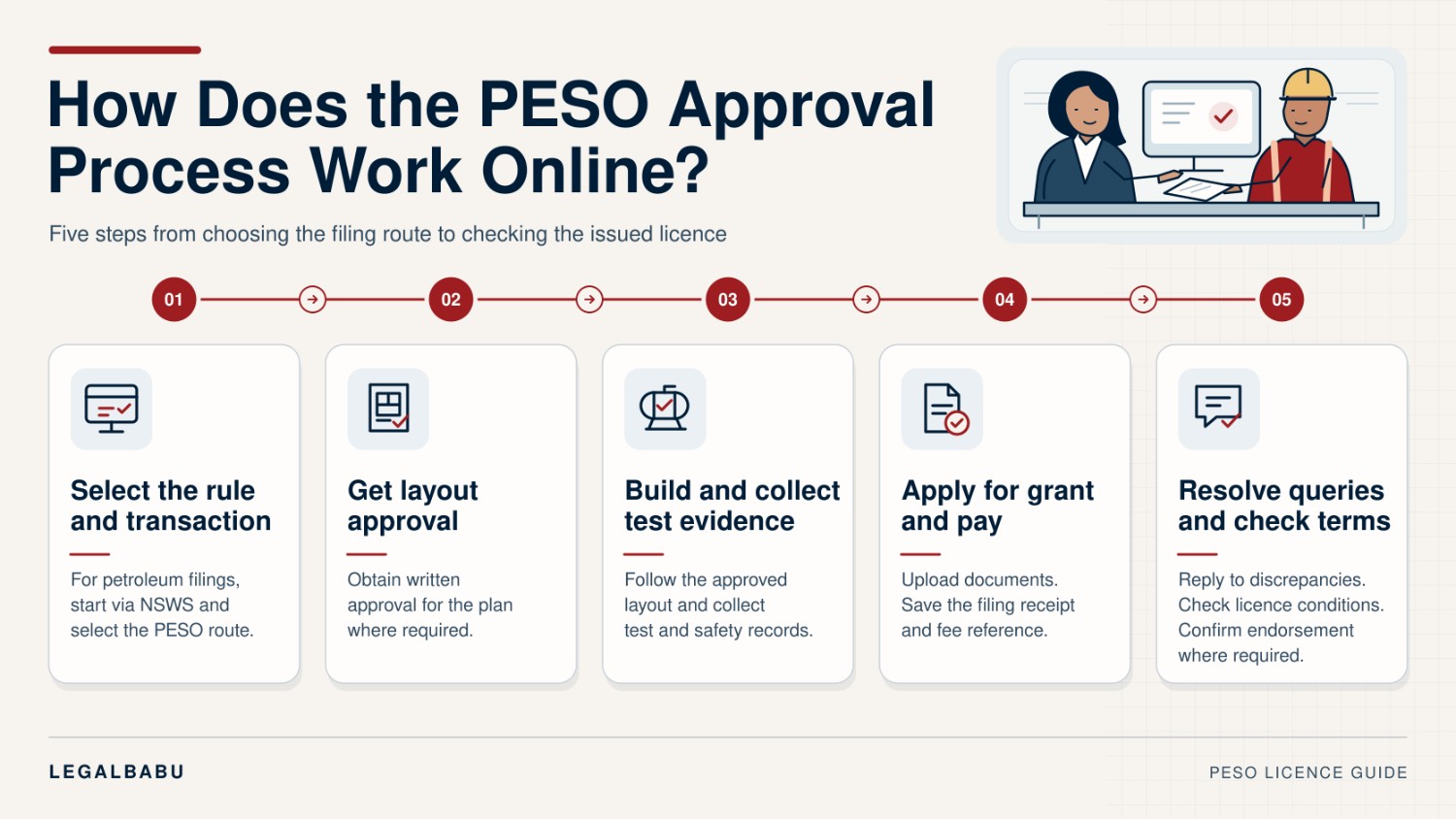
1. Select the rule and transaction in the PESO online application
To start a petroleum PESO license application, register or sign in through the National Single Window System and follow the PESO link. In the licensing module, select the rules and transaction, such as prior approval, grant, amendment or PESO license renewal. For explosives and ammonium nitrate, PESO also identifies a separate login for checking filed applications and issued letters.
2. Get written approval for the layout where required
Check the layout against the PESO license requirements for your form, including tank positions and clearances. Submit it with the specifications and the prescribed scrutiny fee to begin this stage of the PESO approval process. For a petroleum installation requiring plan approval, wait for written sanction before starting work on the proposed facilities. If the contractor proposes moving a fill point or changing tank capacity, resolve the drawing change with the licensing authority before building against the revised plan.
3. Build to the approved layout and collect test evidence
Check the completed work against the drawing issued to the contractor. For petroleum tanks, arrange the applicable testing and safety certification through a recognised competent person or third-party inspection agency authorised for the work. Match the certificates to the tanks, capacities and premises in your PESO license application. Where the filing accepts a lab report, verify the lab’s NABL accreditation scope for the test. Track factory licensing requirements separately for industrial units.
4. Submit the PESO license application for grant and pay
Open the grant transaction and upload the stage-specific PESO license documents, including the local NOC where applicable. Verify the selected capacity and payment amount, then complete the PESO online application and save the acknowledgement and fee reference. A payment debit and a successful submission are separate checks. PESO’s combined module, announced on 8 July 2026, lets qualifying forecourts enter capacities for multiple fuels in one filing.
5. Resolve discrepancies and check the operating conditions
Open the status or discrepancy letter in the portal used for your submission. Reply to the existing PESO online application reference and identify the revised drawing or certificate. Confirm endorsement where the PESO approval process requires it, as for Form F cylinder storage. Before operating under a PESO license in India, verify the authorised product, capacity, premises and licence conditions. Chemical plants can review Responsible Care certification when planning spill prevention and chemical handling procedures.
What Does a PESO License in India Cost and How Long Can It Take?
For a PESO license in India, fees depend on the form, capacity and transaction. Check whether the PESO online application shows a scrutiny, grant or renewal fee. These petroleum examples use the amended First Schedule.
|
Petroleum transaction |
Government fee |
|
Prior approval of premises specifications and plans |
₹2,000 per application under Part C of the First Schedule. |
|
Form XIV or Form XV licence |
For each petroleum class, ₹1,000 for the first 50 kilolitres and ₹15 for every additional kilolitre or part thereof, subject to the scheduled ₹15,000 cap per calendar year or part thereof. |
|
Prior approval for additions or alterations |
₹2,000 under Part C. A subsequent amendment is a separate transaction. |
The annual Form XV licence fee for 60 kilolitres of a single class is ₹1,150 before any separate scrutiny charge. Pay the applicable scrutiny fee at prior approval and the licence fee with the grant filing. For a PESO licence renewal under the Petroleum Rules, Rule 148 sets the ordinary annual fee at the same amount as the grant. Drawings, testing and professional work are separate costs. If you request a quotation, ask for those charges and government payments to be itemised.
PESO’s Citizen Charter gives service targets of two to three days for simple petroleum and gas tanker grant or renewal cases and two to three weeks for other routine cases. Complex cases can take longer. Under Rule 144, the District Authority has up to three months from receipt of the NOC application to issue or refuse it. Plan for the NOC, construction and any required endorsement separately when scheduling the PESO approval process.
What Can Delay PESO License Renewal or Trigger Cancellation?
Under Rule 142, Forms XIV and XV can run for up to three years, generally ending on 31 December of the year specified on the licence. Under Rule 148, a complete PESO licence renewal application must reach the licensing authority at least 30 days before expiry for the licence to remain in force pending renewal or communication of refusal.
If you miss that filing deadline, Rule 148 generally requires twice the ordinary fee. Renewal can still be considered if the complete application arrives within 30 days after expiry. That late-filing window gives no automatic right to keep operating. For a multi-year PESO license renewal, the higher charge applies to the first renewal year only. Beyond 30 days after expiry, Rule 148 bars renewal. Under the Gas Cylinders Rules, Form F can run for up to ten years, generally ending on 30 September of the stated year. File that renewal on or before expiry.
To add a tank, start the PESO approval process with written approval for the altered layout. Apply for amendment after carrying out the approved work. Use an industrial EHS audit to check site practices against the licence conditions. If you follow ISO 45001 requirements, review staff training after the change.
Under Rule 152, a petroleum licence stands cancelled if the licensee loses the right to use the site for storage or if the District Authority NOC is cancelled under Rule 150. Breaches of the Act, rules or licence conditions can also lead to suspension or cancellation. Sections 23 and 24 of the Petroleum Act provide for penalties for specified offences and possible confiscation of petroleum and receptacles after conviction. If the storage licence expires or is suspended or cancelled, Rule 153 requires immediate notice to the District Authority of the class and quantity held and compliance with any disposal directions it issues.
Conclusion
Start the PESO approval process before your lease and equipment orders lock in the layout. To get a PESO license in India, confirm the right form and build to the sanctioned drawing. Keep the PESO license documents, grant reference and expiry date together so that the next amendment or PESO license renewal starts from the current approved record.
FAQS
FAQs About PESO License
-
Can I use the seller’s PESO licence after buying a petroleum installation?
Arrange a transfer through the licensing authority under Rule 156 before the existing licence expires. The PESO licence documents for transfer include the current holder’s request, the licence and approved plans, and the incoming operator’s signed Form IX. Check the endorsed licence before taking over the regulated activity.
- What if I paid but my PESO license application is missing?
- Can a restaurant use a cylinder manifold without a storage licence?
- Can a mobile CNG or CBG unit dispense fuel on public roads?
- Can I recover PESO license renewal fees if I surrender a petroleum licence?
- What if the petroleum authority refuses my PESO licence application?
- Can an approved electrical motor cover my entire skid assembly?
- What changed for an existing fireworks shop with a PESO license in India?
- Can either party arrange ammonium nitrate transport?
- Does importing filled cylinders also require storage permission?


