
How to Start a Petrol Pump Business in India: A Complete Guide
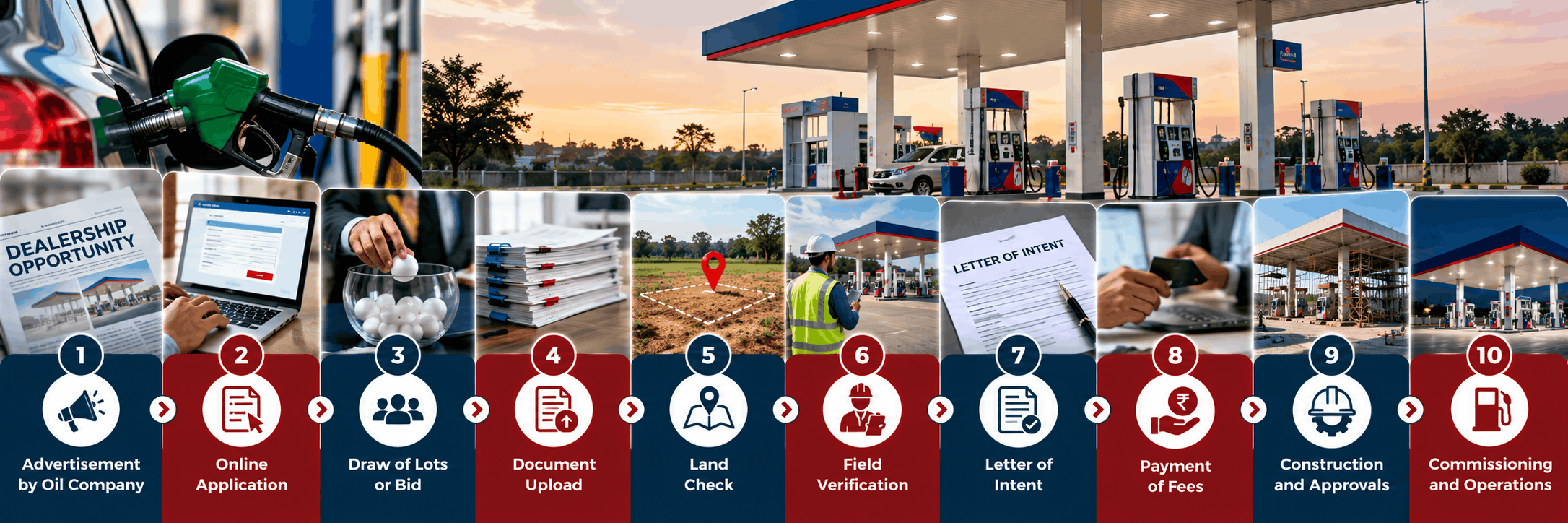
You cannot buy a petrol pump business in India. Oil companies advertise locations, and you apply online on petrolpumpdealerchayan.in with suitable land. A draw of lots or bid picks the dealer. You then pay fees, build the site and get approvals. Age 21 to 60 and a 10th pass are the minimum.
Three public sector oil marketing companies (OMCs) run most of the selection: Indian Oil (IOCL), Bharat Petroleum (BPCL) and Hindustan Petroleum (HPCL). They share one rulebook, the June 2023 brochure on their joint dealer portal. Older guides often quote the 2014 version, so their fees and criteria no longer match.
This guide follows the 2023 brochure. It explains what each rule means for your land, your money and your paperwork.
Is a Petrol Pump Dealership Open for Applications Right Now?
Check the joint dealer portal before you plan anything. At the time of writing (October 2026), every advertisement listed in its 2023 section showed as closed. Oil companies advertise location by location, and each advertisement carries its own cut-off date. The online form closes at that cut-off, and the brochure says late submissions get no relief.
Three other doors exist:
-
Land notices. IOCL’s RO and KSK dealerships page carries notices that invite landowners to offer land to the company. One seeks land at 60 locations in Uttar Pradesh and went up in September 2026.
-
Kisan Seva Kendra (KSK) outlets. The same page records draws for rural KSK dealerships, such as a March 2026 draw for Pavakkal in Krishnagiri district.
-
Other marketers. MRPL ran 2026 dealership advertisements for Andhra Pradesh and Karnataka through its own portal. Private marketers set their own terms, so read each company’s notice.
Use the quiet period as preparation time. Collect land papers, sort out your constitution and line up your funds now.
Who Can Apply for a Petrol Pump Dealership?
The brochure sets these tests for an individual applying as a proprietor or partner:
-
Indian citizen and a resident of India under income tax rules (a stay of 182 days or more in the previous financial year)
-
Age 21 to 60 on the date of application (freedom fighters in category CC2 have no upper limit)
-
At least a 10th pass certificate from a Board or school
-
A valid PAN
-
Suitable land in the advertised location
Each partner in a firm must meet the age and education tests individually. The firm counts the partners’ land as its own.
Some people fail on disqualifiers. You cannot apply if your family unit includes an IOCL, BPCL or HPCL employee. A conviction for an economic offence or moral turpitude also bars you. So does a past dealership terminated for malpractice, or false information in any application.
Companies, trusts and societies can apply under the Open category only. The brochure names government bodies, registered and co-operative societies, charitable trusts and companies, including private limited companies. It does not name LLPs, and it excludes HUFs. The entity must be at least three years old on the application date. Societies and companies must show a net profit in each of the previous three years, certified by a Chartered Accountant. Our pages on company registration, public limited company registration, trust registration and society registration cover those routes. Individuals can also read about proprietorship and partnership set-ups, and our guide to comparing types of business helps you choose.
Dealer-Owned or Company-Owned: Which Type of Site Will You Get?
The advertisement tells you the site type, and it changes your cost and your selection route.
|
Point |
Dealer-owned site (DC / “B”) |
Company-owned site (CC / “A”) |
|
Land |
You own or lease it and keep it |
You sell or long-lease it to the OMC |
|
Who builds |
You develop the land and build the office and other facilities. The OMC supplies tanks, dispensing units, signage and automation. |
You develop the land. The OMC builds the outlet and provides the facilities. |
|
Selection |
Draw of lots |
Sealed bidding, with a draw only to break a tie |
|
Non-refundable amount |
Fixed fee: ₹15 lakh regular, ₹5 lakh rural |
Winning bid: minimum ₹30 lakh regular, ₹10 lakh rural |
|
Licence fee to the OMC, petrol, per kilolitre including GST |
₹196.51 |
₹435.83 |
SC/ST locations follow the Corpus Fund Scheme. The OMC builds the outlet on land you offer and also lends working capital equal to seven days of sales, up to 18 KL each of petrol and diesel. You repay it in 100 monthly instalments from the 13th month.
What Are the Petrol Pump Land Requirements?
Land is the first filter, so check it before you spend on anything else.
-
Ownership or tenure. You must own the land or hold a long lease of at least 19 years 11 months (or the period the advertisement states). A firm offer to buy or lease from a third party also counts, but ranks lower.
-
Priority. The draw runs first among applicants who already hold the land (Group 1). The Group 2 applicants, who have only a firm offer, are drawn only if no Group 1 applicant qualifies. Owning land beats promising land.
-
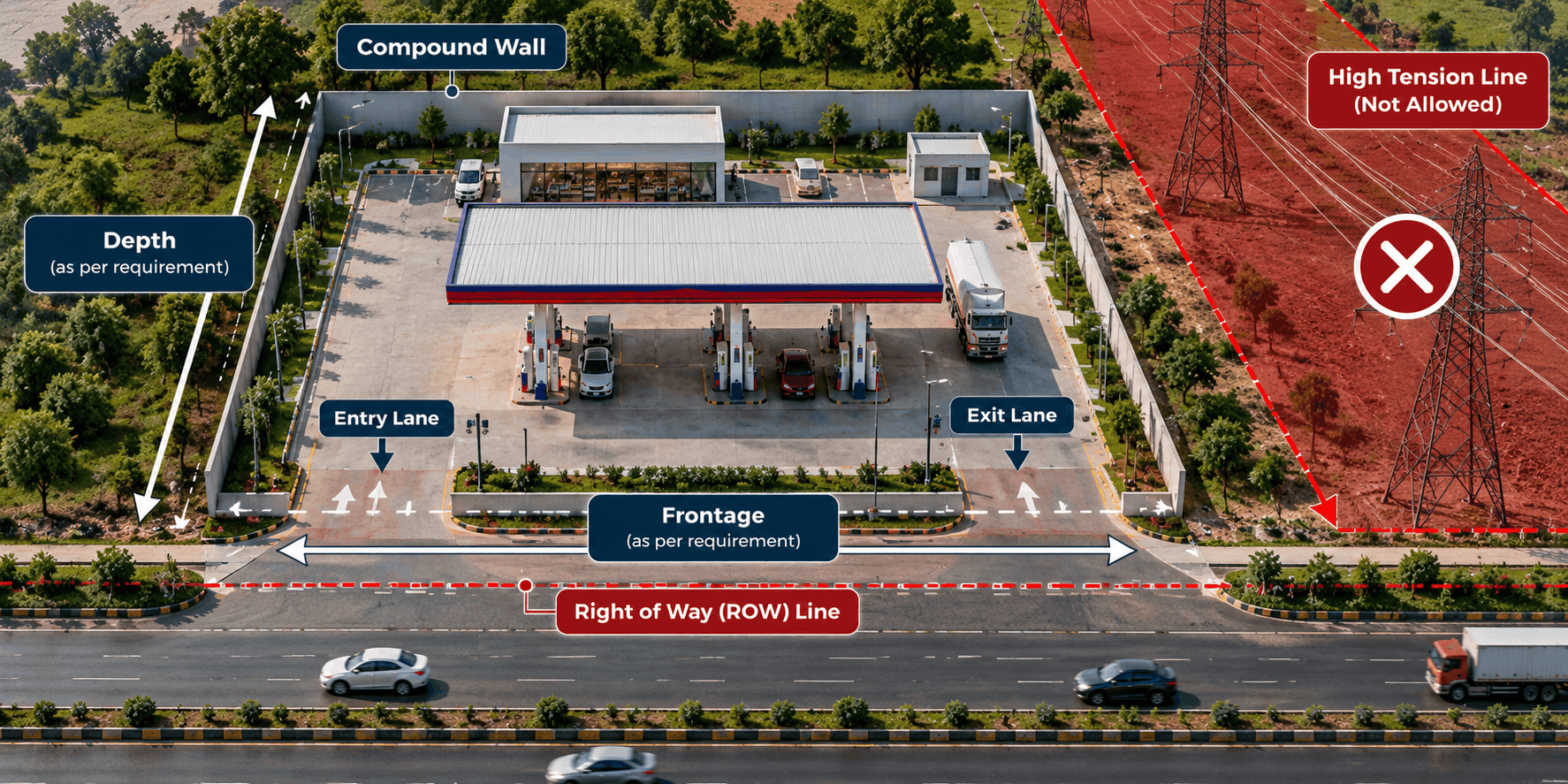
Position. The plot must sit inside the advertised stretch and abut the right of way (ROW) line. No other land, including government land, may lie between the plot and the ROW.
-
Size. The advertisement states the minimum frontage, depth and area, measured after leaving the ROW. The portal shows them under “View Advertisement details”. No single national figure exists.
-
Hard stops. A high tension line above 11 kV crossing the plot rejects it. Highway sites must meet NHAI norms, which the MoRTH access guidelines explain. If two applicants offer the same plot for one location, the OMC rejects both.
-
Site work. You must fill and level the land to road level, build entry, exit and acceleration lanes, and raise a retaining wall and compound wall at least 1.5 metres high. All of this comes before the OMC invests.
The Central Pollution Control Board’s siting guidelines for new petrol pumps (January 2020, amended in 2021) set minimum distances from places such as schools and hospitals. The district authority checks them when it issues the NOC. Read them on the CPCB site before you buy a plot near a school.
The brochure advises you to have an advocate verify your land group before you declare it. A wrong group is a non-rectifiable defect. Our due diligence service checks title and encumbrances, and our guide to legal documents for entrepreneurs covers lease papers.
How Do You Assess Whether a Petrol Pump Location Is Viable?
A plot can meet the dealership's land requirements and still be a weak business location. Before committing money to purchase or lease land, assess both its eligibility and its commercial potential.
Use these checks to evaluate the proposed location:
-
Check the advertised location: Confirm that the plot falls within the exact stretch specified in the oil marketing company's advertisement. A nearby plot outside that stretch may not qualify.
-
Review expected sales potential: Study the estimated monthly sales potential stated in the advertisement. Treat it as an estimate, not a guarantee of future sales.
-
Assess traffic and customer demand: Consider the volume and type of vehicles using the road, including local commuters, commercial vehicles and long-distance traffic.
-
Study nearby competition: Identify existing petrol pumps, their accessibility and the services they offer. Competition alone does not determine whether a location will succeed, but it can affect your sales assumptions.
-
Check safe access: Consider road direction, entry and exit arrangements, turning movements and the space needed for vehicles to enter and leave safely.
-
Estimate site-development costs: Account for levelling, boundary work, access roads, drainage, utilities and other improvements required by the oil marketing company or relevant authorities.
-
Review legal and physical constraints: Check ownership, lease terms, encumbrances, right-of-way conditions, applicable safety distances and any restrictions affecting construction.
-
Calculate the likely operating burden: Estimate staff costs, electricity, maintenance, insurance, financing costs and other recurring expenses before deciding whether the projected sales could support the business.
Use this assessment to compare the expected sales opportunity with the total investment and operating costs. Do not purchase land solely because an intermediary claims that an oil company will approve it.
A commercially promising plot is not automatically eligible for a dealership. The advertised location criteria, land evaluation, statutory approvals and the oil marketing company's selection process still apply.
How Much Does a Petrol Pump Business Cost?
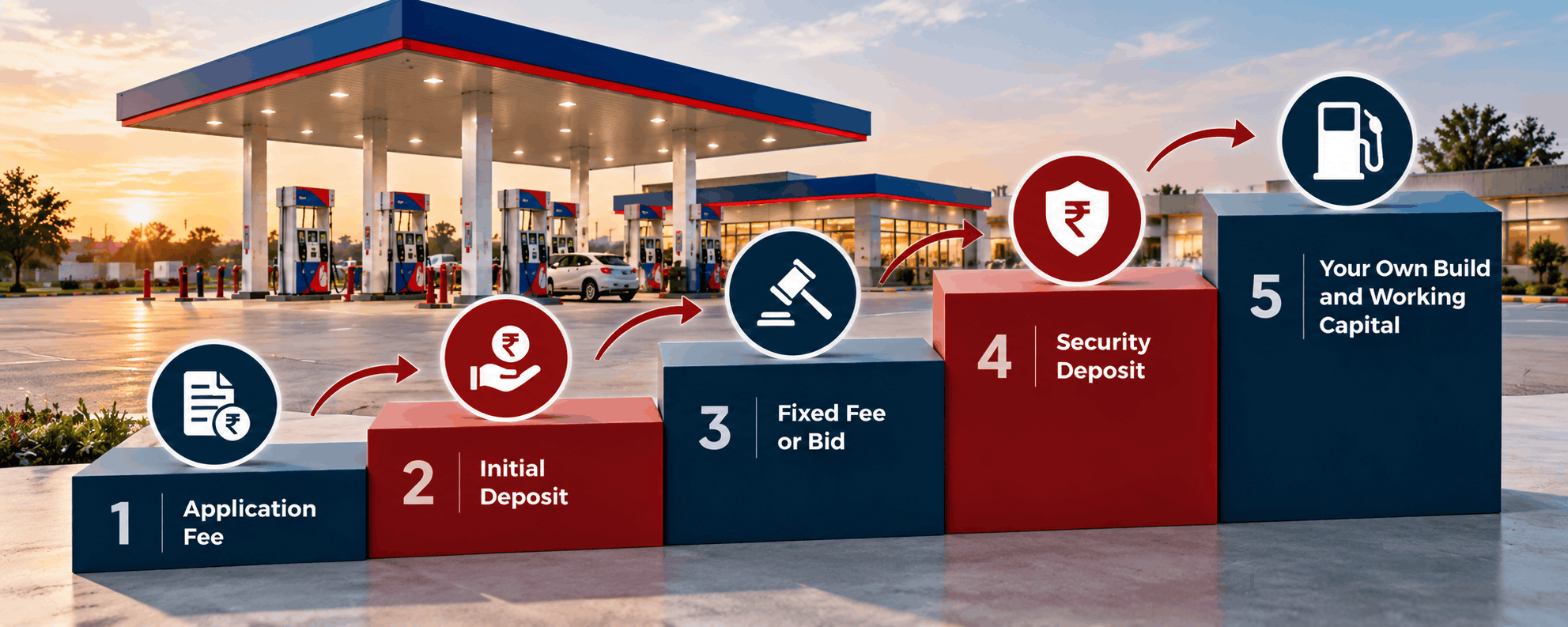
The official fees are fixed, and the brochure shows them all. Each amount below includes GST where the brochure says so.
|
Item |
Regular RO |
Rural RO |
When you pay |
|
Application fee (non-refundable, per location) |
₹10,000 (OBC ₹5,000, SC/ST ₹3,000) |
₹8,000 (OBC ₹4,000, SC/ST ₹2,500) |
At application |
|
Initial security deposit |
10% of the security deposit |
10% of the security deposit |
Within 10 days of the draw or bid result |
|
Security deposit (refundable, interest free) |
₹5 lakh (OBC ₹4 lakh, SC/ST ₹3 lakh) |
₹4 lakh (OBC ₹3 lakh, SC/ST ₹2 lakh) |
Before the Letter of Appointment |
|
Fixed fee, dealer-owned site (non-refundable) |
₹15 lakh |
₹5 lakh |
Within 15 days of the NOC |
|
Minimum bid, company-owned site (non-refundable) |
₹30 lakh |
₹10 lakh |
Within 15 days of the NOC |
For an Open-category regular site, the initial deposit works out to ₹50,000.
The table leaves out the largest costs. You also pay for land (purchase or lease), site development, and on dealer-owned sites the office, electrical and water connections, yard lighting, generator, driveway and canopy. Fire-fighting and safety equipment comes at your cost on every site. Working capital for fuel purchases and operations comes on top.
Each advertisement states the estimated funds for infrastructure and working capital. Use that figure for your budget instead of a generic number from a website.
Lenders usually want a project report. You can then compare a term loan, project finance, a working capital loan and a loan against property. A valuation report supports the land value. A company that borrows against its assets must also complete registration of charges. Keep the fixed fee money liquid, because the OMC installs its facilities only after it collects that fee or bid.
How Does the Petrol Pump Application Process Work?
-
Find an advertisement. Read the detailed advertisement and the brochure. Note the site type, category, selection mode and minimum land dimensions.
-
Register on the portal. Use your PAN, mobile number and email. You cannot change the mobile number or email later, and a change counts as a non-rectifiable defect.
-
Apply and pay. Fill the online form, declare your land group, upload your photograph and signature, and pay through SBI ePay. The portal FAQs confirm that you upload no other document at this stage. Each location needs its own application.
-
Wait for the draw or bid. Group 1 comes first. A lone eligible applicant is declared selected without a draw.
-
Upload documents and pay the initial deposit. If you are provisionally selected, you get 10 days. A reminder adds 10 more.
-
Fix defects. You get 21 days to correct any rectifiable deficiency.
-
Face the land evaluation and field verification. Each visit comes with 10 days’ notice. Bring all originals.
-
Receive the Letter of Intent (LOI). The OMC issues it after verification and not within 30 days of the result. Group 1 applicants get two months to supply land documents, and Group 2 applicants get four.
-
Pay and sign. Pay the fixed fee or bid, deposit the security amount and sign the dealership agreement before the Letter of Appointment.
-
Build, get approvals and commission.
The brochure fixes deadlines for each stage but gives no overall timeline. Construction and approvals decide the rest.
What Documents Do You Need for a Petrol Pump Dealership?
The documents you need depend on your applicant category, the advertised location and the stage of the application. Prepare your records early, but follow the oil marketing company's instructions about when to upload or submit each document.
For the initial online application
-
Valid PAN details matching the applicant's name and identity records.
-
Photograph and signature in the format specified by the application portal.
-
Accurate personal details, including age, address and contact information.
-
The advertised location, applicant category and land-group details.
-
Any other information specifically requested in the online application.
For document verification after provisional selection
-
Class 10 certificate or other accepted educational proof.
-
Proof of identity, citizenship and applicable residency requirements.
-
Registered sale deed, qualifying lease deed or other accepted land documents.
-
Relevant land-revenue records, such as Khasra or Khatauni, where applicable.
-
Landowner consent affidavit, co-owner consent documents or a registered power of attorney, where required.
-
Category certificate and supporting declarations, if applicable.
-
Entity registration records, financial statements and other supporting documents for eligible companies, societies, trusts or other entities.
-
Original documents and affidavits required for land evaluation and field verification.
Keep the applicant's name, PAN, land details and application information consistent across all records. Check the advertisement and the dealership brochure for the prescribed formats, deadlines and requirements for your specific location.
Important: Do not upload documents that the portal does not request at the initial application stage. A document that is required later may not be required with the original online form. Missing originals, incorrect land details or late submissions can put your application at risk.
Which Licences and Approvals Does a Petrol Pump Need?
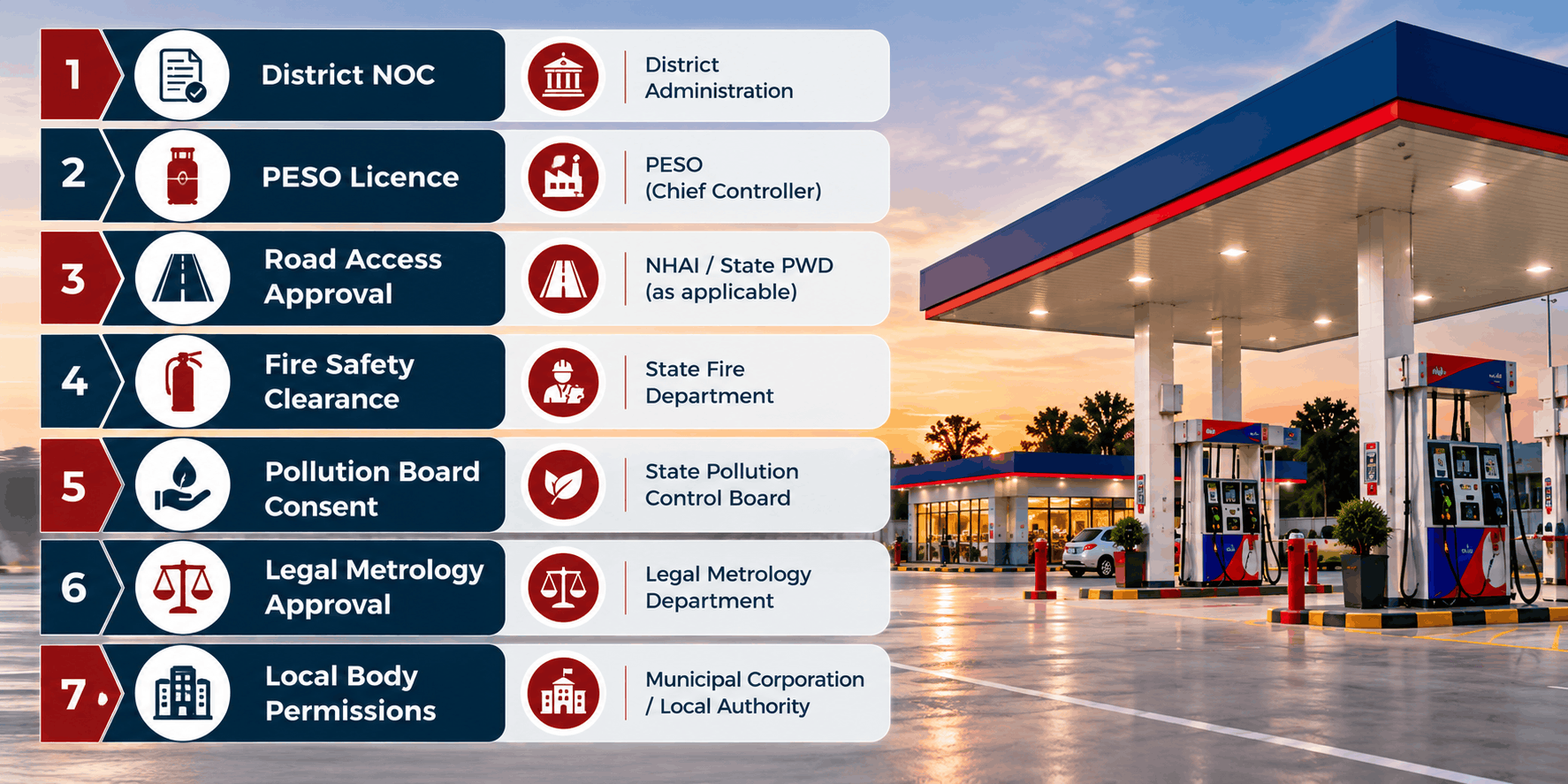
The brochure splits the work. The OMC office prepares the layouts and applications for the statutory approvals. You furnish the land documents and coordinate with the authorities. You must also obtain the licences needed to operate the outlet.
|
Approval |
Authority |
What it covers |
Note |
|
NOC under Rule 144, Petroleum Rules, 2002 |
District authority, through PESO’s LSDA portal |
Confirms the site suits a fuel station |
Siting criteria apply |
|
Plan approval and licence in Form XIV |
PESO |
Storage in tanks for fuelling vehicles |
Follows construction and the district NOC, per the PESO SOP |
|
Road access permission |
NHAI for national highways, state PWD for state highways |
Entry and exit |
State guides such as Meghalaya’s SOP list it |
|
Fire NOC |
State fire department |
Fire safety |
Required in states that list it |
|
Pollution board consent |
State Pollution Control Board |
Varies by state |
Some boards treat pumps as exempt, others require consent |
|
Legal Metrology verification |
State department |
Stamping of dispensing units |
See the Legal Metrology overview |
|
Building plan and trade licence |
Local body |
Construction and local trading |
Rules differ by municipality |
Ask your state which of the state-specific rows apply before you assume anything.
You also need ordinary business registrations. A Shop Act licence or trade licence may apply to the outlet. Udyam registration lets a retail trader access MSME schemes. Once you hire staff, look at PF registration, ESIC registration, professional tax filing, TDS filing and our labour law compliance service. A periodic EHS audit keeps safety and environment records ready, and ISO 45001 is an optional extra.
What Are the Responsibilities of a Petrol Pump Dealer?
A petrol pump dealership involves more than selling fuel. The dealer must follow the oil marketing company's operating procedures and maintain the safety, records and facilities required by the applicable rules.
Key responsibilities generally include:
-
Fuel stock and sales records: Maintain accurate records of fuel receipts, sales, stock and related transactions in the format required by the OMC.
-
Dispensing equipment: Keep dispensing units and related equipment in proper working condition, and ensure applicable Legal Metrology verification and stamping requirements are met.
-
Fire and workplace safety: Maintain required firefighting equipment, follow safety procedures and ensure employees know how to respond to emergencies.
-
Staff management: Arrange suitable staffing, training and supervision, and comply with applicable employment and labour requirements.
-
Customer facilities: Maintain the facilities and services required under the dealership agreement and the approved site layout.
-
Financial and tax records: Maintain business accounts and comply with applicable tax, invoicing and filing obligations.
-
Inspections and corrective action: Cooperate with OMC inspections and relevant authorities, retain required records and address identified deficiencies within the prescribed time.
The precise obligations depend on the dealership agreement, the outlet's facilities and the applicable central, state and local requirements. Review the OMC's operating instructions and keep a compliance calendar so that important inspections, renewals and filings are not missed.
Is a Petrol Pump Business Profitable?
It can be, and nobody can promise it. The brochure itself calls the dealership a business proposition with normal risks and no assured returns or profits.
The oil companies fix your commission. The PPAC commission page lists petrol commission from 1 December 2024 at ₹3,144.03 per kilolitre plus 0.870% of the product billable price. Oil companies had raised dealer margins in October 2024, by about 65 paise a litre on petrol and 44 paise on diesel, the first revision in nearly eight years. PPAC also notes slab-based incentives paid to eligible dealers through credit notes.
Here is an illustration, not a forecast. A dealer-owned site sells 100 KL of petrol in a month. The fixed part of the commission alone comes to ₹3,14,403. The licence fee to the oil company on that volume is about ₹19,651 (₹196.51 per KL). The percentage component adds more. Staff wages, power, repairs and loan interest then come out of the total.
Volume decides your outcome because the per-litre commission is fixed. Each advertisement shows an estimated monthly sales potential, and the brochure tells applicants that volumes may change and to make their own assessment. Do that sum before you commit money to land.
Non-fuel income can add to the total. The brochure lists site-specific facilities such as a restaurant, service station or PUC facility when the OMC specifies them. Ask the OMC before you plan any extra business on the forecourt.
How Can You Spot a Petrol Pump Dealership Scam?
The portal states that applicants should make all payments, including application fees and the initial security deposit, only through the website. It adds that oil companies take no responsibility for payments made any other way. MRPL says it has not authorised any individual, agency or intermediary to help select dealers.
Use these checks:
-
Type the portal address yourself, and avoid ads that appear in search results.
-
Compare every fee against the brochure. A demand outside that list is a warning sign.
-
Walk away from anyone who promises a guaranteed allotment. Selection runs through a draw or a bid.
-
Read the “Beware of Fraudster” notice on the portal’s 2023 page.
What Will Legal Babu Do for Your Petrol Pump Dealership?
Legal Babu helps you prepare. We cannot allot you a dealership, because the oil companies choose dealers by draw or bid. Our team will:
-
Check your eligibility against the June 2023 brochure, including age, education, category and family-unit rules
-
Set up the right constitution for you: proprietorship, partnership, company, trust or society
-
Review your land title and documents through due diligence, and flag co-owner, lease and group issues
-
Test your draft application against the list of non-rectifiable defects before you pay the fee
-
Prepare your project report and guide you on business loan options
-
Support the registrations an outlet needs, such as Shop Act, trade licence, GST and labour registrations
-
Handle bookkeeping through our accounting services for small businesses
Browse our registration services or our consulting services, or book a free consultation.
FAQS
FAQs About Petrol Pump Business in India
-
Can I keep my job or business while I run a petrol pump?
A salaried person cannot. If you work in the private sector or draw a government salary, you must resign and show proof that your employer accepted it before the Letter of Appointment. You also sign an affidavit that you will take no other employment. A self-employed person can keep their own venture, as long as they personally manage the dealership day to day.
- Does my spouse have to become a partner?
- Can I use land owned by my parents, in-laws or other relatives?
- What should my land lease say?
- What happens if I am selected but my land fails the evaluation?
- Can I apply for more than one location?
- Can I add a shop, restaurant or EV charging point at my pump?
- Do I need GST registration to run a petrol pump?
- How do I challenge a selection I think is wrong?
- Can I apply for a petrol pump dealership without owning land?


