
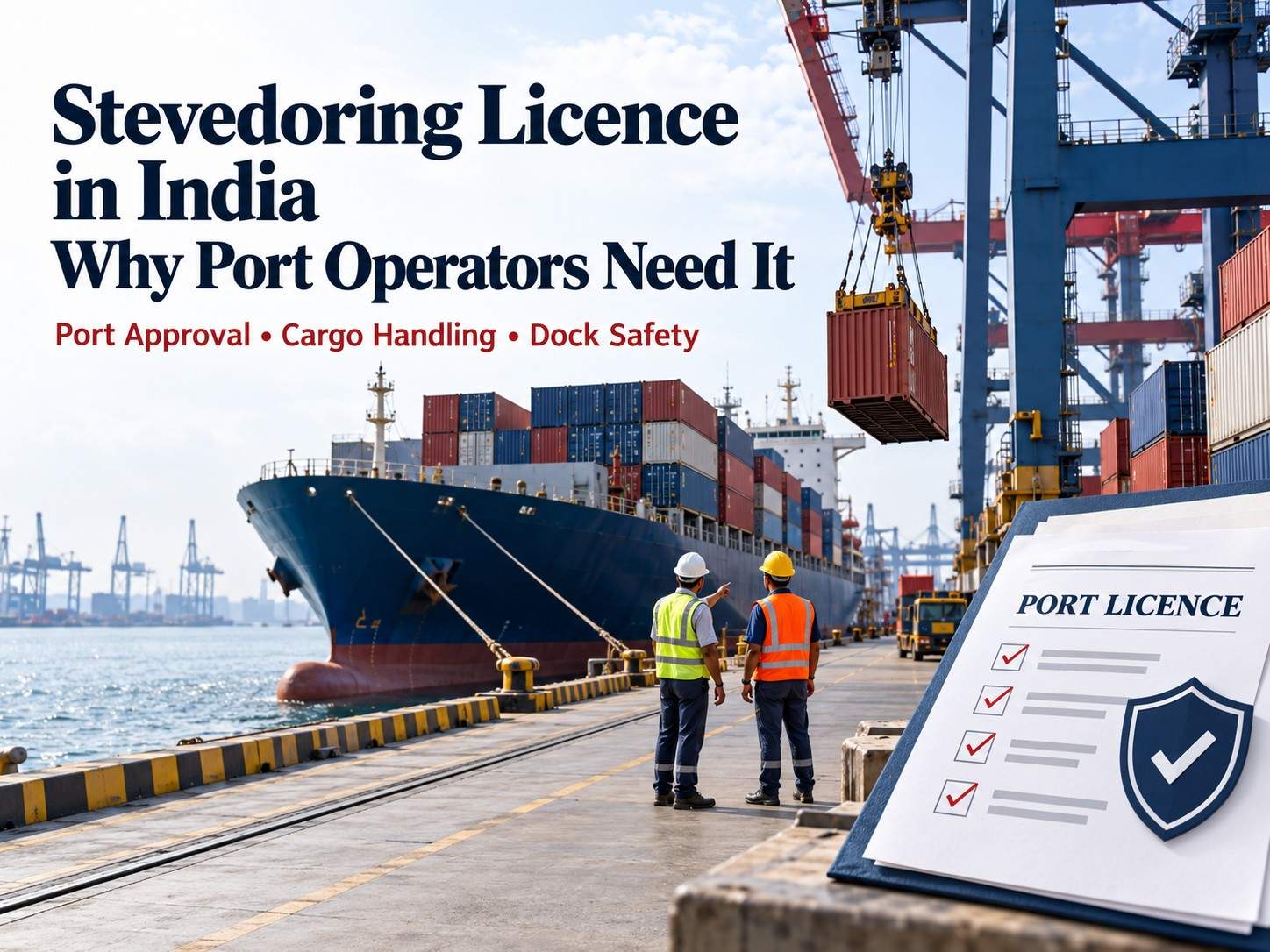
A stevedoring licence in India authorises an eligible cargo handling business to perform approved operations at the issuing port. It matters because loading, unloading and stowing cargo involve workers, lifting equipment, vessel safety and responsibility for damage. Company incorporation alone does not establish permission to undertake these activities.
The Ministry of Shipping announced implementation of its major port stevedoring and shore handling policy from 31 July 2016, with licensing administered through individual ports. However, the applicable port regulations, later amendments and operating arrangements determine the requirements.
A terminal concessionaire may follow a different framework from an independent handling agent. This article explains that distinction, stevedoring licence requirements, the stevedoring licence application, published fee examples and stevedore licence renewal considerations. It also examines Mumbai documentation and the dock safety transition.
Why Is a Stevedoring Licence in India Needed for Cargo Handling?
The permission identifies the business accountable for cargo handling, equipment, supervision and compliance at that port. Under the major port licensing framework, an independent agent must obtain the relevant approval before undertaking activities covered by it. A customer's work order does not itself confer that authority.
Stevedoring covers loading, unloading and stowage onboard vessels. Shore handling covers the movement between the hook point, wharf, stackyard and trucks or wagons. The distinction determines whether the port stevedoring licence must cover both parts of the movement.
For example, discharging bagged cargo from a ship and moving it to a stackyard involves connected but distinct operations. Describe each operation when discussing your proposed scope with the Traffic Department.
The Ministry's 2016 announcement links licensing with productivity monitoring, equipment, supervisory personnel and tariffs. These obligations explain why a stevedoring licence is more than an entry pass.
Start by mapping your services against the logistics business registration guide. Treat the resulting list as an activity map, then verify each legal requirement with its issuing authority.
Does Every Port Operator Follow the Same Licensing Route?
No. Stevedoring licence requirements depend on the port and operating arrangement. The phrase “port operator” can describe a terminal concessionaire, independent cargo handler or service provider with very different permissions.
For example, Cochin's 2019 regulations exclude activities undertaken by the Board itself or under its PPP, BOT or other covered agreements. This is a specific exemption, not a general exemption for anyone working within a concession terminal.
|
Your activity |
Permission boundary to examine |
|
Independent onboard cargo handling |
Stevedoring authorisation for the relevant port |
|
Wharf and stackyard handling |
Shore handling coverage and approved methods |
|
Concession terminal operations |
Concession agreement and applicable port conditions |
|
Customs representation |
Separate Customs Broker authorisation |
|
Sea-cargo reporting |
Applicable SCMTR role and ICEGATE registration |
The customs broker licence guide addresses representation before Customs. Physical cargo handling approval does not establish that separate role.
Likewise, examine the SCMTR registration process guide if you undertake regulated cargo reporting. A port stevedoring licence and a cargo-reporting registration answer different compliance questions.
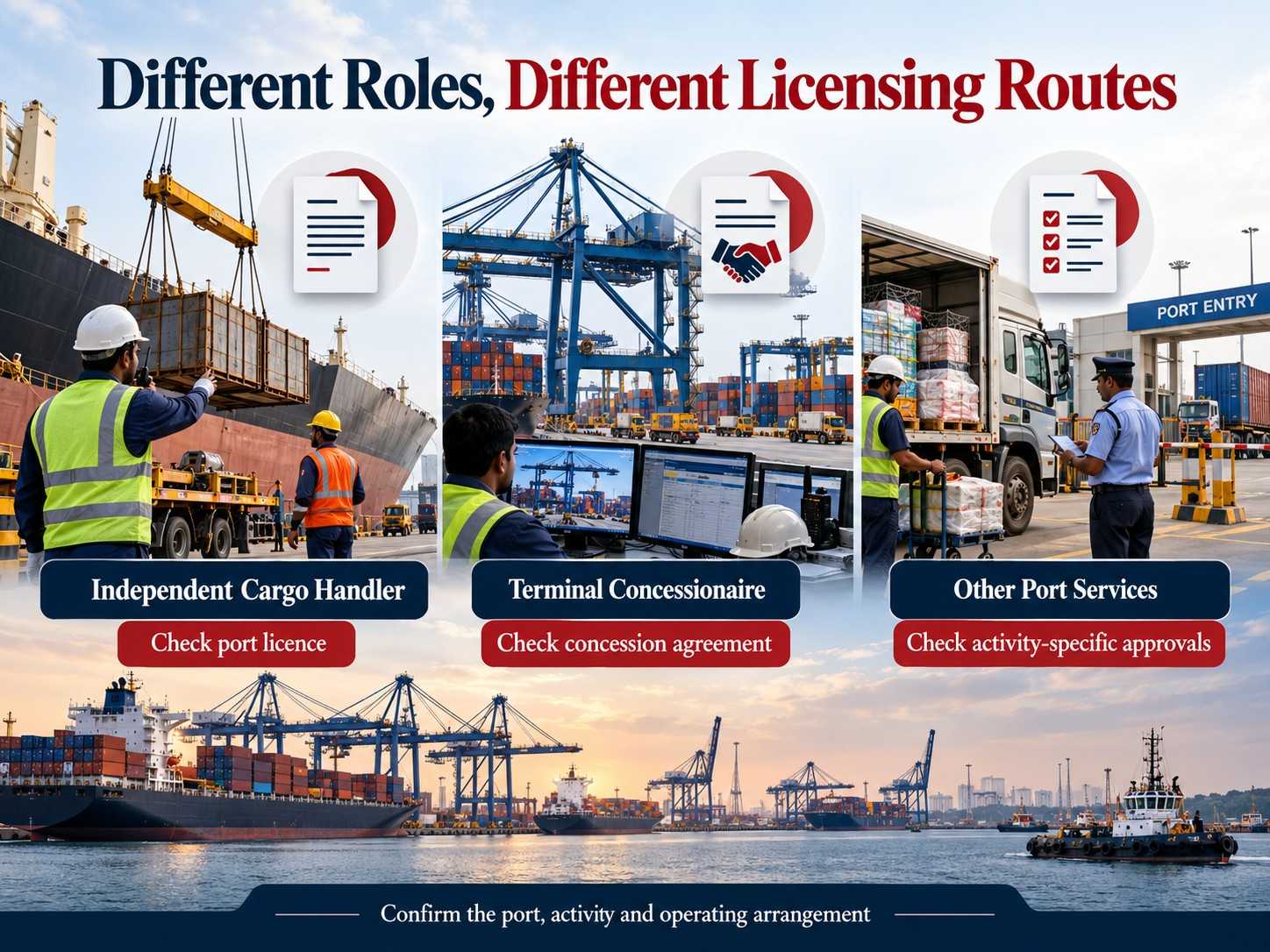
Do not apply major-port examples automatically to non-major ports. Confirm the responsible authority and local licensing instrument before using another port's checklist.
Which Stevedoring Licence Requirements Should Applicants Establish?
Begin with the port's notified regulations and current document checklist. The 2016 major-port policy describes eligible legal entities, equipment commitments, financial security and experienced supervisors. Port-specific implementation determines the evidence needed.
Cochin's published criteria include a company, partnership or other legal entity, at least six supervisors with two years' relevant experience, specified equipment and refundable security. Visakhapatnam's published checklist separately specifies four supervisors. These documents should not be combined into an invented national staffing rule.
A port stevedoring licence assessment therefore needs an identifiable employer and a credible operating arrangement. During preparation, organise:
-
Constitution documents and applicant details
-
Bank evidence of financial capacity
-
Cargo contracts or business assurance letters where prescribed
-
Supervisors' experience records and photographs where requested
-
Equipment lists with the required test certificates
-
Payment receipts and declarations
-
Previous cargo volumes, safety reports and no-dues evidence for renewal
Visakhapatnam's checklist expressly includes PAN, GST documentation, gear inspection and royalty undertakings. Cochin's Form A also requests a ₹10 lakh bankers' solvency certificate and income-tax returns for the previous three years. Confirm the accepted evidence if a published form uses older terminology, particularly when applying as a newly formed entity.
Read stevedoring licence requirements as evidence obligations, not a shopping list of certificates. Stevedore licence renewal requires historical performance records that a fresh applicant cannot supply.
What Should a Mumbai Port Stevedoring Licence Applicant Check?
Mumbai Port's published Form A requests constitution or ownership evidence, address, licence period, vessel-related contracts, bankers' financial evidence, gear, staffing and experience particulars.
Prepare the Mumbai Port stevedoring licence file against the form currently accepted by the Traffic Department. Publicly indexed Mumbai documents include legacy material, so an old amount printed within a downloadable document should not be presented as today's confirmed fee.
For a Mumbai Port stevedoring licence application, obtain written clarification of:
-
The governing regulation and accepted form version
-
Activities and operating locations covered
-
Current fee, security and royalty demand
-
Staffing and equipment evidence
-
Safety-report arrangements and renewal filing deadline
Mumbai Port also separately publishes procedures concerning dock entry permits. Treat access arrangements as an additional operational check.
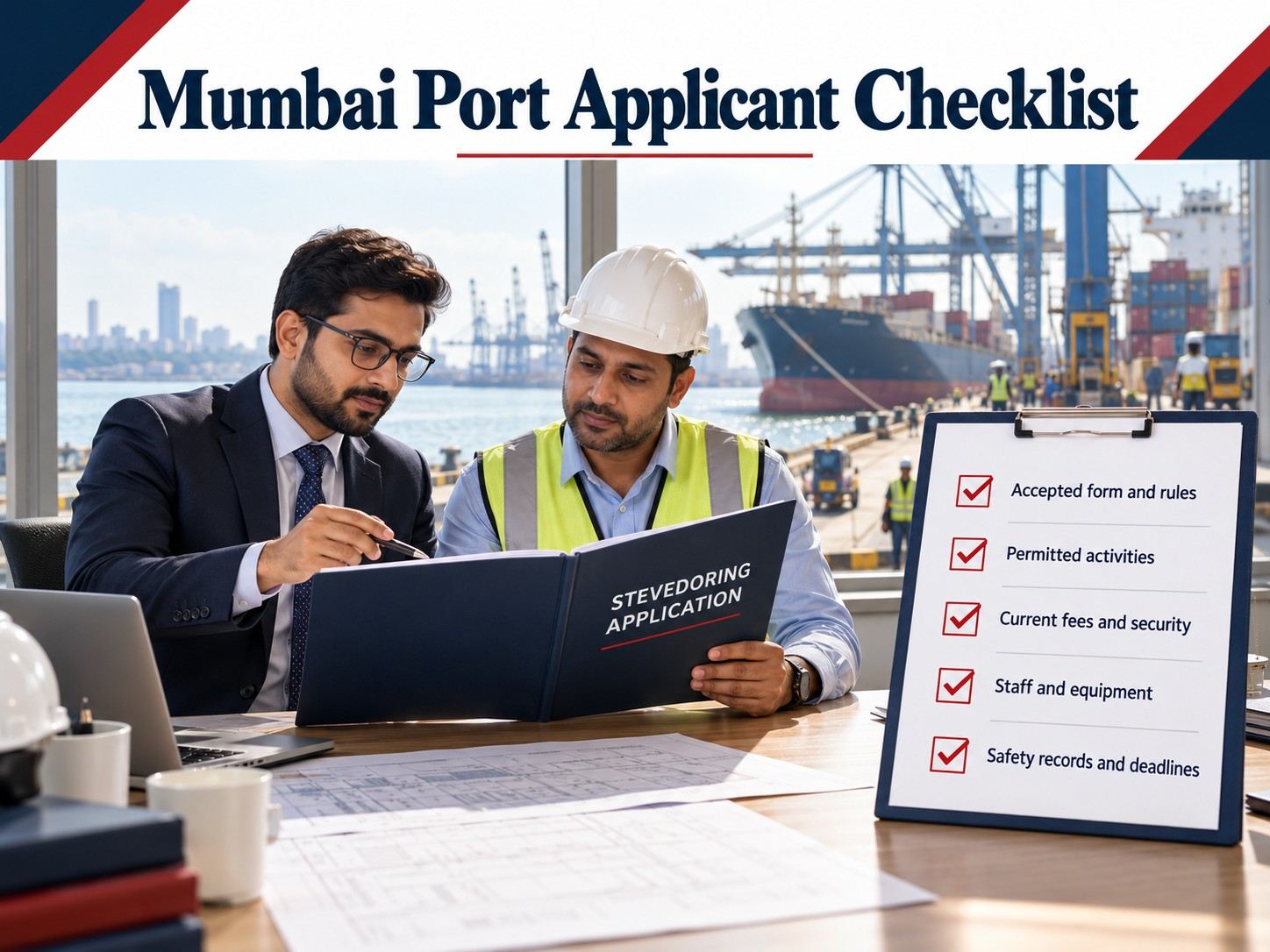
Do not replace Mumbai's instructions with a Chennai or Visakhapatnam checklist. Stevedoring licence requirements can differ even when ports use similarly named forms.
For businesses adding vessel supplies, the ship chandler licence guide explains a different port service. Describe supplies separately from the cargo handling proposed in your stevedoring licence application.
How Should You Prepare a Stevedoring Licence Application?
The sequence below follows Cochin's notified application framework. Other ports may use different submission channels, assessment arrangements or payment sequences.
1. Establish the Applicable Port and Operating Scope
Check whether your proposed work falls within the licensing regulations or a recognised agreement-based exception. Record the onboard and shore activities separately. For a Mumbai Port stevedoring licence, establish Mumbai's route before adopting this example.
2. Assemble the Prescribed Operational Evidence
Complete the port's form and attach its specified records. Cross-check legal names, equipment particulars and supervisor experience against the supporting documents. Inconsistent details weaken the submission and can require correction.
3. Submit the Form and Required Application Payment
Cochin's regulations permit an online application in the available format or a written Form A submission to the Chairman. They require the prescribed documents and application fee. Retain evidence of receipt so your stevedoring licence application can be traced during scrutiny.
4. Complete the Assessment and Security Requirement
The Chairman assesses whether the applicant satisfies the licensing criteria and issues approval or communicates refusal. Cochin's regulations make issuance conditional on the prescribed security payment. Check the fee demand and payee before transferring money.
5. Review the Issued Permission Before Mobilisation
Read the licence conditions, validity and operating scope before deploying workers or gear. Complete the associated port-access arrangements and keep approval accessible to the operations team. Set up performance and safety records immediately, because these support stevedore licence renewal.
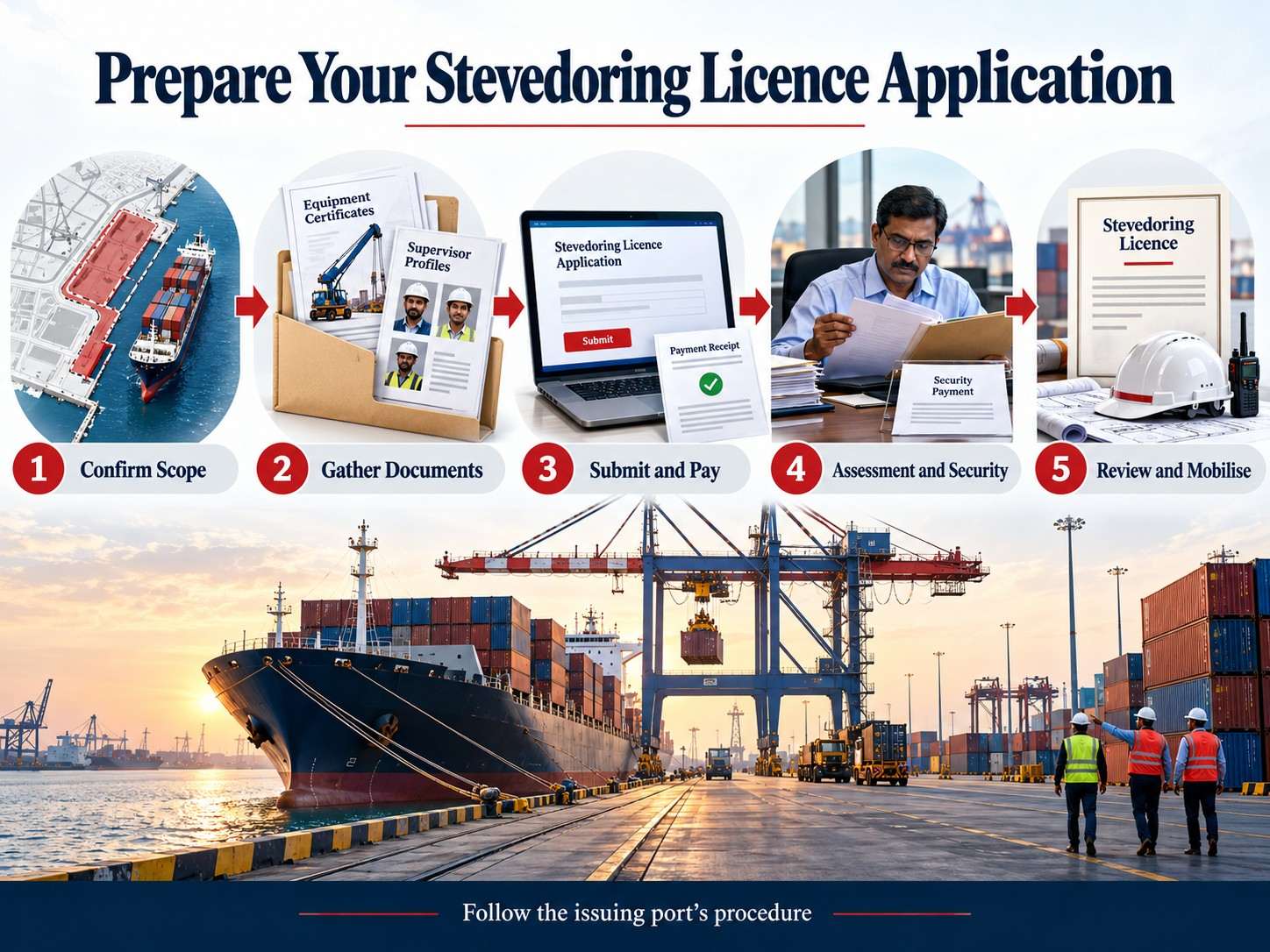
Keep a dated copy of the stevedoring licence requirements used for your submission. This makes later amendments easier to identify and prevents an obsolete checklist from remaining your operational reference.
Which Published Fees and Payment Obligations Can Be Verified?
There is no reliable nationwide price for a port stevedoring licence. Application payments, security deposits, royalty and service charges must be separated.
The Cochin licensing regulations publish a ₹50,000 application fee, subject to revision, and ₹5 lakh security, also subject to revision. Security is payable before issuance. Confirm subsequent Board revisions and applicable tax through the current demand.
Cochin also publishes a ₹50,000 renewal fee and ₹10,000 late fee, both revisable. Its security is interest-free and refundable after adjustment of Board claims in the prescribed closure circumstances, including expiry without renewal or written foreclosure. This does not establish a general application-fee refund entitlement.
Visakhapatnam's official Traffic Department checklist, reviewed on 12 October 2026, publishes these separate amounts:
|
Published item |
Amount and stated period |
|
Fresh licence fee |
₹3,00,325 for three years, including 18% GST |
|
Renewal fee |
₹3,96,905 for three years, including 18% GST |
|
Earnest money deposit |
₹5,000 |
|
Fresh licence security |
₹5,00,000 |
These are published checklist figures, not a confirmed quotation for every 2026 application. Obtain the current demand before payment. A present Mumbai licence amount could not be independently confirmed from the accessible official material reviewed.
Ask for separate payment heads in your stevedoring licence application budget. For renewal, verify the prescribed charges rather than assuming the fresh fee applies. Professional assistance, equipment hire and worker costs are separate from port fees.
How Do the 2026 Dock Safety Developments Affect Operators?
The four Labour Codes became effective on 21 November 2025. The Labour Ministry's transition FAQs explain that earlier rules continue until final replacement, to the extent consistent with the Codes.
The draft dock-worker regulations notification, dated 9 February 2026, proposes regulations under the Occupational Safety, Health and Working Conditions Code. Its publication as a draft does not make every proposed requirement final. Before filing, check for a subsequent final notification and the instructions of the relevant Inspectorate of Dock Safety.
This matters for stevedoring licence requirements because older port forms refer to earlier labour legislation. Keep the licensing checklist and the current safety-law review connected.
The published safety-performance procedure asks for equipment testing, protective equipment, manpower, training, medical examination and cargo-handling particulars. For stevedore licence renewal, assemble these records before the filing deadline.
A Mumbai Port stevedoring licence holder should reconcile its safety file with local inspection instructions. A port stevedoring licence cannot substitute for safe deployment or evidence of compliance.
Use the labour law compliance service to review employer records alongside port documentation. The important operational question is who owns each record and who closes each inspection finding.
When Should Stevedore Licence Renewal Preparation Begin?
Use the expiry date on your actual certificate and the renewal deadline in the applicable regulations. Do not assume that submitting an application automatically extends permission.
Cochin's published framework provides three-year validity unless otherwise specified and requires renewal filing at least three months before expiry. Renewal depends on licence compliance, cargo volumes and safety evidence. Its published cargo threshold is 10,000 metric tonnes annually, subject to Board revision. Chennai's 2021 regulations instead specify 50,000 metric tonnes annually, also revisable. This difference reinforces the need to use the issuing port's renewal criteria.
Plan stevedore licence renewal around those evidence requirements. Reconcile recorded cargo figures, obtain required clearances and close outstanding queries before submission.
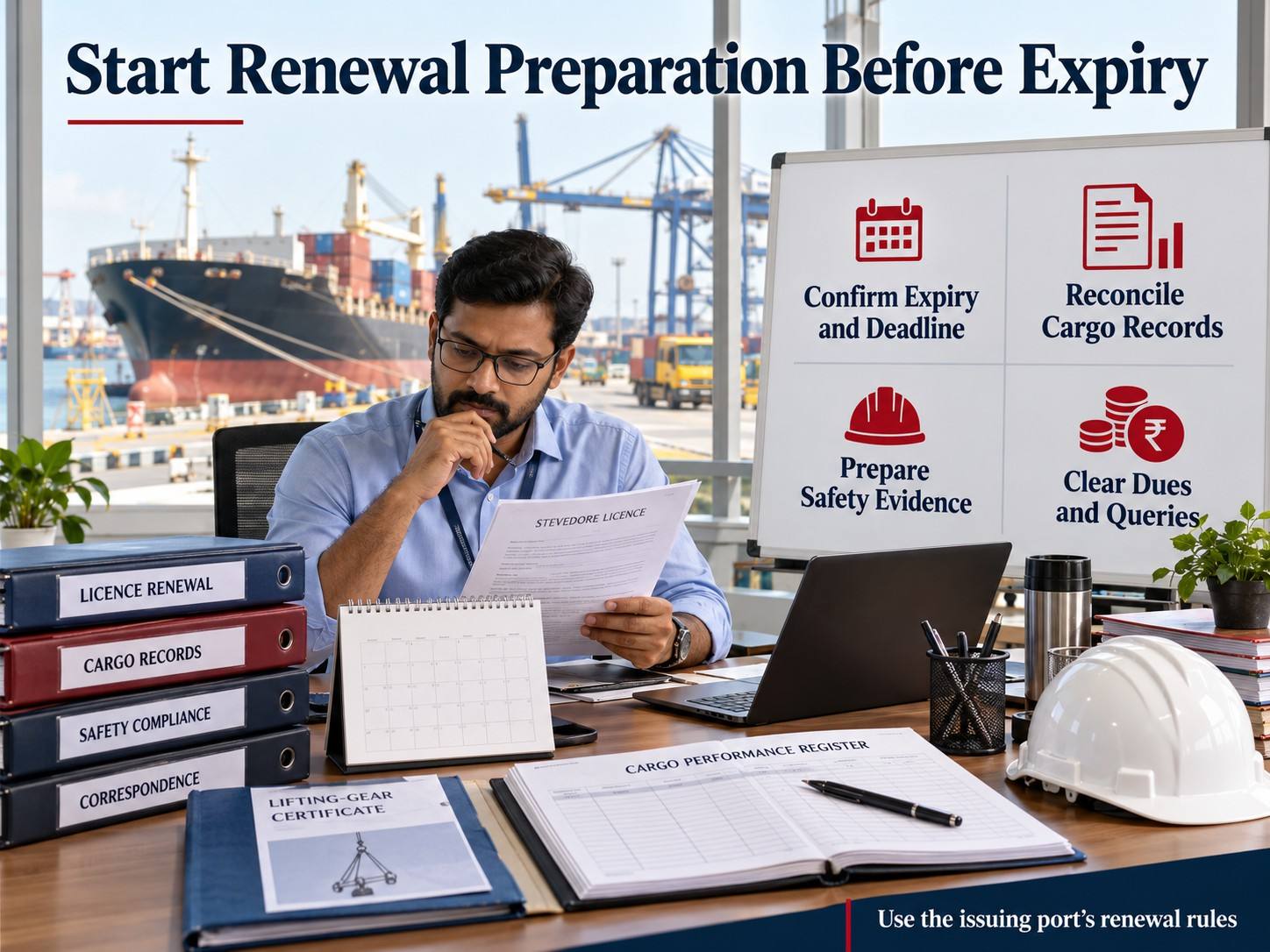
The published dock-safety procedure calls for the port to forward the safety proposal 60 days before expiry. That administrative stage does not replace an earlier port renewal deadline.
For a Mumbai Port stevedoring licence, confirm Mumbai's own deadline and current late-filing conditions. Do not import Cochin's deadline merely because both use a three-year example.
If you separately hold MTO registration, maintain its calendar through the MTO licence renewal guide. Stevedore licence renewal does not renew a different operating authorisation.
What Can Put Continued Cargo Handling Permission at Risk?
Cochin's regulations provide for suspension or cancellation following failures involving licence conditions, safety, performance, port dues or other prescribed grounds. They also provide a show-cause opportunity. Regulation 14 provides an appeal to the Central Government within 30 days of receiving an order refusing issue or renewal, or suspending or cancelling the licence. The precise action depends on the governing provision and circumstances.
For practical control, assign responsibility for:
-
Checking gear certificates before deployment
-
Maintaining supervisory coverage
-
Reconciling royalty and port dues
-
Recording output against applicable standards
-
Answering notices with supporting evidence
Do not invent a national fixed fine for breach of a stevedoring licence. The port stevedoring licence conditions and applicable law determine the consequences.
For a Mumbai Port stevedoring licence notice, identify the cited clause before responding. Preserve the inspection findings, payment records and corrective-action evidence rather than relying on a general assurance of compliance.
What Should Operators Conclude Before Accepting Port Work?
A stevedoring licence in India must match the port, activity and operating arrangement. Establish the stevedoring licence requirements, submit a consistent file, confirm current payments and maintain the records needed for safe operations.
Treat the port stevedoring licence as a continuing responsibility. A Mumbai Port stevedoring licence deserves Mumbai-specific verification, while stevedore licence renewal should be planned from actual expiry and performance evidence. Written clarification is particularly valuable when an official form contains legacy figures or references.
FAQS
FAQs About Stevedoring licence in India
-
Can I Transfer a Stevedoring Licence in India to a Sister Company?
Cochin's published conditions prohibit assigning or transferring the licence or an interest in it to another person. Common ownership should therefore not be treated as permission for a sister company to operate under your certificate. Establish the correct applicant entity before preparing its stevedoring licence application.
- Can a Stevedore Use Hired Cargo Handling Equipment?
- Does a Pending Safety Report Automatically Allow Continued Work?
- What Should I Do if the Original Licence Is Lost?
- Is Cargo Liability Insurance the Same as the Port Security Deposit?
- Will a Customer's Delayed Payment Excuse Unpaid Royalty?
- Can the Same Business Also Provide Multimodal Transport?
- Does Stevedoring Approval Cover Consolidation or NVOCC Work?
- Does Handling Cargo From a Foreign Vessel Authorise Chartering?
- Can an Applicant Rely on a Two-Week Approval Promise?


