How to Get Ship Finance in India: Eligibility, Documents and Application Process
- by kapil
- Updated August 25, 2026
- 24 mins read
Buying a commercial vessel is unlike purchasing an ordinary vehicle or machine. The asset may operate across jurisdictions, earn in a foreign currency, require periodic class surveys and face volatile freight, bunker and insurance costs. A loan for purchasing ship assets is therefore appraised as a combination of corporate credit, project cash flow and movable-asset finance.
This guide explains ship finance in India for businesses considering a newbuild, a second-hand merchant vessel, an offshore support vessel, a coastal vessel or, where a specific lender product permits it, a fishing vessel. It does not assume that every bank finances every vessel type. Credit policy, facility size, pricing, margin, security and approval time remain lender- and transaction-specific.
What is Ship Finance in India?
Ship finance is capital arranged to acquire, construct, refinance, retrofit or sometimes lease a vessel. In a straightforward vessel purchase loan, the borrower contributes part of the acquisition cost and the lender funds an agreed portion. The financed vessel is normally a central part of the security, but the lender may also seek guarantees, account control, assignment of earnings and insurance, or additional collateral.
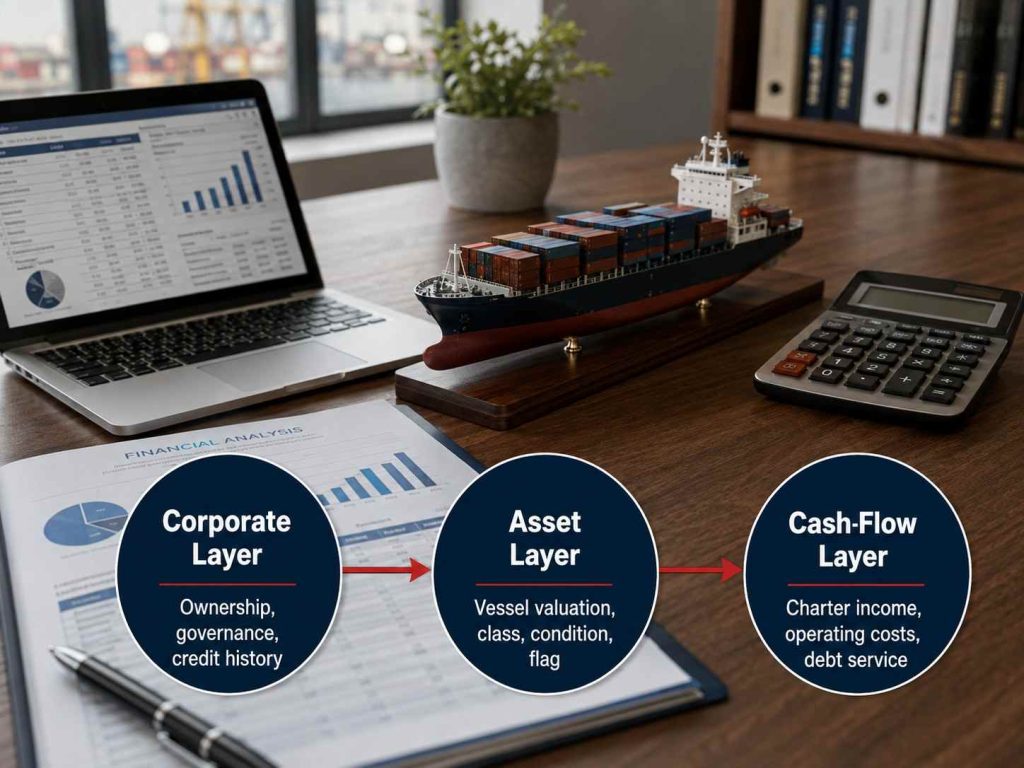
A ship acquisition normally has three connected layers:
- Corporate layer: the legal identity, ownership, governance, financial record and credit quality of the borrowing or ship-owning company.
- Asset layer: the vessel’s ownership, valuation, class, technical condition, flag, certificates, insurance and expected useful life.
- Cash-flow layer: charter income, route demand, operating days, freight rates, bunker costs, crewing, maintenance, dry-docking, taxes and debt service.
The Merchant Shipping Act, 2025 contains India’s statutory framework for vessel registration and recorded mortgages. Sections 26 to 30 address a mortgage of a vessel or share, the mortgagee’s rights and transfer of mortgages. This legal framework does not compel a bank to lend; it helps determine how a valid vessel mortgage is recorded and enforced.
Businesses still deciding whether their requirement is an asset loan or a broader commercial facility can compare a business loan for capital expenditure with a structured term loan for business assets. A ship purchase generally demands more specialised technical, maritime and security due diligence than either generic product description suggests.
Ship-purchase finance is not working-capital finance
Purchase consideration, shipyard instalments and major retrofit costs are long-term capital uses. Crew wages, bunkers, port dues, stores and timing gaps between voyages and collections are operating needs. A separate working capital loan assessment may therefore sit beside the acquisition facility instead of being mixed into it.
| Funding need | More suitable structure | Main repayment source |
| New vessel under construction | Newbuild or project-linked term facility | Future operating or charter cash flow |
| Purchase of existing vessel | Secured vessel purchase loan | Operating earnings from acquired vessel |
| Fleet acquisition | Bilateral or consortium facility | Pooled fleet cash flow and asset cover |
| Bunkers, wages and port costs | Working-capital facility | Voyage receipts and receivables |
| Use without immediate ownership | Operating or finance lease | Operating cash flow during lease term |
| Release of capital from owned vessel | Sale and leaseback, subject to structure | Continued operation under lease |
What are the Main Vessel Financing Options?
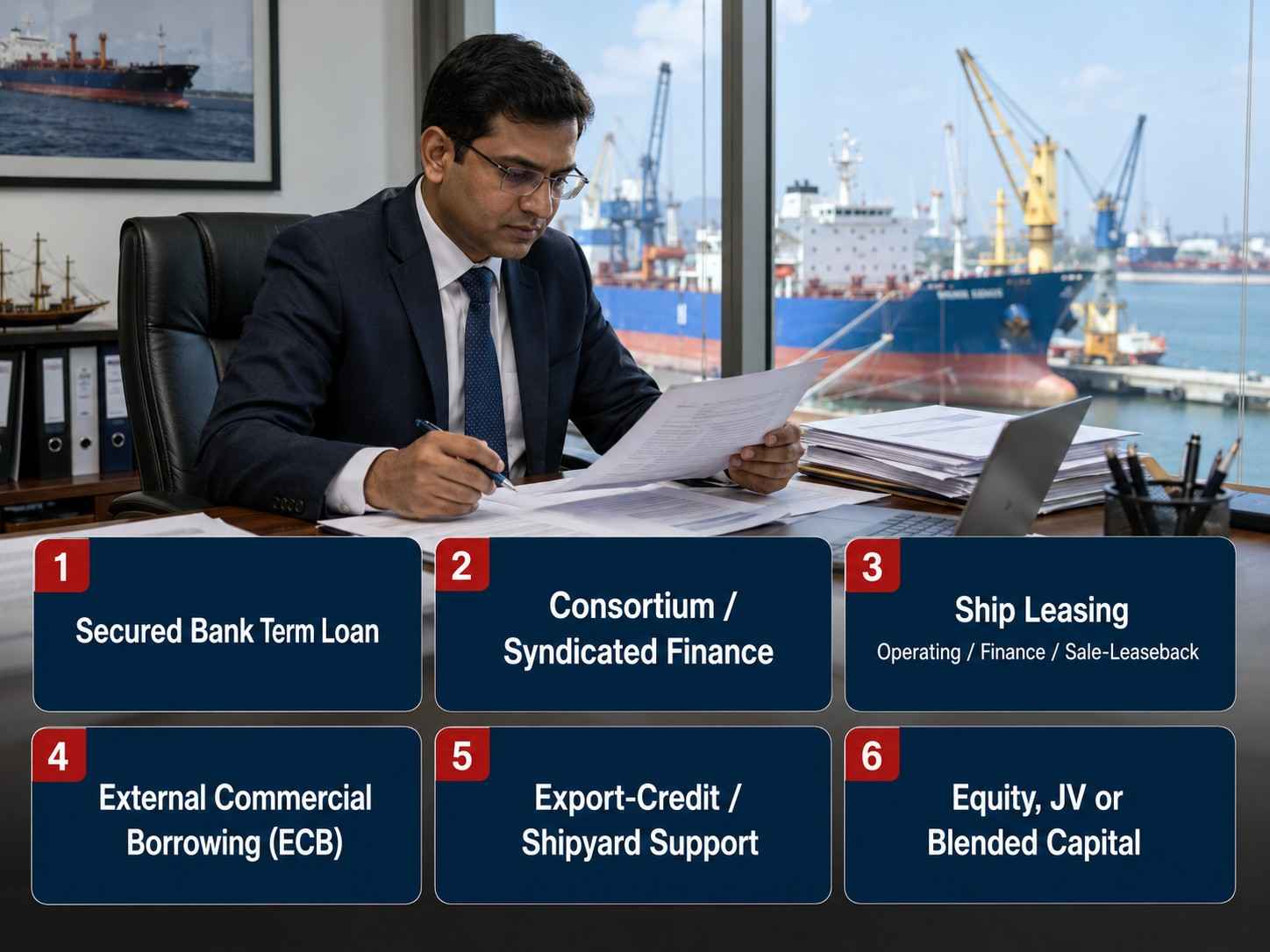
There is no single product called a universal “ship loan”. The appropriate vessel financing options depend on transaction value, vessel type, stage of construction, currency of earnings, sponsor strength and the lender’s maritime exposure.
1. Secured bank term loan
A bank may finance an eligible portion of the purchase or project cost and take a registered vessel mortgage plus supporting security. Repayment may be straight-line, sculpted around forecast cash flow or include a residual or balloon amount, but the structure must remain acceptable to the lender. A low initial instalment does not make an overvalued vessel bankable.
2. Consortium or syndicated finance
Larger transactions may exceed one lender’s exposure preference. Several lenders can participate under common finance and security documents, with a lead bank or facility agent coordinating appraisal, disbursement and monitoring. The borrower should allow additional time for common terms, inter-creditor arrangements and security sharing.
3. Ship leasing
An operating lease gives the business use of the vessel without immediate ownership; a finance lease transfers more economic risk and may lead to ownership under the agreed structure. Sale and leaseback can release capital tied up in an existing ship. The IFSCA ship-leasing framework permits registered lessors in GIFT IFSC to undertake financial leases, operating leases, hybrid structures and related transactions, subject to the applicable regulatory framework.
Leasing is not automatically cheaper than debt. Compare the total lease rentals, security deposit, maintenance allocation, purchase option, tax treatment, foreign-exchange exposure, return conditions and early-termination cost.
Chartering is another way to obtain vessel capacity without buying the asset, but it is not the same as lease finance. A business considering foreign-flag capacity can review the foreign-vessel chartering licence process before deciding that ownership is necessary.
4. External commercial borrowing
An eligible Indian borrower may consider overseas debt only within the current foreign-exchange framework. The RBI’s ECB Master Direction and updated ECB and trade-credit cover recognised lenders, maturity, costs, reporting, end use and other conditions. The transaction should be routed through the designated authorised dealer bank, and currency risk must be modelled rather than ignored.
5. Export-credit, shipyard or supplier-supported structure
A foreign or domestic newbuild may involve shipyard instalments, supplier credit or export-credit support. Availability depends on the exporting jurisdiction, yard, equipment content, buyer and transaction. The borrower must examine guarantee fees, drawdown milestones, local-content tests, governing law and currency exposure alongside the stated interest margin.
6. Equity, joint venture or blended capital
Promoter equity, strategic-investor capital or a joint venture can reduce debt pressure. This may be necessary when projected cash flow cannot support conventional amortisation or when a lender requires a stronger equity cushion. Shareholder rights, exit provisions, reserved matters and related-party charter arrangements should be documented before financial close.
Do Government Maritime Schemes Provide a Direct Ship Loan?
Government initiatives can improve the financing ecosystem, but they should not be presented as guaranteed sanction for every shipowner.
The Union Cabinet’s 2025 maritime package approved a ₹25,000 crore Maritime Development Fund, comprising a ₹20,000 crore Maritime Investment Fund and a ₹5,000 crore Interest Incentivisation Fund. A July 2026 government update stated that the MDF guidelines had been issued and SBI Ventures Limited appointed as fund manager for the investment fund.
Applicants should check current eligibility, operating guidelines and participating channels rather than treating the corpus as an on-demand retail loan. See the Cabinet maritime-financing package and the July 2026 implementation update.
Smaller fishing-vessel requirements may fall under specialised fisheries products rather than merchant-ship finance. For example, Union Bank publishes a fisheries-sector finance product covering eligible inland and marine activities. Product coverage, unit cost, margin, subsidy linkage and security must be confirmed with the lender; a fishing-boat product should not be assumed to cover a cargo ship, tanker or offshore vessel.
Who Is Eligible for a Loan for Purchasing Ship Assets?
No Indian law creates one universal eligibility score for all lenders. A lender sets its credit policy while complying with applicable banking, KYC, foreign-exchange and maritime requirements. The following factors commonly determine whether a loan for purchasing ship assets proceeds to detailed appraisal.
Borrower-level eligibility
- A valid legal entity with constitutional documents permitting shipping, vessel ownership or the proposed activity
- Identifiable promoters, beneficial owners and authorised signatories who satisfy the lender’s KYC and due-diligence checks
- Satisfactory audited financial statements, banking conduct and repayment history
- Adequate promoter contribution from an explainable source
- Relevant technical, operational or commercial experience, or credible contracts with qualified managers
- Ability to service existing and proposed debt under realistic assumptions
- No unresolved statutory default, material litigation or ownership issue that undermines the transaction
The RBI’s KYC Direction governs regulated entities’ customer-identification and beneficial-ownership checks. A clean corporate file is therefore more than a formality. If the project will sit in a newly incorporated special-purpose vehicle, lenders often examine the sponsor or group because the SPV has no operating history.
A business choosing the ownership vehicle should settle its structure before filing the finance application. A private limited company registration may provide a distinct corporate borrower and clearer shareholding, but incorporation alone establishes neither maritime competence nor creditworthiness.
Vessel-level eligibility
- Vessel type and trade acceptable to the lender
- Independent market valuation supporting the purchase price
- Age and remaining economic life compatible with the requested repayment profile
- Satisfactory pre-purchase condition survey and class status
- Clear title, registry history and freedom from undisclosed encumbrances or maritime claims
- Valid or attainable statutory certificates, flag approval and insurance
- Commercially credible charter, contract of affreightment or route-demand evidence
- Acceptable emissions and efficiency position, including retrofit needs where applicable
The technical review should use a competent marine surveyor and an acceptable classification society. The Indian Register of Shipping’s marine services explain class, statutory survey and certification functions. A class certificate is important evidence, but it does not replace a buyer-specific condition survey, valuation or legal-title review.
Transaction-level eligibility
The lender also examines the sale-and-purchase agreement or shipbuilding contract, payment milestones, refund guarantees, delivery conditions, choice of law, permitted flag, charter arrangements, insurance and security perfection. A sound borrower can still receive an adverse credit decision if the vessel is overpriced, poorly maintained, uninsurable or commercially unemployed.
How Do Banks Evaluate a Ship Finance Application?
1. Sponsor and management quality
Lenders test whether the promoters understand the vessel’s trade, operating risks and compliance burden. A first-time owner may strengthen the operating case through an experienced technical manager, commercial manager, crewing arrangement and documented governance. Those contracts do not replace sponsor responsibility, but they reduce execution uncertainty.
2. Vessel valuation and loan-to-value ratio
The lender compares purchase price with independent market value and may lend against the lower acceptable base. The loan-to-value ratio is negotiated under lender policy; there is no universal Indian percentage applicable to every ship. Values can change quickly with freight markets, vessel supply, age, class condition and scrap prices, so finance documents may require periodic valuations and additional security or prepayment if cover falls.
3. Charter and revenue visibility
A long-term charter with a creditworthy counterparty can improve cash-flow visibility, but the lender still reads termination rights, off-hire provisions, performance warranties and assignment restrictions. Spot-market projections require more conservative stress tests. Related-party charter income is examined for arm’s-length terms and actual payment capacity.
4. Operating-cost assumptions
The financial model should separately forecast crew, bunkers, stores, lubricants, port and canal charges, management fees, insurance, repairs, dry-docking, class renewal, statutory surveys and contingency. A detailed maritime project report can connect vessel specifications, route economics, operating costs, insurance and repayment assumptions in one bank-facing case.
5. Debt-service capacity
Banks may review the debt service coverage ratio, interest coverage, break-even freight rate, minimum liquidity and downside cash balance. Do not build the base case on continuous employment, peak freight rates or zero unplanned repairs. A useful model includes lower freight, fewer operating days, higher bunker prices, delayed delivery, higher interest and a weaker exchange rate where debt and revenue currencies differ.
6. Regulatory and environmental position
Vessels must maintain the certificates and management systems relevant to their type, size, flag and trade. The IMO explains that EEXI generally applies from 400 gross tonnage and CII from 5,000 gross tonnage for covered ships. See the IMO EEXI and CII guidance. A poor efficiency profile may imply retrofit cost, speed limitation, weaker charter demand or lower residual value.
The operating company may also need a safety management system under the ISM framework. The IMO ISM Code overview describes the international standard for safe management and operation, while the SOLAS overview explains that Chapter IX makes the ISM Code mandatory for applicable ships.
Read more: LegalBabu’s Document of Compliance certification guide provides a practical starting point for company-level safety-management documentation.
What Documents Are Required for Ship Finance in India?
The exact checklist changes for a newbuild, used vessel, domestic purchase, import, lease or refinancing. Organise documents in indexed folders and reconcile names, dates, values and ownership across every record.
Corporate and KYC documents
- Certificate of incorporation, memorandum and articles or equivalent constitutional records
- PAN, GST registration, registered-office proof and corporate identification details
- Shareholding chart, beneficial-owner declaration and group structure
- KYC of promoters, directors, guarantors and authorised signatories
- Board and, where required, shareholder approvals for borrowing, guarantees and security
- Existing borrowing statement, charge details, litigation and related-party disclosures
Regular statutory filing helps the lender verify continuity and governance. The ROC annual return filing guide explains the difference between corporate annual filings and tax returns, while the GST registration process is useful where business particulars need to be made consistent before appraisal.
Financial and banking documents
- Audited financial statements and tax returns for the period requested by the lender
- Latest provisional financials and management accounts
- Bank statements, existing sanction letters and repayment schedules
- Net-worth statements of promoters or guarantors
- Source and availability proof for promoter contribution
- Projected profit and loss, balance sheet and cash-flow statements
- DSCR, break-even, sensitivity and foreign-exchange analysis
An outsourced finance function can help maintain lender-ready reporting, budgets and controls. See the scope of CFO services for financial planning where the shipping business needs ongoing MIS and covenant monitoring rather than only a one-time application model.
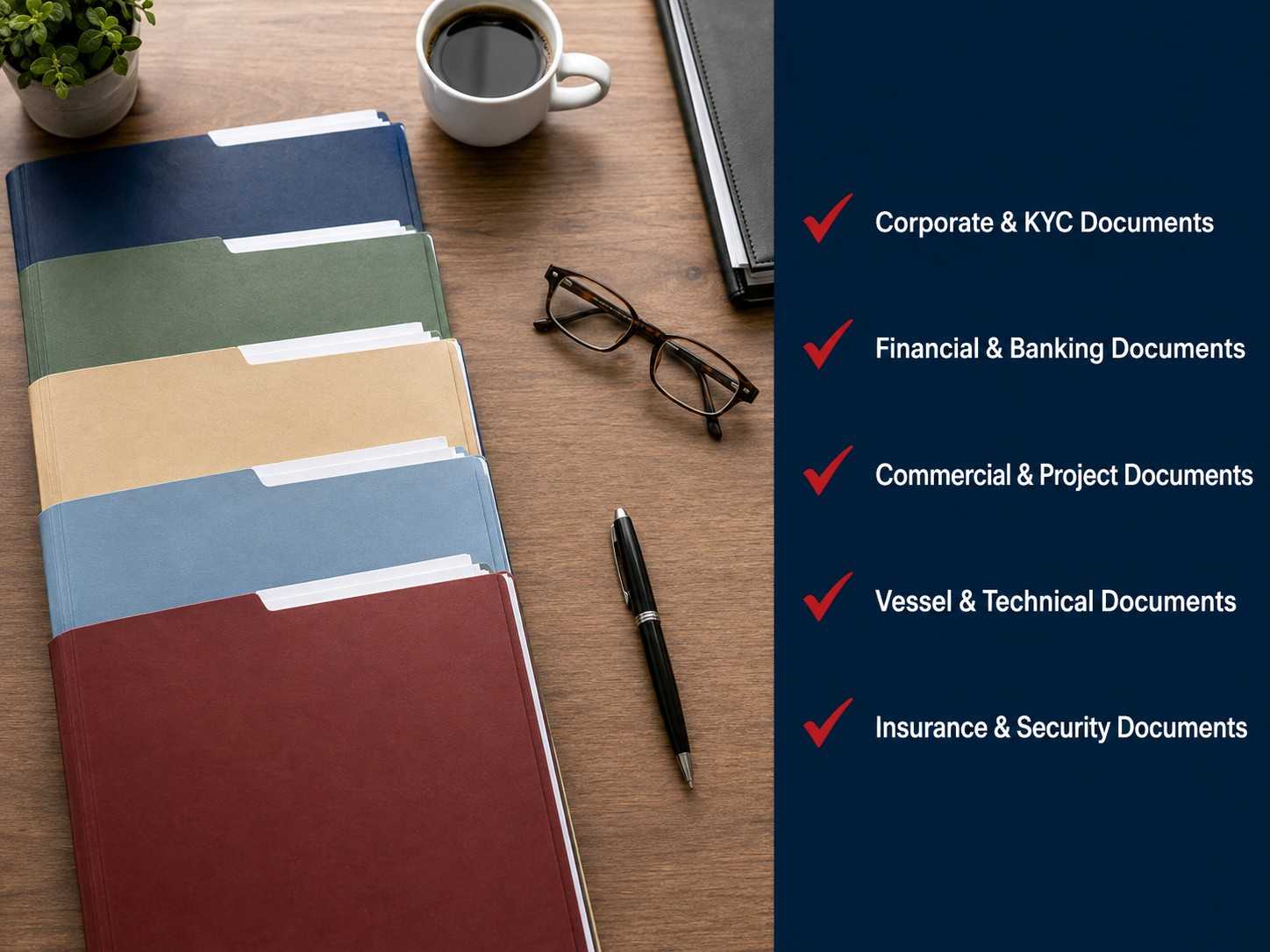
Commercial and project documents
- Detailed project report or credit memorandum
- Vessel deployment plan, target routes and market study
- Charter party, contract of affreightment, tender award or letters of intent, if available
- Counterparty profile and revenue assumptions
- Operating, crewing and technical-management agreements
- Bunker, port, repair, dry-docking and insurance cost estimates
- Proposed facility amount, repayment structure and drawdown schedule
Vessel and technical documents
- Executed or draft memorandum of agreement for a used vessel
- Shipbuilding contract, specifications, milestone schedule and refund guarantees for a newbuild
- Builder’s certificate or existing certificate of registry, as applicable
- Continuous synopsis, class records, survey status and statutory certificates
- Independent valuation and pre-purchase condition survey
- Engine, machinery, capacity, tonnage and equipment particulars
- Dry-dock, casualty, repair, detention and maintenance history
- Title search, encumbrance position and current mortgage-discharge documents
- Energy-efficiency and environmental compliance records applicable to the vessel
For an overseas acquisition intended to move to the Indian register, plan deletion from the previous registry, title transfer, surveys and new registration together. The foreign vessel to Indian flag process outlines the reflagging workflow and supporting records that may intersect with lender conditions precedent.
Where the business will issue multimodal transport documents or combine sea carriage with other transport modes, the operating model may also require Multimodal Transport Operator registration. This is an operating-compliance question, not a substitute for vessel registration or loan approval.
Insurance and security documents
- Indicative or bound marine hull and machinery cover
- Protection and indemnity entry or cover confirmation
- War-risk and other trade-specific covers where required
- Insurance assignment and loss-payee wording acceptable to the lender
- Draft loan agreement, deed of covenant and vessel mortgage
- Corporate or personal guarantees, if sanctioned
- Assignment of earnings, requisition compensation and charter rights where agreed
- Account-control, escrow or debt-service-reserve documents
- Charge-registration and security-perfection filings
If the borrower employs crew through a regulated recruitment structure or operates through a ship manager, licensing and labour compliance should be reviewed early. Relevant starting points include the RPSL licence requirements and MLC 2006 certification.
What Security is Commonly Created for a Vessel Purchase Loan?
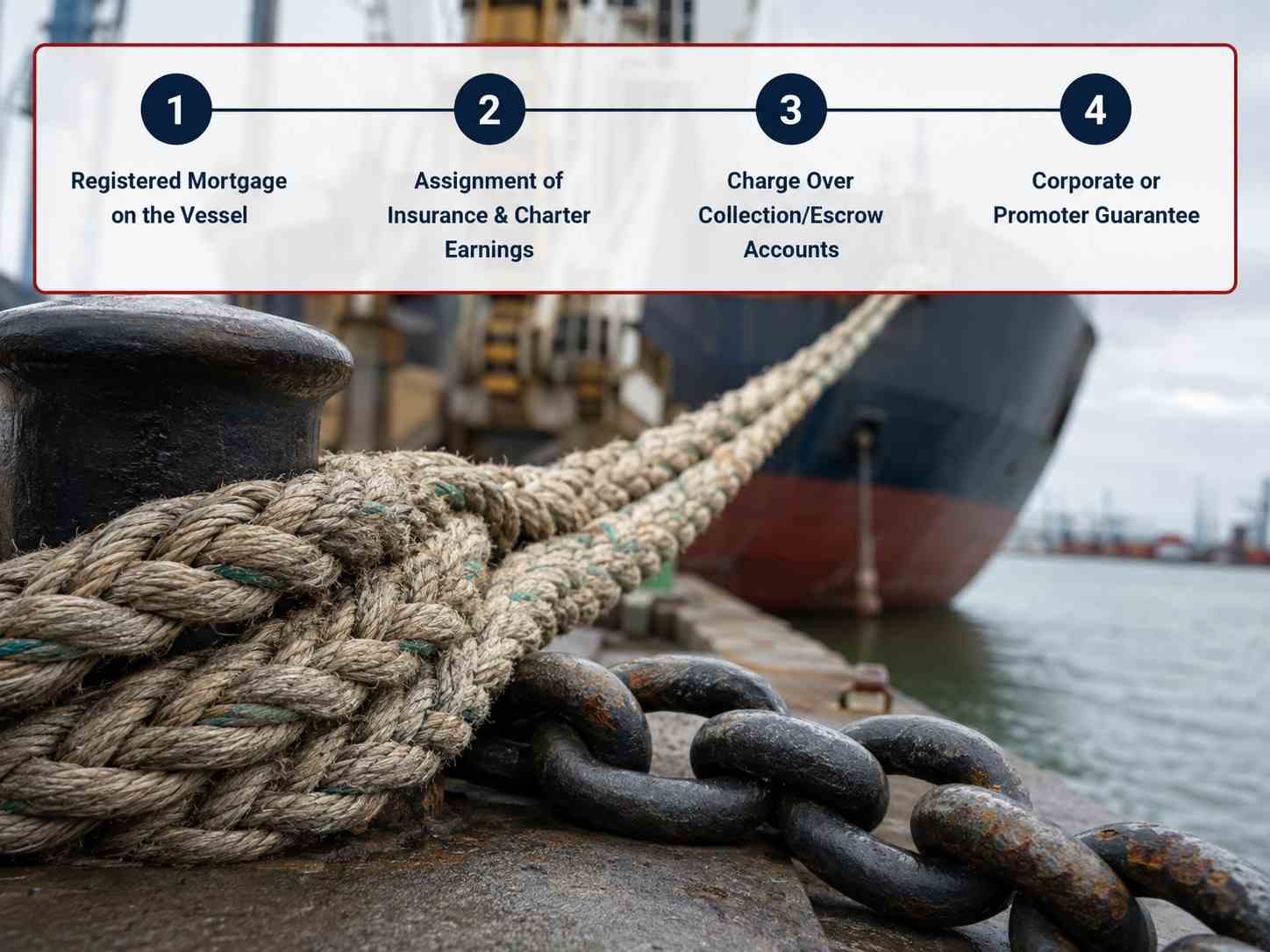
A security package may include the following, subject to the sanction and governing law:
- First-ranking registered mortgage over the financed vessel
- Assignment of hull, machinery, war-risk and P&I insurance proceeds
- Assignment of vessel earnings, charter receivables and requisition compensation
- Charge over designated collection, retention or debt-service accounts
- Corporate or promoter guarantee
- Pledge of shares in the ship-owning SPV
- Additional vessel or property security where required
- Financial covenants, minimum-value cover and restrictions on sale or further debt
If an existing property is proposed as additional collateral, its title and value undergo a separate review.
Read more: The loan against property eligibility guide explains that property value alone does not establish repayment capacity or assure sanction.
Under the Merchant Shipping Act, recorded mortgage priority depends on the date and time of entry in the register. The official DGMA Shipping also emphasises prompt registration at the vessel’s port of registry. Transaction counsel should confirm the currently prescribed form and procedure under the operative rules rather than relying only on an older form specimen.
Mortgage registration does not erase higher-ranking risks. Under the Admiralty Act, 2017, maritime liens rank ahead of registered mortgages in the statutory order of maritime claims. Lenders and buyers therefore investigate crew wages, salvage, collision, port claims and other potential liabilities instead of treating a clean-looking registry extract as complete protection.
Where a company creates a charge over its assets, corporate filing may also be required. The ROC charge-registration process explains the corporate step; it should be coordinated with vessel-registry perfection, not treated as a substitute for the ship mortgage.
How Does Finance Differ for a Newbuild and a Second-Hand Ship?
Below is the table explaining the difference between a newbuild and a second-hand Ship:
| Appraisal point | Newbuild vessel | Second-hand vessel |
| Main contract | Shipbuilding contract | Memorandum of agreement or sale agreement |
| Key value evidence | Contract price, technical specification and yard assessment | Independent current market valuation |
| Drawdown | Milestone-based during construction or paid at delivery | Usually linked to closing and delivery |
| Primary completion risk | Yard delay, cost overrun, specification or refund risk | Title, condition, class and undisclosed-liability risk |
| Technical review | Plan approval, build supervision and sea trials | Pre-purchase survey, records and dry-dock outlook |
| Security before delivery | Assignment of contract, refund guarantee and project rights | Closing mechanics, mortgage discharge and simultaneous new security |
| Revenue start | Only after delivery and operational readiness | Potentially faster, subject to transition and employment |
| Residual-value concern | Design relevance and long delivery cycle | Age, remaining life, efficiency and next special survey |
For a used vessel, the buyer should not rely only on the seller’s class certificate. Inspect underwater condition where justified, machinery performance, thickness measurements, outstanding recommendations, next dry-dock, casualty history, sanctions exposure and beneficial ownership. For a newbuild, the borrower should focus on yard capability, refund-security quality, change-order control, supervision rights, delay damages, trial standards and final acceptance.
What Interest Rate, Margin, Tenure and Costs Apply?
There is no official universal ship loan interest rate in India. A lender may price over its chosen benchmark and add a credit spread based on sponsor strength, vessel risk, charter quality, leverage, currency, tenor and security. The sanctioned rate may be fixed, floating or hedged under a separate arrangement.
Likewise, neither “20% down payment” nor any other margin should be stated as a rule. The required promoter contribution depends on the lower accepted cost or value, transaction risk, lender policy and additional security. A request for a longer tenure can be constrained by vessel age, charter period, economic life and residual-value assumptions.
| Cost item | What to verify |
| Interest | Benchmark, spread, reset date, default interest and hedging |
| Processing or arrangement fee | Upfront amount, tax and refundability |
| Valuation and survey | Approved valuer, marine surveyor, scope and repeat valuations |
| Legal and due diligence | Indian and foreign counsel, title, sanctions and contract review |
| Registration and security | Registry, mortgage, stamp and corporate charge expenses |
| Insurance | Hull, P&I, war risk, deductibles and lender endorsements |
| Commitment fee | Charge on sanctioned but undrawn amount, if applicable |
| Agency and account costs | Facility agent, security trustee, escrow and monitoring |
| Prepayment or cancellation | Conditions, break costs and notice period |
| Foreign exchange | Hedging premium and mismatch between debt and earnings |
Ask for a term sheet showing the annual rate and every non-interest cost. Compare total cash outflow under the same drawdown and repayment assumptions, not just the advertised spread.
How to Apply for Ship Finance in India
Step 1: Define the vessel and funding requirement
Identify whether the transaction concerns a newbuild, used ship, refinancing, retrofit or lease. Record the purchase price, taxes and duties, survey and closing costs, initial repairs, working capital, contingency and promoter contribution. Separate acquisition finance from operating liquidity.
Step 2: Choose the ownership and operating structure
Decide which entity will own the vessel, which will borrow, who will operate it and where income will be collected. Align the memorandum objects, board authority, shareholding and related-party contracts. If a foreign flag, Indian reflagging or overseas lessor is involved, obtain tax, FEMA and maritime advice before signing a binding contract.
Step 3: Conduct preliminary vessel due diligence
For a used ship, obtain independent valuation, class records, condition information, registry history and an encumbrance search before committing a non-refundable deposit. For a newbuild, review the yard, specification, delivery schedule, refund guarantee and supervision regime. Make the acquisition conditional on finance and satisfactory due diligence where commercially possible.
Step 4: Build a bankable project report
Prepare the commercial case, technical plan, management structure and full financial model. State sources for freight, operating-day and cost assumptions. Include downside scenarios, break-even freight, DSCR, residual value and a clear repayment source.
Step 5: Approach suitable lenders or lessors
Shortlist institutions that actually consider the vessel type, ticket size, flag, borrower profile and currency. A generic retail branch may not handle commercial ship finance. Send a concise information memorandum first, then provide the complete data room under the institution’s process.
Step 6: Submit the maritime loan application and documents
File the application with KYC, corporate, financial, commercial, vessel, insurance and security records. Use one document index and a written query tracker. Explain inconsistencies instead of silently uploading conflicting numbers.
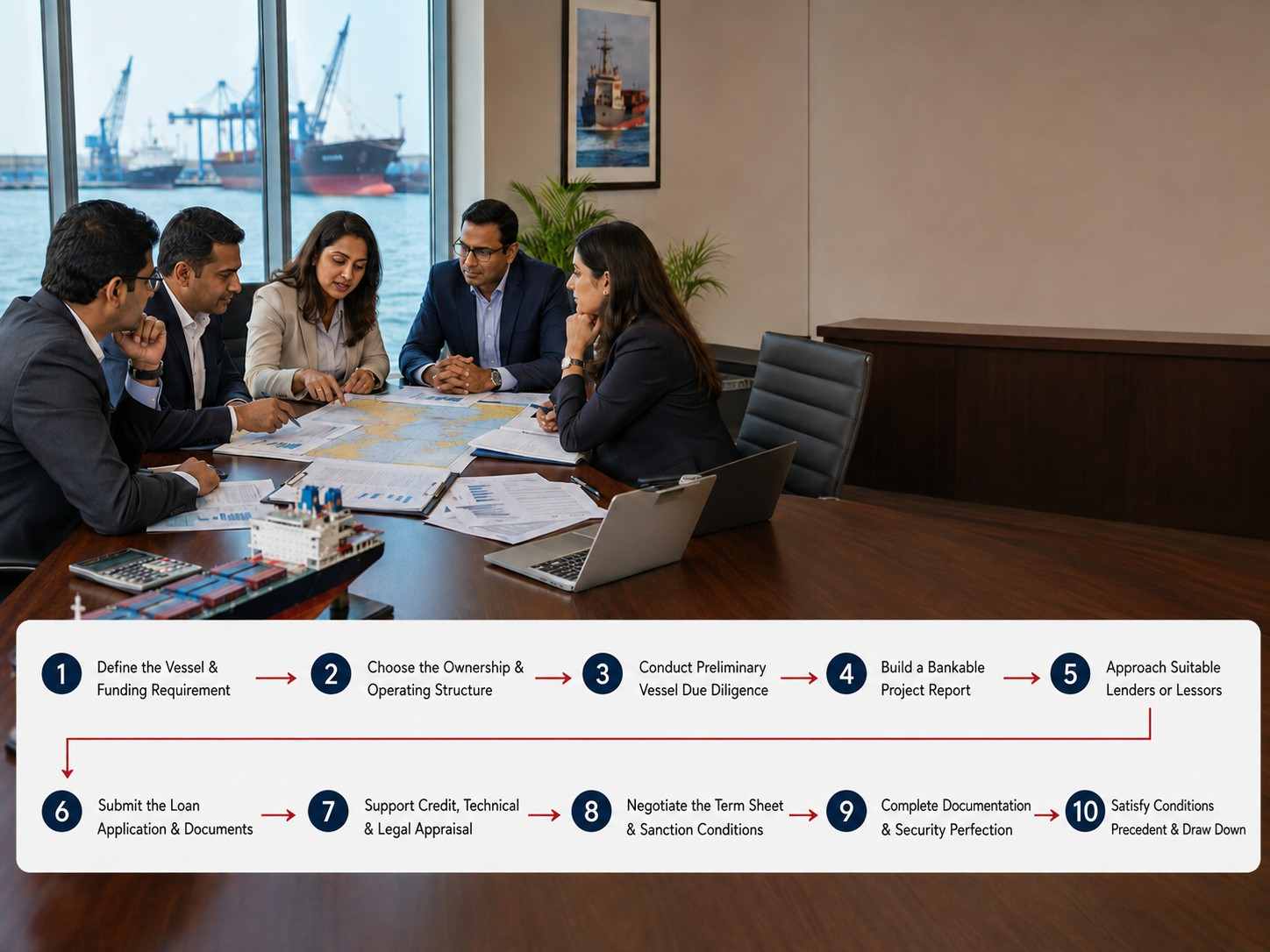
Step 7: Support credit, technical and legal appraisal
The lender may commission its own valuation, survey, title check, legal review and cash-flow stress test. Respond through designated contacts and preserve version control. Any material casualty, charter change, litigation or price revision arising during appraisal should be disclosed promptly.
Step 8: Negotiate the term sheet and sanction conditions
Review facility amount, currency, pricing, margin, repayment, balloon, security, value-cover covenant, restricted payments, mandatory prepayment, reporting and events of default. Ensure the delivery date and purchase-contract milestones can meet the lender’s conditions. A sanction subject to conditions is not the same as an immediately drawable facility.
Step 9: Complete documentation and security perfection
Execute the finance documents, vessel mortgage, guarantees, assignments and account arrangements. Complete vessel-registry and corporate charge filings in the required sequence. Obtain insurer acknowledgements, class confirmations and legal opinions requested by the lender.
Step 10: Satisfy conditions precedent and draw down
Provide evidence of equity contribution, title transfer mechanics, insurance, registration, mortgage priority, charter documents and all closing deliverables. The lender releases funds only after accepting the conditions precedent or formally waiving specific items. After delivery, comply with reporting, valuation, insurance and financial covenants throughout the facility term.
What Commonly Delays or Weakens a Ship Loan Application?
- Purchase price materially above independent vessel value
- Insufficient or unexplained promoter contribution
- Optimistic freight rates with no downside model
- Expiring charter or weak counterparty without replacement assumptions
- Vessel age inconsistent with requested repayment term
- Overdue class recommendations or major dry-dock cost omitted
- Unclear title, prior mortgage or possible maritime lien
- Inconsistent turnover across audited accounts, GST returns and banking records
- Foreign-currency debt without a credible natural or financial hedge
- Missing board authority, related-party disclosure or corporate filing
- Insurance exclusions, high deductibles or unacceptable loss-payee wording
- Sanctions, trading-area, environmental or cyber risks not assessed
Fuel quality and supplier compliance can also affect operations, claims and detention exposure. Businesses arranging marine fuel in Indian ports can use the bunker supplier registration guide to understand why approved sourcing records matter.
Modern ships are also operational technology assets. If a vessel or manager cannot demonstrate reasonable cyber controls, operational disruption and insurance concerns can enter lender due diligence.
How Can a Business Improve Its Application Before Submission?
Start with an evidence room rather than a loan form. Reconcile corporate records, accounts, tax filings, bank credits, vessel price and charter assumptions. Commission the right marine and legal reviews early enough to negotiate protections in the purchase contract.
Next, present one coherent repayment story. The vessel’s expected earnings should connect directly to operating costs, reserve needs, debt instalments and downside liquidity. If additional collateral or group support is proposed, state its ownership, value, existing encumbrances and enforcement jurisdiction clearly.
Finally, separate approval stages. A positive introductory discussion is not a term sheet; a term sheet is not a sanction; a sanction is not drawdown. Maintain sufficient time and contractual protection for valuation, credit committee review, documentation, mortgage registration, insurance endorsement and delivery closing.
Conclusion
Obtaining ship finance in India depends on much more than the borrower’s turnover or credit score. The lender must be satisfied with the sponsor, vessel value, class and regulatory status, commercial employment, stressed repayment capacity and enforceability of the mortgage and supporting security.
A well-prepared loan for purchasing ship assets starts before the formal application. Choose the correct ownership and funding structure, complete technical and title due diligence, build conservative cash flow projections, document the equity source and align the purchase agreement with finance conditions. That preparation cannot guarantee sanction, but it gives the lender a complete, credible case to evaluate.
FAQs About Loan for purchasing ship
Can a business get a loan for purchasing ship assets in India?
Yes, eligible businesses can approach banks, financial institutions, maritime-focused financiers or lessors for a loan for purchasing ship assets. Approval depends on the borrower, vessel, transaction, projected cash flow and security rather than the asset name alone. The institution must also accept the vessel type, ticket size, flag and intended trade under its current policy.
Can the purchased vessel itself be used as collateral?
A lender commonly takes a registered mortgage over the financed vessel. It may also require assignment of earnings and insurance, account control, guarantees, an SPV share pledge or additional assets. The precise package follows the sanction terms, the vessel’s registry and applicable Indian and foreign law.
How much down payment is required for a ship loan?
There is no universal down-payment percentage for ship finance in India. The lender decides promoter contribution after comparing purchase cost, accepted market value, cash-flow strength, vessel risk and additional security. The borrower should budget equity plus survey, legal, insurance, registration, repair and initial operating costs that may not be financed.
What is the normal interest rate and tenure for ship finance?
No single rate or tenure applies across lenders and vessel types. Pricing may depend on the benchmark, borrower rating, leverage, charter strength, currency, age, flag, residual value and security, while tenure may be limited by economic life and charter coverage. Request a written term sheet and compare total cost, including fees, hedging and balloon repayment.
Can a start-up or newly formed SPV obtain vessel finance?
A new SPV may be used as a ship-owning borrower, but it lacks financial history. Lenders therefore commonly assess the sponsors, group support, equity, management contracts, charter arrangements and guarantees more closely. A strong business plan without committed equity, experienced operations and credible revenue may still be insufficient.
Can a second-hand or foreign vessel be financed?
Yes, subject to lender policy and satisfactory valuation, condition, class, title, sanctions, insurance and remaining-life review. A foreign acquisition may also require import, foreign-exchange, deletion-registry, reflagging and mortgage-coordination steps. The sale contract should align delivery and payment with lender conditions and discharge of the seller’s existing security.
Is the Maritime Development Fund available to every ship buyer?
No automatic entitlement should be assumed. The MDF is a government-backed maritime financing initiative with specified funds, guidelines, implementing arrangements and eligible channels. A business must check the current operational criteria and still satisfy the relevant fund, intermediary or lender’s appraisal requirements.
Does the Shipbuilding Financial Assistance Scheme pay the buyer’s ship loan?
The SBFAS is structured as assistance for eligible shipbuilding by qualifying shipyards under its guidelines. It should not be described as a guaranteed direct borrower subsidy or replacement for a vessel loan. Buyers should confirm how any benefit is reflected in the shipbuilding contract, price and finance documents.
Can an MSME obtain collateral-free finance to buy a vessel?
MSME status may influence how a bank classifies eligible credit, but it does not automatically make every vessel purchase collateral-free. High asset value, specialised resale risk and the lender’s product rules still matter. Even where a guarantee scheme is considered, the applicant and facility must meet that scheme’s current eligibility and lender appraisal requirements.
How long does the ship-finance application process take?
There is no reliable universal approval period because a simple fishing-vessel product and a cross-border merchant-ship acquisition are not comparable. Timing depends on document readiness, valuation, survey, credit committee, legal review, flag and registry work, insurance, negotiations and security perfection. The purchase agreement should provide a realistic finance and due-diligence window rather than assume funds will be available by a fixed date.
You may also like

Can PAIMA Membership Expand Your Global Moving Network?
PAIMA membership can help an established Indian moving company build relationsh