
Here is how to start a pharmacy business in India. You need a registered pharmacist, premises of at least 10 square metres and a retail drug licence (Forms 20 and 21) from your State Licensing Authority. Then add GST registration and a shop registration. The government fee for both forms is ₹3,000.
A medical store looks simple from the customer’s side of the counter. Behind it, the law asks for a qualified person, a compliant shop, a licence from your state and records an inspector can open on any day. The Drugs and Cosmetics Act, 1940 and the Drugs Rules, 1945 set these rules. Your state’s drug control department grants the sale licence. The central body, CDSCO, does not.
This guide covers the pharmacy licence in India, step-by-step, in the order most owners need it.
What Do You Need to Open a Medical Store in India?
Four things decide whether you can open the shutter.
-
A registered pharmacist who supervises the counter.
-
Premises that meet the area and storage rules.
-
A retail drug licence from the State Licensing Authority.
-
Business registrations, such as GST and a shop registration.
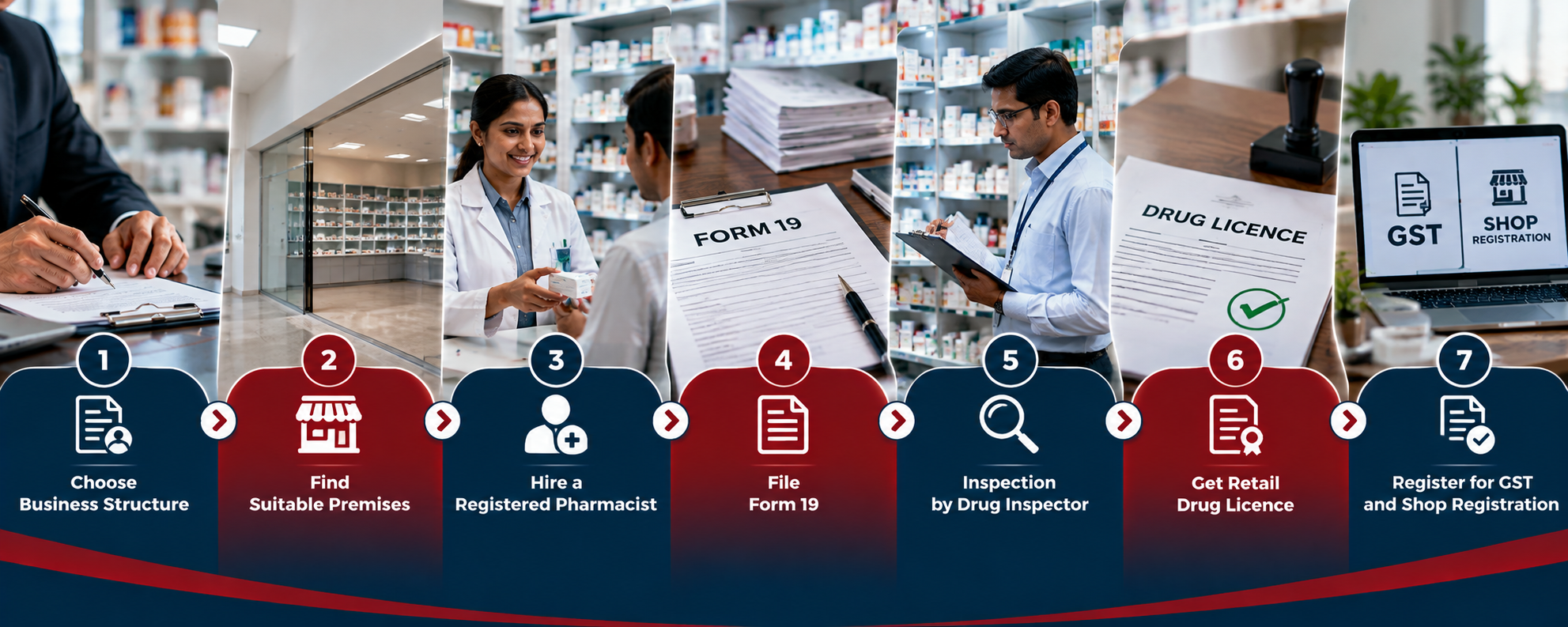
Work in this order. Pick your business structure, find compliant premises, hire your pharmacist, then file the licence application. Register for GST once the licence file is moving. The landlord’s papers and the pharmacist’s certificates go into the licence file, so you need them early.
Here is a pattern worth knowing. Owners often sign a lease first and read the premises rules later. A shop that fails the rules still costs rent while you look for another one. Check the rules before you pay a deposit.
Which Business Structure Suits a Medical Store?
Your structure decides who owns the licence file and who carries the risk. This table compares the common options.
|
Structure |
Good for |
Worth knowing |
|
Sole Proprietorship |
One owner, one shop |
Quickest to set up. Owner liability is unlimited. |
|
Partnership Firm |
Family or friends running the shop together |
Needs a partnership deed. Partners share unlimited liability. |
|
LLP |
Partners who want limited liability |
Annual filings with the ROC apply. |
|
One Person Company |
A single owner who wants company status |
Limited liability, with ROC filings every year. |
|
Private Limited Company |
Owners planning several outlets or outside investors |
More compliance, easier to raise money. |
A first shop with one owner often starts as a sole proprietorship. Two or more owners can choose a partnership firm or an LLP. A One Person Company suits a solo owner who wants limited liability. If you plan a chain, look at private limited company registration.
Decide your structure before you file for the drug licence. The licence file carries the name and constitution you submit.
Which Drug Licence Do You Need for a Pharmacy?
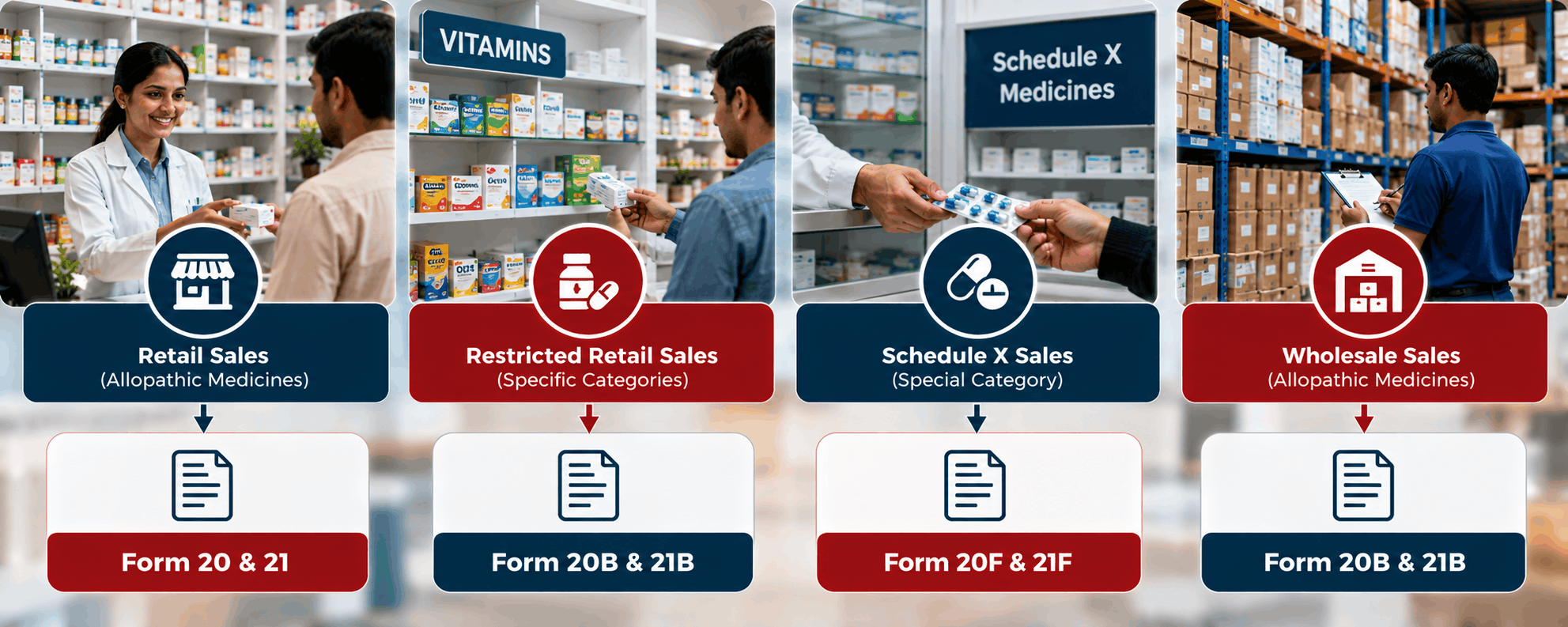
Your stock list decides the licence. You apply on one form and receive a licence in another. The table below follows the Delhi Drugs Control fee table, which reflects the central Drugs Rules.
|
What you will do |
Apply on |
Licence form |
Government fee |
Retention fee (every 5 years) |
|
Retail sale of drugs other than Schedule C, C(1) and X |
Form 19 |
Form 20 |
₹1,500 |
₹1,500 |
|
Retail sale of Schedule C and C(1) drugs, such as vaccines and sera |
Form 19 |
Form 21 |
₹1,500 |
₹1,500 |
|
Restricted retail of household remedies (general store, no pharmacist) |
Form 19A |
Form 20A / 21A |
₹500 |
₹500 |
|
Retail sale of Schedule X drugs |
Form 19C |
Form 20F |
₹500 |
₹500 |
|
Wholesale supply to other shops |
Form 19 |
Form 20B / 21B |
₹1,500 per form |
₹1,500 per form |
Most medical stores take Form 20 and Form 21 together. The government fee for both is ₹3,000. Your state portal may add a small service charge on top.
Form 20 covers most prescription medicines, including Schedule H and H1 drugs. If you want to stock Schedule X drugs, add Form 20F.
Wholesale is a separate licence. If you plan to supply other shops from the same premises, apply for Forms 20B and 21B as well. Our drug licence service covers every category above.
What Are the Premises and Pharmacist Requirements?
Two things decide whether your shop can hold a sale licence. One is the space. The other is the person behind the counter.
Premises
-
Retail alone needs at least 10 square metres. Wholesale alone needs the same.
-
A shop doing retail and wholesale together needs at least 15 square metres. Both figures come from the Delhi Drugs Control FAQs.
-
Storage must protect the drugs. Delhi expects a refrigerator or cold storage for temperature-sensitive medicines.
-
Delhi also sets a minimum height of 2.75 metres. Other states set their own extra conditions, so read your state’s checklist.
-
You must show that the premises can be used commercially under local rules.
Ask your landlord for the ownership papers before you pay a deposit. The licence file needs them, and a landlord who cannot produce them can stall your application.
Pharmacist
A retail pharmacy needs a registered pharmacist. The person must hold registration with the State Pharmacy Council in the state where your shop sits, under the Pharmacy Act, 1948. The Pharmacy Council of India sets the education rules. A D.Pharm or B.Pharm degree is the usual route.
Wholesale works differently. It needs a “competent person”. That can be a registered pharmacist, a matriculate with four years of experience in dealing with drugs, or a graduate with one year of such experience.
Check your pharmacist’s original registration certificate before you hire. A pharmacist who works full time at another shop cannot supervise yours.
What Documents Are Required to Open a Medical Store?
Checklists differ by state, so download yours before you start. This list follows Delhi’s retail licence checklist.
-
Application Form 19 (Form 19C if you add Schedule X), generated online
-
Fee payment receipt
-
Site plan and key plan of the premises
-
Constitution papers: a proprietor’s declaration, a partnership deed, or incorporation papers for a company
-
Premises papers: a sale deed, or a rent agreement along with the landlord’s ownership documents
-
Proof that the premises can be used commercially under local rules
-
Pharmacist papers: qualification proof, State Pharmacy Council registration and a declaration or appointment letter
-
Identity and address proof of the owner, partners or directors
-
Any declarations or affidavits your state asks for
Delhi asks applicants to self-attest the copies. Scan every page clearly, because a blurred upload invites a query.
Our guide on legal documents for entrepreneurs explains how to prepare a rent agreement and other papers.
How Do You Apply for a Retail Drug Licence, Step by Step?
-
Settle your structure. Choose proprietorship, partnership, LLP or company.
-
Lock the premises. Confirm the area, storage and commercial use before you sign.
-
Appoint your pharmacist. Collect the qualification and council registration papers.
-
Register on your state’s portal. Each state runs its own system for the application.
-
File Form 19 and pay the fee. Select every licence you need on one application, such as Forms 20 and 21.
-
Meet the Drugs Inspector. The inspector checks your premises, storage and pharmacist against the papers you uploaded.
-
Answer queries quickly. A query letter is routine. Answer it fast, because a file that sits for weeks loses time.
-
Receive and display your licence. Put it where customers and inspectors can see it, and note your retention date.
How long will it take? The central Drugs Rules set no fixed time for granting a retail licence, so each state follows its own service timeline. Ask your drug control office what applies in your state. Budget for rent during the wait.
How Much Does It Cost to Open a Medical Store in India?
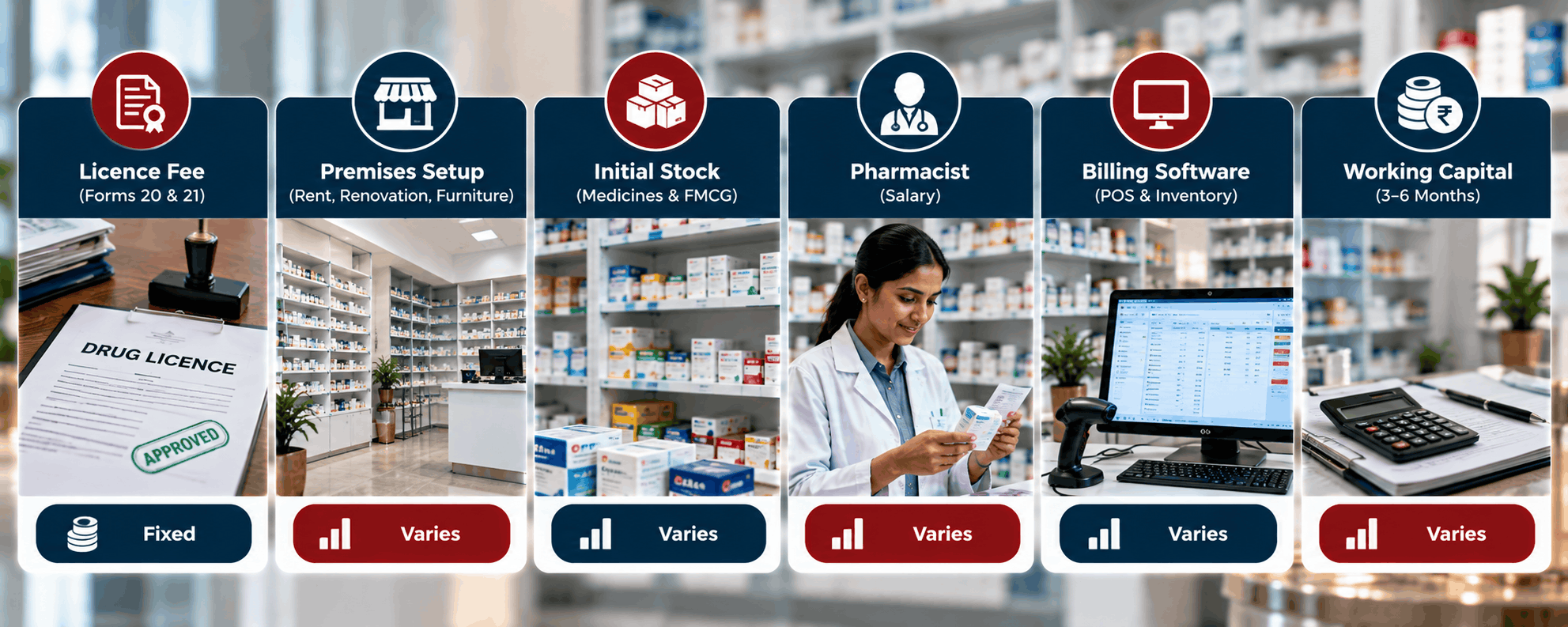
The government fees are small and fixed. The rest depends on your city, shop size and stock range. No honest single number fits everyone.
|
Cost head |
What to expect |
|
Drug licence fee |
₹3,000 for Forms 20 and 21 together. Schedule X adds ₹500. Wholesale forms add ₹1,500 each. |
|
GST registration |
No government fee on the GST portal |
|
Shop registration or trade licence |
Fees vary by state and municipality |
|
Premises |
Rent, deposit and fit-out: racks, counter, refrigerator, lighting and signboard |
|
Opening stock |
Usually your largest single item, and it depends on your range |
|
Pharmacist salary |
A monthly cost from day one |
|
Billing software and registers |
Needed for sale bills and prescription records |
|
Working capital |
Cover rent and salary while the licence is pending |
Ask two or three distributors for stock lists and credit terms before you set your budget. Build the number from the bottom up.
If you need funds, a lender will ask for a project report. Our project report preparation service covers that. You can then compare a business loan, a working capital loan and the Pradhan Mantri MUDRA Yojana loan. Our guide on CGTMSE vs MCGS-MSME helps if you need credit guarantee support.
Does a Drug Licence Need Renewal?
No. A sale licence stays valid as long as you pay a retention fee before the end of every five-year period. The Drugs and Cosmetics (Tenth Amendment) Rules, 2017, notified on 27 October 2017 as G.S.R. 1337(E), made this change. A Mondaq summary of the amendment sets out the details.
-
The retention fee equals the grant fee, excluding any inspection fee.
-
A late fee of 2% of the licence fee applies for each month or part of a month, up to six months.
-
After six months without payment, the licence stands cancelled.
-
Authorities assess compliance at least once in three years, or earlier on a risk basis.
The licence never expires, so nothing prompts you to pay. Put the retention date in your calendar the day you receive the licence.
Which Registrations Does a Pharmacy Need Besides the Drug Licence?
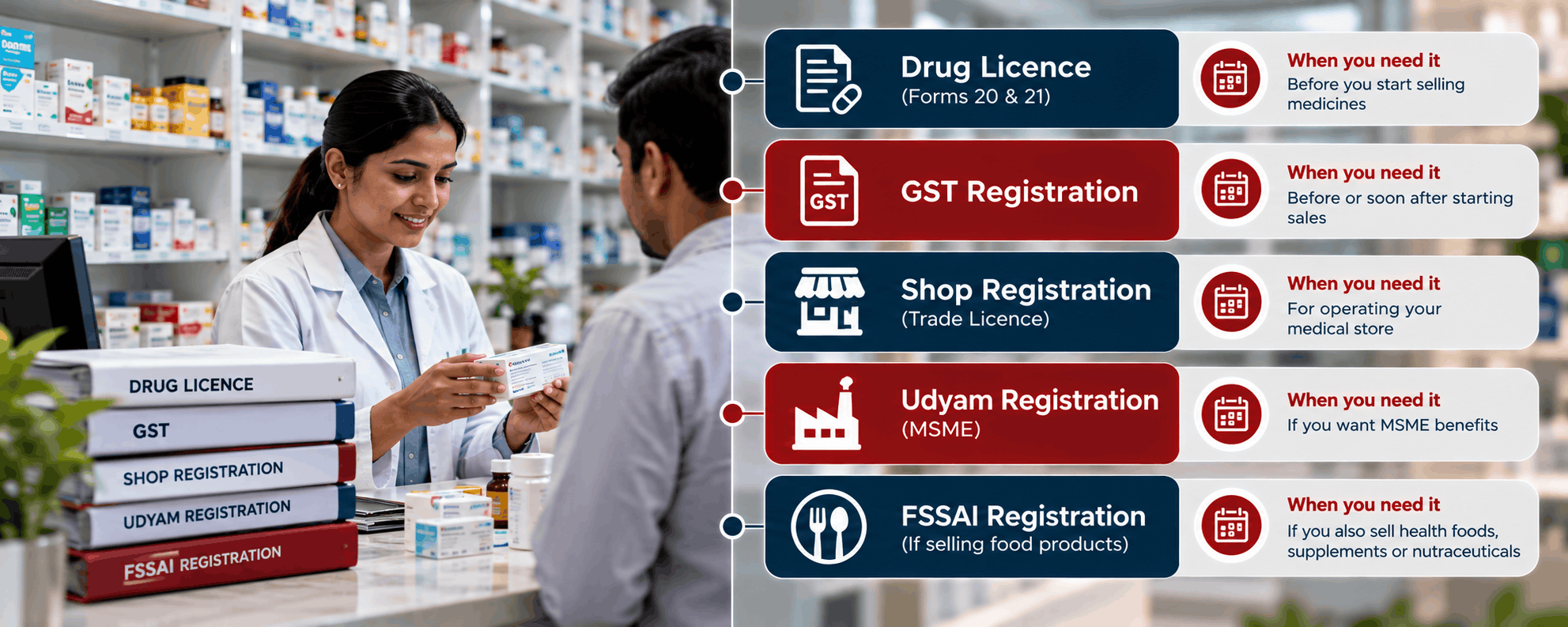
The drug licence is necessary, and it is not enough. Use this checklist.
-
GST registration: Registration is required above the turnover threshold for your state and type of supply. Registering also lets you claim input tax credit on your purchases. From 22 September 2025, GST on all other drugs and medicines fell from 12% to 5%. The Council moved 33 life-saving drugs to nil. Other items you sell, such as supplements or personal care products, can carry different rates. Our GSTIN guide explains the number, and our GST calculator checks your invoices. Registered shops also need regular GST filing.
-
Shop Act licence and trade licence: State and municipal rules decide which ones apply to your shop.
-
Udyam registration: This gives you MSME recognition for lender and scheme purposes. You apply on the Udyam portal.
-
FSSAI registration: You need it if you sell food products, including some health supplements. The FSSAI site explains the categories.
-
NDPS authorisation: Ask your drug control office whether your stock list, such as narcotic drugs, needs extra authorisation.
-
Staff compliance: Once you hire, check PF registration, ESI filing and our labour law compliance service.
A bookkeeper helps from day one. Our accounting services for small businesses keep your records ready for GST and audits.
What Records Must a Pharmacy Keep?
The licence gets you in. The records keep you in. Inspectors open your books first, and Rule 65 of the Drugs Rules lays down your duties. Keep these at a minimum.
-
Purchase bills from licensed suppliers, with the supplier’s licence number on each
-
Sale bills that carry the particulars the Rules prescribe
-
Prescription records for the drugs that need a prescription
-
A separate Schedule H1 register. Rule 65 asks you to keep it for three years.
-
Separate Schedule X records for your Form 20F stock
Buy only from licensed wholesalers and manufacturers. Buying from an unlicensed source breaches your own licence conditions. Our vendor assessment service can vet a supplier before you place a large order.
What Happens If You Sell Medicines Without a Licence?
The penalties are serious. Section 27(b)(ii) of the Drugs and Cosmetics Act, 1940 covers sale without a valid licence. It carries imprisonment of three to five years and a fine of at least ₹1 lakh or three times the value of the drugs confiscated, whichever is more.
A lapsed licence counts as no licence. Inspectors can also inspect your premises, take samples and seize stock. Keep the licence valid and the paperwork current.
Should You Open an Independent Pharmacy or a Jan Aushadhi Kendra?
You can run your own shop or join the Pradhan Mantri Bhartiya Janaushadhi Pariyojana (PMBJP). PMBJP supplies generic medicines through Kendras, and the Pharmaceuticals and Medical Devices Bureau of India (PMBI) runs it.
|
Point |
Independent pharmacy |
Jan Aushadhi Kendra |
|
Drug licence |
You obtain Forms 20 and 21 |
You must obtain a drug licence in the Kendra’s name |
|
Minimum space |
10 square metres |
120 square feet, owned or on a proper lease |
|
Pharmacist |
Registered pharmacist needed |
An individual applicant needs a D.Pharm or B.Pharm, or must employ one |
|
Stock |
Any licensed supplier |
Generic medicines supplied through PMBI, with incentive terms that carry stock conditions |
|
Application |
State drug control portal |
Online application on the Janaushadhi portal, plus your state drug licence |
The scheme’s fees and incentives have changed over time. Read the current PMBJK guidelines before you apply.
A Kendra gives you a ready supplier and a recognised name. An independent shop gives you freedom over brands, pricing and suppliers. Pick the one that fits your capital and your appetite for stock risk.
What Will Legal Babu Do to Help You Start a Pharmacy?
Legal Babu handles the paperwork so you can focus on the shop. Our team will:
-
Review your plan and recommend the right structure and licence forms for your stock list
-
Register your proprietorship, partnership, LLP or company
-
Prepare your documents and file the retail drug licence application
-
Check your pharmacist papers and premises documents against your state’s checklist
-
Follow up with the licensing authority and help you prepare for the inspection
-
Set up GST, Udyam, Shop Act and trade licence registrations
-
Remind you of your retention date and support later compliance
-
Take over GST filing and bookkeeping
-
Prepare your project report and guide you on loans
-
Search, file and protect your shop name, and design your logo
Browse our licence and registration services or our business advisory services. You can also talk to our team for a free consultation.
FAQS
FAQs About Pharmacy Business in India
-
Can I open a medical store if I am not a pharmacist?
Yes. The licence goes to the person or firm that owns the shop. You then appoint a registered pharmacist as your technical person. The pharmacist must supervise the counter whenever the shop is open. You do not need a pharmacy degree yourself, but you do need to find, verify and keep a qualified person.
- Can I buy an existing medical store and keep its licence?
- What if my pharmacist quits or takes leave?
- Can I open a medical shop in my home?
- Can I sell medicines online in India?
- Can I sell cosmetics, supplements and baby products at my pharmacy?
- What are Schedule H, H1 and X drugs?
- How can I check that a supplier is licensed?
- Is a pharmacy business profitable in India?
- Should I trademark my pharmacy’s name?


