Is Neptune Forwarding Membership Right for LCL Forwarders?
- by kapil
- Updated October 5, 2026
- 14 mins read
Neptune Forwarding membership can suit an established Indian LCL forwarder that needs screened overseas partners, lane coverage and a setting for developing reciprocal business. Neptune Cargo Network says its community focuses on sea-freight consolidators and LCL forwarders, while its application requires more than three years in consolidation and at least one direct scheduled consolidation each month. That excludes new or purely co-loading businesses.
This guide examines Neptune membership requirements, published charges, application evidence, payment-security claims and Neptune Forwarding benefits.
Is Neptune Forwarding Membership Right for Your LCL Business?
The short answer is yes for some established LCL forwarders, but not for every logistics company. Neptune Forwarding membership is relevant when your business serves direct clients, handles sea freight regularly and needs partners where it lacks an office.
The business case becomes stronger when:
- Your company already manages recurring LCL traffic rather than occasional enquiries
- The network has active members in the precise ports and trade lanes your customers use
- Your sales and operations teams can respond quickly, exchange enquiries and build reciprocal relationships
It is a weaker fit for a new company, a forwarder without direct monthly consolidation, or a business expecting guaranteed leads. The official Neptune FAQ says enquiries depend heavily on member activity. Neptune Cargo Network membership provides access, not promised cargo or revenue.
Before comparing network names, map the licences and memberships your operation actually needs. An ocean-focused business may need to assess MTO registration requirements separately, while a company building an airline cargo vertical should examine IATA cargo accreditation. Neither credential is replaced by joining an LCL forwarding network.
How Do Neptune Forwarding and Neptune Consol Differ?
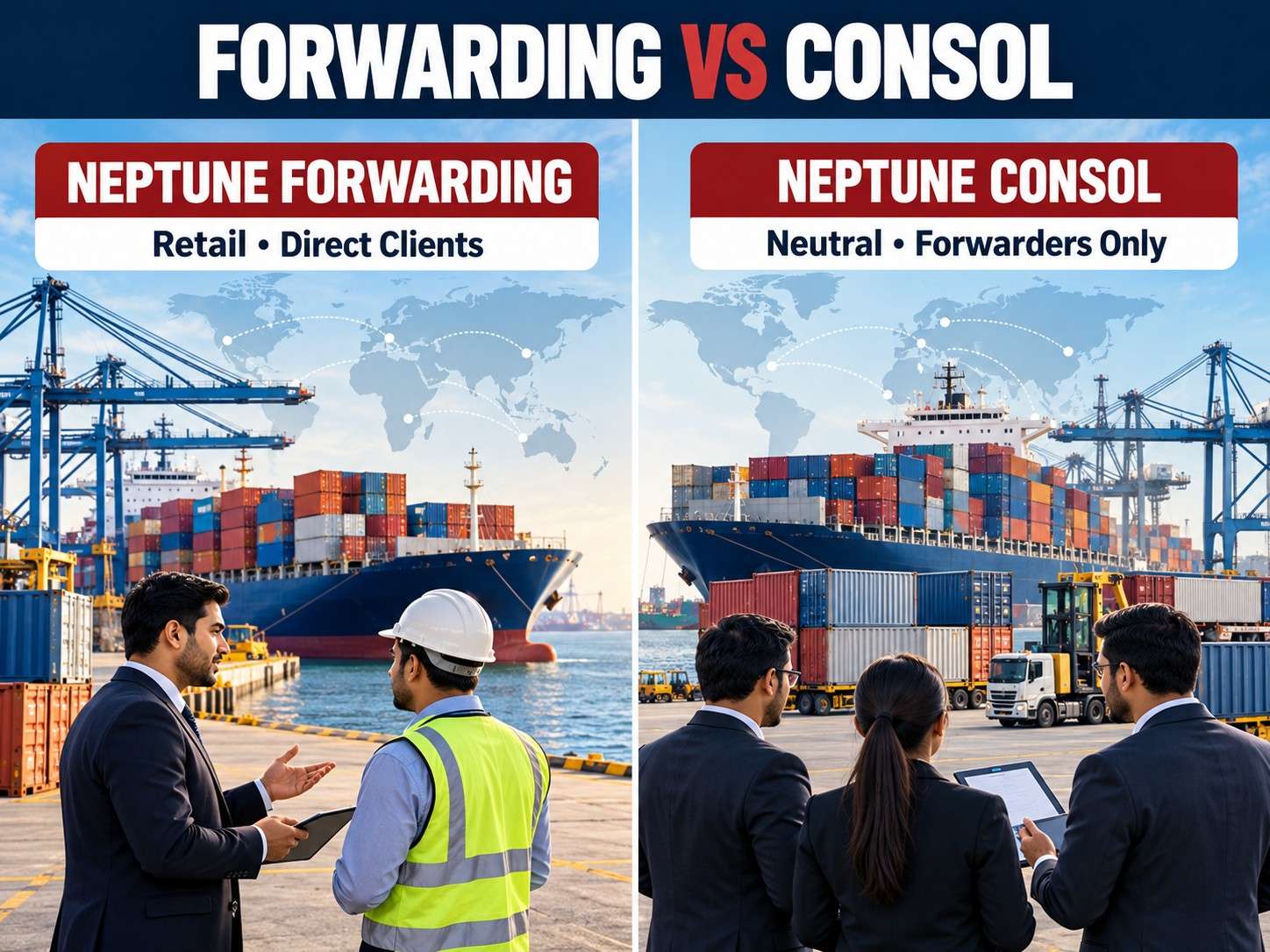
Neptune Cargo Network membership is the umbrella relationship. The organisation places accepted companies into one of two groups according to how they serve the market. An applicant does not need to buy separate membership in both groups.
| Point | Neptune Forwarding | Neptune Consol |
| Commercial position | Retail or non-neutral | Strictly neutral or wholesale |
| Typical customer | Direct shipper or client | Freight forwarder |
| Stated service profile | FCL and LCL sea freight forwarding | Sea-freight consolidation |
| Best fit | Forwarder selling directly to cargo owners | Consolidator serving forwarders exclusively |
This distinction matters during the Neptune Forwarding application. The selected category must align with your website, customer base and references. Direct-client businesses normally fit Neptune Forwarding, while companies serving only forwarders fit Neptune Consol.
Indian applicants should also avoid treating “NVOCC”, “consolidator” and “freight forwarder” as interchangeable labels. If your model involves issuing transport documents or operating as an NVOCC, review the separate NVOCC licensing guide for the Indian compliance context.
Which Neptune Forwarding Benefits Matter Most?
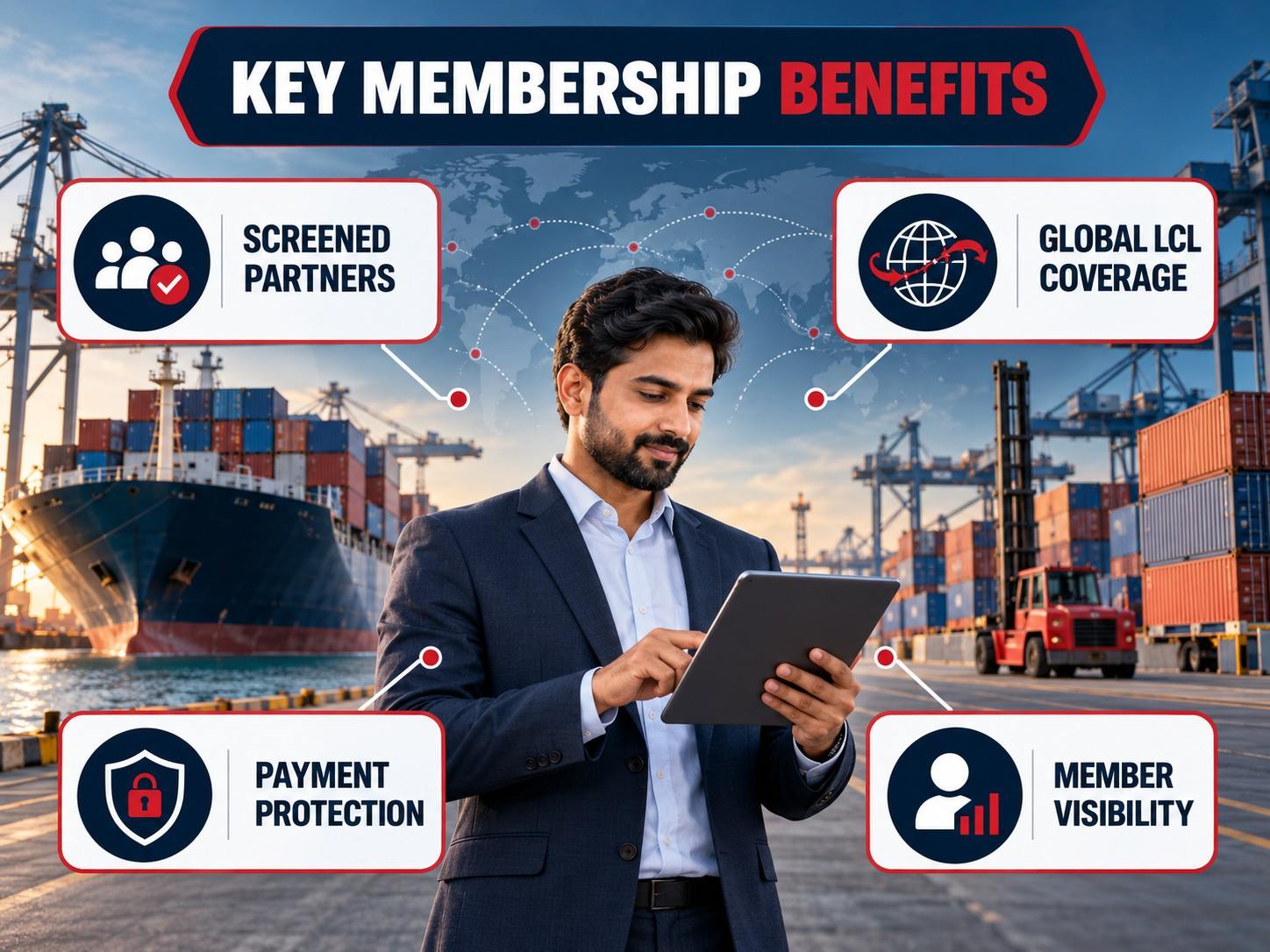
The published Neptune Forwarding benefits centre on screened relationships, network reach, payment-security arrangements, promotion and member communication. Their real value depends on how closely they solve your existing commercial gaps.
Screened overseas contacts
The network says screening considers financial standing, operating history, market reputation and sales strength. It also asks for two long-term agency references. Every forwarder should still apply its own credit and operational checks.
LCL-focused partner coverage
A specialist LCL forwarding network can help when your team needs partners familiar with consolidation, deconsolidation and destination handling. Neptune describes a semi-exclusive model with limited agents per territory. Confirm coverage at port and service level, not merely by country.
Payment-security support
Neptune publishes payment protection and monitoring through member security status. Official pages describe immediate protection at USD 5,000 but conflict on the later limit, showing either USD 10,000 after three years or up to USD 20,000 based on tenure. Request the current policy, exclusions and claim process in writing.
Member visibility and communication
The organisation promotes members through its agency list, announcements, events and member tools. Its FAQ also mentions a mobile app and WhatsApp group. Commercial return still depends on response quality and follow-up.
For comparison, association-based visibility and industry participation serve a different purpose from a private LCL forwarding network. Indian companies considering trade-body connections can separately review ACAAI membership information rather than assuming both options deliver the same benefits.
Read Also: C5C Membership
How Should You Test the Commercial Value Before Joining?
Assess Neptune Forwarding membership against 12 months of lane and enquiry data. Identify business lost because your team lacked a trusted overseas partner, destination handling or local support.
| Decision check | Evidence to review | Positive sign |
| Lane relevance | Top origins, destinations and ports | Active members cover repeated gaps |
| Enquiry potential | Lost and unquoted LCL enquiries | Recoverable margin exceeds membership cost |
| Partner quality | Response time and service capability | Members can meet required service levels |
| Team capacity | Sales follow-up and operations ownership | Named staff can manage network activity |
| Risk control | Credit limits and dispute procedures | Internal controls remain in place |
Do not calculate return from assumed leads. Request the member list, identify lane-fit partners and speak to suitable members before payment. If reliable agents already cover every important lane, value may come mainly from backups, new markets, events or payment-risk support.
What Are the Neptune Membership Requirements?
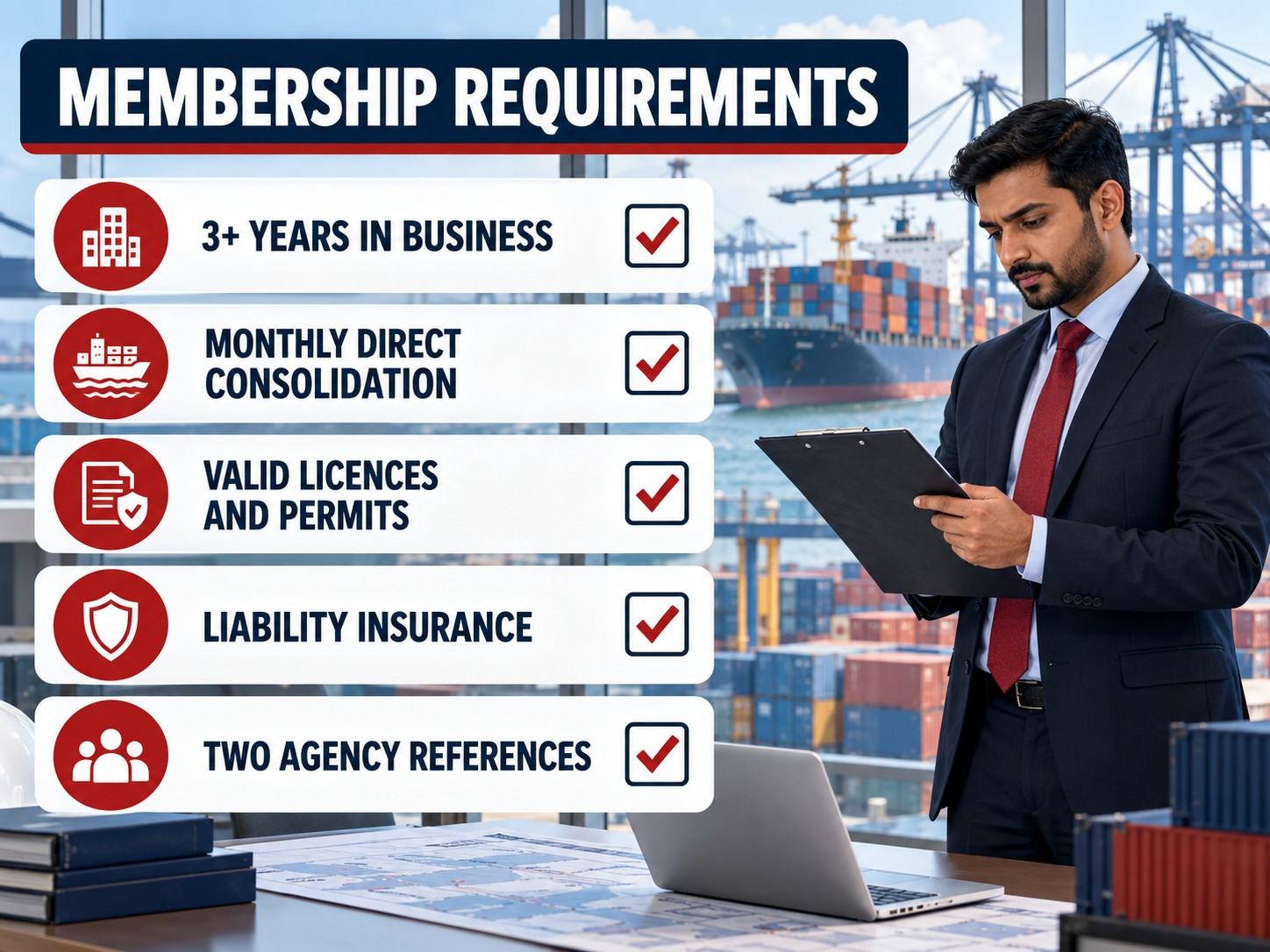
The current official Neptune Forwarding application publishes the core Neptune membership requirements and rate structure. An applicant is expected to confirm that it:
- Has operated in the consolidation business for more than three years
- Runs at least one regular scheduled direct consolidation per month
- Books the shipping-line container rather than merely co-loading
- Wants to develop business with new partners
- Holds the government licences and business permits required for its operations
- Maintains liability insurance
- Can identify itself as either a neutral consolidator or a retail LCL forwarder
These Neptune membership requirements are operational, not merely corporate. A registration certificate alone does not demonstrate direct consolidation activity. Applicants should be prepared to show a consistent relationship between their declared business model, scheduled services, trade lanes, website and reference agents.
For Indian operations, a company offering multimodal transport should examine the relevant registration and locate existing operators through the IndoSearch MTO directory. Where MTO activity applies, the business should also understand MTO insurance essentials independently of any network security programme.
Which Details and Evidence Should an Applicant Prepare?
The official form does not publish a fixed attachment checklist. It asks for company and contact details, establishment year, staff strength and branch locations.
The Neptune Forwarding application asks for two agency referrals from long-term relationships, including name, country, contact and email. Alert both referees and verify their details before submission.
The business-capability section asks for the top five inbound and outbound direct-consolidation lanes. Applicants must provide origin port, destination port and average monthly container volume in TEUs. Prepare these figures from operational records and keep them consistent with the declaration that at least one direct scheduled consolidation is handled each month.
The public form does not list mandatory uploads such as audited accounts, insurance certificates or licence copies. However, because the applicant must confirm licensing and liability coverage and Neptune says screening considers financial standing, keep current supporting records ready if requested. Do not submit expired insurance or describe co-loaded volume as direct consolidation.
Businesses acting in customs clearance or cargo-reporting chains should separately check the scope of a customs broker licence and SCMTR registration process. These Indian permissions remain distinct from Neptune Cargo Network membership.
What Does Neptune Membership Really Cost?
The official online application displayed the following rate structure when verified in October 2026. Neptune states the charges in US dollars, so no invented rupee conversion should be used.
| Payment | When payable | Verified amount or official position |
| Country station fee | Annually for headquarters | USD 1,950 per HQ |
| Branch fee | Annually for each branch | USD 750 per branch |
| Security fee | Annually for each legal entity | USD 500 |
| Bank charge | Per transaction | USD 25 |
| Application fee | One time | USD 200 |
For a one-headquarters applicant with no charged branch, the listed first-year items add up to USD 2,675 before any taxes, conference costs or other contractual charges. This is a calculation from published line items, not an official bundled quotation.
The public rate display does not specify applicable taxes, invoice currency conversion, pro-rata rules, renewal deadlines or whether the one-time application fee is refundable after rejection. It also does not establish that annual conference travel, delegate registration or accommodation is included. Ask for a written quotation showing every payable item, invoice issuer, due date, tax treatment and refund position before authorising payment.
Read Also: IMCA Membership
How Does the Neptune Forwarding Application Work?
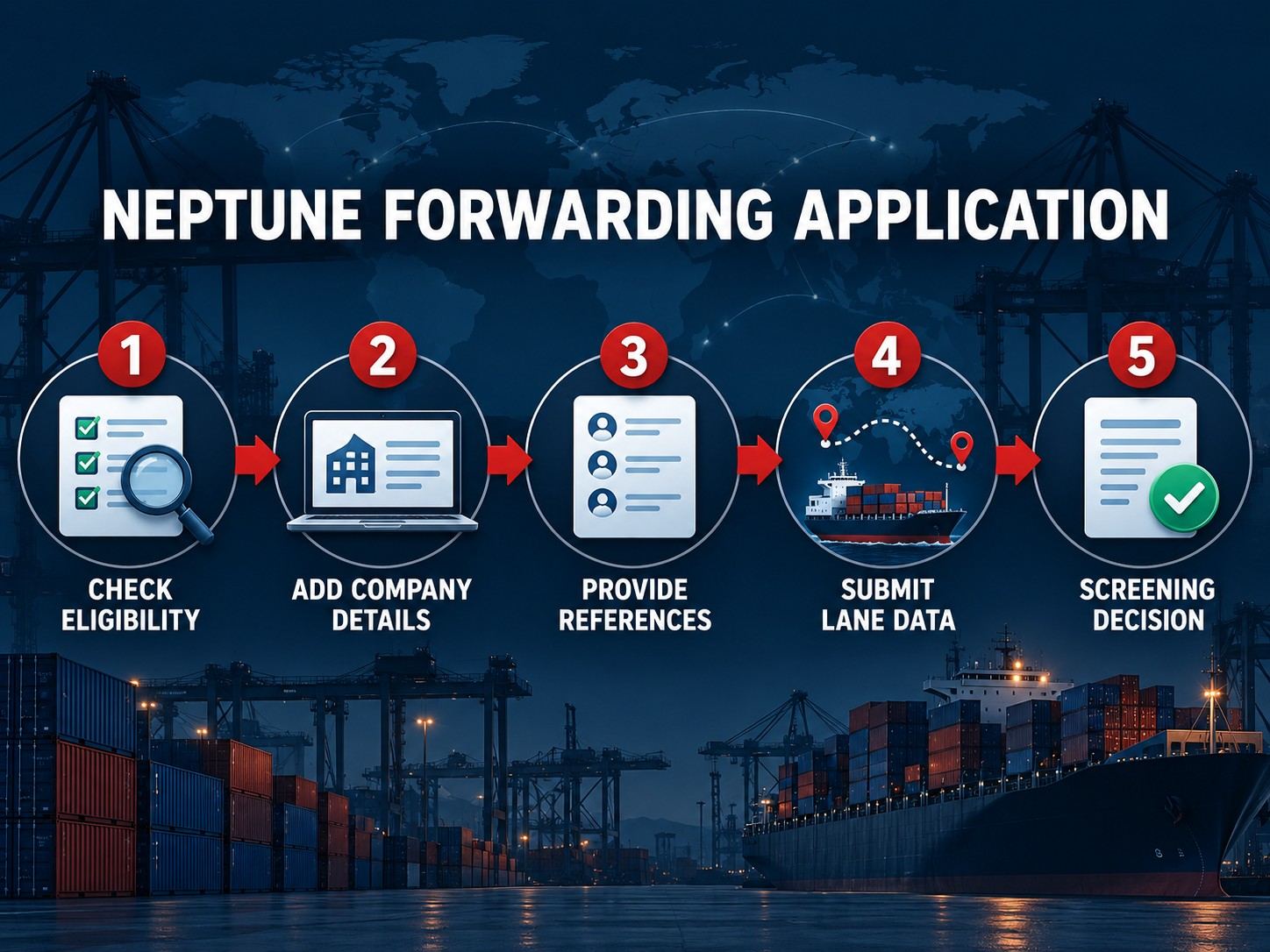
The Neptune Forwarding application follows a short published form followed by screening. The official PDF says applicants will be notified of their application status within one week after submission, but this should be treated as the organisation’s stated notification period, not a guaranteed approval deadline.
Step 1: Check Your Business Model and Eligibility
Confirm that the company exceeds the three-year operating threshold and directly books at least one scheduled consolidation each month. Decide whether the applicant is a retail LCL forwarder or a strictly neutral consolidator. Resolve any mismatch before filing.
Step 2: Assemble Company and Contact Information
Prepare the legal company name, address, website, establishment year, staff count and complete branch details. Nominate both a primary and secondary contact who can respond quickly. The information should match the company’s public and corporate records.
Step 3: Obtain Two Verifiable Agency References
Choose two overseas or agency partners with whom the company has a genuine long-term business relationship. Confirm their contact names and email addresses in advance. A silent or unverifiable reference can interrupt the screening process even when the applicant otherwise appears suitable.
Step 4: Compile Direct-Consolidation Lane Data
List up to five inbound and five outbound lanes with origin port, destination port and average monthly TEUs. Use actual operational data and separate direct consolidations from co-loaded shipments. Inflated or inconsistent figures can undermine the credibility of the Neptune Cargo Network membership request.
Step 5: Submit and Respond to Screening Requests
Complete the form, select the correct neutrality category and provide any further evidence requested by the network. Neptune says screening considers operating history, financial standing, reputation and sales strength. Review the agreement and invoice terms before paying the Neptune Forwarding application and annual charges.
If your Indian business also handles consolidation reporting, the consol agent registration guide can help separate regulatory filing questions from private network onboarding.
What Can Delay or Weaken an Application?
Neptune does not publish a complete rejection-code list. However, its stated Neptune membership requirements and screening fields show where an application can become difficult:
- The company has not completed more than three years in consolidation
- Monthly activity is co-loaded and does not include a directly booked container
- Required operating permissions or liability insurance are missing or expired
- Agency references are outdated, unresponsive or unable to confirm the relationship
- Website claims, legal details and the selected neutrality category do not align
- Operational records cannot support inbound or outbound lane figures
- The relevant territory has already reached the network’s member limit
The official FAQ says the network generally accepts a limited number of agents per country based on geographic or economic size. Meeting the minimum Neptune membership requirements therefore does not guarantee an open position or approval. A careful pre-application discussion can prevent payment or document work for a territory that currently has no capacity.
What Should Indian Forwarders Confirm Before Payment?
Ask the network administrator for written answers that can be reviewed by management, finance and operations. At minimum, confirm:
- The current member list for your target ports and whether those members handle your cargo profile
- The complete first-year and renewal invoice, including branch and security charges
- The current payment-protection wording, claim conditions, exclusions and maximum cover
- Conference attendance expectations and all separately payable event costs
- Renewal notice periods, cancellation grounds, refund rules and treatment of the security fee
- The responsibilities attached to inactivity, payment disputes and code-of-ethics breaches
This also separates network costs from Indian compliance costs. Neptune Forwarding membership is a partnership and business-development expense, not proof that the company holds every permission required for its services.
How Do Renewal, Cancellation and Refunds Work?
The published rate schedule describes the headquarters, branch and security fees as annual, which indicates recurring payment obligations. The official pages also say there is no free trial, although one-time observer access may be available for annual events and free access may be offered for virtual meetings.
Detailed public terms for the membership year, automatic renewal, cancellation notice, ordinary refund entitlement and security-fee return were not found on the current public membership pages. Do not infer these points from conference-registration terms, because event bookings and membership are separate contracts. Obtain the membership agreement and invoice terms before payment, then record the renewal date and internal owner.
The organisation also links continued participation with activity and attendance. Its benefits page states that yearly meetings have to be attended and that an inactive company may be considered disqualified. Ask what attendance standard currently applies, whether virtual participation counts and what notice or appeal process is available.
Read Also: GLA Membership
Conclusion
Neptune Forwarding membership is a credible option for an established retail LCL forwarder whose recurring lanes match the network’s active coverage. The published Neptune membership requirements favour experienced businesses with direct monthly consolidation, valid permissions, liability insurance and references that can be checked.
The Neptune Forwarding benefits are potentially valuable, but they do not guarantee enquiries and should not replace internal credit control or Indian operating registrations. Before submitting a Neptune Forwarding application, verify the member fit at port level, obtain the complete fee quotation and read the payment-protection, renewal, attendance, cancellation and refund terms. Join only when your team has a clear plan to convert access into sustained partner activity.
FAQs About Neptune Forwarding membership
Can a company join Neptune if it already belongs to another freight network?
Yes. Neptune’s official FAQ says companies may be accepted even when they are members of other networks. Before adding another LCL forwarding network, compare overlapping countries, annual costs and the time your team can realistically devote to each community.
Can a freight forwarder try the network before paying for membership?
Neptune says it does not provide a free membership or trial period. Its FAQ instead mentions one-time observer passes for annual events and free access to virtual meetings. Confirm the availability, access limits and current conditions of either option directly with the administrator.
Does one headquarters fee cover every branch office?
No such blanket coverage is shown in the published rate schedule. It lists USD 1,950 annually per headquarters and USD 750 annually per branch. Give Neptune the exact legal-entity and branch structure and request an itemised quotation before paying.
What if an agency reference does not answer Neptune’s verification request?
The application does not publish an automatic rejection rule for an unresponsive reference. Because two long-term agency contacts form part of screening, silence can reasonably delay verification or trigger a request for another contact. Notify each referee first and keep an alternative genuine reference ready.
Does Neptune payment protection guarantee settlement of every member invoice?
The public pages describe payment protection and monitoring, but they do not publish all claim conditions, exclusions or supporting documents. They also show inconsistent figures for later-stage protection limits. Request the current policy wording and never treat network cover as a substitute for credit limits, written terms and shipment documentation.
Can a company younger than three years submit a Neptune Forwarding application?
The published qualification policy requires more than three years in the consolidation business. The public form does not disclose a startup waiver or provisional membership route. A younger business should ask the network whether it can attend an observer event and apply after meeting the stated operating-history threshold.
Does occasional co-loading satisfy the monthly consolidation condition?
No. The stated criterion requires at least one regular scheduled direct consolidation per month in which the applicant books the shipping-line container, rather than co-loading. Keep service schedules and operational records available to support that declaration if screening asks for evidence.
Can an eligible applicant be refused because its territory is full?
Yes, this is possible under the network’s published semi-exclusive model. Neptune says it limits agents by territory and generally accepts a country-level range based on geographic or economic size. Ask about availability for the relevant Indian location before investing substantial time in the application.
How quickly does Neptune decide an application?
The official PDF says the applicant will be notified of application status within one week after submission. That wording concerns status notification and should not be read as an unconditional approval guarantee. Missing references, clarification requests or territory availability may affect the practical timeline.
What happens if a member wants to cancel and request a refund?
The current public membership pages do not set out a complete ordinary cancellation and refund policy. Conference terms should not be assumed to govern the separate membership contract. Obtain written terms covering notice, annual fees, the security fee, termination grounds and any refund before payment.
You may also like


Can PAIMA Membership Expand Your Global Moving Network?
PAIMA membership can help an established Indian moving company build relationsh