Top 20+ Registrations Required for a Logistics Business in India
- by kapil
- Updated September 19, 2026
- 16 mins read
Registrations for a logistics business can feel endless because the list grows with each service added. A trucking firm, a freight forwarder, an NVOCC and a warehouse operator rarely need the same papers, and applying in the wrong order is the most common reason applications bounce. This guide groups every important Indian registration by category, from company incorporation, GST and labour filings to transport permits, MTO registration, SCMTR roles on ICEGATE, IATA accreditation and food transport licences.
For each item, you get the issuing authority, the verified fee position, the validity period and the practical mistakes that trigger queries or rejection. One limitation matters before you begin. No single licence covers a logistics company for every activity, and holding one approval never replaces another. Your total number of registrations changes with fleet size, cargo mix, and trade lanes. That is why this guide avoids a fixed top-ten list and gives you category tables, fee positions and an application sequence you can adapt across road, sea and air.
Registrations for a Logistics Business at a Glance
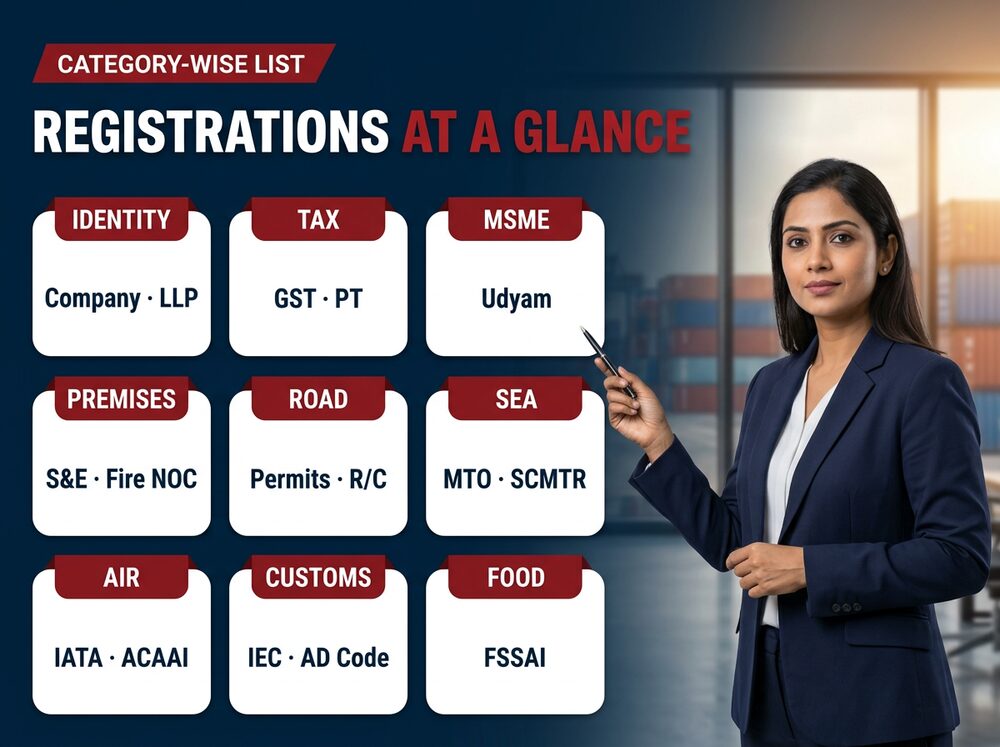
Sort approvals by what triggers them. Legal identity comes first, followed by people and vehicles, and trade-specific approvals arrive only when your model demands them.
| Category | Registrations and approvals | Issuing authority |
| Business identity | Company or LLP incorporation, PAN and TAN | Ministry of Corporate Affairs |
| Tax | GST registration, professional tax where levied | GST portal, state governments |
| MSME | Udyam registration | Ministry of MSME |
| Premises and people | Shops and Establishments, trade licence, fire NOC, EPF, ESI, contract labour approvals | State labour departments, municipal bodies, EPFO, ESIC |
| Road transport | Commercial registration, fitness certificate, state or National Permit, common carrier registration | RTOs and state transport authorities |
| Sea and multimodal | MTO registration, SCMTR roles on ICEGATE, ship chandler licences, chartering permission | DGMA Shipping, Customs, port authorities |
| Air cargo | IATA cargo agency accreditation, ACAAI membership | IATA, ACAAI |
| Customs and trade | Import Export Code, AD Code, Customs Broker licence, AEO status | DGFT, banks and Customs, CBIC |
| Food cargo | FSSAI registration or licence | FSSAI through FoSCoS |
Business Identity and Tax Registrations
Company or LLP Incorporation
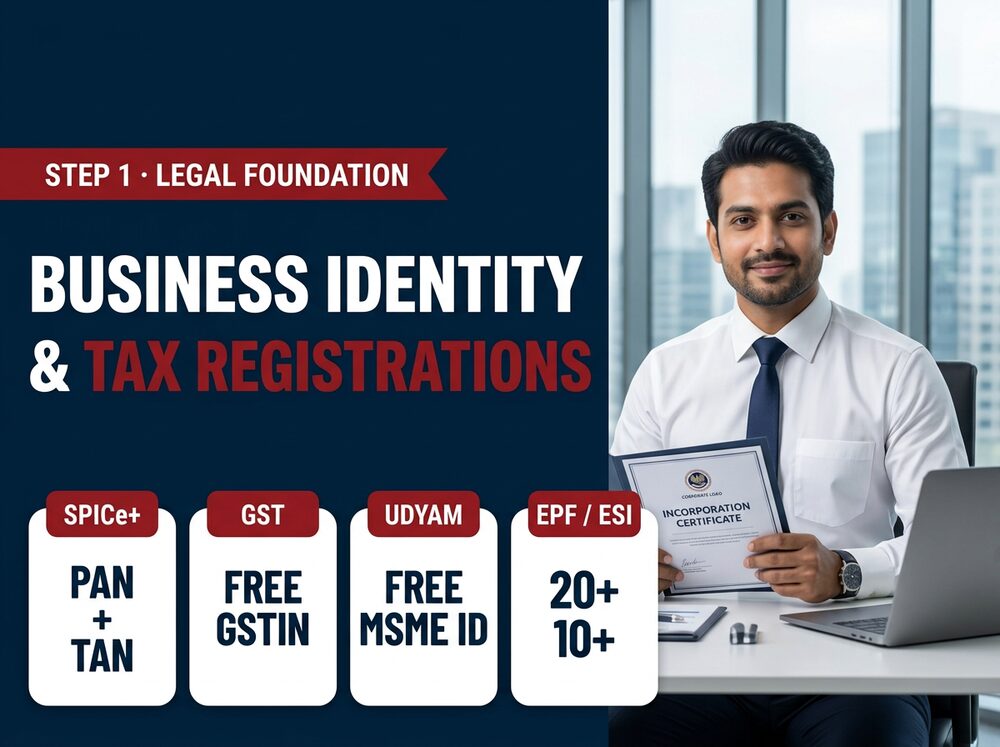
Freight forwarders, 3PL operators and NVOCCs overwhelmingly choose the private limited company because multinational clients expect a corporate counterparty. Incorporation is filed through the MCA’s SPICe+ form, which also allots PAN and TAN, and the linked AGILE-PRO-S form carries applications for GSTIN, EPFO, ESIC, a bank account and, in several states, professional tax and Shops and Establishments registration. The fee varies with authorised capital and state stamp duty, so confirm it on the MCA portal at filing.
GST Registration for Transporters
GST registration turns compulsory once aggregate turnover crosses ₹40 lakh for goods or ₹20 lakh for services, with the lower ₹10 lakh figure in special category states. Most logistics firms register earlier because corporate clients insist on a GSTIN, and inter-state service supplies trigger registration regardless of turnover. Freight paid to an unregistered GTA attracts tax under reverse charge, changing your invoicing posture. Registration is free, and our GST registration process walkthrough covers documents and timelines.
Udyam, Shops and Establishments and Trade Licence
Three low-cost registrations protect your offices and warehouses. Udyam registration is free on the official portal, based on self-declaration with Aadhaar and PAN, and unlocks priority sector lending plus delayed payment protection for MSMEs, as our Udyam registration guide explains.
Shops and Establishments registration with the state labour department is due within 30 days of commencing operations in most states and governs working hours, leave and holidays. The municipal trade licence authorises the business activity itself at each premises, with fees and renewals set city by city.
EPF, ESI and the 2025 Labour Codes
EPF applies at 20 or more employees, and ESI at 10 or more employees earning up to ₹21,000 per month, with loaders, drivers and warehouse staff all counted. From 21 November 2025, four consolidated Labour Codes replaced 29 older laws, moving the contract-labour trigger from 20 to 50 contractor workers, with a single registration and annual return rolling out as state rules are notified.
The new uniform wage definition, which caps allowances at 50% of remuneration, widens the PF and ESI contribution base. Both registrations are free, but late registration attracts backdated contributions with interest and damages.
Road Transport and Fleet Registrations
Vehicle Registration, Fitness and National Permit
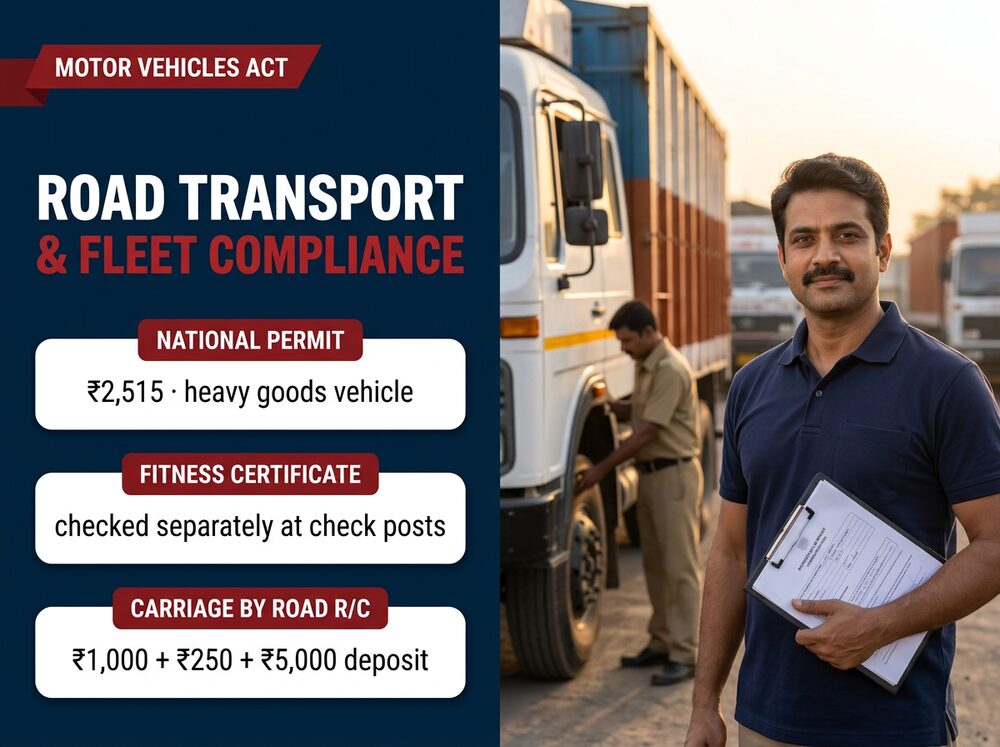
Every goods carriage needs commercial registration, a fitness certificate and a permit under the Motor Vehicles Act. A state permit covers operations within that state, while a National Permit lets a goods vehicle run across India on payment of the prescribed fee, with a minimum of three states authorised at issue.
As per the official Parivahan portal, the National Permit fee for a heavy goods vehicle is ₹2,515, paid online through VAHAN along with state authorisation charges. An expired fitness certificate grounds a truck even when the permit is valid.
Common Carrier Registration under the Carriage by Road Act
Permits alone do not cover the business of carrying goods for hire. The Carriage by Road Act, 2007 requires any common carrier, covering transporters, booking companies, contractors and door-to-door operators, to hold a certificate of registration from the state transport authority. The application goes to the registering authority for the main office with a fee of ₹1,000 plus ₹250 processing and an interest-free security deposit of ₹5,000.
The 2011 Rules ask for registration papers of two commercial vehicles or a work order from a registered company, plus a minimum net worth of ₹5 lakh, rising to ₹20 lakh for higher-risk consignments. The certificate lasts ten years, and registered carriers must issue goods receipts and file quarterly summaries.
Sea, Multimodal and Vessel Registrations
MTO Registration
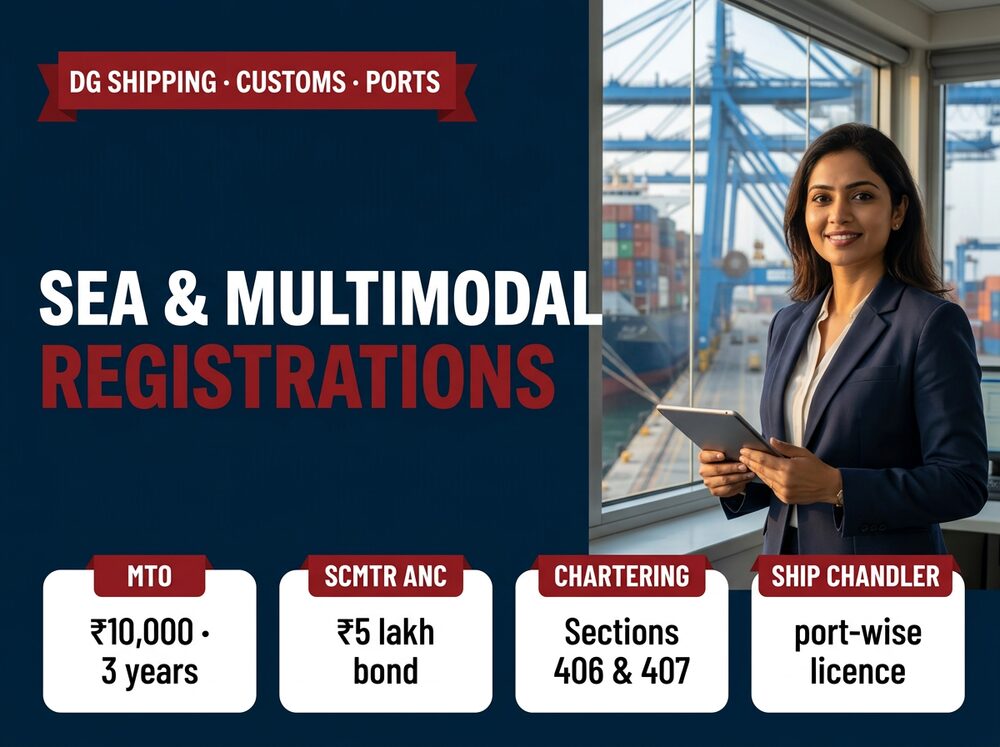
Issuing your own multimodal transport document for cargo moving by two or more modes under one contract makes you a Multimodal Transport Operator under the 1993 Act. The fee is ₹10,000, the certificate is valid for three years with the same renewal fee, and financial eligibility requires ₹50 lakh annual turnover or subscribed and paid-up share capital, agents in at least two foreign countries, and mandatory statutory liability insurance.
Applications go online through DGMA Shipping, our MTO registration service details the eligibility breakdown, and our MTO insurance essentials note explains compliant cover. Before signing contracts, verify partner licences through the registered MTO directory, which lists active, suspended and cancelled certificates.
NVOCC Status and SCMTR Roles on ICEGATE
India does not issue a standalone certificate called an NVOCC licence. Each contract type triggers a different approval, as our NVOCC licence explainer maps out. The current layer is SCMTR, under which every sea-cargo stakeholder registers its role electronically in Form I through ICEGATE, with the jurisdictional Commissioner of Customs approving.
A consol agent, freight forwarder, NVOCC or customs broker maps to the Authorised Notified Carrier role, identified as ANC, which files house-level cargo data as a Cargo Summary Notification for the next consolidator or vessel operator. ANC applicants furnish a ₹5 lakh bond and security, and registration at one customs station is deemed valid at others.
CBIC Circular 38/2026-Customs makes SCMTR operational port by port between 1 September and 15 October 2026, with 31 October 2026 as the transitional date. Consol agents also file the Consol General Manifest for consolidated shipments, and the official ICEGATE CGM webform guidelines walk through the master details, house details and voyage data each filing needs.
Chartering Foreign-Flagged Vessels
Chartering a foreign-flagged vessel for Indian trade needs permission from DGMA Shipping under Sections 406 and 407 of the Merchant Shipping Act, 1958. Indian citizens, companies and cooperative societies apply under Section 406, while foreign entities wanting to carry coastal trade apply under Section 407.
The process runs on the eSamudra portal, with fees varying by licence type and duration paid through Bharatkosh, and contracts of affreightment approved up to three years. Our chartering licence guide covers the licence types and documents in detail.
Ship Chandler Licences at Indian Ports
Supplying vessels with provisions, stores and spares is licensed port by port, because India issues no single national ship chandler licence. V.O. Chidambaranar Port publishes dedicated applications, Visakhapatnam Port requires an Appendix-F filing to the Traffic Manager with one-year validity, and Mormugao Port registers business partners separately. A port licence also does not replace Customs clearances, an FSSAI licence where provisions are supplied, or the passes needed for people and vehicles inside controlled areas.
Air Cargo Registrations
IATA Cargo Agency Accreditation
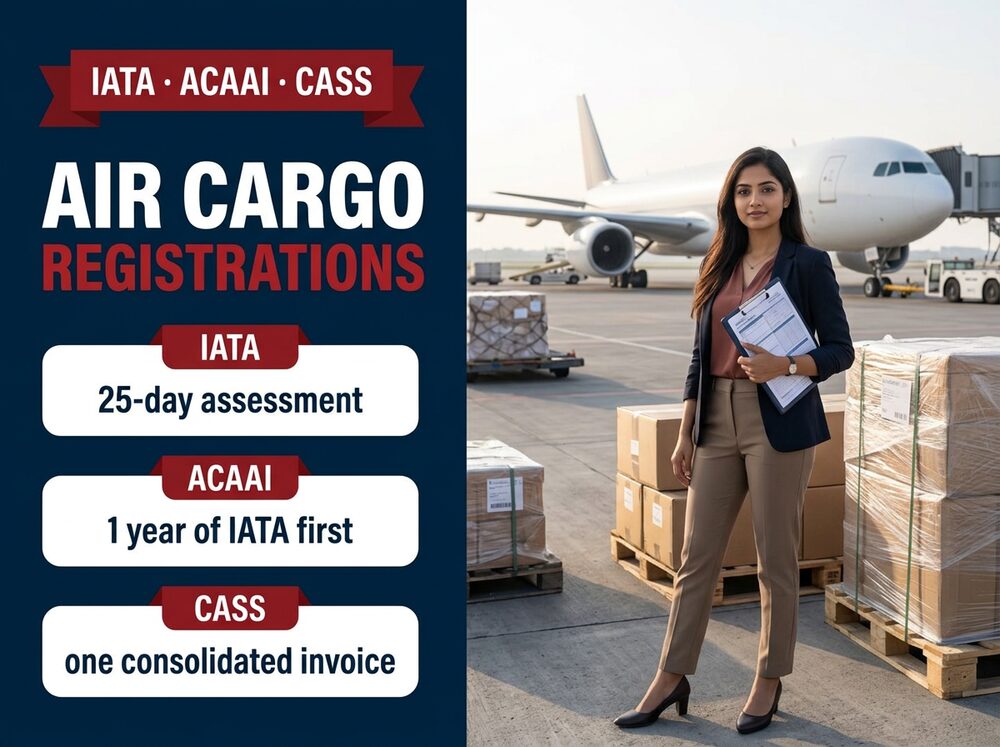
IATA accreditation is the industry gateway for forwarders that want to deal directly with airlines on air cargo. An accredited agency accesses the Cargo Account Settlement System and receives one consolidated invoice from participating airlines.
IATA states that the assessment takes about 25 days and recognises financial soundness and trained staff, but it does not publish a public fee figure for Indian applicants, so confirm current charges with IATA in writing. Our IATA cargo agency registration page lists the financial criteria and documents Indian applicants prepare.
ACAAI Membership
The Air Cargo Agents Association of India, founded in 1970 with more than 600 members, is the national trade body for the air cargo sector, and membership is separate from accreditation. Active membership requires an IATA cargo agency registration held for at least one year from the approval date, plus a proposer who is an active member and a seconder from active or associate membership. Associate and commercial categories cover branches and other organisations, as our ACAAI membership guide explains.
Customs and Import-Export Registrations
Import Export Code
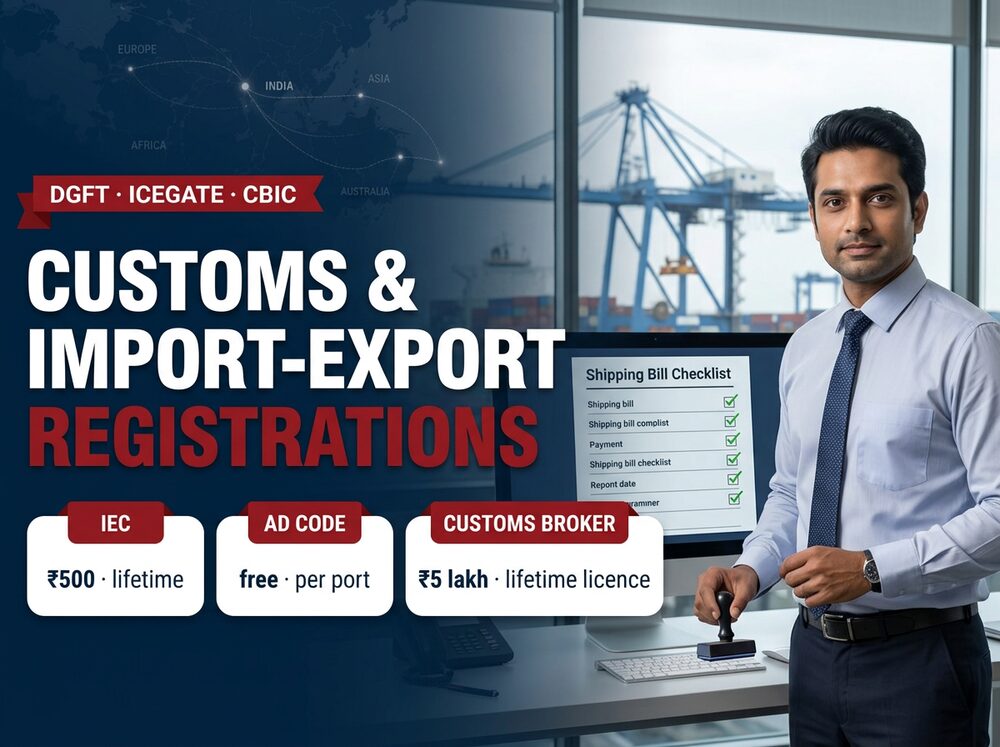
Any logistics business that imports or exports in its own name, clears shipments or receives foreign currency for freight services needs a 10-digit Import Export Code from DGFT. The application is fully online with a government fee of ₹500, the code carries lifetime validity, and one code covers all branches.
Holders must update their particulars electronically every year between April and June, and codes missing the window are deactivated until the update is completed. Our IEC code registration page lists documents and common errors.
AD Code and Port Filings
The 14-digit Authorised Dealer Code issued by your bank must be registered with Indian Customs at every port, airport or ICD from which your goods move, and on ICEGATE for e-filing. Without a registered AD Code, shipping bills are not generated, and exporters routinely lose vessel bookings to this avoidable step. Registration is done once per port through the bank, usually free apart from nominal charges.
Customs Broker Licence
Clearing goods through customs in your own name requires a Customs Broker licence under the Customs Brokers Licensing Regulations, 2018, granted by CBIC. Eligibility needs a professional qualification such as CA, CS, MBA or LLM, or two years of G-card experience, followed by NACIN’s written and oral exams. A ₹5 lakh security deposit accompanies the licence, and since Notification 62/2021-Customs it is valid for life.
Premises, Food Cargo and Voluntary Credentials
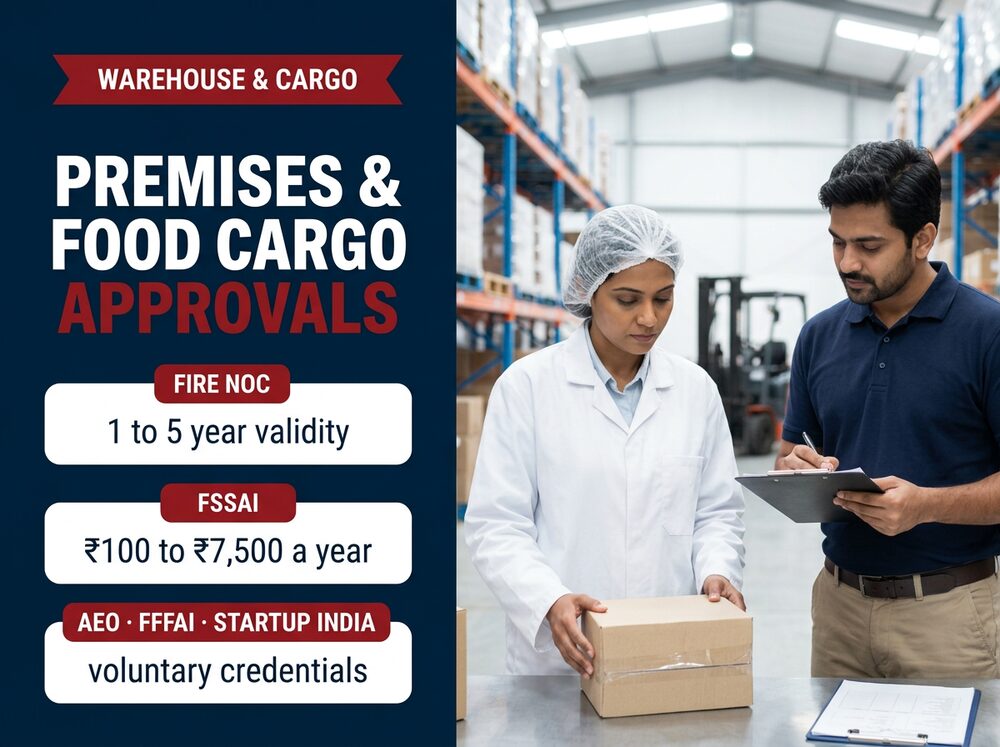
Warehouse premises carry their own approval layer. A fire safety NOC from the state fire services is based on firefighting equipment, exits and storage layout, and several states make it a precondition for the warehouse licence itself, with validity running from one to five years. Food logistics makes you a food business operator under the Food Safety and Standards Act, 2006, even when you only transport sealed packaged goods.
Basic registration costs ₹100 per year, the State Licence runs from ₹2,000 to ₹5,000 depending on category, and the Central Licence costs ₹7,500 per year, with the slab decided by turnover and the scale of transport operations. Our FSSAI licence guide helps identify the right category. Three voluntary credentials round out the stack. AEO status under Indian Customs rewards compliant operators with faster clearance and deferred payment, covered in our AEO registration guide.
Freight forwarders also join FFFAI membership for federation recognition and training access. DPIIT Startup India recognition is free, and companies incorporated before 1 April 2030 can still target the Section 80-IAC tax holiday.
Current Fee Position at a Glance
| Payment | When Payable | Verified Amount or Official Position |
| Company incorporation | At filing | Varies with authorised capital and state stamp duty |
| GST registration | At filing | Free on the GST portal |
| Udyam registration | At filing | Free, self-declaration |
| Shops and Establishments | Within 30 days of commencing | State-specific fee and validity |
| Trade licence | Before operations | Varies by municipal body |
| EPF and ESI | At 20 and 10 employees | Free on the respective portals |
| National Permit | Grant and renewal | ₹2,515 for heavy goods vehicles plus state authorisation charges |
| Common carrier registration | Application | ₹1,000 plus ₹250 processing plus ₹5,000 security deposit |
| MTO registration | Application and renewal | ₹10,000, valid three years |
| SCMTR registration | Before port go-live | ₹5 lakh bond and security for ANC applicants |
| Ship chandler licence | Application and renewal | Port-specific, published by each port |
| Chartering permission | Per application | Varies by licence type and duration, paid through Bharatkosh |
| Import Export Code | Application | ₹500, lifetime validity |
| AD Code registration | Before first shipment | Free through your bank, nominal charges possible |
| Customs Broker licence | Application | ₹5 lakh security deposit plus exam process |
| IATA accreditation | Application | ₹1,20,000 approx. (cargo agency) |
| FSSAI | Annually | ₹100 basic, ₹2,000 to ₹5,000 state, ₹7,500 central |
| FFFAI membership | Annual | Associate ₹2,950 head office including GST, Allied per official schedule |
| FIATA, WCA and WFN memberships | Application | Not publicly disclosed, confirm with each association |
How to Sequence Your Applications
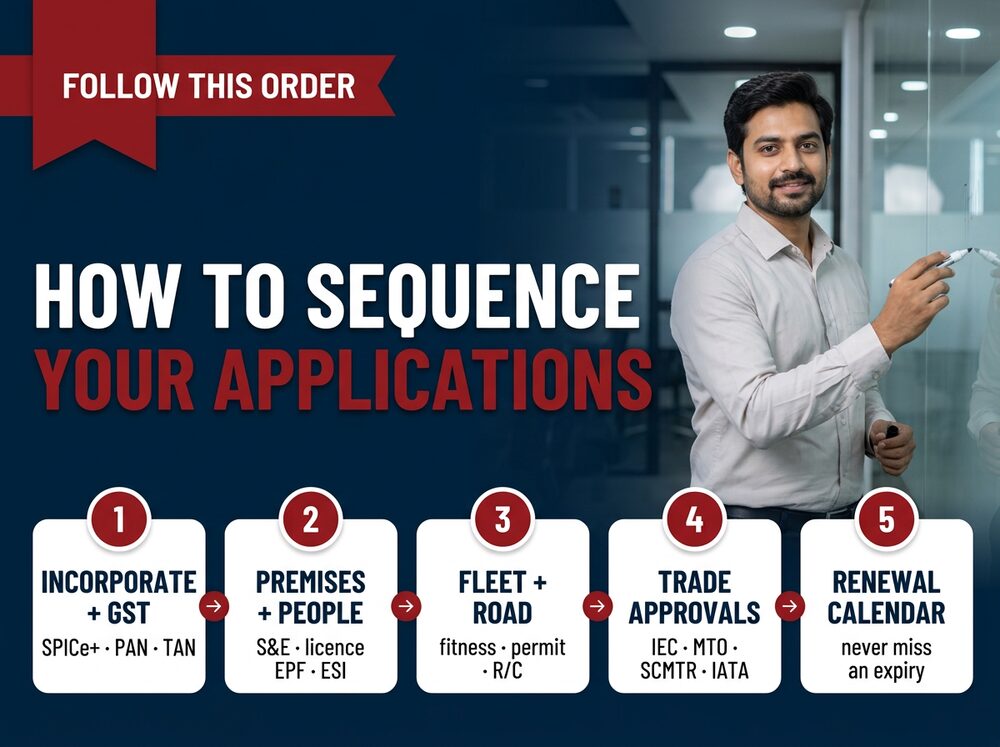
Step 1: Incorporate and Create Your Tax Identity
File SPICe+ with PAN and TAN, then apply for GSTIN through AGILE-PRO-S or the GST portal. Banks, clients and port communities ask for these two identities before anything else.
Step 2: Register Premises and People
Add Shops and Establishments, the trade licence and Udyam for each premises, then register for EPF and ESI as headcounts approach the thresholds. Inspectors and vendor auditors check them before your first big contract.
Step 3: Add Fleet and Road Compliance
Cover every goods vehicle with commercial registration, fitness certification and the right permit, then complete common carrier registration for the carry-for-hire business itself. Road failures surface physically at check posts, so this layer protects revenue directly.
Step 4: Layer Trade-Specific Approvals
Apply for IEC and AD Code registration the moment cross-border work is real, then add MTO registration, SCMTR roles, IATA accreditation or chartering permissions as your service mix demands. A forwarder consolidating an LCL consignment needs the SCMTR role before the shipment, not after.
Step 5: Build the Renewal Calendar
Diarise permit and fitness renewals, MTO renewal before expiry, the annual IEC updation between April and June, and FSSAI returns. Most penalties in logistics come from lapses, not rejections.
Conclusion
The right registrations for a logistics business are not a fixed list of ten, they are the exact stack your model triggers across identity, people, vehicles, sea, air, customs and premises. Work through the categories in sequence, verify each fee on the official portal when applying, and treat approvals as distinct. Do that, and compliance becomes an asset that clients, banks and port authorities recognise the moment your papers reach their desk.
FAQs About Registrations for a Logistics Business
Which registrations for a logistics business are the bare minimum to start with one truck?
At the minimum, incorporate or register your firm, obtain GST and PAN-based tax identity, and cover the vehicle with commercial registration, a fitness certificate and a state permit. Add Udyam and Shops and Establishments registration as you take premises and hire staff. A National Permit and common carrier registration become necessary once you cross state borders regularly or carry goods for hire under a booking arrangement.
Is SCMTR registration required for freight forwarders that own no vessels?
Yes, vessel ownership is not the test. The Sea Cargo Manifest and Transhipment Regulations apply to stakeholders in the cargo chain, and a consol agent, freight forwarder, NVOCC or customs broker maps to the Authorised Notified Carrier role for house-level cargo filings. Registration is granted by the jurisdictional Commissioner of Customs in Form I through ICEGATE. With the 2026 port-by-port rollout, forwarders consolidating sea cargo should register before their port’s operational date.
How do I reactivate a deactivated IEC?
Log in to the DGFT portal and complete the pending annual updation online, because deactivation is lifted once the update is filed. There is no fresh fee for the updation itself beyond the standard application process on the portal. Banks and customs systems take a short while to reflect the active status, so clear the updation well before closing any shipment or remittance.
Can a proprietorship firm obtain a customs broker licence?
The regulations contemplate companies, firms and individuals, so a proprietorship is not barred by entity type. Every applicant still needs the prescribed professional qualification or two years of G-card experience, the NACIN written and oral examinations, and the ₹5 lakh security deposit. Many proprietors incorporate a company first because banks, insurers and large importers prefer contracting with a corporate broker.
Does a pure freight forwarder need MTO registration?
Only if the forwarder accepts responsibility for cargo moving by at least two modes under a single multimodal transport contract issued in its own name. A forwarder that only arranges bookings between the shipper and carriers acts as an agent and does not require MTO registration for that work. The distinction matters because MTO status brings the ₹50 lakh financial test, statutory insurance and foreign agent requirements, so assess the contracts you actually sign before applying.
What happens when a consol agent files the cargo summary after the cut-off?
Late or unaccepted filings break the cargo linkage that vessel operators rely on to build the master manifest, which can hold the container off the vessel or trigger customs queries at the port. The consol agent must retain acknowledgements and pass the accepted cargo reference to the next party in the chain. During the 2026 implementation window CBIC has directed no penal action, but incomplete cargo data is still not accepted, so cut-off discipline remains essential.
Are freight forwarding network memberships such as WFN worth paying for?
Network memberships buy partner discovery, payment protection frameworks and conference access rather than any legal authority, and none of them replaces a registration. They suit forwarders that live on inter-agent business and need overseas correspondents quickly. Before paying, check the membership fee on the organisation’s official page, read the payment protection rules and verify how many active members exist in your target trade lanes.
How do I renew a ship chandler licence and why do applications get refused?
Renewal follows the fresh application route of the specific port, usually filed before expiry with the licence fee, premises proof, security clearances and activity records. Refusals typically follow incomplete documents, mismatched entity names across registrations, unpaid port dues or lapsed supporting approvals such as the FSSAI licence for provisions. Because licences are port-specific and often valid for one year, maintain a renewal tracker for every port you serve.
Did the 2025 labour codes change EPF and ESI thresholds for transporters?
The headcount thresholds survived the reform, so EPF still applies at 20 employees and ESI at 10 employees earning up to ₹21,000 per month. The contract-labour trigger moved from 20 to 50 contractor workers, and establishments are moving toward a single registration and a single annual return as state rules are notified. The uniform wage definition, which caps allowances at 50 percent of remuneration, is the change most likely to raise contributions, so review salary structures rather than thresholds.
What is the difference between CASS and a direct airline agreement?
CASS is IATA’s Cargo Account Settlement System, under which participating airlines send one consolidated invoice through IATA and the accredited agency settles centrally each period. A direct agreement is a bilateral commercial arrangement with an individual airline outside that settlement framework, each with its own credit terms and reporting. Accreditation is what opens CASS access, which is why most serious air forwarders complete the IATA assessment before negotiating airline deals.
You may also like
Top 12 IACS Member Classification Societies (ROs)
IACS classification societies are the 12 organizations, ABS, BV, CCS, CRS, DNV,