
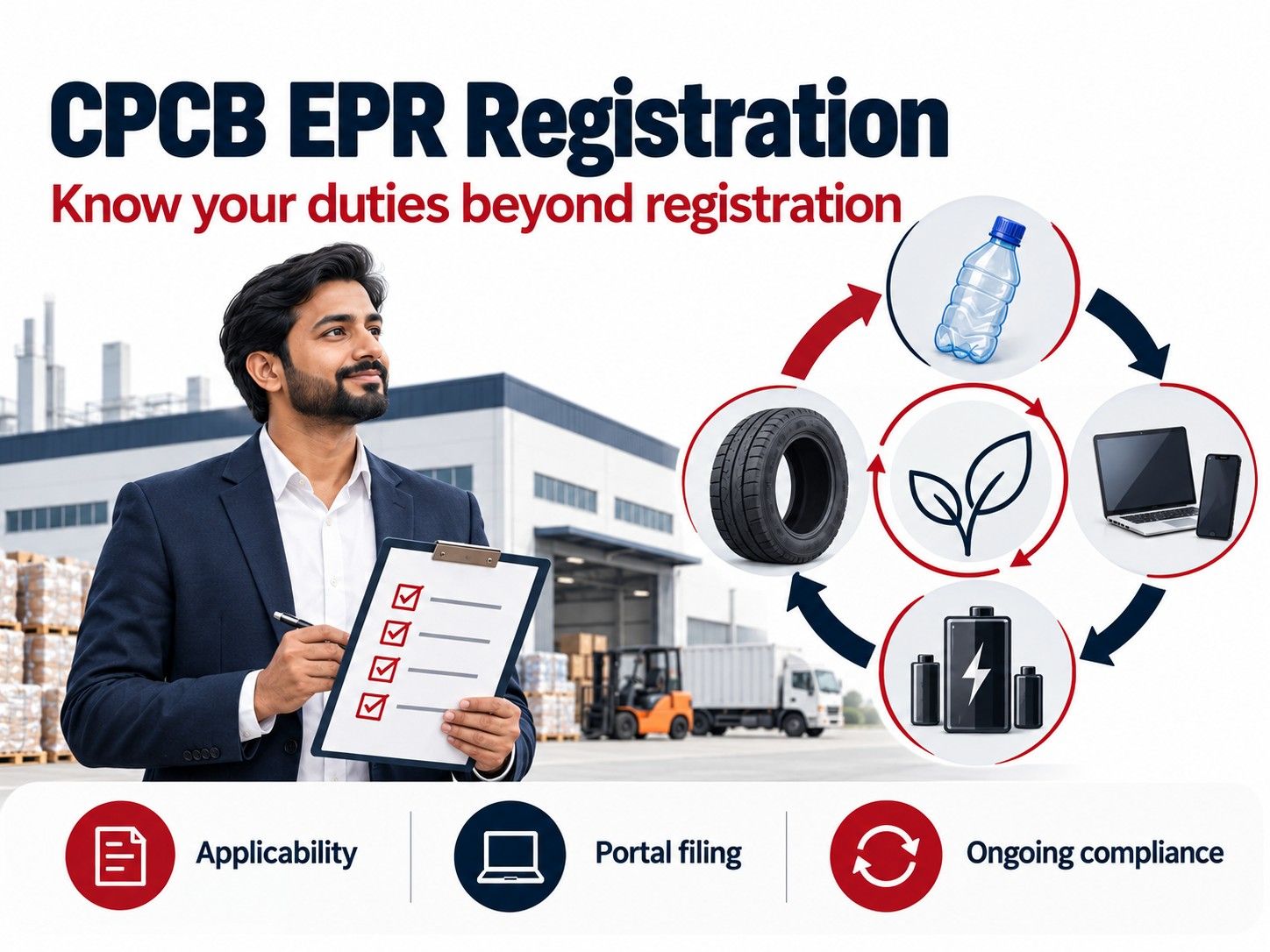
CPCB EPR Registration is mandatory when your business falls within a covered waste stream and regulated role. However, obtaining registration does not complete your environmental obligations. You may need to meet recycling targets, purchase eligible credits, file returns and maintain supporting records.
Extended Producer Responsibility makes covered businesses responsible for managing products or packaging after use. Importers and businesses selling under their own brands can have obligations even without owning a factory.
The application route has changed. CPCB discontinued its standalone plastic portal from 28 June 2026 and migrated registered users’ data to the Common EPR Portal. Existing users must check their migrated information.
This guide explains EPR registration in India, including applicability, exceptions, documents, fees and continuing EPR compliance. It also distinguishes a registration document, often called a CPCB EPR certificate, from a recycling EPR certificate used towards targets, helping you identify what your business must do after approval.
Is CPCB EPR Registration Mandatory for Your Business?
Yes, if the applicable waste rules cover your activity and products. EPR stands for Extended Producer Responsibility, and registration is not compulsory merely because your office or shop generates waste.
Start with what you manufacture, import or sell, whose brand appears on it, and its packaging. EPR registration for producers depends on the definition under each regime.
|
Waste stream |
Businesses and activities to assess |
|
Plastic packaging |
Producers, importers, brand owners and specified plastic raw-material and compostable/biodegradable-item businesses |
|
E-waste |
Producers and importers of electrical and electronic equipment covered by Schedule I of the 2022 rules |
|
Batteries |
Covered battery manufacture, assembly, own-brand supply and imports, including equipment containing batteries |
|
Waste tyres |
Covered tyre manufacturers, own-brand suppliers and importers, including specified vehicle and waste-tyre imports |
|
Used oil |
Covered base/lubricating-oil producers and importers, and used-oil importers |
|
End-of-life vehicles |
Vehicle producers covered by the 2025 rules |
|
Non-ferrous metals |
Covered products made of aluminium, copper, zinc or their alloys under the 2025 amendment |
|
Construction and demolition waste |
Covered producers, including persons occupying or controlling building projects with built-up area of 20,000 square metres or more |
The construction-and-demolition rules and non-ferrous-metal amendment took effect on 1 April 2026. EPR registration in India therefore requires a wider assessment than plastic, electronics and batteries alone.
A business importing battery-powered electronics in plastic packaging may need three separate assessments. A personal care business should examine its packaging and branding arrangements even when another company manufactures the cosmetics.
What Does an EPR Certificate Actually Prove?
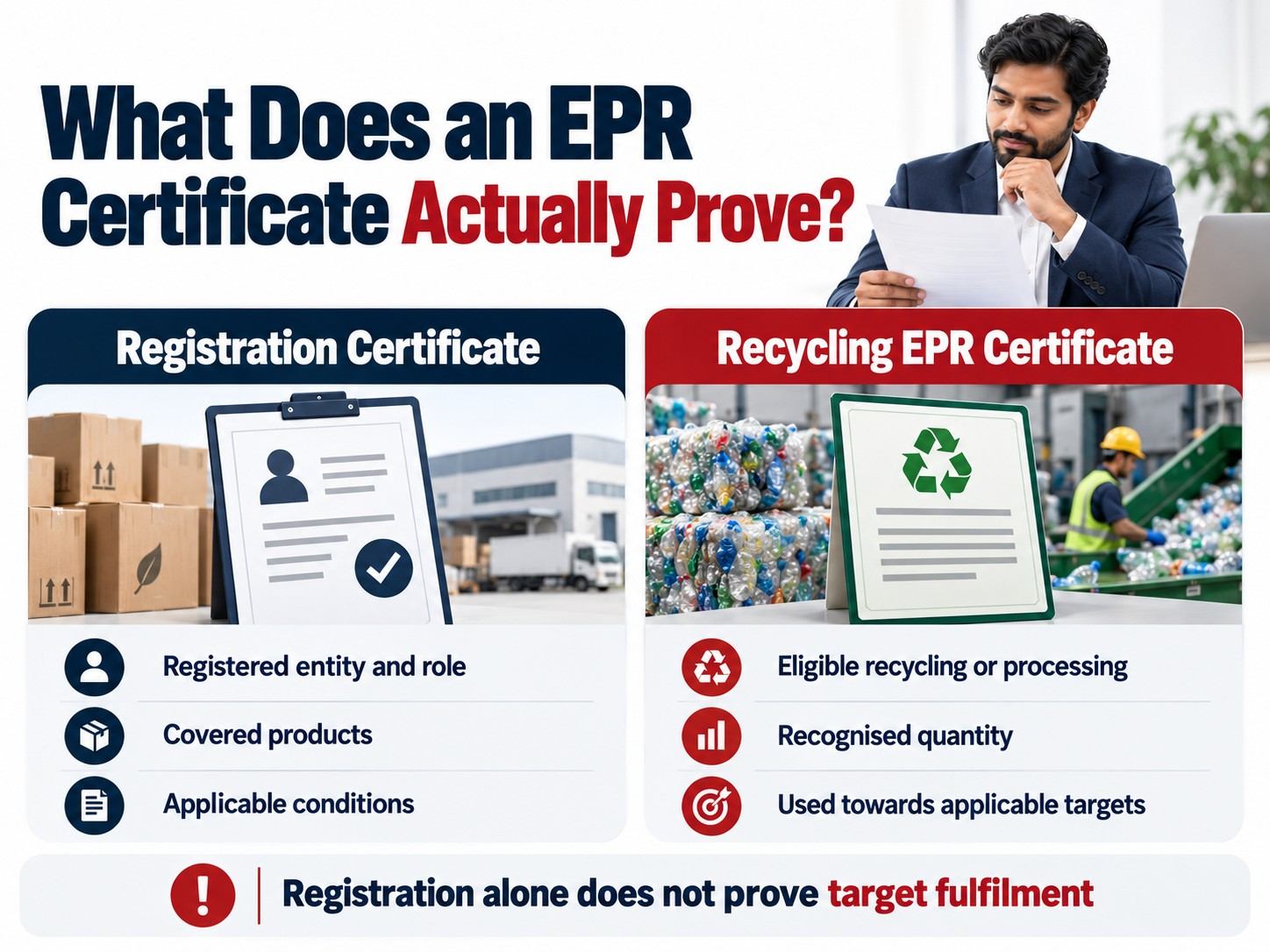
Extended Producer Responsibility involves both registration and fulfilment of applicable targets. These documents serve different purposes:
|
Document |
What it establishes |
|
Registration certificate |
The entity’s registration, stakeholder role, covered products and applicable conditions |
|
Recycling EPR certificate |
Eligible recycling or processing recognised towards the relevant obligation |
When requesting a CPCB EPR certificate, specify the waste stream and whether you mean registration or credits. Paying the registration fee does not purchase recycling certificates.
A CPCB EPR certificate also does not replace applicable facility consents. Maharashtra manufacturers can review the MPCB consent application guide when checking site permissions.
Similarly, ISO environmental management certification serves a separate management-system purpose. It does not replace statutory EPR Registration.
For plastic PIBOs operating in one or two states/Union Territories, registration is handled by the concerned SPCB/PCC. Those operating in more than two register with CPCB through the centralised system.
Are Small Businesses Exempt From EPR Registration?
There is no common MSME exemption across Extended Producer Responsibility regimes.
-
E-waste rules exclude micro enterprises, rather than all MSMEs.
-
Plastic rules provide a specified EPR exclusion for micro and small brand owners.
-
Micro and small plastic producers must nevertheless register.
-
A business acting as an importer must separately examine that role.
Under the 2024 plastic amendment, relevant raw-material manufacturers/importers fulfil specified targets associated with supplies to micro and small producers. The prescribed calculation excludes certain onward supplies, while recycled-content duties remain with those producers.
Check your Udyam enterprise classification alongside your activities. EPR registration for producers should be assessed against the actual supply arrangement, rather than business size alone.
What Documents Support CPCB EPR Registration?
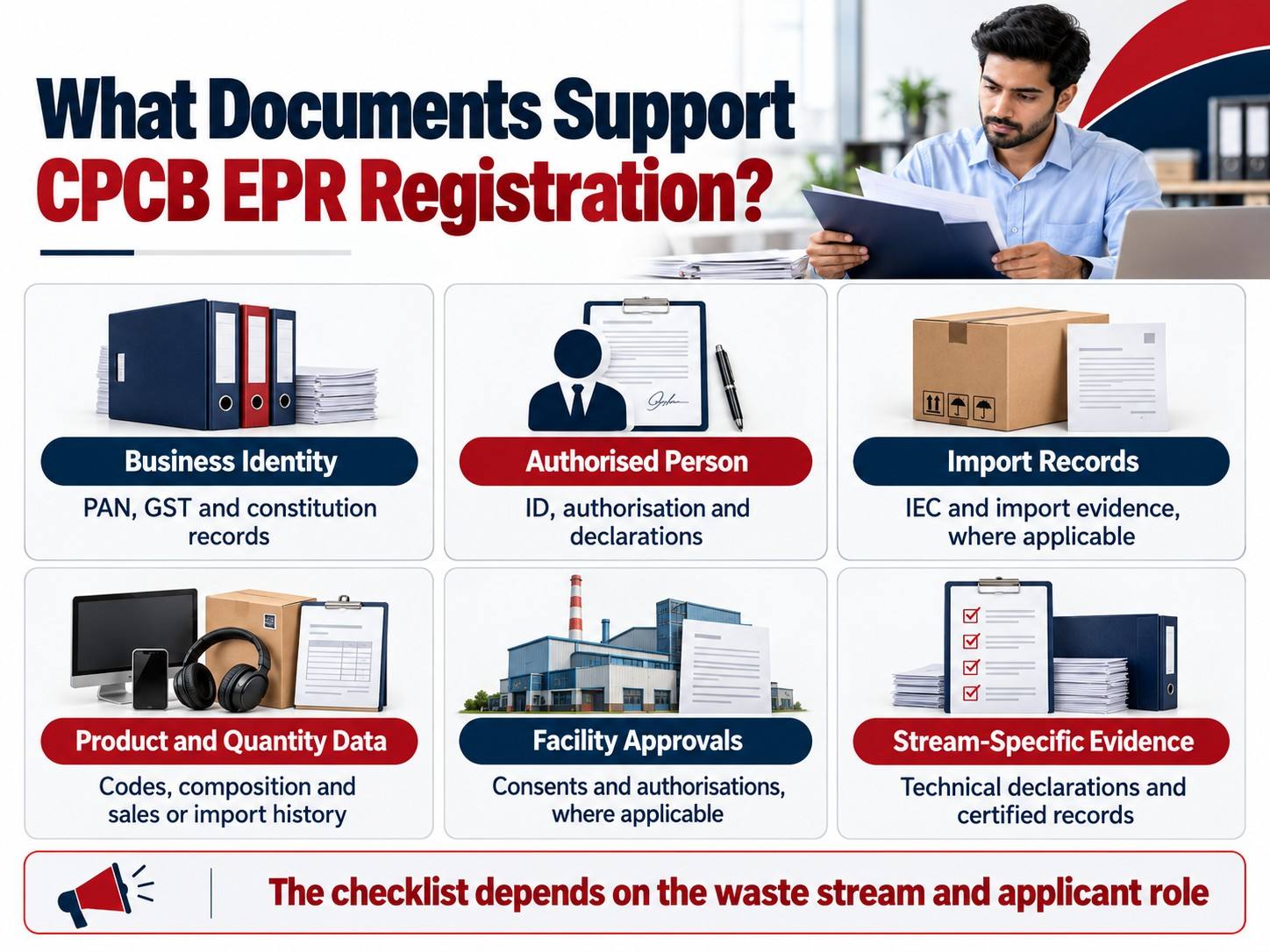
The checklist for EPR registration in India changes with the waste stream and applicant role. Prepare the current portal’s prescribed records, which can include:
-
PAN, GST registration records and applicable incorporation or constitution documents.
-
Authorised-person identification, authorisation, covering letter and declarations.
-
IEC and relevant import evidence.
-
Product codes, material composition, quantities and historical sales/import data.
-
Applicable facility consents, authorisations and capacity records.
-
Stream-specific technical declarations and certified quantity statements.
E-waste producer applications require relevant CA-certified quantities, RoHS declarations and an awareness plan. Battery applications require battery type, chemistry and material composition.
The battery SOP accepts the previous financial year’s GSTR-9 or balance sheet as turnover evidence. Reconcile your GST annual return records before using them.
Organise entity papers using our essential business documents guide. The legal name, address and quantities supporting a CPCB EPR certificate must remain consistent throughout the application.
How Do You Apply Through the CPCB EPR Portal?
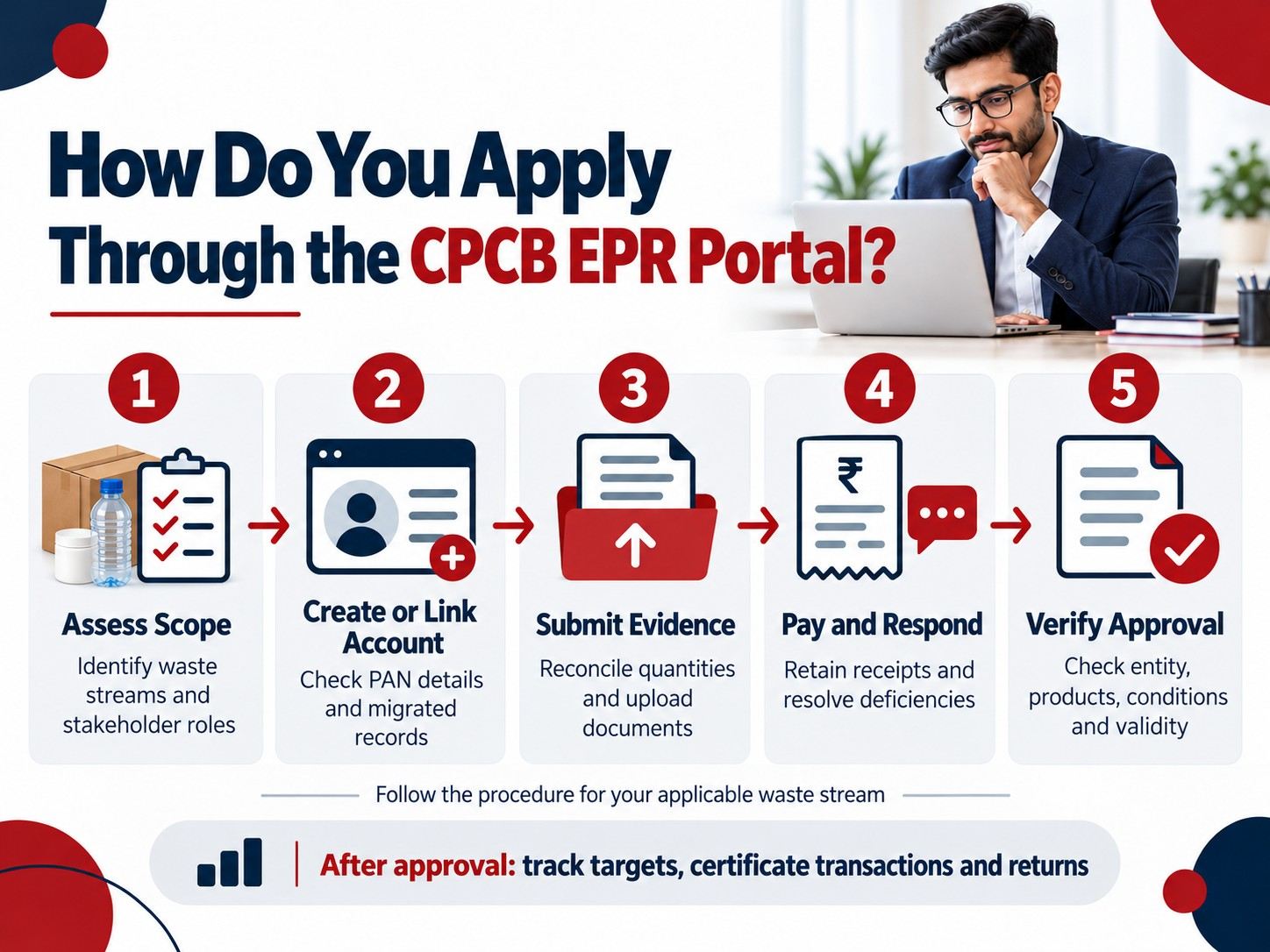
EPR registration for producers follows the selected stream’s procedure. The sequence below brings together the main stages, without assuming that every module uses the same form.
1. Assess EPR Registration for Producers and Other Roles
Map your products, packaging and business activities against the notified definitions and schedules. Record the basis for any exclusion and identify separate roles, such as producer and recycler, before starting EPR Registration.
2. Create or Link the Correct Account
Start with the official CPCB Common EPR Portal for linked modules and follow the relevant instructions. Existing plastic users should use matching company and authorised-person PAN details, then verify migrated records rather than creating conflicting profiles.
3. Reconcile Quantities and Upload Evidence
Enter the required product, material, facility and historical quantity details on the CPCB EPR portal. Importers should check their IEC code registration records against the application, while CA-issued supporting certificates can be checked using the UDIN verification guide, where applicable.
4. Pay the Fee and Answer Deficiencies
Confirm the applicable fee demand, pay through the authorised facility and retain the receipt. Monitor the CPCB EPR portal for observations and answer within the stated period, keeping corrected declarations consistent with supporting records.
5. Check the Approval and Set Up Compliance
Verify the issued registration’s entity, role, products, conditions and validity. Download the CPCB EPR certificate from the CPCB EPR portal and assign responsibility for targets, returns, certificate transactions and future amendments.
There is no universal approval period for EPR registration in India. The e-waste producer SOP specifies 30 working days for complete applications, while battery rules prescribe two weeks for completed applications, including their deemed-registration provision. Check the applicable rule and portal status before treating a pending application as approved.
What Government Fees Apply to EPR Registration in India?
EPR registration for producers has different fee bases across streams. The published schedules below were checked on 29 October 2026.
|
Registration category and fee basis |
Published amount |
|
Plastic PIBO: below 1,000 tonnes annually |
₹10,000 |
|
Plastic PIBO: 1,000–10,000 tonnes annually |
₹20,000 |
|
Plastic PIBO: above 10,000 tonnes annually |
₹50,000 |
|
Battery producer: annual turnover below ₹5 crore |
₹10,000 |
|
Battery producer: ₹5 crore–₹50 crore |
₹20,000 |
|
Battery producer: above ₹50 crore |
₹40,000 |
|
E-waste producer: annual recycling target below 50 tonnes |
₹2,500 |
|
E-waste producer: 50 to below 100 tonnes |
₹7,500 |
|
E-waste producer: 100 to below 1,000 tonnes |
₹1,50,000 |
|
E-waste producer: 1,000 to below 5,000 tonnes |
₹10,00,000 |
|
E-waste producer: above 5,000 tonnes |
₹15,00,000 |
CPCB’s e-waste table labels these as proposed charges and leaves exactly 5,000 tonnes unclear. Confirm the operative portal demand. Producers whose sales have just started have a separately published ₹10,000 processing fee.
E-waste annual maintenance is listed at ₹5,000. Plastic PIBO annual processing charges are 25% of the application fee.
For micro/small plastic producers, December 2024 guidance specifies ₹5 per tonne of production capacity. Specified raw-material manufacturers, importers and sellers have a ₹10-per-tonne rate, with annual WPI-based revision and applicable processing/audit charges.
Used-oil producer registration ranges from ₹25,000 below 5,000 tonnes of annual sales to ₹10,00,000 above 1,00,000 tonnes, with intermediate slabs and 25% annual processing charges.
For tyre producers, CPCB’s FAQ lists ₹25,000 for initial registration and ₹12,500 for renewal, each plus ₹0.625 per tonne manufactured/imported in the preceding two years, where applicable. Addenda are listed at ₹7,500. Its fee column also says “proposed”, so confirm the operative demand. Other roles and streams require their own schedules for EPR registration in India.
Registration charges, recycling EPR certificate purchases and professional fees are separate costs. Check taxes and transaction charges on the payment demand before approving an EPR compliance budget.
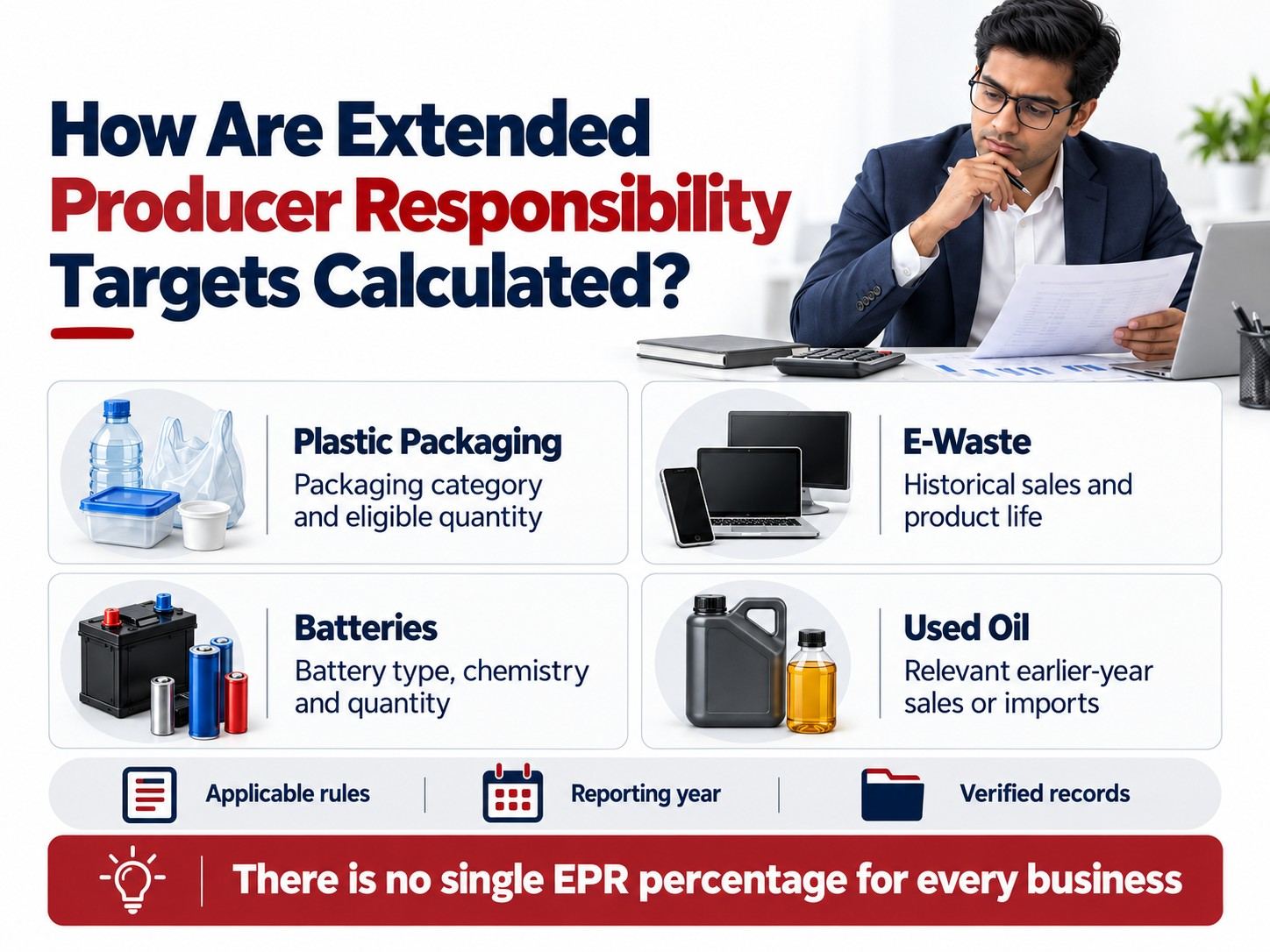
How Are Extended Producer Responsibility Targets Calculated?
Extended Producer Responsibility targets measure prescribed waste-management obligations. They are not a common percentage of turnover or a fee paid for a CPCB EPR certificate.
|
Stream |
FY 2026–27 calculation point |
|
Plastic |
Minimum recycling is 70% of the EPR target for Category I and 50% for Categories II/III |
|
E-waste |
Schedule III specifies 70% of calculated waste generation, while newer producers follow Schedule IV |
|
Used oil |
Producers’ target is 20% of relevant base/lubricating oil sold or imported in FY 2024–25 |
|
Batteries |
Battery category, composition and the applicable collection/recycling schedule determine obligations |
For plastic reporting, Category I is rigid packaging, II is flexible packaging, and III combines plastic with a non-plastic layer. Categories IV and V cover specified compostable and biodegradable packaging, bags and commodities respectively.
Required CPCB certification for compostable or biodegradable items serves a separate purpose. Check it alongside EPR Registration before manufacturing or marketing covered items.
For example, a 100-tonne Category I EPR target means at least 70 tonnes must meet the minimum recycling requirement. It does not mean the remaining obligation disappears. EPR registration for producers therefore needs a target calculation alongside an application file.
What EPR Compliance Continues After Approval?
EPR compliance requires an annual operating process:
-
Reconcile production, imports, sales, exports and relevant waste quantities.
-
Obtain an eligible EPR certificate and verify its transfer and adjustment against the correct obligation.
-
Submit prescribed quarterly and annual returns, as applicable, and retain acknowledgements.
-
Meet applicable reuse, recycled-content, labelling and awareness requirements.
-
Update registration details and preserve evidence for verification.
A recycler’s invoice alone does not prove target fulfilment. Check the recycler’s registration and eligible certificate transaction through the CPCB EPR portal, and include these checks in supplier and vendor assessment.
Using an agency or recycler does not transfer the producer’s statutory responsibility under the e-waste and battery regimes.
Where recycling results support customer or investor disclosures, an ESG compliance and assurance review can help keep statements consistent with the underlying records.
What Changed Under the 2026 Plastic Amendment?
The notified Plastic Waste Management Amendment Rules 2026 specify FY 2026–27 recycled-content requirements of 40% for Category I, 10% for II and 5% for III. These are separate from minimum recycling targets.
For importers, recycled content already present in imported material does not count towards this obligation. The rules provide for equivalent certificate purchases through the prescribed mechanism.
Specified FY 2025–26 food-contact shortfalls can be carried forward over three years from FY 2026–27, with at least one-third addressed each year in addition to current targets. Exemptions based on a legal prohibition need supporting provisions in the annual return.
Plastic and battery labelling also need separate checks. Their respective 2025 amendments permit specified barcode/QR-code or brochure alternatives, subject to the prescribed information being supplied to CPCB.
Which Filing Dates Need Attention Now?
For FY 2025–26, the battery producer annual-return extension runs to 30 November 2026. The used-oil portal also displays 30 November 2026, while e-waste and tyre portals display 30 September 2026, which has passed.
Plastic PIBO annual returns ordinarily fall due by 30 June following the financial year, subject to extensions. Check current notices after portal migration. Battery producers should distinguish Form 1(C) statements from applicable Form 3 annual reporting.
These dates were checked on 29 October 2026. Confirm the relevant return and latest notice on the CPCB EPR portal. An annual-return extension does not automatically extend recycling targets or another stream’s deadline.
How Long Is a CPCB EPR Certificate Valid?
EPR registration in India has no common validity period.
|
Producer registration |
Applicable position |
|
Plastic PIBO |
One-time registration under amended rules |
|
Battery |
One-time registration, valid until cancelled or withdrawn |
|
E-waste |
Five years, with renewal application 120 days before expiry under the producer SOP |
|
Tyre |
Two years, with renewal according to registration validity |
Do not apply older five-year battery renewal wording after the 2023 amendment. One-time registration still requires ongoing EPR compliance. A recycling EPR certificate has its own validity, separate from registration. For example, e-waste recycling certificates remain valid for two years from the end of their generation financial year.
Can CPCB EPR Registration Be Rejected or Cancelled?
Incorrect entity details, missing evidence and inconsistent quantities can delay EPR Registration. False declarations or failures under the rules can lead to environmental compensation and registration action.
For battery applications, the SOP provides for forfeiture of the application fee where false or irrelevant information/documents are submitted.
For e-waste, false information, deliberate concealment or irregularities can lead to revocation for up to three years after an opportunity to be heard. Compensation depends on the breach and applicable guidelines, and paying it does not discharge outstanding Extended Producer Responsibility targets.
An environmental compliance audit can help identify missing returns, unsupported quantities and unresolved controls before regulatory scrutiny.
Conclusion
CPCB EPR Registration establishes the required registration for a covered activity. Continuing EPR compliance depends on accurate declarations, eligible credits, timely returns and evidence of target fulfilment.
Assess EPR registration for producers whenever products, imports or branding arrangements change. A CPCB EPR certificate should sit within a continuing compliance system, with each applicable waste stream reviewed separately.
FAQS
FAQs About CPCB EPR Registration
-
Do online resellers need CPCB EPR Registration?
Selling online alone does not determine applicability. Importing covered goods or selling under your own brand can place you within a regulated producer or brand-owner role. Check the relevant definitions, because a reseller’s position differs from that of an importer or private-label seller.
- Do batteries imported for in-house use create obligations?
- Can a new business apply before starting sales?
- Can I sell covered electronics while registration is pending?
- What if I add a new electronic product after approval?
- What if the business name or address changes?
- What should I do if payment is debited but submission fails?
- What if migrated plastic-portal records do not match?
- Does closing a battery business end its EPR duties?
- Do solar panels follow ordinary e-waste recycling targets?


