
ESG compliance and assurance can reduce business risk when companies use findings to correct weak controls, support disclosures and check sustainability claims. The value comes from evidence and follow-through, rather than a certificate displayed on a website. For Indian companies, an important development is SEBI’s circular dated 28 March 2025, which introduced the option of assessment or assurance for BRSR Core. The applicable verification requirement remains mandatory for listed entities covered by the phased framework.
This article explains applicability, reporting distinctions, supporting records, supplier checks, provider independence and service costs, helping you decide which work your company needs before commissioning an assessment or signing an assurance engagement.
Why Does ESG Compliance and Assurance Matter to Companies?
It connects business responsibilities with information that management and outside readers can examine. An ESG assessment can identify missing records or unclear ownership. ESG risk assessment then helps management decide which exposures need action first.
The practical benefit of ESG compliance services is stronger implementation, while ESG assurance services provide an independent conclusion on specified information. Neither guarantees fewer incidents, cheaper finance or a higher valuation. Sustainability assurance improves confidence only within its stated scope and limitations.
For example, an unexplained fall in reported water consumption should trigger a check of meters, occupied sites and calculation methods. ESG data verification can expose an omitted facility before the number enters ESG reporting. Management must still correct the underlying recording problem.
Where the issue concerns site controls, environmental and safety audits provide a relevant supporting review. A disclosure check alone cannot establish that a factory’s environmental and worker protection arrangements are adequate.
For environmental management procedures, see LegalBabu’s ISO 14001 environmental management guide. Keep the scope of any management-system certificate separate from the ESG information being verified.
Read more: Chemical businesses can explore RC 14001 chemical management for an industry-specific perspective.
Use ESG risk assessment to connect findings with practical decisions:
-
Resource use: investigate unusual consumption before relying on claimed savings.
-
Workforce protection: examine incident records and unresolved complaints before accepting a positive performance summary.
-
Supplier exposure: investigate unsupported declarations before approving a significant relationship.
-
Public claims: check the supporting scope before describing a product or operation as sustainable.
These are management responses to evidence, rather than promised commercial outcomes. ESG compliance services should help assign the necessary follow-up instead of stopping at a completed questionnaire.
How Do Reporting, Assessment and Assurance Differ?
Agree on the deliverable before buying a service. These activities answer different questions, even when a proposal groups them.
|
Activity |
Main purpose |
|
ESG compliance services |
Help identify applicable duties and establish controls and responsibilities |
|
ESG assessment |
Examine practices, gaps or readiness against agreed criteria |
|
ESG risk assessment |
Evaluate relevant exposures and prioritise responses |
|
ESG reporting |
Present information using the applicable disclosure framework |
|
ESG data verification |
Check selected figures against records, boundaries and calculation methods |
|
ESG assurance services |
Perform an independent engagement and issue a conclusion on defined information |
Sustainability assurance is an assurance engagement concerning sustainability information. An ESG supplier audit examines a particular supplier scope and does not automatically cover the reporting company’s entire value chain.
Limited assurance involves less extensive procedures and provides a lower assurance level than reasonable assurance. Reasonable assurance provides a high level of confidence, although neither provides absolute certainty. The chosen level and reporting criteria should be clear before readers rely on a conclusion.
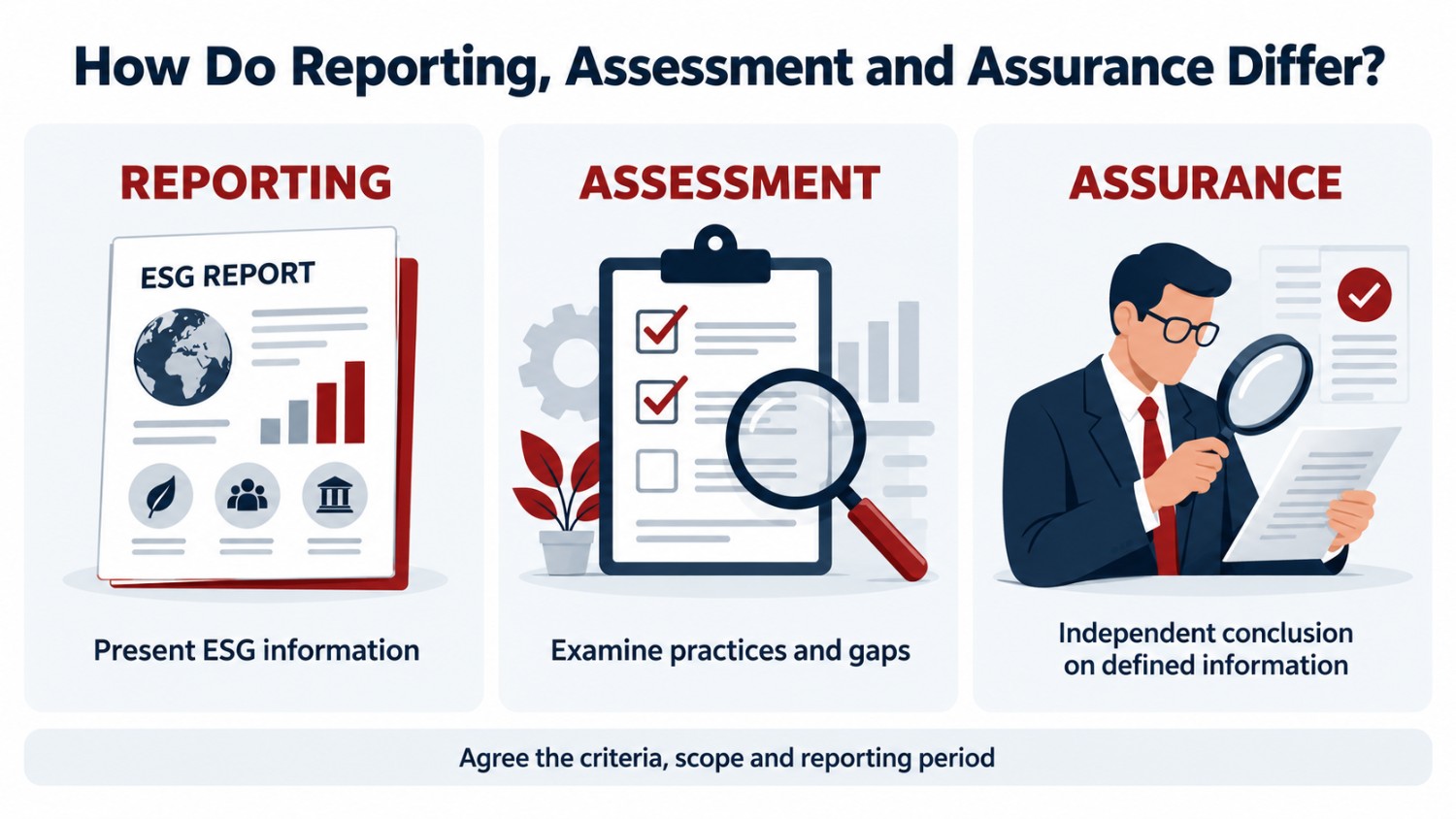
Within SEBI’s framework, BRSR assessment has a specific meaning: third-party assessment under standards developed by the Industry Standards Forum in consultation with SEBI. A general readiness review is not automatically a qualifying BRSR assessment. Likewise, a proposal labelled BRSR Core assurance must identify the information, criteria and engagement being offered.
Which Companies Must Follow BRSR Requirements?
SEBI requires the top 1,000 listed entities by market capitalisation to submit the Business Responsibility and Sustainability Report, or BRSR, with their annual reports. BRSR Core is a subset containing indicators under nine ESG attributes. The mandatory external check applies to that subset through the following rollout.
The attributes cover greenhouse gas, water and energy footprints, circularity, employee wellbeing and safety, gender diversity, inclusive development, fairness with customers and suppliers, and openness of business. This scope explains why procurement, human resources and finance need to contribute alongside environmental teams.
|
Financial year |
Listed entities covered by mandatory BRSR Core assessment or assurance |
|
2023–24 |
Top 150 |
|
2024–25 |
Top 250 |
|
2025–26 |
Top 500 |
|
2026–27 |
Top 1,000 |
These requirements appear in Section IV-B of SEBI’s January 2026 Master Circular. The current requirement permits BRSR assessment or BRSR Core assurance. Statements that every covered company must obtain reasonable assurance alone omit the assessment option.
An unlisted business does not become directly subject to this BRSR filing requirement simply because a listed customer sends a questionnaire. It may nevertheless face contractual information requests and separate legal duties. ESG compliance services should distinguish these obligations before recommending ESG reporting or sustainability assurance.
What Evidence Should an ESG Assessment Examine?
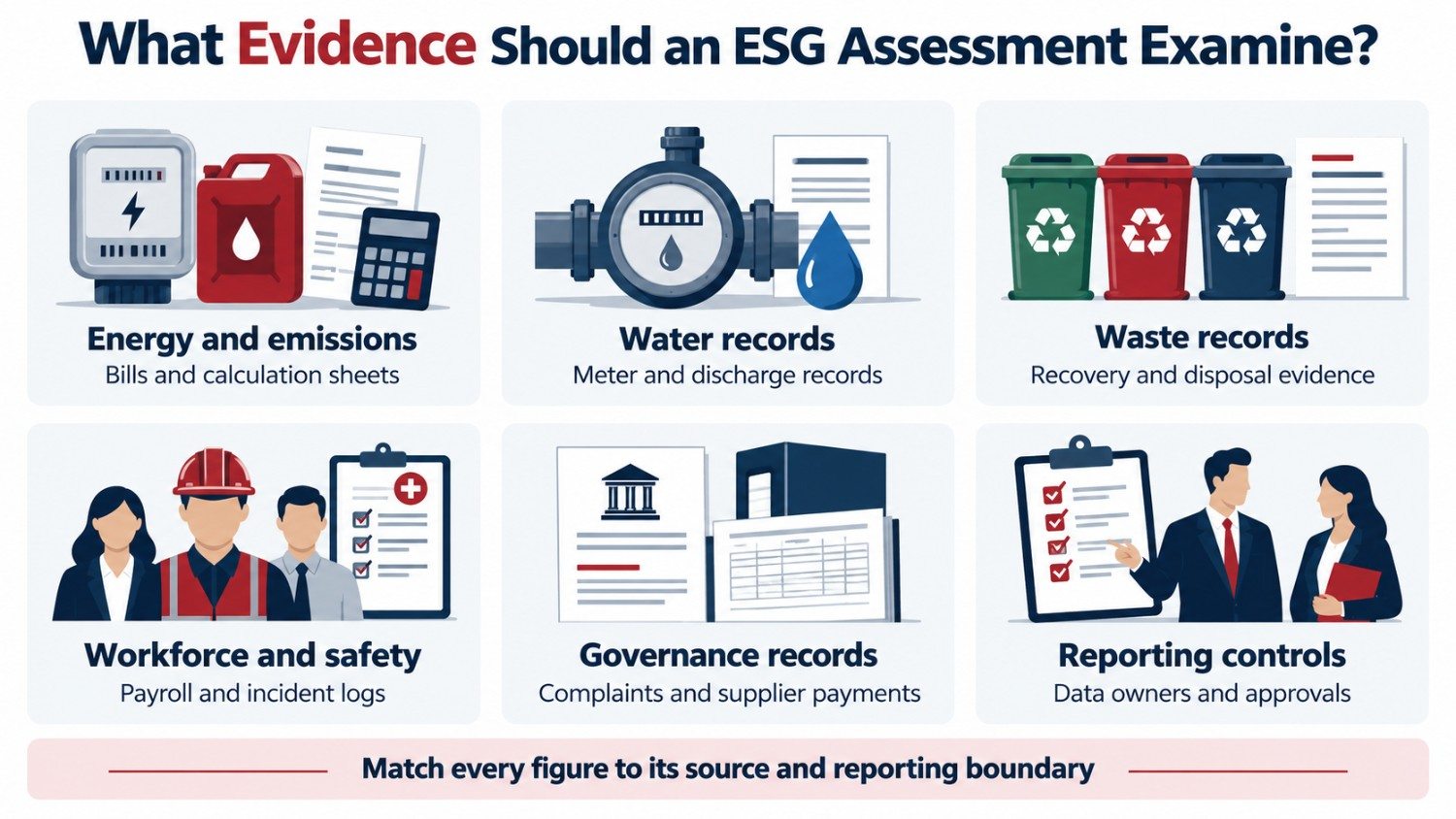
An ESG assessment should connect each relevant indicator to records that explain what was measured and which operations were included. For BRSR Core assurance, the evidence must match the selected indicators and reporting boundary. BRSR assessment also needs a documented basis for the information examined.
Prepare an evidence index covering the applicable areas:
-
Energy and emissions: electricity bills, fuel records, calculation worksheets and emission factors.
-
Water: withdrawal, consumption and discharge records, with measurement or estimation methods.
-
Waste: category records, recovery and disposal information, and relevant vendor evidence.
-
Workforce: payroll, employee and worker classifications, safety incidents and welfare expenditure.
-
Governance: complaints, data breaches, supplier payments, sourcing and related-party information.
-
Reporting controls: data owners, review approvals, correction records and boundary explanations.
ESG data verification should reconcile figures to their sources and explain changes in units, coverage or methods. An ESG risk assessment should also identify where incomplete records prevent a reliable conclusion. Neither activity should quietly convert unavailable information into a reported zero.
Workforce disclosures can draw attention to issues requiring separate labour law compliance reviews. ESG reporting does not replace checking the employment obligations applicable to the establishment.
For workplace safety procedures, see LegalBabu’s ISO 45001 workplace safety guide alongside your review of incident and training records.
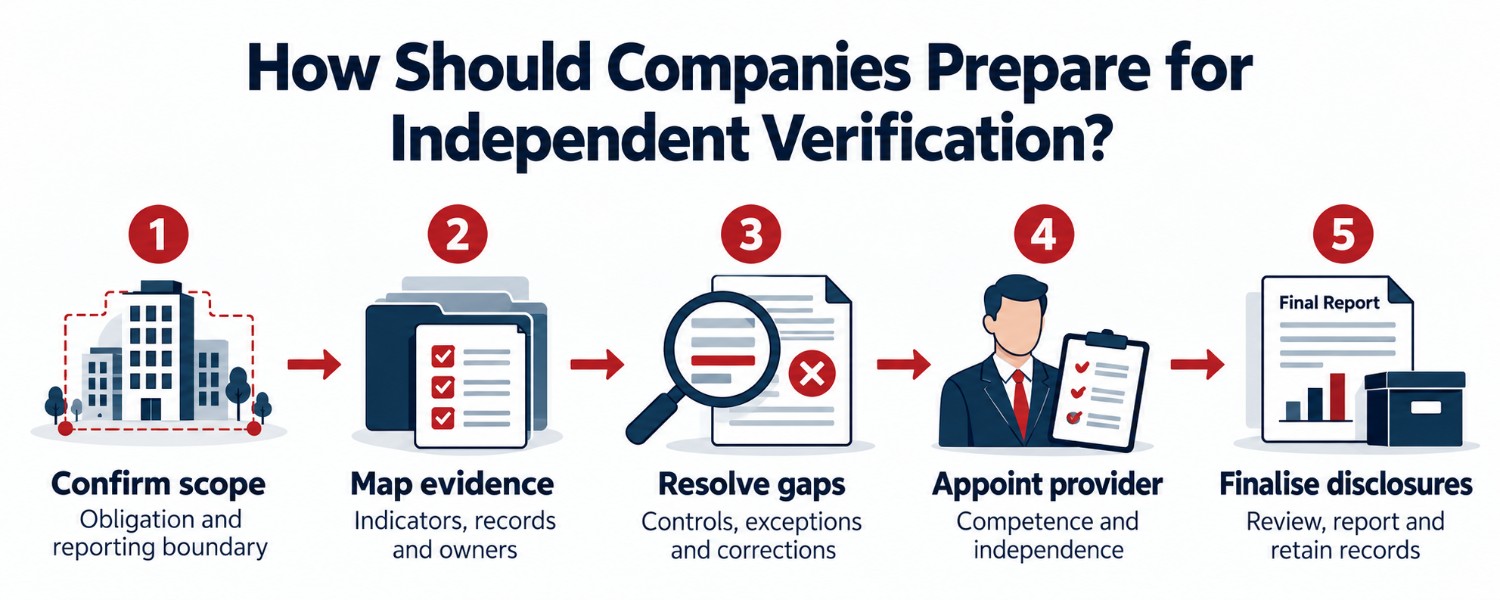
How Should Companies Prepare for Independent Verification?
The following preparation workflow follows the disclosure, evidence and provider requirements in SEBI’s framework. It is an internal compliance workflow, rather than an application for an ESG licence.
Step 1: Confirm the Obligation and Reporting Boundary
Identify the reporting year, applicable listed-entity category and whether the engagement covers the company or its value chain. Record the standalone or consolidated boundary and the information selected for checking. ESG compliance services should resolve these points before an ESG assessment begins, because an incorrect boundary can undermine otherwise accurate calculations.
Step 2: Map Indicators to Records and Owners
Assign responsibility for each indicator and locate its supporting evidence. Use the applicable BRSR Core reporting standards, documenting permitted estimates and methodology adjustments. ESG data verification should expose gaps early enough for the responsible department to explain or correct them.
For energy-specific procedures, consult LegalBabu’s ISO 50001 energy management guide while mapping consumption records and responsibilities.
Step 3: Review Controls and Resolve Exceptions
Compare departmental submissions, investigate inconsistent classifications and retain the reasons for corrections. Use ESG risk assessment to prioritise unresolved issues, including supplier information that cannot be substantiated. Where an ESG supplier audit is relevant, define its records, locations and reporting period rather than accepting a general declaration.
Step 4: Appoint a Competent Independent Provider
Choose the formal BRSR assessment route or BRSR Core assurance and agree the applicable criteria. Obtain competence and independence information before appointing the provider. ESG assurance services should specify the standard, scope and intended conclusion, while sustainability assurance proposals should explain any exclusions clearly.
Step 5: Complete Review and Finalise Disclosures
Provide evidence, answer queries and track unresolved matters through completion. Align the final ESG reporting with the information actually examined and accurately describe the provider’s work. Retain the final report, supporting calculations and approved corrections so the next reporting cycle starts from a reliable record.
When Does an ESG Supplier Audit Become Relevant?
An ESG supplier audit is useful when a company needs to examine the supplier practices or figures supporting its own decisions and disclosures. Start with the purpose of the request. A buyer’s onboarding review, a contractual inspection and BRSR value-chain verification are different assignments.
Under the current SEBI framework, value-chain ESG disclosures are voluntary for the top 250 listed entities from FY 2025–26. Their assessment or assurance is voluntary from FY 2026–27. This differs from the mandatory check of the listed entity’s own BRSR Core.
For those disclosures, the value chain covers upstream and downstream partners individually accounting for at least 2% of purchases and sales by value, respectively. The entity may limit coverage to 75% of purchases and sales, respectively, and must disclose the coverage achieved. Reported indicators should reflect the business attributable to the relevant relationship.
An ESG supplier audit should therefore establish which operations and transactions the evidence represents. Supplier and vendor assessments can support this work, while ESG compliance services should clarify contractual access and responsibilities. ESG data verification must preserve the distinction between a supplier’s total figures and the share reported for a particular customer.
Read more: Companies reviewing event suppliers can explore ISO 20121 sustainable events for event-specific sustainability practices.
How Should You Select ESG Assurance Services?
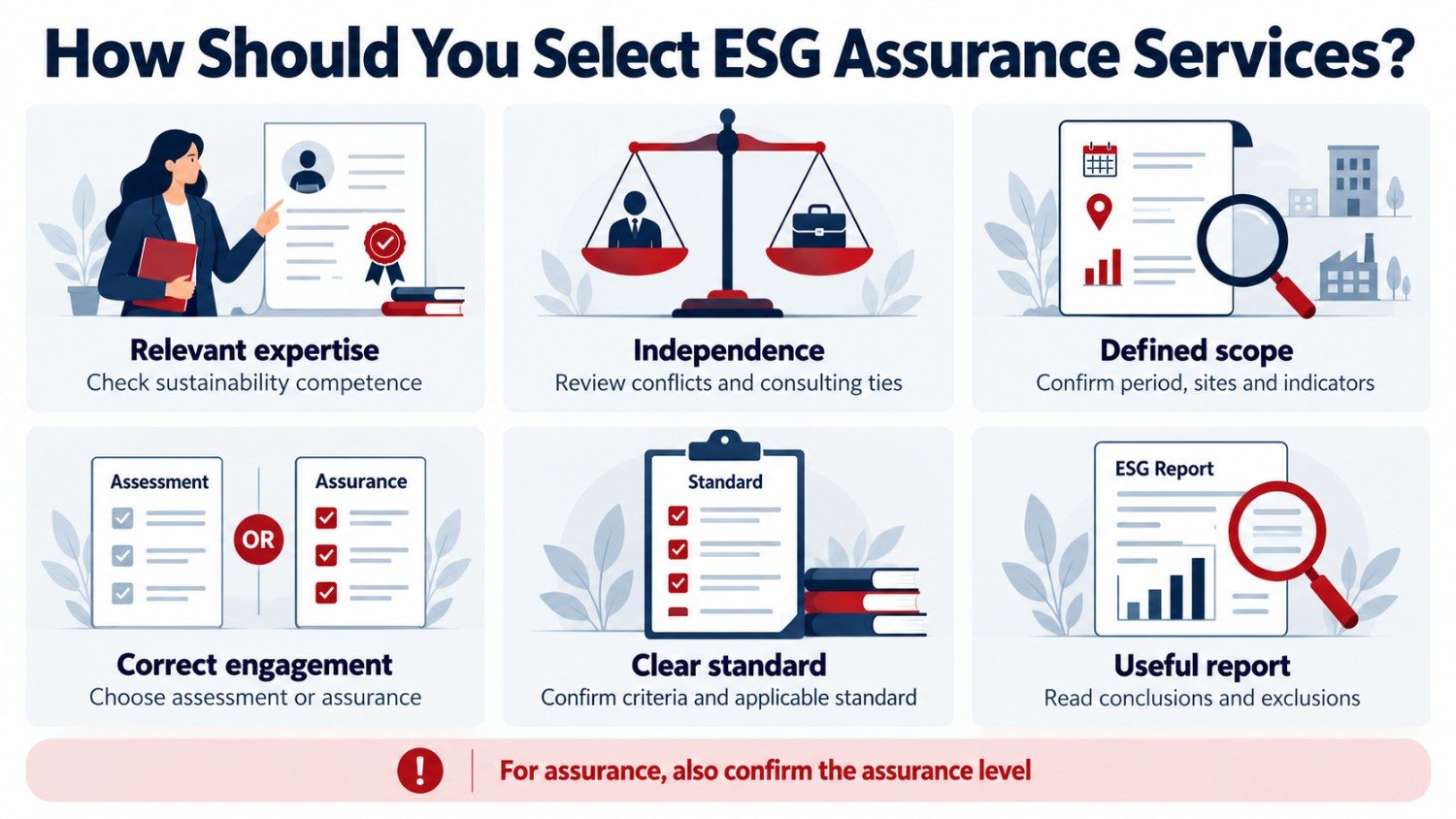
Provider independence deserves the same attention as technical capability. SEBI’s official BRSR Core FAQs explain competence, conflicts and permitted activities. The board must ensure that its appointed provider has the necessary expertise.
The provider or its associates must not sell products or provide prohibited non-audit, non-assessment or non-assurance services, including consulting, to the listed entity or its group. ESG compliance services that design controls therefore require careful separation from the independent engagement. Buying preparation and verification together without checking conflicts can make the appointment unsuitable.
Before commissioning BRSR Core assurance or BRSR assessment, ask for:
-
The reporting period, entities, sites and indicators covered.
-
The criteria and assessment or assurance standard used.
-
The assurance level, where applicable, and proposed report wording.
-
Evidence requirements, planned procedures and treatment of unresolved findings.
-
Independence declarations covering relevant group and associate relationships.
ESG assurance services should not describe a narrow engagement as checking every sustainability claim. Sustainability assurance also does not provide absolute certainty. Read the conclusion and exclusions before using the report in customer or investor communications.
How Can Companies Turn Findings into Better Risk Controls?
ESG compliance and assurance matter most when findings change how information and responsibilities are managed. Give each significant issue an owner, an action and evidence of closure. A repeated finding should trigger a review of the process that produced it.
For environmental or workforce issues, update the relevant operating controls. For governance information, examine access permissions, incident records and approval responsibilities. A focused cybersecurity audit can support technical investigation where data security weaknesses affect governance disclosures.
Use ESG risk assessment to distinguish urgent operational exposure from reporting corrections. An ESG assessment should record remaining gaps, and ESG compliance services should help management address the applicable duties. Recheck significant changes before the next cycle of ESG reporting.
An ESG supplier audit finding also needs follow-up with the supplier, rather than a score filed away after onboarding. During an investment or acquisition, combine relevant findings with broader business due diligence. LegalBabu’s guide to transaction advisory services explains the wider deal-review context, which remains distinct from sustainability assurance.
What Costs and Timelines Should You Confirm?
The reviewed SEBI framework does not publish a standard government fee for purchasing ESG assurance services or a fixed commercial engagement duration. It also does not create a universal ESG certificate with a single validity or renewal period. Do not treat a consultant’s quotation as a government tariff.
Request a written scope and price that separates preparation from independent work. Confirm whether the quotation includes ESG data verification, site visits, an ESG supplier audit and responses to review queries. For BRSR Core assurance or BRSR assessment, identify additional indicators and value-chain work separately.
For scheduling, agree evidence-submission dates, review stages and report delivery against the company’s reporting obligations. Ask what happens if records arrive late or the scope changes. Payment milestones, applicable taxes, cancellation terms and any repeat-work charges should be settled in writing, rather than assumed from an advertised package.
The quotation should also explain whether ESG data verification ends with identifying differences or includes reviewing corrected submissions. Keep this scope distinct from ESG risk assessment, which prioritises exposures and management responses rather than simply reconciling figures.
Conclusion
ESG compliance and assurance can support better decisions when responsibilities, evidence and corrective action work together. Start with the actual obligation, use an ESG assessment to understand gaps and commission the appropriate independent check. BRSR Core assurance is one route within SEBI’s framework, alongside formal BRSR assessment.
The useful result is reliable information and stronger controls. An ESG supplier audit should resolve relevant supply-chain questions, while sustainability assurance should clearly communicate what was examined. Neither replaces management’s responsibility for compliance or action on the findings.
FAQS
FAQs About ESG Compliance And Assurance
-
Can a GRI Sustainability Report Replace BRSR?
SEBI permits cross-referencing relevant disclosures from internationally accepted frameworks such as GRI. This does not remove the applicable BRSR submission requirement. Map the existing ESG reporting to the prescribed disclosures and address any gaps separately.
- Can Our Statutory Auditor Provide BRSR Core Assurance?
- Can Our Internal Auditor Perform the Final Independent Check?
- Must Every Provider Be a Chartered Accountant?
- Are Previous-Year Value-Chain Figures Required in the First Year?
- Can Waste Vendor Certificates Support Reported Recovery Figures?
- Can We Use Estimates Where Direct Measurement Is Unavailable?
- Does a Positive Report Confirm That Every ESG Law Has Been Met?
- Is ISSA 5000 Still Only a Draft Standard?
- Can a Strong ESG Score Replace Reviewing an Acquisition Target?


