
SMS Manual for Ship Managers: Contents & Preparation Help
SMS manual preparation means writing the policies, procedures, checklists and forms that show how your company and ships follow the ISM Code. A good manual covers all ISM elements, links to ship-type procedures, and matches real work onboard and ashore. Legal Babu's Master Mariners and Chief Engineers write, review and update it.
Most ship managers know which manuals they need. Our Document of Compliance (DOC) certification page lists them by name. This article opens those manuals and shows what goes inside. You will see how the ISM Code elements turn into chapters, how to write procedures your crew will follow, and why copied manuals fail.
What is an SMS manual, and how is it different from the ISM Code?
The ISM Code tells a company what its safety management system must achieve. It does not tell you how to run your ships. The SMS manual is your answer. It records how your company meets each requirement in the Code.
IMO adopted the Code through Resolution A.741(18), and SOLAS Chapter IX makes it mandatory. Two points in the Code matter for any ship manager:
-
The Code defines the "Company" as the owner, or any other organisation such as the manager, that has taken over responsibility for operating the ship. A manager who signs up takes on the full set of duties.
-
Section 11 says the documents describing and running the system may be called the Safety Management Manual. The company may keep them in whatever form it considers most effective.
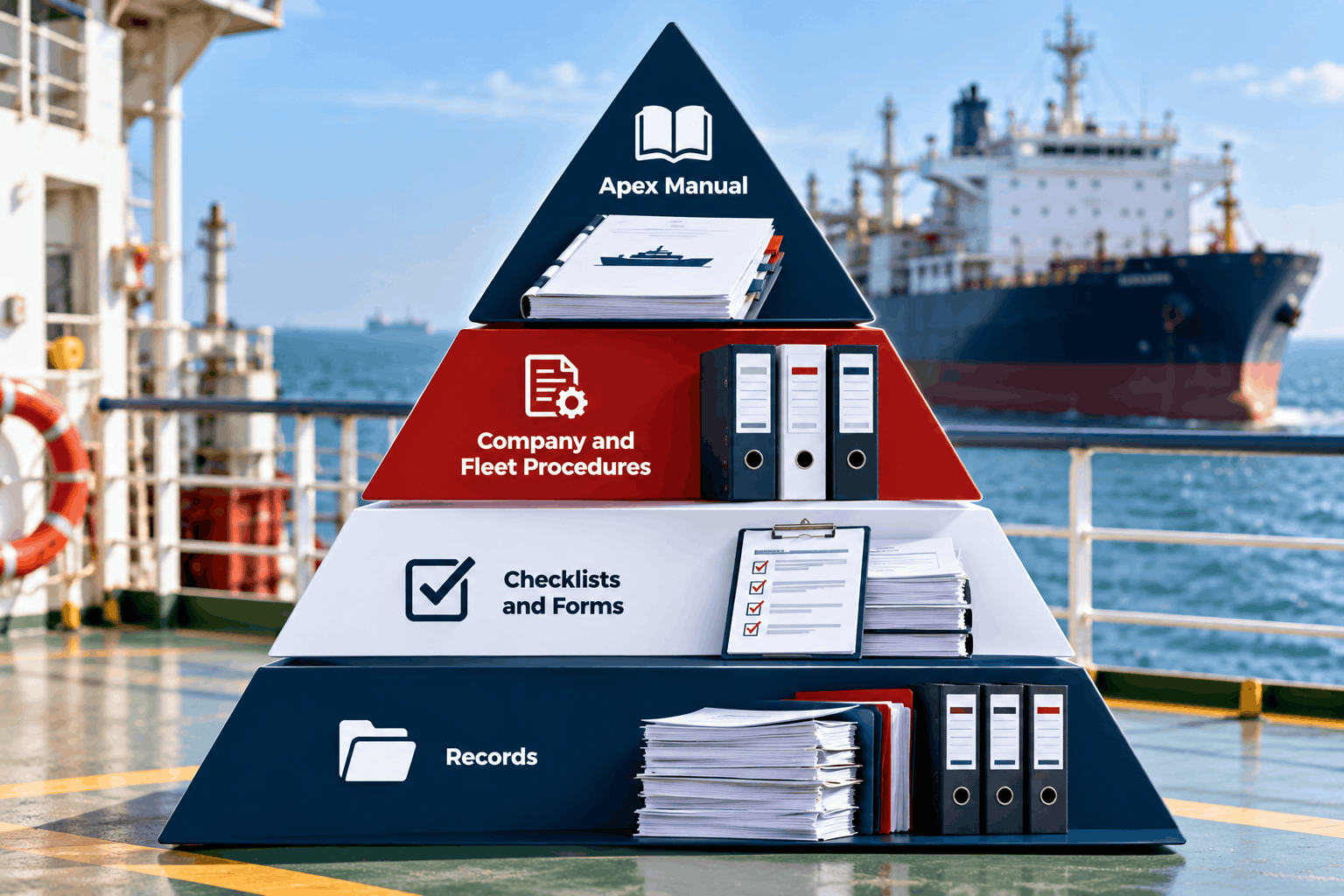
So the "manual" is a set of documents, not one thick book. The company gets a DOC, and each ship gets a Safety Management Certificate (SMC). Auditors judge both against your documents.
Practical insight for Indian-flag work: DGMA's Engineering Circular 118 of 2010 calls the company's apex manual the Safety Management Manual. It expects the apex manual to hold policies, objectives, organisation, responsibilities, communication lines and risk assessment arrangements. It also expects cross-references to every other manual. The circular asks for an apex manual written so it rarely needs amendment. Detailed procedures, checklists and forms that change often can sit in separate documents.
Which manuals make up a ship manager's SMS?
Your DOC application usually needs six manuals. Companies split their content in different ways, so treat this table as a typical layout.
|
Manual |
What goes inside |
Who opens it most |
|
SMS Manual (Apex Manual) |
Safety and environmental protection policy, objectives, organisation chart, responsibilities, DPA role, master's authority, communication lines, risk assessment approach, cross-references to all other manuals |
Top management, DPA, auditors |
|
Company Procedure Manual |
Shore-side procedures: crew selection and familiarisation, training, purchasing, maintenance planning, incident investigation, internal audits, management review, document control, cyber risk |
Superintendents, crewing and purchase staff |
|
Fleet Procedure Manual |
Procedures every ship follows whatever its type: reporting, permits to work, risk assessment, drills, defect and near-miss reporting |
Masters, officers, crew |
|
Office Emergency Manual |
Shore emergency team, roles, contact lists, call-out arrangements, notification of flag, class, insurers and charterers, exercise records |
Emergency team, DPA |
|
Ship type-specific manual and checklists |
Operating procedures and checklists for the type you manage, such as tanker cargo handling or bulk carrier loading |
Deck and engine officers |
|
Shipboard Operation Manual |
The onboard working set: daily instructions, forms, master's authority statement, muster and emergency steps, and cross-references to approved plans |
Everyone onboard |
Useful test: Pick any manual and ask three questions. Who opens it? How often? In what situation? If you cannot answer, the document is probably too long, duplicated or in the wrong place. We see this most often with fleet manuals that repeat the apex manual word for word.
What does each ISM Code element add to the manual?
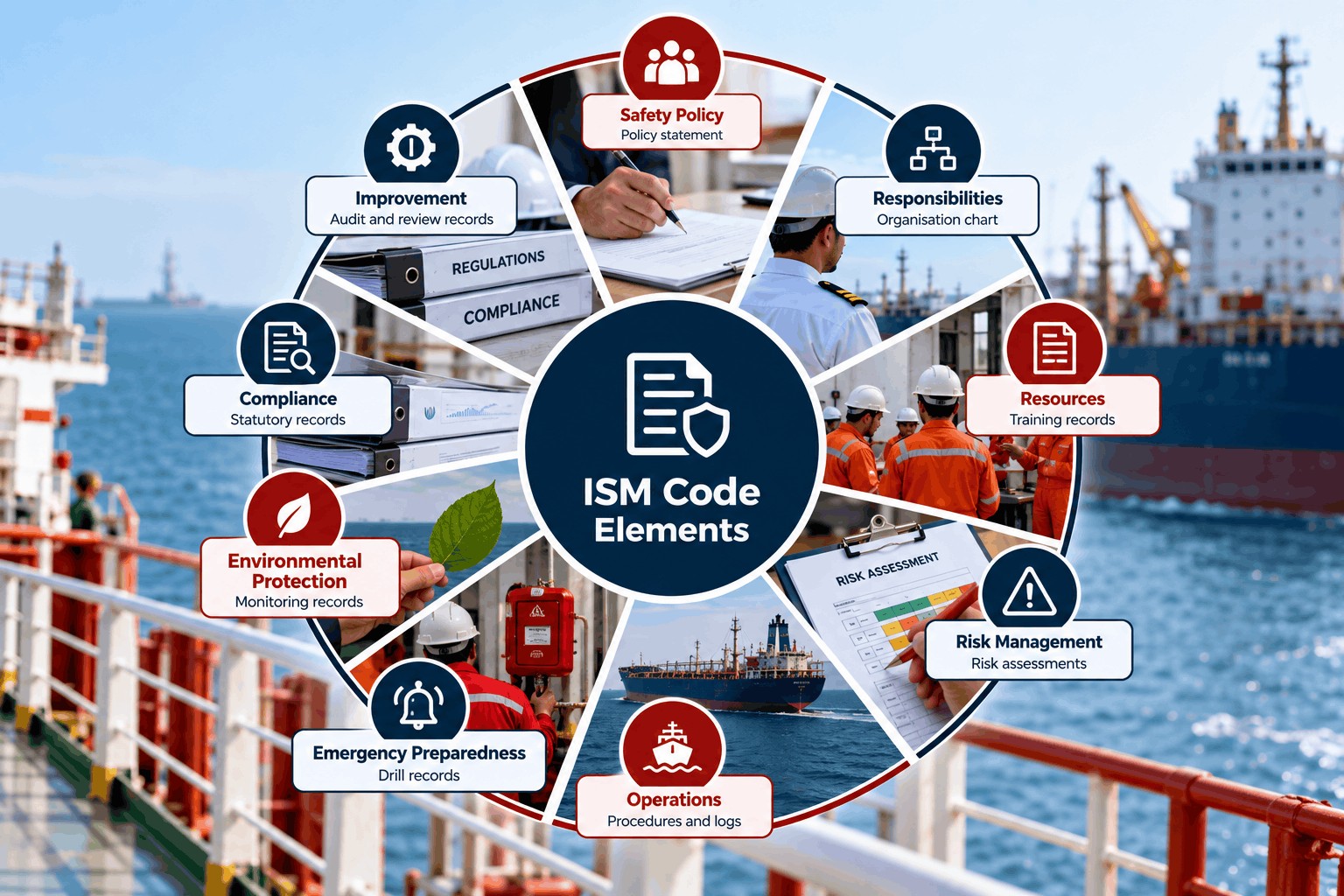
Part A of the Code has twelve sections. Section 1 covers definitions, objectives and the six functional requirements. Sections 2 to 12 are the working elements, and each one becomes a chapter or procedure group in your manual.
|
ISM section |
What to write |
Records an auditor may ask for |
|
2. Safety and environmental protection policy |
A short signed policy and how it will be put into practice at every level |
Signed policy, proof it is displayed ashore and onboard, review notes |
|
3. Company responsibilities and authority |
Organisation chart, job descriptions, reporting lines, who can stop an operation. If the owner and manager differ, the owner must give the manager's details to the flag. |
Appointment letters, current organisation chart |
|
4. Designated person(s) |
DPA duties, direct access to top management, backup cover, how ships reach the DPA |
DPA appointment, DPA course certificate, contact list |
|
5. Master's responsibility and authority |
A clear statement of the master's overriding authority, the master's duties, periodic SMS review and reporting of deficiencies |
Master's review reports, shore replies |
|
6. Resources and personnel |
Crew competence checks, familiarisation, training needs, working language, onboard communication |
Familiarisation checklists, training records, certificate checks |
|
7. Shipboard operations |
Procedures, plans and instructions, with checklists as appropriate, for key operations, with tasks given to qualified people |
Completed checklists, permits, plans |
|
8. Emergency preparedness |
How to identify and respond to emergencies, drill programme, shore response arrangements |
Drill reports, exercise records, contact list tests |
|
9. Non-conformities, accidents and hazardous occurrences |
Reporting route, investigation steps, corrective action and measures to prevent recurrence |
Reports, investigations, action tracker, closure evidence |
|
10. Maintenance of ship and equipment |
Inspection intervals, defect reporting, list of critical equipment, testing of standby arrangements |
Maintenance records, defect lists, test records |
|
11. Documentation |
Who approves changes, how versions are tracked, how old copies leave circulation |
Document register, revision log, distribution list |
|
12. Verification, review and evaluation |
Internal audit programme, auditor independence, management review, follow-up |
Audit reports, review minutes, finding register |
The 2010 amendments set the internal audit interval at no more than twelve months, as the DGMA circular above summarises. The Code also wants auditors to be independent of the area they audit. It allows an exception when that is impracticable because of the company's size. A two-ship manager can use that exception, but it must write down how it keeps audits honest.
How do you write procedures that crew will actually follow?
The best manuals start from the job, not from the clause number. This is how our marine team approaches each procedure:
-
Ask the people who do the work. Talk to a Chief Officer or Chief Engineer about how the task really goes.
-
Name roles, not people. "Chief Officer" survives a crew change. A person's name does not.
-
Put steps in order. Keep one task to one or two pages where you can.
-
Say what record is made. Name the form, who fills it and who reads it.
-
Use plain words. The Code expects crew to get SMS information in a working language they understand.
-
Test it onboard. Run the procedure once before you release it.
Here is how much the wording matters. The first version below looks fine on paper. The second one a crew member can follow at 3 am. The 24-hour and 7-day figures are examples, so set yours to fit how you operate.
|
Vague version |
Practical version |
|
"Near misses must be reported promptly to the company." |
"Anyone who sees a near miss tells the chief officer or chief engineer before the end of the watch. The senior officer completes the near-miss form and emails it to the DPA within 24 hours. The DPA assigns an investigator, and the lesson goes to all ships within 7 days." |
Why do copied SMS templates fail audits?
A template cannot know your ship types, your organisation chart, your trading areas or your flag. Auditors check whether the system works in practice. Our DOC audit preparation guide makes the same point: the audit tests the system, not the presence of manuals in an office.
Typical gaps we find in copied manuals:
-
The manual names a "Technical Superintendent" who does not exist in your company.
-
Emergency contacts, phone numbers and notification routes belong to another company.
-
Checklists describe equipment your ships do not carry.
-
The wording follows another flag's circulars, so Indian-flag expectations are missing.
-
Forms are listed but no procedure calls for them, so nobody fills them in.
Maritime NZ lists missing procedures and checklists for key shipboard operations (clause 7) among its common ISM audit findings. It also lists corrective actions with no measures to prevent recurrence (clause 9.2). Both problems come from procedures written without the real workflow in mind.
Which forms, checklists and records belong in the SMS?
Forms turn procedures into evidence. Most ship management companies need these groups of SMS records and forms:
-
Ship-to-shore reports and master's review forms
-
Operational checklists and permits for key shipboard tasks
-
Familiarisation and training records
-
Drill and emergency exercise reports
-
Maintenance, defect and critical equipment test records
-
Incident, near-miss and non-conformity reports with corrective action tracking
-
Internal audit reports and management review minutes
-
Document control forms: register, revision log, distribution list
Practical insight: Every form needs three things: a procedure that calls for it, a person who fills it and a person who reads it. A form nobody reads is a finding waiting to happen. Keep forms outside the apex manual, as the DGMA circular suggests, so you can change them without reissuing the whole system.
How do cyber risk and approved plans fit into the SMS?
IMO Resolution MSC.428(98) affirms that an approved SMS should take cyber risk management into account. Companies had to address it by the first annual DOC verification after 1 January 2021, as DNV's explainer sets out. DGMA's Engineering Circular 06 of 2017 also asked new Indian DOC applicants, from January 2018, to include cyber-risk procedures in their SMS.
Write cyber procedures as part of your existing risk assessment, not as a separate IT policy. A cyber security audit or an ISO 27001 information security system can support the work. Neither replaces the ISM requirement.
Plans that the flag or class approve separately, such as SOPEP or SMPEP, belong in your system by cross-reference. Link to them from the procedure that uses them instead of rewriting them.
How does the SMS manual connect to DOC, DDOC, MLC 2006, class, SIRE and ISO standards?
Your SMS sits next to several other compliance systems. Each one touches the manual in a different way.
|
Requirement |
How it links to your SMS manual |
|
The manual set is the core evidence. A DOC covers specific ship types, so your manuals must cover every type listed |
|
|
Applies to Type 3 and Type 4 river-sea vessels under the DSM Code. It is a different framework, so check which route fits before you write |
|
|
MLC 2006 and RPSL licence |
Crew procedures on recruitment, hours and living conditions should match your SMS crew chapters. See also MLC Regulation 1.4 |
|
Class and statutory records feed your maintenance and survey procedures. Our condition surveys guide shows what surveyors check |
|
|
Oil majors inspect onboard practice. Procedures that crew do not follow show up quickly |
|
|
They can share document control and audit methods but do not replace the ISM Code. DGMA's circular lets the apex manual reference quality, environment or health manuals, but not the other way round |
|
|
Useful background for your risk assessment method and for office emergency and continuity planning |
A change of flag also changes your paperwork. Authorities issue interim SMCs when a ship changes flag, so plan your documents early. Our guide to converting a foreign vessel to the Indian flag explains the wider process. If you are setting up from scratch, read our maritime technical consultancy for RPSL companies and startups.
When should you update the SMS manual?
Update it when something real changes, not only before an audit. Common triggers:
-
You add a new ship type or take over a vessel.
-
A ship changes flag or class.
-
Rules or guidelines change. IMO's 2023 guidelines for administrations, Resolution A.1188(33), replaced the older A.1118(30).
-
An audit, inspection or SIRE report raises findings.
-
An incident or repeated near miss shows a weak procedure.
-
Your organisation changes: new DPA, new departments, new shore roles.
-
Your management review decides a procedure needs fixing.
Practical insight: Change the detailed procedures and forms, and keep the apex manual stable. Log every revision, and make sure each ship receives the update and confirms it. Section 11 of the Code expects valid documents at all relevant locations and the prompt removal of obsolete ones. Before a verification, our DOC audit preparation service checks that your revision trail holds together.
What will Legal Babu do for your SMS manual preparation?
Our marine team of Master Mariners and Chief Engineers handles complete SMS and ISM manual preparation, review and updating. We write procedures that work onboard and in the shore office. We do not paste template text.
-
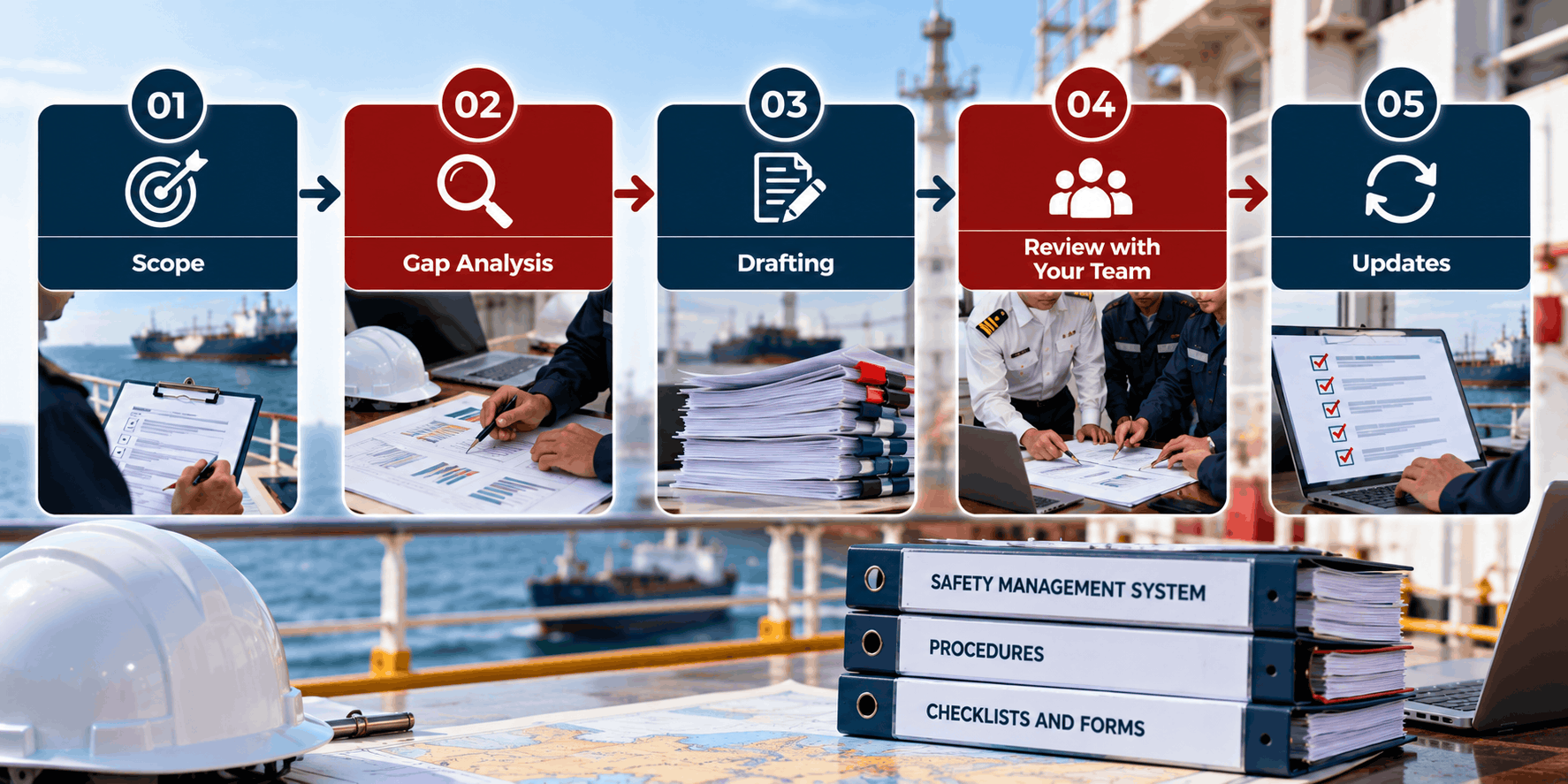
Scope call. We confirm your ship types, flag, trading areas, DOC status and existing documents.
-
SMS gap analysis. We compare your manuals and records against the ISM Code, your flag's expectations and how you actually operate. You get a ranked list of gaps.
-
Drafting or rewriting. We prepare the apex manual, company and fleet procedures, office emergency manual, ship type-specific manuals and checklists, the shipboard manual, and the forms and records list.
-
Review with your team. Your DPA and shore staff test the draft. We change anything that does not match real work.
-
Updating. We revise the system after audit findings, new ship types, flag changes or rule changes.
If you also need the certificate, we support the application through our DOC certification service. For supplier checks in your purchasing procedure, our vendor assessment service can help. You can see the wider range on our consulting services page, or look at related certification services.
What we cannot do: Your company must run the system and keep honest records. The flag or its Recognized Organization decides on approval and certification. We cannot promise an audit result, and we do not replace your DPA.
Ready to find out where your manual stands? Request an SMS gap analysis and we will review your current documents against your actual operation.
FAQS
FAQs About SMS manual preparation
-
1. Can one SMS manual cover both tankers and bulk carriers?
Yes, one company SMS can cover several ship types. Each type needs its own operating procedures and checklists, and your DOC must cover each type. Adding a type to an existing SMS is one reason a company may get an interim DOC, as explained on our DOC page.
- 2. Do I need a separate SMS manual for every vessel?
- 3. Does a small company with two ships need the full set of manuals?
- 4. How many pages should an SMS manual have?
- 5. Can AI tools draft SMS procedures?
- 6. Can I reuse the SMS from my previous employer?
- 7. Who approves the SMS manual?
- 8. Should the SMS be on paper or digital?
- 9. How long must we keep SMS records?
- 10. How long does SMS manual preparation take?


