
A DDOC certification is the certificate DGMA issues to shipping companies that run Type 3 or Type 4 river-sea vessels of 500 GT and above, under India's Domestic Safety Management (DSM) Code. Without it, those vessels cannot legally trade in Indian coastal waters. Here's exactly how the whole process works, from paperwork to audit to renewal.
What Is a DDOC and Who Actually Needs One?
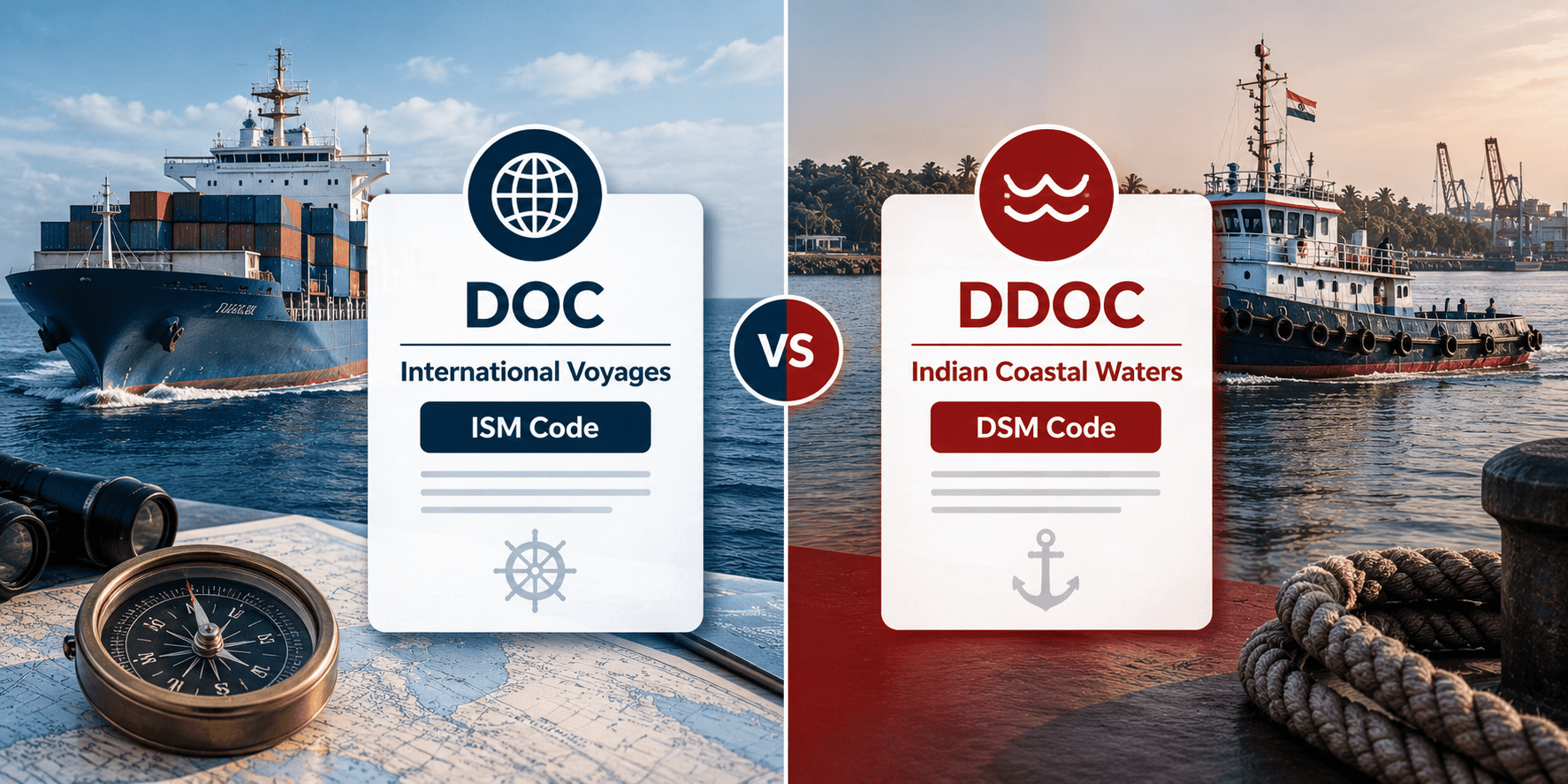
A DDOC (Domestic Document of Compliance) proves that your company runs a safety management system that meets the DSM Code. Think of it as the domestic cousin of the international Document of Compliance that ocean-going ships need under the ISM Code, just built specifically for vessels that never leave Indian waters.
You need a DDOC if your company operates a Type 3 or Type 4 river-sea vessel of 500 gross tonnage (GT) or more. That covers barges, tugs, coastal cargo carriers, and similar vessels shuttling between Indian ports rather than sailing internationally.
Picture a fleet of barges moving cement between Mumbai and nearby Gujarat ports, staying close to the coast the whole way. That's classic Type 3 or Type 4 territory. DGMA expects the company behind those barges, not just the vessels themselves, to hold a valid DDOC before any of them can sail.
One thing worth flagging early: the DDOC belongs to the company, not the ship. A single DDOC can cover your entire fleet of a given vessel type, the same way one international DOC can cover multiple sister ships.
What Is the DSM Code, and How Is a DDOC Different From an International DOC?
The DSM Code sits inside Chapter XII of the Indian River-Sea Vessels rules. Directorate General of Shipping introduced the audit and certification procedure through Engineering Circular No. 135 of 2011, and it borrows heavily from the ISM Code that governs international shipping, scaled down for domestic operations.
If your company recently secured a Full-Term Document of Compliance under the ISM Code for international trading, that's genuinely good news. It means your safety management system passed a demanding global standard, and you can put that on every tender document you send out. A DDOC runs on the same underlying logic: a documented safety system, a Designated Person Ashore, regular audits.
But don't treat the two as interchangeable. A DDOC is a separate certificate, issued under a separate code, for a completely different category of vessel. Companies sometimes assume their international DOC automatically covers a coastal barge they've just added to the fleet. It doesn't. If that barge is a Type 3 or Type 4 river-sea vessel of 500 GT or more, it needs its own DDOC coverage regardless of what the company already holds internationally.
|
Feature |
DOC (International) |
DDOC (Domestic) |
|
Governing code |
ISM Code, under SOLAS |
DSM Code, under Engineering Circular 135 of 2011 |
|
Applies to |
Ships on international or foreign-going voyages |
Type 3 & 4 river-sea vessels, 500 GT+, operating only within Indian waters |
|
Issued by |
DGMA, or a Recognized Organisation authorised on its behalf |
DGMA's ISM Cell directly, not delegated to ROs |
|
Vessel-level check |
Safety Management Certificate (SMC) |
Verified through Indian Register of Shipping (IRS) after the company DDOC is issued |
|
Typical fee, Indian flag |
Around ₹80,000 |
₹25,000 initial, ₹15,000 for renewal |
Which Vessels Actually Fall Under Type 3 and Type 4?
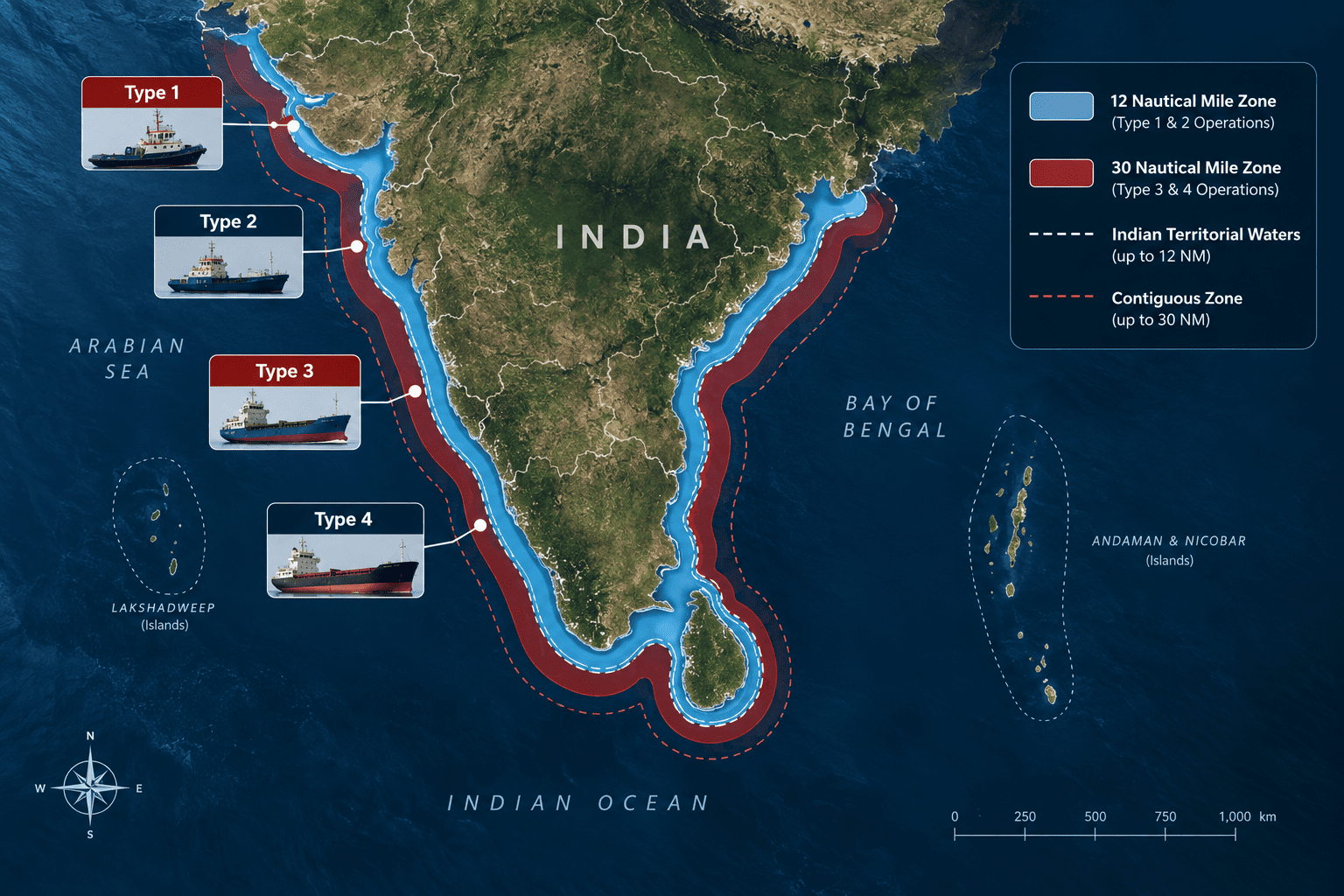
DGMA Order No. 6 of 2010 splits river-sea vessels into four categories. Only two of them, Type 3 and Type 4, need a DDOC, and only once they cross 500 GT.
|
Type |
What it covers |
Needs a DDOC? |
|
Type 1 |
Ship-shore operations beyond inland vessel limits, fair weather only. Coal lighterage outside Mumbai harbour is a common example. |
No |
|
Type 2 |
Voyages between nearby ports, fair weather, daylight hours only |
No |
|
Type 3 |
Voyages between Indian ports lasting under 48 hours, generally within 12 nautical miles of land (30 nautical miles in the Gulf of Cambay and Gulf of Kutch) |
Yes, at 500 GT and above |
|
Type 4 |
Voyages between Indian ports in all weather conditions, same distance limits as Type 3, engaged exclusively in Indian coastal trade |
Yes, at 500 GT and above |
Here's a nuance a lot of companies miss: a Type 1 or Type 2 vessel doesn't need a DDOC at all, even at 500 GT or more. So before you start preparing an SMS manual, confirm your vessel's actual type classification with your surveyor. Getting this wrong either means unnecessary paperwork or, worse, sailing without a certificate you actually needed.
Who Issues a DDOC, and Has the Authority Changed in 2026?
Yes, and it's worth knowing if you're applying now. The Directorate General of Shipping was renamed the Directorate General of Maritime Administration (DGMA) in 2026, under Section 7 of the new Merchant Shipping Act, 2025. The same office in Mumbai, the same ISM Cell that processes DOC and DDOC applications, now operates under the DGMA name.
Engineering Circular No. 135 of 2011 still governs the DDOC process day to day, and it was written when the authority was called DGMA. Some older forms and certificate templates may still carry that name during the transition. Don't let that confuse you. Applications, audit nominations, and certificates for DDOC continue through the same channel, just under DGMA's letterhead now.
What Documents Do You Need Before You Apply?
Get these ready before you approach the ISM Cell. Missing even one of them is the single biggest reason applications sit in a queue longer than they should.
-
Application fee, paid in favour of DGMA (still referenced as "D.G. Shipping" on older forms)
-
A short background note on the company
-
Organisation structure showing staff qualifications and experience
-
The specific ship type(s) the DDOC is being sought for
-
An SMS manual that meets DSM Code requirements
-
Company Identification Number, if you have one (optional)
-
Proof of your registered office, such as a rent agreement or sale deed
-
Certificate of Incorporation from the Registrar of Companies
-
DPA details along with proof of qualification
-
A duly filled DSM Form-03 (the audit request form)
If your company is a first-time applicant working with a company registration that's less than a year old, keep your incorporation documents and office lease handy from day one. Auditors ask for them early in the process.
Who Can Be Your Designated Person Ashore (DPA)?
Every DDOC application needs a Designated Person Ashore, plus an alternate DPA who can step in when the primary DPA is unavailable. This person is the direct link between your shore office and the vessel, and DGMA expects them to have direct access to your company's top management, not just a mid-level supervisor.
For Type 3 and Type 4 river-sea vessels, your DPA needs to meet one of these four qualification routes:
-
A Certificate of Competency (COC) as Master (NCV) or Chief Engineer (NCV), with adequate sea experience, or
-
A Naval Architect or B.E. (Mechanical Engineering) with at least 3 years of relevant past experience, or
-
A COC as Chief Mate (FG) or Second Engineer (FG), with at least 1 year of rank experience, or
-
A COC as 2nd Mate (FG) or Marine Engineer Officer Class IV (FG), with at least 3 years of rank experience
A common mistake here is appointing someone senior on paper who has no real bandwidth for the DPA role. The role isn't ceremonial. DGMA's audit team will ask your DPA specific questions about non-conformity tracking and audit history, and a DPA who's never touched the SMS manual struggles badly at that stage.
How Does the DDOC Application and Audit Process Actually Work?
-
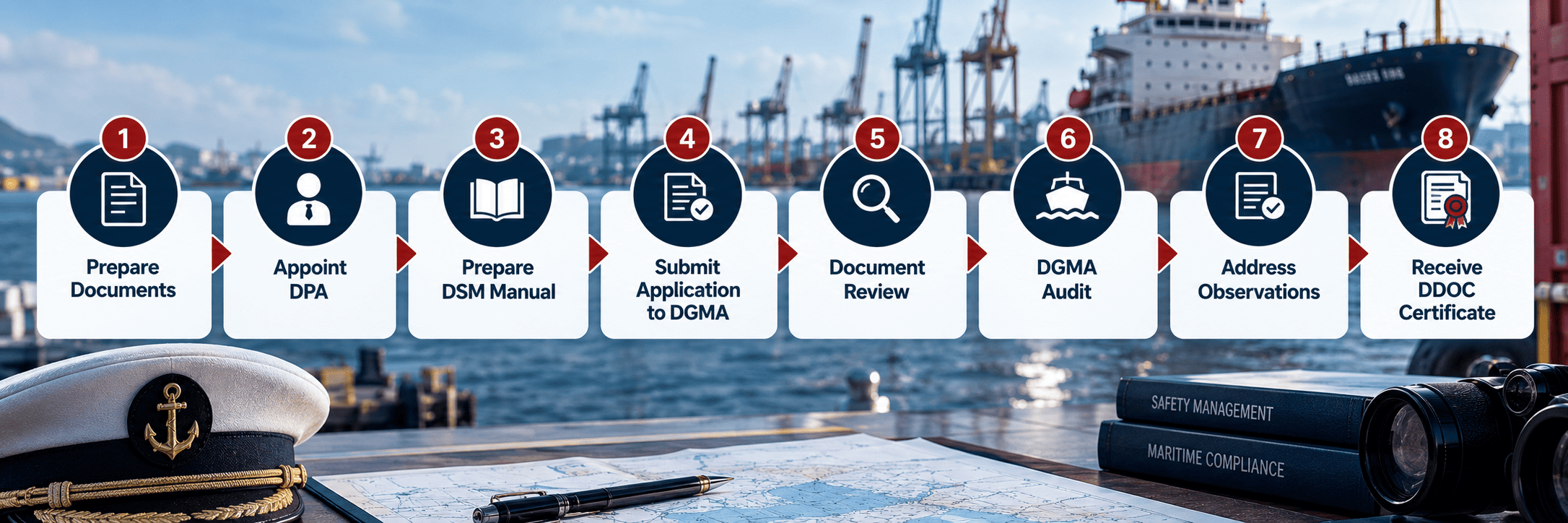
Build your SMS manual. Document your safety management system so it aligns with DSM Code requirements for your vessel type.
-
Appoint your DPA and alternate DPA. Confirm both meet the qualification table above, and keep their proof documents ready.
-
Apply to the ISM Cell. Submit DSM Form-03 along with your documents and the applicable fee, giving at least 30 days' notice before your preferred audit date.
-
Manual scrutiny. DGMA nominates an auditor to review your SMS manual first. Once satisfied, the auditor endorses it and sends a recommendation back to the ISM Cell.
-
Office audit. A DGMA-nominated audit team visits your company premises to verify the SMS in practice, not just on paper.
-
Close any non-conformities. If the audit raises findings, you have a fixed window to fix them (more on this below).
-
Certificate issued. Once the audit clears, DGMA issues your DDOC after you pay the ₹2,000 certificate fee.
-
Vessel-level verification. Take your DDOC to the Indian Register of Shipping (IRS) for the first assessment of your actual vessel, as instructed under MS Notice 07 of 2011.
What Are the DSM Forms You'll Actually Fill Out?
The DSM Code runs on a set of standard forms. Most companies only need to actively fill a handful of these; the rest are completed by the auditor or DGMA during the process.
|
Form |
Purpose |
|
DSM-01 |
Joint declaration by the owner or bareboat charterer and the company, confirming who takes responsibility for the vessel's operation |
|
DSM-02 |
Full company particulars, including DPA, alternate DPA, highest level of management, and branch office details |
|
DSM-03 |
Your audit request form, used for initial, intermediate, renewal, or additional audits |
|
DSM-04 |
The audit assessment report, completed by the audit team after your office audit |
|
DSM-05 |
Document review report, covering the SMS manuals the team leader examined |
|
DSM-06 |
Non-conformity, major non-conformity, or observation report, with a section for your corrective action plan |
|
DSM-07 |
The audit log, recording office and vessel audit details |
|
DSM-08 |
Declaration from the owner, naming the "company" responsible for DSM Code compliance, needed when an operator manages the vessel on the owner's behalf |
|
DSM-09 |
Declaration naming your DPA and alternate DPA, with their full contact details |
Forms DSM-01, DSM-02, DSM-03, and DSM-09 are the ones you'll typically prepare yourself. DSM-08 only applies if your company operates a vessel it doesn't own, which is common in ship management arrangements.
How Much Does a DDOC Cost, and How Long Does It Last?
|
Type of audit |
Fee |
|
Initial DDOC audit |
₹25,000 |
|
Intermediate, renewal, or additional DDOC audit |
₹15,000 |
|
Certificate issuance |
₹2,000 |
A full-term DDOC typically runs for five years, mirroring the international DOC cycle, with a mandatory intermediate audit that must be completed within 30 months (plus or minus 6 months) of issuance. Miss that window and you risk your certificate lapsing before its formal expiry date.
For renewals, apply at least two months before your current DDOC expires. DGMA needs that runway to schedule the audit and issue the new certificate before the old one runs out, and a gap in coverage means your vessels can't legally sail in the meantime.
What Happens After DGMA Issues Your Company's DDOC?
Getting the DDOC is only half the job. Once your company holds one, you still need each individual vessel checked. Under MS Notice 07 of 2011, companies approach the Indian Register of Shipping (IRS) for the vessel's first assessment, and periodically after that, to confirm the ship itself is actually running the SMS your DDOC promises on paper.
For ship managers handling vessels that undergo SIRE inspections, understanding the inspection process is equally important. Read our SIRE inspection guide for ship managers to learn more about preparing for inspections and managing vessel compliance.
If a different company operates the vessel on behalf of the owner, that operating company's full details need to reach both DGMA and IRS before it takes over management, using DSM-01, DSM-02, DSM-08, and DSM-09 together.
If you are planning to bring a foreign-flagged vessel into Indian coastal trade, you may also need to understand the process of converting a foreign vessel to the Indian flag before assessing its domestic compliance requirements.
What If the Auditor Finds a Non-Conformity?
Not every audit clears without findings, and that's normal. What matters is how quickly you close them.
You get a maximum of three months to close a non-conformity. Miss that window, and DGMA can treat it as a major non-conformity against your company, which puts your DDOC itself at risk of withdrawal, not just a delay to the next audit.
For genuinely major non-conformities found during any audit, DGMA won't issue, endorse, or renew your DDOC until you've fixed the issue and it's been verified. This is one area where cutting corners costs far more time than doing it properly the first time.
Is DDOC About to Change? What the Draft 2026 Rules Mean for You
Here's something most guides on this topic won't tell you, because it's genuinely recent. The Ministry of Ports, Shipping and Waterways has circulated draft Merchant Shipping (Safety Management) Rules, 2026, under the new Merchant Shipping Act, 2025. These are still in draft form as of now, not yet notified, so the Engineering Circular 135 process described throughout this article remains what's actually in force.
That said, it's worth knowing where things are headed. The draft rules propose putting DOC and DDOC on formal statutory footing rather than a circular-based scheme. For domestic vessels, they introduce a Ship Safety Certificate (SSC) in place of relying purely on IRS vessel verification, tighten internal SMS audit intervals to a maximum of 12 months, and give the Director General stronger powers to detain a vessel over unresolved non-conformities.
Nothing here changes what you need to do today. But if you're setting up your SMS documentation now, it's worth building it in a way that would transition cleanly if these rules get notified. Companies that treat their DPA role and audit trail seriously already tend to have an easier time whenever a framework like this tightens.
FAQS
FAQs About DDOC Certification
-
Can a company hold both a DOC and a DDOC at the same time?
Yes, and it's fairly common for ship management companies with a mixed fleet. Your international DOC covers vessels on foreign-going trade, while your DDOC covers Type 3 or Type 4 river-sea vessels operating only within Indian waters. They're tracked as separate certificates with separate audit cycles.
- Does a river-sea vessel below 500 GT need a DDOC?
- What happens if the vessel operator isn't the registered owner?
- Is DDOC mandatory for vessels that never leave port limits?
- Does DGMA conduct the DDOC audit online, or is an office visit mandatory?
- What happens to vessel-level certificates if the company's DDOC is withdrawn?
- How is a DDOC different from a Ship Safety Certificate?
- Can one DDOC cover multiple branch offices?
- Who checks the DPA's qualification documents before the audit?
- Can a newly incorporated shipping company apply for a DDOC right away?


