DOC Audit Preparation: Interim, Initial, Annual & Renewal
DOC audit preparation helps a shipping company check whether its Safety Management System (SMS) meets the applicable requirements of the International Safety Management (ISM) Code and works in practice. It includes reviewing procedures, audit records, vessel documents, staff responsibilities and previous findings before the formal verification.
A Document of Compliance (DOC) applies to the company responsible for operating ships under the ISM Code. The company must maintain an effective SMS, keep suitable records and address identified deficiencies. The preparation needed for an interim DOC audit differs from the work required for annual verification or renewal.
Legal Babu helps shipping companies prepare through SMS gap analysis, document reviews, audit readiness planning and corrective action follow-up. Support can be discussed for Indian-flag applications and other flag administrations, subject to the requirements and scope of the specific case.
If your company is approaching its DOC anniversary, setting up a new ship management operation or preparing for renewal, start by confirming the audit stage and reviewing the evidence that the auditor may need.
For an overview of the certification process, see Legal Babu's Document of Compliance (DOC) certification service.
What Is DOC Audit Preparation?
DOC audit preparation is the process of checking whether a shipping company's management arrangements, records and working practices meet the applicable requirements of the ISM Code.
The audit examines the company's Safety Management System, not just the presence of manuals in an office. The company should demonstrate that its procedures guide actual work, that responsible staff understand their duties, and that the system identifies and addresses problems.
For example, a company may have a written procedure for reporting an engine-room incident. During preparation, it should check whether staff understand the procedure, whether incidents are recorded and investigated, and whether the company follows up on corrective actions.
A manual alone cannot demonstrate all of this.
What does a DOC audit examine?
The scope depends on the audit stage, the ship types covered by the DOC, the applicable requirements and the audit plan. Preparation should generally cover:
-
The company's safety and environmental protection policy.
-
Company responsibilities and reporting lines.
-
The role of the Designated Person Ashore (DPA).
-
SMS manuals, procedures, instructions and records.
-
Internal audits and management reviews.
-
Incident reporting, investigation and follow-up.
-
Emergency preparedness and drills.
-
Maintenance arrangements and records.
-
Compliance with applicable statutory requirements.
-
Previous audit findings and corrective action status.
-
Evidence that the SMS works across relevant company and fleet operations.
The company should identify records that demonstrate how each procedure works. For instance, a maintenance procedure should be supported by maintenance plans, work records, defect reports and follow-up evidence where applicable.
The International Maritime Organization's ISM Code resources provide the regulatory starting point for understanding the safety management framework.
Why Does a Shipping Company Need Proper DOC Audit Preparation?
An audit can reveal weaknesses that routine office checks have missed. A company may have updated its manuals but failed to brief the people who use them. It may have completed an internal audit but left findings open without clear evidence of effective action.
A pre-audit review helps the company identify such gaps and decide what needs attention before formal verification.
1. To check whether the SMS works in practice
The company should compare its written procedures with actual operations.
Suppose the SMS requires the DPA to receive reports of serious safety concerns. The preparation review should check how the company receives those reports, who reviews them, how decisions are recorded and how the company communicates outcomes to the vessel.
If staff do not follow the documented process, the company needs to find out why. Changing the wording alone may not resolve the problem.
2. To find gaps in records and evidence
Auditors need evidence to assess whether the company's arrangements meet the applicable requirements.
Missing internal audit reports, incomplete drill records, overdue management reviews or unclear corrective action records can make it difficult to demonstrate effective implementation.
A pre-audit review should identify missing evidence and assign responsibility for addressing it. The company must not create records retrospectively to make the system appear compliant. It should establish what happened, record the facts accurately and correct any underlying process failure.
3. To prepare staff for the audit
The DPA, designated shore staff and other relevant employees should understand the SMS and their responsibilities.
They should be able to explain how the company handles incidents, reports deficiencies, responds to emergencies and follows up on audit findings. They do not need to memorise every sentence in a manual. They do need to understand the procedures relevant to their work.
4. To manage findings before they become larger problems
A pre-audit review can help the company identify repeated issues, unclear responsibilities or weak follow-up arrangements.
For example, if several internal audits identify the same problem with maintenance records, the company should examine why it keeps recurring. A reminder to staff may help, but the underlying cause could involve unclear instructions, insufficient training or an unsuitable recordkeeping process.
Practical insight: Give every identified gap an owner, a due date and a clear record of the evidence needed to close it. A list of problems without assigned responsibility is not an effective corrective action plan.
What Are the Main DOC Audit Stages?
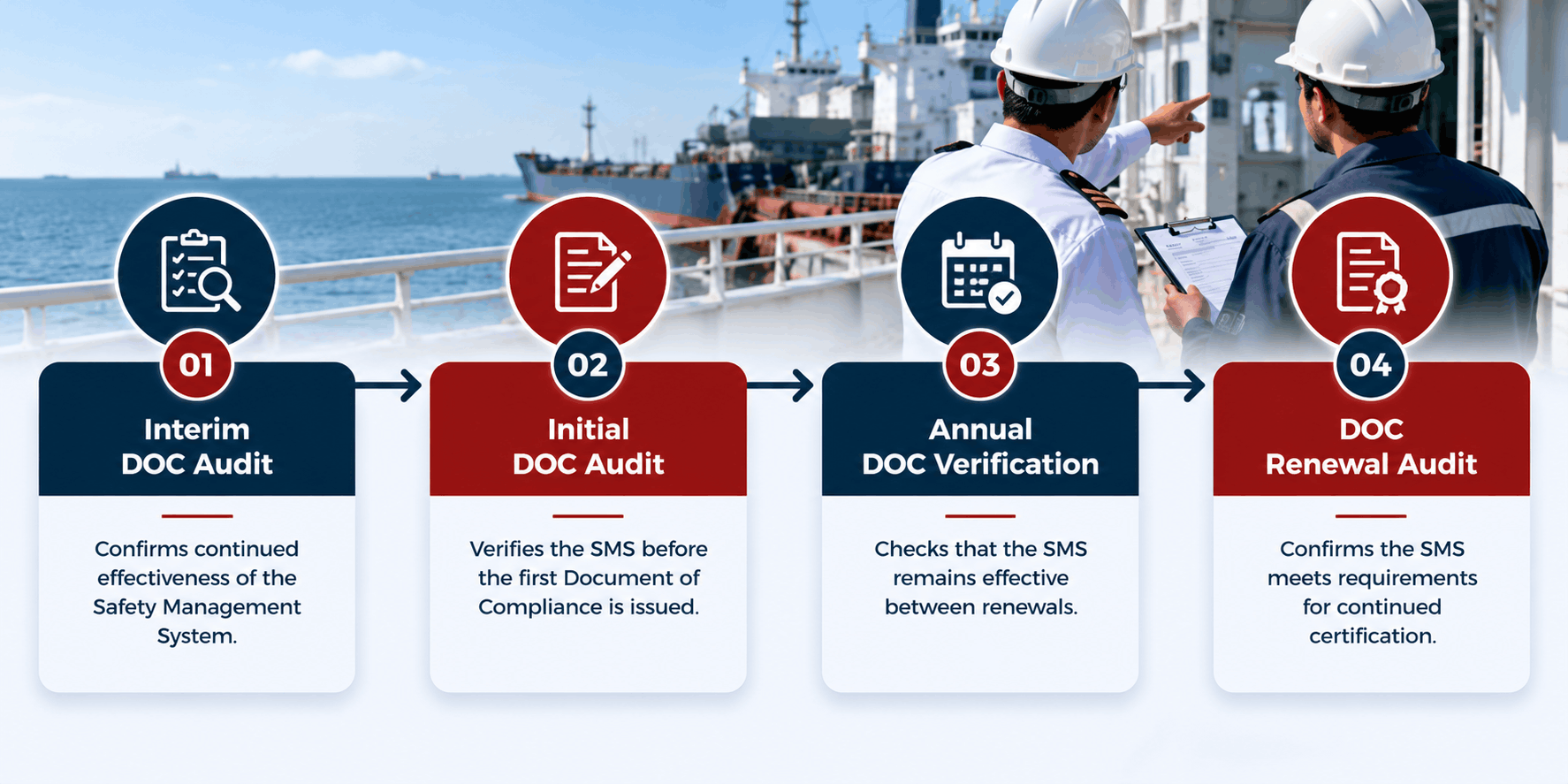
A company may encounter an interim DOC audit, an initial audit, annual verification or a renewal audit. Each stage serves a different purpose, so the preparation plan should reflect the company's circumstances.
| Audit stage | When does it apply? | What should the company prepare? |
|---|---|---|
| Interim DOC audit | When the company seeks interim DOC certification under the applicable ISM Code provisions | Planned SMS arrangements, company organisation, relevant documents and evidence required for the interim audit |
| Initial DOC audit | When the company seeks full-term DOC certification | Implemented SMS, internal audit evidence, management review records, operational controls and relevant statutory and classification records |
| Annual DOC verification | During the annual verification cycle for an existing DOC | Current SMS records, changes to the system, internal audit results, previous findings and relevant statutory and classification records |
| DOC renewal audit | When the DOC approaches the end of its validity | Evidence of continuing SMS effectiveness, previous verification results, corrective action records, system changes and records required for renewal |
The exact scope and evidence requirements depend on the applicable ISM Code provisions, the audit stage and the flag administration or authorised Recognized Organization conducting the verification.
What is the difference between an interim and an initial DOC audit?
An interim DOC supports the initial implementation of the SMS under the conditions set out in the ISM Code. An initial DOC audit assesses whether the company's implemented SMS meets the requirements for full-term certification.
The distinction matters because a new company may still be establishing its arrangements when it seeks interim certification. For full-term certification, the company must be ready to demonstrate that its system has been implemented and is functioning effectively.
The company should confirm the applicable requirements and audit arrangements with the relevant administration or authorised Recognized Organization before setting its preparation schedule.
How does annual DOC verification differ from renewal?
Annual verification checks whether the company's SMS continues to function effectively and remains compliant with the ISM Code. Renewal verification assesses compliance as part of the process for renewing the DOC at the end of its certification period.
The IMO's revised guidelines on implementation of the ISM Code state that annual DOC verification should take place within three months before or after the anniversary date. Renewal verification must be completed before the certificate expires.
Do not wait until renewal to review the system. The annual verification process gives the company an opportunity to identify recurring weaknesses, review changes and address gaps before they become more difficult to resolve.
How Do You Prepare for an Interim DOC Audit?
An interim DOC audit is particularly relevant to a company establishing its ship management arrangements or seeking coverage for an additional ship type, where the applicable requirements permit it.
The preparation work should establish whether the company has the organisation, documentation and planned arrangements required for the interim certification process.
Step 1: Confirm the company and ship-type scope
Before preparing manuals, establish which legal entity will manage the ships and which ship types the company intends to cover.
Confirm the intended operating arrangements, the relevant flag administration and the applicable certification requirements. A company planning to manage oil tankers may need different ship-type procedures from a company planning to manage bulk carriers.
If you are setting up a new maritime business, Legal Babu's maritime technical consultancy for RPSL companies and startups may also be useful for understanding the wider setup and compliance requirements.
Step 2: Review the company's SMS documentation
Check whether the relevant manuals and procedures are available, consistent and suitable for the intended operation.
Depending on the company's SMS, the document set may include:
-
Safety and environmental protection policy.
-
Company and fleet procedures.
-
Shipboard operational procedures.
-
Emergency preparedness arrangements.
-
Incident reporting and investigation procedures.
-
Maintenance and defect reporting arrangements.
-
Internal audit and management review procedures.
-
Document control and recordkeeping processes.
The exact documentation required depends on the applicable requirements and the company's operation. Avoid preparing manuals that describe processes the company has no practical means of implementing.
For a list of the documents commonly associated with an application, refer to Legal Babu's DOC certification and application guide.
Step 3: Confirm responsibilities and resources
Review the organisation chart and make sure assigned responsibilities are clear. Staff should understand who makes decisions, who reports safety concerns and how the company supports its ships.
The company should also review the appointment and responsibilities of the DPA, including communication between the ships and the highest level of management.
Step 4: Confirm the interim audit requirements
Ask the relevant flag administration or authorised Recognized Organization to confirm the applicable interim audit scope, documents, timing and arrangements.
An interim DOC does not remove the need to develop and implement an effective SMS. The company should maintain a clear plan for implementing the system and meeting the conditions required for subsequent certification.
Where Legal Babu can help: Legal Babu can review the proposed SMS, check company documentation, identify gaps and help coordinate audit preparation. The company remains responsible for implementing its procedures and providing accurate evidence.
How Should You Prepare for an Initial DOC Audit?
An initial DOC audit requires the company to demonstrate that its SMS is implemented and meets the applicable ISM Code requirements.
A company should approach this stage with evidence from its actual operations, rather than relying only on manuals prepared during setup.
What should be checked before an initial audit?
1. SMS implementation
Check whether the company has put its documented procedures into practice. Staff should understand their responsibilities, and the company should be able to show how it applies the system to the ships under its management.
2. Internal audit records
Review the internal audit programme, reports, findings and follow-up records. Confirm that the audits covered the required areas and that identified issues received appropriate attention.
3. Management review
Check whether the company has reviewed SMS performance, considered relevant findings and changes, and recorded decisions about improvements or resources.
4. Ship and company records
Review relevant statutory and classification records for the ship types covered by the DOC, together with other records required by the audit scope.
5. Emergency preparedness
Check whether emergency procedures are appropriate, responsibilities are clear and relevant drills or exercises have been carried out and recorded as required.
6. Non-conformity management
Review open and closed findings. Each finding should have a clear description, an assessment of its cause, an appropriate action plan and evidence showing whether the action worked.
How can a company tell whether it is ready?
The company should be able to trace a requirement from the written procedure to its implementation and supporting records.
For instance, if the SMS requires the company to investigate a serious incident, the company should be able to show the applicable procedure, the investigation record for a relevant incident where one occurred, the corrective action decision and any follow-up needed to prevent recurrence.
If no relevant incident has occurred, the company should not manufacture an example. It should demonstrate its arrangements using the evidence that genuinely exists and explain how the process would operate.
Where Legal Babu can help: Legal Babu can conduct a Master Mariner-led gap analysis, review SMS implementation evidence, help organise the audit file and track identified gaps through to documented closure.
What Is Checked During Annual DOC Verification?
Annual DOC verification checks whether the company's SMS continues to comply with the ISM Code and functions effectively.
The IMO's Resolution A.1071(28), Revised Guidelines on the Implementation of the ISM Code, explains that annual safety management audits should include examining and verifying the correctness of statutory and classification records presented for at least one ship of each type covered by the DOC.
Annual verification should take place within three months before or after the DOC anniversary date. Companies should confirm the relevant dates and arrangements with their administration or authorised Recognized Organization.
What should be reviewed before annual verification?
Use the previous verification report as a starting point. Then review:
-
Changes to the company's organisation, responsibilities or SMS.
-
The internal audit schedule and completed reports.
-
Management review records and decisions.
-
Previous non-conformities, observations and corrective actions.
-
Relevant statutory and classification records for the applicable ship types.
-
Incident reports, investigations and follow-up.
-
Emergency drills and preparedness records.
-
Maintenance, defect reporting and related procedures.
-
Staff training and familiarisation records, where relevant.
-
Changes to the fleet or the scope of the company's management activities.
This review should focus on changes and weaknesses since the last verification. Rechecking every document without assessing whether the SMS is working can consume time while leaving important gaps untouched.
How should the company review changes to the SMS?
Identify changes made since the previous audit and check whether the company managed them properly.
For example, a new vessel may bring different equipment, operating procedures or statutory requirements. The company should check whether its SMS covers those changes, whether the relevant staff understand them and whether the required records are available.
A company that has changed its DPA, shore staff or internal responsibilities should also check whether the change was documented and communicated appropriately.
What if the company has open findings?
Do not assume that every open finding will automatically prevent successful verification. The effect depends on the nature of the finding, the applicable requirements and the assessment of the auditor or administration.
The company should know the status of each finding, the reason it remains open, the actions already taken and the evidence still required. It should agree the next steps with the relevant authority or organisation where necessary.
IMO guidance explains that failure to take adequate corrective action, including measures to prevent recurrence, may be considered a major non-conformity. The company should treat repeated or significant findings with particular care.
How Do You Prepare for a DOC Renewal Audit?
A DOC is generally issued for a period not exceeding five years, subject to the applicable certification provisions and continued compliance. Renewal requires the company to demonstrate that its SMS continues to meet the relevant requirements.
Do not leave renewal preparation until the certificate is close to expiry. Begin by reviewing the current certificate, the renewal schedule and the administration's requirements.
What records should be ready for renewal?
The renewal preparation file should include records relevant to the audit scope, such as:
-
The current DOC and previous verification reports.
-
The latest SMS manuals and revision history.
-
Internal audit plans and reports.
-
Management review records.
-
A register of findings and corrective action status.
-
Records of relevant incidents and investigations.
-
Evidence of changes to the company's organisation or fleet.
-
Relevant statutory and classification records.
-
Evidence of implementation of updated procedures.
-
Records requested by the administration or authorised Recognized Organization.
The auditor may need to assess the SMS across the relevant company activities and ship types. Preparation should therefore reflect the actual scope of the DOC rather than relying on a generic folder of documents.
When should renewal preparation begin?
Set the preparation schedule around the DOC expiry date, audit availability and the time needed to address gaps.
The company should confirm the renewal requirements and timetable with the relevant authority or organisation. It should not assume that submitting an application, scheduling an audit or receiving a provisional communication automatically extends the existing certificate.
Practical insight: Review repeated findings from earlier audits first. If the same weakness has appeared in several reports, prepare evidence of the change made to address its underlying cause and how the company checks that the change remains effective.
What Should a DOC Audit Checklist Include?
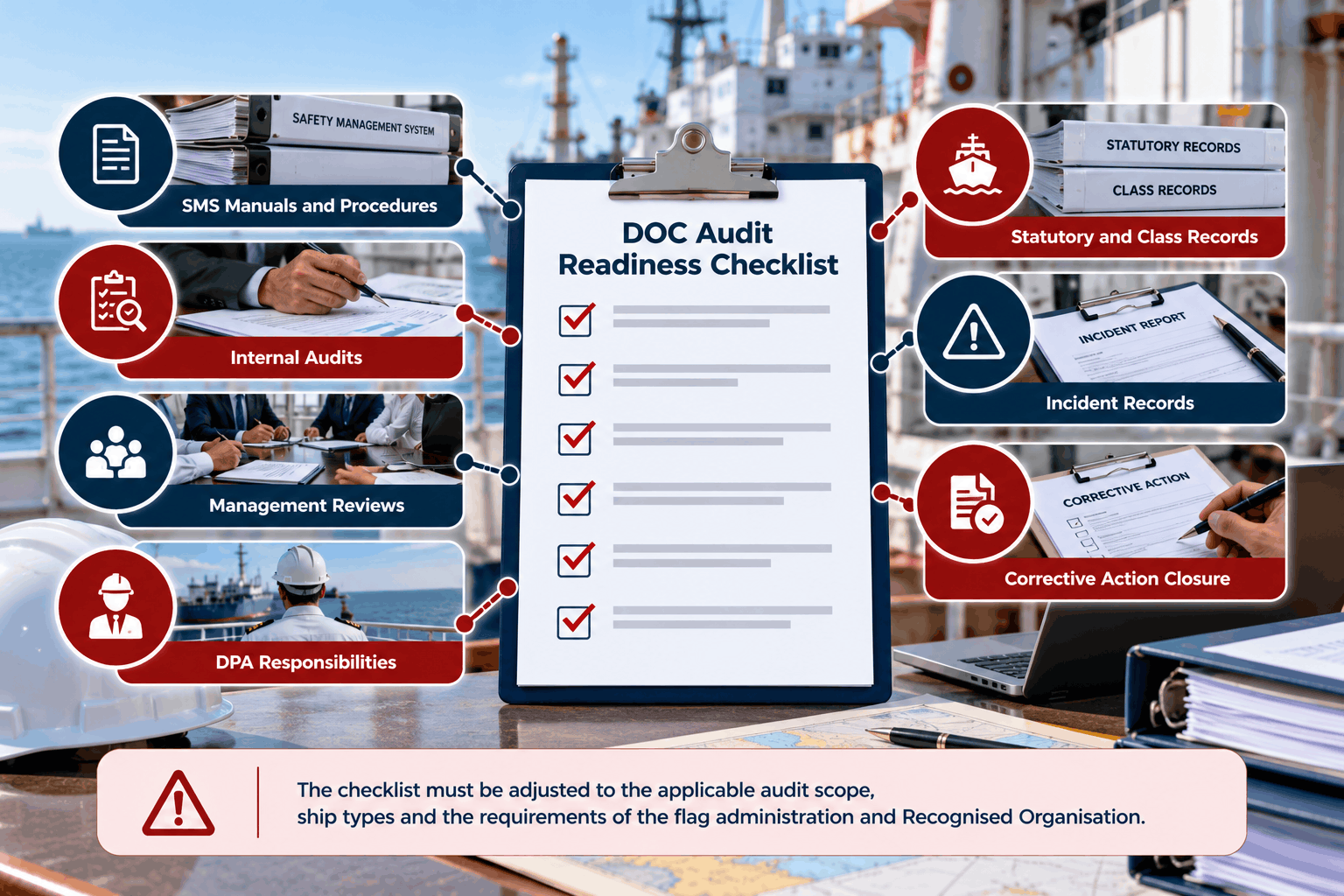
A useful DOC audit checklist should help the company verify both documentation and implementation. It should also identify who is responsible for each item and what evidence will demonstrate that the requirement has been met.
The checklist below is a preparation aid, not an official audit form. The applicable administration or authorised Recognized Organization may require additional evidence.
DOC audit readiness checklist
| Review area | What to check | Evidence to locate |
|---|---|---|
| Company organisation | Are duties and reporting lines clear? | Current organisation chart and assigned responsibilities |
| DPA arrangements | Are the DPA's role and communication routes clear? | Appointment records, role description and communication records |
| SMS documentation | Are procedures current and suitable for company operations? | Controlled manuals, procedures and revision records |
| Document control | Can staff identify the current version of a procedure? | Document register, revision history and distribution records |
| Internal audits | Were audits planned and completed as required? | Audit schedule, reports and finding register |
| Management review | Has management reviewed SMS performance and relevant issues? | Review minutes, decisions and assigned actions |
| Incident management | Are incidents reported, investigated and followed up? | Incident reports, investigation records and action tracking |
| Emergency preparedness | Are relevant arrangements documented and tested as required? | Emergency procedures, drill records and follow-up |
| Maintenance | Are maintenance and defect-reporting processes implemented? | Maintenance records, defect reports and relevant follow-up |
| Statutory and class records | Are applicable records available and correct for relevant ship types? | Relevant statutory certificates and classification records |
| Corrective actions | Are findings assessed, assigned and tracked? | Finding register, action plans and closure evidence |
| SMS changes | Have relevant changes been assessed and communicated? | Revision records, change documentation and familiarisation evidence |
How should you use the checklist?
First, assign an owner to each review area. The person responsible should know which records to check and who can provide missing information.
Second, record the evidence, not just the status. Marking an item “complete” is less useful than recording the report number, document location, review date or other evidence that supports the decision.
Third, identify gaps honestly. If a required record is missing, determine whether the problem is incomplete documentation, a process that was not followed or a wider failure in the SMS.
Fourth, track corrective actions. Set a target date, assign responsibility and define the evidence needed to verify that the action has worked.
Finally, confirm the audit scope. Adjust the checklist to the company, the ship types covered and the applicable requirements. It should not replace the audit plan issued by the relevant administration or organisation.
How Should You Close Non-Conformities Before a DOC Audit?
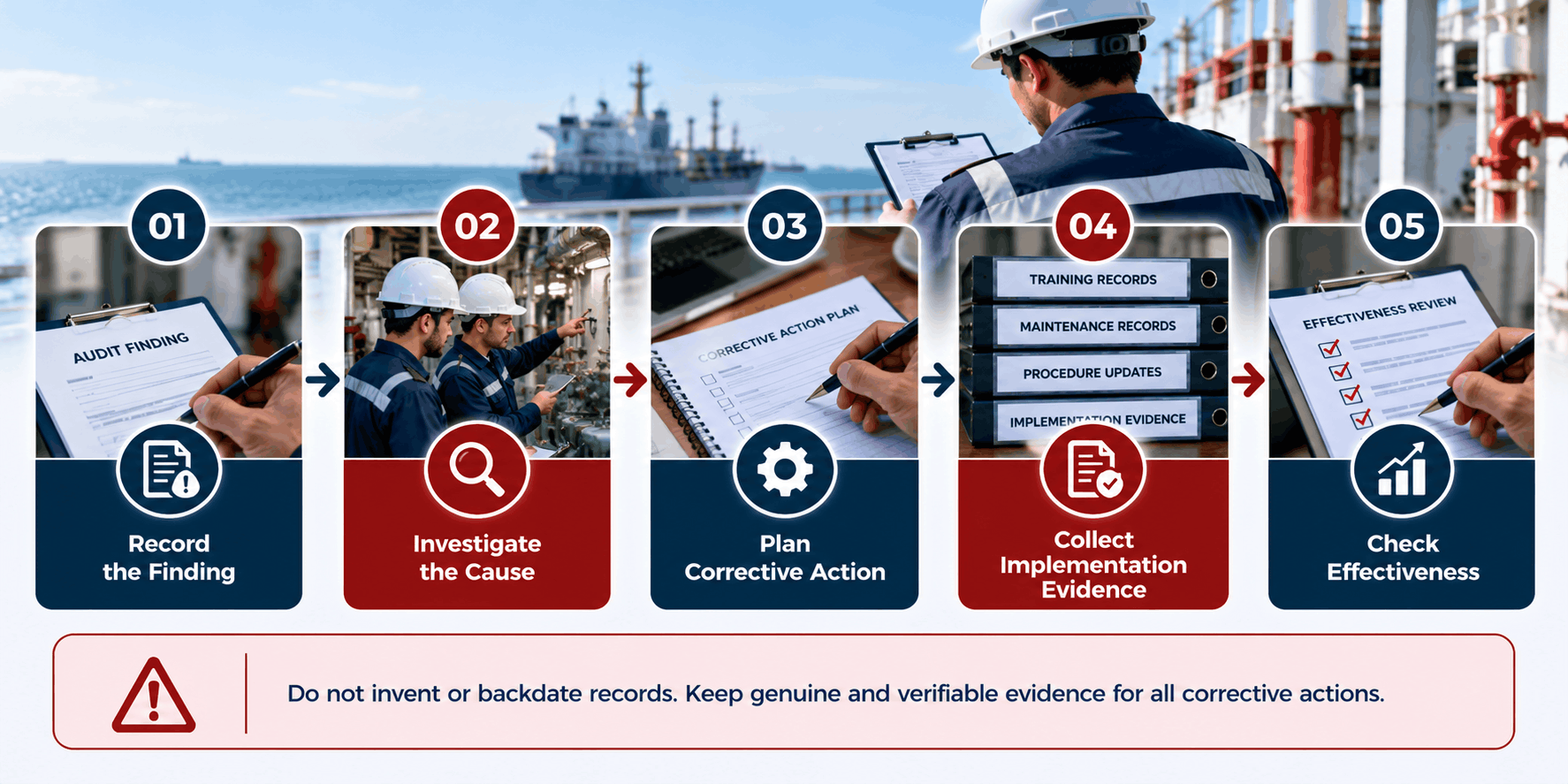
A non-conformity needs more than a quick correction. The company should understand what requirement was not met, what happened, why it happened and what action will prevent recurrence.
The appropriate response depends on the finding, the evidence and the applicable requirements. The auditor or administration determines how the finding is classified and what follow-up is required.
What is the difference between correction and corrective action?
A correction addresses the immediate problem. A corrective action addresses the cause of the problem to prevent it from recurring.
For example, suppose a company discovers that a required record was not completed.
-
Correction: Complete or recover missing information where this can be done accurately and legitimately.
-
Cause analysis: Determine why the record was missed. Possible causes might include unclear responsibility, poor familiarisation or an unsuitable process.
-
Corrective action: Change the process, responsibility or training arrangement to address the identified cause.
-
Effectiveness check: Review subsequent records to see whether the change works.
The company must never backdate records or invent evidence. If an event was not recorded at the time, it should establish the facts, document the issue transparently and follow the applicable reporting and corrective action process.
What should a corrective action record contain?
A practical record usually includes:
-
The finding and the requirement involved.
-
The objective evidence supporting the finding.
-
The immediate correction, where appropriate.
-
The analysis of the underlying cause.
-
The action planned to address that cause.
-
The person responsible for the action.
-
The target completion date.
-
Evidence that the action was completed.
-
An effectiveness review, where applicable.
-
The status of any required audit follow-up.
The required format may vary. What matters is that the company can show a clear, accurate record of its response.
How can Legal Babu help with non-conformity closure?
Legal Babu can help the company review findings, examine likely causes, organise supporting evidence and track corrective action progress. The team can also help identify repeated issues that suggest a wider weakness in the SMS.
The company must implement the agreed changes and provide accurate records. The relevant auditor or administration decides whether the response satisfies the applicable requirements and whether further verification is necessary.
How Do Internal Audits and Management Reviews Support DOC Readiness?
Internal audits and management reviews help a company assess whether its SMS works between external verification visits.
They serve different purposes. An internal audit checks whether relevant activities and arrangements meet the applicable requirements. A management review allows company management to assess performance, consider significant issues and decide what changes or resources may be needed.
What should the internal audit review cover?
The internal audit programme should reflect the company's SMS and applicable requirements. Depending on the scope, it may examine:
-
Whether staff follow documented procedures.
-
Whether records are complete and accurate.
-
Whether assigned responsibilities are understood.
-
Whether previous findings have been addressed.
-
Whether emergency arrangements are implemented.
-
Whether incidents and deficiencies are investigated appropriately.
-
Whether changes to the SMS have been implemented.
-
Whether the company can demonstrate ongoing compliance.
Internal audits should not simply repeat the external audit checklist. They should help the company find weaknesses while there is still time to correct them.
What should management review consider?
The review should address relevant information about SMS performance, including audit findings, incidents, corrective actions, changes to operations and issues requiring management decisions.
A useful management review record identifies the issue discussed, the decision made, the person responsible and any follow-up date. A meeting record that says only “all matters discussed” provides little evidence of what management decided.
For companies that also maintain quality, environmental or occupational health and safety systems, some review processes may share supporting information. Legal Babu's Integrated Management System (IMS) consultancy covers the integration of:
-
ISO 45001 occupational health and safety management, available through Legal Babu's certification services
These standards do not replace the ISM Code or the need to meet the applicable DOC requirements.
How Do DOC Audits Relate to DDOC, MLC 2006, IACS Class and SIRE Inspections?
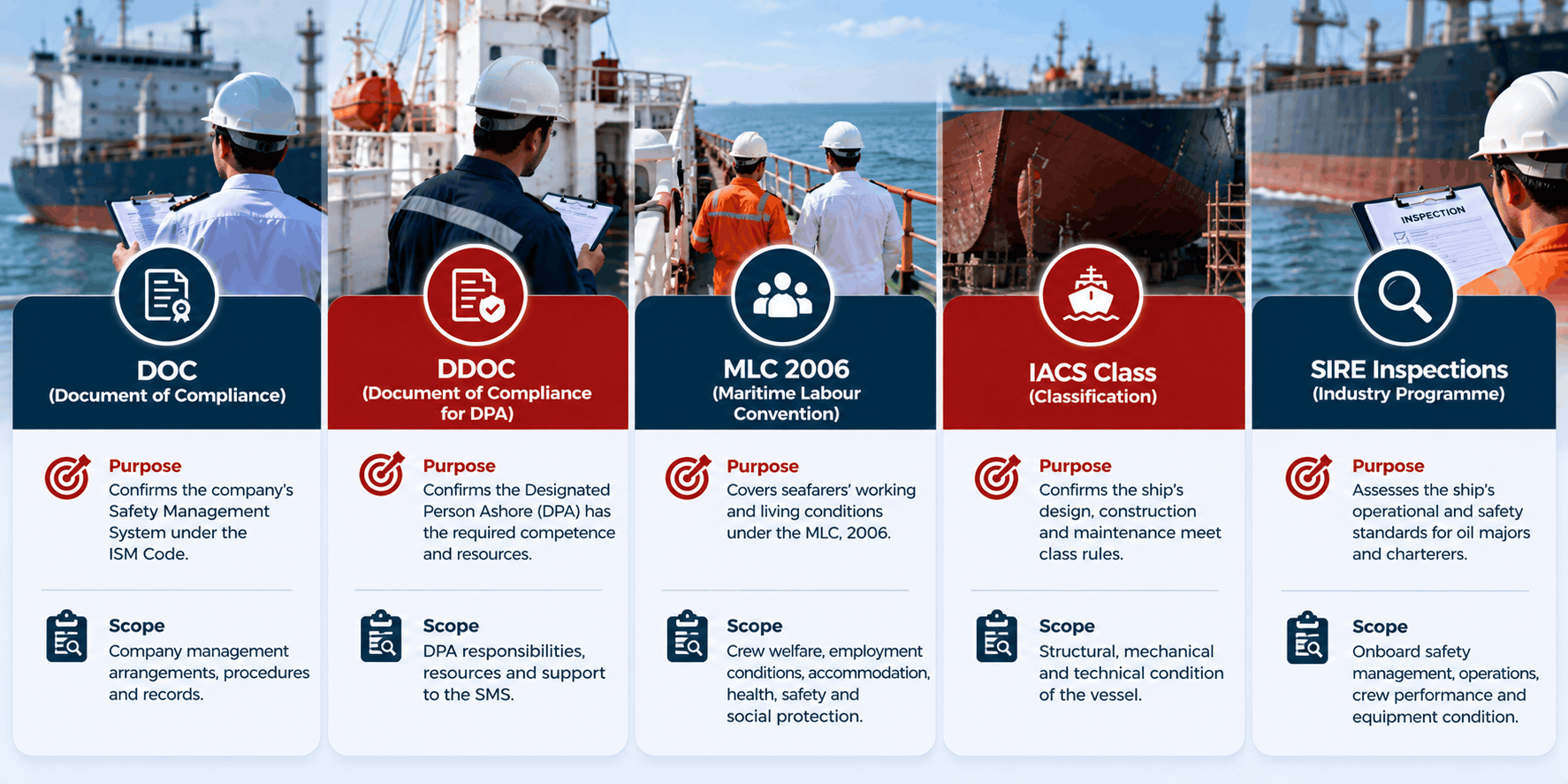
Shipping companies may face several compliance processes at the same time. Some examine the company's safety management system, while others focus on domestic vessel operations, seafarer working conditions, classification or a charterer's inspection requirements.
Understanding the difference helps the company avoid using the wrong checklist or assuming that one certificate satisfies every requirement.
| Compliance area | Main focus | How it relates to DOC preparation |
|---|---|---|
| DOC under the ISM Code | The company's safety management system and its effectiveness | Directly relevant to the company's ISM audit and verification |
| DDOC | Domestic safety management requirements where applicable | Relevant to companies and vessels within the applicable domestic framework |
| MLC 2006 | Maritime labour requirements and seafarer protections within its scope | May involve separate ship or recruitment-related compliance requirements |
| IACS classification | Technical condition of the vessel and compliance with applicable class rules | Relevant statutory and classification records may be reviewed during DOC verification |
| SIRE 2.0 inspections | An oil company's or charterer's vessel inspection process under the applicable SIRE programme | May involve overlapping operational evidence, but does not replace a DOC audit |
| ISO 9001, ISO 14001 and ISO 45001 | Quality, environmental and occupational health and safety management systems | May support related management processes but do not replace ISM Code certification |
Does a DDOC replace a DOC?
No. A DOC and a Domestic Document of Compliance (DDOC) relate to different regulatory frameworks. Whether a company or vessel needs a DOC, a DDOC or another form of compliance depends on the applicable requirements and its operating circumstances.
For more information, read Legal Babu's DDOC certification guide. Companies should confirm the applicable domestic requirements before choosing the certification route.
Does MLC 2006 compliance mean the company will pass a DOC audit?
No. MLC 2006 and the ISM Code address different requirements, even where their practical implementation overlaps.
For example, crew-related procedures, training and emergency arrangements may support safe ship operations, but evidence that a company meets one set of requirements does not automatically establish compliance with the other.
See Legal Babu's MLC 2006 certification guide and its guide to MLC Regulation 1.4 and seafarer recruitment agencies for related compliance information.
Can a class survey replace a DOC audit?
No. Classification surveys and ISM Code verification have different purposes. Class records may form part of the evidence examined during a DOC audit, but the company must still meet the applicable ISM Code requirements.
If the vessel is also changing flag, the company should coordinate registration and technical compliance work alongside its safety management arrangements. Legal Babu's guide to registering a vessel under the Indian flag explains the wider flagging process.
For background on classification organisations, see the IACS classification societies guide.
Does passing a SIRE inspection prove DOC compliance?
No. A SIRE inspection and a DOC audit have different scopes. A company may use findings from one process to identify areas for improvement in its operations, but it should not treat one inspection outcome as proof of compliance with all the requirements of another.
Read Legal Babu's SIRE 2.0 inspection guide for ship managers for details on the separate inspection process.
Can ISO certification replace the company's SMS?
No. ISO management system certification does not replace the company's obligations under the ISM Code.
An integrated management system may help coordinate procedures, audits, document control and corrective action tracking. However, the company must still demonstrate that its SMS meets the applicable ISM Code requirements and works for the ships it manages.
What Does Legal Babu Do During DOC Audit Preparation?
Legal Babu supports shipping companies that need help reviewing their SMS, organising audit evidence and preparing for DOC verification. The work can be planned around the audit stage, the company's existing system and the gaps identified during the review.
1. Master Mariner-led gap analysis
The team reviews relevant documentation and operational evidence against the applicable requirements and agreed scope. This helps identify gaps that the company should address before the audit.
The review may cover the SMS, internal audit records, management review, responsibilities, corrective actions and relevant statutory or classification records.
2. Audit readiness planning
Legal Babu can help organise preparation into a practical plan. This includes identifying outstanding items, assigning responsibilities, tracking target dates and coordinating the documentation needed for the audit.
The plan should reflect the actual audit date and requirements, rather than using the same timetable for every company.
3. SMS and document review
The team can review relevant manuals, procedures, records and revision controls. Where gaps appear, it can help the company identify the changes or evidence needed to address them.
The company remains responsible for ensuring that the SMS reflects its real operations and that its staff follow the applicable procedures.
4. Corrective action follow-up
Legal Babu can help maintain a register of findings, record the planned actions and track the evidence required for closure. Where a problem appears repeatedly, the review can help the company examine whether its response addresses the underlying cause.
Closure remains subject to the applicable requirements and the relevant auditor's or administration's assessment.
5. Coordination for Indian and other flags
Legal Babu can discuss DOC audit preparation for Indian-flag applications and other flag administrations, depending on the specific case.
The audit scope, process, documents, fees and scheduling depend on the relevant administration or authorised Recognized Organization. Confirm these details before committing to an audit date.
To discuss your requirements, visit Legal Babu's consulting and advisory services or contact the team through the Legal Babu contact page.
Important: Legal Babu provides consultancy and preparation support. The relevant flag administration or authorised Recognized Organization retains responsibility for the formal audit and certification decisions.
What Should You Do Before Booking Your DOC Audit?
Before fixing an audit date, complete a short readiness review.
-
Confirm the audit stage and the scope of the DOC.
-
Check the certificate's anniversary or expiry date, as applicable.
-
Confirm audit requirements with the relevant administration or authorised organisation.
-
Review the latest SMS manuals and document register.
-
Check internal audit and management review records.
-
Review all open and previously closed findings.
-
Confirm the status of corrective actions and their supporting evidence.
-
Check relevant statutory and classification records for the applicable ship types.
-
Make sure responsible staff understand their duties.
-
Assign owners and target dates to outstanding preparation work.
If the review identifies significant gaps, discuss the preparation schedule with the relevant administration or organisation before assuming the planned date can be retained.
Get a DOC audit readiness review
If your company is approaching an interim, initial, annual or renewal DOC audit, Legal Babu can help review the SMS, identify documentation gaps and plan corrective action follow-up.
Get a DOC audit readiness review from Legal Babu.
Contact Legal Babu to discuss your audit stage, flag, ship types and preparation needs.
FAQS
FAQs About DOC Audit Preparation
-
1. How early should a company start preparing for a DOC audit?
Start as soon as the audit stage and expected date are known. Review the applicable requirements, previous findings, internal audit records and SMS documentation first. The time needed depends on the company's readiness and the number and severity of gaps. Confirm the audit timetable with the relevant administration or authorised Recognized Organization.
- 2. Can a shipping company prepare for a DOC audit without a consultant?
- 3. What happens if an auditor identifies a major non-conformity?
- 4. Does the company need to close every observation before the audit?
- 5. What should a company do if its previous audit findings keep recurring?
- 6. Can the company change its SMS shortly before a DOC audit?
- 7. What if the company's DPA or key shore staff change before the audit?
- 8. Can a DOC audit be conducted remotely?
- 9. What is the difference between a DOC audit and an SMC audit?
- 10. Does a DOC remain valid if the company has not closed an audit finding?


