
Condition Surveys: Types, Process & Importance in Shipping
Condition surveys are independent, physical inspections of a ship's condition, machinery, safety gear, and documents. P&I clubs, buyers, charterers, and insurers use them to judge risk before entry, purchase, or charter. Unlike a class survey, a condition survey does not renew any certificate. It only reports what the surveyor actually finds on board.
What Is a Condition Survey in Shipping?
A condition survey is a hands-on check of a ship's real, current state. A qualified marine surveyor boards the vessel, walks through it, and writes down what they actually see.
The surveyor looks at the hull, the engine room, the deck gear, the safety equipment, and the paperwork. They weigh all of this against the ship's age, trade, and past record.
Nobody issues a new certificate at the end of a condition survey. Instead, the surveyor files a report. That report tells the client, often a P&I club, a buyer, or a charterer, exactly what shape the ship is really in.
This is what sets a condition survey apart from a statutory survey. A statutory survey checks a ship against fixed legal rules. A condition survey asks a simpler, blunter question: is this vessel a safe bet to insure, buy, or hire right now?
Practical note: Owners sometimes treat a condition survey like a routine formality. It rarely is. A club or buyer reads this report closely, and a rough one can cost far more than the survey fee itself.
Why Do Ships Need a Condition Survey?
Ships age fast under salt water, cargo loads, and constant vibration. A condition survey exists to catch problems before they turn into claims, disputes, or accidents.
For a P&I club, the survey flags a vessel likely to generate future claims. For a buyer, it flags hidden repair bills before money changes hands. For a charterer, it protects against damage disputes once the hire period ends.
Port State Control data backs this up. The Paris MoU's 2024 annual report recorded that inspectors detained roughly 4% of the ships they checked that year, mostly for serious safety or structural deficiencies. A solid condition survey usually catches the same issues weeks or months earlier, while they still cost far less to fix.
A clean survey report also helps day-to-day business. It reassures a P&I club at renewal, speeds up a sale negotiation, and gives a charterer confidence before fixing the ship on a voyage.
How Is a Condition Survey Different From a Classification Survey?
This is one of the most confused points in shipping. Owners often assume that a fresh class certificate means a ship will sail through any condition survey. That is not always true.
A classification survey checks a ship against the technical rules of its class society, on a fixed cycle: annual, intermediate, and special (renewal) surveys, plus periodic dry-docking. Passing these keeps the ship's class certificate valid.
A condition survey has no fixed cycle and no rulebook to renew. A P&I club, a bank, or a buyer requests it whenever they need an honest, independent snapshot of the vessel's actual condition, seen through a commercial and risk lens rather than a pure compliance one.
|
Aspect |
Classification Survey |
Condition Survey |
|
Who requires it |
Class society rules, tied to flag state law |
P&I club, buyer, bank, charterer, or insurer |
|
Purpose |
Confirms the ship meets class rules |
Assesses commercial and safety risk |
|
Outcome |
Certificate renewed or endorsed |
Written report; no certificate issued |
|
Frequency |
Fixed cycle (annual, intermediate, special) |
As needed (age, sale, entry, casualty) |
|
Conducted by |
Classification society surveyor |
Independent marine surveyor, sometimes a class surveyor |
A ship's Document of Compliance and Safety Management Certificate get checked in both a class audit and a condition survey, but for different reasons. Class checks whether the paperwork exists and is valid. A condition surveyor also asks whether the crew actually follows what the paperwork says.
What Are the Different Types of Condition Surveys?
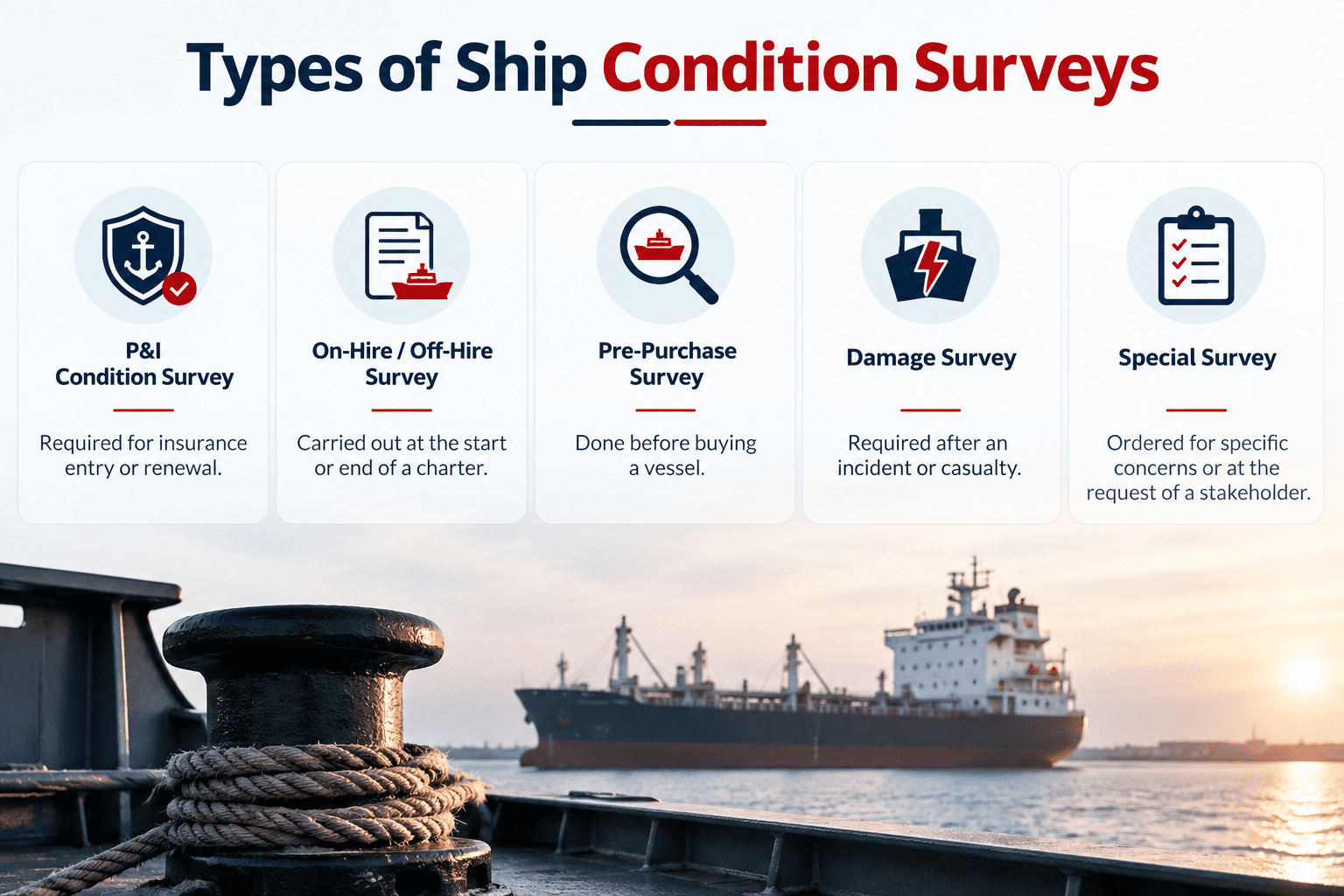
"Condition survey" is really an umbrella term. The scope, depth, and client change depending on why the survey happens.
-
P&I Condition Survey: Ordered by a Protection & Indemnity club, usually when a ship of a certain age is presented for entry, or already entered and due for a periodic check.
-
On-Hire / Off-Hire Survey: Carried out at the start and end of a time charter. It records damage to cargo spaces and decks, plus a bunker survey to measure fuel remaining on board.
-
Pre-Purchase Inspection (PPI): Requested by a prospective buyer before a sale and purchase deal closes. It is the deepest and most time-consuming type, since real money rides on the findings.
-
Damage Survey: Carried out after a casualty, grounding, collision, or fire, to record the extent of damage and estimate repair costs. Hull underwriters often insist on this.
-
Hull & Machinery (Insurance) Survey: Requested by an H&M underwriter, usually tied to the ship's age or a specific claim, to confirm the vessel remains an acceptable insurance risk.
|
Survey Type |
Who Orders It |
Typical Trigger |
Usual Duration |
|
P&I Condition Survey |
P&I club |
Vessel age, new entry, claims history |
Half a day to 2 days |
|
On/Off-Hire Survey |
Owner or charterer |
Start or end of time charter |
About 1 day |
|
Pre-Purchase Inspection |
Prospective buyer |
Sale and purchase transaction |
2 to 4 days |
|
Damage Survey |
Owner, underwriter, or club |
Casualty, grounding, collision, fire |
Depends on damage extent |
|
H&M Survey |
Hull underwriter |
Age threshold or claim history |
1 to 2 days |
When Is a Condition Survey Required?
Most owners run into a condition survey requirement at one of these points:
-
Vessel age: Many P&I clubs in the International Group ask for a survey once a ship hits 10 years old at entry. Some clubs push that threshold to 12 years for cargo ships that are not tankers or passenger vessels. The exact age varies by club, so it is worth checking the specific club's rules rather than assuming a single industry number.
-
Change of P&I club or insurer: A new club almost always wants its own current look at the ship before accepting the risk.
-
Sale and purchase: A buyer rarely signs without a pre-purchase inspection, since it directly shapes the final price.
-
Start or end of a time charter: On-hire and off-hire surveys protect both owner and charterer from disputes about pre-existing damage.
-
After a casualty: A grounding, collision, fire, or heavy weather incident almost always triggers a damage survey.
-
After a PSC detention or flag state action: A club may want an independent view once a ship has been flagged as a concern.
-
At the club's discretion: Rule 20B-type clauses in most P&I club rules let the Managers call for a survey at any time, particularly after a claim linked to a technical defect.
Who Conducts a Condition Survey for Ships in India?
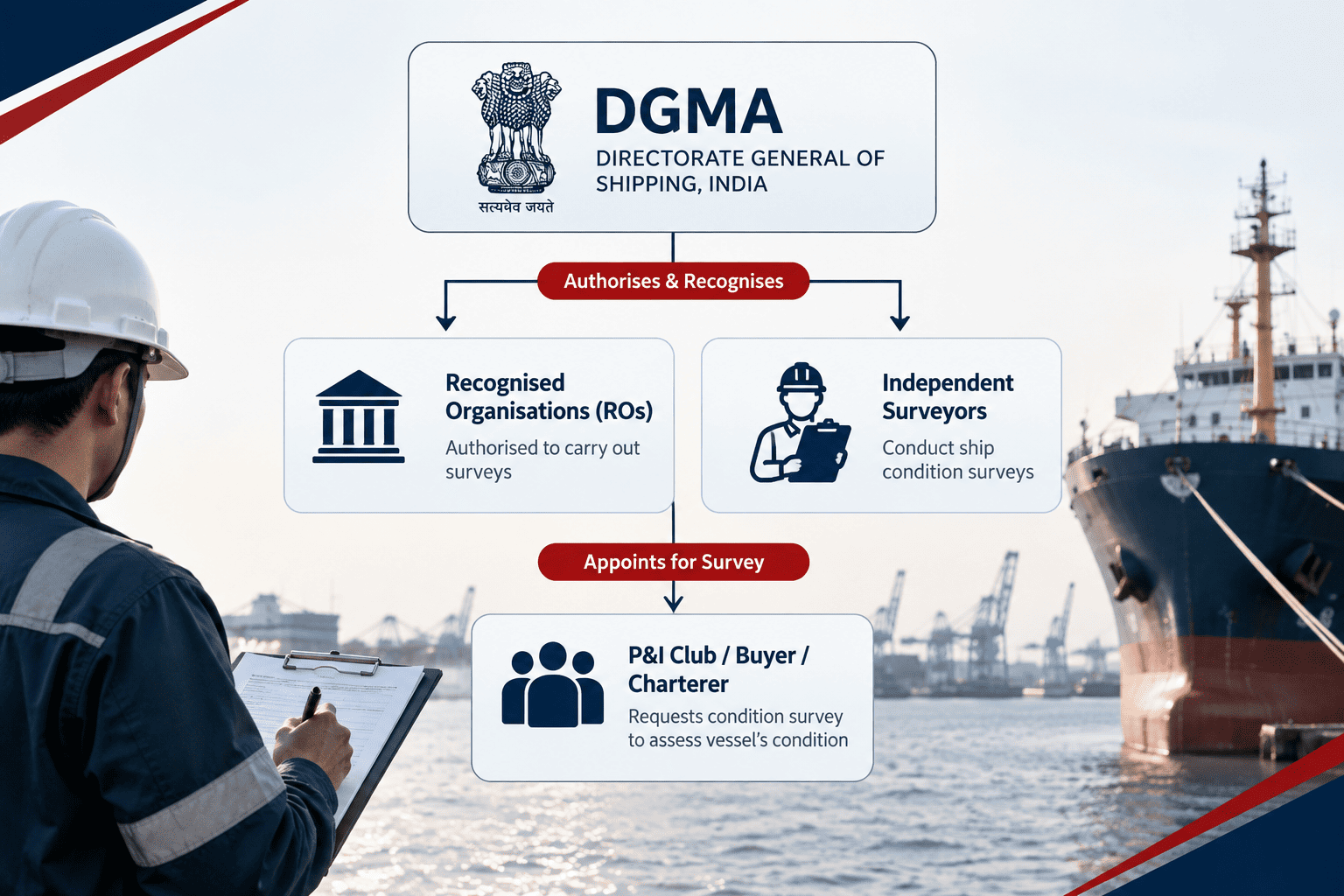
For Indian-flagged tonnage, the Directorate General of Maritime Administration (DGMA) oversees statutory surveys, audits, and certification under the Merchant Shipping Act, 2025. Commercial condition surveys sit outside that statutory framework, but the same technical community usually carries them out.
-
Independent marine surveyors: Often former Masters or Chief Engineers, working for dedicated survey firms rather than any single classification society.
-
Classification societies acting as ROs: Societies empanelled by DGMA as Recognised Organisations, including the Indian Register of Shipping (IRClass), also take on commercial condition survey work.
-
The P&I club's own panel: Most clubs keep a short list of trusted, pre-vetted surveyors in each major port to keep reporting consistent.
-
DGMA-linked surveyors for coastal and river-sea vessels: Type 3 and Type 4 vessels holding a DDOC certificate under the DSM Code follow the same commercial logic. A clean condition survey report makes it easier to renew hull cover or sell the vessel later.
If you are bringing a foreign-owned vessel under the Indian flag, get the ship registration process right first. A fresh condition survey is often requested as part of that transition, especially for older tonnage.
What Does the Condition Survey Process Involve?
A condition survey follows a fairly consistent five-step pattern, whatever the trigger behind it.
-
Document review. Before boarding, the surveyor asks for class records, the last survey report, general arrangement plans, and the Planned Maintenance System (PMS) history. This desk review shapes what they focus on once on board.
-
Onboard inspection. The core of the job. The surveyor walks through cargo spaces, ballast tanks, the engine room, the bridge, and accommodation, checking against a structured list built for that vessel type.
-
Operational testing. Wherever safe and practical, the crew demonstrates key equipment: the emergency generator, steering gear from each control position, deck cranes, and bilge alarms.
-
Certificate and documentation audit. The surveyor checks statutory certificates such as the Document of Compliance, the Safety Management Certificate, and, where relevant, the MLC 2006 certificate covering crew welfare and living conditions.
-
Reporting. After leaving the ship, the surveyor writes up the findings with photos, lists any deficiencies, and gives the client a clear picture for their decision.
Practical note: Ships that keep tidy PMS records almost always get through step one faster. A surveyor who spends less time hunting for paperwork has more time to look at the ship itself, which usually works in the owner's favour.
What Areas Does a Surveyor Check During the Inspection?
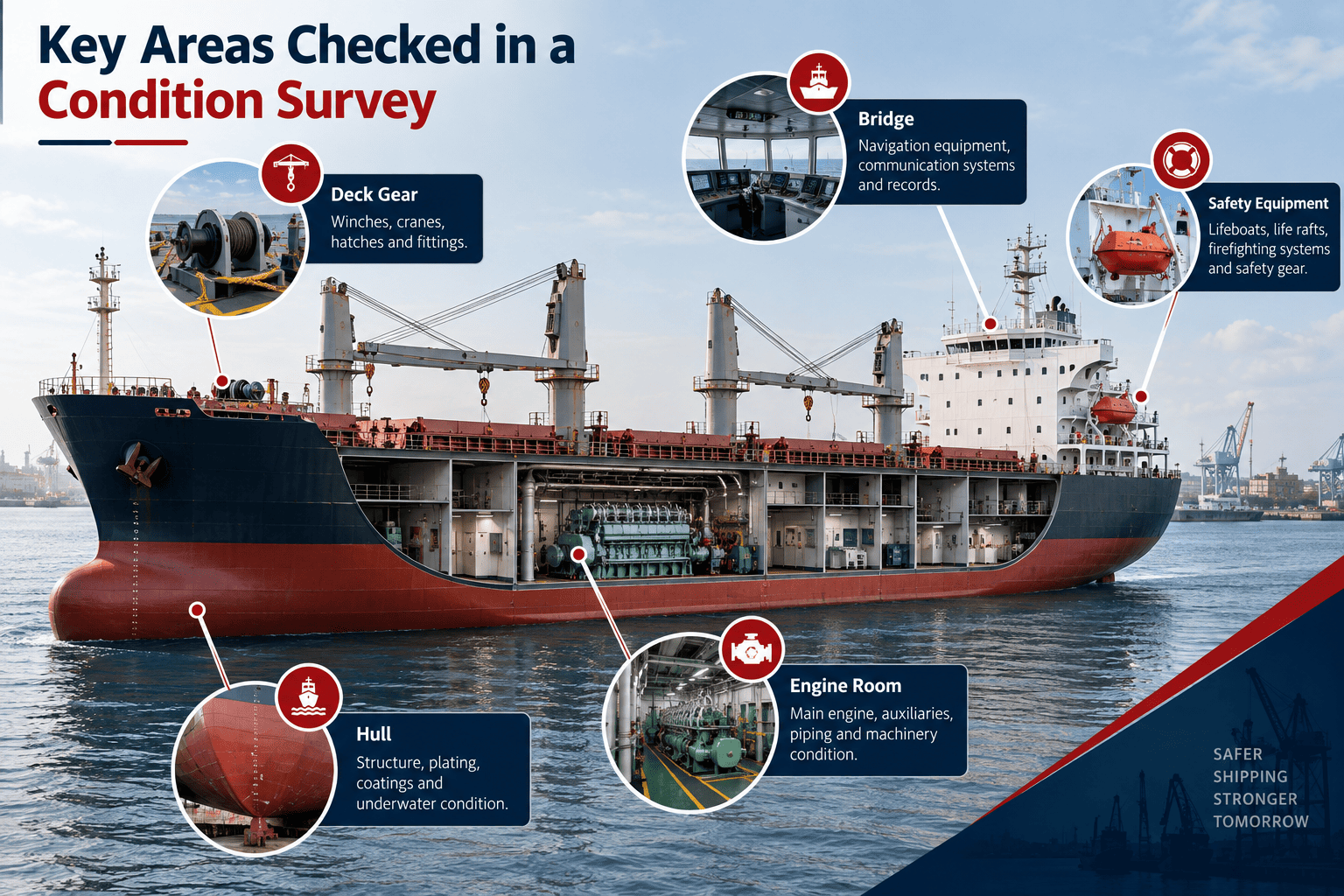
The exact checklist shifts by vessel type, but most condition surveys cover the same core areas:
-
Hull and structure: Plating, the main deck, and internal frames, checked for corrosion, cracking, or deformation. Ballast tank coatings get particular attention, since breakdown here is common and expensive to fix.
-
Machinery and engine room: Main and auxiliary engines, generators, purifiers, and steering gear, judged against running hours and PMS records, not just appearance.
-
Deck and cargo systems: Mooring gear, anchoring equipment, cranes, and, on bulk carriers, hatch cover seals, since a leaking hatch is one of the most common causes of cargo damage claims.
-
Navigation and bridge equipment: Radar, ECDIS, gyrocompass, and GMDSS gear, along with logbook entries and the compass error record.
-
Safety and lifesaving appliances: Lifeboats, davits, life rafts, fire-fighting systems, and personal protective gear, all checked against SOLAS requirements and their own service records.
-
Statutory certificates and crew records: Trading certificates, plus crew contracts and welfare records under MLC 2006. Where a manning agent supplies the crew, the surveyor may also note whether that agent holds a valid RPSL license, since MLC compliance depends on using a properly licensed recruitment and placement service.
Ships whose managers already run a shore-based ISO 45001 occupational health and safety system, or an Integrated Management System (IMS) certification covering quality, environment, and safety together, tend to show fewer findings during these inspections. Their maintenance and safety routines already run on a documented, repeatable system, so there is less for a surveyor to flag.
What Happens When a Surveyor Finds Deficiencies?
Almost no condition survey comes back completely clean, and that is normal. What matters is how serious the findings are and how fast they get closed.
Minor items, like a missing log entry or a worn but functional fitting, usually just go on a list with a rectification deadline. Major items, such as heavy corrosion in a ballast tank or an inoperable lifeboat engine, carry real consequences.
-
A P&I club can decline entry, or accept the ship only with tighter terms.
-
An H&M underwriter can load the premium or exclude certain cover.
-
A buyer can renegotiate the purchase price or walk away from the deal.
-
A charterer can hold the owner liable for damage recorded at on-hire but not present at off-hire.
Most clubs and buyers allow a follow-up survey once repairs are done, so a rough first report is rarely the end of the story. It is a checkpoint, not a verdict.
How Is a Condition Survey Different From a SIRE Inspection?
These two get mixed up often, especially by newer ship managers, but they serve different purposes.
A SIRE inspection is OCIMF's Ship Inspection Report Programme, a vetting system used mainly for tankers before oil majors and terminals agree to charter them. It focuses on operational procedures and crew competence as much as physical condition, and the report goes into a shared industry database.
A condition survey covers any vessel type, not just tankers, and is commissioned privately by a club, buyer, or insurer rather than an oil major.
|
Aspect |
Condition Survey |
SIRE Inspection |
|
Applies to |
All vessel types |
Mainly tankers |
|
Commissioned by |
P&I club, buyer, insurer, charterer |
Oil majors and terminals via OCIMF |
|
Main focus |
Physical condition and commercial risk |
Operational procedures and crew competence |
|
Report destination |
Private client only |
Shared OCIMF database |
A tanker can easily need both in the same year, for entirely different audiences and entirely different reasons.
What Does a Condition Survey Typically Cost?
There is no single fixed fee, since the cost depends on several moving parts.
-
Vessel size and type: A large tanker takes longer to walk through than a small coastal vessel, and the day rate reflects that.
-
Survey type and depth: A pre-purchase inspection runs deeper and longer than an on/off-hire survey, so it usually costs more.
-
Location: Ports with fewer resident surveyors mean higher travel and mobilisation charges.
-
Surveyor experience: A senior surveyor with a strong track record often charges a higher day rate, but frequently finishes the job faster and with a more useful report.
Rather than chase a single number, ask the surveyor or firm for a written quote based on your ship's actual particulars and the survey scope you need. A quote built on real details beats any generic estimate.
How Should a Shipowner Prepare for a Condition Survey?
A little preparation genuinely changes how a survey goes. Before the surveyor arrives:
-
Keep the Document of Compliance, Safety Management Certificate, and MLC certificate current and easy to find.
-
Update the PMS with recent maintenance entries, not just a backlog cleared the week before.
-
Close out old deficiencies from the last survey wherever possible.
-
Brief the crew on which equipment they may be asked to demonstrate, such as the emergency generator or steering gear.
-
Keep spares, log books, and drawings accessible rather than buried in a store room.
For a pre-purchase survey specifically, it helps to run a broader due diligence review alongside the technical inspection, covering ownership history, outstanding claims, and prior class records, so the buyer sees the full picture and not just the ship's physical condition.
Where Does a Condition Survey Fit Into Wider Compliance?
A condition survey rarely stands alone. It usually sits next to a wider set of compliance obligations that shape how a ship trades day to day, from its Document of Compliance and, for coastal tonnage, its DDOC certificate, to crew welfare under MLC 2006 and recruitment through a properly licensed RPSL agent.
Operators who also run shore-based systems, such as an EHS audit programme or a formal ISO 45001 safety framework, tend to walk into a condition survey with fewer surprises, simply because the underlying discipline already exists.
LegalBabu's consulting team works with shipowners and managers across these connected pieces, from certificate readiness and manning compliance to pre-purchase due diligence, so a condition survey becomes one more manageable step rather than an unplanned scramble.
FAQS
FAQs about Condition Surveys
-
How long does a ship condition survey usually take?
Most single-vessel condition surveys take between half a day and two days. A pre-purchase inspection runs longer, often two to four days, since it covers more ground and carries higher financial stakes.
- Who pays for a P&I condition survey, the club or the shipowner?
- Can a P&I club refuse entry after a bad condition survey?
- Is a condition survey the same as a Port State Control inspection?
- Does a condition survey affect hull and machinery insurance premiums?
- How often should an owner get a voluntary condition survey?
- What happens if the crew disagrees with a surveyor's finding?
- Can a classification society surveyor also carry out a P&I condition survey?
- Do small coastal and river-sea vessels in India need condition surveys?
- What documents should be kept ready onboard before the surveyor arrives?


