
A Ship Chandler License in India is not a nationwide permission that lets a supplier work at every seaport. In practice, the applicant must follow the licensing route of the relevant port and may also need Customs clearance, food-safety approval and separate entry passes for people and vehicles. This distinction matters because documents, fees, validity and renewal rules change between ports.
This guide explains what ship chandling covers, how to identify the authority, which records to prepare and how an application moves from registration to approval. It examines the V.O. Chidambaranar Port fee position, Cochin Port user-registration checklist, renewal risks, delay reasons and compliance after approval.
What Does a Ship Chandler License Actually Cover?
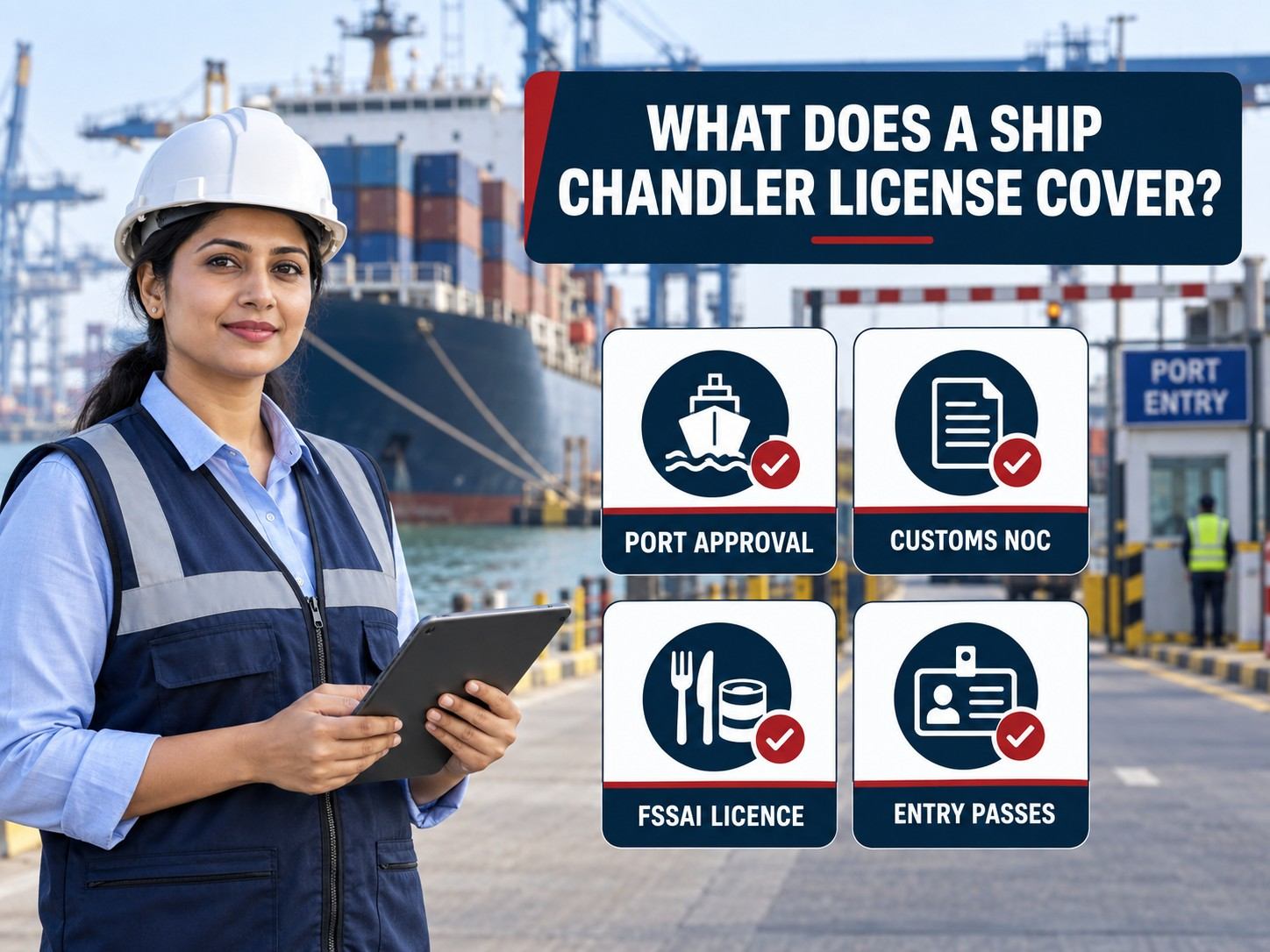
A ship chandler supplies vessels during a port call. The approved scope may cover provisions, cabin stores, deck and engine items, tools, spare parts or another activity accepted by the port. Supplies must also move through controlled port areas.
The phrase “Ship Chandler License in India” can be misleading if read as one central licence. Approval is linked to the port authority's jurisdiction and the trade categories in the application. A licence for one port or activity is not automatic authority for another port, bonded operation, repair or bunkering.
Supplying provisions, technical stores and bunker fuel should not be treated as the same activity. A business intending to deliver marine fuel should separately review the bunker supplier registration requirements and confirm the applicable port, safety and product-specific approvals. A ship-chandler licence alone should not be presented as authorisation to conduct bunkering operations.
The V.O. Chidambaranar Port form lists Ship Chandling, Ship Repairing, Chipping and Painting, and Miscellaneous Trade as separate categories. The applicant must select the actual work proposed.
Licences and approvals that must not be confused
|
Approval or registration |
What it addresses |
Does the port licence replace it? |
|
Business and GST registration |
Legal identity and applicable tax compliance |
No |
|
Ship chandler port approval |
Permission for the approved trade at the named port |
Not applicable |
|
Customs licence or NOC |
Customs-controlled movement or supply requirements |
No |
|
Food-business compliance where provisions are handled |
No |
|
|
Wharf, dock or vehicle pass |
Physical access for approved people and vehicles |
No |
|
Product-specific permission |
Bunkers, bonded goods or regulated equipment |
No |
The same distinction applies to transport services. A ship chandler licence does not authorise the business to issue multimodal transport documents or operate as a Multimodal Transport Operator. A company adding this service should separately review the MTO registration requirements before beginning regulated multimodal operations. Businesses looking for existing operators can also consult the directory of registered MTO companies. Neither registration nor operator discovery expands the scope of a ship-chandling licence.
Which Indian Ports Issue or Register Ship Chandler Licences?
India does not issue one national ship chandler licence covering every seaport. Based on publicly available official port records, the following ports have a clearly documented licensing or registration route for ship chandlers:
|
Indian port |
Type of approval |
Official position |
|
V.O. Chidambaranar Port, Thoothukudi |
Ship-chandling licence |
The port provides dedicated fresh and renewal applications and publishes a list of approved ship-chandling licensees |
|
Visakhapatnam Port |
Ship-chandling licence |
The Dock Regulations require a ship chandler to apply in the prescribed Appendix-F form to the Traffic Manager. The licence is valid for one year |
|
Mormugao Port, Goa |
Ship-chandling licence |
The port’s official business-partner records contain a separate category for ship-chandling licence holders |
|
Cochin Port, Kochi |
Port-user registration |
Ship chandlers must register with the port. After document scrutiny, the port assigns an account number for official transactions |
|
Jawaharlal Nehru Port, Navi Mumbai |
Port-entry authorisation |
JNPA’s entry-pass procedure specifically recognises ship chandlers. Entry-pass applications generally require a recommendation from a registered shipping agent |
|
Mumbai Port |
Registered port-user and dock-entry permission |
Mumbai Port’s published port-user records include ship chandlers among the businesses registered for dock-entry permits |
The terminology should not be treated as interchangeable. V.O. Chidambaranar, Visakhapatnam and Mormugao officially recognise a ship-chandling licence or licence-holder system. Cochin follows a port-user registration route, while JNPA and Mumbai Port publicly document port-entry arrangements for ship chandlers.
Published Ship-Chandler Licence Fees
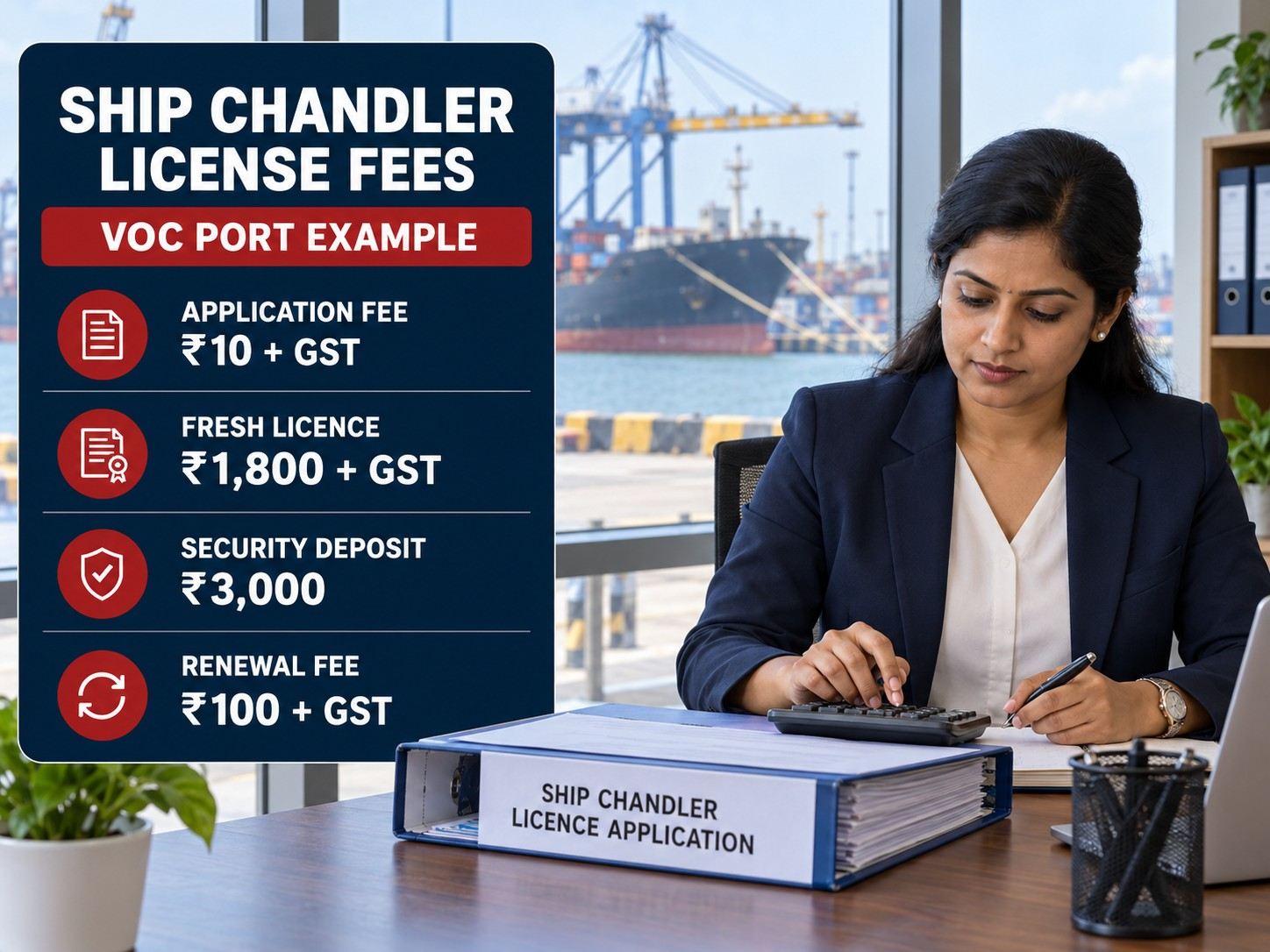
Among these ports, V.O. Chidambaranar Port provides the clearest publicly available ship-chandling fee schedule:
|
Payment |
Published amount |
|
Application form |
₹10 plus 18% GST |
|
Fresh licence fee |
₹1,800 plus 18% GST |
|
Security deposit |
₹3,000 |
|
Renewal fee |
₹100 plus 18% GST |
|
Late-renewal fee |
₹100 plus 18% GST |
The fresh licence at V.O. Chidambaranar Port is valid for one year. The renewal application should be submitted at least 30 days before expiry. Comparable current ship-chandler fees are not publicly disclosed by the other listed ports, so applicants should obtain the latest written fee schedule directly from the relevant port authority.
Approval obtained at one port cannot automatically be used at another. A ship chandler planning to serve vessels at several Indian ports may require separate licensing, port-user registration, employee authorisation and entry passes at each location.
Who Should Apply and Which Port Authority Decides?
A business should apply at every port where it intends to undertake ship chandling under a trade requiring enrolment or licensing. In India, the relevant port authority grants or records port approval for ship chandlers operating within its jurisdiction. Depending on the port, the application may be handled by its Traffic, Commercial or another designated licensing department.
Although applicants commonly search for a single ship chandling license, there is no approval that can automatically be used at every Indian port. Ship chandler registration completed at one port should not be assumed valid at another. The applicant must obtain the latest form, checklist, activity categories, fees and licence conditions directly from each selected port.
Use this pre-application test:
-
Is the applicant's legal name identical across PAN, GST, bank and port records?
-
Is the office or storage address supported by acceptable evidence?
-
Is a valid Customs licence or NOC required by the port?
-
Will food provisions require a valid FSSAI certificate?
-
Does the port ask for solvency, experience or agent support?
-
Are earlier port dues and licence records clear?
-
Do employees and delivery vehicles need separate access permissions?
Complete GST registration in India when it applies before submitting a GST certificate to the port. If the supply chain requires an importer-exporter code, examine the separate IEC code registration route. Neither replaces port approval.
Ship Chandler License Requirements and Documents
Use the current checklist of the target port. The Cochin Port Authority official FAQ asks port users, including ship chandlers, for four sets of the Customs licence, constitutional documents, power of attorney, PAN, authorised-signatory specimen and solvency certificate. After scrutiny, the port allots an account number and separately authorises people conducting transactions.
The V.O. Chidambaranar Port digital form differs. It asks for applicant details, a solvency certificate of at least ₹50,000, Customs NOC, FSSAI certificate, office and residential address proof, and Civil Department NOC. Partnership, technical and past-work evidence appear as category-related uploads.
|
Document group |
Evidence to prepare |
Why the port checks it |
|
Applicant identity |
Legal name, address, email, mobile number and PAN |
Identifies the responsible port user |
|
Constitution |
Incorporation record, memorandum and articles, partnership proof or applicable formation record |
Confirms legal status and permitted activities |
|
Authority |
Power of attorney, board authority and specimen signature |
Identifies who may sign and transact |
|
Financial standing |
Solvency certificate and payment evidence |
Supports financial verification |
|
Premises |
Office, warehouse or residential address proof requested by the port |
Confirms declared operating locations |
|
Customs |
Customs licence or valid NOC |
Supports Customs-controlled port activity |
|
Food safety |
Valid FSSAI certificate where required |
Supports lawful handling of provisions |
|
Port clearance |
Civil or departmental NOC |
Confirms internal port clearance |
|
Experience |
Vessel work record, client or agent evidence where requested |
Supports operational assessment |
|
Renewal |
Previous licence number, expiry date and compliance record |
Connects the new request to the existing approval |
Names, addresses and validity dates must match across the form and attachments. Scan complete documents and keep originals ready for verification.
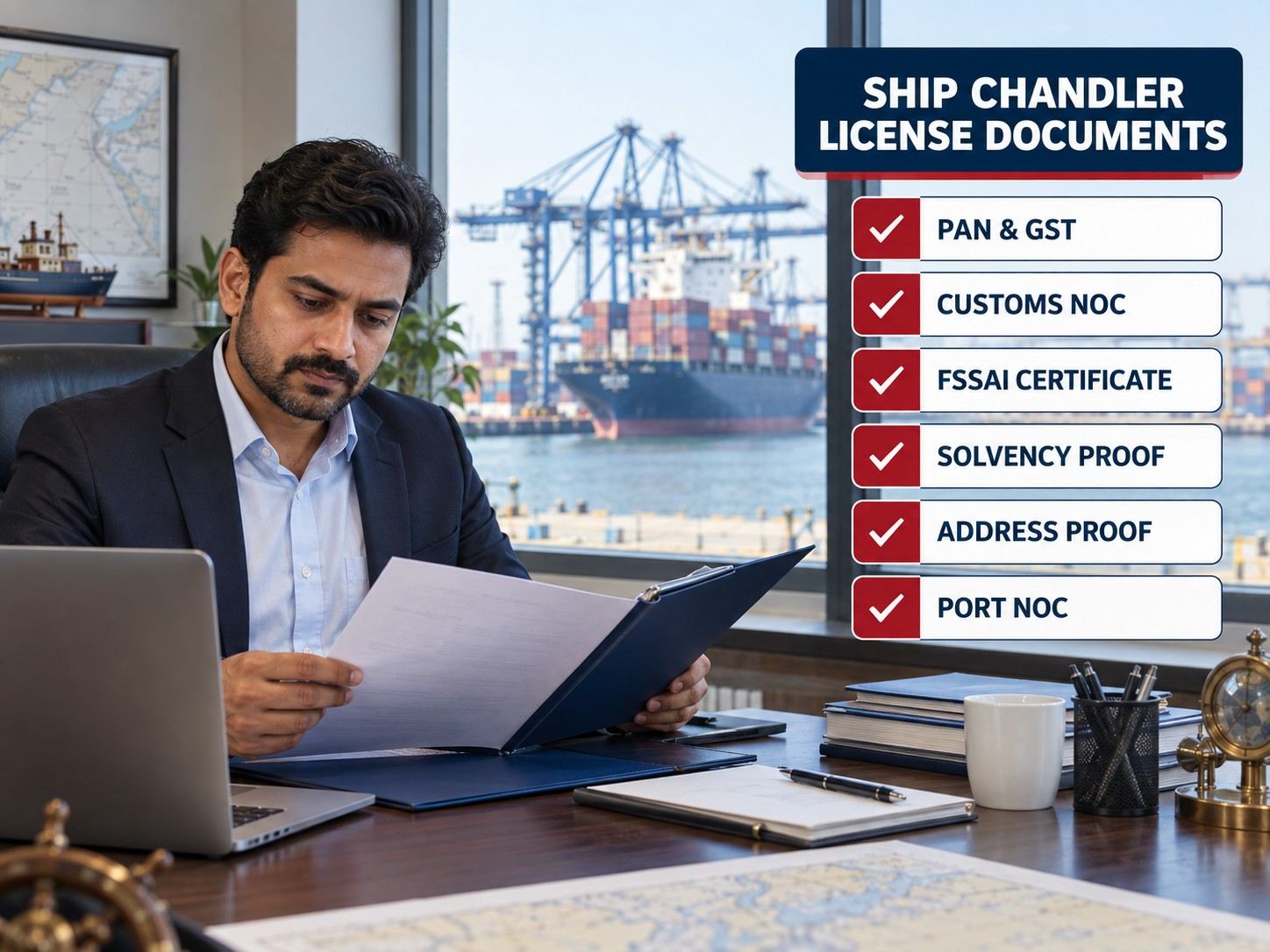
Food suppliers should complete the correct FSSAI licensing process for their model. A technical-stores supplier should obtain written clarification about a mandatory FSSAI field instead of uploading an unrelated registration.
Current Fee Position and Payment Obligations
India does not publish one uniform fee for every port. The table uses the V.O. Chidambaranar Port position checked on 5 September 2026 and must not be applied elsewhere.
|
Payment |
When payable |
Verified amount or official position |
|
Application fee |
With the application process |
₹10 plus 18% GST |
|
Fresh shipping-chandling licence fee |
Fresh application |
₹1,800 plus 18% GST |
|
Security deposit |
Fresh ship-chandling licence |
₹3,000 |
|
Renewal fee |
Renewal of ship-chandling licence |
₹100 plus 18% GST |
|
Late fee |
If renewal is not applied for at least 30 days before expiry |
₹100 plus 18% GST |
|
Other Indian ports |
As their own schedule requires |
No uniform amount is publicly prescribed |
The V.O. Chidambaranar Port ship-chandling portal advises applicants to save the application, obtain the fee details, make payment and then enter the payment information through the edit option. Its conditions also say that pending port dues can prevent the issue of the licence.
Do not assume that a security deposit is refundable. The public portal does not state the refund timing, deductions or closure procedure. Obtain those terms, payment mode and adjustment rules in writing before paying.
Read Also: Consol Agent Registration
How to Apply for a Ship Chandler License in India
The interface differs by port. Follow the chosen authority's form wherever its instructions differ from this sequence.
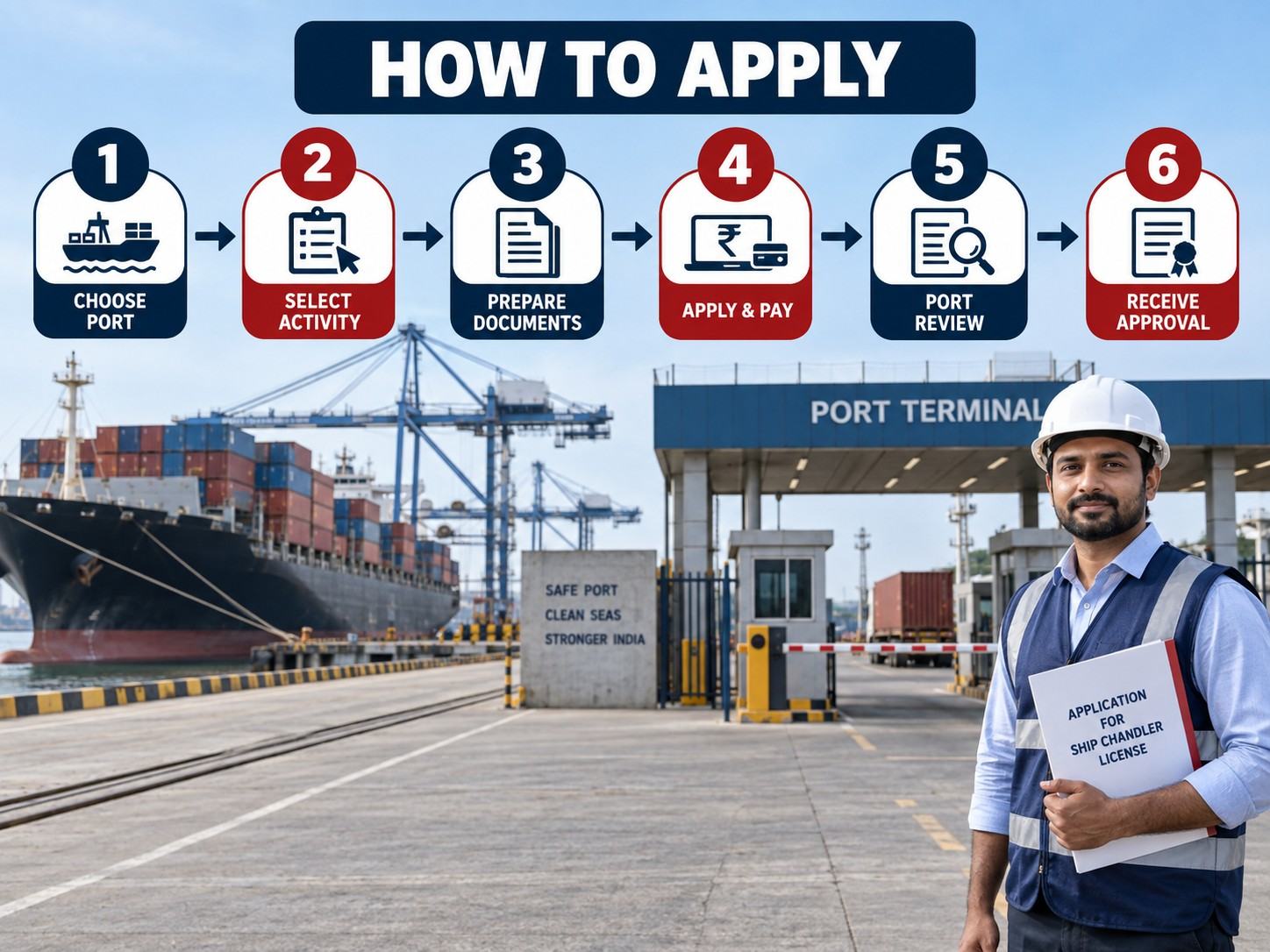
Step 1: Fix the port and activity scope
List each intended port and activity. Separate chandling from repair, chipping, painting, bunkering, bonded stores and miscellaneous trades because they may be licensed differently.
Step 2: Obtain the latest port pack
Request the current form, checklist, fees and conditions. Confirm whether the route is online, physical or combined and whether renewal uses different fields.
Step 3: Align the applicant's records
Use the same legal name, address and authorised signatory throughout. Correct mismatches in PAN, GST, bank or premises records before submission.
Step 4: Secure supporting approvals
Obtain the Customs, FSSAI and internal port approvals required for the selected trade. Check that each will remain valid during scrutiny.
Step 5: Prepare financial and experience evidence
Arrange the prescribed solvency, vessel-work and agent evidence. Use the target port's threshold and format, not another port's requirement.
Step 6: Register and complete the application
Create the applicant account where required. Enter contacts carefully, select Fresh or Renewal, choose the relevant trades and upload files in the prescribed format.
Step 7: Save, review and pay
Save the draft and note its number before paying where that sequence applies. Check the categories and retain the bank reference, voucher and tax breakup.
Step 8: Edit before final submission
Compare the preview with source documents while editing remains available. At V.O. Chidambaranar, a submitted form cannot be changed through the draft process.
Step 9: Submit and respond to scrutiny
Final submission, not saving a draft, moves the file to scrutiny. Monitor the registered email for queries and retain the final form and payment records.
Step 10: Collect the licence and arrange access
Check the approved trade, port, dates and conditions on receipt. Apply separately for the people and vehicle passes needed inside controlled areas.
Processing Period, Validity and Renewal
No standard nationwide processing period is officially published, and the two port sources used here promise no fixed time. Ask the licensing department for its current timeline and do not commit to a delivery date before approval.
At V.O. Chidambaranar Port, a newly approved licence is configured to expire one year from approval. Renewal continues from the preceding licence period. The portal warns applicants to apply at least 30 days before expiry, applies the published late fee when that window is missed and treats an already expired licence as a fresh application.
Create a renewal calendar at least 60 days before expiry. Review the licence, NOCs, FSSAI certificate, solvency evidence, signatory and port account together so defects can be fixed before the 30-day point.
The public V.O. Chidambaranar page does not publish a complete cancellation, appeal or deposit-refund policy. Obtain the licence conditions and written directions for breach, surrender, business changes and discontinuation. Non-use should not be assumed to close the account or release the deposit.
Ship Chandler Registration, Licence and Port Passes
Port-user registration, a ship-chandling licence and physical access passes serve different purposes. Completing one stage does not automatically complete the others.
|
Approval stage |
Primary purpose |
Important limitation |
|
Port-user registration |
Creates or recognises the business account for official port transactions |
It may not authorise every commercial activity |
|
Ship-chandling licence |
Permits the approved ship-chandling activity at the named port |
It remains limited to the approved port, activity and conditions |
|
Employee or transaction authorisation |
Identifies people allowed to act for the registered business |
It applies only to the authorised individuals |
|
Wharf or vehicle pass |
Permits approved people or vehicles to enter controlled areas |
A company licence does not provide unrestricted physical access |
The business should complete these stages in the sequence prescribed by the selected port. Identity records, vehicle documents and delivery details should be prepared before the first vessel supply because an approved company may still face access delays if its workers or vehicles have not been cleared.
Common Reasons Applications are Delayed or Not Issued
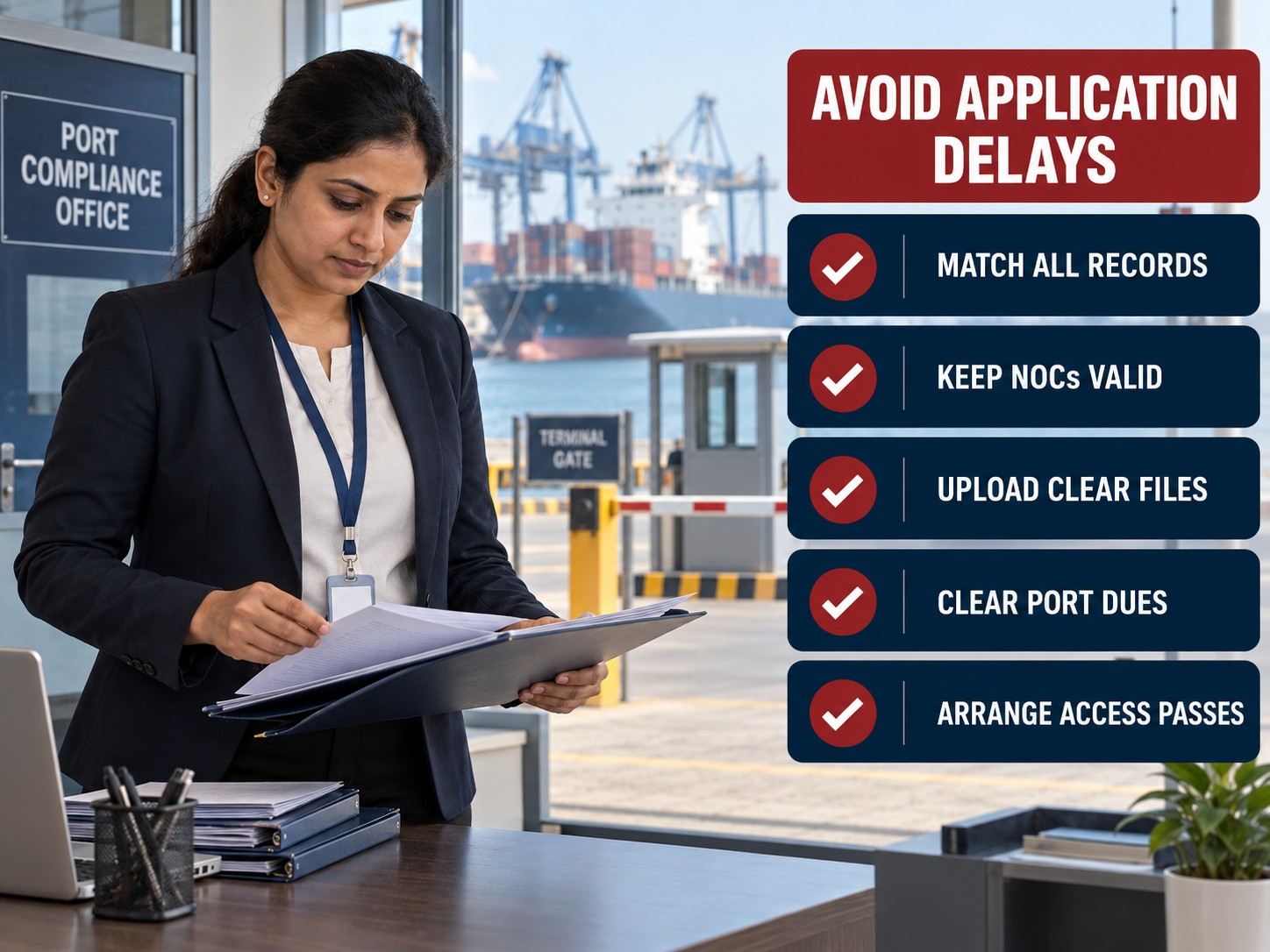
Most preventable problems arise from the file itself or from treating separate approvals as interchangeable. Check for these issues before final submission:
-
Applying to the wrong port department or using an old form
-
Selecting a trade that is not supported by the business profile
-
Different legal names or addresses across PAN, GST and port records
-
Missing power of attorney or unauthorised signatures
-
Expired Customs NOC, FSSAI certificate or solvency evidence
-
Blurred, incomplete or incorrectly sized uploads
-
Paying before an application number or using the wrong fee category
-
Omitting the payment voucher or entering a mismatched bank reference
-
Saving a draft without completing final submission
-
Leaving earlier port dues or compliance queries unresolved
-
Assuming a licence from another port is automatically accepted
-
Arranging a vessel delivery before staff and vehicle passes are approved
Keep an index showing each document's authority, number, validity and uploaded filename. Preserve the acknowledgement, payment receipt, licence and renewal correspondence together.
Practical Controls for a Ship Chandling Business
Port approval is the regulatory entry point. Connect every vessel requisition to its quotation, procurement record, batch or serial details, delivery note, authorised handover and invoice.
Control substitutions, expiry dates, temperature-sensitive goods, partial deliveries and rejected items. State the brand, specification, unit, tax and delivery condition in the quotation, and set credit limits for supply before remittance.
Keep separate port-wise files because licensing conditions, trade categories and access passes may differ. Record every approval number, expiry date, payment receipt, authorised person and approved vehicle against the relevant port.
When Other Logistics Permissions Apply
A ship chandling licence should not be used as evidence of approval for a different logistics activity:
-
A company expanding into airline cargo should separately review IATA cargo registration requirements.
-
A registered Multimodal Transport Operator should understand the applicable MTO insurance requirements.
-
A business chartering a foreign-flagged vessel should check the separate foreign-vessel chartering licence requirements.
These permissions regulate different operations and do not increase the activities permitted under a port-issued ship-chandling licence.
Read Also: NVOOC License
Conclusion
A Ship Chandler License in India begins with one practical decision: identify the port and the precise activity to be approved. The applicant then needs a consistent legal file, current supporting NOCs, financial evidence, correct payment and a complete submission through that port's process. Customs, food-safety, tax and access requirements remain separate even after the port licence is granted.
The V.O. Chidambaranar and Cochin procedures show why copying a generic online checklist is risky. Their documents, fee handling and registration steps are not identical. Verify the latest port material, obtain unclear conditions in writing and build renewal and pass tracking into daily operations. This approach protects the business from avoidable delays without creating expectations of guaranteed approval or a fixed processing time.
FAQS
FAQs About Ship Chandler License
-
Can I edit a saved ship-chandler application before submitting it?
The V.O. Chidambaranar portal allows an applicant to edit a saved application before final submission. It also warns that details cannot be changed through the same process after submission. Review the preview and attachments carefully before using the final submit action.
- What happens if I save the form but forget to submit it?
- Can one V.O. Chidambaranar application include more than one trade?
- Is FSSAI proof required if I plan to supply only technical stores?
- Can office address proof replace residential address proof?
- Does appointing a Customs Broker remove the need for a Customs NOC?
- Is the ?3,000 security deposit automatically refunded after expiry?
- What if the licence-holder has unpaid port dues?
- Do my employees need entry passes after the company is registered?
- Will a ship chandler licence help me contact vessels and win orders?


