
NABH accreditation helps Indian hospitals demonstrate that their patient care and safety systems meet recognised quality standards. Before applying, hospital owners need clear answers about eligibility, documents, assessment and fees. NABH's sixth-edition hospital standards took effect in January 2025, and a January 2026 notification revised minimum bed occupancy requirements for different assessment stages. These changes matter when deciding whether a hospital is ready to apply. This guide explains which NABH programme fits your hospital, the eligibility criteria, essential records, online application steps, assessment, fees and renewal.
It also makes an important distinction: NABH accreditation evaluates hospital quality systems but does not replace statutory licences or guarantee insurance empanelment. You will learn how to prepare evidence, avoid documentation errors and plan for assessment without assuming approval is automatic. The guidance focuses on decisions that owners, administrators and quality teams need to make before paying the application fee or arranging assessment visits.
What Is NABH Accreditation and Why Is It Important?
The National Accreditation Board for Hospitals and Healthcare Providers (NABH), a board of the Quality Council of India, assesses healthcare organisations against published standards for patient safety and service quality. NABH accreditation for hospitals means the hospital's practices are reviewed by external assessors, not merely that it has submitted a set of documents.
For example, a hospital should be able to show how it identifies patients, administers medicines safely, prevents infection, records consent and responds to incidents. NABH accreditation gives hospital management a structured way to check these systems and improve them.
Accreditation is not permission to operate. Hospitals still need applicable registrations and licences, and recognition does not guarantee cashless insurance tie-ups.
What Are the Types of NABH Accreditation for Hospitals?
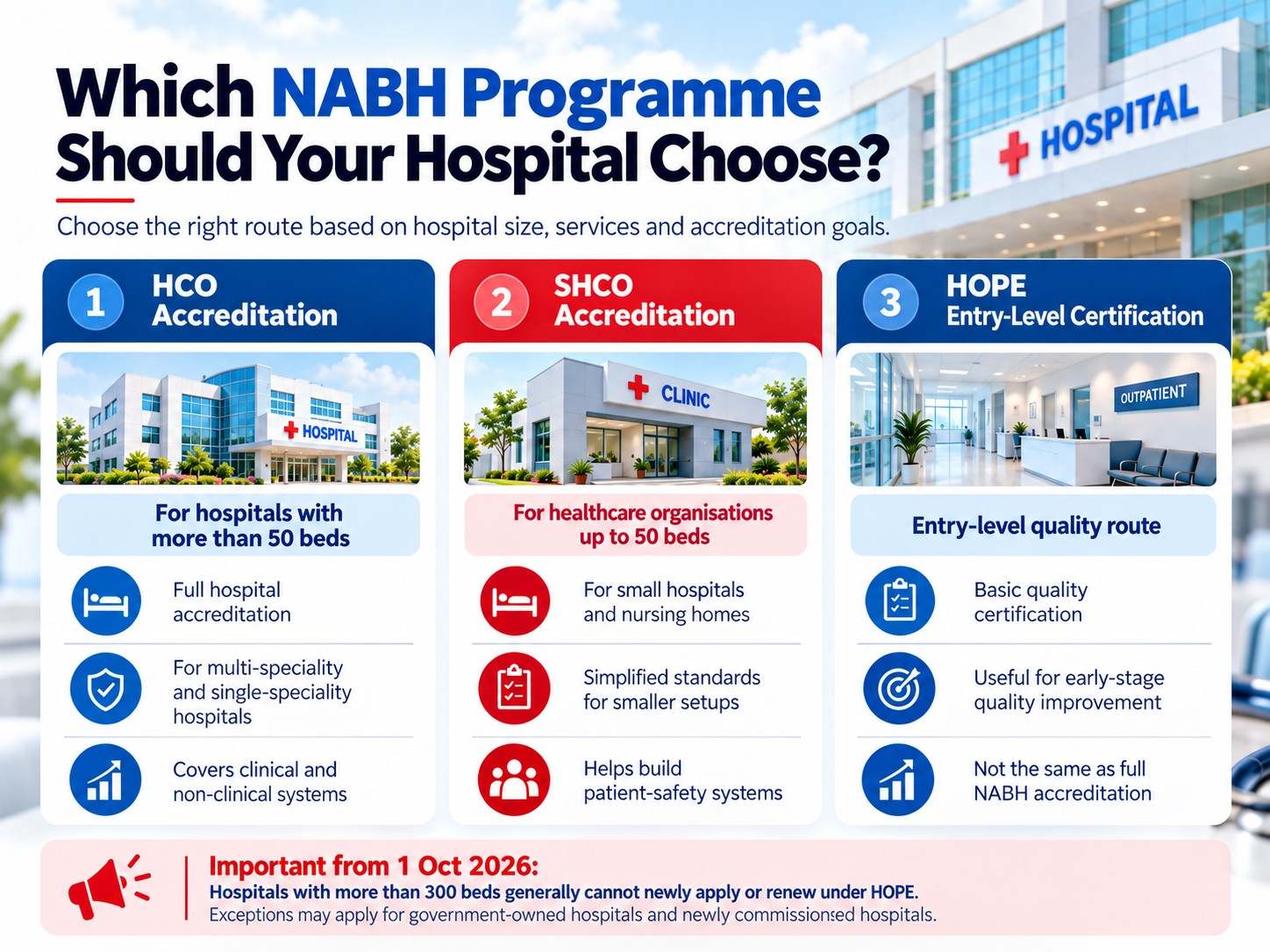
Choose the programme using facility type and sanctioned bed strength, before completing forms or paying.
|
NABH programme |
Who it is meant for |
What the applicant should know |
|
Full Hospital Accreditation (HCO) |
Hospitals with more than 50 sanctioned beds |
Assessment under comprehensive hospital standards |
|
Small Healthcare Organisation (SHCO) Accreditation |
Eligible facilities with up to 50 sanctioned beds |
Separate standards for smaller facilities |
|
HOPE Entry-Level Certification |
Eligible allopathic hospitals and day-care facilities |
A separate entry-level certification, not full accreditation |
Hospitals with more than 300 sanctioned beds also need to check NABH's restrictions on new and renewal HOPE applications from 1 October 2026, including the specified exceptions. Do not assume the HOPE pathway remains available simply because an older article mentions it.
A hospital with 40 sanctioned beds should first examine SHCO eligibility. A 100-bed hospital looking for full accreditation should follow the HCO programme on the official NABH hospital accreditation page.
What Do the Sixth-Edition NABH Standards Actually Assess?
The NABH standards cover both patient-facing work and the systems supporting it. Hospitals should assign each applicable element an owner, evidence record and corrective action. These examples do not replace the official standards.
|
Assessment area |
Evidence assessors may examine |
|
Patient access and continuity |
Triage, admission, transfer, discharge and handover records |
|
Clinical care and medication |
Clinical protocols, prescribing checks and medication incident reviews |
|
Patient rights |
Consent, privacy practices, complaints and bill transparency |
|
Infection prevention |
Hand hygiene observations, surveillance and sterilisation records |
|
Facilities and workforce |
Fire drills, maintenance, staffing credentials and training |
|
Quality management |
Internal audits, incident trends, indicators and corrective actions |
The NABH accreditation requirements in the sixth edition group objective elements into Core, Commitment, Achievement and Excellence. Hospitals should recognise that these are not four optional badges. They represent different assessment expectations across the accreditation cycle. NABH accreditation requirements therefore extend beyond having standard operating procedures stored on a computer.
If an infection-control policy requires daily checks, staff must demonstrate completed checks and review. General ISO 31000 risk guidance can support management thinking, but cannot substitute for patient-specific NABH accreditation requirements.
What Are the Eligibility Criteria for NABH Accreditation?
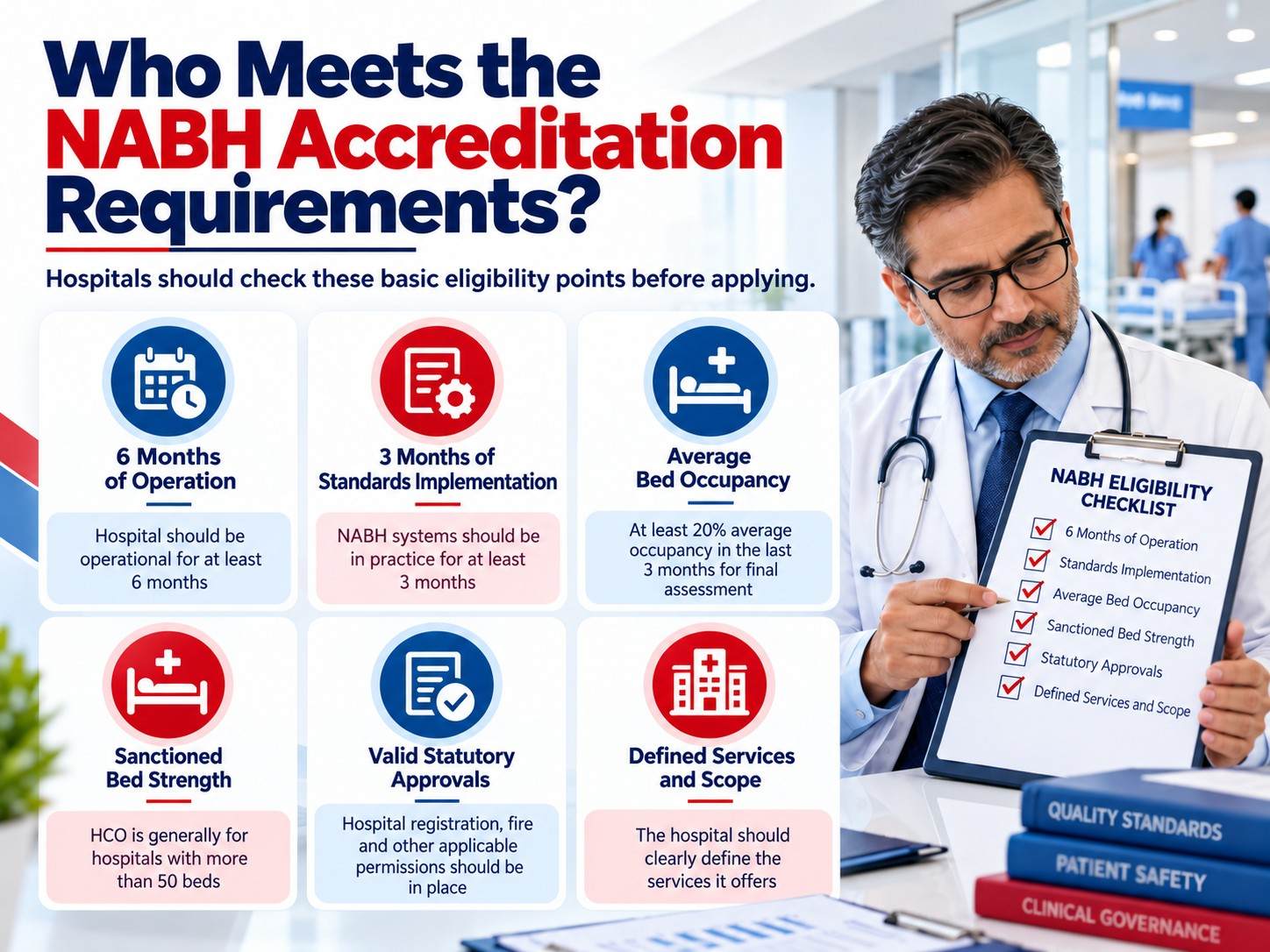
For the full Hospital Accreditation (HCO) route, the NABH accreditation requirements include the following conditions. Check each before starting the application.
- More than 50 sanctioned beds: The HCO route is for hospitals above this threshold. Hospitals at or below 50 beds should check the SHCO or other relevant programme.
- At least six months of operation: NABH's January 2026 notification says the hospital must have been operational for at least six months.
- At least three months of implemented standards: The hospital must have put the applicable NABH standards into practice for a minimum of three months, not merely purchased a manual.
- Minimum occupancy at the relevant stage: A hospital going for final assessment needs an average occupancy of at least 20% in the preceding three months. Different thresholds apply at surveillance and renewal.
- Legal compliance and complete scope: The hospital must meet applicable statutory and regulatory requirements and apply for the services offered at the relevant location, not just its strongest department.
- Applicable clinical services: Public and private single-speciality or multispeciality hospitals can apply where the programme conditions are met.
Other obligations remain separate. A hospital should check applicable local trade licence rules, Shop Act registration requirements, hospital pharmacy drug licences and FSSAI licensing guidance for food operations. In Maharashtra, MPCB consent requirements may also matter. None is a substitute for NABH accreditation.
What Are the Revised NABH Bed Occupancy Rules for 2026?
NABH changed the former occupancy approach through its notification dated 20 January 2026. The following minimum average bed occupancy thresholds apply to the accreditation programme:
|
Assessment stage |
Minimum average bed occupancy |
Period measured |
|
Final assessment |
20% |
Previous 3 months |
|
Surveillance assessment |
25% |
Previous 1 year |
|
Renewal assessment |
30% |
Previous 1 year |
These percentages are minimum eligibility thresholds, not proof that a hospital is accredited. Calculate occupancy from actual inpatient days and operational beds using NABH's instructions. Consult the official NABH notification on revised occupancy norms when checking your figures.
Do not confuse NABH accreditation requirements with other permissions. Depending on location and activities, a hospital may also need a local trade licence, a drug licence for hospital pharmacy activities or an FSSAI licence for food operations. Each serves a different legal purpose.
What Documents Are Required for NABH Accreditation?
NABH asks hospitals to submit the prescribed online application, a self-assessment toolkit/report, supporting documents and the applicable fee. The exact portal upload fields can change by programme and case. The checklist below separates the application materials from evidence that assessors commonly need to examine. It should not be treated as a claim that every item is a compulsory upload for every hospital.
Application Details and Supporting Documents
- Hospital's legal name, address, contact person and authorised applicant details
- Sanctioned bed count and current scope of hospital services
- Completed online application and self-assessment against the applicable standards
- Applicable statutory registrations, permissions and authorisations
- Supporting declarations, agreements and additional uploads requested on the live NABH portal
- Confirmation of the prescribed application fee payment
Hospital Records to Keep Ready for Assessment
|
Record category |
Examples to prepare |
|
Hospital administration |
Organisation chart, roles, service list, department policies |
|
Staff and training |
Doctors' and nurses' qualifications, duty rosters, induction and competency records |
|
Patient care |
Admission records, patient identification, informed consent, discharge summaries and clinical handovers |
|
Medicines and infection prevention |
Medicine storage logs, error reports, hand hygiene and infection-control records |
|
Facilities and equipment |
Fire drill records, equipment maintenance, calibration and emergency response plans |
|
Quality management |
Internal audits, incident investigations, corrective actions, quality indicators and management review minutes |
|
Outsourced services |
Contracts and monitoring records for services handled outside the hospital |
Keep real, dated evidence: a fire-drill policy is not a completed drill record. An EHS safety audit can be a separate way to review facility risks, while ISO 17025 laboratory accreditation concerns testing and calibration competence rather than hospital accreditation itself.
Before submitting: Match the hospital name, address, sanctioned bed number and clinical services across the application and the applicable statutory records. Where a particular attachment is unclear, check the live portal instructions instead of inventing or omitting a document.
What Are the NABH Standards for Hospitals?
The sixth edition of the NABH standards for hospitals, applicable from January 2025, contains 100 standards and 639 objective elements across ten chapters. They address clinical work and the systems that allow a hospital to deliver care consistently.
|
Main area |
Simple example of what a hospital should demonstrate |
|
Access and continuity of care |
Safe admission, referral, transfer and discharge |
|
Care of patients |
Written clinical protocols and coordinated nursing care |
|
Medication management |
Safe prescribing, storage and administration |
|
Patient rights |
Consent, privacy, information and complaint handling |
|
Infection prevention |
Hand hygiene, sterilisation and infection monitoring |
|
Safety and quality improvement |
Reporting incidents and correcting recurring problems |
|
Management and facilities |
Clear responsibilities, staffing and safe buildings |
|
Information management |
Accurate and confidential patient records |
The latest standards classify their objective elements as Core, Commitment, Achievement and Excellence. This helps define what assessors examine at different stages. Hospitals should use the official standards and guidebook rather than relying on a generic template.
Hospital disaster planning can also draw on separate business continuity management guidance. However, ISO certification and NABH accreditation assess different things and cannot replace one another.
How to Apply for NABH Accreditation Step by Step?
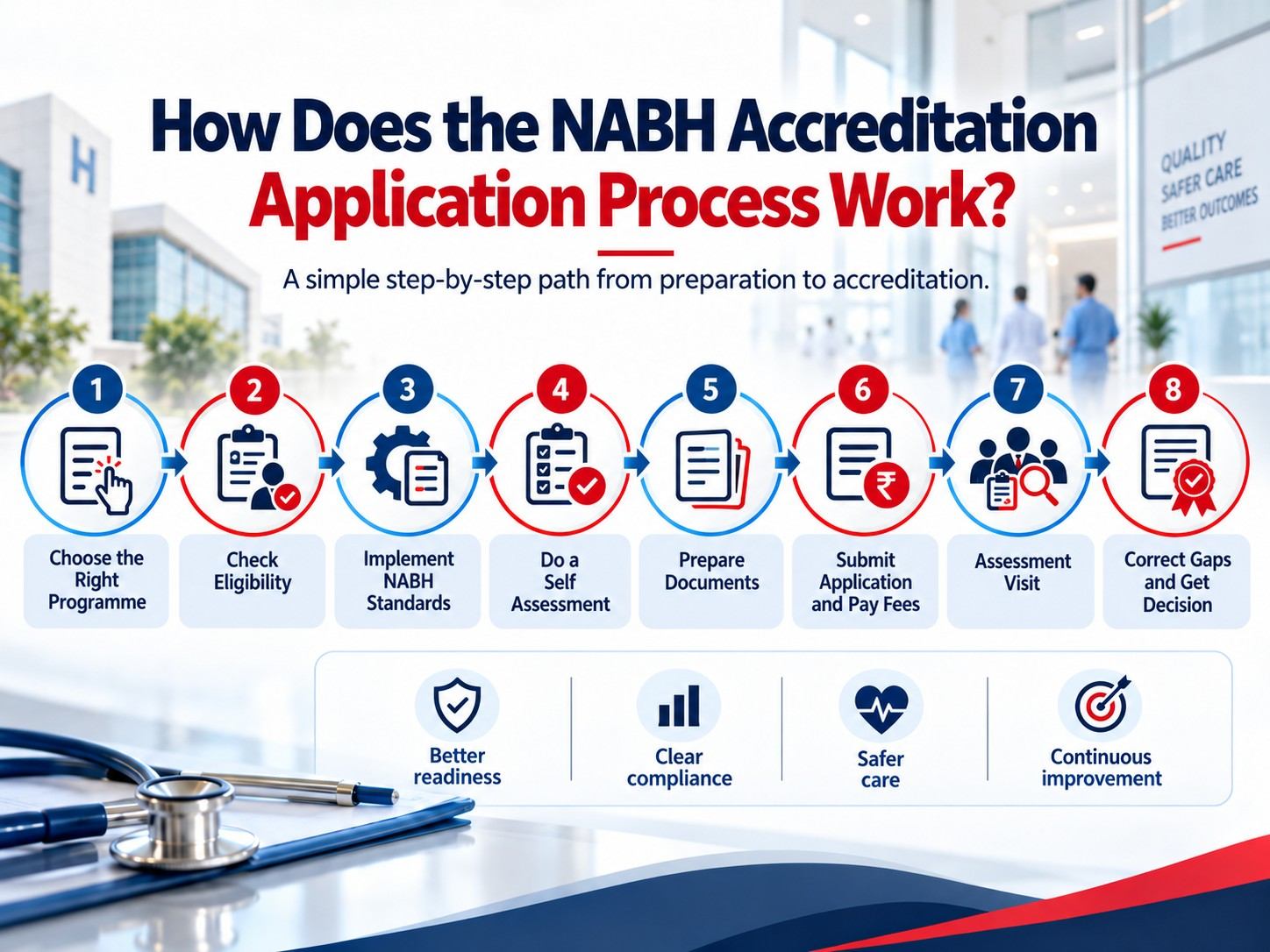
The NABH accreditation process is primarily online, followed by document review and assessment. The following sequence covers the practical stages of the HCO application, including work that must happen before registration.
Step 1: Confirm the Programme and Your Eligibility
Check the hospital's sanctioned bed strength, operational history and clinical service scope. Use the HCO route only if it fits the facility, and confirm the latest occupancy conditions before planning the assessment. This prevents applying in the wrong category.
Step 2: Download the Current NABH Standards
Obtain the sixth-edition hospital standards and read the relevant guidance. Make a department-wise checklist covering patient care, medication, infection prevention, facilities and management. Assign responsibility for each requirement.
Step 3: Implement Standards and Carry Out Self-Assessment
Run the required systems for at least three months and maintain evidence from daily operations. Complete a self-assessment, identify any gaps and correct them before filing. Policies that staff do not follow are unlikely to satisfy an assessor.
Step 4: Complete the NABH Online Application
Register or sign in through the authorised NABH hospital accreditation portal. Fill in the hospital's legal information, sanctioned beds, service scope and other requested details. Upload the self-assessment and the supporting documents specified in the form.
Step 5: Pay the NABH Application Fee
Review the fee category against the hospital's sanctioned beds and pay through the approved payment method. Keep the receipt and application acknowledgement for tracking. The published NABH payment terms state that application and annual fees are non-refundable.
Step 6: Complete the Document Review and Assessment
NABH reviews the application and supporting records, and arranges the applicable assessment stages. A pre-assessment may be optional, while the final assessment tests the hospital's actual clinical and administrative practices. Make staff and supporting records available for verification.
Step 7: Close Non-Conformities and Receive the Decision
If NABH identifies gaps, respond with corrective actions and the supporting evidence requested. The accreditation decision follows assessment report review and committee consideration. Paying a fee or completing an assessment visit does not guarantee approval.
Step 8: Maintain Accreditation and Prepare for Renewal
Continue staff training, monitoring, recordkeeping and internal audits after accreditation. The full hospital accreditation cycle includes surveillance and renewal assessments. Start renewal work well before the certificate expires.
What Are the NABH Accreditation Fees in India?
The live NABH HCO programme page lists the following application fee and annual accreditation fee, revised with effect from 1 April 2024. Its fee table still carries a fifth-edition heading, although sixth-edition applications are open. Confirm the applicable amounts and any portal-specific charges directly before payment.
|
Sanctioned bed category |
Application fee |
Annual accreditation fee |
|
Up to 100 beds |
₹40,000 |
₹2,00,000 |
|
101–300 beds |
₹75,000 |
₹3,00,000 |
|
301–500 beds |
₹1,00,000 |
₹4,00,000 |
|
501 beds or more |
₹1,50,000 |
₹5,00,000 |
GST at 18% is stated as extra. NABH also lists virtual assessment fees by bed category and specific charges for focus assessment and certificate reissue. The listed figures should not be mistaken for an all-inclusive, fixed project quotation.
NABH accreditation fees exclude separate improvement and consultancy costs. NABH also states that hospitals bear assessors' actual travel, boarding and lodging costs. HOPE entry-level certification and SHCO accreditation have separate fee schedules. Confirm the correct programme before paying because an amount paid under one scheme should not be assumed transferable to another.
How Long Does the NABH Accreditation Process Take?
NABH requires at least three months of standards implementation before a hospital submits its HCO application. Beyond that, the time required depends on document review, assessment scheduling, hospital readiness, corrective actions and the accreditation decision. Do not rely on an unsupported promise of approval in a fixed number of days.
A hospital that has complete records may move through assessment more smoothly than one still resolving statutory or patient-safety gaps. Track the status in the authorised portal and respond to NABH requests within the period stated in each communication.
What Is the Validity and Renewal Process for NABH Accreditation?
The sixth-edition full hospital accreditation certificate follows a four-year validity cycle. A surveillance assessment is generally conducted around 21–24 months, and the hospital should apply for renewal six months before expiry. Hospital teams should continue checking the NABH accreditation requirements after approval rather than treating the certificate as permanent.
The January 2026 occupancy norms also matter later in the cycle: 25% average occupancy for surveillance and 30% for renewal, each measured over the preceding year. Check changes in ownership, hospital name, location, beds and clinical services against NABH's change and assessment policies instead of assuming that the old certificate covers them.
What Are the Common Reasons for NABH Accreditation Delays?
Check these preventable problems before submitting.
|
Common problem |
What the hospital should do |
|
Wrong bed category or programme |
Check sanctioned beds and programme eligibility |
|
Inadequate operational history or occupancy |
Check six-month operation and the assessment-stage occupancy rule |
|
Incomplete self-assessment |
Close gaps before submitting the application |
|
Mismatched hospital documents |
Align name, address, permissions and service scope |
|
Policies without operating evidence |
Keep dated clinical and administrative records |
|
Unresolved assessment findings |
Submit genuine corrective actions and proof within the requested period |
Environmental controls may also need attention, depending on the facility. ISO 14001 environmental management can inform a wider improvement programme, but it is not a substitute for statutory biomedical waste authorisation or NABH's infection-prevention requirements.
What Are the Benefits of NABH Accreditation for Hospitals?
NABH accreditation for hospitals helps management identify unsafe practices, monitor results and improve the patient experience.
- Patient safety: Track medication errors, adverse events and the action taken after incidents.
- Infection control: Review hand hygiene observations, infection trends and cleaning practices.
- Patient experience: Record complaints, response times, consent and feedback.
- Staff readiness: Maintain training, credential checks and competency assessments.
- Better management: Use quality indicators, internal audits and corrective actions to find repeated problems.
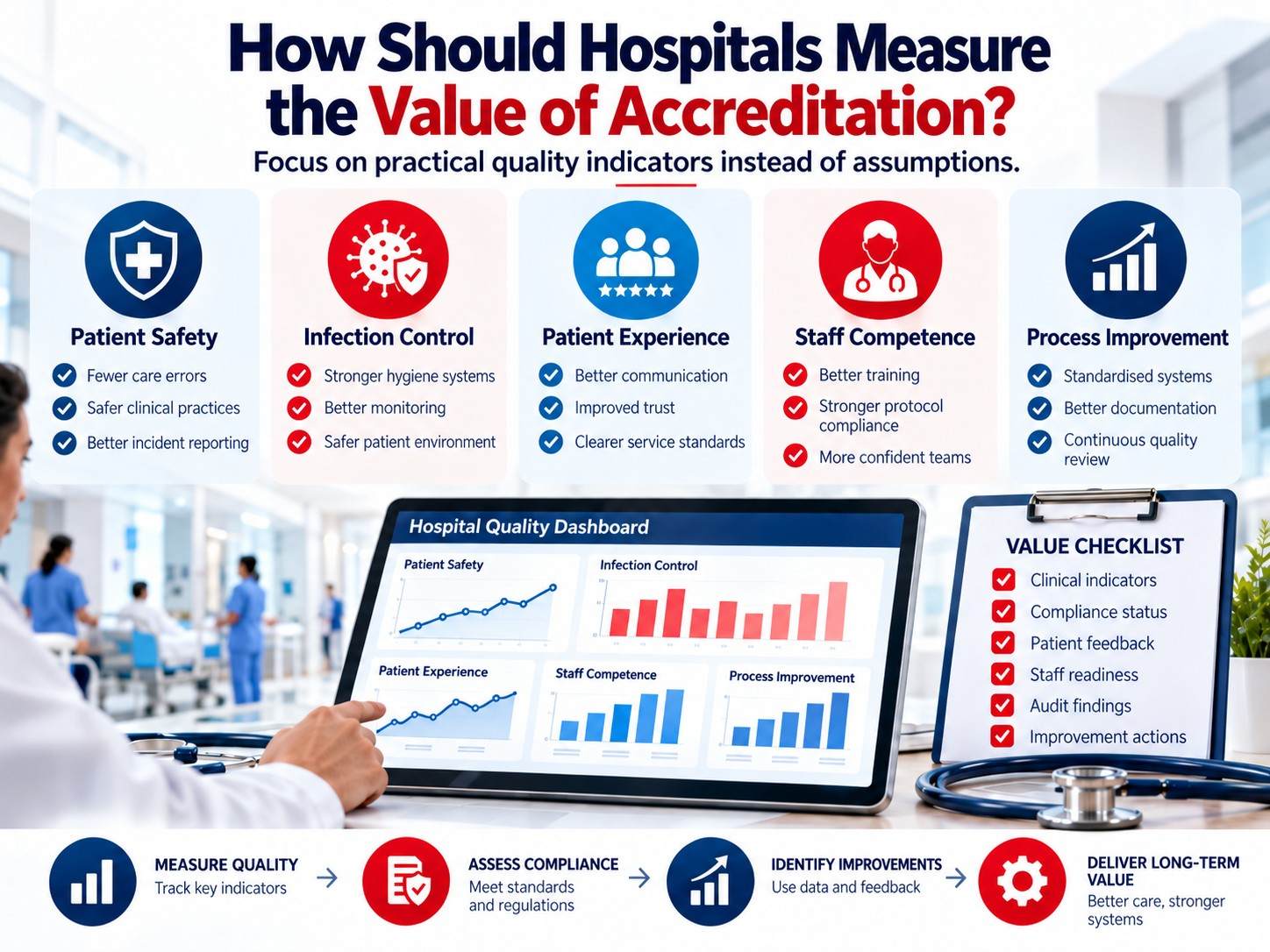
Accreditation may help build patient confidence, but it guarantees neither better outcomes nor insurance empanelment. Compare genuine performance data without unsupported percentage claims.
Conclusion
NABH accreditation is important for hospitals that want documented and independently assessed quality systems. The practical starting point is not the application fee: it is confirming the right programme, six months of operation, three months of standards implementation and the correct 2026 occupancy threshold. After that, organise the documents, complete the self-assessment, follow the online application steps and prepare for assessment. By treating the process as ongoing patient-safety work, hospital management can make accreditation more useful than a certificate on the wall.
FAQS
FAQs About NABH Accreditation
-
Does a hospital automatically receive cashless insurance approval after NABH accreditation?
No. NABH accreditation may support an insurer's or scheme's quality assessment, but it is not itself a cashless treatment contract. Hospitals must check each payer's empanelment terms and network status before promising cashless admission.
- Can a hospital apply if it outsources laboratory or imaging services?
- Can one NABH accreditation certificate cover several hospital branches?
- What if the hospital changes its registered name after accreditation?
- Can hospital employees complete the NABH application process without a consultant?
- Does NABH certification guarantee that a patient will not experience a medical error?
- Can an applicant ask NABH to review an adverse accreditation decision?
- How can patients verify an advertised NABH accreditation status?
- Are NABH accreditation fees refundable when a hospital withdraws?
- Does a clinic without inpatient beds need to apply under the hospital programme?


