
A Pune restaurant that wants to serve whisky can apply for an FL-III license. Someone buying a Mumbai wine shop faces a different decision. Maharashtra State Excise lists a ban on fresh FL-II grants, so the buyer needs to check the transfer route before agreeing to a price. A shop selling sealed beer or wine has a separate option. The right liquor license in Maharashtra depends on the drinks you sell and where customers will consume them.
The Maharashtra Home Department notified the FY 2026–27 liquor license fees on 18 February 2026. Use that schedule to budget for the grant or liquor license renewal, and keep any takeover price or solvency requirement separate. This guide compares the main liquor license types, shows what inspectors check, and explains which liquor license documents to prepare. It also shows how Delhi, Goa and other states handle similar businesses under their own excise rules.
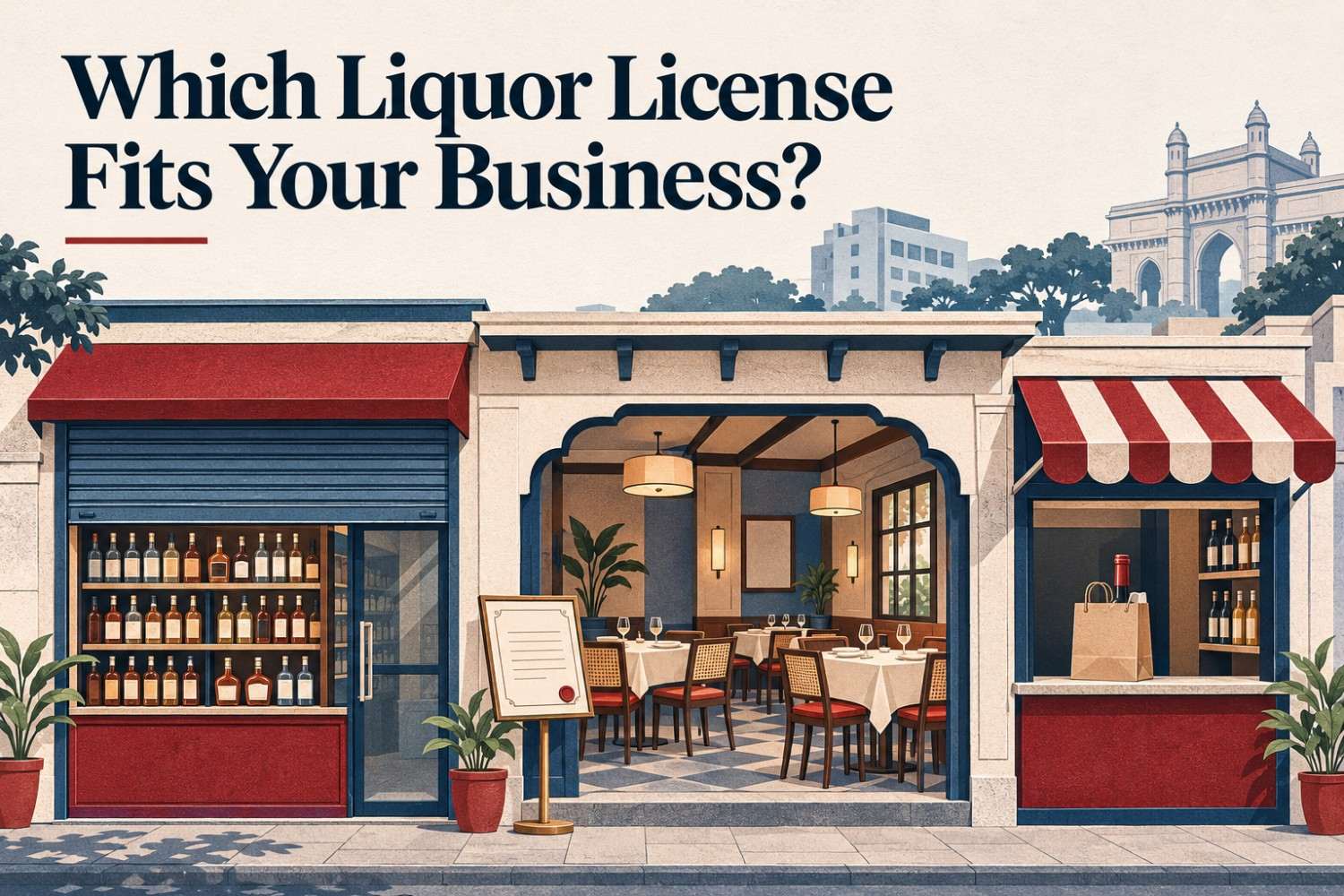
Which liquor license in Maharashtra fits your business?
Start with a simple distinction. Will customers drink at your premises or leave with sealed bottles?
Then write down what you will sell. Under Maharashtra’s foreign-liquor rules, the category includes imported liquor and Indian-made foreign liquor (IMFL). The same shop sign can refer to different liquor license types. A “wine shop” may hold an FL-II license that covers spirits as well.
|
Business plan |
Liquor license types to check |
What the approval covers |
|
Serve whisky, rum or other spirits at a restaurant or hotel |
FL-III |
A permit room serving duty-paid imported liquor and IMFL at the approved outlet |
|
Sell spirits in sealed bottles for takeaway |
FL-II |
Foreign-liquor retail. State Excise lists a ban on fresh grants. |
|
Sell sealed beer or wine for takeaway |
FL/BR-II |
Takeaway of beer, wine or both, as specified in the licence |
|
Serve beer or wine at a restaurant, hotel, canteen or club |
Form E |
Mild liquor, wine or both within the authorised scope |
|
Serve wine only on site |
Form E-II |
On-premises wine sales |
|
Sell wine at its manufacturing site |
FL/W-II |
Retail at the premises of a qualifying BRL wine manufacturer |
|
Serve spirits at a members’ club |
FL-IV |
Duty-paid foreign liquor and IMFL at the licensed club |
|
Run a country-liquor shop |
CL-III |
Country-liquor retail. State Excise also lists a ban on fresh CL-III grants. |
The Maharashtra Excise licence catalogue describes FL/BR-II as sealed beer for takeaway. The State Excise services directory also lists sealed wine under that service. If wine is central to the shop’s business plan, confirm what your Maharashtra State Excise license will cover before ordering stock. A winery selling its own label should also check excise brand and label approval and the separate wine trademark classification.
What should you verify before buying a wine shop?
For a full retail liquor license in Maharashtra, check the FL-II license transfer before paying the seller. Ask the district Superintendent of State Excise to confirm the holder, address and expiry of the FL-II license. Request the last renewal endorsement and challan from the seller, and check with Excise whether any outstanding dues or proceedings affect the transfer.
If you plan to move the shop, get the shifting route checked separately. A deal can involve two decisions even if the seller quotes one price. The notified FL-II transfer service standard is 30 working days from receipt of the complete liquor license application and required documents. Ask for government liquor license fees and any privilege charge separately from the amount payable to the seller.
Who is eligible for a liquor license in Maharashtra?
Eligibility depends on the licence category and the proposed activity. For an FL-III license, Maharashtra State Excise identifies the applicant as the manager or proprietor of a hotel or restaurant holding valid eating-house permission. Its application checklist also recognises companies, partnership firms, LLPs, trusts and cooperatives, where applicable.
|
Eligibility requirement |
What you must establish |
|
Authority to apply |
Identify the business operator and provide the relevant entity documents and applicant authorisation. |
|
Right to use the premises |
Establish ownership or a registered tenancy, with the owner’s specific consent for the liquor business. |
|
Operating approvals |
Hold the applicable eating-house, food and local permissions. The detailed FL-III guidance also lists Grade-I restaurant certification in municipal corporation areas. |
|
Suitable premises |
Meet the floor-area, building and distance requirements applicable to the licence category. |
|
Applicant verification |
Disclose previous licence suspensions, cancellations and government arrears, and complete the prescribed police checks. |
|
Financial capacity |
Provide the solvency certificate, bank guarantee or other instrument required by the licensing authority. |
For Form E, the department similarly identifies an eligible hotel or restaurant manager or proprietor with eating-house permission. FL/W-II is restricted to qualifying BRL wine manufacturers selling at their manufacturing premises. The department continues to list a ban on fresh FL-II and CL-III grants.
Can the site qualify for a Maharashtra State Excise license?
For an FL-III license, the department’s checklist calls for at least 25 square metres for the restaurant and 10 square metres for the permit room. Before paying a deposit, mark the bar, dining area and proposed service areas on a floor plan. Ask the landlord for written consent specifically for the liquor business and check municipal trade licence requirements against the property’s approved use.
Distance checks differ across liquor license types. For an FL-II license, the published shop rule sets a distance of 50 metres from qualifying educational or religious institutions in municipal corporations and Class A or B municipal councils, and 100 metres elsewhere. It also specifies 50 metres from a Maharashtra State Road Transport Corporation bus stand, station or depot. Permit rooms have separate checks under Rule 45. If the entrance is near a school, place of worship or highway, ask Excise to assess the site before you spend on the fit-out.
Which liquor license documents go into a permit-room file?
Prepare the file against the FL-III retailer checklist and the current online application fields. Match the applicant’s name, business constitution and premises address across the documents.
|
Document group |
Papers to prepare |
|
Applicant identity |
Identity proof, address proof, photograph and signature. |
|
Business constitution |
Registered partnership deed or relevant LLP formation documents. Company applicants should prepare their company incorporation documents, memorandum, articles and board resolution. |
|
Property records |
Applicable ownership evidence, such as a property card or 7/12 extract. |
|
Rented premises |
Registered lease or rent agreement and the owner’s NOC specifically permitting the liquor business. |
|
Building approvals |
Evidence of authorised construction and the completion or occupancy certificate requested by the service portal. |
|
Premises drawings |
Four blueprint copies, a site plan, boundaries, north direction, address and area schedule. Clearly identify the restaurant and proposed permit room. |
|
Operating permissions |
Applicable eating-house or local hotel permission, food-authorisation evidence and Shop Act registration documents. Check the FSSAI licence requirements for the outlet’s food activities. |
|
Additional records |
The detailed departmental guidance also lists police restaurant registration, tax no-dues records, grading and a menu card. Confirm which current records satisfy these entries. |
|
Solvency evidence |
The online checklist refers to a solvency certificate or bank guarantee equal to 50% of the licence fee. The retailer process page separately mentions a ₹10,000 National Savings Certificate at grant. Obtain written instructions from the district office about the required instrument and amount. |
The document checklist changes with the application. Form E uses Form D, while FL/BR-II uses F.L./A-10. An FL-II transfer or premises shift requires the existing licence records and evidence supporting the proposed holder or location.

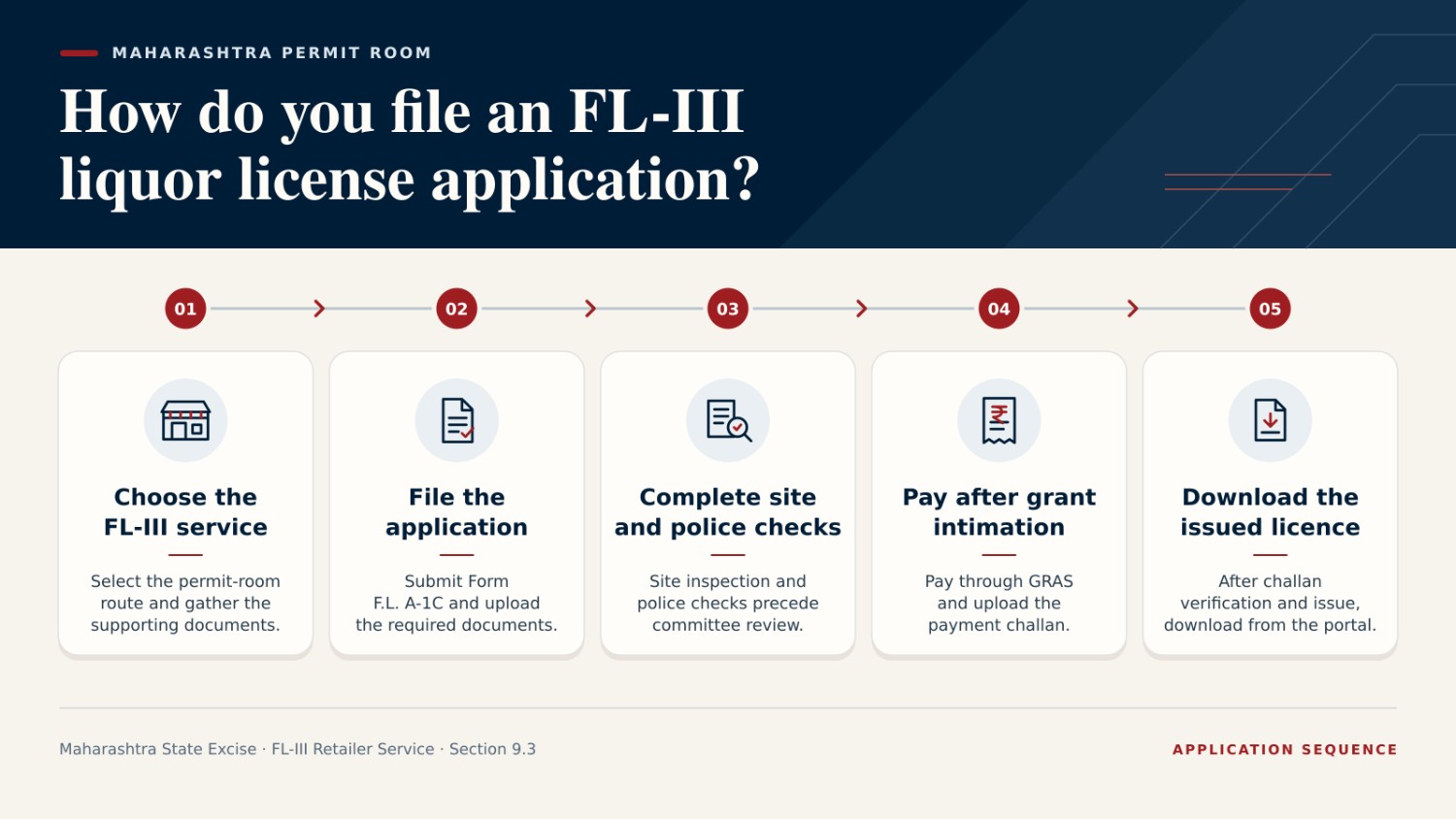
How do you file an FL-III liquor license application?
Below are the steps to apply for a liquor license:
Step 1: Confirm the category and applicant
On the portal, select the FL-III license for a permit room. Check that the name on the liquor license documents matches the applicant and that the plan shows each proposed serving area.
Step 2: Register and submit the form
Sign in to the excise portal and use Form F.L./A-1C for the liquor license application. The checklist lists a ₹1,000 application fee and a ₹5 court-fee stamp. Upload the liquor license documents and save the tracking reference.
Step 3: Complete the site and police checks
An excise officer inspects the premises and reports on the liquor license application. The Superintendent seeks police checks on the applicant and site before committee review. If the outlet occupies part of a larger building, use the fire clearance guide to check which building evidence to keep ready.
Step 4: Pay through GRAS after the grant intimation
After grant intimation, match the liquor license fees and filing reference to the demand. Pay through the Government Receipt Accounting System (GRAS), upload the challan and submit the solvency evidence the office requests.
Step 5: Download the issued licence and check its scope
After challan verification, Excise digitally approves the liquor license application and notifies you when the licence is ready to download. Check the holder, address and expiry on the Maharashtra State Excise licence.
How long does a liquor license application take?
The Maharashtra Home Department’s notification dated 15 October 2024, numbered MIS 1017/CR229/EXC-2, specifies the following service periods. These periods begin after receipt of a complete application and the required documents.
|
Application or service |
Notified processing period |
|
Fresh FL-III licence |
45 working days |
|
New Form E or Form E-II licence |
45 working days |
|
New FL/BR-II licence |
30 working days |
|
FL-II licence transfer |
30 working days |
|
FL-II or FL-III licence renewal |
15 working days |
Obtaining prerequisite approvals, correcting drawings and responding to document queries can add to the overall time needed to open the outlet. Retain the acknowledgement and correspondence. For delayed service, check the designated appeal route under the Maharashtra Right to Public Services framework.
What are the liquor license fees for FY 2026–27?
Use Home Department Notification BPA-0126/C.R.14/Exc-2, Maharashtra Government Gazette, Part IV-B, Extraordinary No. 79, dated 18 February 2026. Its one-year government liquor license fees for the categories below apply from 1 April 2026 to 31 March 2027. The three liquor license types in the table use the same seven population bands. Ask Excise which band applies to your address.
|
Population of the applicable area |
FL-II license |
FL-III license for restaurants |
FL/BR-II sealed beer fee entry |
|
Up to 50,000 |
₹3,09,700 |
₹95,500 |
₹28,700 |
|
50,001 to 1,00,000 |
₹4,92,700 |
₹1,42,900 |
₹42,900 |
|
1,00,001 to 2,50,000 |
₹7,45,200 |
₹2,85,400 |
₹85,700 |
|
2,50,001 to 5,00,000 |
₹10,43,900 |
₹4,75,500 |
₹1,42,700 |
|
5,00,001 to 10,00,000 |
₹12,96,100 |
₹7,60,500 |
₹2,28,200 |
|
10,00,001 to 20,00,000 |
₹17,33,700 |
₹10,45,600 |
₹3,13,700 |
|
Above 20,00,000 |
₹20,32,100 |
₹11,40,500 |
₹3,42,200 |
For population bands of up to 1 lakh, 1,00,001 to 10 lakh, 10,00,001 to 20 lakh and above 20 lakh, Form E fees are ₹55,000, ₹1,65,000, ₹3,30,000 and ₹4,95,000, respectively. Form E-II fees for those same bands are ₹38,300, ₹95,300, ₹1,42,900 and ₹1,90,300. The FL/BR-II fee entry describes sealed beer. If you also plan to stock wine, confirm the authorised products and the amount due. The separate FL/W-II winery retail entry is ₹12,200.
If the hotel’s Maharashtra State Excise license includes liquor service in guest rooms, the schedule adds a charge to one FL-III license used for that service. The add-ons are ₹8,94,400 for three-star hotels, ₹14,90,600 for four-star hotels, ₹22,85,100 for five-star hotels and ₹50,000 for other hotels covered by the entry.
Which charges are payable besides the annual licence fee?
Budget separately for application charges, annual liquor license fees and any transaction-specific payments.
|
Payment |
Published requirement |
|
FL-III application |
₹1,000 application fee and ₹5 court-fee stamp |
|
Form E application |
₹100 application fee and ₹5 court-fee stamp |
|
FL/BR-II application |
₹100 application fee and ₹5 court-fee stamp |
|
Annual grant or renewal |
Applicable FY 2026–27 rate for the licence category and population band |
|
Transfer or shifting |
Separate charge applicable to the transaction |
|
Solvency or security |
Instrument and amount confirmed by the licensing authority |
For a fresh FL-III application, follow the grant intimation when paying the scheduled licence fee through GRAS. Upload the challan for departmental verification.
The Central and Maharashtra Notifications 25/2019 (Rate) exclude the state’s grant of an alcoholic liquor licence against a licence or application fee from GST. Keep professional charges and the seller’s price separately identified.
What is the validity of a liquor license in Maharashtra?
Rule 3 of the Maharashtra Potable Liquor (Periodicity and Fees for Grant, Renewal or Continuance of Licences) Rules, 1996 provides one-year or five-year terms for covered licences, subject to the applicable conditions.
|
Licence term |
How validity is counted |
|
One year |
The licensing financial year ends on 31 March. Check the expiry date endorsed on the licence. |
|
Five years |
The financial year of grant or renewal and the following four financial years. |
|
Temporary event permission |
The specific event dates and duration endorsed in the permission. |
For example, a five-year licence granted during FY 2026–27 runs to 31 March 2031 under this counting rule. Check the actual term recorded on your Maharashtra State Excise license when collecting it.
How should you arrange liquor license renewal?
Select the renewal service for your existing licence category and file before expiry. Keep the current licence, supporting documents, renewal acknowledgement, GRAS challan and renewed endorsement together. The notified renewal period for FL-II and FL-III is 15 working days after receipt of a complete file.
Rule 4 sets the fee for a five-year term at 4.5 times the applicable annual fee. The FY 2026–27 notification protects existing five-year renewals made before that financial year for their remaining validity. Check the previous renewal endorsement before calculating the amount payable.
Which changes should trigger a fresh check with Excise?
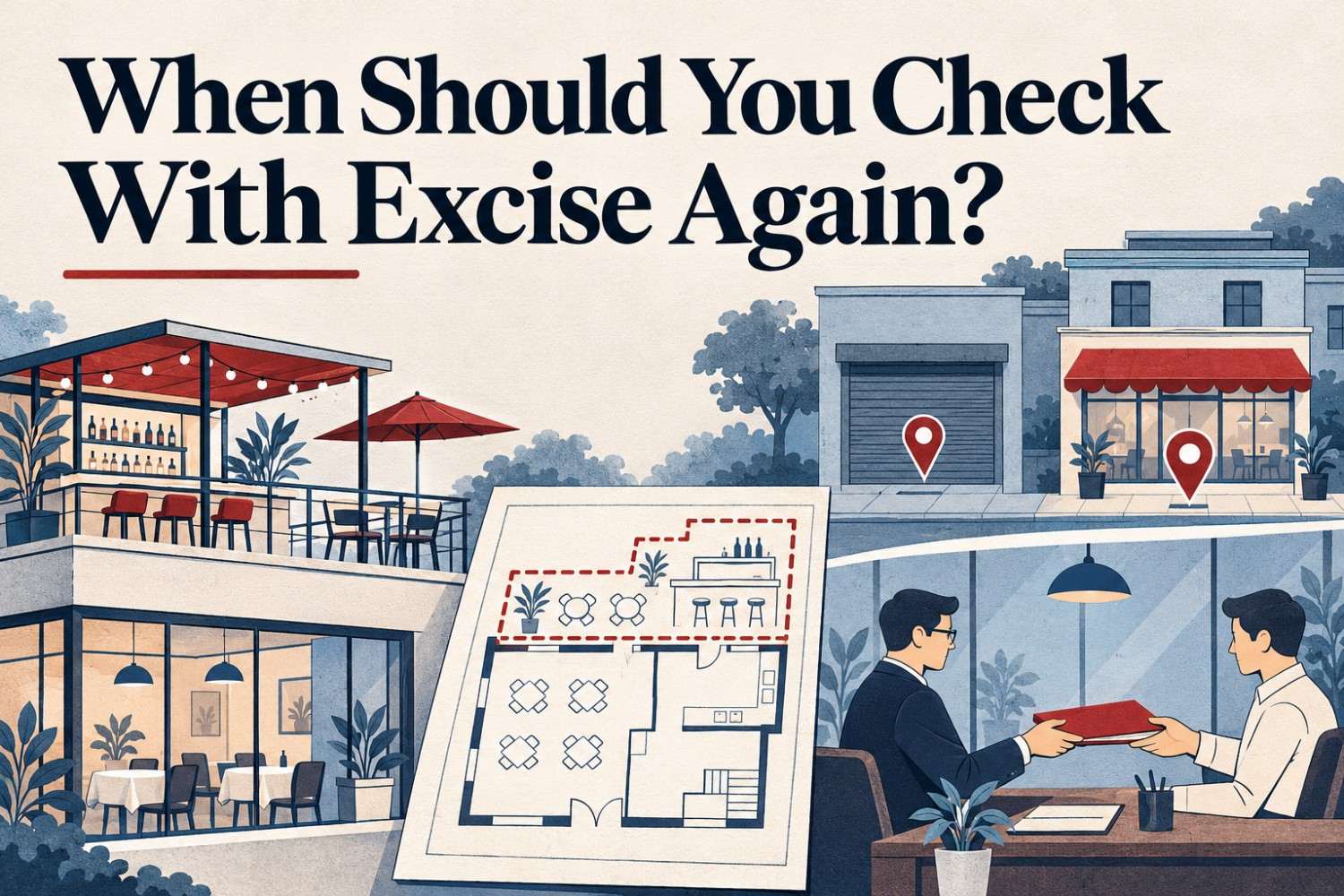
A rooftop counter, a shift to the next unit or a new operating entity can put the actual business outside the approved plan or record. If a beer café wants to add whisky, compare liquor license types before changing the menu. If the drinks stay the same and the outlet moves, ask which premises approval is required. Keep the Maharashtra State Excise licence, endorsed plan and supporting liquor licence documents available for inspection.
Section 54 of the Maharashtra Prohibition Act, 1949 allows suspension or cancellation for grounds such as unpaid fees, breach of licence conditions or deliberate misrepresentation. Under Section 65, unauthorised sales can lead to three to five years’ imprisonment, a fine of ₹25,000 to ₹50,000, or both.
How do liquor licences work across India?
Entry 8 of the Constitution’s Seventh Schedule places intoxicating liquor under the State List. A liquor licence in Maharashtra covers the activity and premises approved there. For an outlet in another state or Union Territory, check its current policy for the right liquor license types, whether grants are open and what the local authority charges.
|
State or Union Territory |
What a business should check |
Official reference |
|
Delhi |
Independent restaurants and bars attached to hotels have distinct routes. The June 2026 disclosure lists L-17/L-17F for independent restaurants and L-16/L-16F for hotel bars. |
Delhi Excise PA-21, June 2026 |
|
Goa |
Form E-28 is used for applications for both packed-bottle retail and retail for consumption. On-premises service has a separate checklist that includes a restaurant licence. |
Goa Excise retail checklists under Rule 90 |
|
Uttar Pradesh |
The FY 2026–27 policy lists F.L.-5DB composite shops for foreign liquor, beer, wine and low-alcohol beverages. The policy provides e-lottery rounds for eligible unsettled shops. |
Uttar Pradesh Excise Policy 2026–27, sections 1.2 and 1.11 |
|
Tamil Nadu |
TASMAC holds the exclusive retail shop privilege for Indian-made foreign spirits. Check the rules for your business model before treating a private bottle shop as an option. |
Tamil Nadu Prohibition Act, Section 17-C |
|
Bihar |
Statewide prohibition governs ordinary commercial liquor sales. Check the law before budgeting for a retail shop or restaurant bar. |
Bihar Prohibition and Excise Act, 2016 |
For example, a Mumbai restaurant opening a branch in Panaji should budget separately for the Goa liquor license application. If the business moves stock between states, check the applicable export and import or transport permissions as well. If the chain has separate GST registrations for taxable food sales, plan GST return filing for each registration.
Conclusion
Choose the liquor license in Maharashtra that fits your actual menu or shop inventory. For a bar, settle the premises plan before applying. For an FL-II shop takeover, verify the transfer and any shift before paying the seller. Budget for the notified liquor license fees and plan liquor license renewal around the expiry of your own licence.
FAQS
FAQs About Liquor License
-
Can I move a village wine shop licence to Mumbai?
The notified shifting services within a taluka or district expressly exclude Mumbai City and Mumbai Suburban. A transfer of an FL-II license changes the holder, while a shift concerns the address. Ask Excise which shifting route applies to the two addresses before paying a deposit.
- Can I add an incoming partner when I renew a shop or bar licence?
- Which licence applies if I serve liquor at a wedding for one evening?
- Does a business liquor license in Maharashtra cover a guest’s personal permit?
- Can a beer-only restaurant brew its own beer under Form E?
- Can I add a rooftop bar under an existing FL-III license?
- How should a restaurant account for food and alcohol sales?
- Can I serve while my renewal is pending after expiry?
- Do dry-day restrictions apply to hotel permit rooms?
- Can I recover prepaid fees if I surrender a five-year licence?


