NVOCC License in India: Know What You Actually Need
- by kapil
- Updated September 13, 2026
- 17 mins read
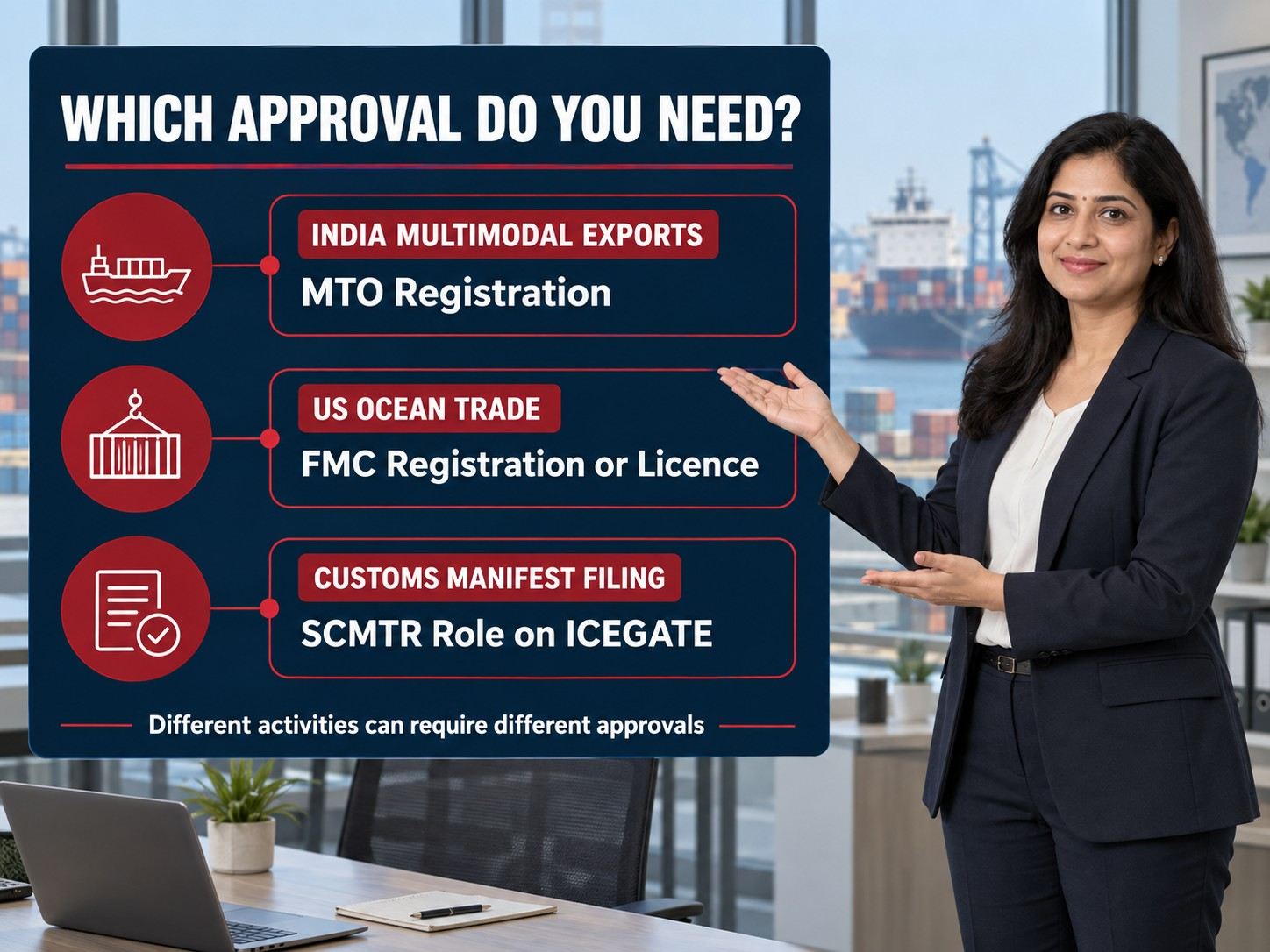
Searching for an NVOCC License in India often leads to one confusing assumption: that every non-vessel operator needs the same certificate. Your actual requirement depends on the contract you issue, the transport modes involved, the customs role you perform and the trade lane you serve. An operator accepting responsibility for an export movement from India by at least two transport modes may need Multimodal Transport Operator registration.
A business filing sea-cargo manifests may need a separate customs registration, while United States trades can trigger Federal Maritime Commission requirements. This guide explains those boundaries first, then covers current MTO eligibility, documents, official fees, the online application, insurance, validity, renewal and cancellation.
What Is an NVOCC?
An NVOCC is a common carrier that provides ocean transportation services without operating the vessels used for carrying the cargo. It purchases transportation from vessel-operating common carriers and offers that transportation to exporters, importers and other customers.
An NVOCC occupies two contractual positions:
- It acts as a carrier towards the customer whose cargo it accepts
- It acts as a shipper towards the vessel-operating common carrier
An NVOCC may issue its own house bill of lading, collect freight charges, consolidate cargo, arrange inland movement and coordinate with destination agents. However, it does not become a vessel-operating carrier simply because it sells ocean freight.
Under US regulations, NVOCC services can include purchasing carrier services for resale, issuing shipping documents, arranging through transportation, leasing containers and collecting freight from customers. The current definition appears in 46 CFR Part 515.
How Does an NVOCC Work?
Suppose an Indian exporter wants to send a less-than-container-load shipment to the United States. Instead of booking directly with a shipping line, the exporter approaches an NVOCC.
The NVOCC may combine that cargo with shipments from other customers, purchase container space from a vessel operator and issue its own house bill of lading to the exporter. The shipping line issues its master bill of lading to the NVOCC or its appointed party.
The commercial arrangement generally works like this:
- The customer books ocean transportation with the NVOCC.
- The NVOCC accepts responsibility under its transport terms.
- The NVOCC books space with a vessel-operating carrier.
- The NVOCC issues its house bill of lading.
- The shipping line transports the container under its master bill of lading.
- The NVOCC or its destination agent coordinates delivery to the consignee.
This arrangement allows the NVOCC to provide ocean freight services without purchasing or operating a ship.
This should be the only short process-style explanation in the article. Do not add a lengthy FMC application walkthrough.
NVOCC vs Freight Forwarder vs Shipping Line
Although these businesses work together, they do not perform the same role.
| Particulars | NVOCC | Freight forwarder | Shipping line or VOCC |
| Operates the carrying vessel | No | No | Yes |
| Acts as carrier towards customer | Generally yes | Generally acts as agent | Yes |
| Purchases vessel space | Yes | May arrange space for customers | Provides vessel capacity |
| Issues house bill of lading | Commonly yes | May prepare documents but does not necessarily assume carrier responsibility | No |
| Issues master bill of lading | No | No | Yes |
| Consolidates cargo | Common activity | May coordinate consolidation | Carries the consolidated container |
| Main function | Resells ocean transportation and accepts carrier responsibility | Arranges logistics for the shipper | Physically performs ocean carriage |
The difference depends on contractual responsibility, not merely the description used on the company’s website. A business does not automatically become an NVOCC only because it negotiates freight rates or prepares shipping documents.
Does India Issue an NVOCC License?
India does not issue a universal approval specifically named an “NVOCC License”. NVOCC is an industry and regulatory description of the role performed by the business.
Indian logistics companies must obtain registrations based on their actual services. For example, MTO registration may apply when a company undertakes international multimodal transportation from India under one contract using at least two modes. Customs filing, customs clearance and air-cargo activities have separate regulatory requirements.
MTO registration is therefore not another name for an NVOCC licence. It covers qualifying multimodal transport operations under Indian law, while FMC licensing or registration concerns NVOCC services in US foreign ocean commerce.
An Indian business providing only port-to-port ocean freight services should not assume that MTO registration automatically applies. Similarly, an MTO certificate does not by itself authorise the company to provide NVOCC services in US trade.
What Other Registrations May an Indian NVOCC Need?
The absence of a standalone Indian NVOCC licence does not mean the business can operate without other registrations.
| Business activity | Relevant compliance |
| International multimodal transportation from India under one contract | MTO registration may apply |
| NVOCC services in US foreign ocean commerce | FMC licence or foreign NVOCC registration |
| Sea-cargo manifest filing in India | Appropriate ICEGATE and SCMTR role |
| Customs clearance for clients | Customs Broker Licence |
| Import and export activity | Import Export Code |
| Accredited air-cargo agency services | IATA registration, where applicable |
| Chartering a foreign-flagged vessel | Separate chartering permission, where applicable |
Each registration has a different purpose. Holding one does not automatically satisfy the requirements of another. For a combined road-and-sea export under one document, review the detailed MTO registration guide.
For airline cargo agency work, examine IATA cargo agent registration separately. Neither status is another name for an NVOCC License.
Documents Required for NVOCC Registration in India
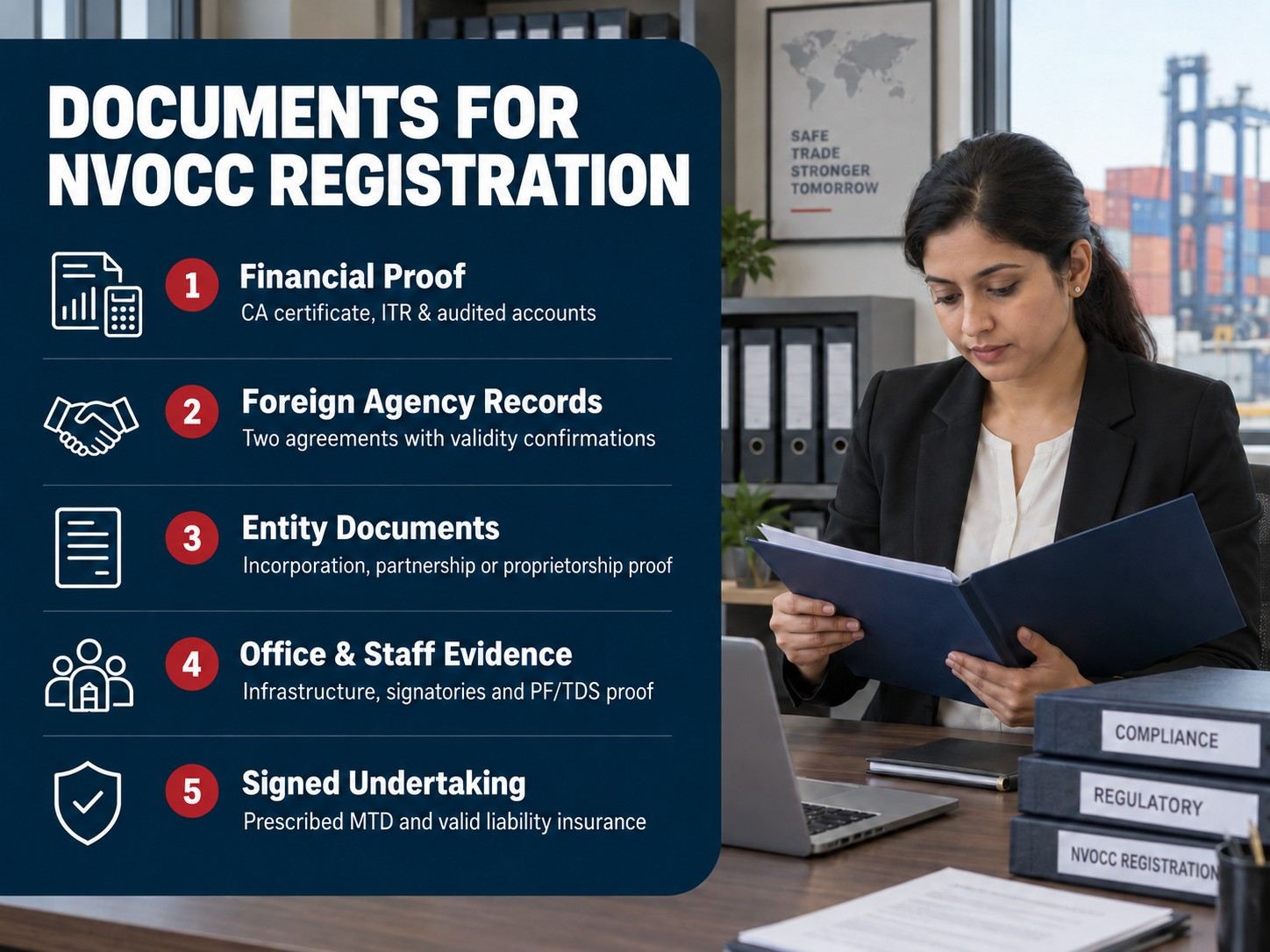
For an MTO application, organise the evidence by what it proves.
Financial capacity
- A CA certificate for the applicable ₹50 lakh turnover test, the relevant income-tax return front page and complete audited accounts, including schedules and notes.
- Alternatively, the applicable CA or company secretary certificate proving at least ₹50 lakh capital for an applicant not already in shipping or freight forwarding.
Foreign network
- Signed and dated multimodal agency agreements with two agents located in two different foreign countries.
- Confirmation from each agent that its agreement remains valid. The confirmation should be dated, preferably on the agent’s letterhead, and communicated through the agent’s official email or fax.
Entity and Indian presence
- Certificate of incorporation with memorandum and articles, partnership registration, or registered proprietorship deed, as applicable.
- Proof of the registered office or permitted Indian presence, plus the names and Indian contact details of directors, partners or the proprietor.
Operations and undertaking
- Office and telecommunications details, the authorised MTD-signatory list, CEO-authenticated specimen signatures and the stated employment evidence.
- An undertaking to issue only the prescribed MTD for covered exports and to keep it protected by valid liability insurance.
Each upload must be a PDF not exceeding 5 MB. Align the entity name, address, PAN, GST details and financial period throughout.
NVOCC Application Process for Indian Companies
India does not have a separate application portal for an approval officially named an NVOCC licence. An Indian company planning to provide NVOCC services in US foreign ocean commerce must apply to the Federal Maritime Commission.
A foreign-based NVOCC can choose between:
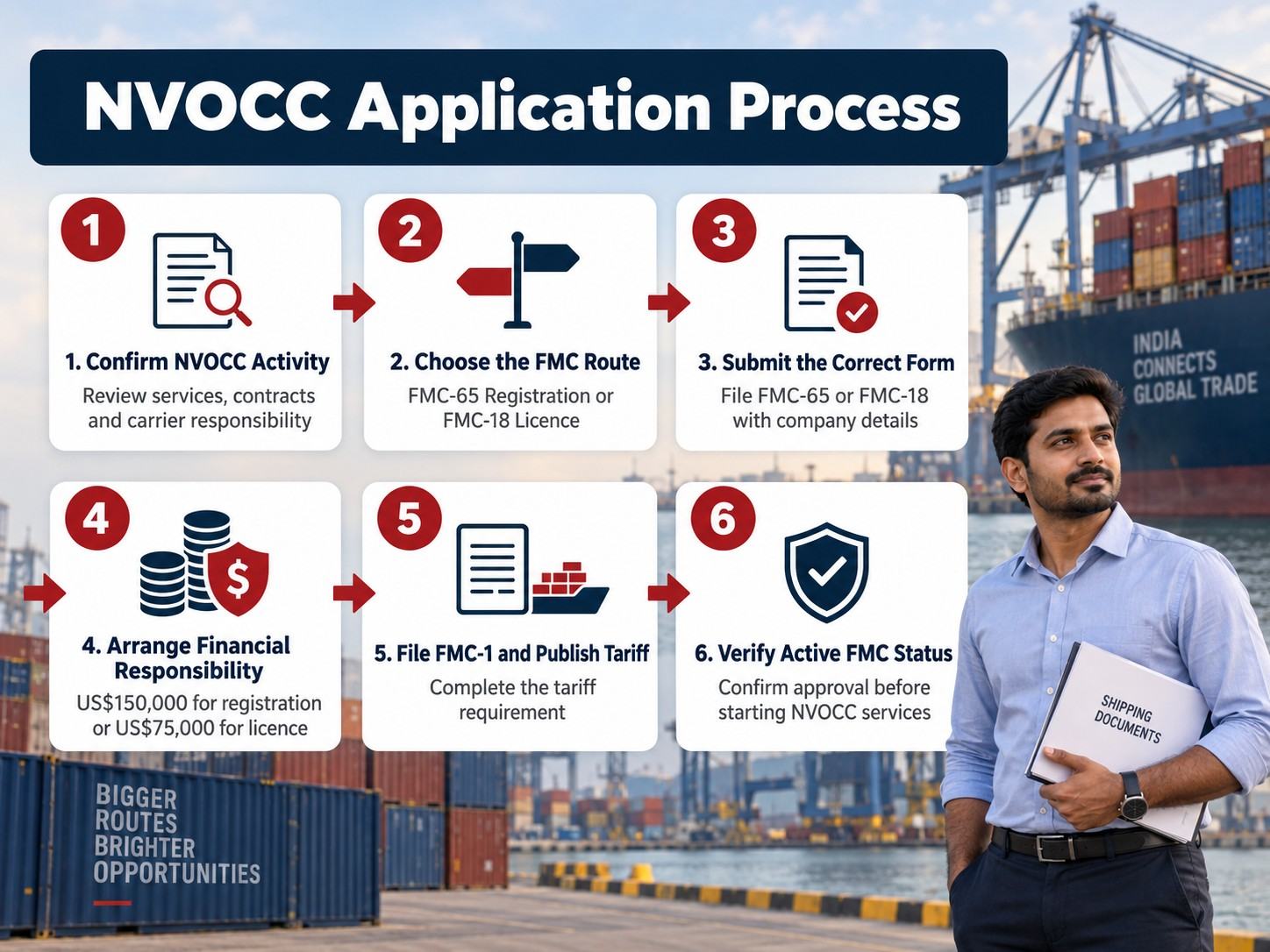
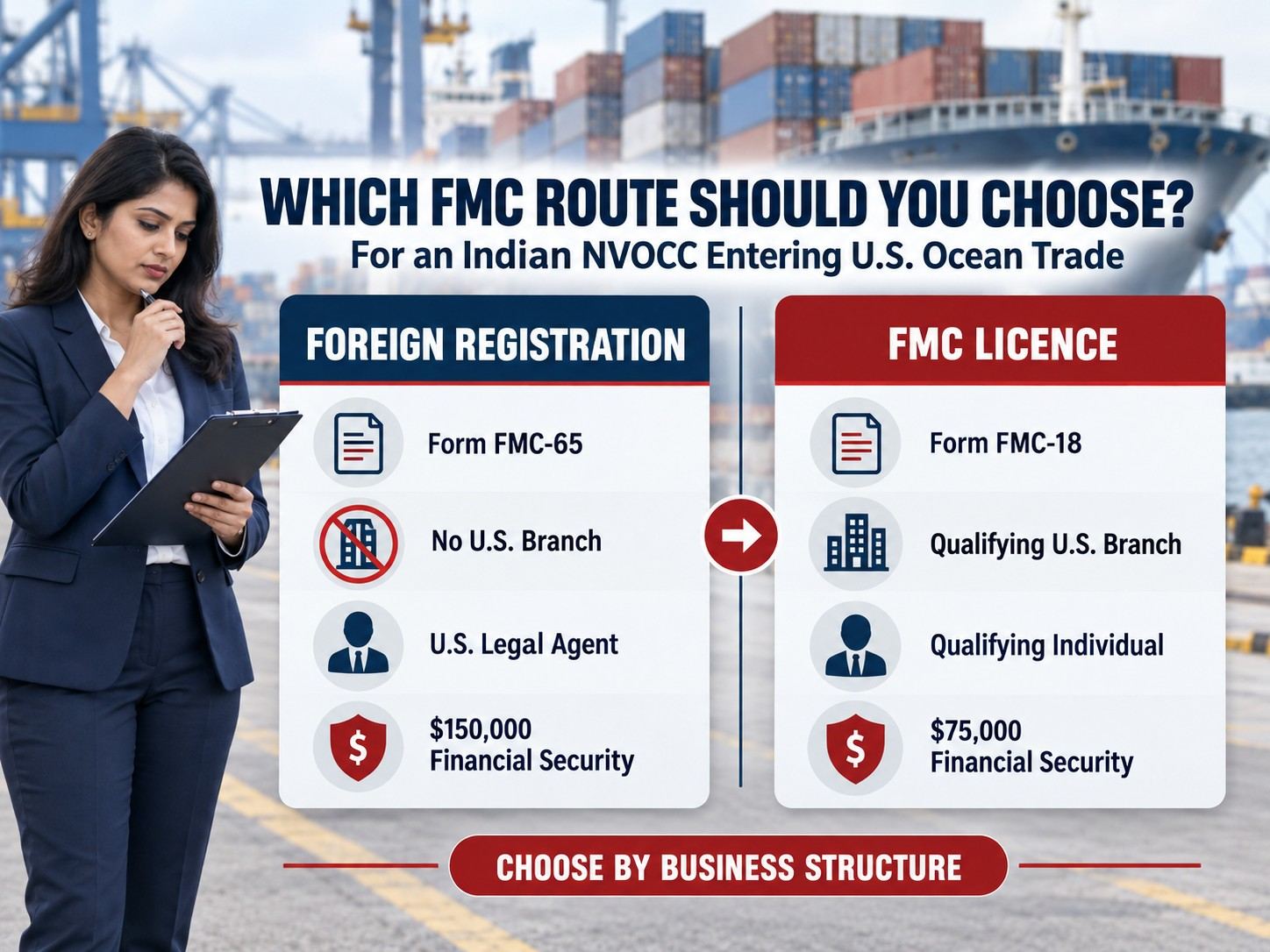
- Foreign NVOCC registration through Form FMC-65
- An FMC-issued NVOCC licence through Form FMC-18
The appropriate route depends primarily on whether the Indian company maintains a qualifying business presence in the United States.
Option 1: Foreign NVOCC Registration Without a US Branch
This route is generally suitable for an Indian company whose principal place of business remains outside the United States and which does not want to establish the US branch required for an FMC licence.
Step 1: Confirm the NVOCC Activity
Examine the company’s proposed services, contracts and transport documents. Foreign NVOCC registration becomes relevant when the company provides ocean transportation involving the United States in its own name, without operating the carrying vessel.
Issuing a house bill of lading, purchasing ocean transportation for resale and accepting carrier responsibility are important indicators of NVOCC activity.
Step 2: Appoint a US Legal Agent
The Indian company must designate and maintain a person in the United States to receive judicial and administrative process.
The legal agent’s name, address and contact information must be included in Form FMC-65. Any later change to these details must be reported to the FMC.
Step 3: Submit Form FMC-65
Complete Form FMC-65 with the company’s:
- Exact legal name
- Applicable trade names
- Principal business address
- Telephone and contact details
- Authorised contact person
- US legal-agent information
The certification must be signed by the proprietor, partners, corporate officer or eligible LLC member, depending on the business structure.
Step 4: Arrange Financial Responsibility
A foreign-based registered NVOCC must maintain US$150,000 in acceptable financial responsibility.
The FMC permits a bond, insurance or guaranty in the prescribed form. If a surety bond is used, the provider generally files Form FMC-48 directly with the FMC.
This amount is financial security and not the price charged for registration. The commercial premium payable to the surety or insurer depends on the provider’s assessment.
Step 5: Submit Form FMC-1 and Publish the Tariff
The applicant must submit Form FMC-1 containing information about its tariff and tariff publisher.
The tariff must remain available for public inspection and contain the NVOCC’s applicable rates, charges, rules, classifications and operating practices.
Step 6: Confirm That the Registration Is Effective
The company cannot commence NVOCC services in US foreign trade merely because it submitted Form FMC-65.
Registration becomes effective only after the FMC has received:
- An acceptable Form FMC-65
- Valid proof of financial responsibility
- Form FMC-1
- Confirmation that the required tariff is effective
The company should verify its status on the FMC’s Ocean Transportation Intermediary list before offering regulated NVOCC services.
Option 2: Applying for an FMC-Issued NVOCC Licence
An Indian company can choose an FMC-issued licence if it establishes the qualifying US presence required for foreign-based licensed NVOCCs.
Step 1: Establish a Qualifying US Office
The applicant must establish and maintain an unincorporated office in the United States. The office must be resident in the United States and qualified to conduct business in the state or territory where it is situated.
Merely appointing a legal agent or using a mailing address does not satisfy the US-presence condition for this licence route.
Step 2: Appoint a Qualifying Individual
The company must appoint an officer as its qualifying individual. That person must have at least three years of demonstrable Ocean Transportation Intermediary experience connected with US oceanborne foreign commerce.
For a foreign-based licence applicant, the qualifying experience may have been gained in the United States or another country, provided it relates to US oceanborne foreign commerce and can be verified.
Step 3: Submit Form FMC-18
The applicant must complete the electronic Form FMC-18. The form collects information about the company, ownership, management, qualifying individual, business history and relevant OTI experience.
The current electronic application fee is US$1,304. This amount should be checked against the FMC’s fee schedule immediately before payment because regulatory charges can change.
Step 4: Complete the FMC Review
The FMC investigates the application and may examine:
- Accuracy of the submitted information
- Character and business background
- Financial responsibility
- Qualifying individual’s experience
- Information received from professional references
Failure to supply requested information by the prescribed date can result in the application being closed.
Step 5: Complete the Conditions After Approval
After conditional approval, the applicant must provide US$75,000 in acceptable financial responsibility and submit Form FMC-1 for its tariff.
The FMC must receive these requirements within 120 days of conditional approval. Otherwise, the conditional approval becomes invalid.
Step 6: Receive and Verify the Licence
The FMC issues the licence after the applicant satisfies the experience, character, financial responsibility, and tariff requirements.
The company should verify that its name and licence status appear correctly in the FMC database before commencing NVOCC services.
Which Application Route Should an Indian NVOCC Choose?
The table below explains which application route will be best to choose from:
| Business position | More relevant FMC route |
| Indian company without a qualifying US branch | Foreign registration through Form FMC-65 |
| Indian company with a qualifying unincorporated US branch | FMC licence through Form FMC-18 |
| Company acting only as a disclosed agent | Review whether independent NVOCC status is triggered |
| Company providing only qualifying multimodal transport from India | Examine MTO registration separately |
| Company providing both Indian multimodal and US NVOCC services | MTO and FMC requirements may apply independently |
The official FMC guidance confirms the separate licence and foreign-registration routes.
NVOCC Licence Cost and Financial Responsibility
The current government fee should be separated from bond and tariff-related expenses.
| Expense or requirement | FMC position |
| New electronic FMC-18 licence application | US$1,304 |
| FMC licence change or transfer application | US$943 |
| Foreign NVOCC registration through FMC-65 | No separate filing charge appears in the current FMC fee schedule |
| Licensed NVOCC financial responsibility | US$75,000 |
| Registered foreign NVOCC financial responsibility | US$150,000 |
| Surety, insurance or guaranty charge | Determined by the provider |
| Tariff publication charge | Determined by the tariff publisher |
Licensed and Registered NVOCCs: What Is the Difference?
A non-US NVOCC, including an Indian company, can operate under one of two FMC routes. It may obtain an FMC-issued licence or register as a foreign-based unlicensed NVOCC.
| Requirement | Licensed foreign NVOCC | Registered foreign NVOCC |
| FMC form | FMC-18 | FMC-65 |
| Qualifying US presence | Unincorporated US branch required | US branch not required |
| Qualifying individual | Required | Not required under Form FMC-65 |
| US legal agent | Required | Required |
| Financial responsibility | US$75,000 | US$150,000 |
| Public tariff | Required | Required |
| Registration or licence number | FMC licence number | FMC registration number |
The foreign-registration route allows an Indian NVOCC to comply with FMC requirements without obtaining an FMC-issued licence. However, “unlicensed” does not mean unregulated. The registered NVOCC must maintain its registration, financial responsibility, legal agent and tariff.
The licensed route involves a qualifying unincorporated US branch and an officer serving as the qualifying individual. That individual must have at least three years of verifiable OTI experience connected with US oceanborne foreign commerce.
The FMC application page officially explains both routes.
Why Do Logistics Companies Operate as NVOCCs?
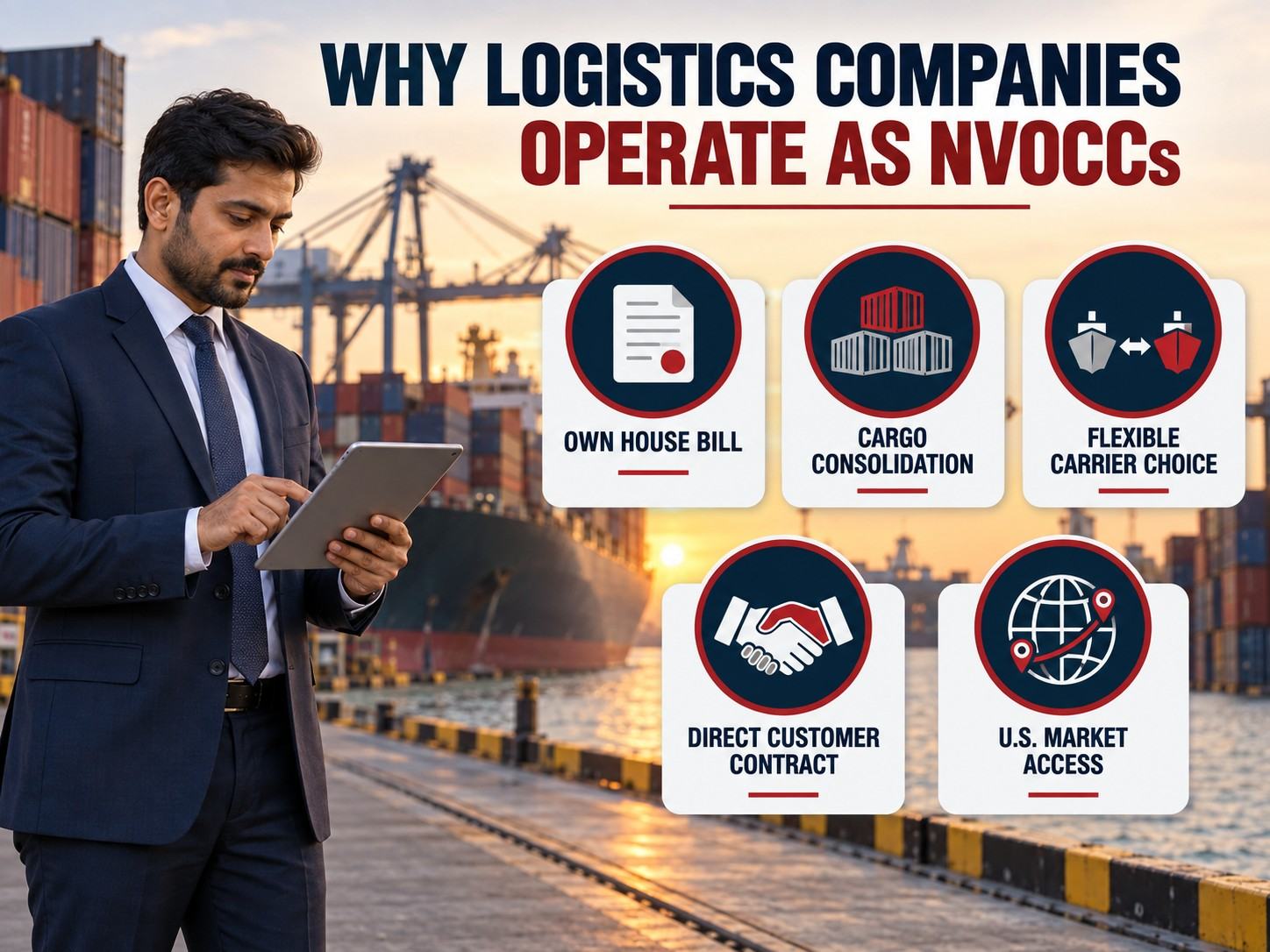
An NVOCC structure can offer several operational advantages to an established logistics business.
Ability to issue its own transport document
An NVOCC can issue its own house bill of lading when acting as the contractual carrier. This allows it to maintain a direct contractual relationship with the customer.
Cargo consolidation
NVOCCs can combine smaller shipments from different customers and book larger volumes with vessel operators. This can make them particularly relevant for less-than-container-load cargo.
Greater routing flexibility
Because an NVOCC does not operate its own vessels, it may work with multiple vessel operators and compare available sailings, routes and capacity.
Direct commercial relationship
The customer deals with the NVOCC for freight terms and contractual carriage. The NVOCC separately deals with the shipping line as the purchaser of ocean transportation.
Entry into US ocean trade
FMC licensing or registration allows a compliant Indian NVOCC to offer regulated NVOCC services in US foreign ocean commerce. However, FMC status does not guarantee customers, shipping capacity or commercial success.
Other Registrations an NVOCC Should Not Confuse with MTO
If the business files cargo-summary or manifest data with Indian Customs, it needs the appropriate ICEGATE registration and SCMTR role. MTO registration does not provide that filing identity.
Customs clearance is separately regulated. Use an authorised customs broker unless the NVOCC independently holds that authorisation.
IATA accreditation concerns airline cargo, not MTDs. The MTO operator assistance directory may support market-level due diligence, but official status must be checked against the regulator’s register.
Buying vessel space is not vessel chartering. Assess the separate maritime permission before signing a foreign-vessel charterparty.
Conclusion
The correct NVOCC License route depends on the obligation accepted. For multimodal exports taken in charge in India under one contract, MTO registration is central. Customs filing, brokerage, IATA cargo work, US ocean trade and vessel chartering remain separate.
Map a real shipment from acceptance to delivery, identify each mode and record whether the company acts as principal or agent. For MTO registration, prepare consistent financial evidence, two confirmed foreign agency agreements, employee proof, the correct fee, timely insurance and MTD uploads.
FAQs About NVOCC License
Can an NVOCC issue its own house bill while its MTO application is pending?
A pending application is not an MTO registration. The Act prohibits carrying on covered multimodal transportation without registration, and the prescribed MTD can be issued only under a valid certificate and insurance cover. A pure ocean document may fall under a different legal analysis, so do not use a “house bill” label to bypass the multimodal test.
Do I need an NVOCC licence when I only arrange transport for my own cargo?
The answer depends on the legal role, not merely cargo ownership. If the business is not offering carriage to another person and is not entering a multimodal transport contract as principal, the MTO trigger may not arise from that activity alone. Customs, importer-exporter and carrier-filing obligations can still apply, so document the exact contractual arrangement.
Does marking up an ocean-freight quote make my business an NVOCC?
A markup alone does not decide regulatory status. Authorities examine the service offered, who contracts as carrier, who assumes transportation responsibility and which document is issued. Map those facts against India’s multimodal test and, for US trade, the FMC’s NVOCC definition before selling the service.
Can I work through another NVOCC while my own registration is pending?
You may buy services from a properly authorised operator, but the contract must identify the actual principal. A pending applicant must not present itself as a registered MTO or issue its own prescribed MTD for covered exports. Record your limited agency or customer role clearly in quotations, invoices and shipment instructions.
How long does MTO registration take in India?
DGMA’s current public manual does not disclose a fixed processing or disposal period. Its 30-day rule concerns how long an unsubmitted draft remains editable, not the time for approval. Track the reference number and answer portal queries promptly without promising customers a date the authority has not published.
Does a foreign NVOCC need a qualifying individual for FMC registration?
The foreign-registration route using Form FMC-65 does not list a qualifying individual as a condition. A foreign applicant seeking an FMC OTI licence instead must establish the required US branch and appoint an officer as qualifying individual with at least three years of demonstrable US OTI experience. Choose the route before budgeting for personnel and filings.
What happens if an FMC NVOCC’s bond or other financial responsibility lapses?
FMC status requires acceptable proof of financial responsibility to remain on file. The operator should stop regulated NVOCC activity in US foreign commerce if that proof terminates and restore compliant coverage before resuming. Confirm active status on the FMC’s OTI list rather than relying on an old certificate or bond copy.
Can an inactive MTO keep its registration without issuing any transport documents?
The Act makes failure to enter any multimodal transport contract during the preceding two years a cancellation ground. Renewal also asks for some MTD copies issued during the preceding two years. An inactive operator should not assume that paying the renewal fee alone preserves eligibility.
Can one Indian company hold both MTO and FMC NVOCC registrations?
Yes, if its operations fall within both regulatory scopes and it independently meets each set of conditions. MTO registration addresses covered multimodal exports from India, while FMC status addresses US foreign ocean commerce. One certificate does not extend, replace or renew the other.
How can a shipper verify an NVOCC before paying freight?
For an Indian multimodal movement, check the operator’s name, certificate number and validity on DGMA’s current registered-MTO list. Match those details with the transport document, authorised signatory and current liability cover, and use the FMC’s official OTI list for a claimed US status. A logo, association membership or freight quotation is not a substitute for the relevant regulator’s record.
You may also like
NVOCC License in India: Know What You Actually Need
Searching for an NVOCC License in India often leads to one confusing assumptio