Top 12 IACS Member Classification Societies (ROs)
- by kapil
- Updated September 19, 2026
- 15 mins read
IACS classification societies are the 12 organizations, ABS, BV, CCS, CRS, DNV, IRS, KR, LR, ClassNK, PRS, RINA, and Türk Loydu, that make up the International Association of Classification Societies. Together they class over 90% of the world’s cargo-carrying tonnage, run statutory surveys on behalf of flag states, and write the technical rules that keep ships and offshore units safe. This guide lists all 12, their India contacts, and what each one is actually authorised to do.
What Is an IACS Classification Society?
A classification society is a technical body that checks whether a ship or offshore structure is designed, built, and maintained to a recognised safety standard. Insurers, banks, port authorities, and flag governments all rely on that check before they will insure, finance, register, or allow a vessel to trade.
IACS itself does not survey ships. It is the association that its 12 member societies belong to. Each member is independently accredited, but they agree to a common set of minimum rules called Unified Requirements, so a tanker classed by DNV in Norway and one classed by ClassNK in Japan are still held to the same structural floor.
In India, the term “Class” gets used loosely to mean any inspection agency. Strictly speaking, only these 12 societies (plus a handful of smaller non-IACS class societies recognised for specific trades) can issue an IACS-recognised class certificate. If a vendor quotes you a “classification survey” from an agency that is not one of these 12, ask which flag administration actually accepts that certificate before you pay for it.
What Does an IACS Class RO Actually Do?
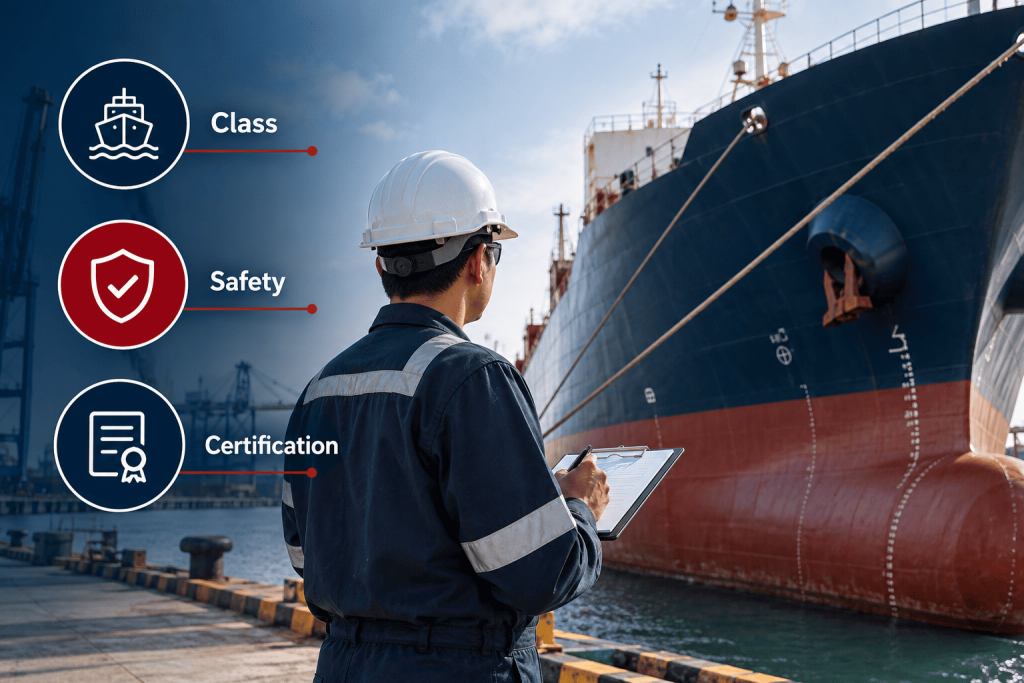
The term Recognized Organization (RO) comes from the flag state, not from IACS. When a government delegates part of its ship-safety inspection work to a classification society, that society becomes an RO for that flag. Most of the 12 IACS societies act as ROs for dozens of flag administrations, including India’s own maritime administration.
An IACS-member RO typically handles five jobs:
- Ship and offshore classification. Reviewing hull and machinery design, surveying construction, and issuing the class certificate that confirms structural and mechanical soundness.
- Statutory certification. Carrying out surveys and issuing SOLAS, MARPOL, Load Line, and MLC certificates on behalf of the flag administration.
- Product and industrial certification. Type-approving marine equipment, materials, and components, with several societies now extending into renewable-energy and industrial inspection work.
- Verification and audit services. ISM and ISPS audits, ISO management-system certification, and the routine annual, intermediate, special, and docking surveys a ship needs to keep its certificates valid.
- Rule development and R&D. Writing the Unified Requirements that harmonise minimum safety standards across all 12 societies, plus joint research on new fuels and ship designs.
Most shipowners only ever see the survey and certification side of this work. The rule-writing happens quietly in the background, and it is the reason a bulk carrier built in China and one built in Korea can both meet the same Common Structural Rules for hull strength.
For ship managers preparing for operational inspections, our SIRE Inspection: A Ship Manager’s Guide explains the inspection process, key requirements, and how to prepare for a successful inspection.
Which Are the 12 IACS Member Classification Societies?
IACS currently has 12 full members. The table below lists each one along with its verified India office details where one exists. A handful of the 12 do not maintain a dedicated India office; those are marked clearly, and the head office contact is given instead so you are not left chasing a number that does not exist.
| S.No | Classification Society / Website | Address (India) | Telephone |
| 1 | ABS (American Bureau of Shipping) – eagle.org | City Ice Building, 298 Nariman Street, Fort, Mumbai 400001, Maharashtra (India representative office, per MCA foreign-company records) ABSServiceDesk@eagle.org | +65 6276 8700 (ABS PACMEA regional survey desk, which covers India) |
| 2 | BV (Bureau Veritas) – marine-offshore. bureauveritas.com | 72 Business Park, Ground Floor, Marol Industrial Area, Cross Road C, MIDC, Andheri (East), Mumbai 400093, Maharashtra industry.mumbai@bureauveritas.com | +91 22 6274 2000 |
| 3 | CCS (China Classification Society) – ccs.org.cn | No standalone India branch office at present. Head Office: Chuanjian Dasha, Dongzhimen Nan Dajie No. 9, Beijing 100007, China ccs@ccs.org.cn | +86 10 6513 6633 |
| 4 | CRS (Croatian Register of Shipping) – crs.hr | No India office. Head Office: Marasovića 67, 21000 Split, Croatia contact: Via the contact form at crs.hr | +385 21 408 111 |
| 5 | DNV – dnv.com/maritime | Equinox Business Park, Tower 3, 6th Floor, Off Bandra-Kurla Complex, LBS Marg, Kurla (West), Mumbai 400070, Maharashtra Via dnv.com/maritime/contact | +91 22 6176 9000 |
| 6 | IRS / IRClass (Indian Register of Shipping) – irclass.org | 52A, Adi Shankaracharya Marg, Opp. Powai Lake, Powai, Mumbai 400072, Maharashtra ho@irclass.org | +91 22 3051 9400 |
| 7 | KR (Korean Register) – krs.co.kr | Mumbai Branch Office, with additional site offices in Kochi and Kolkata. KR does not publish the exact street address outside its own office locator Use KR’s office locator at krs.co.kr | Use KR’s office locator at krs.co.kr |
| 8 | LR (Lloyd’s Register) – lr.org | Lloyd’s Register Marine & Offshore India, Building Q2, 17th Floor, Aurum Q Parc, Thane-Belapur Road, Ghansoli, Navi Mumbai 400710, Maharashtra mumbai-admin@lr.org | Check LR’s Office & Port Finder at lr.org; the number on older directories predates this office’s 2023-24 move from Andheri |
| 9 | NK / ClassNK (Nippon Kaiji Kyokai) – classnk.or.jp | 201-204, Level 2, F Wing, Tower 2, Seawoods Grand Central, Plot R-1, Sector 40, Nerul, Navi Mumbai 400706, Maharashtra by@classnk.or.jp | +91 22 6849 1111 |
| 10 | PRS (Polish Register of Shipping) – prs.pl | A901, Neel Sidhi Splendour CHS, Plot 58 & 65, Sector 15, CBD Belapur, Navi Mumbai 400614, Maharashtra a.anand@prs.pl | +91 99304 49490 |
| 11 | RINA – rina.org | 606, B-Wing, Everest Chambers, Marol Naka, Andheri-Kurla Road, Andheri (East), Mumbai 400059, Maharashtra rpk@rina.org | Contact via the RINA India office locator at rina.org |
| 12 | TL (Türk Loydu) – turkloydu.org | No India office. Head Office: Evliya Çelebi Mah. Tersaneler Cad. No. 26, 34944 Tuzla, Istanbul, Türkiye info@turkloydu.org | +90 216 581 3700 |
A quick way to spot an outdated directory: if it still lists the Russian Maritime Register of Shipping (RS) as a current IACS member, or leaves out Türk Loydu, the page has not been updated since 2023. We cover exactly why that matters next.
Why Did Russia’s Classification Society Leave IACS, and Who Replaced It?
This is the single biggest fact that older articles on this topic get wrong, and it is worth getting right before you rely on any class list.
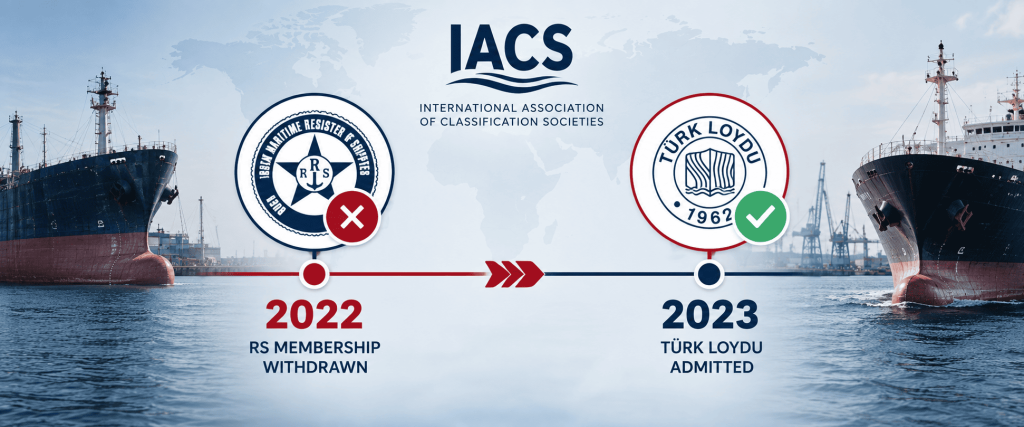
On 11 March 2022, the IACS Council voted to withdraw the Russian Maritime Register of Shipping’s (RS) membership with immediate effect, following the sanctions imposed after Russia’s invasion of Ukraine. That vote needed a 75% majority, and it dropped IACS from 12 members to 11 overnight.
IACS stayed at 11 members for over a year and a half. Then, on 1 November 2023, Türk Loydu, Turkey’s national classification society, completed a multi-year compliance process and was admitted as the 12th member, restoring the count to 12. Türk Loydu joined initially as a non-voting member because part of its classed fleet was not yet fully compliant with IACS resolutions; those ships had three years to either upgrade or be reclassed elsewhere.
If you are auditing a vendor’s compliance claims, a supplier list, or an old blog post that names RS as an IACS member, treat that as a sign the source has not been checked since early 2022.
How Does a Ship Actually Get Classed? (Step by Step)
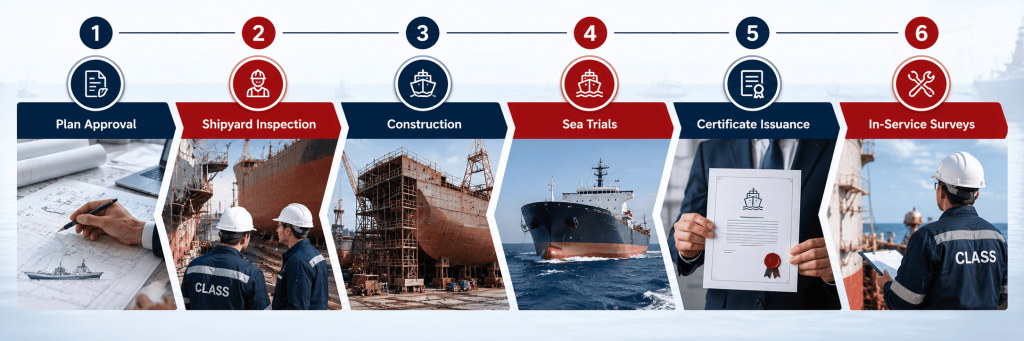
Getting a new ship classed is not a single inspection. It is a sequence that starts before steel is cut and continues for the entire life of the vessel.
- Application and plan approval. The shipyard or owner submits design drawings to the chosen society’s plan approval centre. The society checks hull strength, stability, and machinery arrangements against its own rules before construction begins.
- Construction survey. A surveyor attends the shipyard at defined stages, welding, steel-cutting, machinery installation, and outfitting, to confirm the ship is being built exactly to the approved drawings.
- Sea trials and delivery. The surveyor witnesses sea trials and confirms performance figures (speed, stability, engine output) match the design before the ship is handed over.
- Issue of the class certificate. Once construction and trials are signed off, the society issues the initial class certificate, usually alongside the statutory certificates if it also acts as RO for the flag state.
- In-service surveys. Annual, intermediate, special (every five years), and docking surveys keep the certificate valid through the ship’s working life.
- Renewal or transfer of class. At the five-year special survey, or if the owner changes society, a fresh full survey is carried out before the certificate is renewed or transferred.
Skipping or rushing the plan approval stage is the single biggest cause of expensive rework once steel-cutting has already started, because any structural change discovered mid-build has to be re-approved from scratch.
How Is Classification Different From Statutory Certification?
These two get bundled together in everyday conversation, but they come from different legal sources and cover different things.
| Aspect | Classification | Statutory Certification |
| Who requires it | The society’s own rules, and commercially, insurers and financiers | The flag state, under international conventions such as SOLAS, MARPOL, and the Load Line Convention |
| What it confirms | Structural and mechanical soundness of the hull, machinery, and equipment | Legal compliance with safety, pollution-prevention, and manning rules |
| Who can issue it | Any classification society, IACS member or not | Only a body the flag state has formally delegated authority to (usually an IACS-member RO) |
| What happens if it lapses | The ship loses class, insurance and financing typically become invalid | The ship cannot legally trade; port state control can detain it |
| Typical certificates | Class Certificate, Class Notation | SOLAS Safety Certificate, IOPP Certificate, Load Line Certificate, ISM DOC/SMC |
A valid class certificate does not automatically mean the SOLAS and MARPOL certificates are also in order. First-time exporters and new shipowners in India often assume one covers the other; it is worth checking both separately before a vessel sails or is chartered.
Which Classification Society Should an Indian Shipowner or Shipyard Pick?
There is no single “best” society. The right choice depends on the trade the vessel runs, the flag it flies, and the ports it regularly calls at. Before signing a classification contract, it helps to check:
- Whether the society is authorised as an RO by the flag you plan to register under
- The society’s port state control detention record in the trade lanes you actually sail (published in annual Paris MoU and Tokyo MoU reports)
- Whether the society has a survey office or agreed surveyor coverage at your build yard and regular ports of call
- The society’s specific technical rules for your vessel type (gas carriers, offshore support vessels, and inland craft all need different expertise)
- Turnaround time for plan approval, since delays here push back the entire build schedule
- Whether banks and P&I clubs financing or insuring the vessel have a preferred or excluded list of societies
Indian coastal cargo operators often default to IRS purely on cost and local access. That is a reasonable choice for domestic trade, but a vessel that also trades internationally may need a society with a stronger detention record specifically in the ports it calls at abroad, not just a good overall global average.
Which Class Should You Choose for Obtaining a DOC?
Before selecting a classification society for obtaining a Document of Compliance (DOC), consider the following factors:
- Location of the shipowner: Identify where the shipowner is based and which classification societies have a strong presence in that region.
- Existing vessels: Check which classification society currently classifies the shipowner’s vessels. Choosing the same class may help streamline coordination and audits.
- Flag requirements: Identify the flag under which you intend to obtain the DOC and verify which classification societies are authorised by that flag administration to conduct DOC audits and issue certificates.
- Compliance requirements: Most classification societies have become increasingly stringent in issuing DOCs. Therefore, assess their requirements, audit procedures and documentation standards before making a decision.
Our recommendation: Choose a classification society that is authorised by your intended flag administration, has experience with your type of vessels and can provide reliable support throughout the DOC certification process.
Can a Foreign Classification Society Open an Office in India?
Yes, and most of the 12 already have. Looking at the table above, ABS, BV, DNV, IRS, KR, LR, ClassNK, PRS, and RINA all maintain a physical India presence, usually structured as a liaison office, a branch office, or a locally incorporated private limited company, rather than a full Indian subsidiary. That structure makes sense because survey and certification work does not need local manufacturing, warehousing, or retail activity; it needs a compliant legal footprint and local surveyors.
A foreign classification society, or any foreign maritime services company, weighing up a similar move typically has three routes:
- Opening a liaison office in India, which lets a foreign entity maintain a local presence and communicate with clients without carrying out revenue-generating activity directly
- Setting up a branch office in India, which permits billing and survey fee collection under RBI’s conditions for representing the parent’s business activity
- Incorporating a company in India as a wholly owned or joint-venture subsidiary, which is the route several societies have used for their technical services entities
Whichever structure is chosen, a foreign entity generating income in India will also need to look at GST. Our separate guide on GST registration for foreign businesses walks through the NRTP and OIDAR pathways and which one applies depending on how the survey and certification services are billed.
How Does Legal Babu Help Shipping Companies With Classification and Maritime Compliance?
Classification is only one piece of the paperwork a ship, shipyard, or shipping agent needs in India. Legal Babu regularly works alongside classification societies and shipowners on the surrounding compliance layer:
- MLC 2006 certification for seafarer welfare and working conditions
- Document of Compliance (DOC) certification under the ISM Code
- RPSL licensing for crewing and recruitment agencies
- Multimodal Transport Operator (MTO) registration for logistics companies moving cargo across modes
- ISO 9001 quality management certification, which several classification societies also assess as certification bodies
- Chartering licenses for foreign-flagged vessels operating in Indian waters
If your business needs to line up class survey timelines with statutory certificates, crewing compliance, or a new India office structure, our team can map out the full sequence before you commit to a build or charter schedule.
Frequently Asked Questions
Is IRS (Indian Register of Shipping) as good as foreign societies like ABS or DNV?
IRS is a full IACS member and meets the same Unified Requirements as the other 11 societies, so technically it is held to the same structural floor. In practice, the right choice depends on your trade route, since banks, insurers, and charterers sometimes have their own preferences based on regional familiarity rather than any technical gap.
Which classification society is best for a small coastal vessel or fishing trawler in India?
Small coastal craft and fishing vessels often fall outside full IACS class requirements and are instead surveyed by the Mercantile Marine Department or a smaller, India-specific class society. Where full classification is needed, IRS is usually the most practical choice for coastal tonnage because of its dense India-wide survey network.
Can a ship change its classification society mid-life, and is it a red flag?
Yes, transfer of class is routine and happens for commercial, geographic, or service-quality reasons. It only becomes a red flag when a ship transfers class shortly after a serious deficiency or detention, which is exactly why IACS runs a Transfer of Class Agreement requiring the new society to review the ship’s full survey history first.
Do all 12 IACS societies charge the same classification fees?
No. Each society sets its own commercial fee schedule, and rates vary by vessel type, tonnage, build location, and how much local survey travel is involved. Getting quotes from two or three societies before finalising a newbuild contract is common practice.
What happens if a ship loses its class certificate?
Losing class effectively grounds the ship commercially. Insurance and financing agreements are typically tied to maintaining valid class, port state control can detain a vessel with lapsed certificates, and most charterers will refuse to fix an out-of-class ship.
Is ABS or DNV better for LNG carriers and gas tankers?
Both have deep gas-carrier expertise and large LNG fleets under class, so the more useful comparison is each society’s specific rule set for the fuel and containment system you are using (membrane versus Moss-type tanks, for example), plus which one has surveyors close to your build yard.
Why do some ships list two classification societies (dual class)?
Dual class is used mainly by naval and some high-value commercial vessels to get independent cross-checks on structural integrity, or to satisfy two different flag or insurance requirements at once. It roughly doubles survey cost, so it is uncommon outside specialised fleets.
How do I verify if a classification society is a genuine IACS member and not a fake “class” company?
Check the current member list on iacs.org.uk directly rather than relying on a third-party blog, since that list is the only one that updates in real time when membership changes, as it did with RS in 2022 and Türk Loydu in 2023.
Does IACS itself classify ships, or only its member societies?
IACS itself never surveys or classes a ship. It is strictly the association and rule-harmonisation body; every survey, certificate, and audit is carried out by one of its 12 member societies acting independently.
Can Indian seafarers or engineers get jobs directly with IACS, or only through member societies?
IACS’s own secretariat in London is a small policy and technical-standards office with limited headcount. Almost every surveyor, plan approval engineer, and auditor job in this field sits with one of the 12 member societies directly, including their India offices listed above.
Which Class Is the Most Cost-Effective?
Indian Register of Shipping (IRS) is generally the most cost-effective option. Its inspection charges are typically 60–70% lower than those of other classification societies, making it an attractive choice for shipowners seeking to optimise inspection costs.
This competitive pricing, combined with its extensive client base, makes IRS a preferred choice for many shipowners.
You may also like
Top 12 IACS Member Classification Societies (ROs)
IACS classification societies are the 12 organizations, ABS, BV, CCS, CRS, DNV,