
India's hospital quality benchmark has changed. The sixth edition of NABH standards took effect on 1 January 2025, introducing 639 objective elements across ten chapters. From October 2026, hospitals with more than 300 beds also face tighter access to the separate HOPE entry-level route. For hospital owners, these changes make accreditation planning a management decision, not simply a branding exercise.
NABH accreditation can help demonstrate organised patient care, safety controls and continual improvement, but it does not replace a hospital's statutory licences or guarantee insurance empanelment. This guide explains programme selection, NABH accreditation requirements, preparation records, NABH accreditation fees, application assessments and renewal responsibilities.
Why Is NABH Accreditation Becoming More Important for Hospitals?
NABH, a constituent board of the Quality Council of India, evaluates healthcare organisations against published patient safety and quality requirements. NABH accreditation for hospitals involves external assessment of real clinical and administrative practice rather than approval of a brochure or a single speciality. The sixth edition contains 100 standards and 639 objective elements across ten chapters.
A patient transferred from casualty to intensive care needs reliable handovers, medication records and infection controls. NABH standards make those activities measurable, while the NABH accreditation process tests how well they work.
Payers and government schemes may consider quality credentials when evaluating hospitals. However, NABH accreditation is not a universal legal licence to run a hospital, does not automatically create a cashless insurance agreement and cannot replace separate scheme-specific empanelment criteria. Treat its reputation benefits as opportunities, not guaranteed revenue from the NABH accreditation process.
Which NABH Programme Should Your Hospital Choose?
Choosing the wrong pathway is an expensive starting error. NABH accreditation requirements differ by programme and sanctioned bed strength. Full NABH accreditation for hospitals generally covers more than 50 sanctioned beds; SHCO covers up to 50. HOPE entry-level certification is a separate, less extensive certification pathway, not an interchangeable full-accreditation certificate.
|
Programme |
Typical applicant |
Important distinction |
|
Full Hospital Accreditation (HCO) |
Hospitals with more than 50 sanctioned beds |
Sixth-edition comprehensive hospital assessment |
|
Small Healthcare Organisation (SHCO) Accreditation |
Hospitals and nursing homes with up to 50 sanctioned beds |
Separate SHCO standards and assessment pathway |
|
HOPE Entry-Level Certification |
Eligible hospitals across specified bed categories |
Two-year certification, not full HCO accreditation |
Important October 2026 change: Under NABH notification NABH/Gen/2025/3798, hospitals with more than 300 sanctioned beds generally cannot submit new or renewal HOPE applications from 1 October 2026. Exceptions remain for government-owned hospitals and hospitals newly commissioned on or after that date, with the latter eligible for one HOPE cycle. Read the official NABH entry-level transition notification before deciding which route applies.
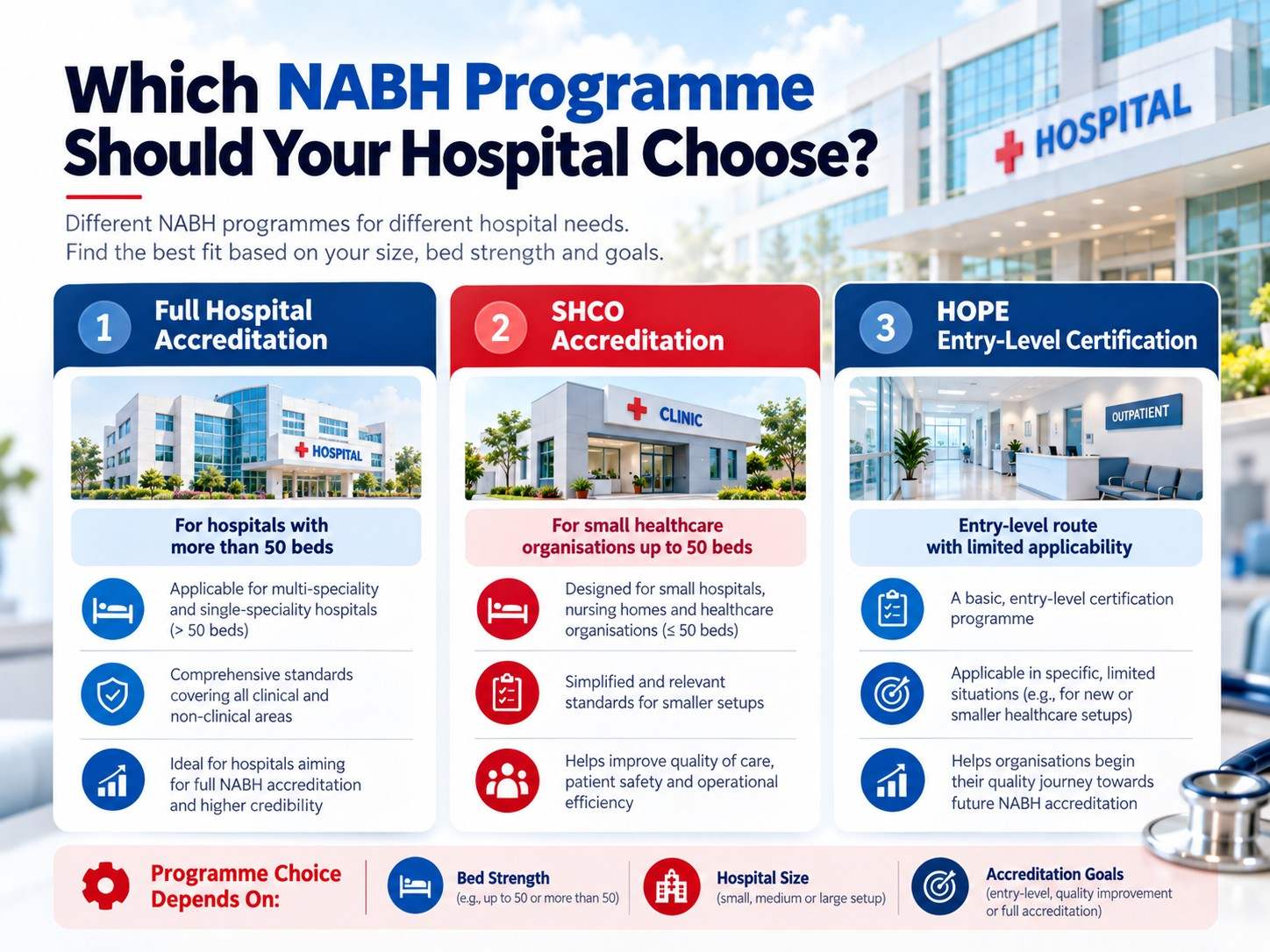
A 40-bed nursing home should not assume the standard HCO fee table applies. Equally, a 350-bed private hospital planning its first quality credential in October 2026 should check the transition restrictions before paying under HOPE. Proper selection is the first stage of the NABH application process for full hospital accreditation.
What Do the Sixth-Edition NABH Standards Actually Assess?
The NABH standards cover both patient-facing work and the systems supporting it. Hospitals should assign each applicable element an owner, evidence record and corrective action. These examples do not replace the official standards.
|
Assessment area |
Evidence assessors may examine |
|
Patient access and continuity |
Triage, admission, transfer, discharge and handover records |
|
Clinical care and medication |
Clinical protocols, prescribing checks and medication incident reviews |
|
Patient rights |
Consent, privacy practices, complaints and bill transparency |
|
Infection prevention |
Hand hygiene observations, surveillance and sterilisation records |
|
Facilities and workforce |
Fire drills, maintenance, staffing credentials and training |
|
Quality management |
Internal audits, incident trends, indicators and corrective actions |
The NABH accreditation requirements in the sixth edition group objective elements into Core, Commitment, Achievement and Excellence. Hospitals should recognise that these are not four optional badges. They represent different assessment expectations across the accreditation cycle. NABH accreditation requirements therefore extend beyond having standard operating procedures stored on a computer.
If an infection-control policy requires daily checks, staff must demonstrate completed checks and review. General ISO 31000 risk guidance can support management thinking, but cannot substitute for patient-specific NABH accreditation requirements.
Who Meets the NABH Accreditation Requirements?
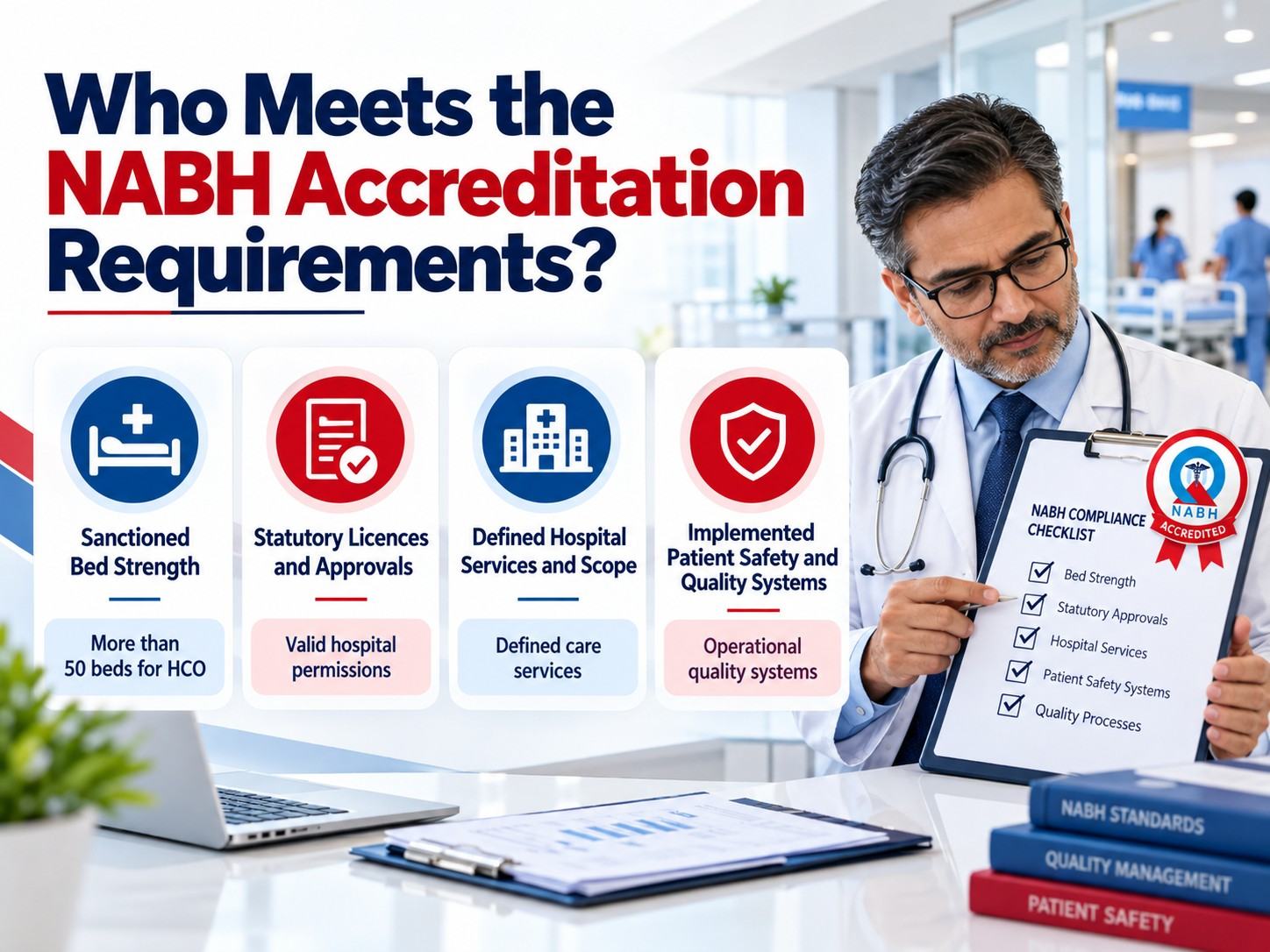
Full NABH accreditation requirements include more than 50 sanctioned beds, implementing hospital standards and complying with applicable laws. Both public and private hospitals may apply, including single-speciality and multispeciality facilities. The requirements apply to the institution's declared scope rather than allowing a hospital to quietly exclude inconvenient departments.
Before paying, management should check four matters:
-
Correct sanctioned bed count: Use the officially sanctioned figure, not a marketing number or average occupancy.
-
Declared service scope: Align inpatient, emergency, critical care, surgical and outsourced services with the actual facility.
-
Regulatory permissions: Verify the hospital's local registration, fire safety approvals, biomedical waste arrangements and other permissions applicable to its activities and state.
-
Operational readiness: Confirm staff competence, working systems, monitoring and evidence maintained for at least three months before applying.
Other obligations remain separate. A hospital should check applicable local trade licence rules, Shop Act registration requirements, hospital pharmacy drug licences and FSSAI licensing guidance for food operations. In Maharashtra, MPCB consent requirements may also matter. None is a substitute for NABH accreditation.
Which Documents Should Hospitals Prepare Before Applying?
Portal uploads differ by programme; no single document checklist covers every hospital. However, the following records support NABH accreditation for hospitals and should be checked before a filing is started.
|
Record group |
What to assemble |
|
Identity and scope |
Registered hospital name, address, sanctioned beds, management contact and services offered |
|
Statutory compliance |
Applicable hospital registration, fire permissions, waste authorisations and service-specific licences |
|
Staff and facilities |
Professional credentials, duty rosters, equipment inventory, maintenance and calibration logs |
|
Patient-care evidence |
Consent formats, clinical records, discharge summaries and medication controls |
|
Quality evidence |
Self-assessment, incident reporting, committee minutes, audits, indicators and corrective actions |
|
Outsourced services |
Current service agreements, responsibilities and monitoring records where services are outsourced |
NABH accreditation requirements are evaluated against the declared facility, so consistency matters. If a lease names one entity, a hospital registration another and the application a third, investigate the difference before submission rather than assuming it will be overlooked.
Outsourced diagnostic testing still needs oversight of reports and critical alerts. A supplier and vendor assessment supports due diligence, while ISO 27001 information security addresses a separate management system for protecting patient data. Neither replaces NABH standards.
How Does the NABH Accreditation Application Process Work?
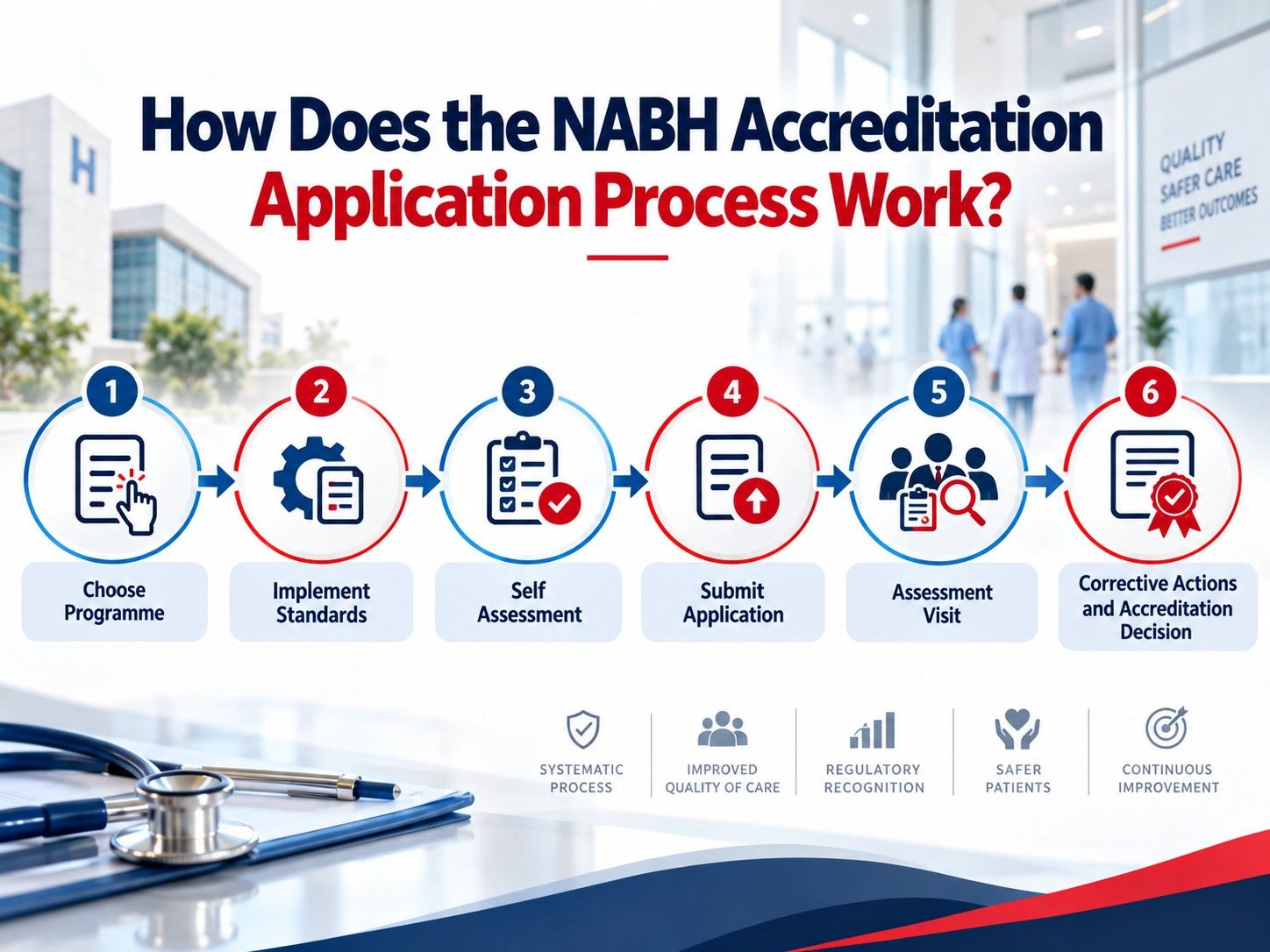
The NABH accreditation process proceeds through preparation, filing, assessment, review and a formal decision. The official Hospital Accreditation Programme states that standards should be implemented internally for at least three months before submission. The NABH application process needs a team spanning nursing, clinical care, facilities and quality.
Step 1: Select the Appropriate Hospital Programme
The NABH application process starts by checking whether HCO, SHCO or entry-level certification fits the facility. Check current eligibility and any transition notification before opening a new application. Incorrect programme selection can mean avoidable expenditure and rework.
Step 2: Obtain and Implement the Applicable Standards
Download the current standards and use the relevant NABH guidebook for interpretation. Assign each requirement to a department and retain evidence of implementation over at least three months. The NABH accreditation process measures functioning systems, not documents produced immediately before an inspection.
Step 3: Complete a Self-Assessment and Close Gaps
Compare existing practice against all applicable objective elements and record nonconformities. Prioritise failures affecting patient identification, medication safety, infection control and emergency readiness. This reduces surprises later in the NABH application process.
Step 4: Submit the Online Application and Payment
In the NABH application process, use the authorised portal account and enter the correct identity, beds, services and required documents. Pay the prescribed application charge through the approved mechanism and retain the acknowledgement. NABH accreditation fees are programme- and bed-category-specific, so verify the portal-generated demand before payment.
Step 5: Undergo Document Review and Assessment
NABH carries out document scrutiny and arranges the applicable assessment. Pre-assessment may be optional, while the final assessment examines clinical care, interviews staff and tests real implementation. Assessment timing depends on review, readiness and outstanding findings, so the NABH accreditation process has no guaranteed universal completion date.
Step 6: Address Findings and Await the Decision
Respond to recorded nonconformities with corrective actions and supporting evidence within the applicable communication deadline. Accreditation follows committee review, not automatic approval after a visit. Track the NABH application process through the authorised portal and maintain the controls during the wait.
What Are the NABH Accreditation Fees in 2026?
NABH publishes these NABH accreditation fees, revised on 1 April 2024. Importantly, its table still bears a fifth-edition label even though new HCO assessments use the sixth edition. These are the amounts displayed on the live official page when checked on 12 October 2026, not a separately verified sixth-edition quotation.
|
Sanctioned beds |
Application fee |
Annual accreditation fee |
|
Up to 100 |
₹40,000 |
₹2,00,000 |
|
101–300 |
₹75,000 |
₹3,00,000 |
|
301–500 |
₹1,00,000 |
₹4,00,000 |
|
501 and above |
₹1,50,000 |
₹5,00,000 |
NABH also lists virtual assessment charges of ₹3,000, ₹5,000, ₹10,000 and ₹15,000 respectively across those four categories, a ₹15,000 focus assessment charge and ₹6,000 for certificate reissue. GST at 18% applies extra according to the published schedule. NABH accreditation fees are distinct from internal improvement expenditure, consultants and any separate training expenditure.
Because the table retains a fifth-edition label, confirm sixth-edition charges with NABH and preserve the invoice. Do not multiply annual charges into a purported fixed NABH accreditation fees package without checking the payment schedule and any programme-specific conditions.
NABH's published online payment terms state that application and annual payments received are non-refundable. Duplicate registrations for the same programme at the same location are not accepted. Check details before payment.
Entry-level fees are different. Following expiry of the temporary rebate on 30 September 2026, the published two-year HOPE schedule shows ₹21,000 for up to five beds, ₹40,000 for six to 20, ₹80,000 for 21 to 50, ₹1,60,000 for 51 to 100 and ₹2,00,000 for 101 to 300 beds, plus the applicable tax. Those figures must never be presented as full NABH accreditation fees.
How Long Does Accreditation Last and What Must Be Renewed?
For the sixth-edition full hospital programme, NABH accreditation has a four-year cycle, with a surveillance assessment around the second year. The published standards describe surveillance at approximately 21–24 months and instruct hospitals to apply for renewal around six months before expiry. Entry-level HOPE certification has a separate two-year cycle.
During that period, NABH standards continue to apply. Maintain audits, staff training, incident reviews, maintenance and statutory permissions. Separate ISO 22301 business continuity guidance may inform disaster planning, but last-minute documentation cannot replace missing operating records.
Check changes in beds, services, ownership or name against NABH policies. If the scope changes materially, seek official clarification rather than assuming the original certificate covers everything added later. Renewed NABH accreditation for hospitals depends on ongoing conformity, not the historical award alone.
What Delays or Weakens a Hospital's Accreditation Application?
Most preventable problems are easier to identify internally than during external assessment. The following examples explain where the NABH accreditation process can stall and how to reduce the risk.
|
Avoidable problem |
Practical response |
|
Wrong programme or bed category |
Reconcile sanctioned beds and review October 2026 HOPE rules |
|
Policies with no implementation records |
Run real audits and keep dated evidence |
|
Inconsistent legal names or addresses |
Correct discrepancies before filing |
|
Outsourced services without accountability |
Assign oversight and retain current agreements |
|
Unclosed medication or infection-control incidents |
Record root causes, corrective actions and effectiveness checks |
|
Staff unfamiliar with procedures |
Test knowledge across all shifts |
Do not treat a purchased manual as proof of NABH accreditation requirements being met. Likewise, do not ask employees to reconstruct historical checklists just before the assessment. Build truthful records through routine operations and correct deficiencies promptly.
Hospital readiness can also involve EHS safety audits and ISO 14001 environmental management concepts. For major expansion, hospital project report preparation concerns separate planning needs. None replaces the clinical evidence demanded by NABH standards.
How Should Hospitals Measure the Value of Accreditation?
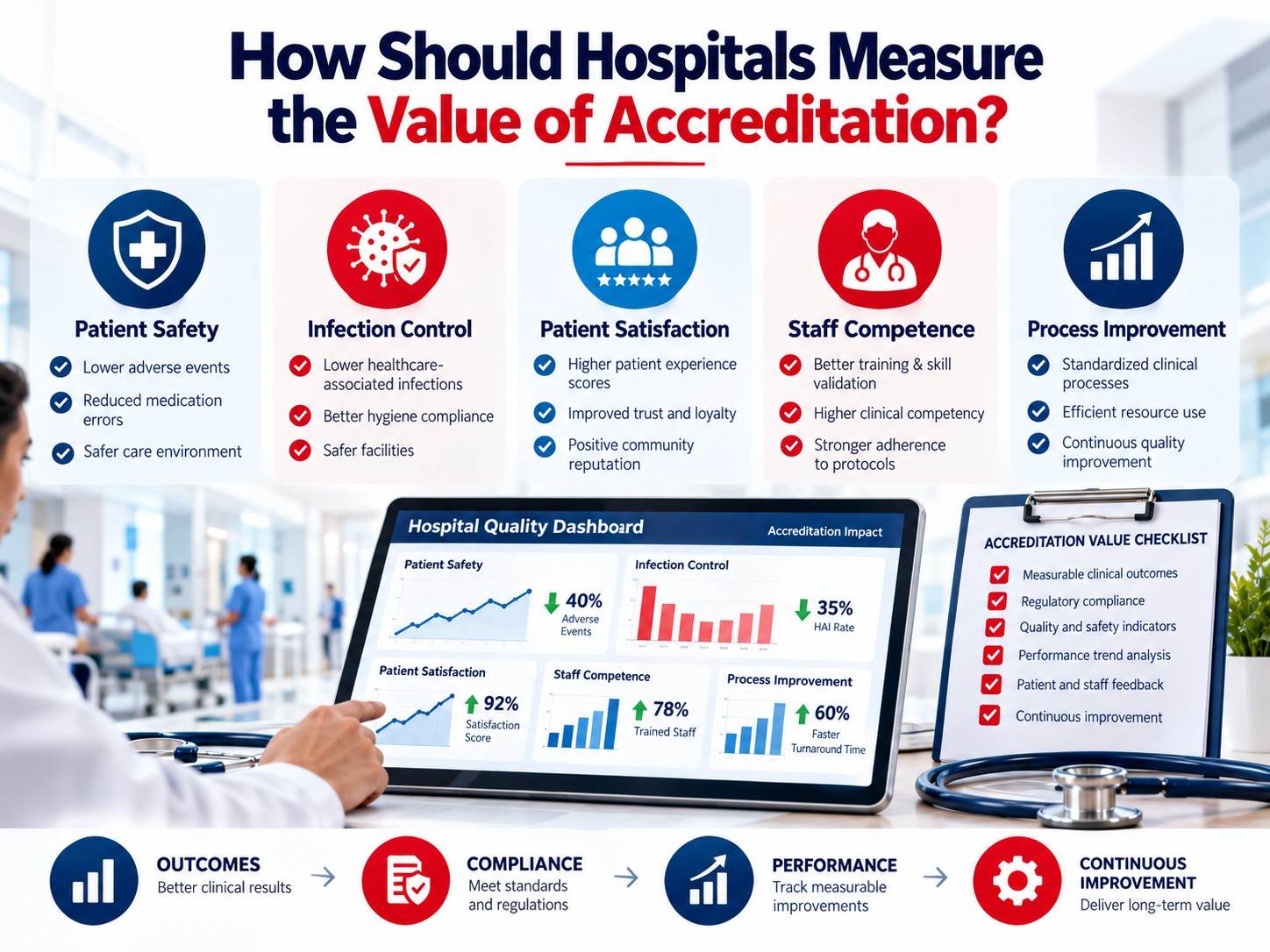
Measure the effect of NABH accreditation for hospitals through care processes that management can actually review: adverse event reporting, hand hygiene compliance, medication errors, discharge delays, complaint closure and staff competency. Trends matter more than attractive numbers selected for an assessment presentation.
A sound NABH accreditation process identifies variations between departments, shifts and sites. It can also make conversations with patients and payers clearer because policies and records are more consistent. Still, no accreditation mark proves that every future clinical decision will be correct.
With NABH accreditation for hospitals, communicate the authorised scope, not unrelated services. If a facility conducts seafarer fitness examinations, check separate medical examiner approval rules. The hospital's brand under Class 44 medical services is another distinct matter. Use NABH marks only under NABH conditions.
Conclusion
NABH accreditation is becoming vital because hospital quality is judged through observable systems, not reputation alone. The sixth edition sets a demanding framework, while the October 2026 HOPE changes make programme selection more consequential for larger facilities. For NABH accreditation for hospitals, start with sanctioned beds, statutory position and scope.
Then implement the NABH standards, close evidence gaps, check the current NABH accreditation fees and submit a complete application. Effective accreditation should leave the hospital better managed long after the assessment team departs.
FAQS
FAQs About NABH Accreditation
-
Does a hospital automatically receive cashless insurance approval after NABH accreditation?
No. NABH accreditation may support an insurer's or scheme's quality assessment, but it is not itself a cashless treatment contract. Hospitals must check each payer's empanelment terms and network status before promising cashless admission.
- Can a hospital apply if it outsources laboratory or imaging services?
- Can one NABH accreditation certificate cover several hospital branches?
- What if the hospital changes its registered name after accreditation?
- Can hospital employees complete the NABH application process without a consultant?
- Does NABH certification guarantee that a patient will not experience a medical error?
- Can an applicant ask NABH to review an adverse accreditation decision?
- How can patients verify an advertised NABH accreditation status?
- Are NABH accreditation fees refundable when a hospital withdraws?
- Does a clinic without inpatient beds need to apply under the hospital programme?


