Trademark Rectification in India: Grounds, Process and How to File
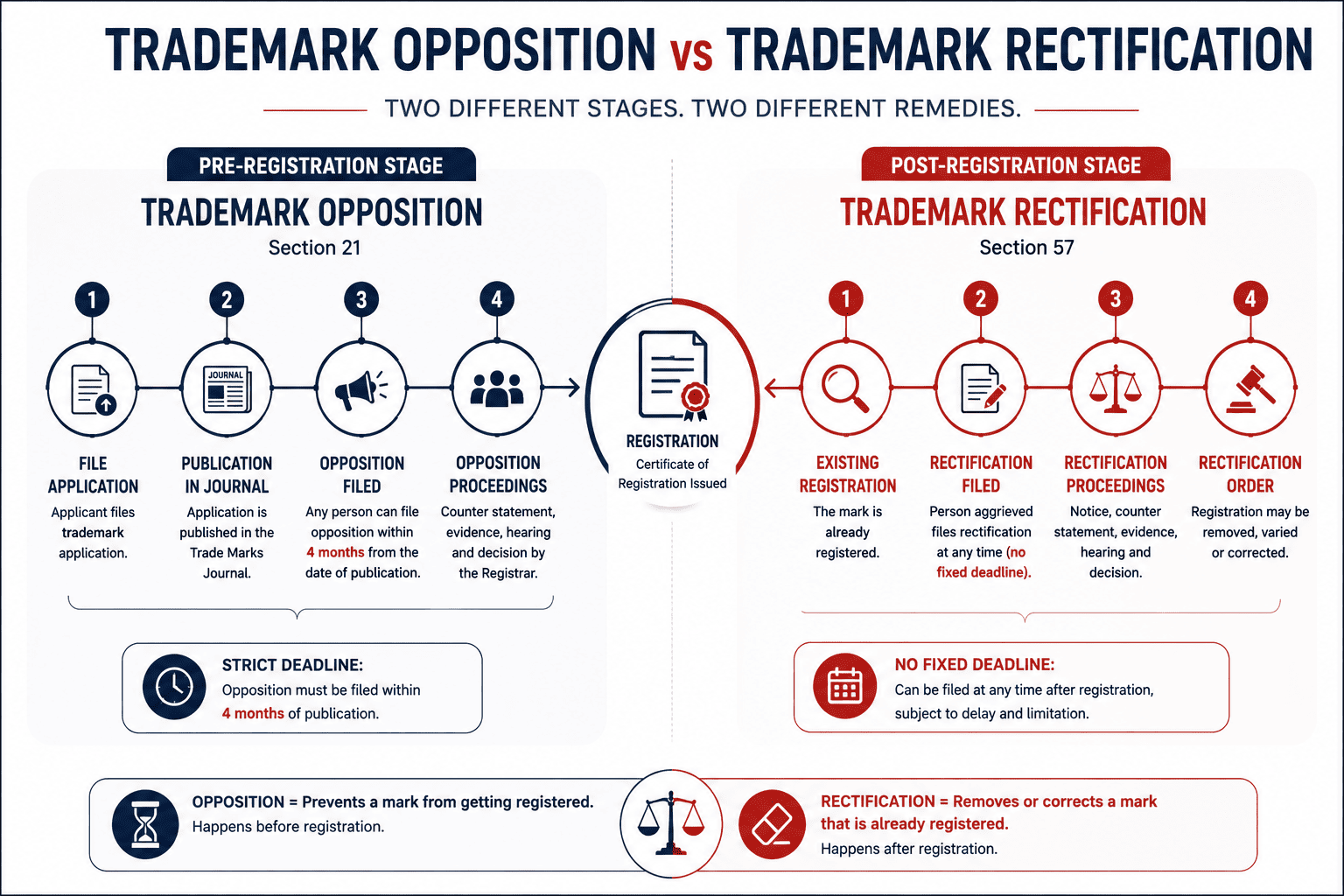
Trademark rectification in India is the legal process to correct, cancel, or remove a wrongly registered trademark from the Register, under Section 57 of the Trade Marks Act, 1999. Unlike opposition, which happens before registration, rectification applies after a mark is already registered, and it's filed on Form TM-O with the Registrar or the High Court.
What Is Trademark Rectification in India?
Trademark rectification is how you clean up the Register after a mark has already been granted. It covers correcting an entry, removing a mark that shouldn't be there, or varying the conditions attached to a registration.
Picture this scenario. You've built a clothing label called "Northline" for three years, run it as an unregistered brand, and finally decide to formalise it. A trademark search shows someone else registered "Northline" five years ago, in your exact class, but they've never sold a single product under it. That registration is now blocking yours, and it wasn't even challenged during its own opposition window, because you didn't exist as a brand back then. Rectification is your way back in. You can apply to remove that dormant registration for non-use, clearing the path for your own application.
Rectification proceedings are covered under Chapter VII of the Act, and Rule 97 of the Trade Marks Rules, 2017 sets out the procedure before the Registrar.
How Is Trademark Rectification Different from Trademark Opposition?
This is where a lot of business owners get confused, and honestly, it's an easy mix-up because both processes can end with a trademark being refused or removed.
|
Aspect |
Trademark Opposition |
Trademark Rectification |
|
Stage |
Before registration, after publication |
After the mark is already registered |
|
Governing section |
Section 21 |
Section 57 (and Section 47 for non-use) |
|
Who can file |
Any person |
A "person aggrieved" |
|
Filing deadline |
4 months from journal publication, strict |
No fixed deadline, subject to delay and non-use waiting periods |
|
Forum |
Registrar only |
Registrar or High Court |
|
Form |
TM-O |
TM-O |
If your mark is still pending and hasn't been registered yet, you're probably looking for our guide on trademark opposition in India instead, since that's a different fight with a different clock.
What Are the Grounds for Trademark Rectification?
Section 57 gives the Registrar and the High Court fairly wide powers here, and the grounds generally fall into a few buckets.
-
The entry was made without sufficient cause, meaning the mark shouldn't have been registered in the first place, often because it was identical or deceptively similar to an earlier mark
-
The entry wrongly remains on the Register, for example because the original proprietor no longer exists, or the registration was never renewed correctly
-
There's an error or defect in an entry, such as an incorrect class, an incorrect specification of goods, or wrong proprietor details
-
The registration was obtained by fraud or misrepresentation of facts before the Registrar
-
Non-use of the mark for a continuous period, which is significant enough to have its own dedicated section of the Act
A single rectification petition can, and often does, combine more than one of these grounds. A petition alleging fraud, for instance, will usually also argue the entry was made "without sufficient cause."
What Is Removal for Non-Use Under Section 47?
Non-use is by far the most commonly used ground for rectification, and it deserves its own explanation because the math behind it trips people up.
Under Section 47, a registered trademark becomes vulnerable to removal if either:
-
It was registered without any genuine intention to use it, and there's been no genuine use up to three months before you file the rectification application, or
-
It hasn't been genuinely used for a continuous period of five years, counted from the date of actual registration, plus an additional three months before your filing date
Practitioner tip: That extra three months isn't a typo or a rounding error. It exists specifically to stop a proprietor from rushing out a token sale the week before a rectification petition lands, just to claim "recent use." Courts have consistently rejected that kind of last-minute activity as evidence of genuine, bona fide use.
The burden starts with you, the petitioner, to show a prima facie case of non-use, often through an investigator's affidavit or market inquiry. Once you've done that, the burden shifts to the registered proprietor to prove genuine use. Business difficulties, low demand, or lack of funds generally don't count as valid excuses for non-use.
Who Can File a Trademark Rectification Application?
You need to qualify as a "person aggrieved," and that phrase means something slightly different depending on which ground you're relying on.
Courts have read this term liberally for general Section 57 grounds like fraud or wrongful entry, since removing an improperly registered mark serves the public interest as well as your own. The Supreme Court, in Hardie Trading Ltd. v. Addisons Paint & Chemicals Ltd., took a narrower view specifically for non-use cases under Section 47, holding that you must show the registered mark genuinely restricts your own legal rights, not just that you'd prefer it wasn't there.
In practice, people who typically qualify include:
-
Competitors who are blocked from registering or using a similar mark in the same trade
-
Prior users with an earlier, unregistered claim to the mark
-
Parties facing a cease-and-desist notice or an infringement suit from the registered proprietor
-
The registered proprietor themselves, when correcting their own registration's errors
Where Do You File a Trademark Rectification Petition?
You have a genuine choice here, which isn't the case with opposition.
Section 57 gives concurrent jurisdiction to the Registrar of Trade Marks and the High Court. For most straightforward cases, filing with the Registrar at the office where the original application was made (Mumbai, Delhi, Chennai, Kolkata, or Ahmedabad) is faster and cheaper.
There's one important exception. If an infringement suit involving the same mark is already pending before a court, that court gets priority, and the rectification issue typically gets referred to the relevant High Court's Intellectual Property Division rather than the Registrar. Since the Intellectual Property Appellate Board was abolished in 2021 under the Tribunals Reforms Act, complex or high-value rectification matters that would once have gone to IPAB are now filed directly with the jurisdictional High Court.
How Do You File a Trademark Rectification Application?
-
Confirm your standing as a person aggrieved, and identify precisely which ground under Section 57 or Section 47 applies to your case.
-
Choose your forum, the Registrar for most matters, or the High Court if an infringement suit is already active or the matter is legally complex.
-
Draft a statement of case, setting out your interest, the facts you're relying on, and the exact relief you want, whether that's cancellation, correction, or variation of the entry.
-
File Form TM-O along with the statement of case and the prescribed fee, per class of the registration you're challenging.
-
Serve the application on the registered proprietor once the Registrar or Court processes it.
-
Track your rectification number, which confirms the matter has formally entered proceedings.
Weak petitions usually fail for one of two reasons: vague grounds that don't cite a specific section, or missing evidence of the petitioner's own standing as a person aggrieved. Both are avoidable with careful drafting.
What Is the Trademark Rectification Process and Timeline?
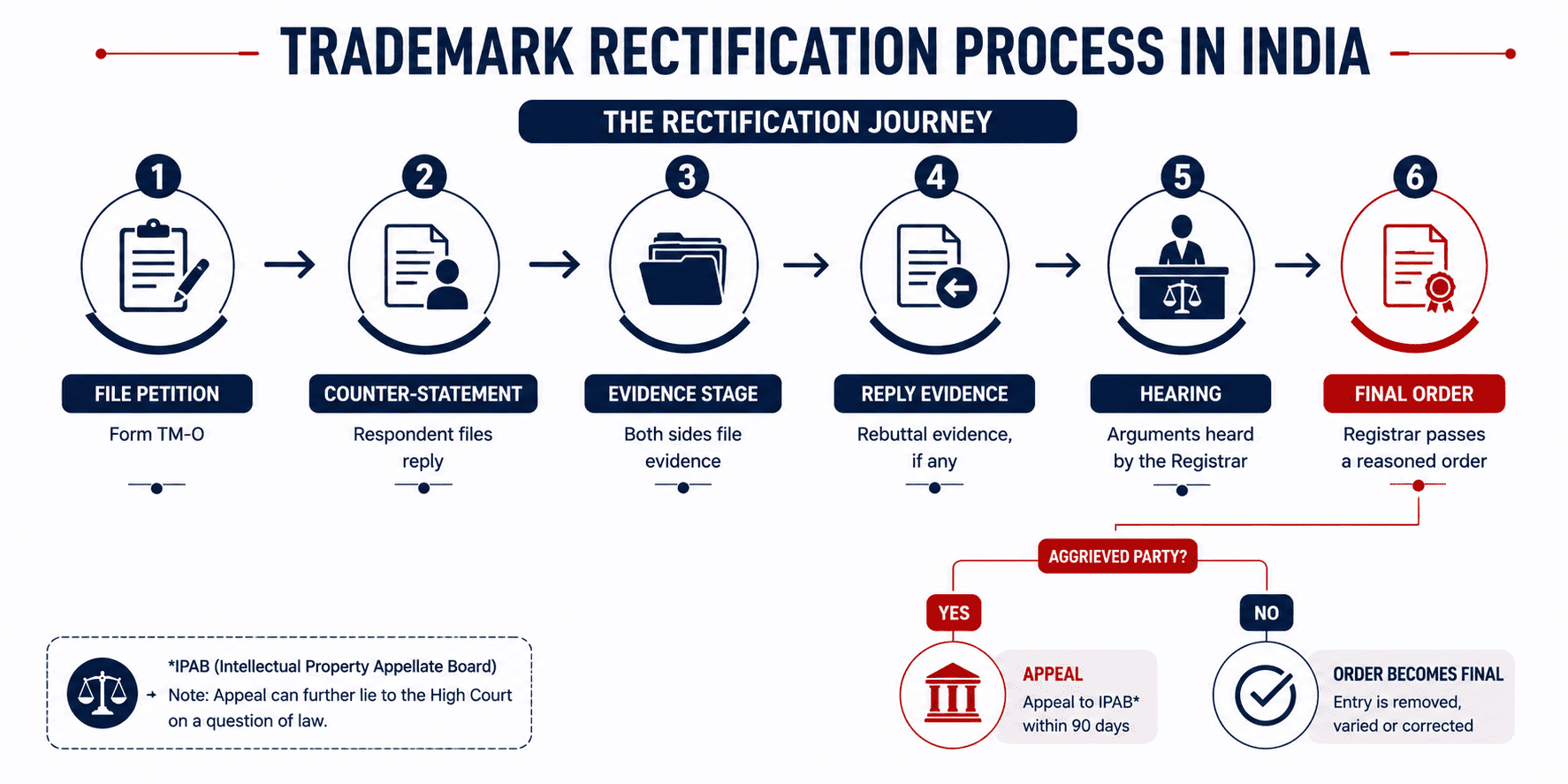
Once filed, a rectification petition before the Registrar follows a structure that closely mirrors opposition proceedings, though without opposition's rigid four-month starting deadline.
|
Stage |
Who Acts |
Typical Time Limit |
|
Filing of Rectification Petition |
Petitioner (person aggrieved) |
No fixed deadline, subject to delay and Section 47 waiting period |
|
Counter-Statement |
Registered proprietor |
Around 2 months from receipt of notice |
|
Evidence in Support |
Petitioner |
Affidavit-based, similar structure to opposition evidence |
|
Evidence in Reply |
Proprietor |
Affidavit-based |
|
Hearing |
Registrar or Court |
Scheduled after evidence is complete |
|
Final Order |
Registrar or Court |
Cancels, maintains, or varies the entry |
|
Appeal |
Aggrieved party |
To the jurisdictional High Court under Section 91 |
Contested rectification cases, especially ones involving detailed non-use evidence or fraud allegations, commonly take two to four years to reach a final decision. Straightforward corrections that the proprietor doesn't contest can move considerably faster.
How Much Does Trademark Rectification Cost in India?
The government fee for filing a rectification petition on Form TM-O is ₹2,700 per class for e-filing, or ₹3,000 per class for physical filing, the same First Schedule entry that covers opposition filings.
This is only the official government fee. Professional fees for drafting the statement of case, compiling non-use evidence, engaging a market investigator, and representing you at the hearing sit on top of this, and they scale with how contested the matter becomes. A simple, unopposed correction costs far less in practice than a multi-year non-use battle over a valuable brand name.
If you're rectifying a mark to clear the way for your own application, it's worth getting an expert trademark review done first, so you know whether the blocking mark is genuinely vulnerable before you commit to a rectification filing.
What Happens If Someone Files Rectification Against Your Trademark?
If you're the registered proprietor and someone files a rectification petition against your mark, you'll receive a notice from the Registrar or Court, and you generally get around two months to file a counter-statement.
Your response should cover:
-
Evidence of genuine, continuous use of the mark, if non-use is the alleged ground
-
A rebuttal of each specific factual allegation raised in the petition
-
Any procedural defence available, such as delay or acquiescence by the petitioner, where genuinely applicable
Don't treat a rectification notice as something to sit on. If you don't respond within the prescribed period, the Registrar can proceed to decide the matter based on the petitioner's case alone, and losing a registered trademark this way is far harder to reverse than defending it properly the first time.
Can You Appeal a Trademark Rectification Order?
Yes. An order passed by the Registrar in a rectification proceeding can be appealed to the jurisdictional High Court under Section 91 of the Trade Marks Act, generally within three months of the order being communicated.
If the rectification petition was filed directly with the High Court to begin with, rather than the Registrar, that order sits at a higher level already, and any further appeal would follow the ordinary appellate route within that court system.
Trademark Rectification vs Correction Under Form TM-P: What Is the Difference?
Not every fix to your trademark record needs a contested rectification battle. If you're the registered proprietor and you just need to correct your own details, there's a simpler route.
|
Aspect |
Rectification (Section 57, Form TM-O) |
Correction (Section 58, Form TM-P) |
|
Who files |
A person aggrieved, or the proprietor in some cases |
The registered proprietor only |
|
Nature |
Contentious, inter-partes proceeding |
Administrative request |
|
Typical use |
Removing a wrongly registered or unused mark |
Fixing a clerical error, address change, or striking out goods/classes |
|
Involves the other side |
Yes, notice and counter-statement |
No, it's a one-sided request. |
|
Evidence and hearing |
Usually required |
Rarely required |
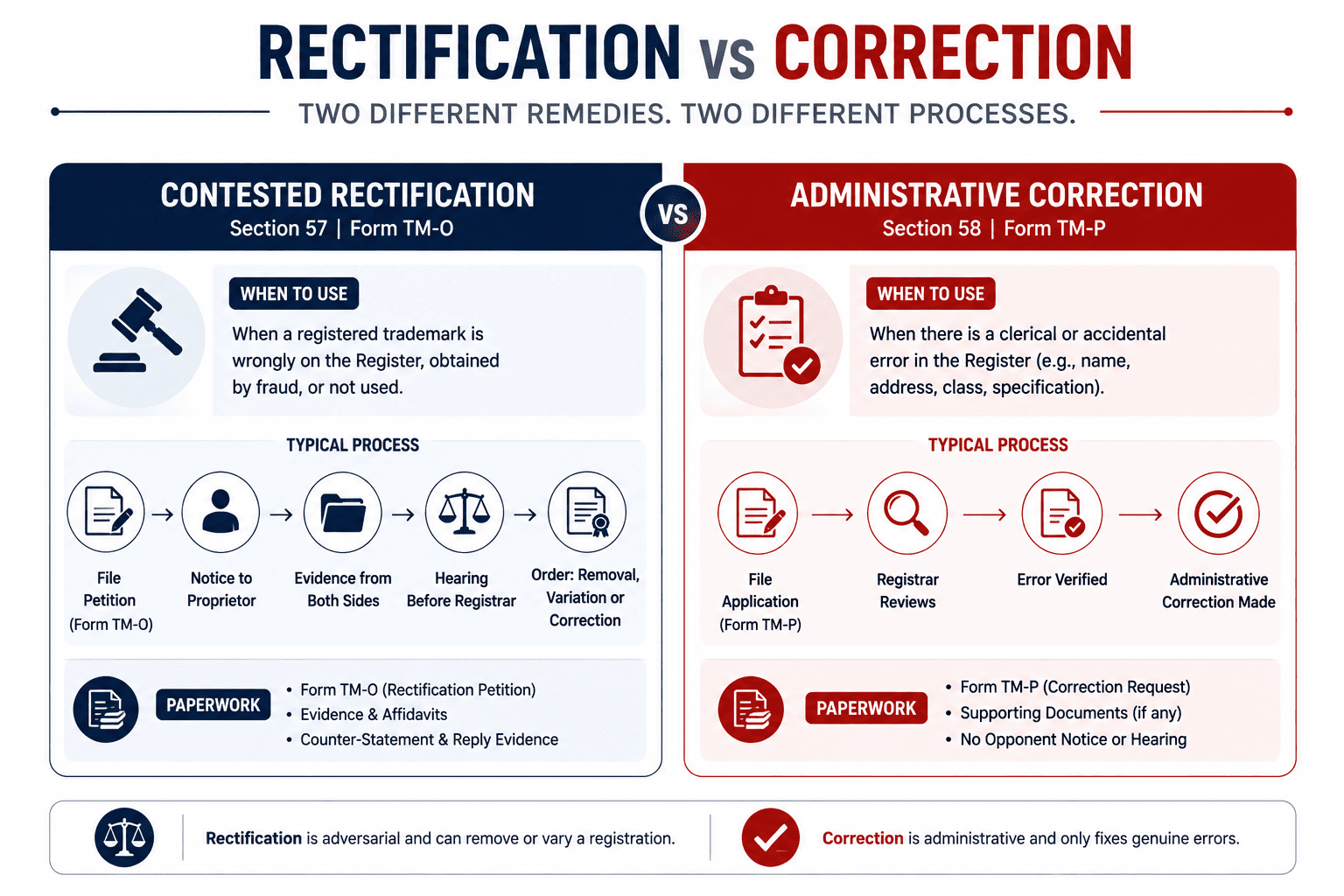
If all you need is a name or address update on an existing registration, filing Form TM-P is far quicker and cheaper than opening a rectification proceeding. Save Section 57 for genuine disputes over whether a mark deserves to stay on the Register at all.
[Infographic Suggestion 4] Placement: Within the "What Is Removal for Non-Use Under Section 47?" section, after the bullet points on non-use conditions. Idea: A calendar-style graphic counting back five years and three months from a rectification filing date, marking the registration date at one end. ALT Text: "Infographic showing the five year three month non-use period for trademark rectification"
Once a mark clears rectification or you've secured your own trademark registration, remember that registration isn't permanent protection on its own. Marks still need renewal every ten years, and it's worth browsing the full list of trademark classes to confirm your specification is airtight before you file again. Our intellectual property services cover registration, renewal, opposition, and rectification support if you'd rather have professionals manage the filing for you, and if what you're actually facing is an examination-stage objection rather than a post-registration dispute, that's a different process entirely with its own 30-day deadline.
FAQS
Have questions about Trademark Rectification?
We have got you covered.
-
What is trademark rectification in India?
It's the legal process, under Section 57 of the Trade Marks Act, 1999, to correct, cancel, or remove an entry from the trademark Register after registration has already happened.
- What is the difference between trademark rectification and trademark opposition?
- Who can file a trademark rectification application?
- What are the main grounds for trademark rectification?
- How long must a trademark go unused before rectification applies?
- Where do I file a trademark rectification petition?
- How much does trademark rectification cost in India?
- How long does a trademark rectification case take to resolve?
- Can I appeal if I lose a trademark rectification case?
- Do I need rectification to fix a simple clerical error in my registration?


