Trademark Objection in India: What It Means and How to Reply
A trademark objection is a formal notice from India's Trade Marks Registry raising concerns about your application, usually under Section 9 or Section 11 of the Trade Marks Act. You get 30 days to file a written reply. Miss that window, and the Registrar treats your application as abandoned.
What Is a Trademark Objection in India?
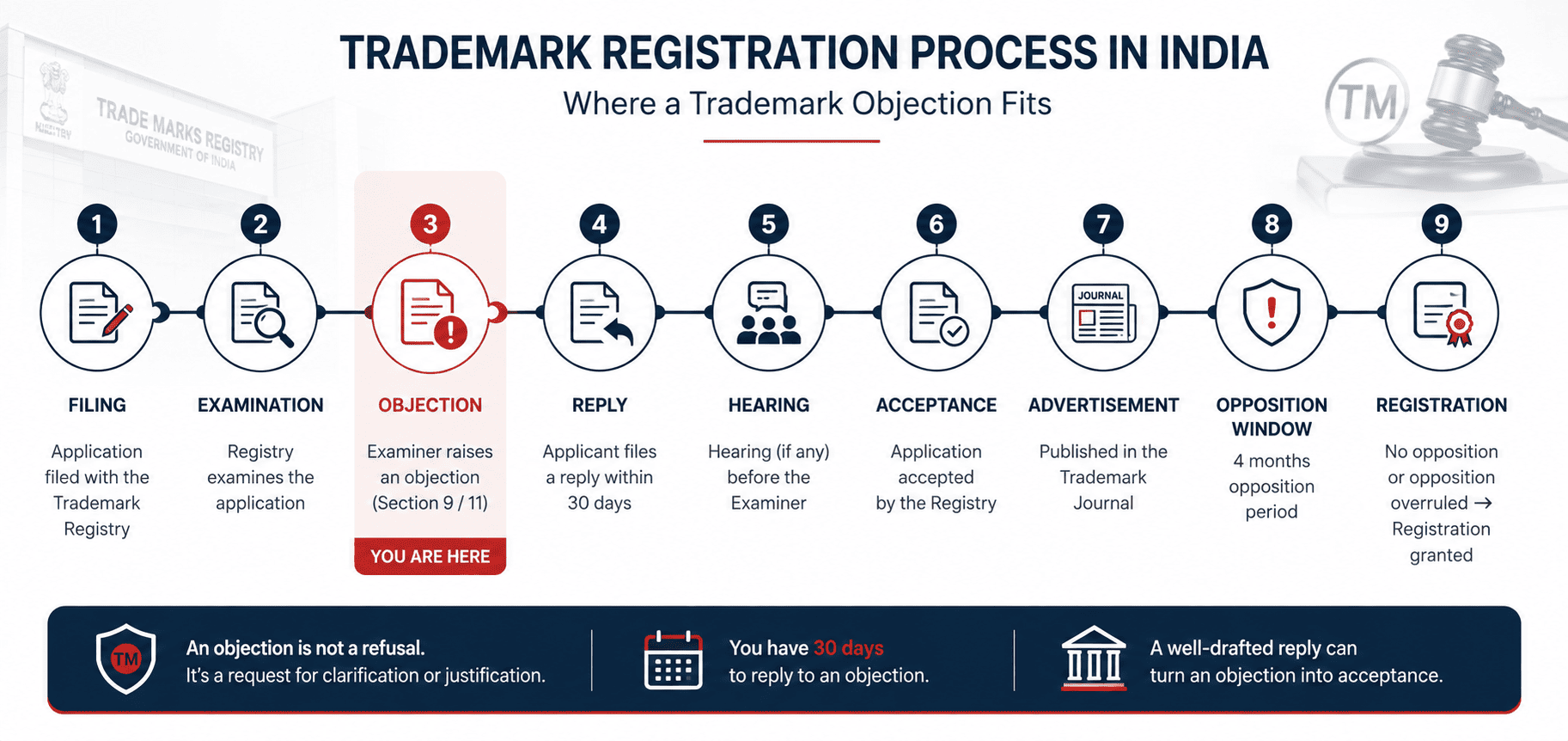
A trademark objection shows up during the examination stage, after you file your application but before it gets advertised in the Trade Marks Journal. An examiner at the Trade Marks Registry checks your mark against the Trade Marks Act, 1999, and flags any concerns in a document called an examination report.
Getting objected to does not mean your brand name is rejected. It means the Registrar wants clarification, argument, or evidence before deciding whether your mark can move forward. A large share of applications in India pick up at least one objection somewhere along the way, so this step is routine rather than a warning sign about your business.
Trademark protection is one piece of a bigger picture. If you are still working out which form of protection your brand or product needs, LegalBabu's guide to types of intellectual property lays out how trademarks, copyrights, patents, and designs each cover different ground. This particular guide sits inside LegalBabu's Intellectual Property services, and it picks up right where trademark registration leaves off, once your application has actually been filed and the examiner starts reviewing it.
Why Do Trademark Applications Get Objected To?
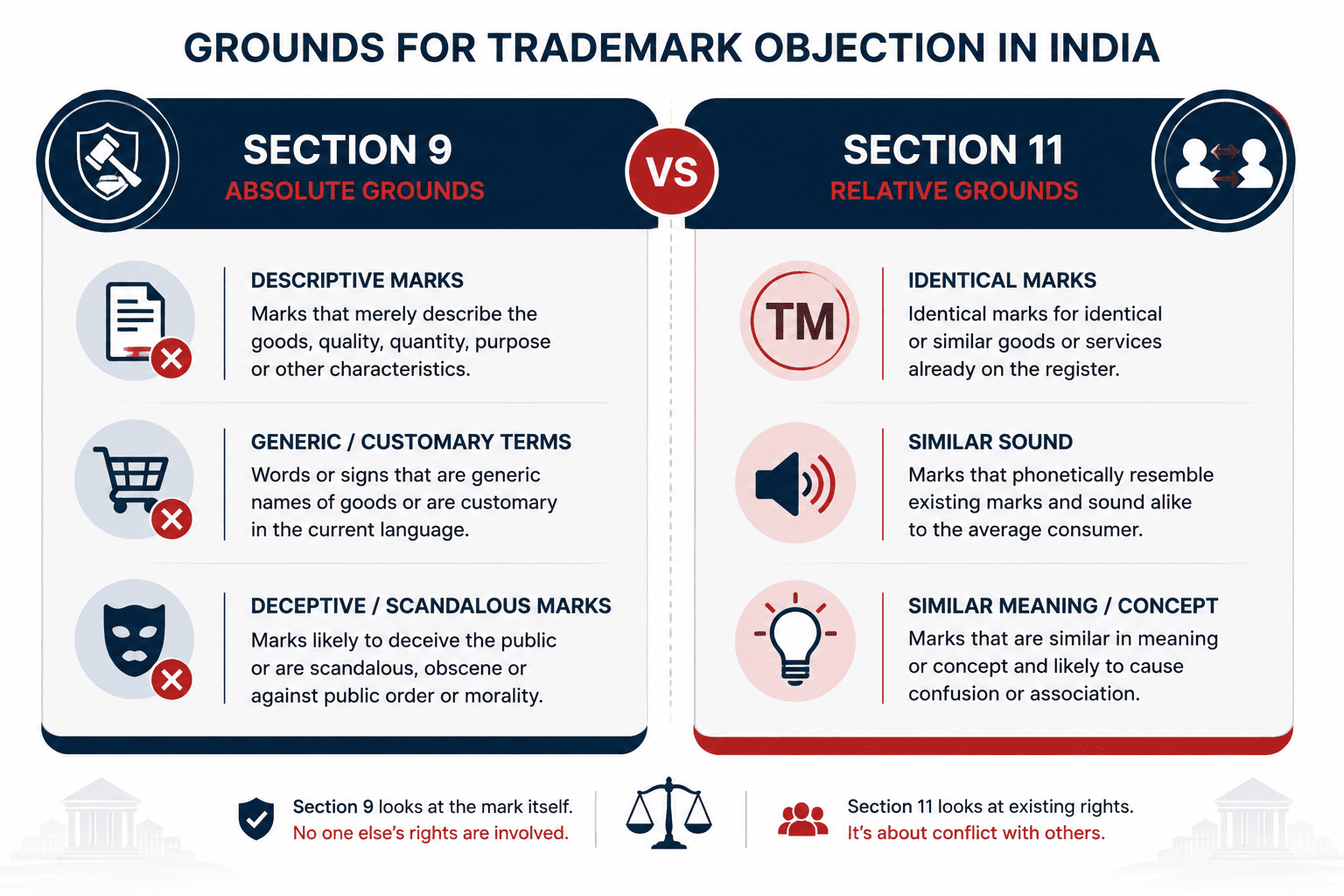
The Registrar can object to your mark for two broad reasons, and Indian law splits them cleanly into two sections of the Trade Marks Act, 1999.
Objections Under Section 9: Absolute Grounds
Section 9 objections have nothing to do with anyone else's brand. They are about your mark on its own merits.
-
Devoid of distinctive character - a single common letter, a plain shape, or a mark too simple for buyers to connect it with one specific business
-
Descriptive marks - a name that just describes the product, its quality, or where it comes from. Calling a spice brand "Fresh Masala" invites an objection, since both words describe the product rather than identify a particular seller
-
Generic or customary terms - words the trade already uses for that entire category of product
-
Deceptive or scandalous marks - names likely to mislead buyers about what they are actually getting, or that touch on obscene, religious, or otherwise sensitive territory
Objections Under Section 11: Relative Grounds
Section 11 objections are about conflict. The examiner runs your proposed mark against the existing trademark database and flags anything too close for comfort.
-
Identical marks for identical or similar goods or services
-
Marks that sound alike, even with different spelling. A name like "Kwikserve" can still draw an objection if "Quick Serve" is already registered for a similar business, because the two sound identical to a buyer hearing them out loud
-
Marks similar in meaning or concept to something already on the register in the same category
In practice, Section 11 objections turn up more often than Section 9 ones. India's trademark register already holds several million active entries, so a short, catchy name has decent odds of bumping into something filed years earlier.
How Do You Know If You've Received a Trademark Objection?
You will not get a letter in the post. The Trade Marks Registry runs almost entirely online now, so the fastest way to check is to look up your application directly.
-
Visit the Trade Marks application status portal and search using your application number
-
If the status reads "Objected," the examiner has already generated an examination report against your file
-
Download the report from the same portal. It names every section the examiner is relying on, along with the specific reasoning for each one
Here's a mistake worth avoiding: plenty of applicants only discover an objection weeks late because they assumed the Registry would email them directly, then never checked the portal themselves. Set a reminder to check your application status every few weeks once you have your application number, especially between month three and month eight after filing, since that is when most examination reports get issued.
How Long Do You Have to Reply to a Trademark Objection?
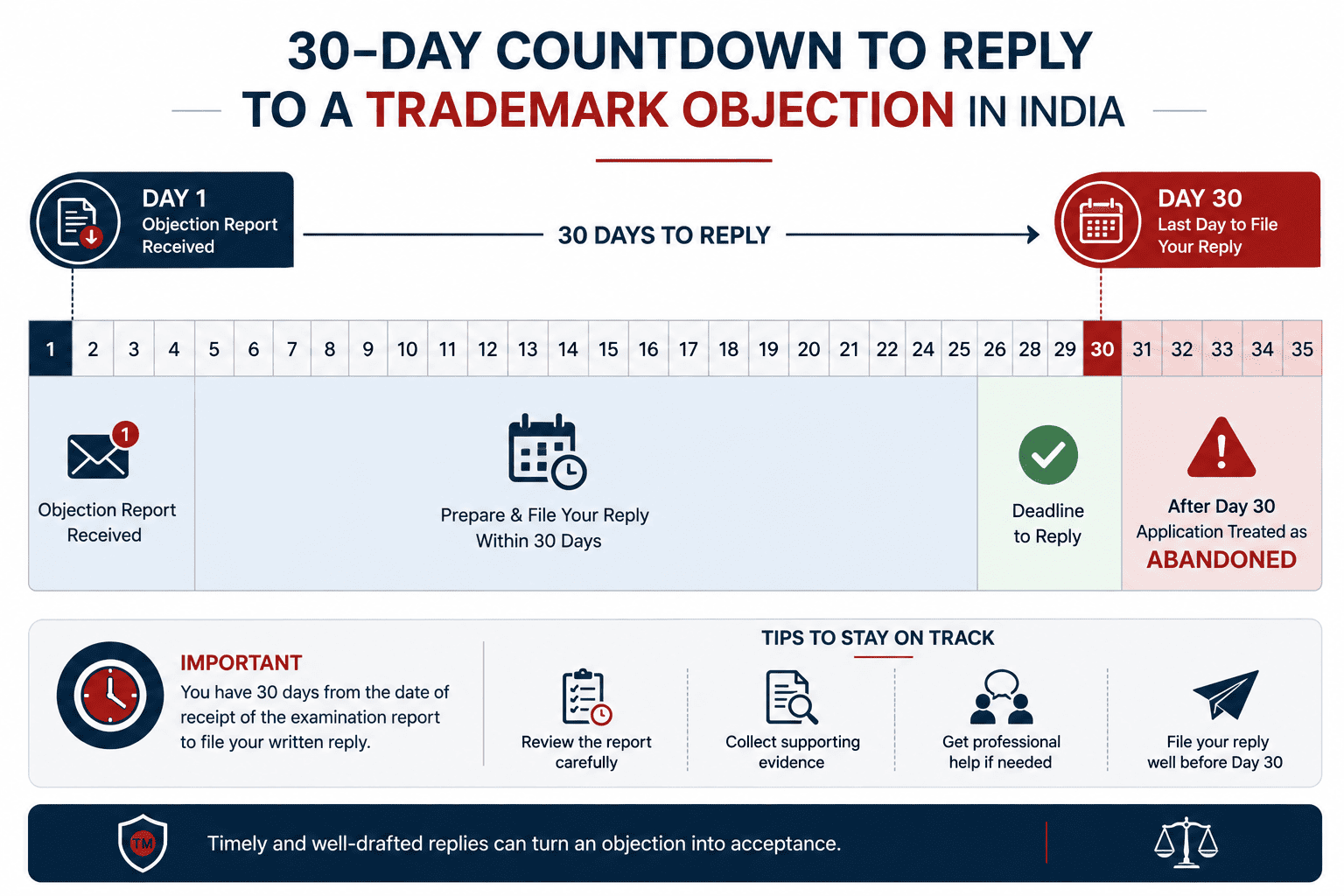
Once the examination report lands, the clock starts immediately. Rule 33 of the Trade Marks Rules, 2017 gives you one month, generally treated as 30 days, from the date of the report to file a written reply.
Miss that window, and the Registrar can mark your application abandoned. That outcome is close to final, not a soft warning. An abandoned application usually means starting over: a fresh Form TM-A, a new filing date, the government fee paid again from scratch, and the loss of your original priority date.
The rules do not guarantee an extension if you run short on time. In practice, the Registry rarely grants extra time for this particular deadline, so treat 30 days as fixed rather than negotiable, and start drafting the day the report arrives rather than the day before it is due.
|
Stage |
Who Acts |
Time Limit |
Governing Provision |
|
Reply to examination report |
Applicant |
30 days (one month) from the date of the report |
Rule 33, Trade Marks Rules, 2017 |
|
Show-cause hearing (if scheduled) |
Applicant or agent appears |
As fixed in the hearing notice |
Rule 33(6), Rule 115 |
|
Opposition by a third party |
Any person |
4 months from the date of Journal advertisement |
Section 21, Rule 42 |
|
Counter-statement to an opposition |
Applicant |
2 months from receiving the opposition notice |
Rule 44 |
|
Appeal against final refusal |
Applicant |
As per the relevant High Court's rules |
Tribunals Reforms Act, 2021 (IPAB abolished) |
What Documents Do You Need for a Trademark Objection Reply?
A strong reply leans on evidence, not just argument. Depending on which section the objection cites, gather what applies to your case:
-
Copy of the examination report
-
Invoices, purchase orders, or delivery challans showing you have actually used the mark
-
Marketing material: advertisements, packaging photos, dated website or social media screenshots
-
A signed user affidavit, if you are claiming use before your filing date (Rule 25 requires this whenever you assert prior use)
-
Business proof: incorporation certificate, GST registration, or Udyam/MSME certificate
-
A short list of similar marks that already coexist on the register, if you plan to argue your mark can too
-
A no-objection or consent letter from the owner of a cited mark, if you have managed to secure one
-
Power of attorney (Form TM-48), if a trademark agent is filing the reply on your behalf
Not every reply needs every item on this list. A straightforward Section 9 argument about distinctiveness might only need your marketing material. A Section 11 conflict usually needs more: a legal argument for why the two marks will not confuse buyers, backed by evidence of how each one actually gets used in the market.
How Do You Draft and File a Trademark Objection Reply?
-
Read the report line by line. Note every section cited (9, 11, or both) and every conflicting mark named, since your reply has to answer each point directly rather than in general terms.
-
Search the cited marks yourself. Look up any application or registration number the examiner mentions, so you understand exactly what your mark is being compared against.
-
Gather your evidence first. Pull together the documents from the checklist above before you start writing, so the reply reads as one connected argument instead of a promise to send proof later.
-
Draft a point-by-point reply. Address each objection separately, cite the specific section and sub-clause, and explain in plain terms why your mark should still go through.
-
File online through the IP India e-filing portal. Submit the reply against your existing application number, along with any supporting affidavits and evidence.
-
Track the status afterward. Keep checking the portal. An accepted reply moves your status to "Accepted." An unconvinced examiner triggers a show-cause hearing notice instead.
What Happens After You File the Reply?
If your reply satisfies the examiner, your application status changes to "Accepted," and your mark moves toward advertisement in the Trade Marks Journal. That advertisement opens a public window for anyone to oppose your registration.
If the examiner remains unconvinced, the Registry schedules a show-cause hearing rather than rejecting you outright. You, or your trademark agent, get to appear, often over video call through IP India's virtual hearing rooms, and argue the case directly. Plenty of objections that struggle on paper get resolved at this hearing stage, since a face-to-face explanation often lands better than a written note ever could.
If the Registrar refuses the application even after the hearing, the next step used to be an appeal to the Intellectual Property Appellate Board. The Tribunals Reforms Act, 2021 abolished that board and moved its powers to the High Courts. Today, an appeal against a final refusal goes to the jurisdictional High Court, and cities like Delhi and Madras now run dedicated Intellectual Property Divisions built specifically to hear this kind of case.
What's the Difference Between a Trademark Objection and a Trademark Opposition?
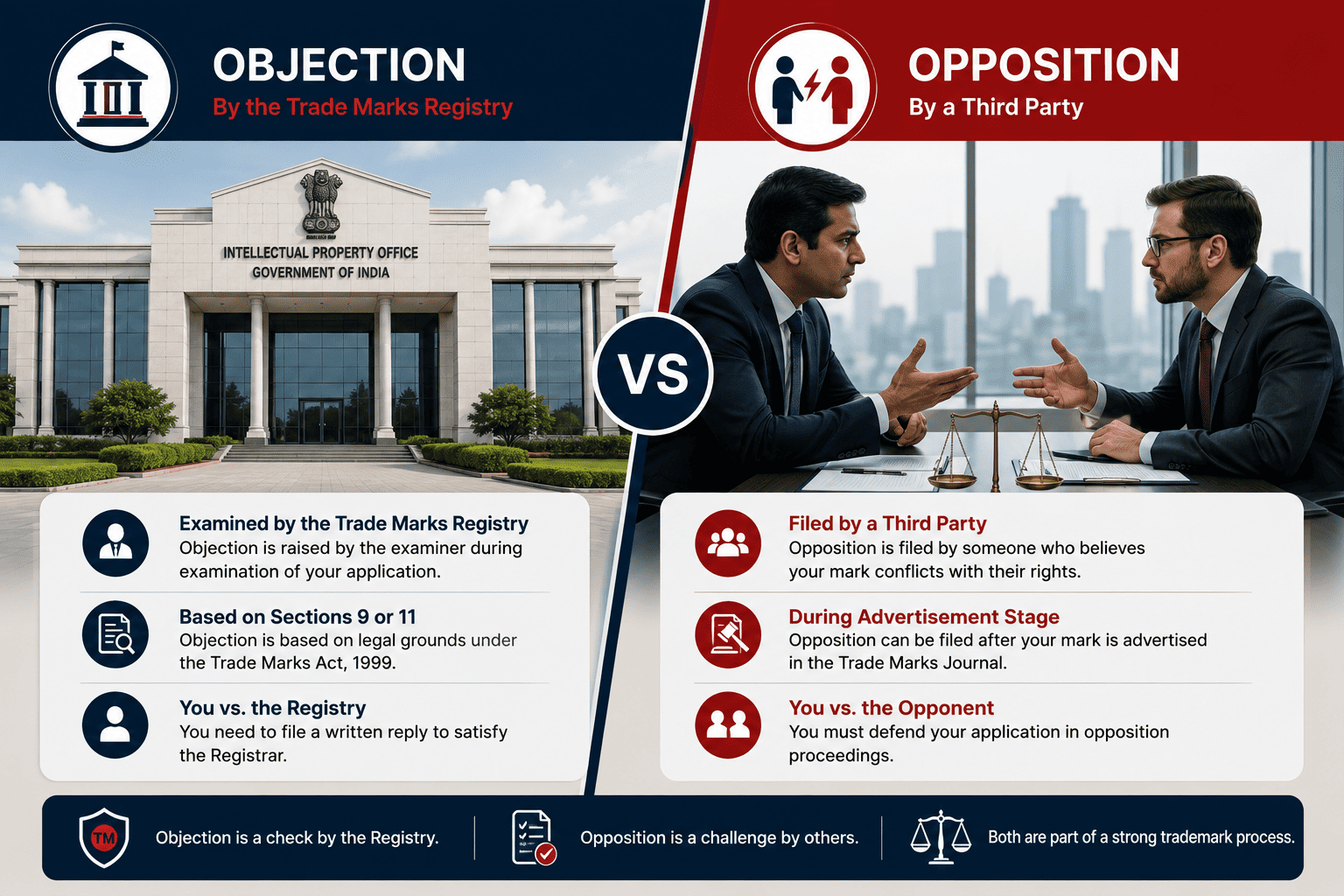
People mix these two up constantly, and the confusion makes sense since both sound like the Registry, or somebody else, is unhappy with your mark. They are separate events, though, and they run on separate clocks.
|
Point |
Trademark Objection |
Trademark Opposition |
|
Raised by |
The Registrar or Examiner at the Trade Marks Registry |
Any third party - a competitor, an existing brand owner, or a member of the public |
|
Stage |
During examination, before advertisement |
After advertisement in the Trade Marks Journal |
|
Governing provision |
Section 9 / Section 11, Trade Marks Act |
Section 21, Trade Marks Act |
|
Reply window |
30 days (one month) |
Counter-statement within 2 months of receiving the notice |
|
Form used |
Written reply against the application (no dedicated form) |
Form TM-O |
|
Nature |
The Registry checking its own rules |
An adversarial dispute between two parties |
An objection is the Registry checking its own rulebook. An opposition is a rival business, or occasionally an ordinary member of the public, formally disagreeing with your registration once it becomes public. Clearing an objection does not guarantee a free pass through opposition too, so the two stages deserve separate attention rather than one combined effort.
What Common Mistakes Make a Trademark Objection Reply Fail?
-
Filing a generic, copy-pasted reply that never actually names the specific section or the specific cited mark
-
Waiting until close to day 30 to start drafting, leaving no room to fix a missing signature or an incomplete affidavit
-
Arguing distinctiveness with no evidence of real sales, use, or promotion behind it
-
Ignoring a cited mark entirely instead of explaining why it does not genuinely conflict with yours
-
Skipping a personal hearing when the written reply alone was clearly not going to carry the argument
-
Leading with a defensive tone. Examiners respond better to a reply that engages directly with the objection than one that simply insists the mark is fine
Can You Avoid a Trademark Objection Before It Happens?
You cannot rule out an objection completely, but a proper search before filing cuts the odds by a wide margin.
-
Run a full clearance search, not just a check for the exact same name; phonetic and conceptual matches count just as much
-
Favour a coined or arbitrary name over one that describes what you sell
-
Write a precise, narrow specification of goods and services instead of copying broad, generic wording from somewhere else
-
Get a second opinion on your shortlist before you commit to filing, not after an objection has already landed
This is exactly the gap LegalBabu's Expert Trademark Review is built to close. A professional look at your shortlist before filing costs far less time and money than fixing an objection after the fact, and it can also help you settle between a few name options if you are still undecided.
How Much Does It Cost to Reply to a Trademark Objection?
The government itself does not charge anything extra for this step. Filing the reply under Rule 33 carries no separate government fee, unlike the original trademark registration application, which costs ₹4,500 per class for individuals, startups, and small enterprises, and ₹9,000 per class for companies and other entities.
What you might pay for, if you choose it, is professional help drafting the reply itself. A straightforward Section 9 argument usually costs less than a Section 11 conflict that needs legal reasoning and evidence review built in. Either way, that cost is normally far smaller than the alternative: an abandoned application means paying the full government fee all over again, on top of losing months of waiting time and your original priority date.
This guide covers the general process that applies to most applications. Complex conflicts, especially objections involving a well-known mark or multiple cited marks, often benefit from a trademark attorney's judgment, since outcomes can shift with the specific examiner, the evidence on file, and prior decisions in similar cases.
FAQS
Have questions about Trademark Objection
We have got you covered
-
What does it mean if my trademark application shows
It means the examiner has raised at least one concern under Section 9 or Section 11 of the Trade Marks Act. It is a request for clarification or evidence, not a rejection.
- Is a trademark objection the same as my application being rejected?
- How many days do I get to reply to a trademark objection?
- Can I file the objection reply myself, or do I need a trademark attorney?
- What happens if I miss the 30-day deadline?
- Does the Trade Marks Registry charge a fee to file an objection reply?
- Can I request a personal hearing if my reply is not accepted?
- Where do I appeal if the Registrar refuses my trademark after the hearing?
- Once my reply is accepted, is my trademark registered immediately?
- Can two businesses use similar names if they sell completely different products?


