
Trademark Opposition in India: Process, Timeline and How to Respond
Trademark opposition in India is the process where any person can challenge a trademark application within four months of its publication in the Trade Marks Journal, by filing Form TM-O with the Registrar. If your mark has been opposed, or you're planning to oppose someone else's, you're working against a strict, non-extendable clock, and what you do in the next few weeks usually decides the outcome.
What Is Trademark Opposition in India?
Trademark opposition is a formal objection filed against a trademark application after the Registry has already accepted it and published it in the Trade Marks Journal. It's governed by Section 21 of the Trade Marks Act, 1999, and by the Trade Marks Rules, 2017.
Here's a simple way to picture it. Say you run a small snacks brand called "Crunchy Bites". You spent two years building the name and filed your trademark application, and it sailed through examination. Three months after publication, a large FMCG company files an opposition, claiming your mark is deceptively similar to their registered "Crunch Bites". Your application doesn't die automatically. It moves into a structured, evidence-based proceeding before the Registrar, and you get a real chance to defend it.
Every week, the Trade Marks Journal publishes thousands of freshly accepted applications. Opposition exists so that anyone with a genuine stake, or even the general public, can flag a problem before a mark is locked in for ten years.
Who Can File a Trademark Opposition in India?
Section 21(1) uses the phrase "any person," and courts have read that phrase broadly. You don't need to own a registered trademark to oppose one.
People who commonly file oppositions include:
-
Owners of an earlier registered trademark who believe the new mark is identical or deceptively similar
-
Businesses with prior, unregistered use of a similar brand name (common law rights)
-
Competitors in the same or a related industry
-
Consumer groups or members of the public, where a mark could genuinely mislead buyers
-
Franchisees, distributors, or licensees protecting a brand they represent
There's no requirement to prove personal or commercial loss before filing. This is deliberate. Trademark registration is a public grant, so the law lets the public help keep the register clean.
What Are the Grounds for Trademark Opposition?
The Trade Marks Act doesn't list a fixed, closed set of grounds. In practice, most oppositions rely on Section 9 (absolute grounds) or Section 11 (relative grounds), sometimes both together.
Common grounds include:
-
The mark is identical or deceptively similar to an earlier registered or well-known trademark
-
The mark lacks any distinctive character
-
The mark is purely descriptive of the goods or services (for example, "Fresh Bakery" for a bakery)
-
The mark has become customary in the trade or in everyday language
-
The mark is likely to deceive the public or cause confusion
-
The application was filed in bad faith
-
The mark contains a name, emblem, or symbol prohibited under the Emblems and Names (Prevention of Improper Use) Act, 1950
-
The mark contains matter likely to hurt religious sentiments of any class of citizens
-
The mark is scandalous or obscene, or its use is prohibited by law
A strong opposition rarely leans on just one ground. Most well-drafted notices combine a similarity argument with at least one statutory ground, backed by evidence.
When Should You File a Trademark Opposition?
You have exactly four months from the date the application is advertised in the Trade Marks Journal, and this deadline runs from the publication date, not from the date you happened to notice the mark.
Practitioner tip: Older articles online still describe this window as "four months, extendable by one more month." That was true under the 2002 Rules. The Trade Marks Rules, 2017 removed the Registrar's power to grant that extension, and recent High Court decisions have repeatedly confirmed there is no way around this deadline. Set a calendar reminder the day a competitor's mark gets published. Don't wait.
If you miss the window, your only real option is a rectification or cancellation petition after registration, which is a longer and harder fight than an opposition.
How Do You File a Trademark Opposition?
Filing is done entirely online through the IP India trademark e-filing portal, using Form TM-O.
-
Track the Trade Marks Journal for marks similar to yours, or monitor your own filed applications for status changes.
-
Confirm the publication date of the application you want to oppose, along with its application number and class.
-
Draft the notice of opposition, setting out the application details, your interest in the matter, and the specific grounds you're relying on, citing the relevant sections of the Act.
-
Pay the prescribed fee per class through the integrated payment gateway.
-
Sign and submit the form, using a digital signature certificate if you're filing through an agent or attorney.
-
Receive your opposition number once the system processes the filing, which confirms the matter has formally entered proceedings.
Vague notices are one of the most common reasons oppositions weaken early. Naming the exact earlier mark you're relying on, and the specific legal ground, matters more than the length of the document.
What Is the Complete Trademark Opposition Timeline?
Once filed, an opposition moves through a fixed sequence of stages. Missing any one of these can end the case, for either side.
|
Stage |
Who Acts |
Governing Rule |
Time Limit |
Extendable? |
|
Notice of Opposition |
Opponent |
Section 21(1), Form TM-O |
4 months from journal publication |
No |
|
Counter-Statement |
Applicant |
Rule 44, Form TM-O |
2 months from receipt of opposition notice |
No |
|
Evidence in Support of Opposition |
Opponent |
Rule 45 |
2 months from receipt of counter-statement |
Generally no |
|
Evidence in Support of Application |
Applicant |
Rule 46 |
2 months from receipt of opponent's evidence |
Generally no |
|
Evidence in Reply (optional) |
Opponent |
Rule 47 |
1 month from receipt of applicant's evidence |
Limited scope |
|
Hearing Notice |
Registrar |
Section 21(5) |
Usually at least 1 month before the hearing date |
N/A |
|
Appeal |
Aggrieved party |
Section 91, to the jurisdictional High Court |
Generally 3 months from the date the order is communicated |
N/A |
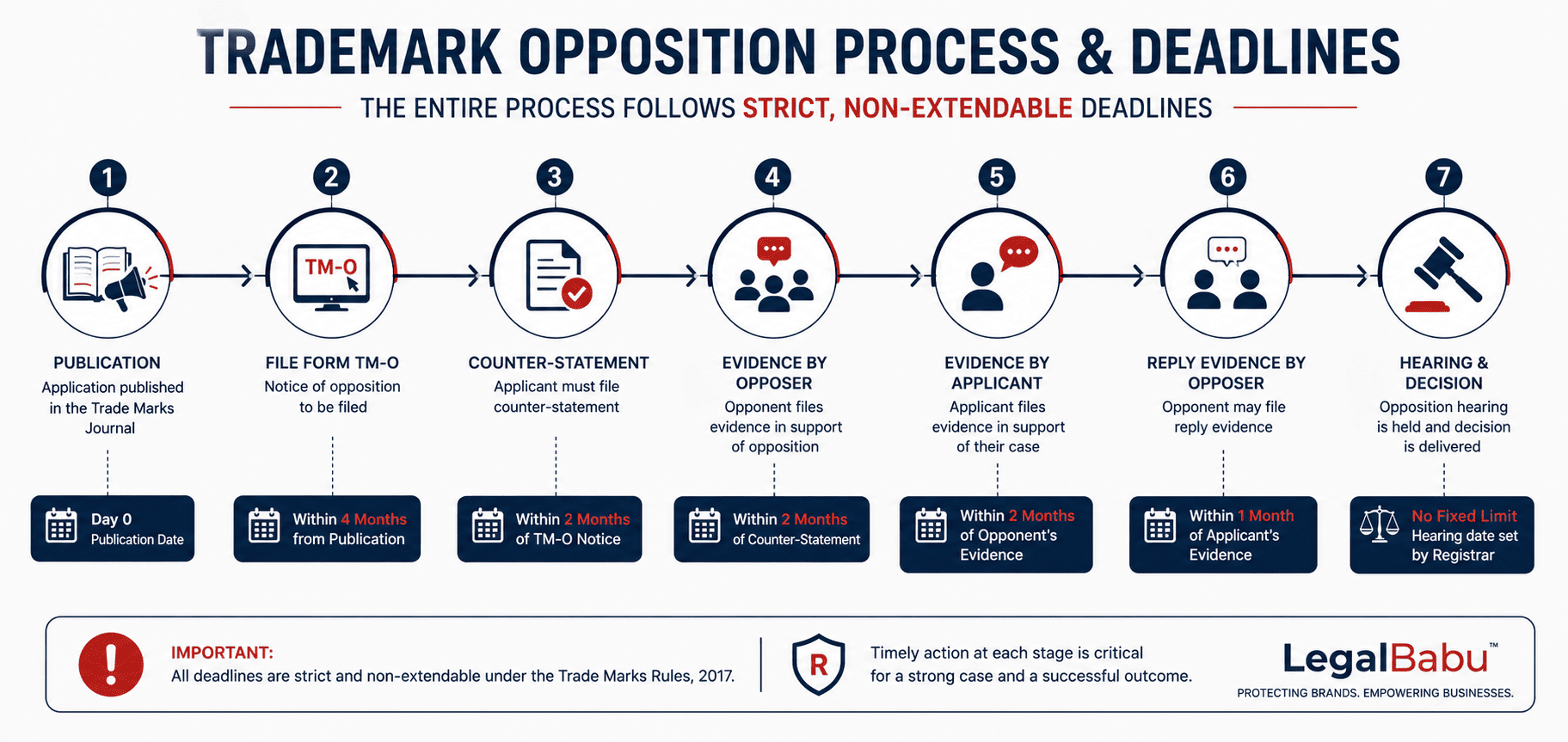
A fully contested opposition, one that runs through every stage and a hearing, typically takes anywhere from two to five years to reach a final decision, largely depending on how backed up the Registry's hearing calendar is. Cases that settle early move far faster.
How Much Does Trademark Opposition Cost in India?
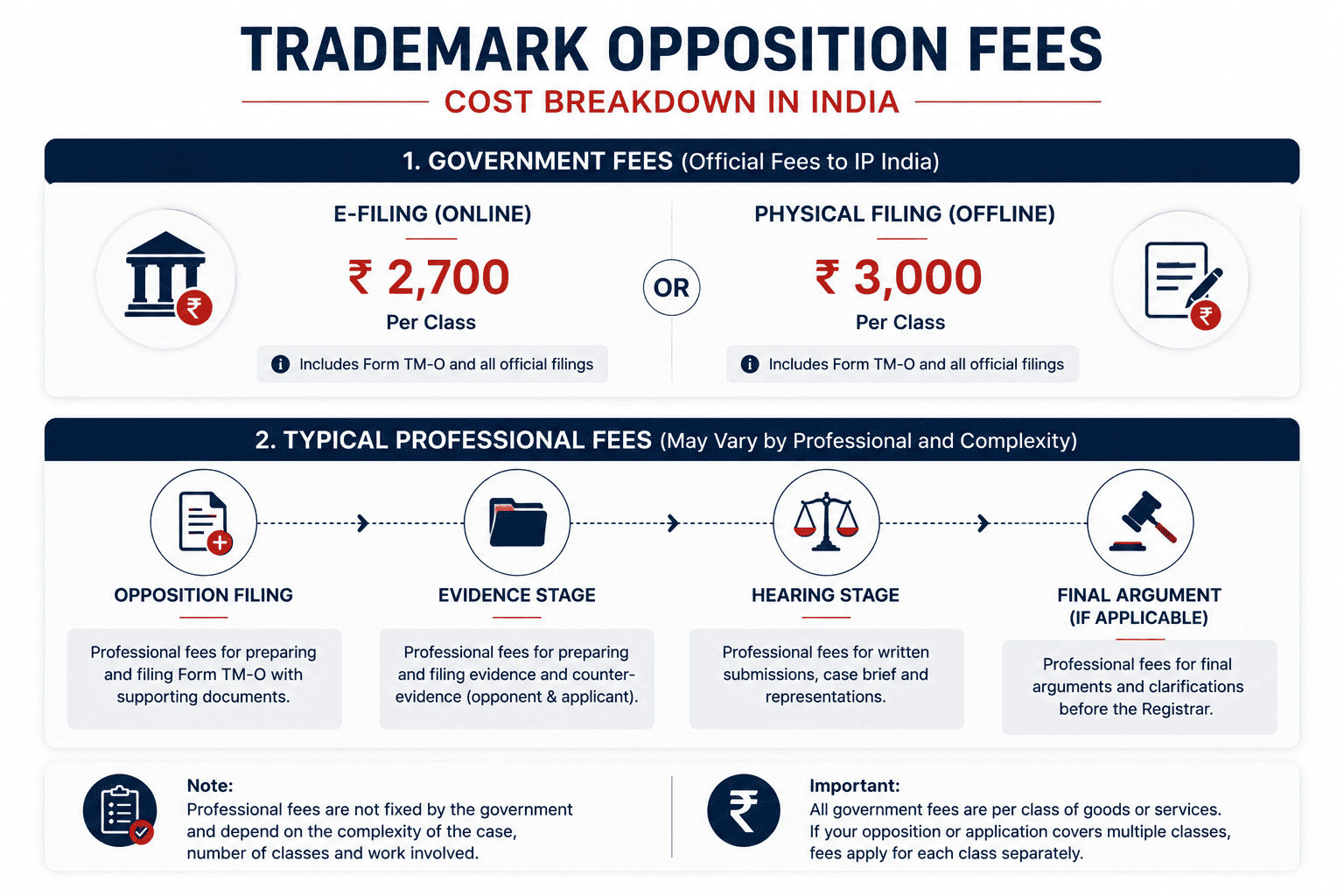
The government fee is charged per class, for both the notice of opposition and the counter-statement.
|
Filing |
Form |
Fee (E-filing) |
Fee (Physical) |
|
Notice of Opposition |
TM-O |
₹2,700 per class |
₹3,000 per class |
|
Counter-Statement |
TM-O |
₹2,700 per class |
₹3,000 per class |
One detail catches people off guard. Unlike the trademark application fee under Form TM-A, which drops from ₹9,000 to ₹4,500 per class for individuals, startups, and MSMEs, the TM-O fee doesn't have a discounted slab. Everyone pays the same rate, whether you're a solo founder or a listed company.
These figures cover government fees only. Professional or attorney fees for drafting, evidence, and hearing representation sit on top, and vary with how contested the matter gets. If you'd rather avoid an opposition altogether, an expert trademark review before you file can flag conflicting marks early.
What Happens If Your Trademark Application Is Opposed?
If someone opposes your application, the Registry serves you a copy of the notice of opposition, and your two-month clock for the counter-statement starts from that date of receipt.
Your counter-statement, also filed on Form TM-O, needs to do three things well:
-
Admit or deny each specific allegation in the opposition notice, point by point
-
Set out your own factual basis for adopting and using the mark, including the date you started using it
-
Respond directly to every legal ground the opponent has raised, rather than a general denial
Silence is costly here. If you don't file a counter-statement within two months, your application is deemed abandoned automatically, and there's no route to revive it through a late filing.
Once your counter-statement reaches the opponent, the matter moves into the evidence stage, which is really where opposition cases are won or lost.
What Evidence Do You Need in a Trademark Opposition?
Evidence in opposition proceedings is filed by affidavit, not just as plain documents, and each side gets a defined window to present its case.
A strong evidence file for either an opponent or an applicant usually includes:
-
Dated invoices and sales records showing continuous use of the mark
-
Advertising and marketing spend, ideally with certified figures over several years
-
Product packaging, brochures, and digital marketing samples carrying the mark
-
Trans-border reputation evidence, such as international sales or press coverage, for brands with cross-border presence
-
Certificates of any earlier trademark registrations you're relying on
-
Consumer surveys or market research, where available
Practitioner tip: Rule 45 evidence is where most oppositions actually fail, not at the hearing. Recent Delhi and Madras High Court rulings have both held that the two-month evidence deadline under Rule 45 cannot be extended, even by a day, unlike the old 2002 Rules which allowed a one-month grace period. Start collecting invoices and marketing records the moment you file, don't wait for the counter-statement to arrive.
If the opponent skips the evidence stage entirely and files no formal intimation either, the opposition is treated as abandoned under Rule 45(2), and the application proceeds toward registration.
How Is a Trademark Opposition Hearing Conducted?
Once both sides have finished the evidence rounds, the Registrar fixes a hearing date and notifies both parties, usually giving at least a month's notice.
At the hearing:
-
Each side's representative presents oral arguments, often citing recent judicial precedent
-
The Registrar compares the marks visually, phonetically, and conceptually
-
Written submissions filed earlier are taken into account alongside the oral arguments
If the opponent doesn't show up, the opposition is dismissed and the mark proceeds to registration. If the applicant doesn't show up, the application is treated as abandoned. Either way, the Registrar's decision is communicated in writing to both parties at their registered addresses.
Can You Appeal a Trademark Opposition Decision?
Yes. Since the Intellectual Property Appellate Board was abolished in 2021 under the Tribunals Reforms Act, appeals under Section 91 of the Trade Marks Act now go directly to the Intellectual Property Division of the relevant jurisdictional High Court.
You generally have three months from the date the Registrar's order is communicated to file the appeal. Beyond appeal, both sides retain the option to settle at any point in the proceedings, whether that means the applicant narrowing their goods and services, the opponent withdrawing in exchange for a coexistence agreement, or a straightforward brand name change.
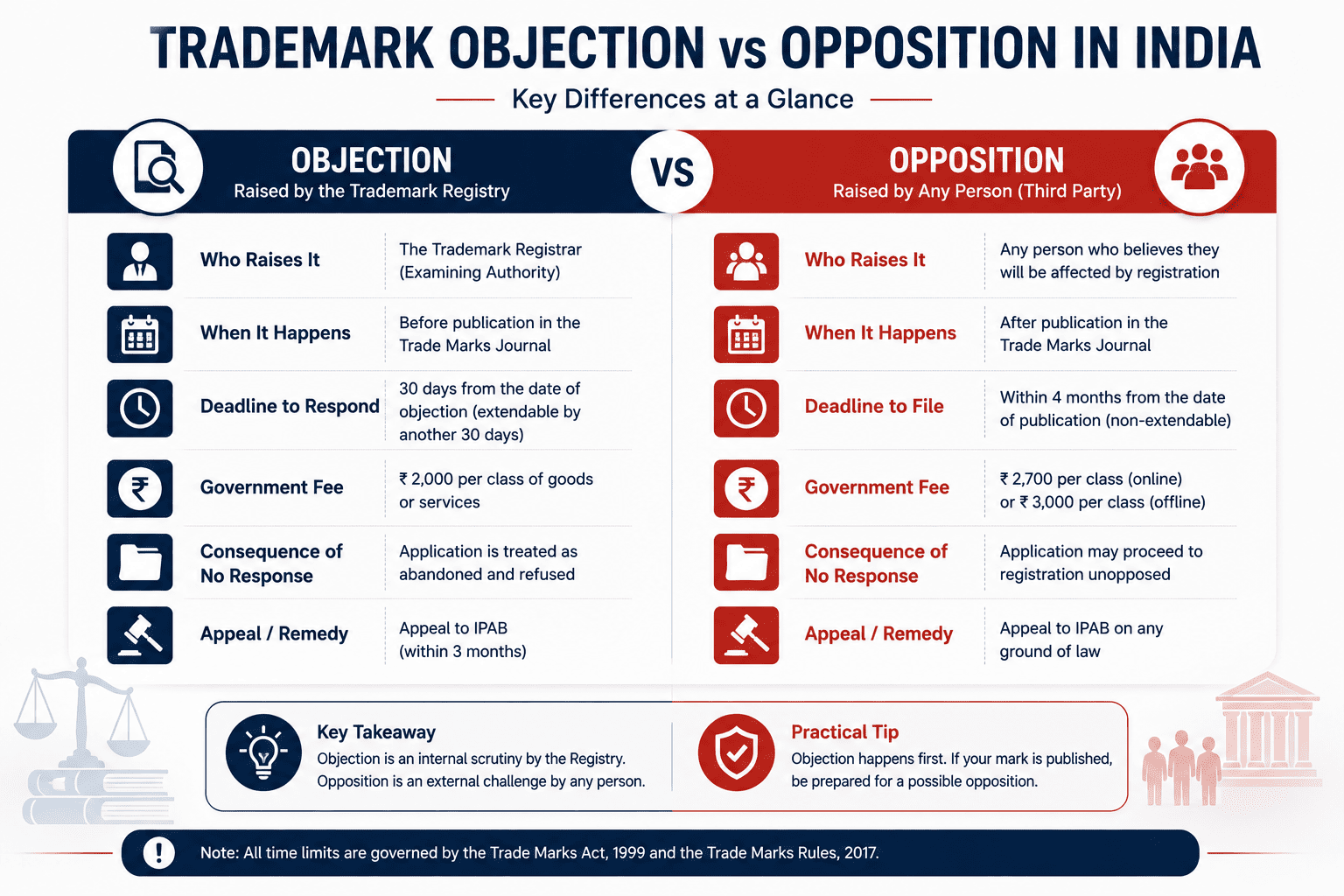
Trademark Opposition vs Trademark Objection: What Is the Difference?
People mix these two up constantly, and they're not the same thing at all. If you've received a notice from the Registry and you're not sure which one you're dealing with, this table should clear it up fast.
|
Aspect |
Trademark Objection |
Trademark Opposition |
|
Raised by |
The Trademark Examiner at the Registry |
Any third party, including competitors or the public |
|
Stage |
During examination, before publication |
After the mark is published in the Trade Marks Journal |
|
Reply deadline |
30 days from the examination report |
2 months for the counter-statement |
|
Government fee for reply |
None |
₹2,700 per class (e-filing) |
|
Consequence of no response |
Application treated as abandoned |
Application deemed abandoned |
|
Appeal route |
Show-cause hearing, then High Court |
Directly to the High Court (IP Division) |
If you've landed here because you actually received an examination report rather than a Form TM-O notice, our guide on trademark objection covers that process in detail.
How Can You Reduce the Risk of Facing a Trademark Opposition?
You can't fully eliminate the risk, since anyone can oppose for almost any reason, but you can cut it down considerably before you ever file.
-
Run a thorough clearance search across the correct trademark class before you apply, not after
-
Choose a genuinely distinctive mark rather than a descriptive one, since descriptive marks attract more objections and oppositions
-
Check the full list of trademark classes carefully so your goods and services are classified correctly the first time
-
Get an expert trademark review done on your shortlisted names before filing
-
Keep dated proof of first use from day one, even before you file, in case you need to demonstrate prior adoption later
-
Monitor the Trade Marks Journal after your own mark is published, since a quiet four months means you're close to registration
Once your mark clears opposition and gets registered, remember it isn't protected forever. You'll need to renew your trademark every ten years to keep the trademark certificate valid, and browsing the broader types of intellectual property protection available is worth doing early if your brand also involves a logo, a tagline, or original content. Our intellectual property services page covers registration, renewal, and opposition support in one place if you'd rather have a team handle the filings for you.
FAQS
Have questions about Trademark Opposition?
We have got you covered.
-
What is trademark opposition in India?
It's a formal challenge filed against a trademark application after the Registry publishes it in the Trade Marks Journal. Any person can file it using Form TM-O, within four months of the publication date.
- How long do I have to file a trademark opposition?
- Who can file a trademark opposition in India?
- What happens if I miss the counter-statement deadline?
- How much does it cost to oppose a trademark in India?
- Can I withdraw a trademark opposition once filed?
- What is the difference between trademark opposition and trademark objection?
- How long does a trademark opposition case take to resolve?
- What evidence do I need to support a trademark opposition?
- Where can I appeal if I lose a trademark opposition case?


