
MSME Credit Rating Scheme: Best Guide, Costs & How to Apply
- by kapil
- Updated August 25, 2026
- 19 mins read

Micro, small and medium enterprises can obtain credit ratings through commercial rating providers, banks and credit information companies. The correct assessment depends on whether it is required for a loan, bank facility, supplier onboarding, tender or commercial transaction.
Different products follow different rating scales, methodologies, costs and review requirements. This guide explains the current MSME rating structure, providers, benefits, documents, costs and application process.
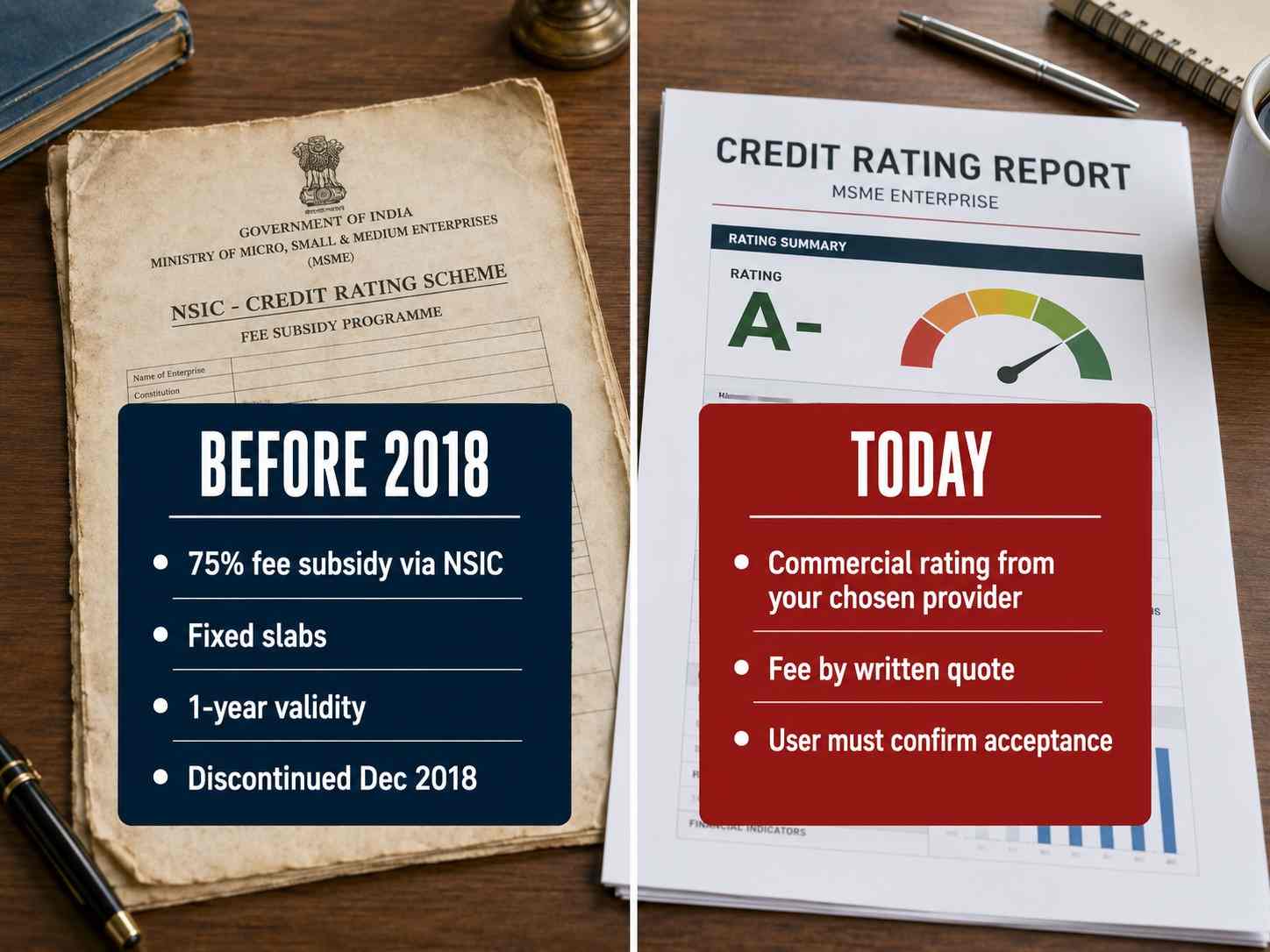
Important update: The government’s Performance and Credit Rating Scheme was discontinued in December 2018. However, independent commercial MSME ratings and bank facility ratings remain available.
How Does the Current MSME Rating Structure Work?
There is no single universal MSME rating applicable to every purpose. The correct assessment depends on who needs the report and how it will be used.
| Current rating route | Who provides it? | Main purpose | How to obtain it |
|---|---|---|---|
| Commercial SME entity rating | An agency offering a specific SME rating or grading product | Business credibility, lender discussions, vendor onboarding and internal assessment | Apply directly after confirming that the intended user accepts it |
| Bank-facility rating | A credit rating agency accepted for the proposed facility | Assessment of a particular term loan, cash-credit limit or other banking facility | Usually initiated with the lender and rating agency |
| Bank internal credit grade | The lending bank or financial institution | Loan approval, limit setting, monitoring and risk-based pricing | Completed internally during loan appraisal |
| Company credit report or rank | An RBI-regulated credit information company | Review of lender-reported borrowing and repayment conduct | Obtain from the relevant credit information company |
| Debt-instrument rating | A SEBI-registered credit rating agency | Rating bonds, debentures or another specified debt instrument | Appoint an eligible agency under the applicable regulatory requirements |
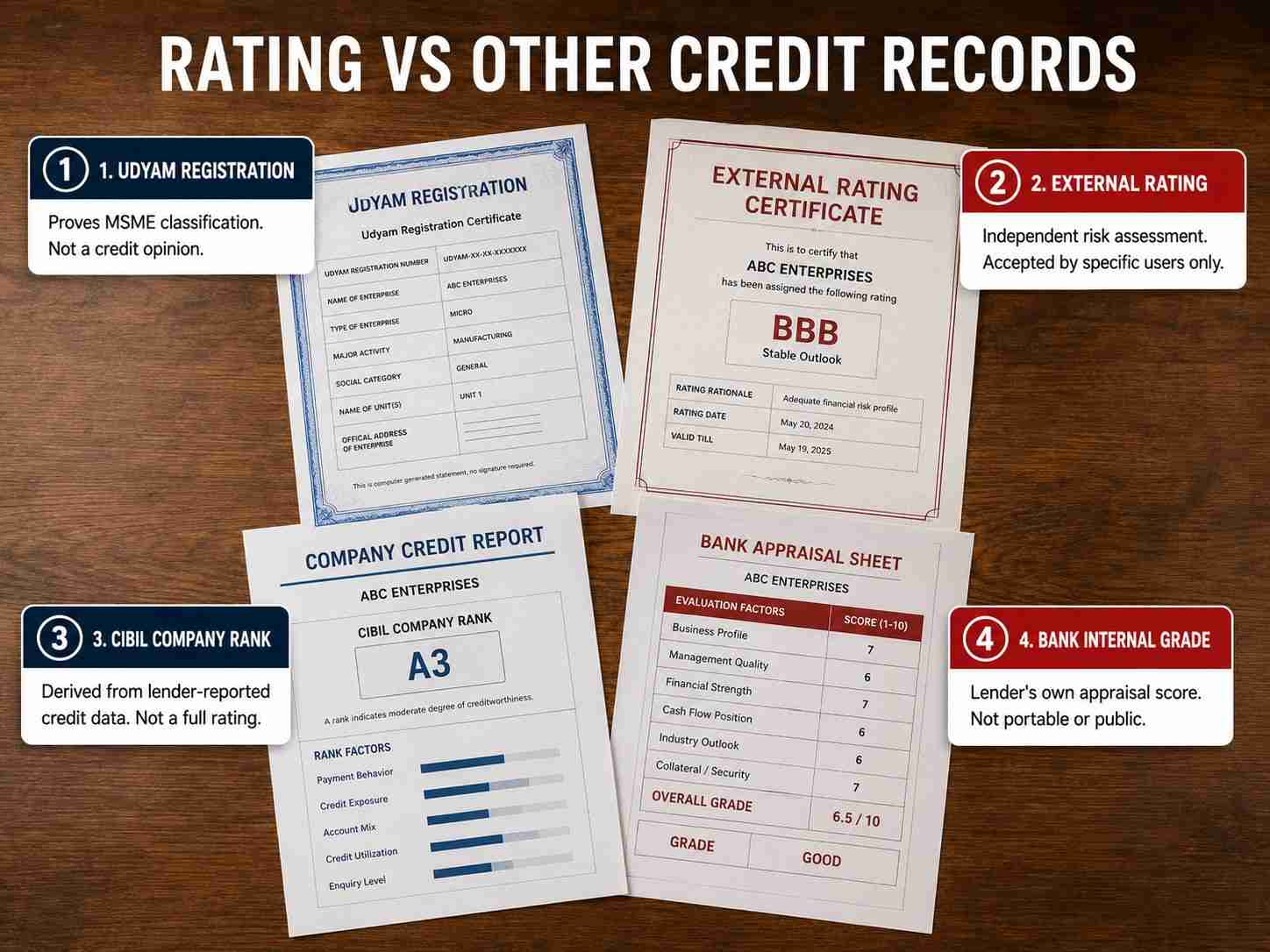
These assessments are not interchangeable. Udyam Registration proves MSME classification but does not establish creditworthiness. Similarly, a CIBIL Company Credit Report or rank is not the same as a complete external MSME rating.
Who Provides MSME Credit Ratings in India?
Commercial MSME ratings are provided by agencies offering an appropriate SME assessment product. For example, CRISIL currently offers SME Ratings that assess an enterprise’s performance capability and financial strength.
For regulated bank-facility or debt-instrument ratings, businesses should check the current SEBI register of credit rating agencies. Registered agencies currently include:
- ACER Credit Rating Private Limited
- Acuité Ratings & Research Limited
- Brickwork Ratings India Private Limited
- CARE Ratings Limited
- CredStone Ratings Private Limited
- CRISIL Ratings Limited
- ICRA Limited
- India Ratings and Research Private Limited
- Infomerics Valuation and Rating Private Limited
SEBI registration does not mean every agency offers the same MSME product or that every lender accepts every agency. Before submitting an application, ask the intended lender, buyer or authority to confirm:
- The acceptable rating agency
- The required rating product
- The applicable rating scale
- Any minimum acceptable grade
- Maximum permissible age of the report
- Renewal or surveillance requirements
Obtain written quotations from two or three suitable providers. Compare the complete scope, including fees, GST, site visits, report publication, confidentiality, surveillance and renewal costs.
How are Current MSME Ratings Presented?
The rating scale depends on the product. Bank-facility and debt ratings commonly use agency-prefixed symbols ranging from high-credit-quality grades to default grades. Commercial SME grading products may use a numerical or provider-specific scale.
For example, some SME grading products use a scale in which a lower number represents stronger creditworthiness. Bank internal grades follow the lender’s own system and may not be transferable to another bank.
Therefore, an MSME should not compare two ratings solely by their symbols. It should read:
- The rating definition
- The facilities or entity covered
- Key rating strengths
- Identified risk factors
- Rating outlook
- Validity or surveillance conditions
- Date of the latest review
What does MSME credit rating mean today?
An MSME credit rating is an independent assessment of a business’s capacity and willingness to meet financial obligations, often considered alongside operational capability, management quality and business risk. In current practice, an external credit rating or business credit rating is a commercial product rather than a revived government subsidy. The exact methodology, scale, report format, surveillance and permitted use depend on the selected product.
| Record or assessment | What it establishes | What it does not establish |
| Udyam Registration | Government-recognised MSME classification based on current investment and turnover criteria | Creditworthiness, repayment capacity or guaranteed scheme eligibility |
| External MSME rating | Independent opinion under a defined agency product and methodology | Automatic bank sanction, fixed pricing or collateral waiver |
| Company credit report or rank | Credit behaviour reported by lenders to a credit information company | Complete operational, management or market assessment |
| Promoter credit score | Individual promoter’s reported retail credit history | The enterprise’s full financial strength |
| Bank internal rating | Lender’s own risk grade for appraisal, monitoring and pricing | A universally portable public rating |
| Statutory instrument rating | Opinion on a specified debt instrument under the applicable regulatory framework | A general certificate for every borrowing or commercial use |
The RBI’s updated MSME state that an external agency rating is not compulsory from a regulatory-capital perspective where aggregate exposure to one counterparty does not exceed ₹7.5 crore, subject to the stated conditions. This is not a blanket rule that prohibits lenders from applying their own policies or seeking information for a particular facility.
Which enterprises should consider an MSME rating?
A rating is most useful when an identified user will recognise it or when management needs a structured diagnostic review. A business researching MSME rating in India should therefore begin with the decision or transaction the report must support. Suitable situations may include:
- A lender asks for an acceptable external assessment for a proposed facility.
- A large buyer uses third-party supplier-risk reports during vendor onboarding.
- A manufacturer wants to demonstrate financial and operational discipline to customers or distributors.
- An enterprise is preparing for a larger debt requirement, tender, strategic partnership or investor review.
- Management wants a benchmark before improving leverage, collections, governance or reporting systems.
- A current programme or counterparty offers a specific benefit against a recognised rating category.
For example, NSIC’s current Raw Material Assistance terms publish different interest rates for units holding valid SME 1 or SME 2 ratings. That is a programme-specific benefit with its own conditions, not proof that every bank must offer cheaper credit to a highly rated enterprise.
Businesses preparing for finance should also identify the actual facility required. The records needed for a business loan application may differ from those needed for an independent rating, even though much of the financial data overlaps.
What benefits can an MSME rating provide today?
The practical MSME rating benefits depend on the report’s intended use and the reader’s acceptance of the provider. The benefits of credit rating for small business are strongest when the exercise improves decision-ready information rather than being purchased only for a certificate.
Independent view of financial strength
A rating can convert several years of accounts, banking conduct and operating information into a structured risk opinion. This gives management an external view of leverage, liquidity, profitability, customer concentration and repayment capacity.
Better-prepared credit discussions
A favourable report may improve the quality of a conversation with a lender when the lender accepts that rating product. It can reduce information gaps, but it cannot replace credit appraisal. Interest rates on bank advances are governed by lender policies within the applicable RBI framework, so a rating does not create a right to a particular rate.
An enterprise seeking short-term finance should separately prepare stock, receivables and cash-cycle data for a working capital loan. A rating report alone does not establish the correct facility size.
Vendor and customer confidence
Some buyers assess whether suppliers have the capacity to complete contracts without financial or operational disruption. An accepted third-party assessment may support this review. Businesses can compare this with a broader supplier and vendor assessment, which may also cover statutory, quality, labour, safety and delivery risks.
Internal improvement roadmap
The most durable benefit may be diagnostic. A rating exercise can expose weak receivable controls, excessive related-party balances, poor debt-service coverage, missing management information, overdependence on one customer or gaps in succession planning. Management can then address the causes rather than treating the grade as a marketing badge.
Support for transaction readiness
A clean independent assessment may help an enterprise organise records before a partnership, investment or sale. It is not a substitute for financial and legal due diligence, which verifies a broader range of liabilities, contracts, tax exposures and operational risks.
What do rating agencies and lenders assess?
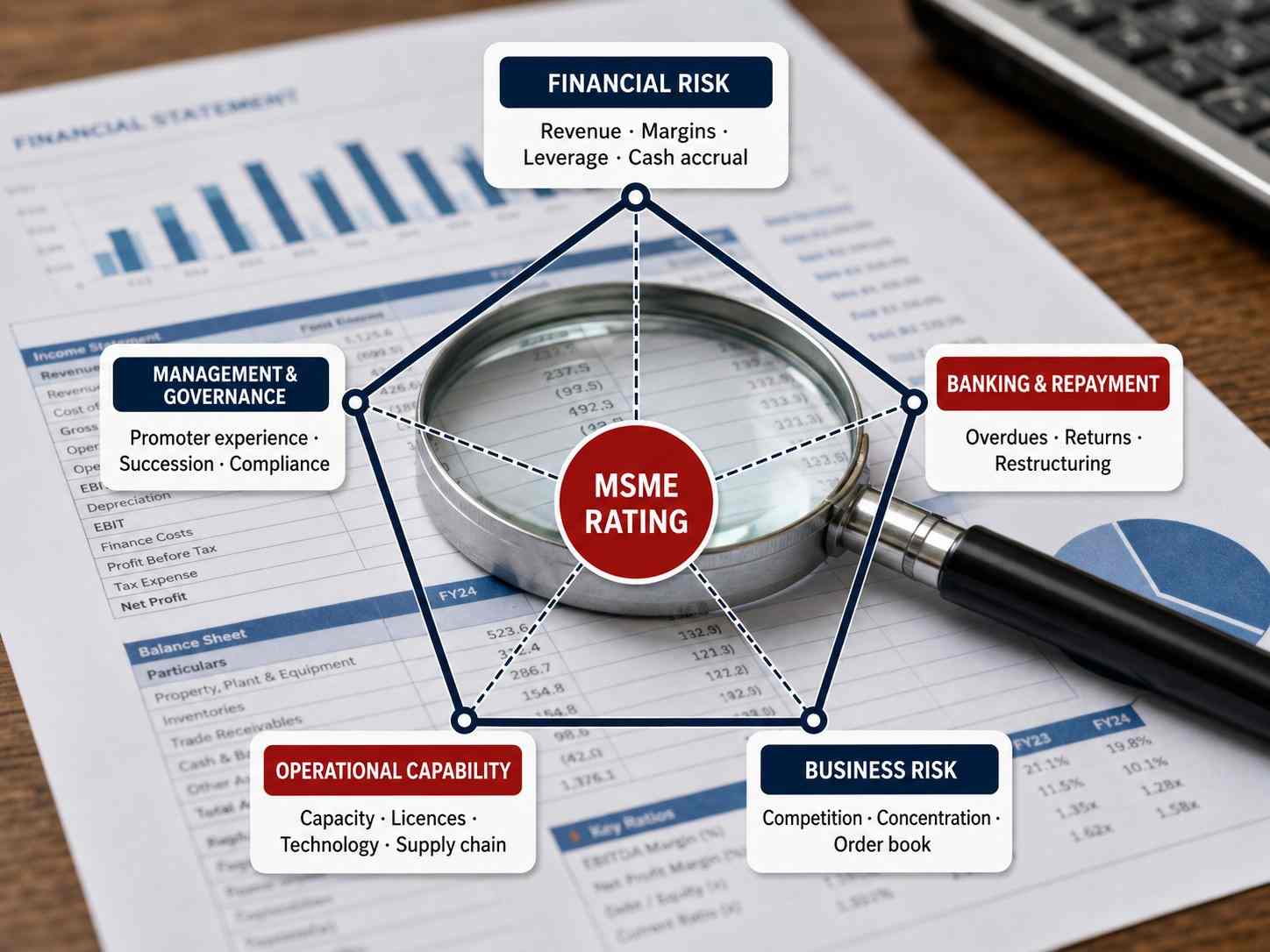
Methods vary, but an MSME rating process commonly examines five connected risk blocks that together indicate MSME creditworthiness.
| Assessment block | Typical review points | Preparation focus |
| Financial risk | Revenue quality, margins, net worth, leverage, liquidity, cash accrual, debt-service ability and contingent liabilities | Reconcile audited figures, returns, statements and debt schedules |
| Banking and repayment conduct | Existing facilities, utilisation, overdues, cheque returns, restructuring, guarantees and reported credit history | Obtain current statements and explain isolated irregularities with evidence |
| Business risk | Industry conditions, competition, customer and supplier concentration, order book, pricing power and working-capital cycle | Provide customer-wise sales, ageing, contracts and realistic projections |
| Operational capability | Capacity, technology, quality controls, licences, insurance, site condition and supply-chain resilience | Keep operating records, approvals and maintenance data organised |
| Management and governance | Promoter experience, decision controls, succession, related parties, statutory compliance and information systems | Document authority, policies, management roles and compliance status |
Consistency matters more than presentation. Turnover in audited accounts should reconcile with GST returns, tax filings and bank credits, subject to explainable accounting differences. Good small-business accounting systems make this reconciliation easier and give the analyst reliable ageing, margin and cash-flow data.
An applicant should verify its legal identity before the review begins. The official Udyam Registration portal shows the current classification limits effective from 1 April 2025: micro enterprises must not exceed ₹2.5 crore in investment and ₹10 crore in turnover; small enterprises, ₹25 crore and ₹100 crore; and medium enterprises, ₹125 crore and ₹500 crore. The same limits were announced in the Union Budget 2025 classification update.
How much does an MSME credit rating cost now?
Current MSME rating costs are set commercially by the selected provider. There is no single fee applicable to every agency or product. The quotation may depend on the enterprise’s turnover, operational complexity, number of locations, facilities being rated, site visits, information quality and surveillance requirements.
Ask for a written quote that separates:
- Initial assessment or rating fee
- Applicable GST and reimbursable expenses
- Site-visit or multi-location charges
- Surveillance or periodic review fee
- Renewal or revalidation fee
- Appeal, reconsideration or expedited-service charges, if any
- Charges for extra copies, certificates, portals or report distribution
- Cancellation and refund terms if information remains incomplete
Do not compare only the headline price. Confirm the rating scale, report contents, analyst interaction, expected information requests, factual-review process, permitted use, confidentiality, publication policy, validity or review cycle and whether the intended lender or customer accepts the product.
Where the rating is being obtained to support a large project, the enterprise may also need forecasts, sensitivity analysis and a bankable note. A properly prepared project report for bank finance is a separate deliverable and should match the financial information supplied for rating.
What documents are needed for an MSME rating?
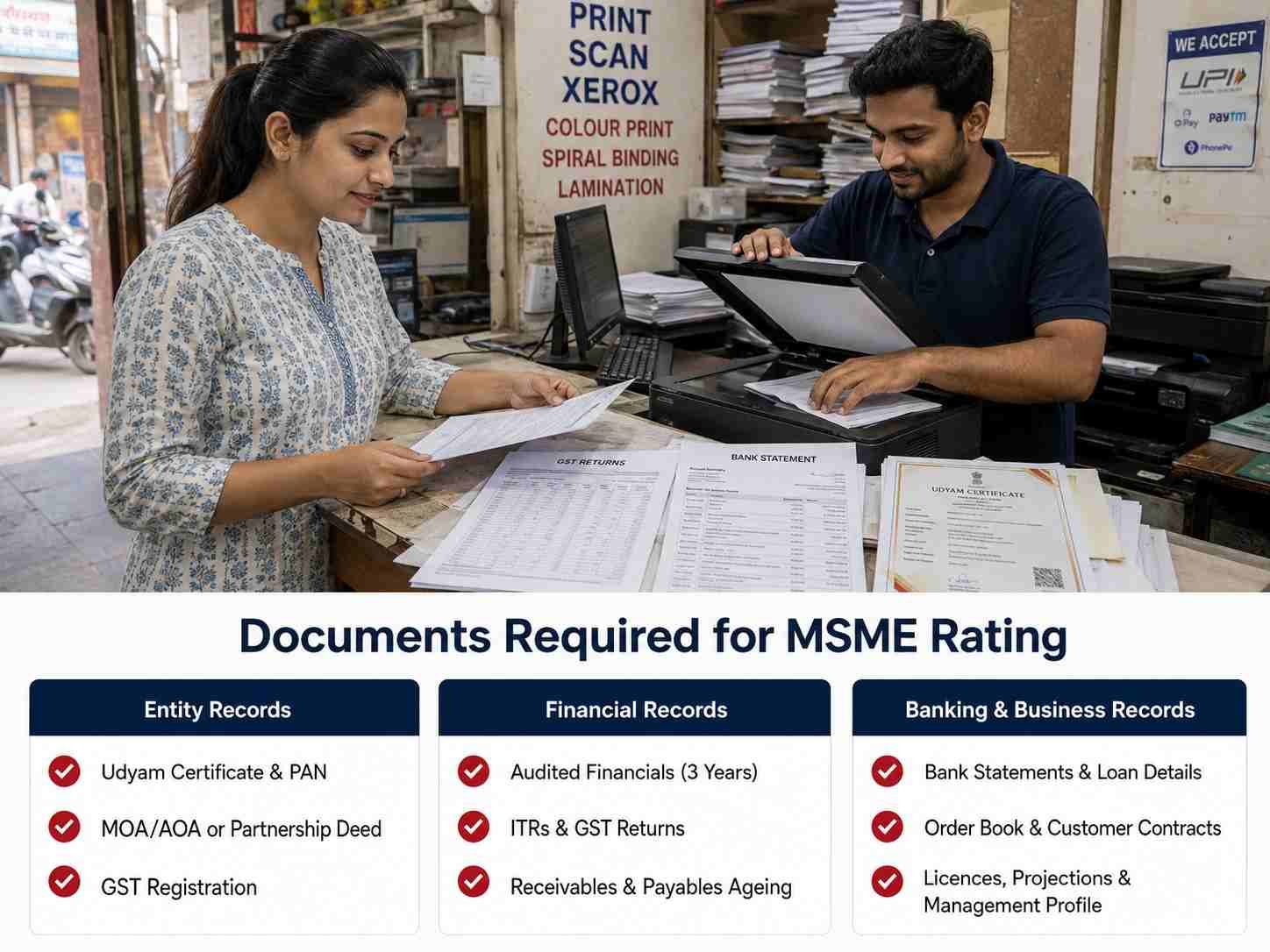
The exact list comes from the provider, but the following checklist covers the documents required for MSME credit rating in most full-scope assessments.
Entity, ownership and authorisation records
- Udyam Registration Certificate and PAN
- Certificate of incorporation, partnership deed or LLP agreement
- Memorandum and Articles of Association, where applicable
- GST registration and principal-place-of-business details
- Ownership, shareholding and beneficial-ownership information
- Board or partner authorisation and authorised-signatory details
- Promoter and key-management profiles with KYC documents
Check that trade names, addresses and activities match across the rating form and GST registration records. A mismatch should be corrected or explained before submission.
Financial and tax records
- Audited financial statements for the period requested by the agency
- Latest provisional balance sheet, profit and loss account and trial balance
- Cash-flow statement and key financial ratios
- Income-tax returns and tax-audit reports, where applicable
- GST returns and reconciliation with reported revenue
- Receivables and payables ageing with major-party details
- Inventory statement and ageing
- Fixed-asset register and capital-expenditure schedule
- Contingent liabilities, guarantees and related-party transactions
Timely income-tax filing and record reconciliation help establish a traceable income history. The official Income Tax e-Filing portal should be used for tax records and verification services.
Banking and borrowing records
- Bank statements for the requested period
- Sanction letters for fund-based and non-fund-based facilities
- Repayment schedules and current outstanding balances
- Security, collateral and charge details
- Details of overdues, restructuring, settlements or guarantee invocation
- Company credit report and promoter bureau reports, if requested
- Existing loan applications or lender correspondence relevant to the purpose
India has four RBI-regulated credit information companies, as explained in the RBI’s credit-bureau framework release. A company credit report is different from an external rating; The CIBIL Company Credit Report explains that the report and rank rely on information reported by lenders.
Business and operating information
- Business profile, product mix and revenue model
- Customer-wise and supplier-wise concentration
- Major contracts, work orders and current order book
- Capacity, utilisation and production records
- Industry licences, quality certificates and insurance
- Site, machinery and technology details
- Litigation, regulatory notices and material disputes
- Three-year or provider-required projections with assumptions
- Business-continuity, succession and key-person arrangements
For capital-intensive proposals, align rating projections with the proposed term loan structure and equipment schedule. Inconsistency between a rating case and a later bank application can create unnecessary questions.
How can an MSME obtain a credit rating now?
Before applying, check the selected provider’s requirements. The provider may ask for an established operating history, complete financial statements, current Udyam Registration and management participation. A new enterprise with limited financial history may be offered a different assessment product or may need to provide additional business and cash-flow information.
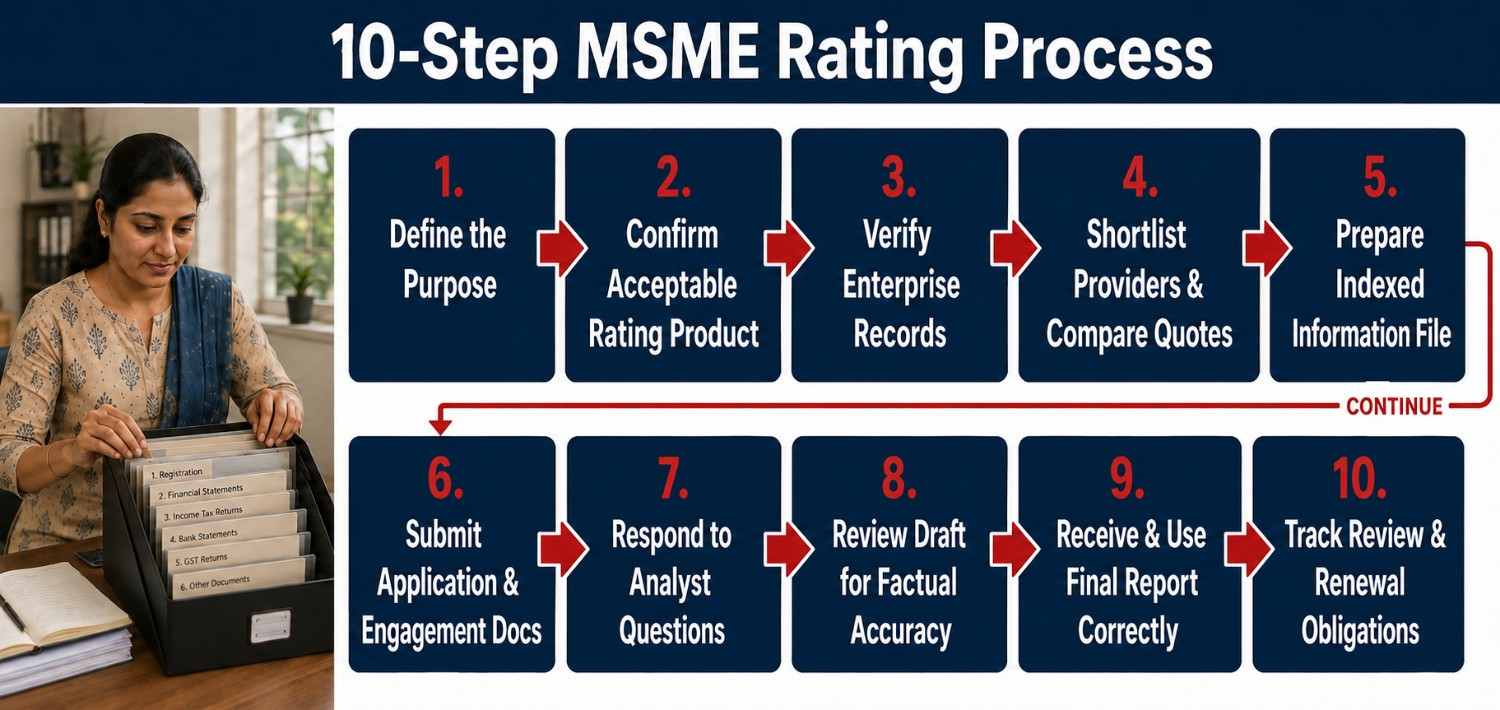
Step 1: Define the purpose
Write down the transaction the rating is expected to support. Identify the lender, buyer, supplier, tender or internal governance need and the date by which the report is required.
Step 2: Confirm the acceptable rating product
Ask the intended user which agencies, scales and report types it accepts. Confirm whether it needs an external rating, credit-bureau report, bank internal grade, vendor assessment or instrument rating.
Step 3: Verify enterprise records
Match the legal name, PAN, GSTIN, Udyam number, constitution, address and activities. Resolve material errors before an analyst finds them. Use the official GST portal for GST services and verification.
Step 4: Shortlist providers and compare written quotes
Compare scope, methodology, fee, tax, expenses, information requirements, delivery assumptions, report use, confidentiality and renewal. Check regulatory registration where it is relevant to the product.
Step 5: Prepare one indexed information file
Create folders for entity, financial, tax, banking, operations, management and legal records. Add a reconciliation note for differences among audited turnover, GST returns, income-tax records and bank credits.
Step 6: Submit the application and engagement documents
Complete the provider’s form accurately and sign the engagement terms after reviewing publication, withdrawal, confidentiality, surveillance and payment clauses. Do not leave material borrowings, disputes or contingent liabilities undisclosed.
Step 7: Respond to analyst questions
Provide clarifications with supporting evidence. A management discussion or site visit may cover strategy, customer concentration, working-capital pressure, succession, production capacity and financial controls.
Step 8: Review the draft for factual accuracy
Check names, dates, amounts, facility details and business descriptions. A factual review is not an opportunity to demand a better grade, but it is the right stage to correct supported errors.
Step 9: Receive and use the final report correctly
Share it only as allowed by the engagement terms. Give the lender the complete report rather than an edited extract, and disclose later material changes if required.
Step 10: Track review and renewal obligations
Record the rating date, surveillance requirements, information deadlines and next review. The validity period, surveillance requirements and renewal schedule are determined by the selected rating product and engagement terms.
No universal completion period applies to commercial ratings. Timing depends on document readiness, management availability, site work, analyst questions and committee scheduling. Businesses considering a major plant or infrastructure proposal should coordinate the rating timetable with their broader project finance preparation.
How can an enterprise improve rating readiness?
Improvement begins before the application. The aim is not to cosmetically change ratios for one date, but to make cash flow, reporting and governance more dependable.
- Reconcile statutory and financial data. Investigate differences among accounts, GST, tax returns, bank credits and Udyam information.
- Reduce avoidable repayment irregularities. Schedule debt and statutory payments, monitor drawing power and explain any genuine one-off delay.
- Tighten receivables. Use customer limits, ageing reviews, collection ownership and escalation for overdue invoices.
- Control concentration. Track reliance on the largest customers, suppliers and products, then create a realistic diversification plan.
- Document related-party transactions. Keep approvals, contracts and pricing support so balances are transparent.
- Strengthen cash-flow forecasting. Use monthly forecasts, sensitivity tests and covenant monitoring rather than annual estimates alone.
- Maintain licences and insurance. Expired approvals or inadequate coverage can turn an operating issue into a credit risk.
- Formalise management controls. Define authorities, maker-checker controls, MIS frequency and succession for key roles.
Smaller businesses that lack an in-house finance head may use virtual CFO support to build forecasts, debt schedules and management reporting. The professional should improve the evidence and controls, not manufacture a rating outcome.
What should an MSME do after receiving the rating?
Read the report beyond the headline grade. List every weakness that management can control, assign an owner and review progress monthly. Common priorities include reducing overdue receivables, improving interest coverage, correcting statutory mismatches, lowering short-term debt dependence and strengthening reporting.
Provide updates required under the engagement terms. A material new loan, default, litigation, plant shutdown, customer loss or ownership change may affect the opinion. Do not continue circulating a withdrawn, expired or superseded report as if it were current.
Where cash flow is weakened by unpaid customer invoices, financing and recovery should be treated separately. LegalBabu’s guide to MSME payment recovery explains the delayed-payment route, while the official MSME Samadhaan portal is the government platform for eligible applications.
What common mistakes should applicants avoid?
- Purchasing a rating before confirming lender acceptance
- Confusing Udyam Registration with a credit rating
- Submitting inconsistent financial, GST and banking figures
- Withholding existing liabilities, disputes or repayment irregularities
- Accepting an agent’s promise of a predetermined grade
- Continuing to use an expired, withdrawn or superseded report
What Happened to the Government MSME Credit Rating Scheme?
The Performance and Credit Rating Scheme was implemented through the National Small Industries Corporation and previously provided partial government support towards rating fees. The Ministry of MSME confirmed that the rating component was discontinued with effect from December 2018.
Its former subsidy slabs, NSIC application route, one-month target and one-year validity should not be treated as current terms. MSMEs seeking a rating now must use an appropriate commercial product and pay the fees quoted by the selected provider.
Conclusion
MSME credit ratings continue to be available through commercial rating providers, banks and other authorised assessment channels. The right product depends on whether the report is required for a loan, bank facility, vendor assessment, tender or debt instrument.
Before applying, an MSME should confirm the accepted agency and rating scale, compare written quotations and prepare consistent financial, tax, banking and operational records. A suitable current rating can support financial transparency, business credibility and better-prepared credit discussions when the intended user accepts the selected product.
One practical current example is NSIC’s Raw Material Assistance programme, which presently publishes different rates for units holding valid SME 1 or SME 2 ratings. However, this is a programme-specific benefit, not a universal concession offered by every lender.
FAQs About MSME credit-rating scheme
What happened to the government MSME credit-rating scheme?
The government-supported Performance and Credit Rating Scheme was implemented through the National Small Industries Corporation. Its rating component and fee subsidy were discontinued in December 2018. MSMEs can now obtain commercial ratings directly from suitable providers.
Who provides MSME credit ratings in India?
Commercial MSME ratings are provided by agencies offering suitable SME rating products. Regulated bank-facility and debt ratings are issued by eligible credit rating agencies, while banks assign their own internal credit grades. An enterprise should confirm which provider and product its lender, buyer or authority accepts before applying.
Can an MSME still obtain a credit rating in India?
Yes, an enterprise can obtain a commercial external rating or assessment from a suitable provider. It should first ask the lender, buyer or other intended user which product and agency it accepts. The fee, process, report use and review cycle will follow the current provider’s terms rather than the former subsidy rules.
Is an external MSME credit rating mandatory for a bank loan?
An external rating is not universally mandatory for every MSME loan. RBI’s MSME guidance discusses circumstances in which an external rating is not compulsory from a regulatory-capital perspective, while banks continue to use internal appraisal and their own board-approved policies. A specific lender may still request information or an assessment appropriate to the proposed exposure.
What is the current MSME rating cost?
There is no uniform government-set MSME rating cost under the discontinued programme. Providers price commercial assessments according to product, business size, complexity, locations, analyst work, surveillance and other terms. The enterprise should obtain an itemised quote covering tax, expenses, renewal and any additional charges.
Which documents are required for an MSME credit rating?
Common records include Udyam, PAN, constitution documents, GST details, audited and provisional financials, tax returns, bank statements, sanction letters, debt schedules and receivable ageing. Agencies may also seek customer concentration, order book, licences, management profiles, litigation, projections and a site visit. The provider’s current checklist controls, so applicants should not rely only on a generic online list.
How long does an MSME rating take?
There is no universal current timeline for a commercial MSME rating. The former scheme mentioned completion within one month after receipt of all information, but that archived target is not a present guarantee. Timing now depends on document completeness, analyst questions, management meetings, site work and the provider’s committee schedule.
How long is an MSME rating valid?
Validity and surveillance depend on the selected product and engagement terms. The old scheme described a one-year validity period, but that historical rule should not be applied automatically to present commercial reports. Check the issue date, review requirement, expiry, withdrawal terms and material-event reporting obligations on the final document.
What is the difference between an MSME rating and a CIBIL rank?
An external MSME rating is generally a solicited assessment using documents, analysis and management interaction under the provider’s methodology. A company credit report or CIBIL rank is primarily derived from credit information reported by lenders. Both may inform a credit decision, but neither replaces the bank’s internal appraisal.
Does a strong MSME rating guarantee cheaper finance?
No, a strong rating does not guarantee approval, a lower interest rate, a higher limit or collateral relief. A lender also considers cash flow, repayment history, facility purpose, security, sector risk and internal policy. The report may support the discussion only where the lender recognises it and decides it is relevant.
You may also like


Can PAIMA Membership Expand Your Global Moving Network?
PAIMA membership can help an established Indian moving company build relationsh