
 The Mutual Credit Guarantee Scheme framework can help an eligible micro, small or medium enterprise seek a sizeable term loan for plant, machinery or equipment without asking the lender to carry the entire default risk. Under the mutual credit guarantee scheme, the National Credit Guarantee Trustee Company Limited provides guarantee support to a registered Member Lending Institution, or MLI. The borrower still has to satisfy the lender’s credit appraisal and repay the full debt.
The rules changed materially in March 2026. Service-sector MSMEs are now included, the minimum machinery or equipment component has been reduced from 75 per cent to 60 per cent of project cost, the standard 5 per cent upfront contribution can be refunded in stages subject to satisfactory loan performance, and the guarantee now expires after ten years. Qualifying exporter MSMEs also receive separate terms.
This guide uses the revised framework, explains the difference between a guarantee and a subsidy, and separates central scheme conditions from lender-specific loan policy. It also shows how to prepare a bankable application rather than assuming that a government guarantee creates automatic approval.
What is the MCGS-MSME Scheme?
The mutual credit guarantee scheme for MSMEs is a Government of India credit-risk-sharing mechanism implemented through NCGTC’s MCGS-MSME framework. Its main purpose is to support term loans used for purchasing plant, machinery or equipment. The ordinary scheme provides 60 per cent guarantee coverage for an eligible credit facility of up to ₹100 crore.
As an MSME credit guarantee rather than a direct loan product, it supports the lender’s risk position while leaving the credit decision with the MLI. A business searching for an MSME machinery loan or plant and machinery finance must therefore approach a participating lender with a viable project, not apply to NCGTC for cash.
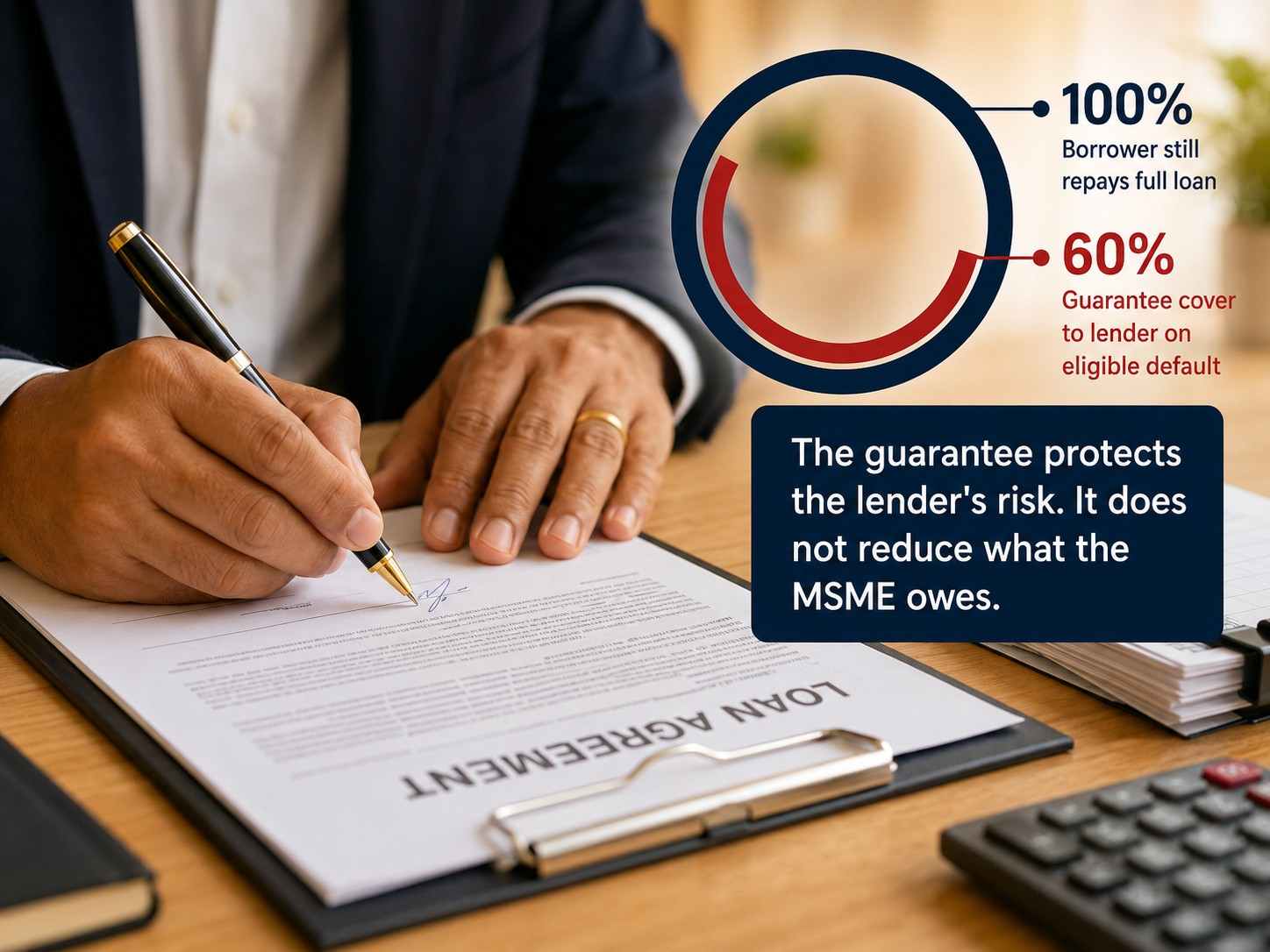
The word “guarantee” needs careful reading. It is a guarantee given by NCGTC to the participating lender, not cash paid to the MSME and not a promise that 60 per cent of the borrower’s loan will be forgiven. The lender sanctions and disburses the facility, monitors end use and repayment, and may seek a claim under the scheme only after a qualifying default and compliance with the guarantee conditions.
The January 2025 launch announcement originally focused on manufacturing and required machinery or equipment to account for at least 75 per cent of project cost. The March 2026 modification expanded eligibility and changed important economics. Applicants should therefore avoid using an old checklist without confirming that it reflects the revised MCGS-MSME scheme.
Businesses comparing a general borrowing product with this purpose-linked programme can first review how a business loan is assessed. An MCGS loan is still a lender-sanctioned term loan; the guarantee is an added risk-sharing layer behind it.
Current MCGS Scheme Features at a Glance
| Feature | Current general position | Important qualification |
|---|---|---|
| Implementing institution | NCGTC | Guarantee is issued to a registered MLI, not directly to the borrower. |
| Eligible borrower | Micro, small or medium enterprise with valid Udyam Registration | The borrower should not be an NPA with any lender at the relevant sanction or disbursement stage. |
| Eligible sectors | Manufacturing and service-sector MSMEs | Project and end use must still satisfy scheme and lender rules. |
| Facility | Term loan | A standalone working-capital limit is not the central purpose of this scheme. |
| Main end use | Purchase of plant, machinery or equipment | The machinery/equipment component must be at least 60 per cent of total project cost under the revised framework. |
| Guaranteed loan amount | Up to ₹100 crore | Total project cost or total loan may be higher, but ordinary guarantee support does not exceed the scheme ceiling. |
| Standard guarantee cover | 60 per cent of eligible amount in default | It is not 60 per cent of every instalment and does not reduce the borrower’s full liability. |
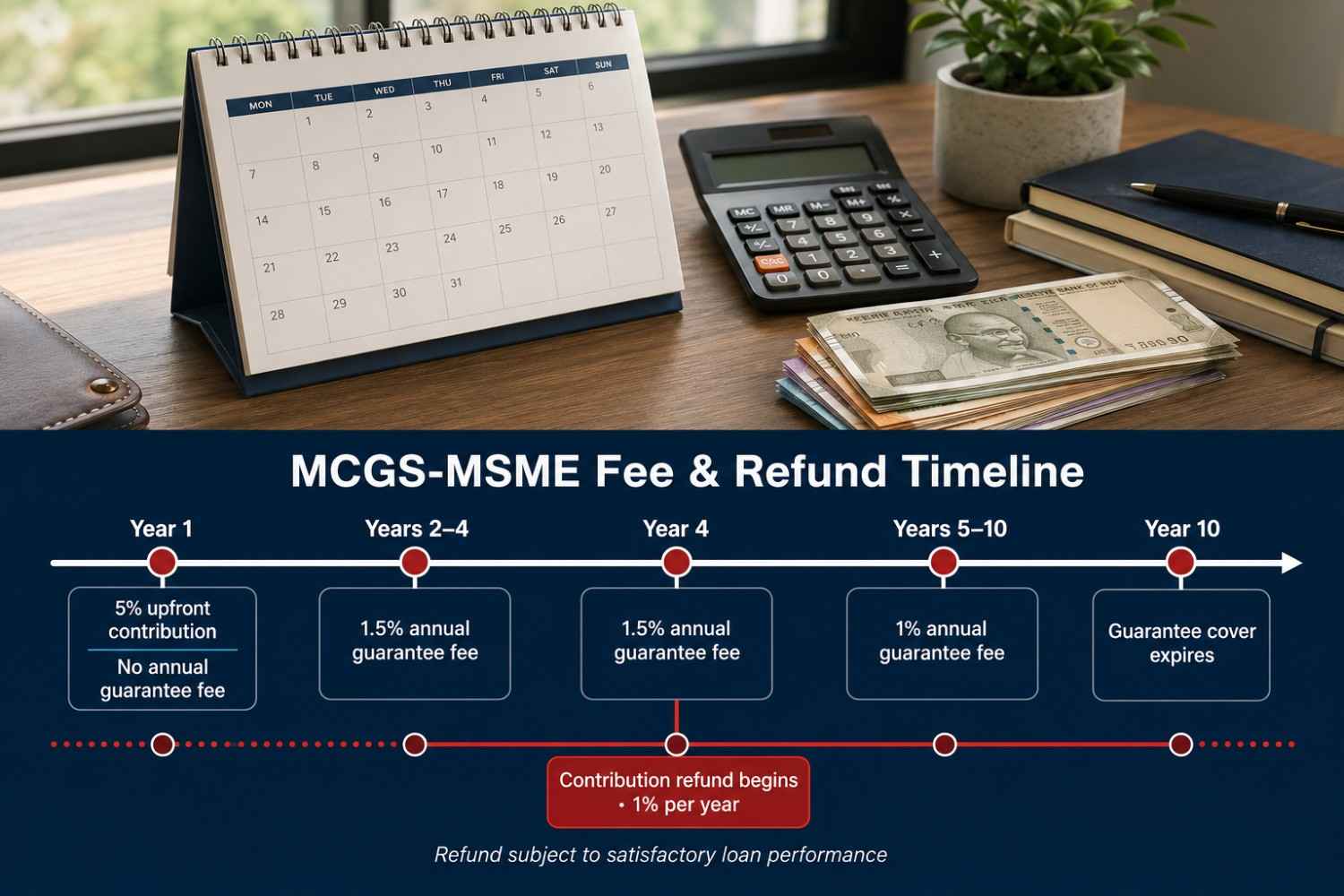
| Standard upfront contribution | Five per cent of the relevant loan amount | Subject to satisfactory account performance, one percentage point may be returned annually from Year 4 until the scheduled refund is completed. |
| Standard annual guarantee fee | No annual fee in Year 1; 1.5 per cent during Years 2–4; 1 per cent from Year 5 onward | Applied to the relevant outstanding balance under scheme rules; confirm the computation and tax treatment with the MLI. |
| Guarantee tenure | Up to 10 years | The loan schedule and guarantee period must be read separately. |
| Scheme window | Four years from operational guidelines dated 27 January 2025, or until cumulative guarantees reach ₹7 lakh crore, whichever is earlier | Availability should be reconfirmed before filing. |
How Does the Mutual Credit Guarantee Scheme Work?
The NCGTC guarantee scheme works through the lender rather than through a direct borrower portal.
Four parties or roles are relevant:
-
MSME borrower: proposes the project, contributes the required funds, provides accurate records and remains responsible for repayment.
-
Member Lending Institution: appraises the proposal, decides whether to sanction the term loan, completes security and documentation, and seeks guarantee cover.
-
NCGTC: administers MCGS-MSME, registers eligible MLIs, collects the applicable contribution or fee and provides the guarantee under its rules.
-
Government framework: the Department of Financial Services under the Ministry of Finance sets the policy context, while MSME status is established through Udyam and the applicable MSME classification.
Scheduled commercial banks, eligible NBFCs and All India Financial Institutions can participate if they register with NCGTC under the scheme. Being a regulated lender does not by itself prove MCGS registration. Applicants should use the NCGTC scheme page and registered-MLI facility or ask the lender for written confirmation.
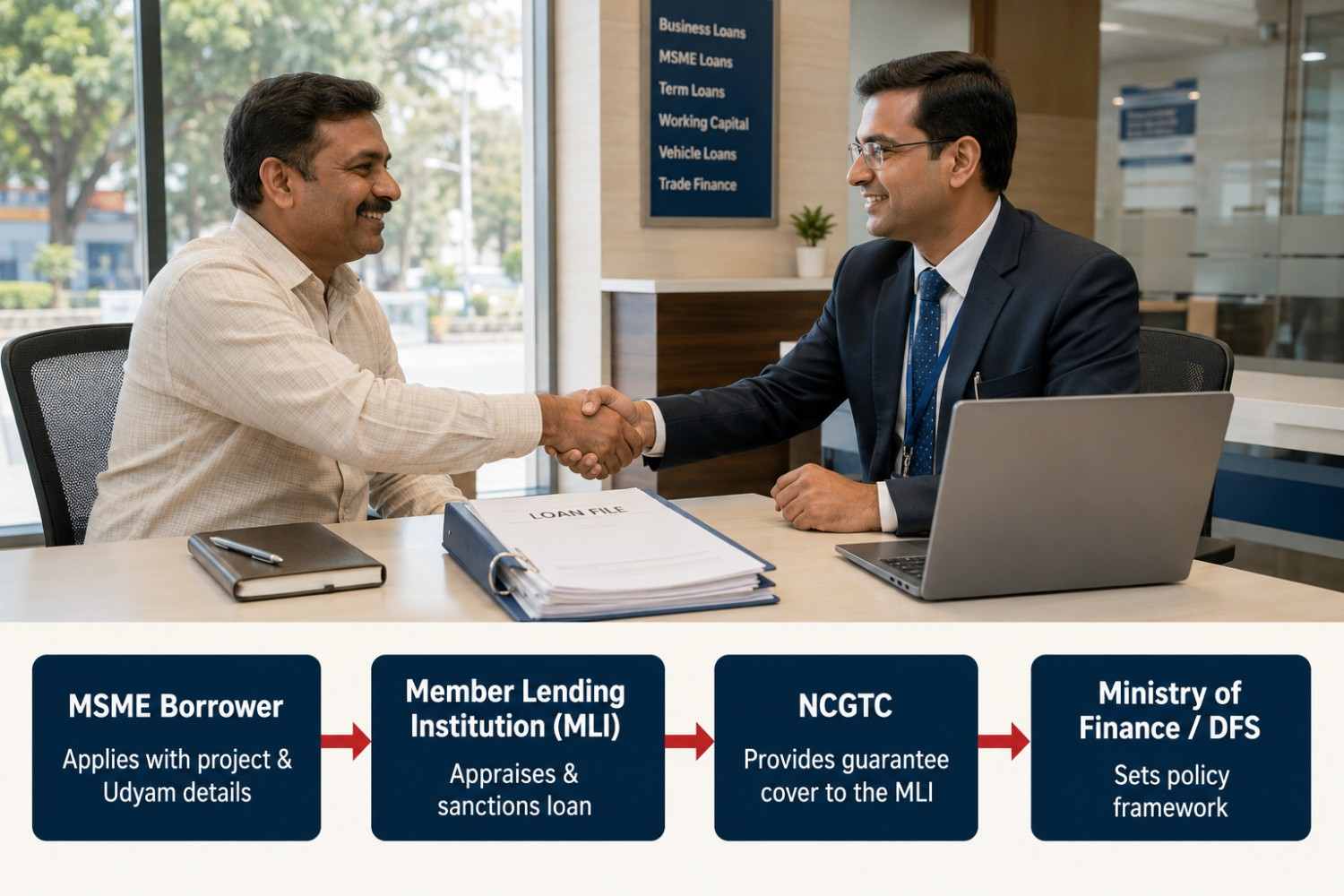
The practical sequence is simple: the MSME applies to the MLI; the MLI performs credit appraisal and sanctions an eligible facility; the MLI then submits the guarantee-cover particulars to NCGTC and completes the applicable payment and documentation. The borrower does not bypass the lender’s appraisal by approaching NCGTC directly.
Who is Eligible for the MCGS Scheme?
The MCGS-MSME eligibility criteria operate in two layers: the central scheme test and the selected lender’s credit policy. Meeting the first layer permits consideration under the guarantee framework; it does not override the second.
Central Scheme Conditions
An applicant should first satisfy the conditions that arise from the MCGS scheme itself:
-
The enterprise must qualify as a micro, small or medium enterprise and hold a valid Udyam Registration Number.
-
The borrower should not be classified as an NPA with any lender when the relevant sanction or disbursement is considered.
-
The project may relate to a new or existing unit, subject to the MLI’s appraisal.
-
The borrowing should be a term loan connected with the purchase of eligible plant, machinery or equipment.
-
Machinery and equipment should represent at least 60 per cent of total project cost under the revised rules.
-
Manufacturing and service-sector MSMEs can be covered.
-
The requested guarantee support must remain within the applicable general or exporter-specific ceiling.
The enterprise classification should be checked under the revised MSME limits effective from 1 April 2025: micro enterprises have investment up to ₹2.5 crore and turnover up to ₹10 crore; small enterprises have investment up to ₹25 crore and turnover up to ₹100 crore; and medium enterprises have investment up to ₹125 crore and turnover up to ₹500 crore. Both tests matter. The statutory framework originates in the Micro, Small and Medium Enterprises Development Act, 2006, while the RBI’s updated MSME lending direction instructs banks to use the classification recorded in the Udyam Registration Certificate for relevant lending purposes.
Because a valid Udyam number is a scheme condition, incorrect PAN, GST, activity or investment details should be corrected before the lender relies on the certificate. The official Udyam Registration portal is free, while LegalBabu’s Udyam registration process guide can help businesses organise the information used in the filing.
Lender-Specific Eligibility
Passing the scheme test does not compel an MLI to sanction the loan. A lender can still assess:
-
promoter experience, background and contribution;
-
business vintage or the quality of a new project’s execution plan;
-
credit bureau reports and conduct of existing facilities;
-
historical profitability, leverage and net worth;
-
projected cash accrual and debt-service capacity;
-
machinery supplier, technology, capacity utilisation and implementation risk;
-
licences, land or premises, power, labour and other operational approvals;
-
sector concentration, customer dependence and sensitivity to input prices;
-
security structure, insurance and enforceability of documents; and
-
internal exposure limits, risk grade and pricing policy.
There is no central MCGS-MSME rule prescribing one universal credit-score cut-off, turnover floor, promoter margin, interest rate or approval period. These belong to the lender’s credit decision unless a specific scheme clause fixes them. A financial and operational due-diligence review can reveal inconsistencies before the bank does.
Can New Units Apply?
The scheme can cover new as well as existing projects, but a new unit has no established repayment history. Its application will usually depend more heavily on promoter credentials, verifiable contribution, supplier quotations, licences, project implementation milestones, market evidence and conservative financial projections.
The legal constitution must also match the records presented to the lender. Founders still deciding between structures can compare the main types of business entities, while an incorporated applicant should keep its company registration records or LLP registration documents consistent with PAN, GST, Udyam and bank data.
Which Loans and Project Costs Are Eligible?
MCGS-MSME is designed around capital expenditure. The core facility is a term loan for plant, machinery or equipment, not an unrestricted cash facility. Typical eligible purposes may include a production line, specialised service equipment, automation, modernisation, capacity expansion or technology-linked machinery, provided the assets and project structure meet the scheme and lender rules.
The MCGS-MSME scheme for service businesses follows the same equipment-led logic. Inclusion of the service sector does not turn the programme into a general-purpose working-capital or unsecured loan.
The revised 60 per cent test applies to total project cost. If a project costs ₹50 crore, eligible machinery and equipment should generally account for at least ₹30 crore. The remaining ₹20 crore may include other accepted project components, but the MLI must determine whether each item is eligible and properly evidenced.
| Project-cost item | Likely treatment | Evidence commonly expected |
| New plant and machinery | Core eligible component | Supplier quotation, pro forma invoice, technical specifications and delivery schedule |
| Service equipment | Potentially eligible after March 2026 | Equipment list, business use, capacity and revenue linkage |
| Installation and commissioning | May form part of accepted project cost | Vendor contract, tax breakup and implementation plan |
| Civil work or premises-related cost | Possible non-machinery component | Title/lease, approved estimate and lender acceptance |
| Working capital | Separate from the core term-loan purpose | Stock, receivable and operating-cycle assessment under lender policy |
| Used machinery | Lender and scheme verification required | Ownership trail, age, condition, independent value and residual life |
| Land purchase | Not a substitute for the machinery threshold | Title, valuation and specific lender/end-use approval |
| General corporate expense | Usually unsuitable without clear project linkage | Detailed end-use explanation and lender approval |
Applicants should divide costs line by line instead of labelling the whole proposal “machinery”. A lender may exclude taxes eligible for credit, unrelated civil work, unsupported contingencies or already-paid expenditure from its eligible calculation. If the project also needs short-term operating funds, examine a separate working-capital loan structure rather than using an MCGS term loan for an unintended purpose.
For a deeper understanding of asset-linked repayment, security and disbursement, see the term loan application guide.
How Does the 60 per cent Guarantee Cover Work?
Under the ordinary MCGS scheme, NCGTC provides the MLI with guarantee cover equal to 60 per cent of the eligible amount in default, subject to the operational guidelines, guarantee validity and claim conditions. The “amount in default” is a defined claim concept; it should not be casually replaced with “60 per cent of the original loan”. Repayments, eligible outstanding amounts, recoveries, collateral adjustments and claim conditions can affect the amount.
Suppose an eligible term loan receives MCGS-MSME cover. The MSME owes the lender 100 per cent of principal, interest and agreed charges under the loan documents. If the account later defaults, the MLI must follow recovery and claim procedures. A payout by NCGTC does not discharge the borrower, prevent recovery action or transfer 60 per cent of the loan into a grant.
Guarantee Cover is Not the Same as Security
These four concepts should remain separate:
| Concept | Meaning |
| Primary security | Usually the plant, machinery or equipment created from the loan, charged or hypothecated to the lender |
| Collateral security | Additional property or asset offered beyond the primary financed asset |
| Personal or corporate guarantee | A contractual promise by a promoter or another person/entity, if required and permitted |
| NCGTC guarantee cover | A scheme-based protection available to the MLI for a stated share of eligible default loss |
The Government’s launch communication describes the programme as facilitating collateral-free lending. Published MLI terms nevertheless need close reading: Bank of Maharashtra’s MCGS page says collateral should not be insisted upon but explains how cover is adjusted if collateral is obtained, while Indian Overseas Bank’s product page refers to its prevailing collateral policy. The safest conclusion is not that every applicant receives a zero-security loan, but that the final sanction letter determines the security package and the MCGS cover may be calculated net of accepted collateral value.
For a company borrower, creation or modification of a lender’s charge may also require corporate filings. The ROC charge-registration process explains the supporting instruments and filing workflow, while CERSAI’s security-interest registry provides the central registry framework for secured interests.
What Special Rules Apply to MSME Exporters?
The March 2026 revision created a separate package for qualifying MSME exporters. According to the Ministry of Finance announcement, the exporter must be profitable, exports must have represented at least 25 per cent of sales turnover in each of the previous three financial years, and applicable export-realisation conditions must be satisfied.
| Exporter feature | Special provision |
| Guaranteed loan amount | Up to ₹20 crore |
| Guarantee cover | 75 per cent of eligible amount in default |
| Upfront contribution | Two per cent of the loan amount, capped at ₹40 lakh |
| Refund schedule | One percentage point in Year 4 and another percentage point in Year 5, subject to the applicable conditions |
| Annual guarantee fee | No annual fee in Year 1; 0.50 per cent of the outstanding loan in later years |
Exporters should keep the DGFT IEC profile, shipping and tax records, bank realisation evidence and audited sales breakup consistent. The special terms should not be assumed merely because the business has made an occasional export. The lender will need to verify profitability, the 25 per cent test for each of three years and export-realisation compliance.
What are the MCGS-MSME Fees, Repayment Terms and Costs?
Standard Upfront Contribution and Guarantee Fee
For the ordinary MCGS-MSME facility, the borrower-funded upfront contribution is 5 per cent of the relevant loan amount under scheme computation. The March 2026 change made this contribution refundable at 1 per cent each from the fourth year onwards, subject to satisfactory performance of the loan account. It is therefore a meaningful initial cash requirement even though refund may later become available.
The annual guarantee fee is nil in the first year. It is 1.5 per cent per annum for the next three years and 1 per cent per annum thereafter, calculated on the applicable loan outstanding as at 31 March of the preceding year under the scheme. The Indian Bank MCGS-MSME page also explains treatment of later disbursements and current exporter terms.
Illustrative Cost Calculation
Assume a non-exporter receives an eligible ₹40 crore facility and, for a simplified illustration, the scheme contribution is calculated on the full amount with no collateral adjustment:
-
Initial contribution at 5 per cent: ₹2 crore.
-
First-year annual guarantee fee: nil.
-
If the relevant outstanding for the following fee year is ₹36 crore, a 1.5 per cent annual guarantee fee would be ₹54 lakh before applicable taxes or lender treatment.
-
Interest, processing fee, legal fee, valuation, insurance, documentation charges and promoter contribution remain separate.
This example is explanatory, not a quotation. Ask the MLI for a written break-up covering the base loan, margin, upfront contribution, annual guarantee fee, taxes, interest benchmark and spread, reset rules, processing cost, prepayment provisions and security expenses.
The RBI’s Key Facts Statement requirements for loans and advances require regulated entities to provide standardised key information for covered retail and MSME term loans, including the annual percentage rate and repayment schedule. Applicants should compare the total cost, not only the nominal interest rate.
Repayment and Moratorium
The original central announcement provides that loans up to ₹50 crore may have a repayment period up to eight years and a principal-instalment moratorium up to two years. For loans above ₹50 crore, a longer repayment schedule and principal moratorium may be considered. The exact structure remains subject to scheme limits, project cash flow and the MLI’s policy; interest normally continues during a principal moratorium unless the sanction letter expressly says otherwise.
After the 2026 revision, the guarantee itself expires after ten years. Do not assume that guarantee tenure, loan tenure and moratorium are identical. These three periods should be recorded separately in the sanction note and loan agreement.
What is the Difference Between MCGS-MSME and CGTMSE?
MCGS-MSME and CGTMSE both reduce lender credit risk, but they serve different borrower and facility profiles. CGTMSE is not merely a smaller version of the MCGS scheme.
| Comparison point | MCGS-MSME | CGTMSE Credit Guarantee Scheme |
| Implementing body | NCGTC | Credit Guarantee Fund Trust for Micro and Small Enterprises |
| Eligible enterprise size | Micro, small and medium enterprises | Primarily micro and small enterprises under the applicable CGTMSE scheme |
| Main financing focus | Term loan for plant, machinery or equipment-led projects | Eligible term loan and/or working-capital credit under CGTMSE rules |
| Current guarantee-linked loan ceiling | General cover on eligible facility up to ₹100 crore; special exporter cover up to ₹20 crore | Credit support up to ₹10 crore from 1 April 2025 under the current principal scheme framework |
| Machinery share | At least 60 per cent of project cost under revised MCGS-MSME | No identical universal 60 per cent project-cost test for ordinary CGTMSE coverage |
| Standard cover | 60 per cent of eligible amount in default | Coverage percentage varies by borrower category, facility and scheme rules |
| Application route | Borrower applies to registered MLI; MLI seeks NCGTC cover | Borrower applies to CGTMSE MLI; lender seeks CGTMSE cover |
| Best fit | Larger machinery- or equipment-led capital expenditure, including eligible medium enterprises | Broader eligible MSE credit needs within the CGTMSE framework |
The Development Commissioner’s CGTMSE summary confirms the ₹10 crore credit-support ceiling effective 1 April 2025, while the CGTMSE official portal should be checked for current categories and fees. LegalBabu’s CGTMSE collateral-free loan guide explains the lender-led process in detail.
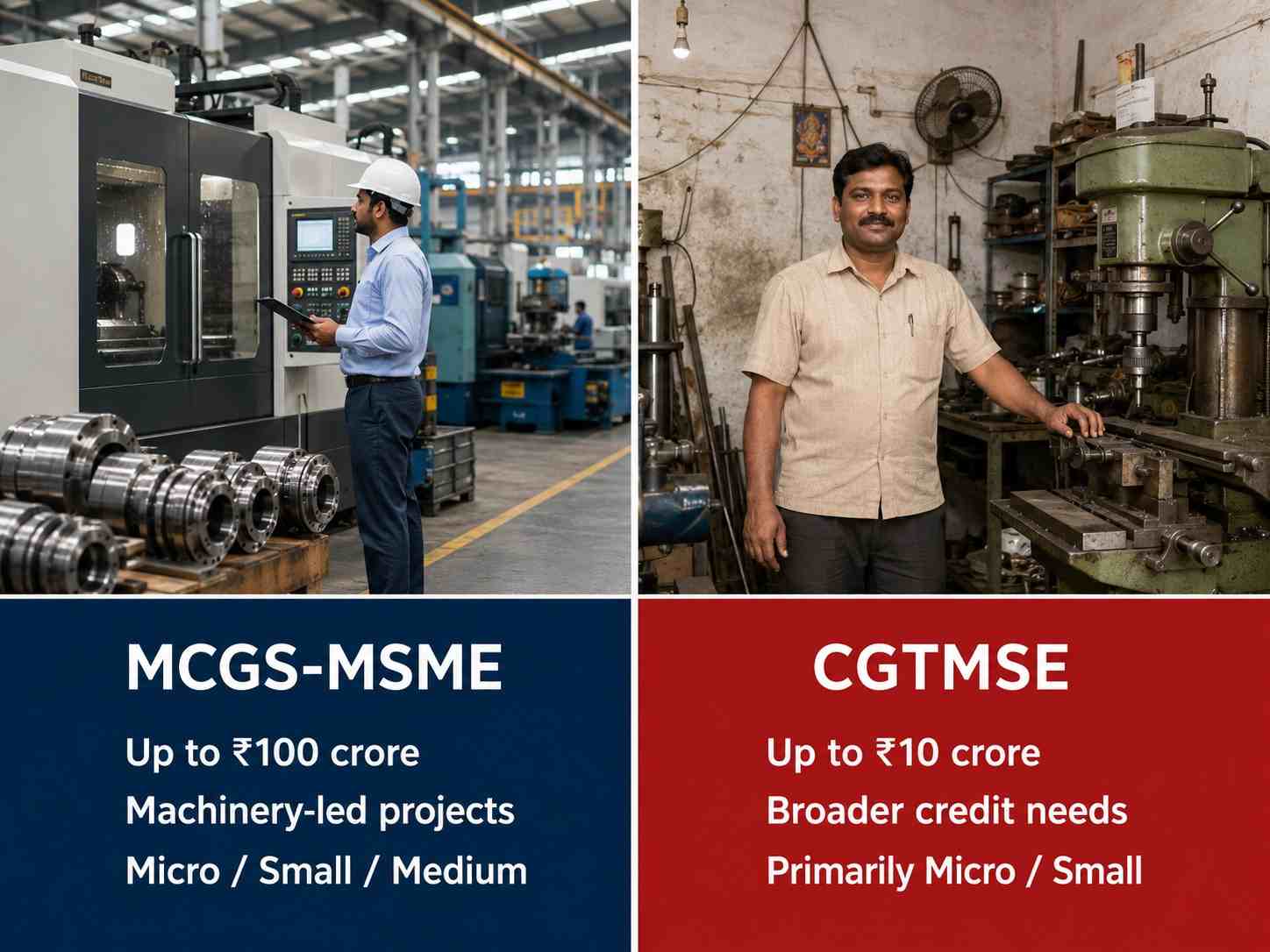
The correct scheme depends on enterprise classification, amount, facility type and end use. A micro enterprise seeking a working-capital limit may fit CGTMSE better; a medium enterprise planning a large equipment-led project may look to MCGS-MSME. The lender must confirm final eligibility.
What Documents are Required for MCGS-MSME?
There is no single central public checklist that replaces each MLI’s application pack. Separate the minimum scheme evidence from the records a lender needs for credit appraisal.
Applicants searching for “MCGS-MSME documents required” should therefore use the following tables as a preparation list and then obtain the selected MLI’s current, entity-specific checklist.
Scheme-Critical Evidence
| Document or evidence | What it establishes |
| Valid Udyam Registration Certificate | MSME status and Udyam Registration Number |
| Existing-loan statement and credit checks | Whether the borrower is an NPA with any lender |
| Detailed project-cost statement | Whether machinery/equipment forms at least 60 per cent of total project cost |
| Machinery and equipment schedule | Asset description, supplier, quantity, cost and intended use |
| Term-loan request and end-use note | Connection between borrowing and eligible capital expenditure |
| Export records, where special terms are claimed | Profitability, export share and export-realisation compliance |
Common Lender-Appraisal Documents
-
PAN, constitutional documents, address proof and authorised-signatory KYC;
-
certificate of incorporation, partnership deed, LLP agreement or proprietorship proof;
-
board or partner resolution authorising borrowing and security creation;
-
GST registration and filed returns, where applicable;
-
income-tax returns and tax-audit reports applicable to the entity;
-
audited balance sheets, profit-and-loss accounts and cash-flow statements;
-
recent bank statements and statements of all existing credit facilities;
-
promoter net-worth statement, contribution evidence and credit reports;
-
detailed project report, implementation plan and projected financial statements;
-
supplier quotations, technical specifications and purchase contracts;
-
land or lease papers, statutory approvals, utility arrangements and insurance plan;
-
debtor/creditor ageing, order book, customer contracts and capacity data;
-
title, valuation and search reports for any security accepted by the MLI; and
-
details of related entities, contingent liabilities, litigation and tax notices.
Financial statements, GST turnover, income-tax filings, bank credits and Udyam data should tell the same commercial story. The official GST portal allows taxpayers to view filed GST returns, and the Income Tax Department lists the returns applicable to business income. Where the books do not reconcile, accounting support for small businesses can help build a traceable file before submission.
Company applicants should also check whether annual filings are current. The ROC annual-return filing guide covers the financial statements and corporate records that often surface during lender due diligence.
What Should the Project Report Contain?
The project report should connect technical capacity with repayment. It should normally cover promoter background, product or service, market evidence, location, approvals, machinery specifications, supplier and implementation schedule, total means of finance, revenue assumptions, operating costs, break-even, projected cash flow, debt-service coverage and downside sensitivity.
A proposal that simply increases sales after machinery installation without showing utilisation ramp-up, working-capital need or customer demand is weak. A properly structured bank-loan project report should make every major assumption traceable to a quotation, contract, historical result or stated basis. For used or specialised assets, an independent machinery or asset valuation report may also be relevant if the lender requires it.
How to Apply for an MCGS-MSME Loan
The MCGS-MSME loan application process is lender-led. If your question is how to apply for MCGS-MSME loan support, the sequence below starts with borrower preparation and ends with the MLI obtaining guarantee cover after sanction.
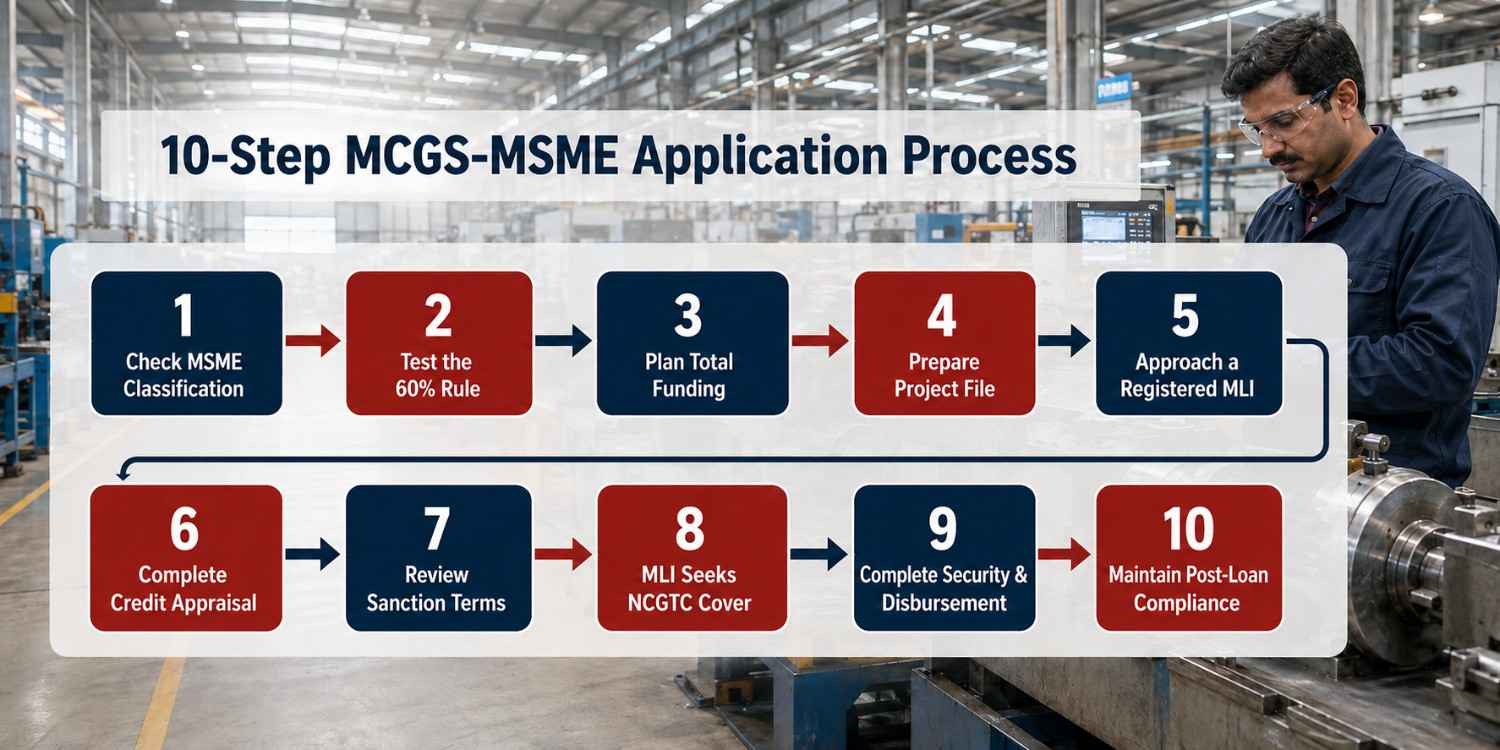
Step 1: Confirm Current MSME Classification
Verify that investment and turnover fall within the current micro, small or medium thresholds and that Udyam details match PAN and GST data. Do this before asking the bank to structure the facility under MCGS-MSME.
Step 2: Test the Project Against the 60 per cent Rule
Prepare a cost table that separates machinery/equipment from land, building, installation, pre-operative expense, contingency and working capital. If the eligible equipment share is below 60 per cent, changing the label will not solve the problem; the project may need a different financing structure.
Step 3: Calculate the Complete Funding Requirement
Estimate promoter contribution, 5 per cent upfront scheme contribution, taxes, fees, interest during implementation, working capital and cost overruns. A project can be viable on paper and still fail if initial cash outflow is underestimated. Strategic virtual CFO planning can help test the funding mix and projected debt service.
Step 4: Prepare the Technical and Financial File
Collect quotations, approvals, financial statements, tax records, bank statements and a detailed project report. Reconcile names, addresses, turnover and borrowings across every document. Explain non-recurring losses, related-party entries, statutory arrears and recent credit enquiries rather than waiting for the lender to discover them.
Step 5: Approach a Registered MLI
Ask whether the branch or business unit handles MCGS-MSME proposals and whether the institution is registered with NCGTC for the scheme. Submit the lender’s application form and obtain an acknowledgement. The RBI’s MSME lending guidance explain that banks should recognise Udyam classification and acknowledge MSME loan applications.
Step 6: Complete Lender Credit Appraisal
The lender may conduct promoter discussions, bureau checks, account review, site inspection, technical appraisal, legal search, valuation and cash-flow sensitivity. It may ask for revised projections or additional evidence. Respond in one controlled document trail so different versions do not create inconsistencies.
Step 7: Review the Sanction Terms
Check the sanctioned amount, interest benchmark and spread, repayment, moratorium, margin, primary security, collateral if any, guarantees, upfront contribution, annual guarantee fee, pre-disbursement conditions and reporting covenants. Compare the annual percentage rate and total cash burden, not merely the headline rate.
Step 8: MLI Seeks NCGTC Guarantee Cover
After sanctioning an eligible loan, the MLI submits the facility details to NCGTC under its portal process and completes the required contribution or fee. Ask the lender to confirm when guarantee cover becomes effective and which borrower-funded charges have been collected. The borrower should not treat a sanction as proof that the guarantee has already been activated.
Step 9: Complete Security, Charge and Disbursement Conditions
Execute loan and security documents, create the required charge, arrange insurance, bring in promoter contribution and satisfy approvals. Disbursement may be milestone-based or paid directly to suppliers. Preserve invoices, payment evidence, asset identification and commissioning records for end-use verification.
Step 10: Maintain Compliance After Disbursement
Pay interest and instalments on time, use funds only for sanctioned purposes, submit stock or financial statements when required, maintain insurance and obtain consent before material project changes. The RBI’s direction on comprehensive credit information reports shows why repayment conduct across facilities can surface in lender credit review.
What Does the Lender Examine Before Approval?
The guarantee reduces a part of the MLI’s loss risk; it does not replace credit appraisal. A lender usually asks five connected questions:
-
Is the borrower eligible? Udyam status, non-NPA condition, sector and scheme window must be valid.
-
Is the project eligible? Machinery/equipment must satisfy the 60 per cent test and the proposed end use must be clear.
-
Is the project viable? Demand, capacity, pricing, operating costs, implementation and downside risk must support cash generation.
-
Can the borrower repay? Historical and projected cash accrual should cover existing and proposed debt without depending on an unsupported future event.
-
Can the loan be documented and monitored? Asset title, supplier trail, approvals, insurance, charge and disbursement controls must be enforceable.
| Appraisal area | Stronger application | Warning sign |
| Promoter contribution | Funds are identifiable and available before disbursement | Contribution depends on another uncertain loan or asset sale |
| Machinery purchase | Multiple verifiable quotations with specifications and warranty | Inflated, related-party or unverifiable quotation |
| Sales projection | Linked to capacity, customers, price and ramp-up | Immediate full-capacity sales without evidence |
| Financial records | Audited accounts reconcile with tax and banking data | Cash sales, related-party balances or debt omitted |
| Repayment | Conservative cash flow covers all debt service | EMI depends on subsidy, refinancing or perfect market conditions |
| Compliance | Udyam, GST, tax and corporate filings are current | Dormant registrations, overdue filings or unresolved notices |
| End-use control | Milestones and supplier payments are documented | Request for unrestricted diversion of term-loan funds |
If delayed receivables are weakening an otherwise viable business, financing and recovery should be handled separately. The MSME payment-recovery process may address qualifying overdue invoices, while the term-loan proposal should show a sustainable operating cycle.
Is an MCGS Loan Fully Collateral-Free?
It can support collateral-free lending, but applicants should not equate that phrase with “no security, no appraisal and no recovery”. The financed machinery is normally primary security. An MLI may also seek promoter guarantees, insurance, charge creation and other contractual protections under its policy and the applicable scheme structure.
In other words, “collateral-free MSME loan” does not mean obligation-free finance. The borrower remains liable for the full sanctioned debt and the lender retains the rights created by the executed documents.
Where additional collateral is accepted, published lender terms indicate that guarantee computation may be reduced by the collateral value. This makes a hybrid proposal possible but changes the effective guaranteed exposure. A borrower considering property-backed finance as an alternative should compare it with the separate loan-against-property framework rather than assuming both facilities create the same rights, costs or end-use conditions.
Always ask the MLI to state in writing:
-
assets treated as primary security;
-
additional collateral, if any;
-
personal or corporate guarantees;
-
value deducted for guarantee-cover computation;
-
charge-registration responsibility and cost;
-
events of default and recovery rights; and
-
the date and amount of effective NCGTC cover.
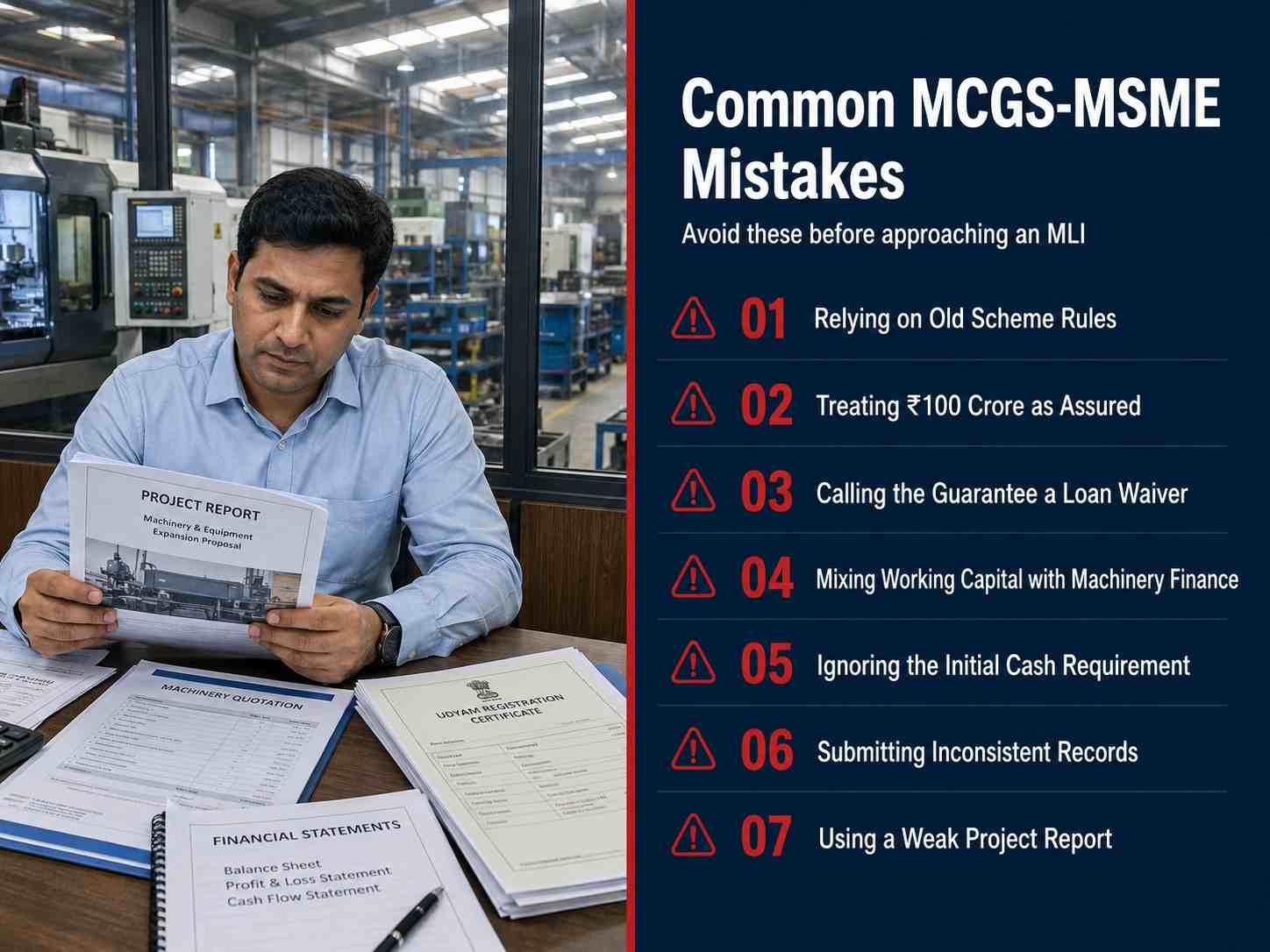
What Common MCGS-MSME Mistakes Should Applicants Avoid?
Using Old Scheme Rules
The most common error is relying on the 2025 launch summary. The machinery share is now 60 per cent, service-sector MSMEs are included, the standard upfront contribution can be refunded subject to performance, and the guarantee expires after ten years.
Treating ₹100 Crore as an Entitlement
₹100 crore is the ordinary ceiling for guarantee-linked support, not a minimum and not an assured sanction. The MLI decides the viable debt amount after examining project cost, promoter contribution, cash flow and exposure policy.
Calling the Guarantee a Debt Waiver
The MSME remains liable for the entire loan under its documents. The 60 per cent guarantee cover protects the lender for an eligible share of default loss and does not cancel recovery rights against the borrower.
Mixing Working Capital With Machinery Finance
The MCGS loan is centred on capital expenditure. Stock, wages and receivables may need a separate assessed facility. Combining every need into one undifferentiated number makes the end use difficult to verify.
Underestimating the Initial Cash Requirement
Promoter margin, the upfront contribution, taxes, non-financed project cost and pre-operative expenses can create a large funding gap. Prepare a sources-and-uses statement before accepting the sanction.
Submitting Inconsistent Records
Udyam turnover, GST returns, audited accounts, ITRs and bank credits should reconcile. Explain genuine differences with a schedule. Unexplained discrepancies can delay appraisal or reduce confidence in projections.
Assuming the MLI Will Correct the Project Report
The lender evaluates the proposal; it does not build the borrower’s business case. Unsupported capacity, pricing, receivable and cost assumptions weaken both eligibility assessment and repayment analysis.
MCGS-MSME Pre-Application Checklist
-
Current Udyam Registration Certificate downloaded and verified
-
Enterprise remains within current MSME classification limits
-
No account classified as NPA with any lender
-
Machinery/equipment schedule equals at least 60 per cent of total project cost
-
General or exporter-specific guarantee ceiling correctly selected
-
Promoter contribution and upfront contribution funding identified
-
Three years of audited accounts and tax records compiled, where available
-
GST, income-tax, bank and Udyam figures reconciled
-
Project report includes implementation, cash flow and downside sensitivity
-
Quotations, technical specifications and supplier checks completed
-
Licences, land/lease, utilities and insurance plan available
-
Existing facilities, security and contingent liabilities fully disclosed
-
Registered MLI and responsible branch/business unit confirmed
-
Interest, APR, fees, repayment, moratorium and security recorded in writing
-
Post-disbursement reporting and end-use controls understood
Conclusion
MCGS-MSME can support substantial equipment-led investment, including eligible service projects and medium enterprises that may fall outside the ordinary CGTMSE borrower profile. Its value lies in sharing a defined portion of lender default risk, not in replacing the borrower’s contribution, cash flow, documentation or repayment duty.
A strong mutual credit guarantee scheme application begins with the revised rules: valid Udyam status, no NPA classification, at least 60 per cent of project cost in machinery or equipment, a lender-ready term-loan proposal and a registered MLI. It then succeeds or fails on normal credit fundamentals, project viability, promoter strength, consistent records and enforceable documentation. Treat the guarantee, the loan and the security package as three separate layers, and review all three before signing.
FAQS
FAQs About Mutual Credit Guarantee Scheme
-
What is the MCGS-MSME scheme?
MCGS-MSME is a credit guarantee framework administered by NCGTC for eligible term loans used to purchase plant, machinery or equipment. Under the ordinary MCGS scheme, a registered MLI can receive 60% guarantee cover on the eligible amount in default for a facility up to ?100 crore. The borrower still owes the full amount under the loan agreement and must pass the lender’s credit appraisal.
- Who can apply for an MCGS loan?
- Can a service-sector MSME use the mutual credit guarantee scheme?
- Is MCGS-MSME a collateral-free loan?
- Does the 60% guarantee reduce the borrower’s repayment?
- How do I apply for MCGS-MSME loan support?
- What is the MCGS scheme guarantee fee?
- What are the special MCGS-MSME benefits for exporters?
- What is the difference between MCGS-MSME and CGTMSE?
- How long does MCGS-MSME approval take?


