
An MSME can be profitable on paper and still miss a loan payment. A large buyer may delay an invoice, stock may move slowly, a machine may remain idle, or an expansion may take longer to generate cash. When that shortage is temporary and the business remains viable, MSME loan restructuring can align repayment with realistic cash flow. It is not, however, an automatic moratorium, waiver or right to a lower interest rate.
The timing of the request matters. India has a continuing framework for the revival and rehabilitation of eligible stressed MSMEs, while the special COVID-era one-time restructuring windows have closed. The current process depends on the borrower’s MSME status, loan limits, account classification, viability, lender type and board-approved policy.
This guide explains the live RBI framework, corrective action plans, documents, application stages and NPA risks. It answers how to apply for MSME loan restructuring, the documents required for MSME loan restructuring, the impact of MSME restructuring on credit score and the difference between restructuring and OTS. It also distinguishes regulatory requirements from the commercial terms that an individual bank or NBFC may approve.
Important: This is general information, not legal, tax or credit advice. A borrower facing an NPA notice, SARFAESI action, insolvency demand or limitation deadline should obtain advice on its documents and facts without delay.
What is MSME Loan Restructuring?
MSME loan restructuring is a lender-approved change to existing credit terms because the borrower faces financial difficulty. Depending on viability and the lender's policy, it may involve rescheduling instalments, extending the tenure, converting overdue interest into a separate facility, revising working-capital limits, granting a limited moratorium, or providing need-based additional finance.
The objective is to preserve a viable enterprise—not to hide a loss or keep an unviable account artificially regular. A longer tenure may reduce the immediate instalment but increase total interest. A moratorium postpones payment; it does not normally erase the amount due. Fresh security, promoter contribution, monitoring covenants or a personal guarantee may also be required.
The RBI’s Prudential Framework for Resolution of Stressed Assets broadly defines restructuring as a concession granted for economic or legal reasons related to the borrower’s financial difficulties. The lender must therefore examine the reason for stress and the business’s ability to repay under revised terms.
Businesses should first make their records lender-readable. Small-business accounting and bookkeeping can help reconcile bank entries, receivables, GST data and financial statements before a proposal is submitted.
Which RBI Framework Applies in 2026?
There is no new universal “RBI MSME restructuring scheme 2026” that guarantees a moratorium or preserves every account as standard. The current RBI MSME restructuring guidelines must be read by account type and exposure; the applicable route is determined by the borrower’s facts.
|
Situation |
Main Route |
Practical Meaning |
|
Eligible MSME with loan limits up to ₹25 crore |
RBI Framework for Revival and Rehabilitation of MSMEs |
Early identification, committee or branch examination, and a CAP choosing rectification, restructuring or recovery |
|
MSME not covered by the ₹25 crore framework |
RBI Prudential Framework and lender policy |
Lender-led resolution; multi-lender, appraisal, asset-classification and implementation conditions may apply |
|
Account eligible under a lender’s current board-approved workout policy |
Contractual/lender-specific resolution |
Terms, fees, ratios, security and approval authority vary by institution |
|
NPA considered for compromise |
Lender’s board-approved OTS/compromise policy |
Settlement is distinct from revival-oriented restructuring and may involve a negotiated payment against closure |
|
Corporate debtor requiring formal resolution |
IBC or another recovery/resolution route |
Legal process with statutory consequences; specialist advice is essential |
The RBI’s current MSME lending states that the revival and rehabilitation framework covers MSMEs with loan limits up to ₹25 crore, including consortium and multiple-banking arrangements. It also points MSMEs above that limit to the Prudential Framework. The consolidated RBI Master Direction on MSME lending should be read with later amendments and the lender’s current policy.
Why the COVID restructuring window should not be presented as current
The RBI Resolution Framework 2.0 for MSMEs required invocation by 30 September 2021 and implementation within 90 days after invocation. It was a special, time-bound asset-classification relief. Those dates have passed.
An article that still tells a borrower to apply under Resolution Framework 2.0 is outdated. A borrower should instead ask the lender which current RBI route and board-approved policy apply to its account.
Who Can Seek MSME Debt Restructuring?
The starting point is authentic MSME status. Loan restructuring eligibility is not decided by Udyam Registration alone. The revised MSME classification effective from 1 April 2025 uses both investment and turnover criteria. The Ministry of MSME classification page lists the current composite thresholds, while the official Udyam portal is the registration channel.
|
Enterprise |
Investment in plant, machinery or equipment |
Annual turnover |
|
Micro |
Up to ₹2.5 crore |
Up to ₹10 crore |
|
Small |
Up to ₹25 crore |
Up to ₹100 crore |
|
Medium |
Up to ₹125 crore |
Up to ₹500 crore |
Both conditions matter for classification. A certificate alone does not make a restructuring proposal viable, and restructuring does not become compulsory merely because a borrower holds Udyam Registration.
Under the RBI’s 17 March 2016 framework, an MSME borrower may voluntarily initiate proceedings when it reasonably apprehends business failure, inability or likely inability to pay debts, or specified erosion of net worth. For loan limits above ₹10 lakh and up to ₹25 crore, the case is referred to the Committee for Stressed MSMEs; accounts up to ₹10 lakh may be examined at branch level under the bank’s approved policy.
The proposal is more likely to be considered for restructuring where a stressed MSME loan still supports an operating and potentially viable enterprise:
-
the enterprise remains operational and has a credible route to positive cash flow;
-
stress is temporary, measurable and supported by records;
-
promoters disclose all bank, statutory and unsecured liabilities;
-
funds have not been diverted, and records do not indicate fraud or malfeasance;
-
revised repayments are supported by conservative projections; and
-
promoters are willing to contribute funds, security or operational changes where required.
The framework generally excludes wilful defaulters from restructuring, subject to its limited review provisions, and treats fraud or malfeasance as ineligible unless a qualifying change in promoters and other conditions are met. A weak business cannot be converted into a viable one by extending tenure alone.
Read more: Udyam Registration and MSME status should be checked before the account reaches a critical stage. The Supreme Court has emphasised that an enterprise must produce authenticated and verifiable material proving MSME status in time.
How Do SMA and NPA Classification Work?
A Special Mention Account records early stress before NPA classification. Understanding SMA classification is central to the RBI framework for stressed MSME accounts. The framework uses the following stages for non-agricultural MSME loans:
|
Category |
Payment Position |
What the Borrower Should Do |
|
SMA-0 |
Payment not overdue for more than 30 days, but warning signs exist |
Notify the lender, diagnose the cash gap and submit evidence before arrears deepen |
|
SMA-1 |
Principal or interest overdue for 31–60 days |
Submit a written CAP/restructuring request and immediate cash-flow plan |
|
SMA-2 |
Principal or interest overdue for 61–90 days |
Urgent lender action; referral/examination under the framework becomes critical |
|
NPA |
Term-loan principal or interest remains overdue for more than 90 days, subject to applicable IRACP rules |
Recovery, restructuring or settlement becomes more difficult and asset-classification consequences apply |
For cash credit or overdraft, NPA analysis also considers whether the account is “out of order,” not merely whether an EMI was missed. The RBI’s 2021 IRACP clarification explains day-end classification and requires an NPA to be upgraded only after the entire arrears of principal and interest across the borrower’s facilities with that lender are paid, except where specific restructuring rules prescribe another upgrade test.
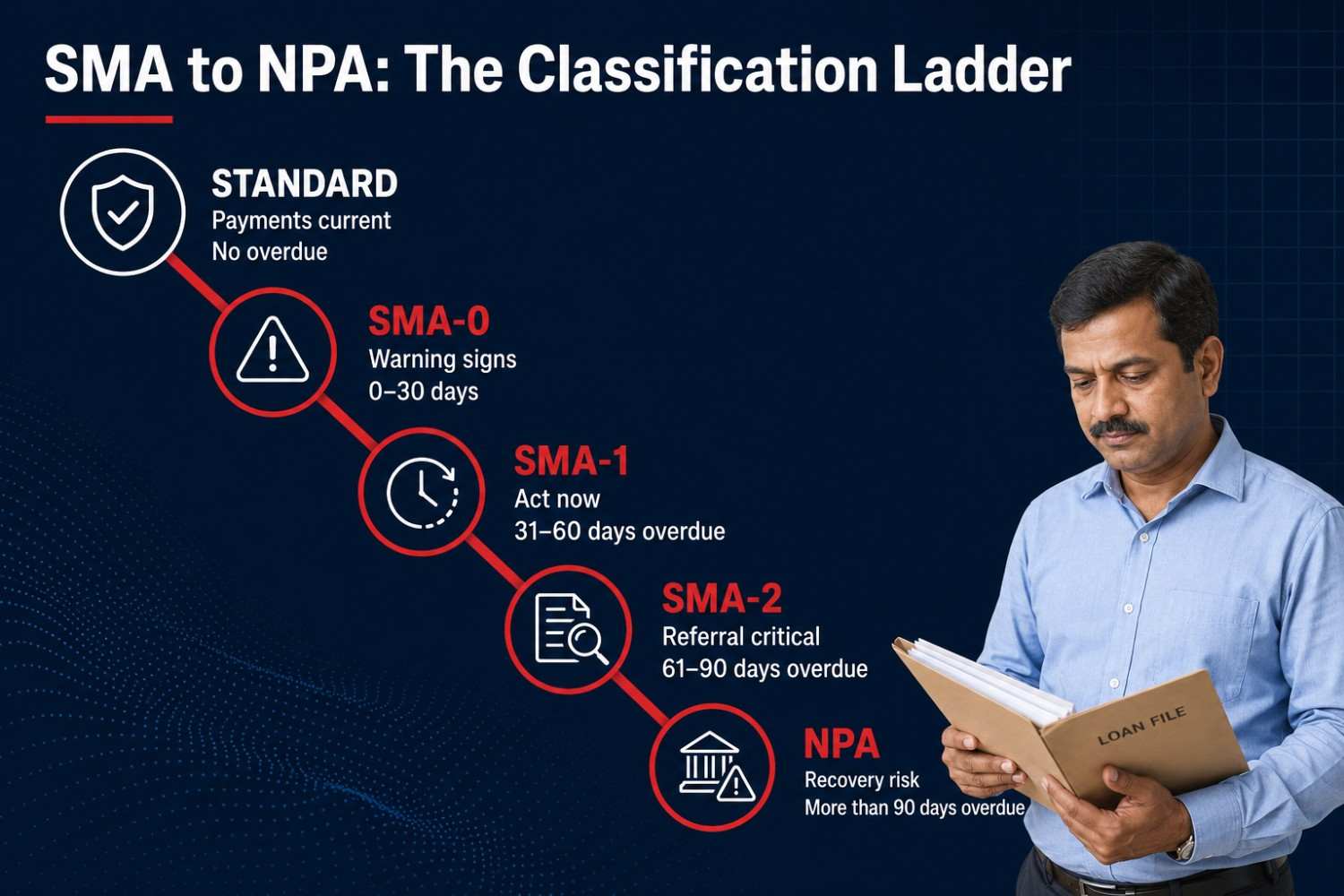
Early-warning signals can arise before a missed EMI
The framework lists practical signals such as delayed stock statements, sales or profit materially below projections, repeated cheque returns, reduced drawing power, non-renewal based on audited figures, LC devolvement, BG invocation, frequent overdrafts, diversion concerns and a borrower’s own report of stress.
An ageing receivables report often reveals the problem earlier than the repayment account. Businesses with delayed customer payments can review MSME payment-recovery options while continuing to communicate with the lender. Recovery from a customer and restructuring of a bank loan are separate processes and should run on coordinated cash-flow assumptions.
What Did the Supreme Court Say About MSME Accounts Before NPA?
In M/s Pro Knits v. Board of Directors of Canara Bank (2024 INSC 565), the Supreme Court held that the Central Government and RBI directions governing MSME revival and rehabilitation have statutory force and bind banking companies. The framework exercise is required before an eligible MSME account turns NPA. The ICSI case summary of the judgment records the mandatory character of the directions.
The decision is important, but it should not be read as an automatic restructuring order. The Court also stressed that an MSME must remain vigilant and provide authenticated, verifiable proof of its MSME status before NPA classification. A borrower that waits until security enforcement is complete may not be permitted to raise MSME status belatedly to obstruct recovery.
Practical steps are therefore simple:
-
Keep Udyam and entity records current.
-
Notify the lender in writing as soon as stress is foreseeable.
-
Ask expressly for examination under the applicable revival framework and CAP policy.
-
Obtain an acknowledgement and preserve the complete correspondence trail.
-
Submit reliable financial and operational evidence, not a one-page request for an EMI holiday.
How Does the Corrective Action Plan Work?
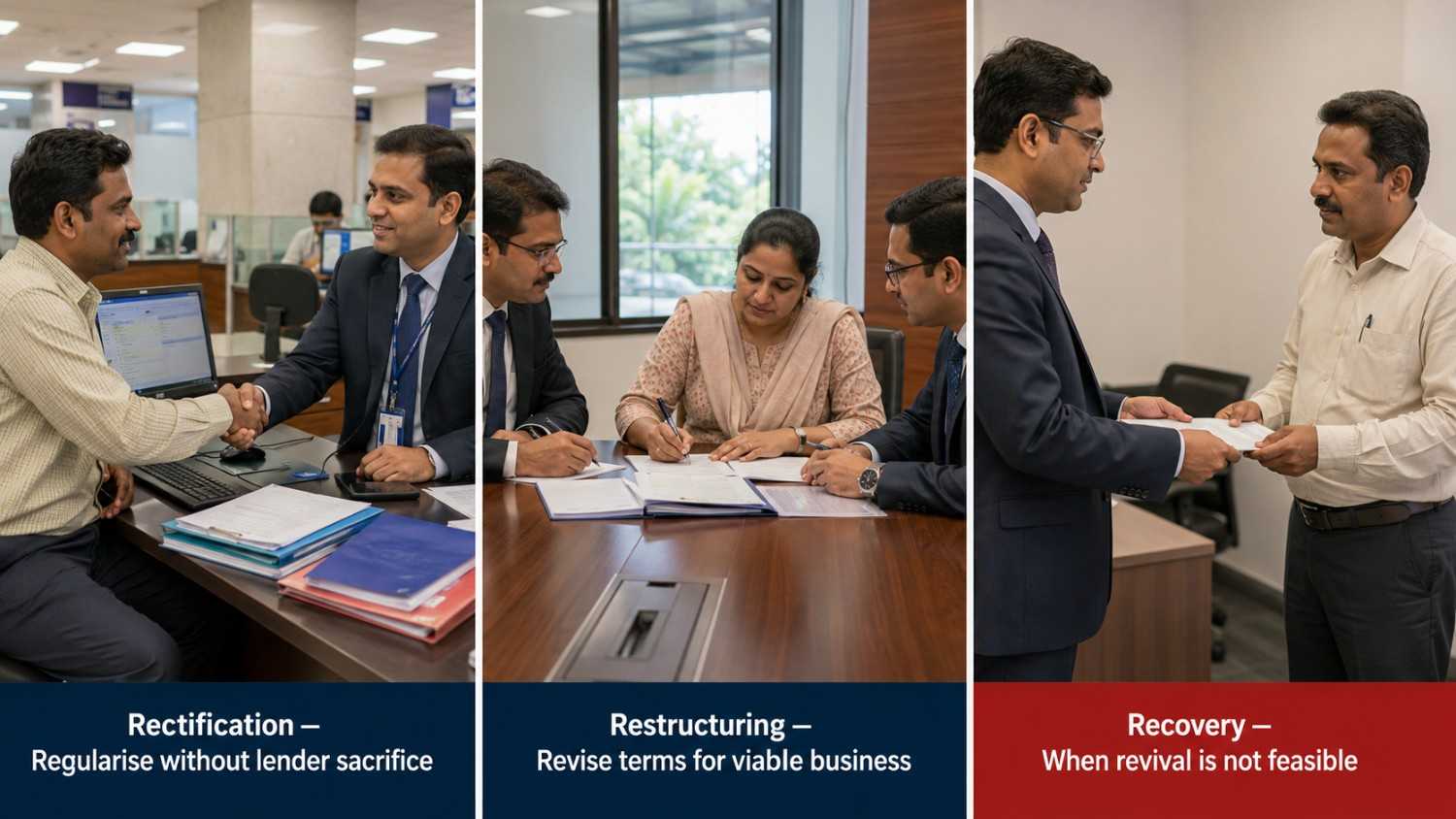
The corrective action plan for MSME accounts has three possible outcomes. The Committee should choose the option that fits the evidence rather than assume that every stressed business must be restructured. The corrective action plan timeline for MSME cases appears in the chronological table below.
1. Rectification
Rectification aims to regularise the account without lender loss or sacrifice. The borrower gives a time-bound commitment supported by identifiable cash flow. In exceptional cases, the lender may consider short-term, need-based working-capital support, but diversion of that finance can have serious classification consequences.
Rectification may be suitable where one delayed receipt caused a short mismatch and the underlying margins, orders and repayment capacity remain sound. A correctly sized working capital facility may address an operating-cycle gap, but it should not be used to conceal continuing losses.
2. Restructuring
Restructuring is considered when the business is prima facie viable but cannot meet the original schedule. The lender conducts a viability assessment and may require a techno-economic viability study. The proposal can alter debt terms and may include promoter contribution, additional security, an escrow, covenant changes or monitored asset sales. In consortium cases, an inter-creditor agreement may govern lender coordination and voting.
If fixed-asset finance caused the mismatch, the borrower should map the revised repayment to the useful life and cash generation of the asset. LegalBabu’s term-loan preparation guide explains the records normally used for long-term credit appraisal.
3. Recovery
Recovery is selected when rectification and restructuring are not feasible or when the borrower fails the agreed plan. The method depends on the lender’s policy, security, documentation and applicable law. It can include recall, enforcement, OTS, assignment, DRT action or insolvency proceedings.
Security enforcement under section 13 of the SARFAESI Act is a legal process, not merely a collection reminder. A borrower that receives a demand or possession-related notice should obtain case-specific legal advice promptly.
What Are the RBI CAP Timelines?
The 2016 framework sets a structured sequence. These are framework timelines; an individual case can still be affected by missing information, multiple lenders, approvals, legal documentation and the borrower’s response time.
|
Stage |
Framework Timeline |
|
Branch identifies a stressed account above ₹10 lakh for referral |
Within five working days; SMA-2 referral is mandatory |
|
Borrower-initiated request above ₹10 lakh |
Committee meeting at the earliest, not later than five working days after receipt |
|
Committee chooses CAP option |
Within 30 days of its first meeting; borrower notified within five working days of decision |
|
Restructuring terms for exposure up to ₹10 crore |
Viability study and terms within 20 working days |
|
Restructuring terms for exposure above ₹10 crore and up to ₹25 crore |
Within 30 working days |
|
Rectification implementation |
Within 30 days after CAP terms are finalised |
|
Restructuring implementation |
Within 90 days after CAP terms are finalised |
|
Review request against recovery decision |
Borrower may seek review within 10 working days on limited grounds |
If information on statutory dues is unavailable, the Committee may take limited additional time under the framework. Borrowers should not rely on that possibility; incomplete liabilities are a common source of delay.
For a current example of lender implementation, the Canara Bank MSME information page provides separate CAP application forms for limits up to ₹10 lakh and above ₹10 lakh up to ₹25 crore. PNB MSME banking also publishes its revival framework and MSME resources. These show how banks operationalise RBI instructions, but each lender’s policy and approval route must be checked directly.
What Terms Can a Restructuring Plan Include?
The sanctioned terms must solve the cause of stress and remain affordable under a downside case. Possible measures include:
-
rescheduling overdue principal or future instalments;
-
extending loan tenure;
-
a limited principal or interest moratorium;
-
converting unpaid interest into a funded interest term loan;
-
converting an irregular working-capital portion into a working-capital term loan;
-
reassessing cash-credit limits, drawing power, margins or the operating cycle;
-
need-based additional finance for revival;
-
revising the repayment frequency to match seasonal cash generation;
-
promoter contribution or sale of non-core assets;
-
additional collateral, guarantees, insurance or charge perfection; and
-
tighter reporting, escrow, cash-sweep or covenant conditions.
These are possible structures, not borrower entitlements. A loan moratorium or working capital restructuring is not automatically available. RBI does not prescribe one interest rate, moratorium, DSCR, security package or approval period for every MSME. The lender’s board-approved policy and credit assessment decide the final terms.
Where expansion or a new project created the stress, a revised project report for bank appraisal should show remaining cost, completion date, capacity, demand, working capital, cash accrual and debt service under realistic assumptions. Larger or complex files may benefit from financial and legal due diligence before lender submission.
Which Documents Are Required for MSME Restructuring?
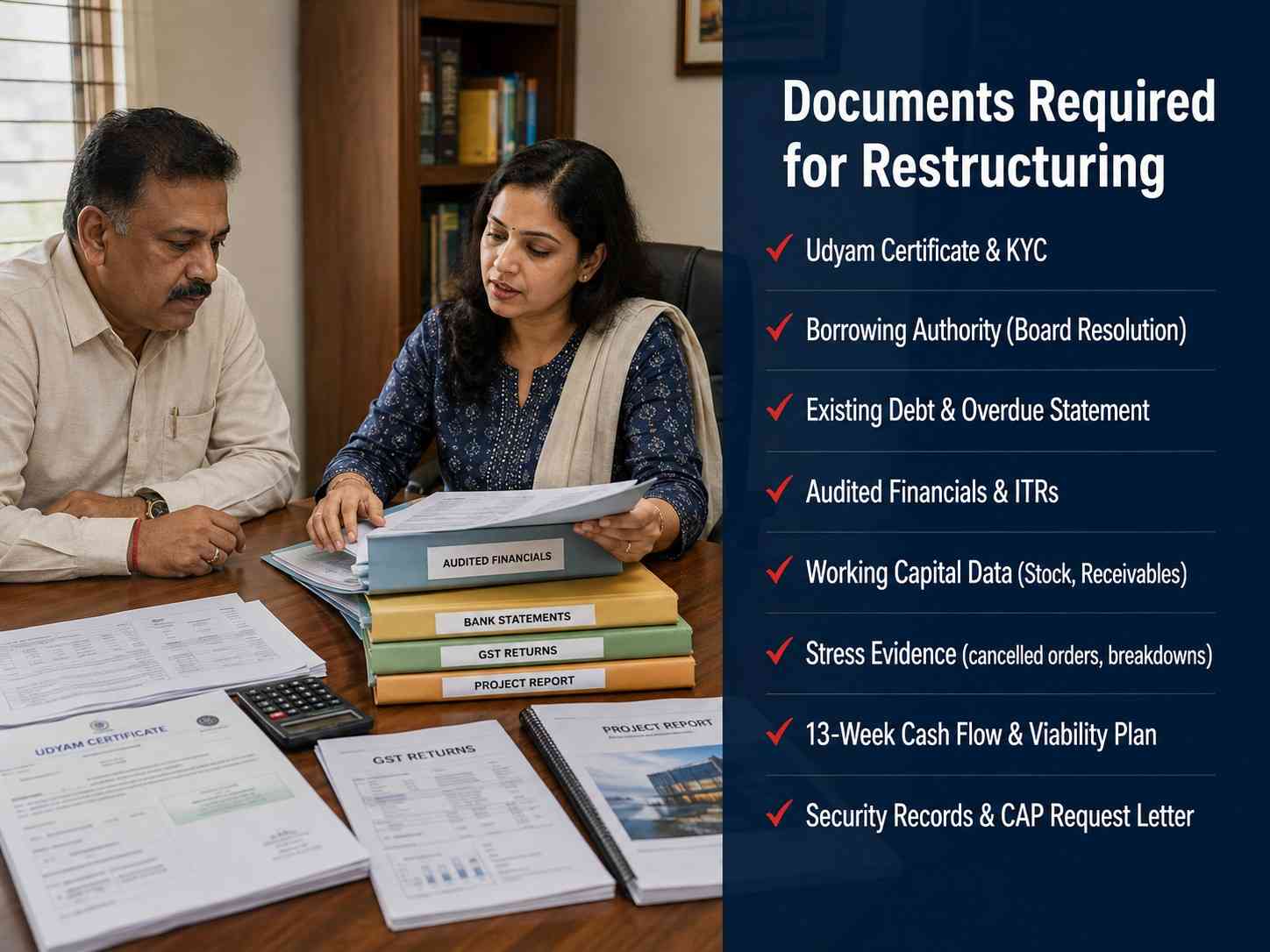
No single checklist applies to every lender. The following MSME restructuring documents form a useful lender-ready file.
|
Document Group |
Typical Records |
Why It Matters |
|
Identity and MSME status |
Udyam certificate, PAN, GSTIN, incorporation or constitutional records, KYC and authorised-signatory proof |
Establishes eligible enterprise and correct borrower identity |
|
Borrowing authority |
Board/partner resolution, MOA/AOA or LLP/partnership powers, security approval |
Confirms authority to request revised terms and create security |
|
Existing debt |
Sanction letters, loan agreements, repayment schedules, security list, guarantees, overdue statement and lender-wise exposure |
Establishes the complete liability and default position |
|
Historical financials |
Audited statements, ITRs, GST returns, bank statements and current provisional accounts |
Tests reported performance and consistency |
|
Working-capital data |
Stock statements, receivables/payables ageing, drawing-power calculation and order book |
Identifies the operating-cycle gap |
|
Stress evidence |
Cancelled orders, buyer delays, raw-material shock, breakdown records, regulatory closure or other verifiable cause |
Connects the concession request to genuine difficulty |
|
Viability plan |
13-week cash flow, monthly projections, sensitivity case, DSCR, break-even, promoter contribution and milestones |
Shows repayment capacity under revised terms |
|
Statutory liabilities |
GST, income tax, PF, ESI, electricity, municipal and other dues with proposed payment plan |
Prevents hidden claims from invalidating cash-flow assumptions |
|
Security records |
Title papers, valuation, insurance, CERSAI/ROC charge details, asset condition and consent of owners/guarantors |
Supports modification or perfection of security |
|
CAP request |
Formal application, affidavit/declaration where required, proposed relief and implementation schedule |
Gives the lender a clear, auditable request |
Financial statements, GST returns and bank credits should be reconciled. GST registration records and income-tax filing documentation must tell the same business story as the proposal.
If a company’s secured terms change, charge creation or modification may require corporate action and filings. Review the ROC charge-registration process and ensure that ROC annual filing records do not contradict the financial statements supplied to the lender.
How to Build a Credible Viability Proposal
A request that merely says “business is slow” does not show repayment capacity. A restructuring proposal should answer six questions:
-
What caused the stress? Separate one-time disruption from a structural fall in demand or margin.
-
How large is the cash gap? Build a weekly 13-week cash-flow statement and monthly forecast for the remaining tenure.
-
What relief is actually required? Quantify the instalment, moratorium, conversion, additional finance or working-capital change.
-
What will the promoters contribute? State the amount, source, timing and proof of funds or assets.
-
How will performance recover? Link orders, capacity, cost reduction and collection milestones to cash generation.
-
What happens if assumptions fail? Show a downside case and corrective triggers rather than using only optimistic sales.
The base case should reconcile with installed capacity, actual margins, current orders, receivable age and tax records. It should also show total debt, not only the facility being restructured. Credible cash-flow projections should state their source assumptions. Structured virtual CFO and cash-flow support can help a business produce rolling forecasts and monitor covenants after implementation.
How to Apply for MSME Loan Restructuring
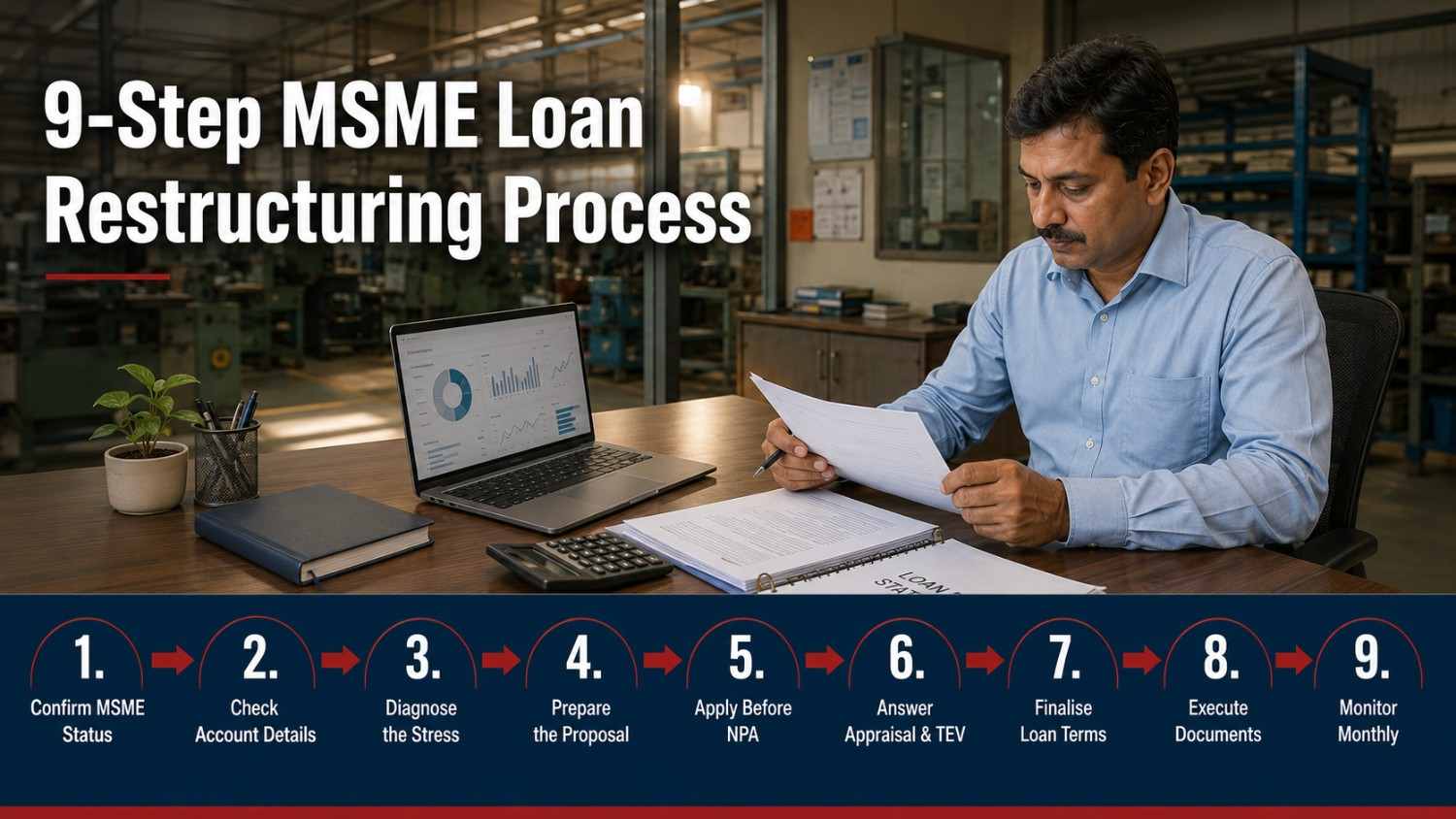
Step 1: Confirm MSME status and the applicable route
Check the Udyam certificate, current classification and aggregate loan limits. Identify whether the ₹25 crore revival framework, the Prudential Framework, a co-operative-bank rule or an NBFC policy applies.
Step 2: Obtain exact account information
Collect the loan statement, days-past-due status, sanctioned limits, drawing power, security records and lender-wise exposure. Do not estimate the overdue amount from memory.
Step 3: Diagnose the problem before choosing the relief
An operating-cycle mismatch may require receivables action and working-capital revision. A long-term asset may require tenure alignment. Recurring operating losses require cost, pricing or business-model correction before new debt is added.
Step 4: Prepare the restructuring proposal
State the cause, requested relief, revised cash flows, promoter contribution, security position, statutory dues and milestones. A broader business-loan documentation guide can help identify missing financial and entity records, but the restructuring file must additionally explain stress and recovery.
Step 5: Submit a written request before NPA
Address the branch and the appropriate MSME/CAP authority. Refer to the applicable framework, attach an indexed document set and obtain a dated acknowledgement. If several lenders are involved, notify each and identify the consortium leader or largest-exposure lender.
Step 6: Respond to appraisal and TEV queries
Provide explanations promptly. Do not alter projections simply to reach a preferred ratio. If the lender requires an independent TEV study, ensure its assumptions match the submitted accounts and operational evidence.
Step 7: Negotiate the complete term sheet
Compare instalments, total interest, moratorium accrual, rate reset, fees, collateral, promoter guarantees, reporting, default clauses, prepayment and right-of-recompense provisions. A lower immediate EMI may be expensive over the full term.
Step 8: Complete documentation and security changes
Pass corporate approvals, execute revised agreements, perfect charges, update insurance and complete required filings. A sanction without completed documentation may not amount to implementation under the applicable rules.
Step 9: Monitor the plan monthly
Track actual versus projected sales, EBITDA, collections, stock, bank utilisation, statutory dues and debt service. Escalate variance early rather than waiting for the next missed payment.
How Does MSME Loan Restructuring Affect NPA Status and Credit?
Restructuring does not freeze asset classification while the request is under consideration. Ordinary MSME NPA rules continue unless a specific regulatory exception applies. Under the normal Prudential Framework, a standard account that is restructured is generally downgraded to NPA, while an existing NPA retains its classification and must meet prescribed satisfactory-performance conditions for later upgrade.
For MSMEs handled under the revival framework, the RBI circular expressly says that extant asset-classification and provisioning norms apply. The closed COVID windows provided special standard-asset retention in qualifying cases, but that relief should not be imported into a 2026 proposal.
Restructuring information can also be reported to Credit Information Companies. It may affect the business’s commercial credit profile and future lender appetite, but no authority prescribes one fixed score drop for every case. Future impact depends on reporting, existing delinquencies, leverage and performance under revised terms. Continued default is usually more damaging than a transparent, sustainable resolution, but restructuring should not be accepted without understanding the cost and reporting consequences.
What are the Costs and Approval Conditions?
RBI rules do not set one universal restructuring fee. The borrower may face lender processing or review fees, TEV or professional costs, legal scrutiny, valuation, inspection, stamp duty, insurance, documentation and charge-modification expenses. GST can apply to taxable service charges.
The lender may also require promoter margin, cash collateral, additional security or asset sale. These are funding conditions, not “fees,” but they affect liquidity. Ask for an itemised term sheet and model the total cash outflow during the moratorium and after repayment restarts.
|
RBI/Legal Requirement |
Lender-Specific Decision |
|
Applicable framework and prudential treatment |
Whether the unit is viable under the lender’s benchmarks |
|
SMA/NPA classification rules |
Approved moratorium, tenure and repayment frequency |
|
CAP options and framework timelines |
Interest spread, fees and rate reset |
|
Need for documented implementation |
Promoter contribution and additional finance |
|
Statutory rules for security and corporate filings |
Collateral, guarantees, escrow and covenants |
|
Reporting and grievance framework |
Approval authority and internal processing time |
What Are the Risks and Alternatives?
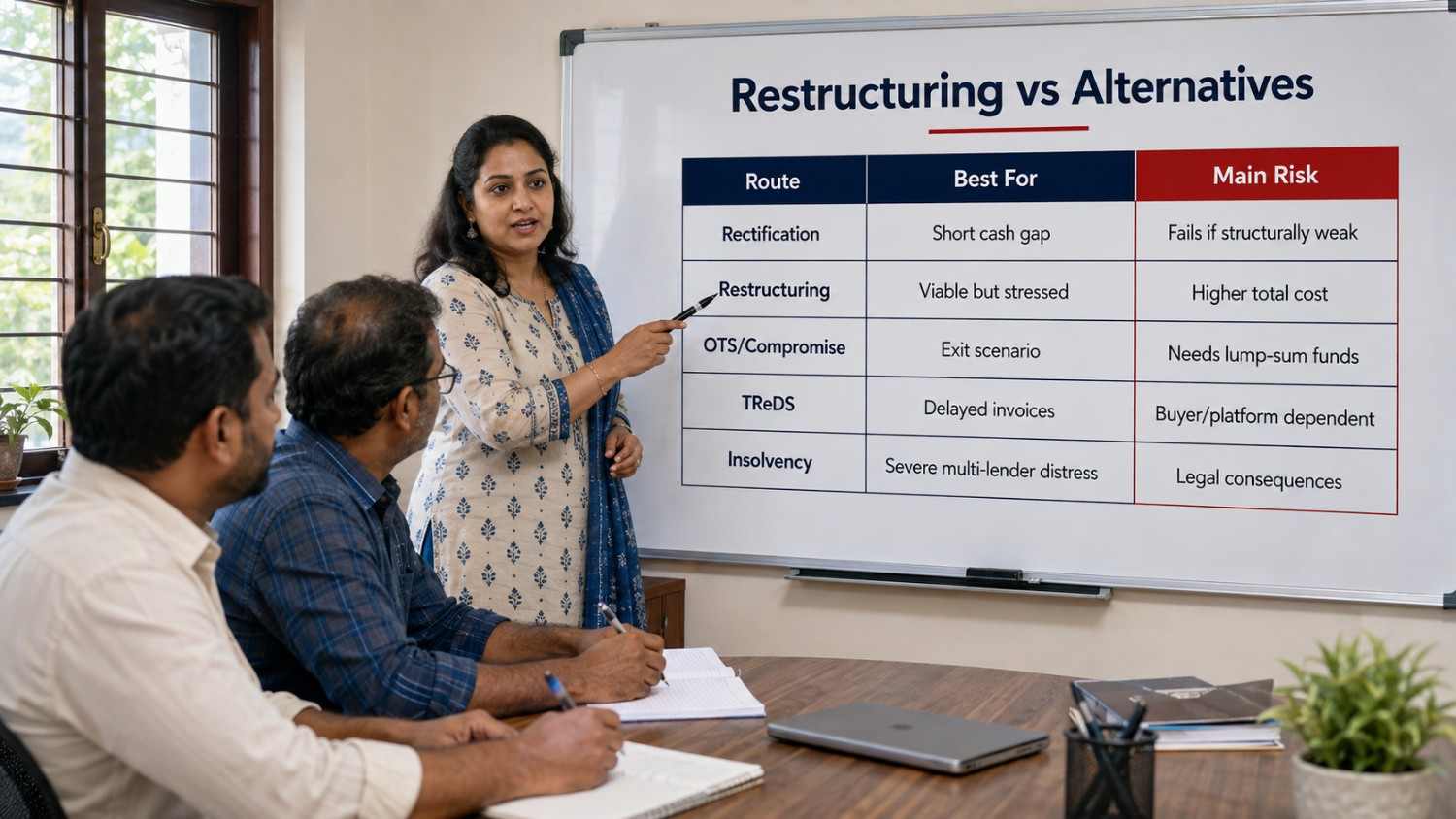
Restructuring versus other routes
|
Route |
Best Suited To |
Main Limitation |
|
Rectification |
Short, identifiable cash mismatch with no lender sacrifice |
Fails if the underlying business cannot generate cash quickly |
|
Restructuring |
Viable business needing revised debt terms |
Can increase total cost and cause adverse classification/reporting consequences |
|
Refinancing |
Performing borrower that can move to a better-suited facility |
A refinance obtained during financial difficulty may itself be treated as restructuring; approval is not assured |
|
OTS/compromise settlement |
Exit or recovery where continuing exposure is not suitable |
May require lump-sum funds, can affect credit records and ends differently from revival finance |
|
Receivables finance/TReDS |
Cash locked in accepted invoices |
Depends on buyer/platform participation and invoice acceptance |
|
Insolvency or formal recovery |
Severe multi-creditor distress or unviable business |
Legal, control, cost and time consequences are substantial |
The IBBI legal framework should be reviewed where formal insolvency becomes relevant. Where the root problem is delayed invoices, TReDS can facilitate discounting of eligible MSME receivables through multiple financiers. Micro and small enterprises can also examine the official MSME Samadhaan portal for delayed-payment matters. These tools can improve liquidity, but neither automatically cures bank arrears.
If collateral-free finance remains relevant after stabilisation, review the conditions for an eligible CGTMSE-backed collateral-free loan. CGTMSE provides a guarantee to member lenders; it does not restructure loans directly or guarantee sanction. The current CGTMSE scheme information should be checked before relying on coverage.
Asset-backed borrowing is another possible route, but it shifts risk to the property and should not fund recurring losses. Compare this carefully with a loan against property for business. Businesses with non-fund-based exposure should also include every bank guarantee obligation in the debt schedule because invoked guarantees can create funded liability.
For larger projects, incomplete construction and incorrect debt-tenure matching require a full project-finance review, not only an EMI extension. If the enterprise is no longer viable, an orderly asset or business-sale assessment may preserve more value than repeated borrowing.
What if the Lender Does not Follow the Framework?
First, write to the branch and the lender’s designated grievance authority with the Udyam certificate, CAP request, acknowledgements and a precise account of the alleged procedural failure. Ask for a reasoned written response. A complaint should not be used to avoid admitted dues; it should identify the specific service or compliance issue.
If an eligible complaint against a regulated entity remains unresolved after the required first-level process, the Reserve Bank–Integrated Ombudsman Scheme explains the complaint route and CMS portal. The MSME CHAMPIONS portal also provides guidance and grievance support for MSMEs. Neither route replaces a court, tribunal or statutory response deadline.
Where SARFAESI, DRT or insolvency proceedings have started, obtain legal advice immediately. Rights and remedies depend on notice dates, security, borrower status and prior proceedings.
What Should an MSME Do After Restructuring?
Implementation is the beginning of recovery, not the end. The business should maintain a monthly dashboard covering:
-
revised instalment and interest due dates;
-
weekly collections and 13-week liquidity;
-
sales, gross margin and operating profit against plan;
-
stock days and receivable ageing;
-
cash-credit utilisation and drawing power;
-
statutory dues and filing dates;
-
promoter-contribution milestones;
-
covenant and security compliance; and
-
early-warning triggers for lender communication.
Do not divert additional finance or use a working-capital facility for unapproved long-term expenditure. Submit stock statements, financials and monitoring reports on time. If actual performance misses the viability plan, present a corrective response before another payment default.
Conclusion
MSME loan restructuring works only when a viable business identifies stress early, proves its status, discloses every liability and proposes repayments supported by evidence. For eligible loan limits up to ₹25 crore, the RBI revival framework provides a structured CAP route involving rectification, restructuring or recovery. Larger exposures move to the Prudential Framework and lender-led resolution.
The most important action is not to wait for NPA. A request for MSME loan restructuring before NPA gives the parties more room to assess rectification and viability. Reconcile the accounts, prepare a realistic cash-flow and viability pack, submit a written request, and review the classification, security, fees and total cost before accepting revised terms. Good documentation cannot guarantee approval, but it gives the lender a credible basis for decision-making and reduces avoidable delay.
FAQS
FAQs About MSME loan restructuring
-
Is RBI Resolution Framework 2.0 still open for MSMEs?
No. The special COVID-era window required restructuring to be invoked by 30 September 2021 and implemented within the prescribed period. A borrower seeking relief now must be assessed under the continuing MSME revival framework, the RBI Prudential Framework and the lender’s current board-approved policy.
- Who is eligible for MSME loan restructuring?
- Can an MSME apply before missing an instalment?
- Can an NPA MSME loan be restructured?
- What is a corrective action plan for MSMEs?
- What documents are required for MSME loan restructuring?
- Does MSME debt restructuring reduce the principal amount?
- Does restructuring affect the CIBIL or commercial credit profile?
- How long does the MSME loan restructuring process take?
- What happens if the MSME fails after restructuring?


