
CKYCRR: Meaning, Importance, CKYCRR 2.0 & How Does It Work?
- by kapil
- Updated September 28, 2026
- 15 mins read

As financial services become increasingly digital, customers often interact with multiple banks, NBFCs, insurance companies, mutual funds and other financial institutions. This has made efficient KYC management an important part of the financial ecosystem. Repeatedly submitting the same documents can make onboarding slower and create inconsistencies when customer information changes.
To address these challenges, India has moved towards a more centralised approach to KYC record management – CKYCRR. This framework strengthens the way customer KYC information is collected, maintained, updated and accessed across participating financial institutions, making the overall process more streamlined and consistent.
Let’s explore in detail what CKYCRR is!
What Does CKYCRR Mean?
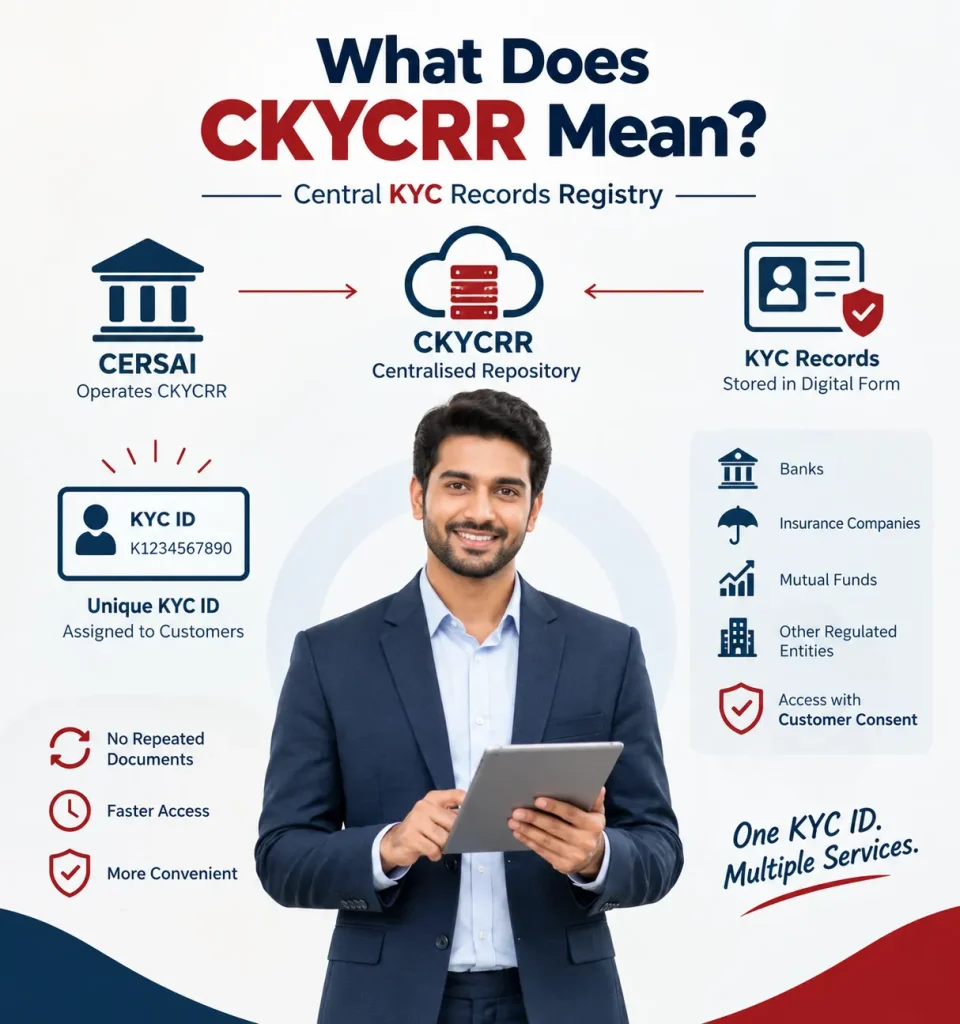
CKYCRR stands for Central KYC Records Registry, a centralised repository that stores and manages customers’ KYC records in digital form. It enables authorised financial institutions to access and use a customer’s KYC information with the required consent, reducing the need to submit the same KYC documents repeatedly when accessing different financial services.
The CKYCRR is operated by CERSAI (Central Registry of Securitisation Asset Reconstruction and Security Interest of India) under the framework established for the Central KYC process. It assigns a unique KYC Identifier (KYC ID) to customers whose KYC records are registered. Financial institutions such as banks, insurance companies, mutual funds and other regulated entities can use this identifier to retrieve KYC records, subject to applicable rules and customer consent.
What is the Purpose of CKYCRR?
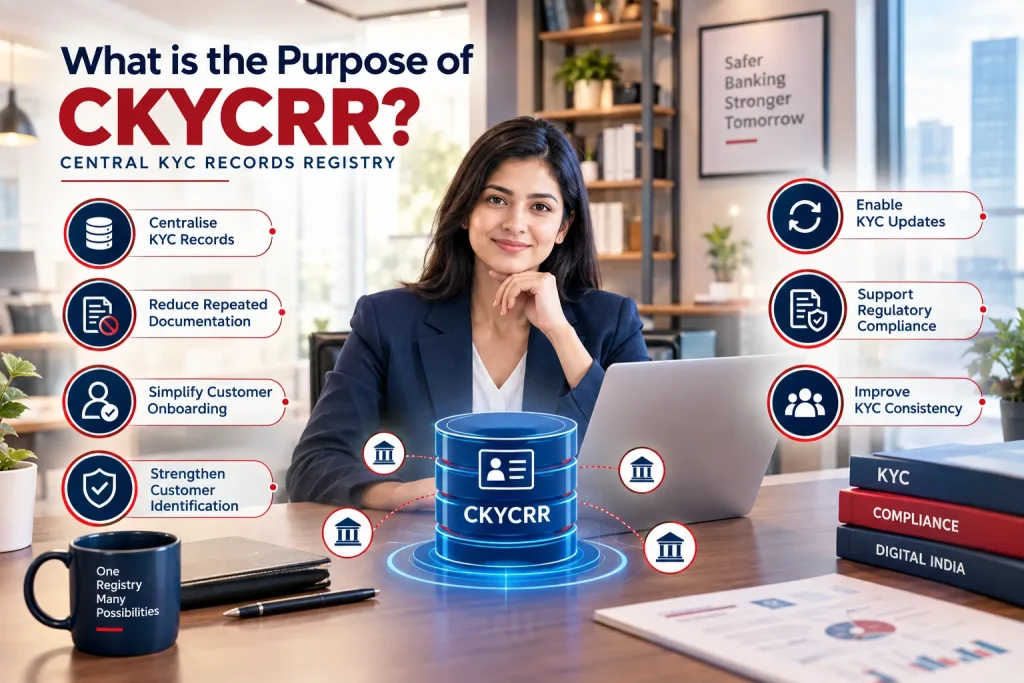
The Central KYC Records Registry is designed to centralise and standardise KYC records, making customer identification and verification more efficient for financial institutions. Its key purposes include:
- Centralise KYC Records: Stores customers’ KYC information in a central repository, allowing authorised financial institutions to access standardised records when required.
- Reduce Repeated Documentation: Minimises the need for customers to submit identical KYC documents repeatedly when opening accounts or accessing different financial services.
- Simplify Customer Onboarding: Helps financial institutions retrieve existing KYC records, making the account opening and customer verification process faster and more streamlined.
- Improve KYC Consistency: Promotes uniformity in KYC records and processes across banks, financial institutions and other reporting entities.
- Strengthen Customer Identification: Supports reliable customer identification and verification by maintaining KYC information in a centralised digital system.
- Enable KYC Updates: Facilitates the updating and sharing of revised KYC information with authorised reporting entities, subject to applicable requirements.
- Support Regulatory Compliance: Helps financial institutions meet applicable KYC and customer due diligence requirements through a centralised framework for maintaining KYC records.
What are the Functions of CKYCRR?
The CKYCRR performs several functions to standardise, maintain and facilitate the secure sharing of KYC records across authorised financial institutions. Its major functions include:
1. Receives and registers KYC records submitted by authorised reporting entities, creating a centralised record for each customer.
2. Assigns a unique KYC Identifier (KYC ID) to customers, helping financial institutions retrieve their KYC records efficiently.
3. Maintains customers’ KYC information in a central repository, ensuring records remain organised and accessible to authorised entities.
4. Enables authorised financial institutions to retrieve existing KYC records, subject to applicable rules, consent and prescribed procedures.
5. Facilitates the updating of customer KYC information when revised or additional details are submitted by reporting entities.
6. Enables the secure sharing of KYC records among authorised reporting entities, reducing repeated submission and verification of documents.
7. Supports the validation and standardisation of KYC information submitted by reporting entities to improve the quality and consistency of records.
Who Must Comply with the Requirements of CKYCRR?
CKYCRR compliance applies to Reporting Entities regulated by financial-sector regulators. The key entities covered under the CKYC framework include:
| Regulator | Entities Covered |
| RBI | Commercial Banks, Payment Banks, Small Finance Banks, NBFCs, and Cooperative Banks |
| SEBI | Stock Brokers, Depository Participants, Mutual Funds, Portfolio Managers, Research Analysts, and Investment Advisers |
| IRDAI | Life, General and Health Insurance Companies, Insurance Intermediaries, and Corporate Agents |
| PFRDA | National Pension System (NPS) Intermediaries and Pension Fund Managers |
What is the Difference Between CKYCRR and CKYC?
CKYCRR and CKYC are closely related but refer to different aspects of India’s centralised KYC framework. CKYCRR refers to the central registry that stores and manages KYC records, while CKYC generally refers to the centralised KYC system or the KYC record maintained through that framework. Here’s the key difference between the two:
| Basis | CKYCRR | CKYC |
| Meaning | A central repository for storing, maintaining and retrieving KYC records. | A centralised KYC process that allows customers to maintain a single KYC record. |
| Primary Role | Manages and maintains KYC records submitted by reporting entities. | Enables standardised KYC across financial institutions using a central KYC record. |
| Nature | It is the registry/database infrastructure. | It is the centralised KYC framework and customer record. |
| Purpose | To securely store and make KYC information available to authorised financial entities. | To reduce repeated KYC procedures when customers use different financial services. |
| Who Uses It? | Reporting entities submit, update and retrieve KYC records through the registry. | Customers and financial institutions use the centralised KYC mechanism for KYC verification. |
Why is CKYCRR Important?

CKYCRR plays an important role in making the KYC process more standardised and efficient across India’s financial sector. It enables financial institutions to access and update centralised KYC records, reducing repetitive documentation for customers. It is important because it:
1. Centralised KYC Records: CKYCRR maintains KYC records in a centralised repository, allowing authorised financial institutions to access standardised customer information when required.
2. Reduces Repeated KYC: Customers do not need to repeatedly submit the same KYC documents when accessing services from different financial institutions using the centralised KYC framework.
3. Improves KYC Efficiency: Financial institutions can retrieve existing KYC information through the central registry, making customer onboarding and verification processes more streamlined and efficient.
4. Promotes Standardisation: CKYCRR supports a uniform approach to collecting, storing and retrieving KYC information, helping financial institutions follow consistent customer identification procedures.
5. Supports Regulatory Compliance: Maintaining and retrieving KYC records through the central registry helps reporting entities meet applicable KYC and customer identification requirements under the regulatory framework.
6. Simplifies Customer Identification: The unique KYC Identifier helps financial institutions identify and retrieve a customer’s centralised KYC record without requiring the customer to provide identical information repeatedly.
What is the Legal Framework of CKYCRR?
The legal framework of CKYCRR is primarily based on the Prevention of Money-Laundering Act, 2002 (PMLA) and the Prevention of Money-Laundering (Maintenance of Records) Rules, 2005. These provisions establish the requirements for maintaining, submitting and retrieving customer KYC records through the Central KYC Records Registry. Here is a breakdown of the legal framework of CKYCRR:
| Prevention of Money-Laundering Act, 2002 | The PMLA provides the broader legal framework for preventing money laundering and requires reporting entities to comply with prescribed customer identification and record-maintenance requirements. |
| PML (Maintenance of Records) Rules, 2005 | The Rules provide the specific legal basis for CKYCRR. Rule 9 deals with customer identification and KYC information, while Rule 9A specifies the functions and obligations of the Central KYC Records Registry. |
| CERSAI | The Government authorised the Central Registry of Securitisation Asset Reconstruction and Security Interest of India (CERSAI) to act as the Central KYC Records Registry through Gazette Notification S.O. 3183(E), dated November 26, 2015. |
| RBI KYC Directions | The RBI Master Direction – Know Your Customer (KYC) Directions, 2016 requires regulated entities to capture and share KYC information with CKYCR in the manner prescribed under the PML Rules and applicable KYC templates |
What is the CKYCRR Bearing Number?
The CKYCRR Bearing Number refers to the unique identification number associated with a customer’s KYC record maintained in the Central KYC Records Registry (CKYCRR). It is commonly known as the KYC Identifier or CKYC Number and consists of 14 digits. The number is generated when a customer’s KYC record is successfully registered with CKYCRR through a bank or other regulated financial institution.
It helps financial institutions retrieve the customer’s centralised KYC information when required, reducing the need to submit the same KYC documents repeatedly. Customers can use this identifier for KYC-related purposes when establishing financial relationships with participating institutions.
How can a Customer find their CKYC number or CKYCRR Bearing Number?
A customer can find their CKYC number or CKYCRR bearing number using these steps:
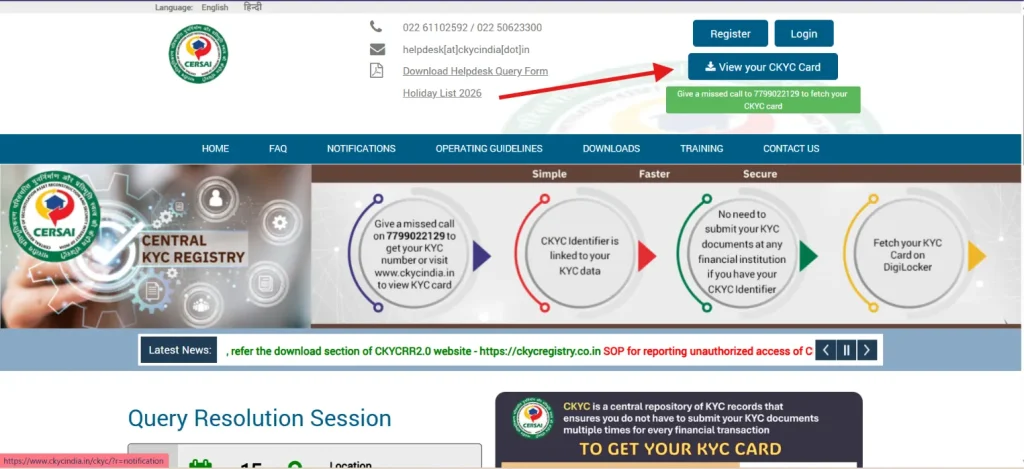
Step 1: Go to the official CKYC portal and click on “View Your CKYC Card”
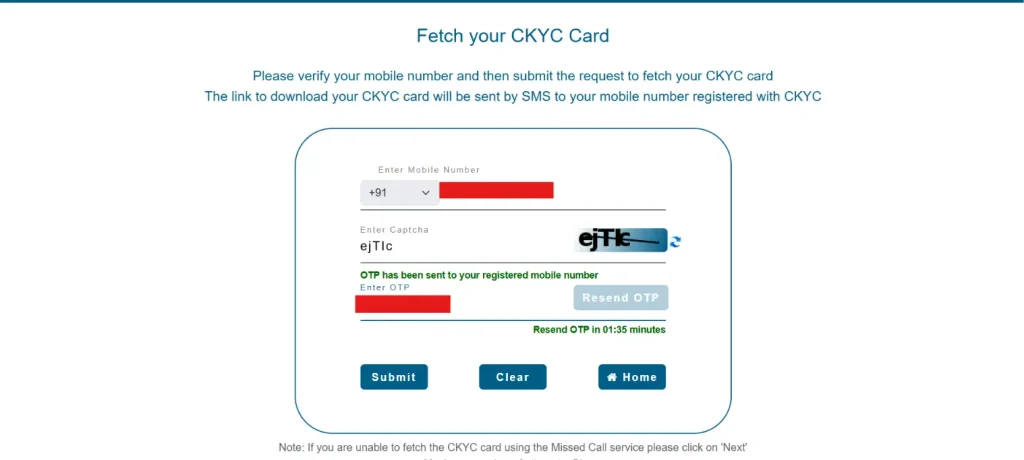
Step 2: Enter your mobile number and captcha and submit to receive an OTP on the registered mobile number. Once you successfully receive the OTP, enter it and submit.
Step 3: The portal will reflect the name of the CKYC holder associated with the mobile number. Select it and request the CKYC card.
Step 4: You will receive a request reference number, and the CKYC card will be sent to the registered mobile number.
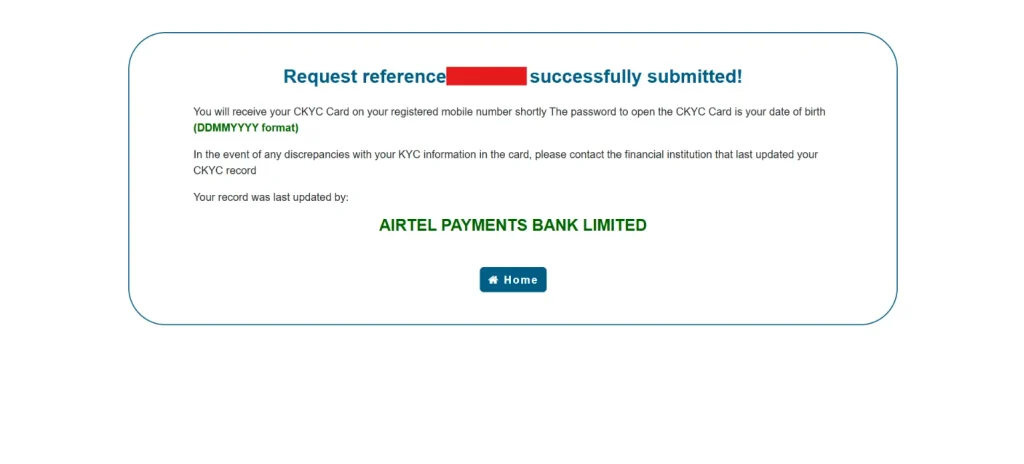
Step 5: To access the CKYC card, you need to enter a password, which is your registered date of birth in the format – DDMMYYY.
Step 6: After successfully entering the password, the CKYC card will open, and there you can access your records and details like name, DOB, email, address, and your “KYC Identifier or CKYC Number.”
How does CKYCRR work?
Here is the Step-by-Step Working of CKYCRR:
1. Customer submits KYC documents
The customer provides identity, address and other required KYC information to a bank or another regulated financial institution.
2. Financial institution verifies the information
The Reporting Entity verifies the customer’s documents and completes its KYC process according to applicable regulatory requirements.
3. KYC record is submitted to CKYCRR
The Reporting Entity uploads the customer’s KYC information and supporting documents to the Central KYC Records Registry.
4. CKYCRR processes the record
CKYCRR checks and processes the submitted information and determines whether a KYC record already exists for the customer.
5. KYC Identifier is generated or retrieved
For a new KYC record, CKYCRR generates a 14-digit KYC Identifier (KIN). If a record already exists, the existing identifier can be used.
6. KYC record becomes available for retrieval
Authorised Reporting Entities can retrieve the customer’s KYC record from CKYCRR when permitted and required for customer identification and onboarding.
7. KYC information is updated when necessary
When the customer’s KYC information changes, the concerned Reporting Entity can submit the updated information to CKYCRR in accordance with applicable requirements.
Which documents are required for CKYCRR?
For CKYCRR registration, customers generally need to provide documents that establish their identity, address, and other required KYC details. Here is the checklist of documents required:
- Proof of Identity
- Proof of Address
- Recent Passport-Size Photograph
- PAN Card
- Aadhaar Card
- Passport
- Driving Licence
- Voter Identity Card
- Officially Valid Documents
- Proof of Date of Birth
- Business Registration Documents
- Beneficial Ownership Documents
- KYC Declaration Form
How does the Central Know Your Customer Records Registry Porcess works for NRIs?
The CKYCRR process for Non-Resident Indians (NRIs) is broadly similar to that for resident customers, but additional requirements may apply for verifying identity and documents issued or certified outside India. NRIs provide their KYC documents to a regulated financial institution in India, which verifies and submits the KYC record to CKYCRR. RBI permits certified copies for NRIs to be certified by specified overseas banking officials, notaries, courts or Indian Embassies/Consulates.
Step-by-Step Process for NRIs
1. Approach a Financial Institution
The NRI approaches an Indian bank or another regulated financial institution to establish a financial relationship.
2. Submit KYC Documents
The NRI provides the required identity, address and other KYC documents, including documents applicable to their non-resident status.
3. Get Overseas Documents Certified
Where applicable, copies of documents can be certified by authorised officials of overseas branches of Indian scheduled commercial banks, certain overseas banks, a notary public, court magistrate, judge or the Indian Embassy/Consulate.
4. Complete KYC Verification
The financial institution verifies the NRI’s identity and documents and completes the required customer due diligence process.
5. KYC Record is Submitted
The Reporting Entity submits the NRI’s KYC information electronically to CKYCRR in accordance with the applicable requirements. CKYCRR is responsible for receiving, storing, safeguarding and retrieving digital KYC records.
6. KIN is Generated or Retrieved
If the NRI does not already have a CKYC record, a KYC Identifier (KIN) is generated. If a record already exists, the existing KIN can be used for retrieving the centralised KYC record.
7. KYC Record Can Be Retrieved
Once registered, the NRI’s CKYC record can be retrieved by authorised financial institutions when permitted and required for KYC purposes.
What are the Benefits of the Central KYC Records Registry?
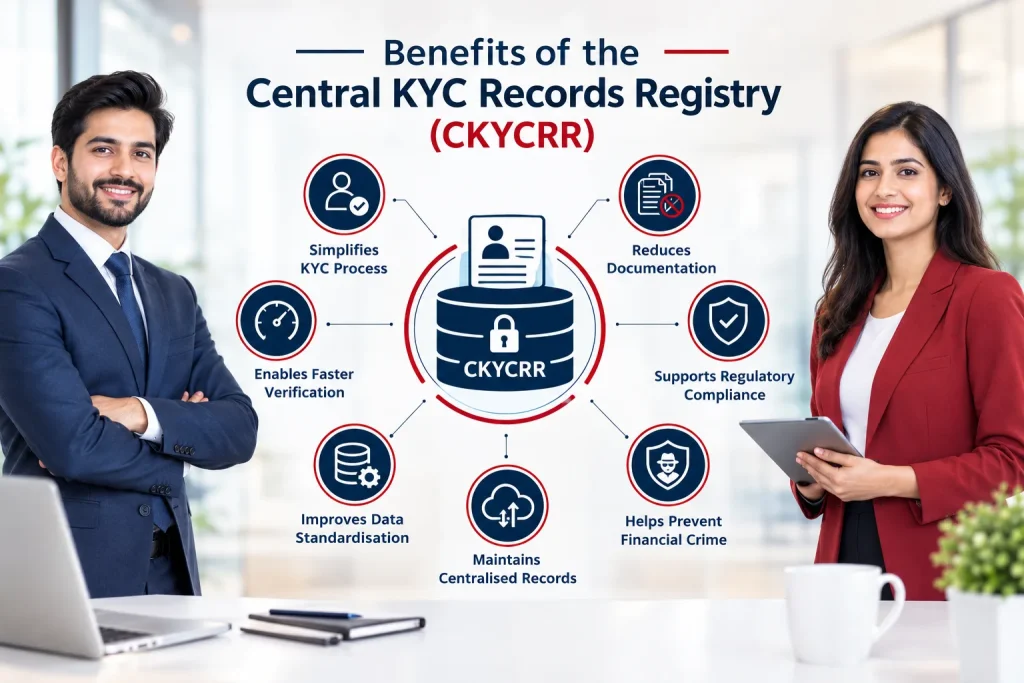
The Central KYC Records Registry (CKYCRR) framework creates a centralised mechanism for maintaining and sharing KYC information. It helps customers avoid repetitive documentation while enabling financial institutions to access standardised KYC records for verification and compliance purposes.
Here are the key benefits of Central KYC Record Registry:
- Simplifies KYC Process: Customers can use their existing centralised KYC record when establishing financial relationships with participating institutions, reducing repetitive documentation.
- Reduces Documentation: Centralised KYC records can reduce the need for customers to repeatedly submit identical identity and address documents.
- Enables Faster Verification: Financial institutions can retrieve available KYC records from CKYCRR, helping streamline customer identification and onboarding procedures.
- Improves Data Standardisation: CKYCRR provides a common framework for collecting, storing and retrieving KYC information across participating financial institutions.
- Supports Regulatory Compliance: The framework helps Reporting Entities meet applicable KYC and customer identification requirements under the relevant regulatory framework.
- Maintains Centralised Records: KYC information is maintained through a central repository, making authorised retrieval and updating of records more systematic.
- Helps Prevent Financial Crime: Centralised KYC information supports customer identification and due diligence measures that form part of India’s anti-money-laundering framework.
What is CKYCRR 2.0?
CKYCRR 2.0 refers to the upgraded version of the Central KYC Records Registry system, designed to modernise the way KYC records are registered, managed, retrieved and updated by Reporting Entities.
It provides an enhanced digital framework for financial institutions to handle customer KYC information through a centralised system. The upgraded platform supports improved workflows for KYC record management, user administration, data processing and interaction between Reporting Entities and the registry. It is intended to make KYC operations more streamlined while supporting regulatory compliance and reducing repetitive KYC procedures for customers.
CKYCRR 2.0 also forms part of the broader digital infrastructure used for maintaining centralised KYC records across participating financial institutions.
What is the difference between CKYCRR and CKYCRR 2.0?
CKYCRR 2.0 is the upgraded version of the Central KYC Records Registry, designed to improve the speed, accuracy, security and efficiency of KYC record processing. Here is how CKYCRR 2.0 is different from CKYCRR:
| Criteria | CKYCRR 1.0 | CKYCRR 2.0 |
| Submission Method | Scheduled batch file uploads | Real-time API-based submission |
| Data Format | Flat files containing data and scanned images | Structured data formats, including JSON/XML |
| Validation | Batch reports with delayed error identification | Instant validation through APIs |
| De-duplication | Manual review of potential duplicate records | AI-assisted matching for duplicate detection |
| Aadhaar Masking | Manual masking of Aadhaar details | Automated masking, with only the last four digits visible |
| Customer Consent | Basic consent mechanism | OTP-based consent, with improved control over KYC data access |
| Security and Audit | Standard security and audit mechanisms | Enhanced API security, encryption and audit tracking |
| Processing Speed | Batch-based processing, potentially taking days | Near-real-time processing, subject to validation and system response |
What are the Recent Changes in CKYCRR Regulations?
There have been numerous changes in the CKYCRR regulations recently. Some of them are:
1. Protection for Low-Risk Accounts: Banks cannot immediately freeze or shut down low-risk accounts with overdue periodic KYC updates; these accounts must remain active until at least June 30, 2026, or one full year past the due date.
2. Mandatory Advance Reminders: Regulated entities (REs) must issue at least three advance notices (including one physical letter) before a KYC deadline and three subsequent reminders after the deadline, with documented tracking.
3. Use of Business Correspondents (BCs): Local business correspondents (such as microfinance workers or designated local shops) are authorised to assist with KYC periodic updates and collect self-declarations for unchanged info or address updates via biometric or physical forms.
4. No Fresh Proof for Minor Changes: Minor updates or self-declarations where there is “no change” or “change only in address” bypass the requirement to submit fresh physical identification documents.
5. Any-Branch and Digital Updation: Customers can complete periodic re-KYC or address changes at any branch of their bank or via digital channels, Aadhaar OTP, and Video-based Customer Identification Process (V-CIP).
6. Eased Norms for Foreign Portfolio Investors (FPIs): Under amendments effective September 2026, banks can accept original certified copies of KYC documents certified by authorised overseas authorities, aligning treatment with NRIs.
Frequently Asked Questions
1. Is CKYCRR mandatory?
CKYCRR compliance is mandatory for applicable Reporting Entities under the relevant KYC and PML framework. Customers do not register directly with CKYCRR.
2. How to resolve CKYCRR discrepancies?
Contact the bank or financial institution that submitted your KYC record, provide corrected documents and request them to update the information with CKYCRR.
3. What is the impact of Central Know Your Customer Records Registry on NRE Accounts?
For NRE accounts, banks must follow applicable KYC requirements. CKYCRR enables centralised KYC record retrieval, helping streamline verification and account-related compliance.
4. What are the common issues that NRIs face with CKYCRR?
NRIs may face document-certification issues, mismatched personal details, outdated information, difficulty retrieving records, or delays in updating KYC information.
5. What happens if you don’t comply with the requirements of CKYCRR?
Non-compliance can result in regulatory action against the concerned Reporting Entity, including penalties or other consequences under applicable KYC and anti-money-laundering requirements.
6. What are the benefits of CKYCRR for customers?
CKYCRR reduces repetitive KYC documentation, provides a centralised KYC record, facilitates faster verification and allows authorised institutions to retrieve existing KYC information.
You may also like


What GLA Membership Can Mean for Logistics Businesses
GLA Membership can help a logistics business find overseas partners, but the de