
Monetary Loss Protection for Seafarers: What Agencies Must Have
- by kapil
- Updated October 5, 2026
- 18 mins read

Seafarer monetary loss protection requires private seafarer recruitment and placement services to establish protection through insurance or an equivalent appropriate measure. It compensates seafarers for certain financial losses caused by a recruitment service or shipowner failing to meet obligations under the seafarer’s employment agreement. Seafarers must also be told about their rights under this protection before or during engagement.
What is seafarer monetary loss protection under MLC 2006?

Seafarer monetary loss protection is a financial protection system required for private seafarer recruitment and placement services under Standard A1.4(5)(c)(vi) of the Maritime Labour Convention, 2006.
The system must use insurance or an equivalent appropriate measure to compensate seafarers for monetary loss they may suffer when a recruitment and placement service or the relevant shipowner fails to meet its obligations under the seafarer’s employment agreement.
The MLC does not prescribe one fixed insurance product or one standard policy format. Convention leaves the exact form of the protection to the national regulatory system, referring to insurance or an equivalent measure.
This matters for agencies because simply having an internal promise to reimburse a seafarer is not the same as establishing the protection system required by the applicable national framework.
For an Indian RPSL company, the MLC requirement must also be read alongside the applicable Indian recruitment and placement rules and DGMA requirements.
Why does the MLC require protection against monetary loss?
A seafarer can suffer financial harm when an agency or shipowner fails to perform an obligation connected with the employment agreement.
For example, imagine a seafarer accepts a job, completes the required engagement process and joins a vessel. The shipowner later fails to meet an obligation under the employment agreement, leaving the seafarer with an unpaid entitlement.
A monetary-loss protection system provides a route for compensation where the loss falls within the applicable protection.
The ILO explains that the term “monetary loss” is not specifically defined in the Convention. It refers to financial loss suffered by a seafarer as a result of breaches of obligations under the seafarer’s employment agreement.
What does the protection actually respond to?
The protection is connected to failures by:
- The recruitment and placement service
- The relevant shipowner
- A party that has failed to meet its obligations under the seafarer’s employment agreement
The exact claim process, scope and form of the protection depend on the national system implementing Standard A1.4.
That distinction is important. The MLC establishes the international requirement, while the country regulating the recruitment and placement service determines how that requirement operates through its laws, regulations or other measures.
Who must establish this system of protection?
The requirement applies to private seafarer recruitment and placement services operating within the territory of an MLC Member that regulates such services.
Under Standard A1.4, the Member must ensure that private recruitment and placement services establish the required system of protection. The Member itself does not simply become the insurer or compensation provider.
Instead, the national system must regulate the recruitment and placement services and require them to maintain the appropriate protection.
This fits into the wider MLC framework governing seafarer recruitment and placement. LegalBabu’s MLC certification page explains the wider compliance obligations for recruitment and placement services, including fair recruitment practices, records, complaints and related requirements.
What form can monetary loss protection take?
The MLC gives two broad options:
| Protection method | What the MLC says |
| Insurance | The recruitment and placement service can establish protection through insurance |
| Equivalent appropriate measure | Another suitable protection mechanism may be used if it meets the applicable requirements |
| Fixed MLC insurance policy | The MLC does not prescribe one universal policy |
| National implementation | The competent national system determines how the requirement is regulated |
The ILO FAQ specifically states that the MLC does not specify the form of the system beyond referring to insurance or an equivalent measure.
So an agency should avoid assuming that any ordinary business insurance automatically satisfies Standard A1.4.
The better approach is to identify the applicable national requirement, confirm what protection the competent authority accepts and keep documentary evidence showing that the system is in place.
Is recruitment agency insurance the same as ordinary business insurance?
Not necessarily. An agency may already carry professional indemnity insurance, general liability insurance or other commercial policies. Those policies should not automatically be treated as the MLC monetary-loss protection system.
The relevant question is whether the protection satisfies the applicable national implementation of Standard A1.4 and covers the type of monetary loss contemplated by the requirement.
For compliance purposes, the agency should be able to show:
- What protection mechanism it maintains.
- Which entity provides the protection.
- What losses the protection covers.
- Which seafarers are covered.
- When the protection applies.
- How a seafarer can make a claim.
- How long the protection remains valid.
- What evidence proves that the protection remains active.
That documentation becomes particularly useful during audits, inspections or a dispute involving a seafarer.
What rights must agencies explain to seafarers?
The 2022 amendment added an important requirement. Seafarers must be informed, prior to or in the process of engagement, of their rights under the monetary-loss protection system maintained by the recruitment and placement service.
The ILO’s 2026 FAQ confirms this directly and explains that the requirement was expressly added through the 2022 amendment to Standard A1.4(5)(c)(vi).
In practice, an agency should make the information easy for a seafarer to understand.
A useful information sheet can explain:
- That monetary-loss protection exists.
- What type of losses may be covered.
- Who provides the protection.
- Who can make a claim.
- How to start a claim.
- What documents may be required.
- Where the seafarer can raise a complaint.
- Any applicable time limits or procedural requirements.
- Whom the seafarer can contact for assistance.
The agency should also retain evidence that this information was provided.
When should the agency provide this information?
The timing matters.
The requirement says prior to or in the process of engagement. It should therefore form part of the agency’s recruitment and engagement workflow rather than being treated as information that can be supplied months later.
A practical compliance file could contain:
- Signed acknowledgement
- Engagement documentation
- Information sheet
- Employment agreement records
- Claim procedure
- Evidence of the active protection system
This creates a clear audit trail.
Is monetary loss protection the same as abandonment protection?
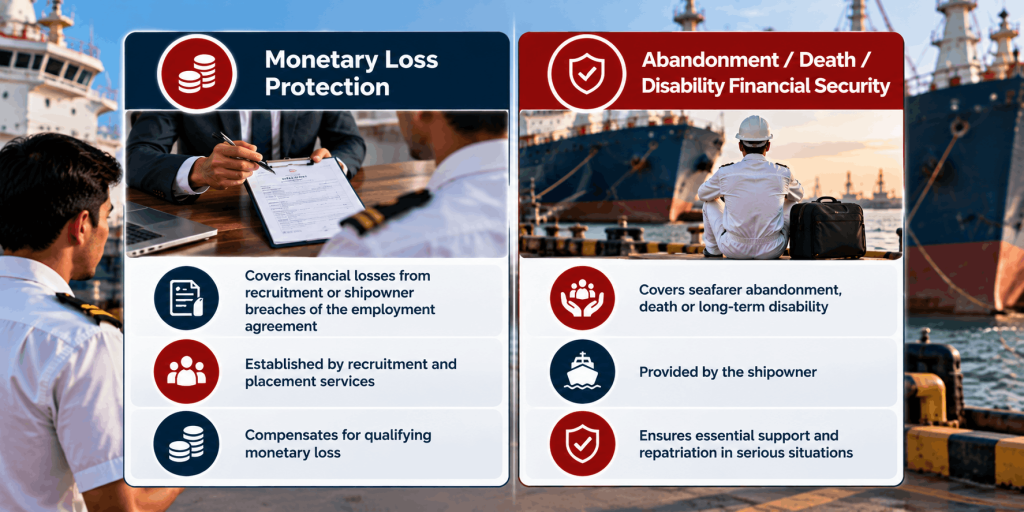
No. They are separate financial protection systems. The monetary-loss protection under Standard A1.4 is different from the financial security system dealing with abandonment and death or long-term disability introduced through the 2014 amendments to the MLC.
The ILO states that seafarers hired through a recruitment and placement agency must be covered by both systems in practice.
Monetary loss protection vs abandonment and disability security
| Point | Monetary loss protection | Abandonment/death/disability financial security |
| Main MLC area | Regulation 1.4, recruitment and placement | Regulation 2.5 and related provisions |
| Main purpose | Protect against specified monetary loss | Protect against abandonment and qualifying death or long-term disability situations |
| Who is involved | Recruitment/placement service and relevant shipowner | Primarily shipowner-related financial security obligations |
| Protection method | Insurance or equivalent appropriate measure | Financial security meeting the applicable MLC requirements |
| Seafarer information | Rights must be explained before or during engagement | Separate information and documentary requirements apply |
| Are they interchangeable? | No | No |
A recruitment agency should therefore avoid describing one financial security document as if it automatically satisfies every MLC protection requirement.
Does an RPSL bank guarantee automatically replace monetary loss protection?
This requires care. The MLC itself says that monetary-loss protection may be established through insurance or an equivalent appropriate measure, but it does not prescribe a universal form.
India’s regulatory framework may use financial security mechanisms that address monetary loss and related obligations. LegalBabu’s current guide on RPSL bank guarantee requirements explains that the 2026 rules provide for a bank guarantee and identify monetary loss among the circumstances in which it may be invoked.
That does not mean every bank guarantee everywhere is automatically an MLC-compliant monetary-loss system.
The correct question is:
Does the financial security mechanism required under the applicable national rules provide the protection required by Standard A1.4?
For an Indian RPSL company, the agency should follow the current DGMA requirements rather than relying on a generic insurance policy or an outdated understanding of the rules.
Related reading: LegalBabu’s RPSL bank guarantee requirements explain the current 2026 framework, including when a bank guarantee may be invoked for monetary loss.
How does the RPSL bank guarantee relate to monetary loss?
Under the current Indian RPSL framework covered by LegalBabu’s 2026 guidance, monetary loss is one of the situations connected with invocation of the bank guarantee.
The current rules cover outstanding wages or other entitlements owed under the seafarer’s employment agreement or applicable collective bargaining agreement where the recruitment and placement service or shipowner fails to meet its obligations. The current LegalBabu guide also explains the complaint steps associated with a monetary-loss claim.
This creates an important practical connection between the international MLC requirement and India’s national regulatory framework.
However, agencies should keep the concepts separate in their compliance records:
MLC requirement → national implementation → financial protection mechanism → seafarer information → claim procedure → evidence
That chain is easier to audit than simply keeping a document labelled “insurance” or “bank guarantee.”
What should an agency keep as proof of compliance?

A good compliance file should allow an auditor to answer three questions quickly:
Is the protection active?
Does it cover the relevant seafarers and risks?
Were seafarers informed of their rights?
A practical checklist includes:
- Current insurance policy or equivalent financial-security document
- Certificate or evidence of validity
- Terms and scope of protection
- Name of the provider or issuing institution
- Renewal records
- Claim procedure
- Internal procedure for handling seafarer claims
- Evidence that seafarers receive information about their rights
- Engagement records
- Seafarer acknowledgements, where applicable
- Complaint records
- Evidence of corrective action
- Records of payments or settlements arising from claims
LegalBabu’s current guide on RPSL company responsibilities also covers recordkeeping, employment agreements, cost allocation, complaints and financial-security responsibilities that agencies need to manage as part of their wider compliance system.
What should an agency check before an audit?
Use this quick internal test:
Financial protection
- Is the protection currently valid?
- Does it meet the applicable national requirement?
- Has it expired or been cancelled?
- Are renewal dates recorded?
Seafarer information
- Are seafarers told about their rights?
- Is the information provided before or during engagement?
- Can the agency prove that it was provided?
Claims
- Is there a documented claims process?
- Does staff know where a seafarer should submit a claim?
- Are previous claims recorded and resolved?
Records
- Can the agency identify which seafarers were covered?
- Are relevant employment records available?
- Can the agency produce the financial protection documents quickly?
What happens if the protection system is missing?
The consequences depend on the national law and regulatory framework governing the recruitment and placement service.
The MLC requires Members to regulate private recruitment and placement services through laws, regulations or other measures. The ILO FAQ does not prescribe one universal penalty for an agency that fails to maintain the required protection.
For an Indian RPSL company, non-compliance can have consequences under the applicable RPSL framework.
LegalBabu’s current RPSL annual compliance guide notes that violations of RPSL requirements can lead to regulatory action, including suspension or cancellation of an RPSL licence in serious cases.
The safest approach is to treat monetary-loss protection as a continuing compliance obligation, rather than something to arrange only when an audit is approaching.
Can a seafarer claim money directly from the insurance provider?
The MLC does not provide one universal claims process.
The exact procedure depends on the national system and the form of protection established by the recruitment and placement service.
An agency should therefore avoid telling seafarers that they can automatically approach an insurer directly unless the applicable policy and national rules actually provide for that route.
Instead, the agency should give the seafarer clear written instructions explaining:
- Where the complaint or claim begins.
- Which documents are needed.
- Who receives the claim.
- What role the recruitment agency has.
- What role the shipowner has.
- What escalation route is available.
Clear instructions can prevent a relatively simple financial dispute from becoming a larger compliance issue.
What should an agency do when a monetary-loss claim arises?
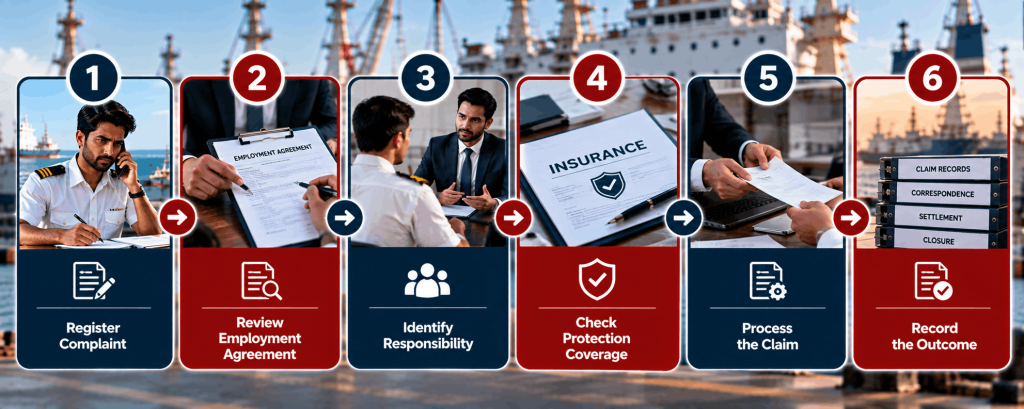
A practical internal process can look like this:
Step 1: Record the complaint
Record the seafarer’s name, vessel, employment agreement, recruitment details and description of the alleged financial loss.
Step 2: Identify the obligation
Check the seafarer’s employment agreement and any applicable collective bargaining agreement.
The purpose is to establish what obligation was allegedly not met.
Step 3: Identify the responsible party
Determine whether the issue concerns the recruitment and placement service, the shipowner or another party involved in fulfilling the employment agreement.
Step 4: Preserve evidence
Keep relevant employment records, wage records, communications, agreements, payment records and other supporting documents.
Step 5: Check the protection mechanism
Confirm which insurance or equivalent financial-security arrangement applies and whether the circumstances fall within its scope.
Step 6: Follow the applicable claim procedure
Use the process established under the applicable national rules and the financial protection mechanism.
Step 7: Record the outcome
Document the decision, payment, rejection, settlement or corrective action.
This process also helps the agency demonstrate that it takes seafarer complaints seriously.
How is monetary loss different from unpaid wages?
Unpaid wages can be an example of financial loss, but agencies should not treat every unpaid amount as automatically covered without checking the applicable protection mechanism.
The relevant question is whether the amount represents a financial loss resulting from a failure to meet an obligation under the seafarer’s employment agreement and whether the applicable national protection system covers that loss.
The current Indian RPSL framework specifically addresses outstanding wages and other entitlements in connection with monetary-loss claims involving the recruitment and placement service or shipowner.
This is why maintaining accurate employment and payment records matters.
Does the protection cover losses caused by the recruitment agency itself?
The MLC specifically refers to monetary loss resulting from the failure of a recruitment and placement service or the relevant shipowner to meet obligations under the seafarer’s employment agreement.
Therefore, the system is not limited to mistakes made by the shipowner.
An agency should examine its own recruitment and placement procedures for situations that could create financial loss for a seafarer.
Examples could include:
- Failure to meet a relevant contractual obligation
- Failure in the recruitment or placement process
- Mishandling an obligation that results in a financial loss
- Failure to carry out an agreed responsibility connected with the engagement
The precise coverage still depends on the applicable national framework and protection mechanism.
What are the most common compliance mistakes agencies should avoid?
1. Treating any insurance as MLC protection
A general insurance policy does not automatically prove compliance.
2. Forgetting the seafarer information requirement
Maintaining financial protection is only part of the requirement. Seafarers must also be informed of their rights under the system before or during engagement.
3. Mixing different financial-security systems
Monetary-loss protection, abandonment protection and death or long-term-disability financial security have different purposes.
4. Keeping expired documents
An agency may have once arranged appropriate protection but fail to renew it.
5. Having no claim procedure
Staff should know what happens when a seafarer reports a financial loss.
6. Relying on outdated Indian rules
RPSL requirements can change. LegalBabu’s current 2026 coverage of RPSL responsibilities and bank guarantees should be read alongside the latest applicable regulatory requirements.
What should seafarers ask a recruitment agency about financial protection?
A seafarer does not need to understand insurance law to ask useful questions.
Before accepting an engagement, ask:
- What financial protection applies to me?
- Who provides that protection?
- What type of monetary loss can I claim?
- How do I make a claim?
- Who should receive my complaint?
- What documents should I keep?
- What financial security applies if the shipowner fails to meet its obligations?
- Where can I find the written information about my rights?
The MLC specifically requires seafarers to be informed of their rights under the monetary-loss protection system before or during engagement.
If an agency cannot clearly explain the applicable protection and complaint route, that is a useful compliance warning sign.
Does this requirement apply when the recruitment agency is in a non-ratifying country?
The MLC FAQ explains that when a shipowner uses a recruitment and placement service located in a country where the MLC does not apply, the shipowner must ensure, as far as practicable, that the service meets the requirements of Standard A1.4. Documentary evidence such as audits or certifications may assist with demonstrating compliance.
This makes financial protection relevant even when the recruitment service is outside an MLC ratifying country.
For international shipowners, checking the recruitment agency’s financial protection should therefore form part of due diligence.
Related reading: See LegalBabu’s guide to the MLC 2006 certification process for the broader recruitment and placement compliance framework.
How does this requirement fit into wider RPSL compliance in India?
Monetary-loss protection is one part of a much wider compliance system.
An RPSL company also needs to manage matters such as:
- Seafarer records
- Employment agreements
- Qualification and document verification
- Recruitment practices
- Complaints
- Repatriation
- Financial security
- Cost allocation
- Welfare obligations
- Reporting requirements
LegalBabu’s current guide on RPSL company responsibilities covers these obligations under the 2026 Indian framework.
The agency should therefore treat financial protection as part of its daily compliance system rather than a standalone insurance purchase.
What recent Indian financial-security changes should RPSL companies know?
The 2026 Indian RPSL rules introduced revised bank guarantee requirements, including provisions relating to monetary loss. LegalBabu’s current RPSL bank guarantee guide explains the current framework and the circumstances in which the guarantee may be invoked.
There is also a separate recent regulatory development concerning P&I insurance verification for RPSL companies deploying Indian seafarers on foreign-flag vessels. LegalBabu has covered this in its guide to DGMA Order 22 and RPSL insurance requirements.
These mechanisms should be reviewed separately because each serves a particular regulatory purpose.
FAQs
1. Does every seafarer recruitment agency need monetary loss protection?
Private seafarer recruitment and placement services are required to establish the protection under the applicable national implementation of Standard A1.4. The MLC requires insurance or an equivalent appropriate measure but leaves the detailed form to the national regulatory system.
2. Does MLC 2006 specify a particular insurance company for monetary loss protection?
No. The MLC does not name a particular insurer or prescribe one universal insurance product. It refers to insurance or an equivalent appropriate measure. The national regulatory system determines how the requirement is implemented.
3. Can an agency use its normal business insurance for MLC monetary loss protection?
Not automatically. The agency must check whether the policy actually satisfies the applicable national requirements for the Standard A1.4 protection system. Ordinary commercial insurance should not be treated as compliant without checking its scope and acceptance.
4. Does monetary loss protection cover a seafarer’s unpaid salary?
It can cover financial loss arising from failure to meet obligations under the seafarer’s employment agreement, subject to the applicable protection system. India’s current RPSL framework specifically addresses outstanding wages and other entitlements in its monetary-loss provisions.
5. What should a seafarer do if an agency refuses to explain its financial protection?
Ask the agency for written information about the protection system, your rights under it and the applicable claim procedure. Keep your employment agreement, payment records and communications. If the issue remains unresolved, use the applicable complaint mechanism.
6. Does a seafarer have to pay for the agency’s monetary loss insurance?
The MLC’s monetary-loss protection is an obligation imposed through the regulatory framework for private recruitment and placement services. It should not be confused with the separate rules governing which recruitment-related costs may be borne by a seafarer.
7. Does the monetary-loss system protect a seafarer if the shipowner becomes unable to meet its obligations?
The MLC specifically requires protection for monetary loss that may result from the failure of the recruitment and placement service or the relevant shipowner to meet obligations under the seafarer’s employment agreement. The exact claim scope depends on the applicable national protection system.
8. Is a bank guarantee the same thing as MLC insurance?
Not necessarily. The MLC allows an “equivalent appropriate measure” rather than prescribing insurance in every case. Whether a particular bank guarantee satisfies the applicable MLC requirement depends on the national regulatory framework. India’s current RPSL rules contain specific bank guarantee provisions, including monetary-loss situations.
9. When must an agency tell a seafarer about monetary-loss protection?
The 2022 amendment requires the seafarer to be informed of their rights under the protection system prior to or in the process of engagement.
10. Does monetary loss protection replace abandonment or death and disability financial security?
No. The ILO expressly distinguishes the two systems. Seafarers hired through recruitment and placement agencies must, in practice, be covered by both the monetary-loss protection system and the financial security system addressing abandonment and death or long-term disability.
You may also like


What Does Project Logistics Alliance Membership Offer?
Project Logistics Alliance membership offers an Indian project cargo business a