
₹1 Crore Insurance Cover for RPSL Companies Under DGMA Order 22
- by kapil
- Updated September 3, 2026
- 18 mins read
DGMA Order 22 of 2026 tells every RPSL company the same thing: check the P&I cover before you sign a seafarer on. If the vessel carries valid P&I insurance from an IGP&I club or a DGMA-approved non-IG insurer, you can proceed. If it doesn’t, you need a ₹1 crore backup policy per seafarer first.
That single rule, issued by the Directorate General of Maritime Administration (DGMA) on 28 August 2026, closes a gap that has cost Indian seafarers dearly for years: getting stuck on a ship with no working insurance behind them.
What Is DGMA Order 22 of 2026?
DGMA Order 22 of 2026 is a directive issued by the Directorate General of Maritime Administration (DGMA) under the Ministry of Ports, Shipping and Waterways. Dated 28 August 2026, it sets stricter P&I insurance verification requirements for RPSL companies deploying Indian seafarers on foreign-flag vessels.
The order operates under Section 301 of the Merchant Shipping Act, 2025 and draws on the Maritime Labour Convention, 2006 (MLC 2006) and the Merchant Shipping (Recruitment and Placement of Seafarers) Rules, 2016. Its core requirement is simple: RPSL companies must verify that the vessel has valid and acceptable P&I insurance before deploying an Indian seafarer.
Order 22 also builds on DGMA Order No. 08 of 2026, dated 14 May 2026, which introduced preventive measures against the abandonment of Indian seafarers on foreign-flag vessels. Order 22 adds more specific requirements for verifying the insurance protection available to those seafarers.
Who Must Comply With DGMA Order 22 of 2026?
Every recruitment and placement service license company falls under this order before it engages, recruits, or deploys an Indian seafarer on a foreign-flag vessel. That includes RPSL companies that already have crew placed on vessels as of the order’s issue date.
If you run or manage a licensed manning agency, this applies to you directly. If you’re a seafarer, it’s worth knowing what your RPSL company is now required to check before you sign a contract. You can look up a company’s current RPSL registration and standing on the directory of registered RPSL companies before you commit to an offer.
Why Did DGMA Tighten Insurance Rules for RPSL Companies?
Seafarer abandonment usually starts the same way. A shipowner runs into money trouble, wages stop, and the crew is left on a vessel with no fuel, no food budget, and no way home. When that happens, a working P&I policy is often the only thing standing between a stranded crew and a genuine crisis, since P&I cover is what typically pays for repatriation, unpaid wages, and medical care in these cases.
DGMA Order No. 08 of 2026 already asked RPSL companies to avoid vessels flagged as high-risk and to keep valid financial security paperwork on file. Regulators found that paperwork alone wasn’t enough. A certificate can be outdated, issued by an insurer that isn’t recognised, or simply never verified properly before a seafarer signs on. DGMA Order 22 of 2026 answers that gap with a specific, checkable standard: recognised P&I cover, or a defined ₹1 crore fallback, confirmed before deployment, not after something goes wrong.
What Insurance Options Must an RPSL Company Check?
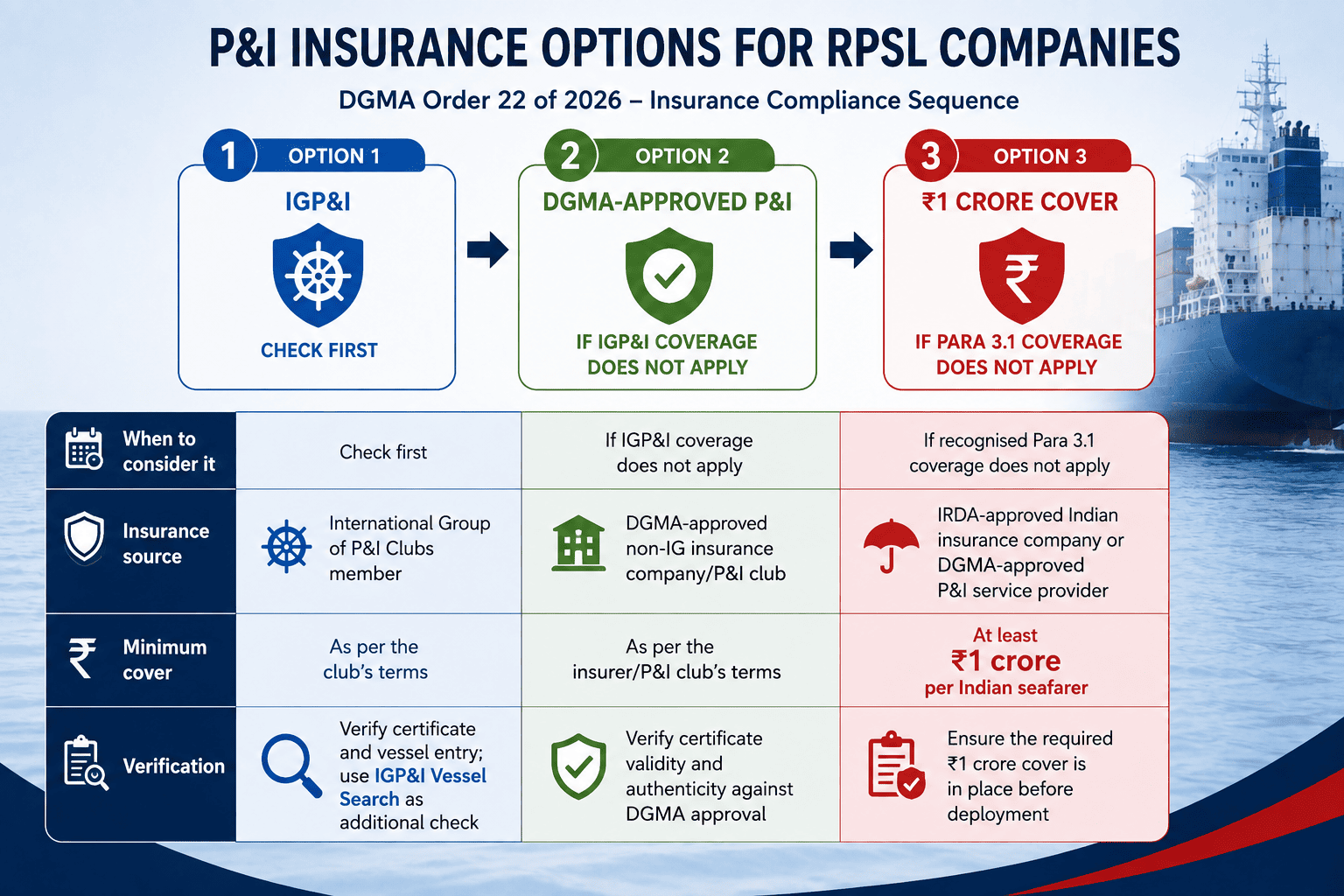
An RPSL company should first check whether the vessel has recognised P&I coverage through an International Group of P&I Clubs (IGP&I) member. If not, it should check whether the vessel is covered by a DGMA-approved non-IG P&I insurer or P&I club. If neither recognised P&I option applies, the company must arrange at least ₹1 crore cover per Indian seafarer through an IRDA-approved Indian insurance company or other permitted.
| Requirement | Option 1: IGP&I | Option 2: DGMA-Approved P&I | Option 3: ₹1 Crore Cover |
|---|---|---|---|
| When to consider it | Check first | If IGP&I coverage does not apply | If recognised coverage does not apply |
| Insurance source | International Group of P&I Clubs member | DGMA-approved non-IG insurance company/P&I club | IRDA-approved Indian insurance company or DGMA-approved P&I service provider |
| Minimum cover | As per the club’s terms | As per the insurer/P&I club’s terms | At least ₹1 crore per Indian seafarer |
| Verification | Verify certificate and vessel entry; use IGP&I Vessel Search as an additional check | Verify certificate validity and authenticity against DGMA approval | Ensure the required ₹1 crore cover is in place before deployment |
Route 2 only kicks in when Route 1 doesn’t apply. A vessel already covered by a recognised P&I club doesn’t also need the ₹1 crore backup policy stacked on top.
What Counts as Valid P&I Coverage?
Two categories qualify:
- IGP&I member clubs. The International Group of P&I Clubs is made up of thirteen principal mutual clubs that together cover close to 90 percent of the world’s ocean-going tonnage for liability risks such as injury, wages, pollution, and collision. DGMA recognises all of them automatically.
- DGMA-approved non-IG insurers. Insurance companies and P&I clubs outside the International Group can still qualify if DGMA has approved and published them. DGMA currently lists over twenty such approved entities on its official insurance page, each with a stated approval validity date.
An RPSL company can’t just take a certificate at face value. Verification duty squarely on the company: check that the certificate is genuine and current, and keep that proof on file. In our experience advising RPSL companies on compliance, this is the step agencies skip most often, usually because the certificate looks official and nobody thinks to cross-check the issuing club against DGMA’s own list.
For vessels covered by an International Group P&I Club, the RPSL company can also use the IGP&I Vessel Search facility to check whether the vessel appears in the group’s ship-search records before deployment.
Which Companies Are Members of the IGP&I?
The International Group of P&I Clubs (IGP&I) consists of 12 separate and independent principal P&I Clubs, with certain Clubs also having affiliated associations. These clubs collectively provide P&I insurance and share expertise and resources on marine liability and insurance matters.
List of IGP&I Member Clubs
- American Steamship Owners Mutual Protection and Indemnity Association, Inc. (American Club)
- Assurance foreningen Gard (Gjensidig) / Gard P&I
- Assuranceforeningen Skuld (Gjensidig) / Skuld
- The Britannia Steam Ship Insurance Association Limited (Britannia P&I)
- The Japan Ship Owners’ Mutual Protection & Indemnity Association
- The London Steam-Ship Owners’ Mutual Insurance Association Limited (London P&I Club)
- North Standard Limited
- The Shipowners’ Mutual Protection & Indemnity Association (Luxembourg) (Shipowners’ Club)
- The Steamship Mutual Underwriting Association (Bermuda) Limited (Steamship Mutual)
- Sveriges Ångfartygs Assurans Förening / The Swedish Club
- The United Kingdom Mutual Steam Ship Assurance Association Limited (UK P&I Club)
- The West of England Ship Owners Mutual Insurance Association (Luxembourg)
Why the IGP&I Clubs matter
Membership of an International Group Club gives shipowners and charterers access to P&I insurance backed by the Group’s collective pooling and reinsurance arrangements. The Clubs provide cover for liabilities such as crew and passenger injury, cargo damage, pollution, wreck removal, collision and property damage.
DGMA-Approved Non-IG Insurance Companies and P&I Clubs
Not all P&I insurers and clubs outside the International Group of P&I Clubs automatically qualify under DGMA Order 22 of 2026. For the non-IG route, RPSL companies should use the list published by the Directorate General of Maritime Administration (DGMA) to verify whether the insurer or P&I club has been approved.
The DGMA list provides the name of each approved non-IG insurance company or P&I club, its approval validity date, and a sample insurance certificate. RPSL companies should check this list before accepting a non-IG P&I certificate and should confirm that the approval remains valid on the date of deployment.
Current DGMA-Approved Non-IG Insurance Companies and P&I Clubs
| Sr. | Name of Non-IG Insurance Company / P&I Club | Approval Valid Until | Sample Certificate |
|---|---|---|---|
| 1 | Alandia Forsakring ABP, Finland | 20.02.2027 | Download |
| 2 | Alfastrakhovanie PCL, Russia | 20.02.2030 | Download |
| 3 | ASTK Insurance LLC, Russia | 20.02.2027 | Download |
| 4 | Balance Insurance JSC, Russia | 19.02.2027 | Download |
| 5 | Gazprom Insurance Ltd., Russia | 19.02.2027 | Download |
| 6 | Great American Insurance Company, Singapore Branch | 20.02.2028 | Download |
| 7 | Hydor AS, Oslo, Norway | 20.02.2027 | Download |
| 8 | Ingrosstrakh Insurance Company, Russia | 20.02.2029 | Download |
| 9 | Institute of Qeshm International Trust Alliance Mutual Club, Iran | 20.02.2029 | Download |
| 10 | Islamic Protection & Indemnity Club Dubai | 19.02.2027 | Download |
| 11 | Korea Ship Owner Mutual Protection and Indemnity Association, South Korea | 20.02.2028 | Download |
| 12 | Mitsui Sumitomo Insurance Co., Ltd., Japan | 20.02.2028 | Download |
| 13 | MSIG Europe SE, with underwriting agency MSIG Specialty Marine NV, Belgium | 20.02.2029 | Download |
| 14 | QBE Insurance (Europe) Limited, represented by British Marine, UK | 20.02.2028 | Download |
| 15 | Rosgosstrakh Insurance, Russia | 19.02.2027 | Download |
| 16 | SBERBANK Insurance, LLC, Russia | 20.02.2027 | Download |
| 17 | Sogaz Insurance Co., Russia | 20.02.2030 | Download |
| 18 | Soglasie Insurance Company Limited, Russia | 20.02.2027 | Download |
| 19 | Sun Re Ltd., Nevis | 20.02.2031 | Download |
| 20 | The New India Assurance Co., Ltd., Mumbai | 20.02.2029 | Download |
| 21 | UGORIA Group of Insurance Companies, Russia | 20.02.2027 | Download |
| 22 | VSK Insurance, Russia | 20.02.2030 | Download |
Important: Approval validity dates can change. Before deployment, RPSL companies should check the latest DGMA insurance list rather than relying on an older copy of this table or certificate.
When Does the ₹1 Crore Backup Insurance Apply?
It only applies when a vessel isn’t covered under Route 1, meaning it has no valid IGP&I or DGMA-approved non-IG policy behind it.
In that situation, the RPSL company must arrange insurance of not less than ₹1,00,00,000 per Indian seafarer, sourced from an IRDA-approved Indian insurance company or a DGMA-approved P&I service provider. This is a per-seafarer figure, not a per-vessel one, so a vessel with five Indian crew members needs five times that cover arranged for them collectively.
What Happens If a Vessel’s P&I Cover Is Invalid or Not Recognised?
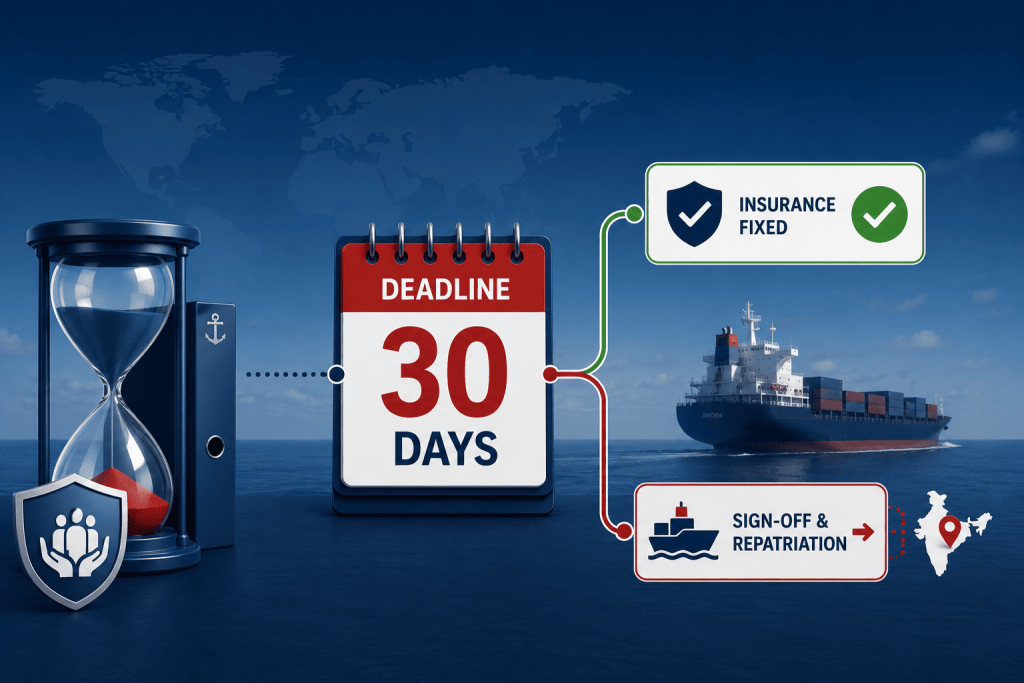
The messier real-world scenario: seafarers already onboard a vessel whose insurance turns out to be missing, expired, unverifiable, or from an insurer DGMA hasn’t approved. The RPSL company then has one month to do one of two things:
- Fix the cover. Arrange the ₹1 crore per-seafarer backup insurance, so the vessel becomes compliant.
- Bring the seafarers home. Arrange sign-off at the earliest port of call, followed by safe repatriation to India.
Until either step is complete and verified, the RPSL company cannot engage, recruit, or deploy any further Indian seafarer on that vessel. There’s no partial compliance option here. It’s fix the insurance or bring the crew home, and the clock starts the moment the gap is found.
What Must RPSL Companies Report to DGMA?
An RPSL company that finds non-compliant insurance on a vessel has to tell DGMA about it within one month. That report needs to cover what went wrong, what corrective action was taken to fix the insurance gap, and, if it applies, the status of the affected seafarers’ sign-off and repatriation.
This reporting duty sits alongside the general notification obligations RPSL companies already carry under their annual compliance requirements, such as informing DGMA about crew complaints or missing crew members within 24 hours. If you want the full list of what your agency needs to track and report, our guide to RPSL annual compliance service walks through it end to end.
What Records Must RPSL Companies Keep, and How Fast Must They Produce Them?
Every RPSL company has to hold on to its P&I and insurance certificates, along with proof of any additional ₹1 crore cover arranged. When DGMA asks for these records, the company has seven working days to hand them over.
Seven working days isn’t a lot of runway if your records live in scattered emails or a filing cabinet at a branch office. Building a simple, dated log of every vessel’s insurance verification, updated at the point of deployment rather than reconstructed later, is the difference between a smooth DGMA request and a scramble.
What Is the Compliance Deadline for RPSL Companies?
| Situation | Deadline | Action Required |
| New deployment from 28 August 2026 onward | Before deployment | Confirm valid P&I cover or arrange ₹1 crore cover |
| Seafarers already deployed as of 28 August 2026 | Within 30 working days | Bring the vessel or seafarer’s insurance status into line |
| Non-recognised, invalid, or unverifiable P&I cover is discovered | Within 1 month | Obtain, or sign off and repatriate, the seafarer |
| Non-compliance is identified | Within 1 month | Report to DGMA with details of the corrective action taken |
| DGMA requests insurance records | Within 7 working days | Produce the certificates and verification evidence |
The order came into force with immediate effect, and the 30-working-day window for existing deployments is a grace period for cleanup, not a delay of the rule itself.
What Happens If an RPSL Company Ignores DGMA Order 22 of 2026?
The order says non-compliance will be “viewed seriously” and can trigger action under the Merchant Shipping Act, 2025, the Merchant Shipping (Recruitment and Placement of Seafarers) Rules, 2016, and other applicable DGMA orders. In practice, insurance-related lapses tend to surface as part of broader compliance reviews, and they can factor into the same enforcement track that leads to licence suspension or cancellation for other violations. We’ve covered the seven most common reasons an RPSL licence gets cancelled if you want to see how DGMA typically builds an enforcement case.
How Does DGMA Order 22 of 2026 Fit With DGMA Order No. 08 of 2026?
DGMA Order No. 08 of 2026 set the broader framework: it asked RPSL companies to steer clear of vessels flagged as restricted or blacklisted, to report past deployments on such vessels, and to keep valid financial security documents on hand. DGMA Order 22 of 2026 zooms in on one piece of that framework, financial security through P&I insurance, and turns a general obligation into a specific, checkable standard with named routes, a rupee figure, and firm deadlines.
Read together, the two orders form a single compliance chain: know which vessels to avoid, confirm the vessels you do use are properly insured, and act fast if either check fails.
Practical Compliance Checklist for RPSL Companies
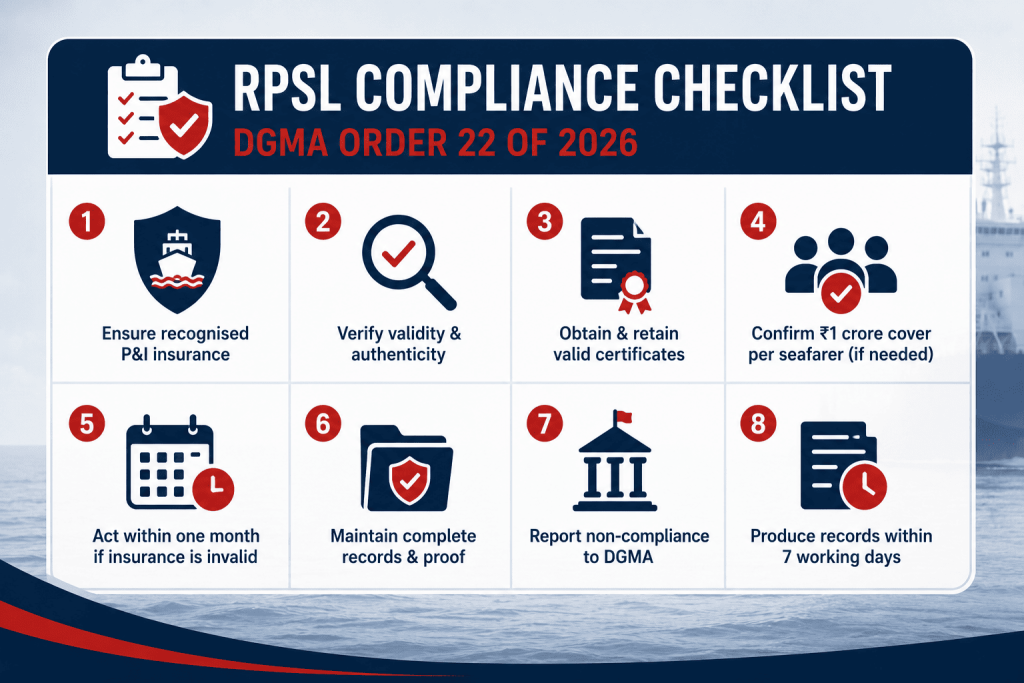
- Confirm every vessel booked for an Indian seafarer’s deployment carries valid P&I cover from an IGP&I club or a DGMA-approved non-IG insurer from above list.
- Cross-check the insurer or club against DGMA’s published approval list before sign-on, not after.
- Keep dated proof of that verification on file: certificate copy, verification note, you may upload verification screenshot along with P&I vessl documents at ship section on RPS profile
- If a vessel isn’t covered under Route 1, arrange the ₹1 crore per-seafarer backup insurance before deployment, not after.
- Audit every seafarer already onboard as of 28 August 2026 and close any insurance gaps within 30 working days.
- If invalid or unrecognised cover turns up mid-contract, act within one month: fix the cover, or arrange sign-off and repatriation.
- Notify DGMA within one month of any non-compliance found, along with the corrective steps taken.
- Keep insurance records organised and ready to produce within seven working days of a DGMA request.
Agencies that already run a structured annual compliance process will find this checklist easy to fold into their existing documentation review rather than treating it as a separate exercise.
FAQs
Does DGMA Order 22 of 2026 apply to Indian flag vessels or only foreign flag ones?
The order’s subject line and its reference order both specifically address Indian seafarers on foreign flag vessels. Indian flag vessels follow a separate compliance track through their Document of Compliance registration, so this particular insurance mandate is written for the foreign-flag deployment scenario.
Is the ₹1 crore insurance a per-vessel amount or a per-seafarer amount?
It’s per seafarer. The order states the cover must be “not less than ₹1,00,00,000/- per Indian seafarer,” so a vessel carrying multiple Indian crew members needs that amount arranged for each one, not a single ₹1 crore policy shared across the whole crew.
How can a seafarer check if an RPSL company has actually verified the vessel’s P&I cover?
The order doesn’t set up a public real-time checker for individual vessels. The practical step is to ask the RPSL company directly for a copy of the vessel’s P&I certificate before signing a contract, and to confirm the company itself is currently active by searching the RPSL company directory.
I’m already on a foreign flag vessel and I’m not sure the P&I cover is valid. What should I do?
Raise it with your RPSL company first, since you have one month to either fix the cover or arrange your sign-off and repatriation. If you don’t get a clear answer, DGMA’s e-Navik grievance mechanism is built for exactly this kind of crew welfare issue and takes complaints around the clock.
What’s the difference between P&I insurance and the ₹1 crore Order 22 insurance?
P&I insurance from an IGP&I club or approved non-IG insurer is the standard, broader liability cover a vessel carries for risks like injury, pollution, and collision. The ₹1 crore cover is a narrower, DGMA-mandated fallback that applies only when that standard P&I cover isn’t in place, acting as a minimum financial safety net for the seafarer rather than a replacement for full P&I.
Does this order apply to cruise ship crew placed through an RPSL company?
The order doesn’t carve out an exception for any vessel type, so a foreign flag cruise ship engaging Indian crew through an RPSL company would fall under the same insurance verification duty as a cargo or tanker vessel. If you’re recruiting hospitality or catering crew for cruise liners, the same RPSL licence rules and now this insurance check both apply.
How do I verify if an insurer is actually an IGP&I member or a DGMA-approved non-IG entity?
The International Group publishes its current list of member clubs on its own website, and DGMA maintains its approved non-IG insurer list on its official insurance page under the Nautical Wing. Checking both before accepting a certificate takes a few minutes and is far cheaper than discovering the cover was never valid.
Will the ₹1 crore insurance pay seafarers directly if something goes wrong?
The order requires the RPSL company to ensure this cover is obtained, and its stated purpose is safeguarding seafarer safety, dignity, and welfare, but it doesn’t spell out a specific claims process in the text of the order itself. Agencies and seafarers should watch for any follow-up DGMA circular that details how claims under this cover are actually made.
Does DGMA Order 22 of 2026 replace the SWFS death and disability compensation scheme?
No. The Seafarers’ Welfare Fund Society (SWFS) scheme and this P&I insurance mandate are separate obligations. SWFS contributions fund welfare payouts for death, disability, and related benefits, while Order 22’s insurance requirement is about the vessel and seafarer having recognised financial security in place before deployment. RPSL companies need to stay on top of both.
What proof should an RPSL company keep to show it checked a vessel’s insurance before deployment?
A dated copy of the P&I or insurance certificate, a note confirming the insurer or club was checked against the IGP&I or DGMA-approved list, and, proof the ₹1 crore cover was actually placed. Keeping this organised by vessel and updated at the point of deployment makes the seven-working-day DGMA production window far easier to meet.
Is DGMA Order No. 22 of 2026 applicable to riding squads placed through a non-RPSL licence?
No. DGMA Order No. 22 of 2026, which requires RPSL agencies to maintain valid P&I coverage or ₹1 crore in backup insurance/security, is applicable to activities covered under the RPSL framework. Riding squads placed through a non-RPSL licence are not covered by this specific requirement, provided the activity genuinely falls outside the scope of RPSL recruitment and placement requirements.
However, the applicable DGMA rules, approvals, contractual requirements, and insurance obligations should still be complied with for the riding squad deployment
Does DGMA Order No. 22 of 2026 apply to crew deployed on coastal or offshore vessels?
Yes. DGMA Order No. 22 of 2026 does not provide an exclusion based on the size or type of vessel. Therefore, if the crew deployment falls within the scope of the Order, the requirements must be complied with irrespective of whether the vessel is a large ocean-going vessel, small tugboat, barge, coastal vessel, or offshore vessel.
RPSL agencies should therefore verify the applicable P&I insurance/security requirements before deploying Indian seafarers on such vessels.
Does DGMA Order No. 22 of 2026 apply to crew deployed on sanctioned vessels, including vessels operating in Russia or Iran?
Yes. Under DGMA Order No. 22 of 2026, the prescribed insurance requirements must be strictly complied with. If the vessel does not have insurance coverage from a DGMA-approved P&I Club or an IGP&I member, the crew should not continue to serve and appropriate arrangements for their sign-off must be made. It is also noteworthy that, due to sanctions and related underwriting restrictions, Indian insurance companies generally do not provide coverage for Indian seafarers serving on sanctioned vessels.
Some of our vessels have P&I insurance from an IGP&I Club, while others are covered by a DGMA-approved non-IGP&I insurer. However, the death and disability compensation specified in the Seafarer Employment Agreement (SEA) is less than ₹1 crore. Do we need to amend the SEA to provide ₹1 crore compensation?
No. DGMA Order No. 22 of 2026 does not specifically require the death and disability compensation amount stated in the SEA to be increased to ₹1 crore.
The ₹1 crore insurance requirement is an alternative/backup requirement applicable where the prescribed first two criteria relating to P&I/insurance coverage are not met. Therefore, merely because the compensation amount mentioned in the SEA is less than ₹1 crore, an amendment to the SEA is not automatically required under DGMA Order No. 22, provided the applicable insurance/P&I requirements are otherwise being duly met.
You may also like


What Does Project Logistics Alliance Membership Offer?
Project Logistics Alliance membership offers an Indian project cargo business a