
Online Money Restoration Module: How to Recover Funds
- by kapil
- Updated September 28, 2026
- 15 mins read
The Online Money Restoration Module is a Ministry of Home Affairs portal that lets cyber fraud victims request the return of money traced and frozen in a scammer’s bank account. You need your 14-digit NCRP complaint number, a PAN card and bank details. Whether you also need an FIR depends on how much money is frozen.
Cyber fraud has become one of India’s fastest-growing crime categories. The Indian Cyber Crime Coordination Centre reports that Indians have lost close to ₹53,000 crore to online fraud and cheating cases over the past six years, with 2025 alone accounting for nearly ₹19,800 crore across roughly 21.8 lakh complaints. A good share of that money does get traced and frozen inside the banking system before scammers can move it further. Until mid-2026, getting that frozen money back to its rightful owner still meant visiting police stations and bank branches, sometimes more than once. The Online Money Restoration Module changes that by putting the entire refund request online.
This guide covers who qualifies, what documents you’ll need, how the application actually works, and what your options look like if things get stuck along the way.
What Is the Online Money Restoration Module?
The Online Money Restoration Module, usually shortened to MRM, sits inside the National Cyber Crime Reporting Portal (NCRP). The Indian Cyber Crime Coordination Centre (I4C), which operates under the Ministry of Home Affairs, built and runs it.
Its job is narrow but useful. Once a bank freezes money connected to a fraud complaint, someone still has to formally ask for that money back, get the request verified by police, and get the bank to release it to the right account. MRM is the digital front door for that process. You raise your request, upload your documents and track the status without visiting a police station or bank branch for every single step.
One thing is worth flagging early. MRM only works on money that has already been traced and frozen. If your money already left the fraudster’s hands before authorities could act, the portal itself cannot pull it back. We’ll walk through what your options look like in that situation later in this guide.
Why Was the Online Money Restoration Module Launched?
Before MRM existed, refund cases mostly ran on paper. A government order issued in January 2026 had already simplified the rules for smaller cases, removing the need for a court order when the frozen amount stayed under ₹50,000. What MRM did when it launched in June 2026 was put a proper online layer on top of that same policy, so victims no longer had to chase multiple offices just to use it.
MRM launched alongside a companion portal, the Grievance Redressal Module (GRM), which serves a different group entirely: people whose own bank accounts got frozen or lien-marked by mistake during a cybercrime investigation, even though they had nothing to do with the fraud. We’ll compare the two portals in detail further down this guide.
Both portals get tracked at the ministry level. Review meetings led by the Union Home Minister have monitored how quickly complaints move through the system, and one such review reported that over a lakh citizens had already benefited from the two modules combined. Separately, data shared in Parliament showed that authorities had frozen or saved upward of ₹11,000 crore across over 32 lakh complaints. That gap between money frozen and money actually credited back to a victim’s account is exactly what MRM was built to close.
How Does Money Reach the Point Where MRM Can Help?
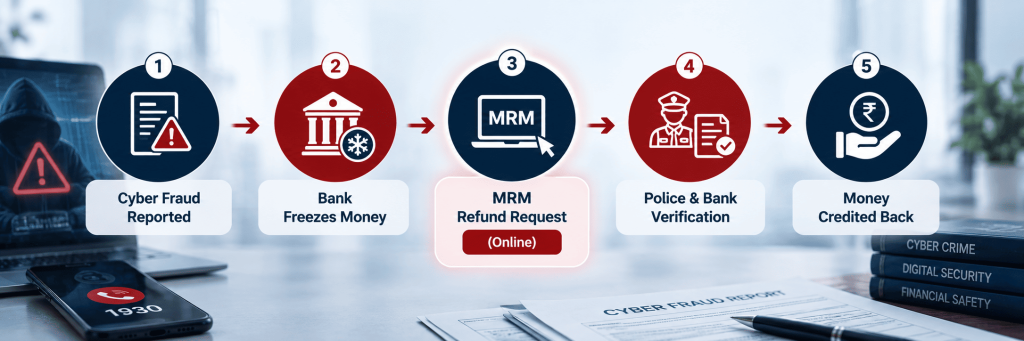
MRM never works in isolation. A specific chain of events has to happen first.
- You lose money to a scam, whether through a fake investment scheme, a task-based job fraud, a fake courier or customs call, or a straightforward UPI scam.
- You report it immediately, either by calling the 1930 cybercrime helpline or filing a complaint on cybercrime.gov.in.
- Investigators trace where your money went and ask the receiving bank to freeze it before the scammer can withdraw it.
- Only once that freeze happens does a restoration request through MRM become possible.
Speed matters enormously at step two. Police officers often talk about a “golden hour,” the short window right after a fraudulent transfer when a fast complaint can still get the money frozen before it disappears through several layered accounts. Waiting a day or two to report a scam, even out of embarrassment or confusion, lowers your chances well before you ever reach the MRM stage.
Who Is Eligible to Use the Online Money Restoration Module?
Two conditions have to be true before you can even open a request on MRM:
- You registered your complaint through the 1930 helpline or the NCRP portal and hold a 14-digit Registered Acknowledgement Number, sometimes called the Complaint ID.
- The defrauded amount has actually been located and frozen in the beneficiary’s or scammer’s bank account. If the money has already been withdrawn, MRM cannot process a refund for that portion.
Beyond these two baseline conditions, what happens next depends on how much money is frozen and how it’s spread across accounts.
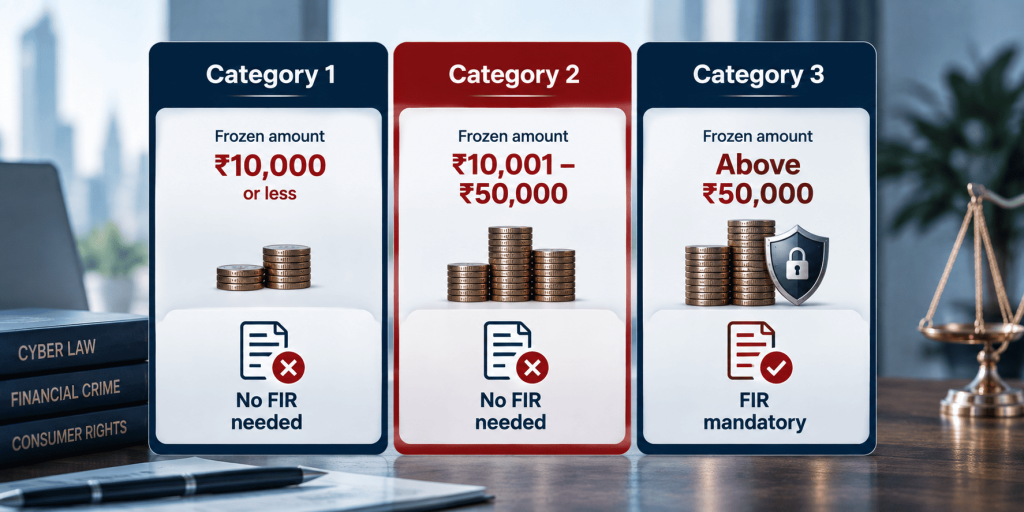
| Category | Frozen Amount | FIR Required? | How the Refund Is Processed |
| Category 1 | Up to ₹50,000 in a single bank account | No | Directly through MRM, based on the police report and an indemnity bond |
| Category 2 | Over ₹50,000 in total, spread across multiple accounts, with no single account holding more than ₹50,000 | No | Processed through MRM based on the police report alone |
| Category 3 | Over ₹50,000 frozen in a single bank account | Yes | Refund proceeds through MRM only after the FIR is registered |
Notice what actually triggers the FIR requirement. It isn’t the total amount you lost overall. It’s how much sits frozen in any one account. A victim with ₹1.2 lakh frozen across four different accounts, none holding over ₹50,000, can still avoid the FIR route entirely. The exact same ₹1.2 lakh sitting in a single account cannot.
What Documents Do You Need Before You Apply?
Keep scanned copies ready before you start. The portal moves quickly once you’re logged in, and switching tabs to hunt for a PAN card scan halfway through is where a lot of applicants lose momentum.
- Your 14-digit NCRP Acknowledgement Number or Complaint ID
- The mobile number registered against that complaint, since it’s used for OTP login
- A scanned copy of your PAN card
- Your bank account number and IFSC code for the account you want the refund credited to
- The police report, or the SMS or email notifying you that an eligible amount has been identified for restoration
- A court order, where one has been issued and applies to your case
- An indemnity bond, where the portal or the police ask for one
How Do You Apply on the Online Money Restoration Module?
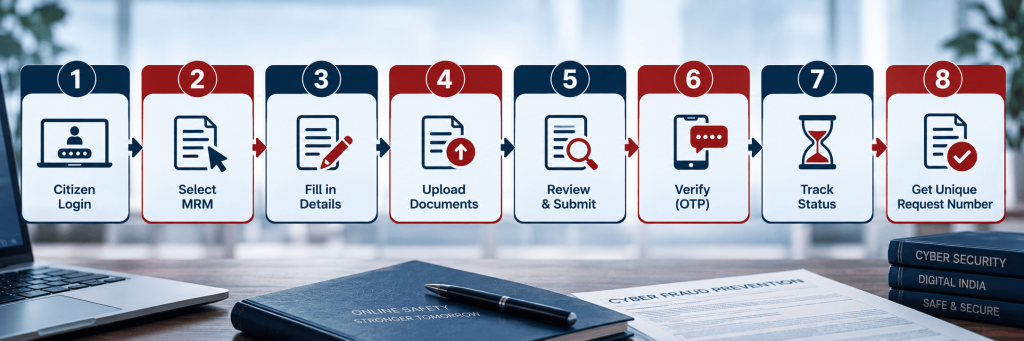
- Go to the MRM portal and select Citizen Login.
- Enter the mobile number registered against your NCRP complaint and verify the OTP sent to it.
- Select “Raise Refund Request” and enter your 14-digit NCRP acknowledgement number.
- Review the details the portal pulls up, including your complaint information, the frozen amount and the “Refund Account Details” section.
- Upload a copy of your PAN card and enter the bank account number and IFSC code where you want the money credited. Double-check these carefully, since a data entry error here is one of the most common reasons refunds get delayed.
- Upload a court order if your case falls under Category 3 and one has been issued.
- Accept the declaration and submit. The portal generates a Unique Request Number, sometimes called a URN or Request ID, which you’ll use to track your case going forward.
- If asked, submit your indemnity bond to the police station handling your original complaint.
After that, the process moves to the police and the bank. Police complete their verification, the bank processes the release, and the amount gets credited to the account you provided. None of these later steps happen inside the portal itself, which is exactly why your URN matters so much. It’s your reference point when you’re following up by phone or in person.
What Is an Indemnity Bond and Why Does the Portal Ask for One?
An indemnity bond is a signed, usually notarised undertaking where you promise to compensate the bank or the government if it later turns out the refunded money shouldn’t have gone to you, say, if a rival claim shows up or the underlying fraud finding gets overturned. Section 124 of the Indian Contract Act governs this kind of promise.
For Category 1 cases, the indemnity bond substitutes for a court order. It’s the mechanism that lets the government skip a lengthy legal process for smaller amounts while still protecting the bank from paying out twice.
Getting the wording right matters more than most applicants expect. A bond that’s missing a required clause, or that names the wrong bank branch, can bounce back and cost you several weeks. If you’d rather not draft this yourself, LegalBabu’s notice and legal drafting support can help you get the wording right the first time, since resubmitting a rejected bond usually means going back to the end of the queue.
How Long Does the Online Money Restoration Module Take to Refund Money?
There’s no single published turnaround time for MRM, which is worth knowing upfront so you don’t set your expectations against a number nobody actually promised. What determines your real timeline:
- Which category your case falls into, since Category 3’s FIR requirement adds genuine time before MRM can act at all
- How quickly your local police station processes the report or FIR
- How responsive the specific bank branch is once it receives the release order
- Whether your submitted documents were correct the first time
Cases without an FIR requirement generally move faster, since the police report and indemnity bond route skips a full criminal registration process. Cases needing an FIR depend heavily on how busy the local cyber cell is at the time.
Can You Track Your Refund Request Online?
Yes. Your Unique Request Number is built specifically for this. Log back into the MRM portal with your registered mobile number and OTP, and you’ll see the current stage of your request, whether it’s pending police verification, awaiting bank action, or completed. Keep your URN saved somewhere safe the moment you receive it. It’s the most reliable way to follow up if your case stalls, and quoting it when you call your local cyber cell or the 1930 helpline gets you a far more specific answer than describing your case from scratch every time.
What Happens If the Scammer Already Withdrew the Money?
This is the one situation MRM genuinely cannot fix. If a scammer withdrew or transferred out the money before banks could freeze it, there’s no frozen balance left for MRM to release, since the entire mechanism depends on money physically sitting in a traceable account.
Your options at that point shift toward investigation and prosecution rather than a portal-based refund: continuing to cooperate with the police investigation, providing any transaction evidence you still hold, and, for larger losses, discussing recovery through a civil suit with a lawyer. None of these move as fast or as simply as an MRM request, which is exactly why reporting a scam within the golden hour matters so much before you ever reach this stage.
For businesses, prevention is usually worth more than any recovery route after the fact. If a fraud happened because a company email account or system got compromised rather than through simple social engineering, a cyber security audit can identify how the breach happened and close that same gap before it costs you again. And if the fraud involved a fake investment platform or an unfamiliar vendor, running proper due diligence before wiring money to any new counterparty is one of the few genuinely reliable ways to avoid a repeat.
Online Money Restoration Module vs Grievance Redressal Module: What Is the Difference?
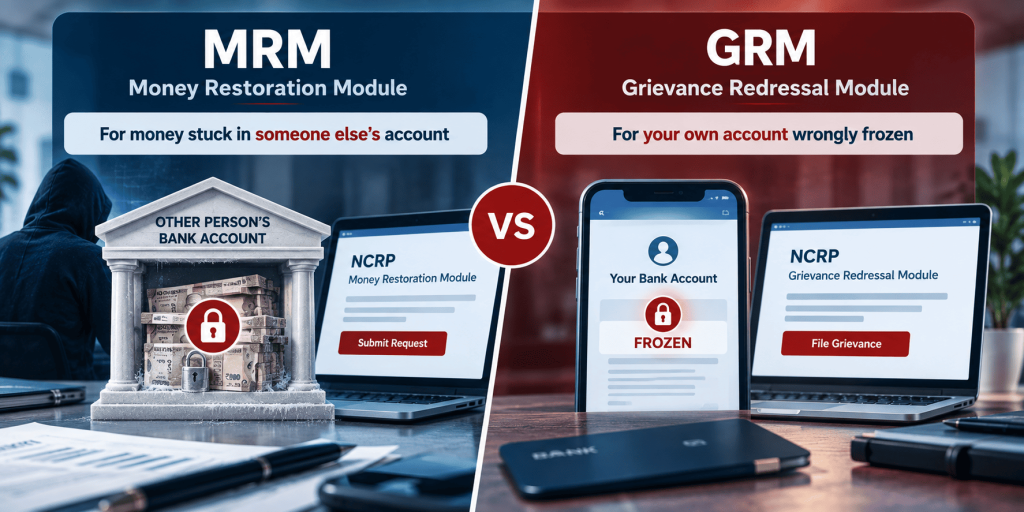
It’s easy to confuse the two, since both sit under the same NCRP umbrella and both deal with frozen bank accounts. The distinction that actually matters is whose account is frozen, and why.
| Point | Money Restoration Module (MRM) | Grievance Redressal Module (GRM) |
| Who it’s for | People who lost money to fraud and want it back | People whose own account got frozen or lien-marked by mistake |
| What it does | Releases traced, frozen fraud money to the victim | Reviews and lifts wrongful freezes on innocent account holders |
| Trigger | Your complaint led to money being frozen in someone else’s account | Your own account got frozen because of someone else’s fraud complaint |
| Outcome you want | A credit to your bank account | Your account restrictions lifted |
If your money is stuck in a scammer’s account, you want MRM. If your own account got frozen because your account number showed up somewhere in someone else’s fraud case, even though you did nothing wrong, GRM is the portal built for you.
What Common Mistakes Delay a Refund Request?
- Reporting the fraud days after it happened, by which point the money has already moved through several accounts
- Entering a bank account number or IFSC code with even a single digit wrong
- Assuming a Category 1 or 2 refund is automatic once submitted, and never following up
- Forgetting to submit the indemnity bond to the police after the portal asks for one
- Not keeping the Unique Request Number saved somewhere accessible
- Registering the original complaint under a different mobile number than the one used to log into MRM
When Should You Get Legal Help With Your Restoration Request?
Most straightforward Category 1 and 2 cases don’t strictly need a lawyer involved. Where legal help genuinely earns its cost:
- Drafting an indemnity bond or affidavit that a bank or police station won’t reject over a technicality
- Following up when a bank or police station stops responding for weeks at a stretch
- Category 3 cases where the FIR itself is being delayed or contested
- Larger amounts where a parallel civil recovery route might make sense alongside your MRM request
If you’re stuck at any of these points, LegalBabu’s team can help draft the paperwork correctly or advise on next steps. Get in touch if you’d like a second set of eyes on your case before you submit it.
FAQs
Can I use the Online Money Restoration Module if I live outside India or am an NRI?
Yes, as long as your original complaint on the NCRP portal or through the 1930 helpline is registered correctly and you hold a valid 14-digit acknowledgement number. The refund account you provide simply needs to be a valid Indian bank account, since the portal releases the money in rupees to that account.
What if I don’t receive the OTP when trying to log in?
This usually means the mobile number registered against your original NCRP complaint doesn’t match the number you’re trying to use. Check which number you gave when you first filed your complaint. If that number is no longer active, you’ll likely need to contact your local cyber cell or the 1930 helpline to have it updated before you can log in.
Is there any fee to apply on the MRM portal?
No. Filing a restoration request on MRM doesn’t cost anything. Be cautious of anyone, online or offline, who asks for a “processing fee” to speed up your MRM request. That request pattern itself is a common secondary scam that specifically targets cyber fraud victims.
I only called the 1930 helpline and never filed anything on the NCRP website. Can I still apply?
Yes. Calling 1930 generates the same kind of complaint record and acknowledgement number as filing directly on the NCRP portal. Either route gets you the 14-digit ID that MRM needs.
My Unique Request Number status hasn’t changed in weeks. What should I do?
Contact the police station or cyber cell handling your original complaint directly, quoting your URN. Status updates depend on manual verification steps that happen outside the portal, so a phone call or an in-person visit often moves things faster than waiting for the online status to update on its own.
Can two joint account holders both apply for a refund from the same frozen amount?
Generally, one restoration request per frozen amount is appropriate, filed by the complainant on record. If you jointly hold the account that will receive the refund, that’s fine, but the underlying MRM request still needs to trace back to the original NCRP complaint and complainant.
Does MRM handle UPI fraud the same way as a regular bank transfer scam?
Yes. Once the money lands in a beneficiary bank account, whether it got there through UPI, IMPS, NEFT or any other transfer method, the same freeze-then-restore process applies. What matters for MRM is where the money currently sits, not which payment rail moved it there.
The fraud happened over a year ago. Can I still apply through MRM?
You can apply if the money is still frozen and traceable, since MRM doesn’t set an outer deadline the way court filings often do. That said, older cases are far less likely to have frozen money still sitting untouched, since long-pending fraud accounts frequently attract other, competing claims and investigations too.
Can my lawyer or a family member submit the MRM request on my behalf?
The portal login uses your registered mobile number and OTP, so someone else can operate the portal on your behalf if you share that access with them, which is common when a family member handles the digital side for an elderly relative. For anything requiring a signature, like the indemnity bond, that still needs to be yours.
My business had a payment dispute with a vendor, not a cyber fraud case. Does MRM apply to me?
No, and this distinction trips people up. MRM only applies to money frozen because of a reported cyber fraud complaint. An unpaid invoice or vendor dispute is a completely different legal problem, and if you’re an MSME chasing a delayed payment rather than recovering fraud money, our guide to MSME payment recovery covers the right process for that instead.
You may also like


What Should Taxpayers Know About Income Tax Rules 2026?
The Income Tax Rules 2026 have changed the working language, form numbers and r