
Trademark Protection in India: How to Protect Your Trademark
- by kapil
- Updated August 25, 2026
- 9 mins read
Trademark protection in India starts with registration, but it does not end there. Real protection means watching the market for copycats, sending cease and desist notices, pursuing civil or criminal action against infringers, recording your mark with Customs, and renewing on time. Registration alone gives you rights; enforcement is what actually protects them.
What Does Trademark Protection Actually Mean?
Trademark protection covers everything that keeps your exclusive rights to a mark real and enforceable, not just the paperwork that first establishes them. It includes registering the mark, using it correctly, watching for anyone copying it, and actually doing something when someone does.
A lot of businesses treat the trademark registration certificate as the finish line. It is closer to the starting gun. A registered mark that nobody defends tends to attract more copycats over time, not fewer, since infringers notice which brands never push back.
Is Registration Enough to Protect Your Trademark?
Registration gives you the strongest form of protection available, but it is not automatically self-enforcing, and it is not the only form of protection that exists under Indian law.
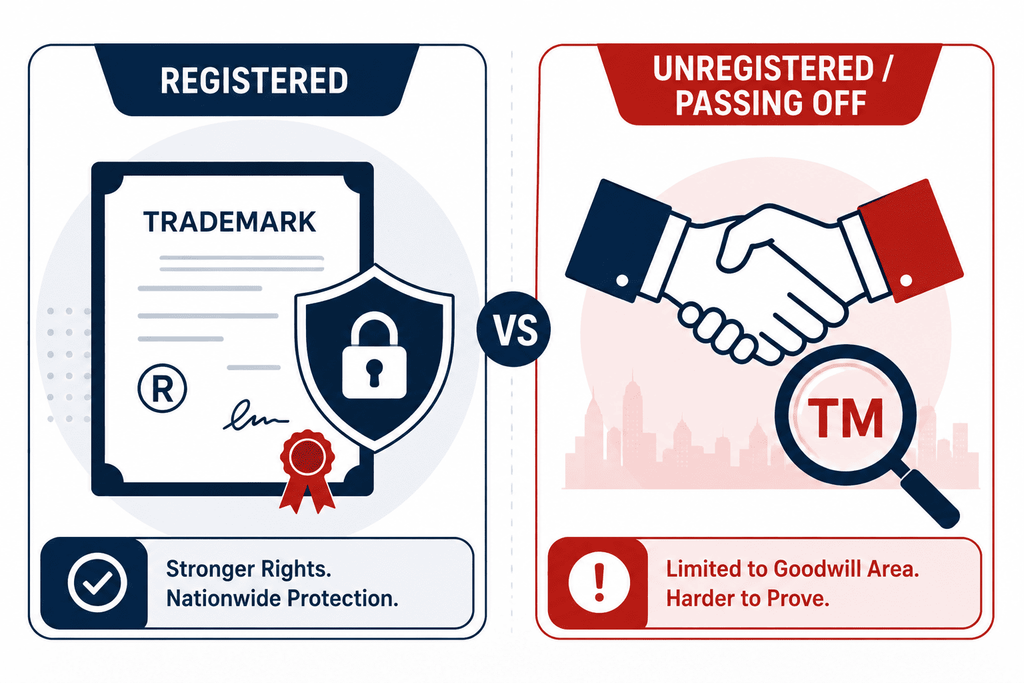
| Point | Registered Trademark | Unregistered Trademark |
| Legal basis | Trade Marks Act, 1999 | Common law (passing off) |
| Geographic reach | Protected across all of India | Limited to where you have actually built a reputation |
| Burden of proof | Registration certificate is strong evidence of ownership | You must prove goodwill, misrepresentation, and damage yourself |
| Action available | Infringement suit under Section 29 | Passing off action only |
| Symbol you can use | ® | TM |
Section 27 of the Trade Marks Act specifically preserves the right to bring a passing off action even without registration, so an unregistered mark is not defenceless. It is simply a harder, slower fight, resting entirely on evidence you have to gather yourself rather than a certificate that does the proving for you.
Can You Protect a Trademark Without Registering It?
Yes, through what Indian law calls a passing off action, though it takes more work than relying on a registration certificate. Courts look for three things, often called the classic trinity: goodwill built up in the mark, a misrepresentation by the other party that is likely to confuse customers, and actual or likely damage to your business because of it.
A local restaurant that has traded under a distinctive name for years, without ever filing for registration, can still stop a copycat that opens up nearby using a near-identical name. What that restaurant cannot do is stop someone using a similar name in a city where it has no reputation at all, since passing off protection only reaches as far as your actual goodwill extends. This is exactly why registration matters even for businesses that already have a strong local reputation; it turns a regional, evidence-heavy claim into a nationwide, certificate-backed one.
How Do You Monitor for Infringement?
You cannot enforce what you never notice. Watching the Trade Marks Journal for similar marks filed by others is the most basic form of monitoring, since anyone can review new advertisements and file an opposition within the four-month window if a conflicting mark shows up.
Beyond the Journal, keep an eye on marketplaces, social media, and search results for your brand name being used by sellers you never authorised. A five-minute search of your own brand name once a month, across a shopping site and a search engine, catches more real infringement than people expect, particularly for brands that sell online. Small counterfeit listings often start quietly on a single marketplace long before they show up anywhere else.
What Can You Do If Someone Copies Your Trademark?
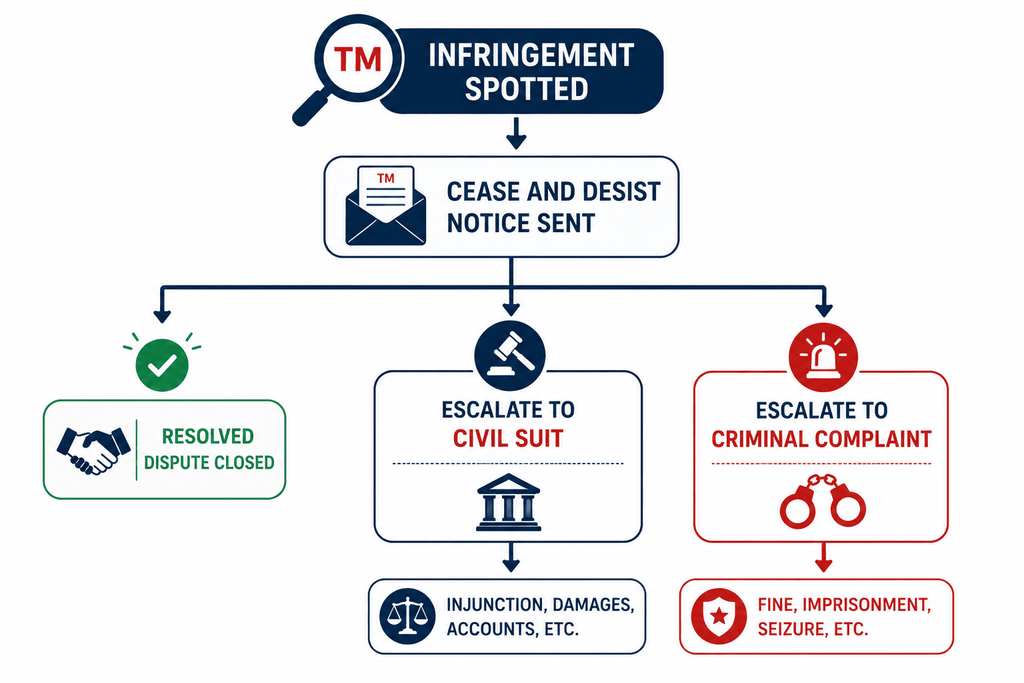
Most infringement disputes get resolved without ever reaching a courtroom, and it helps to start at the lighter end of the scale before escalating.
- Send a cease and desist notice. A clearly worded notice, referencing your registration and the specific infringing use, resolves a surprising number of cases on its own, especially with smaller sellers who did not realise they were infringing.
- Pursue a civil suit if the notice is ignored. You can seek an injunction to stop the use immediately, along with damages or an account of the infringer’s profits.
- Ask for destruction of counterfeit stock. Courts can order infringing goods to be destroyed or handed over, not just that the infringing use stop going forward.
- Consider an anticipatory order for unknown infringers. Indian courts, particularly the Delhi High Court, regularly grant what are informally called John Doe orders, allowing action against unidentified infringers who are expected to appear around a specific event, launch, or season.
| Point | Civil Action | Criminal Action |
| Who initiates it | The trademark owner, through a civil suit | A police complaint, since these are cognizable offences |
| Governing provision | Section 29 (infringement) or a passing off claim | Sections 103 to 105 |
| Remedies available | Injunction, damages, account of profits, destruction of goods | Imprisonment and a fine |
| Best suited for | Stopping ongoing use and recovering losses | Counterfeiting, deliberate fraud, repeat offenders |
Can Trademark Infringement Lead to Criminal Charges?
Yes, and this surprises people who assume trademark disputes only ever play out as civil lawsuits. Sections 103 and 104 of the Trade Marks Act make falsifying a trademark, or knowingly selling goods carrying a false trademark, a criminal offence, punishable with imprisonment of six months to three years and a fine between ₹50,000 and ₹2,00,000.
Repeat offenders face steeper consequences under Section 105, with a minimum sentence of one year rather than six months. These offences are cognizable, meaning police can act on a complaint directly rather than waiting for a court to first establish the case, which makes criminal action a genuinely useful route against deliberate counterfeiters rather than a purely theoretical one. Worth knowing too: Sections 108 and 109, which used to cover some related paperwork offences, were actually removed from the Act by the Jan Vishwas Act, 2023, since they had stopped serving much practical purpose.
Can You Stop Counterfeit Goods at the Border?
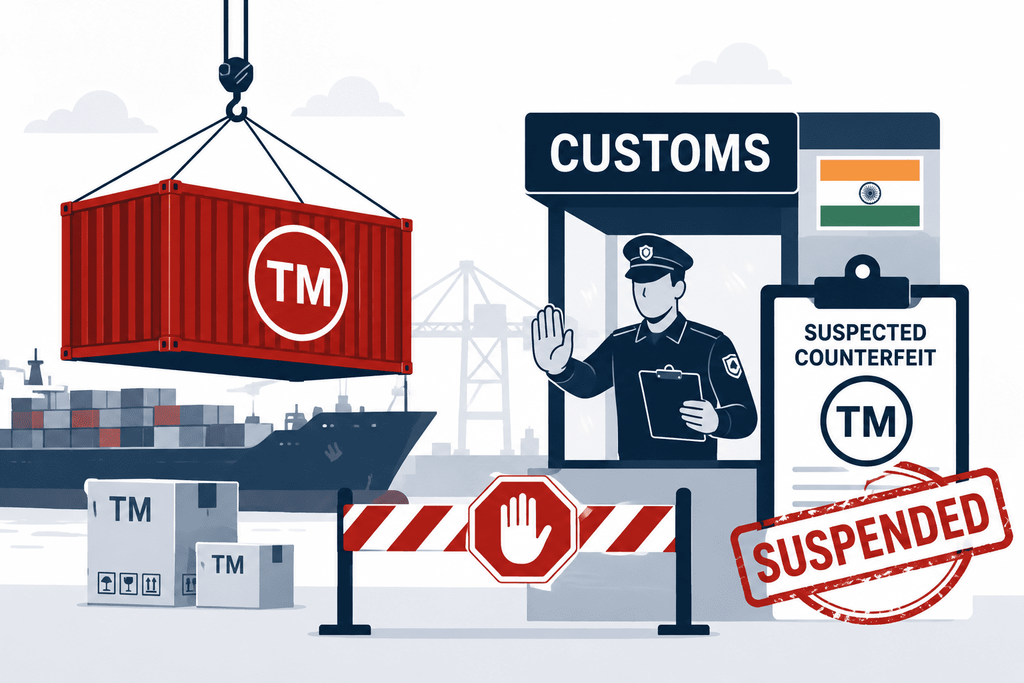
Yes, and this is one of the more underused tools available to trademark owners. Under the Intellectual Property Rights (Imported Goods) Enforcement Rules, 2007, you can record your registered trademark with Indian Customs through the IPR Recordation Portal, giving customs officers the authority to suspend clearance of suspected counterfeit imports before they ever reach the market.
Once your application is approved, you get a registration valid for five years, renewable afterward. If customs flags a shipment matching your recorded mark, both you and the importer get notified, and you then need to confirm the infringement within a set window for the goods to be seized and destroyed. For brands dealing with counterfeit imports rather than domestically produced fakes, this route often works faster than chasing individual sellers after the goods have already reached shelves.
How Do You Protect a Trademark Outside India?
Through the Madrid Protocol, which India joined in July 2013. Instead of filing a fresh application in every country where you want protection, you file one international application, on Form MM2, through the Indian Trade Marks Registry, designating whichever of the 130-plus member countries you actually need.
The Indian Registry checks that your international application matches your existing Indian mark and forwards it to WIPO in Geneva. Each country you designate then examines the mark under its own local law, exactly as if you had filed there directly, and can raise its own objections independently of what happened in India. This route only works if you already have an Indian application or registration to base it on, so it is a next step after Indian protection rather than a substitute for it.

What Common Mistakes Weaken Trademark Protection Over Time?
- Missing the renewal deadline. A trademark renewal filed late, or not at all, quietly ends protection that took years to build, regardless of how strong the brand had become.
- Using the mark inconsistently. Switching logos, spellings, or colour schemes frequently weakens your ability to prove the mark has a single, recognisable identity.
- Letting the mark become generic. A brand name that becomes the everyday word for the product, rather than staying tied to one company, risks losing distinctiveness altogether over time.
- Not updating ownership records. After a trademark transfer or a company restructuring, an outdated register entry can complicate enforcement right when you need it most.
- Ignoring small infringers. Letting minor, obvious copies slide because they seem too small to matter often invites larger ones later, since a mark that is never defended starts to look undefendable.
Frequently Asked Questions
What is trademark protection?
It is the full set of legal rights and practical steps that keep a trademark exclusive to its owner, covering registration, monitoring, and enforcement together rather than registration alone.
Does registering a trademark automatically protect it?
Registration establishes your legal rights, but you still need to monitor for infringement and act on it. A registered mark that nobody defends can still be copied and diluted over time.
Can I protect a trademark without registering it in India?
Yes, through a passing off action under common law, though you carry the full burden of proving goodwill, misrepresentation, and damage yourself, and protection only extends as far as your actual reputation reaches.
What can I do if someone is using a trademark similar to mine?
Start with a cease and desist notice. If that does not resolve it, you can pursue a civil suit for an injunction and damages, or a criminal complaint in cases involving deliberate counterfeiting.
Is trademark infringement a criminal offence in India?
Yes, for cases involving falsifying a trademark or knowingly selling counterfeit goods. Sections 103 to 105 of the Trade Marks Act provide for imprisonment and fines, on top of any civil remedies.
Can customs stop counterfeit goods from entering India?
Yes. Recording your trademark with Indian Customs under the IPR Rules, 2007 lets customs officers suspend clearance of suspected counterfeit shipments at the border.
How do I protect my trademark in other countries?
Through the Madrid Protocol, which lets you file one international application through the Indian Trade Marks Registry to seek protection in over 130 member countries, based on your existing Indian application or registration.
Does my trademark stay protected forever once I register it?
Only if you renew it. Registration lasts 10 years at a time and needs to be renewed before expiry to keep your protection active indefinitely.
What’s the difference between civil and criminal action against an infringer?
Civil action, brought by you, focuses on stopping the use and recovering damages. Criminal action treats deliberate counterfeiting as an offence against the state, with police involvement and the possibility of imprisonment.
Do I need to actively monitor my trademark, or does the Registry do that for me?
You need to monitor it yourself. The Registry checks new applications against existing marks during examination, but it does not track marketplace listings, social media, or day-to-day misuse on your behalf.
You may also like


What Does Project Logistics Alliance Membership Offer?
Project Logistics Alliance membership offers an Indian project cargo business a