
Trademark Transfer in India: How Assignment and Transmission Work
Trademark transfer in India happens through assignment, a written agreement transferring ownership, with or without goodwill. You file Form TM-P with the Trade Marks Registry within six months of signing, along with the assignment deed and supporting documents. Miss that window, and the transfer can lose its legal effect.
What Is a Trademark Transfer?
A trademark transfer moves ownership of a registered or unregistered mark from one person or business to another. The law calls this an assignment, and Section 37 of the Trade Marks Act, 1999 gives the registered proprietor the power to carry it out and collect payment for it.
The mark itself does not change. What changes is who holds the rights to stop others from using it, license it, or take legal action if someone copies it. Once a transfer is recorded, the new owner steps fully into those shoes.
This whole process belongs under LegalBabu's Intellectual Property services, alongside trademark registration itself. A transfer only makes sense once a mark already exists on the register or is at least genuinely in use, so it sits at a later stage of ownership rather than at the filing stage.
What's the Difference Between Assignment and Transmission?
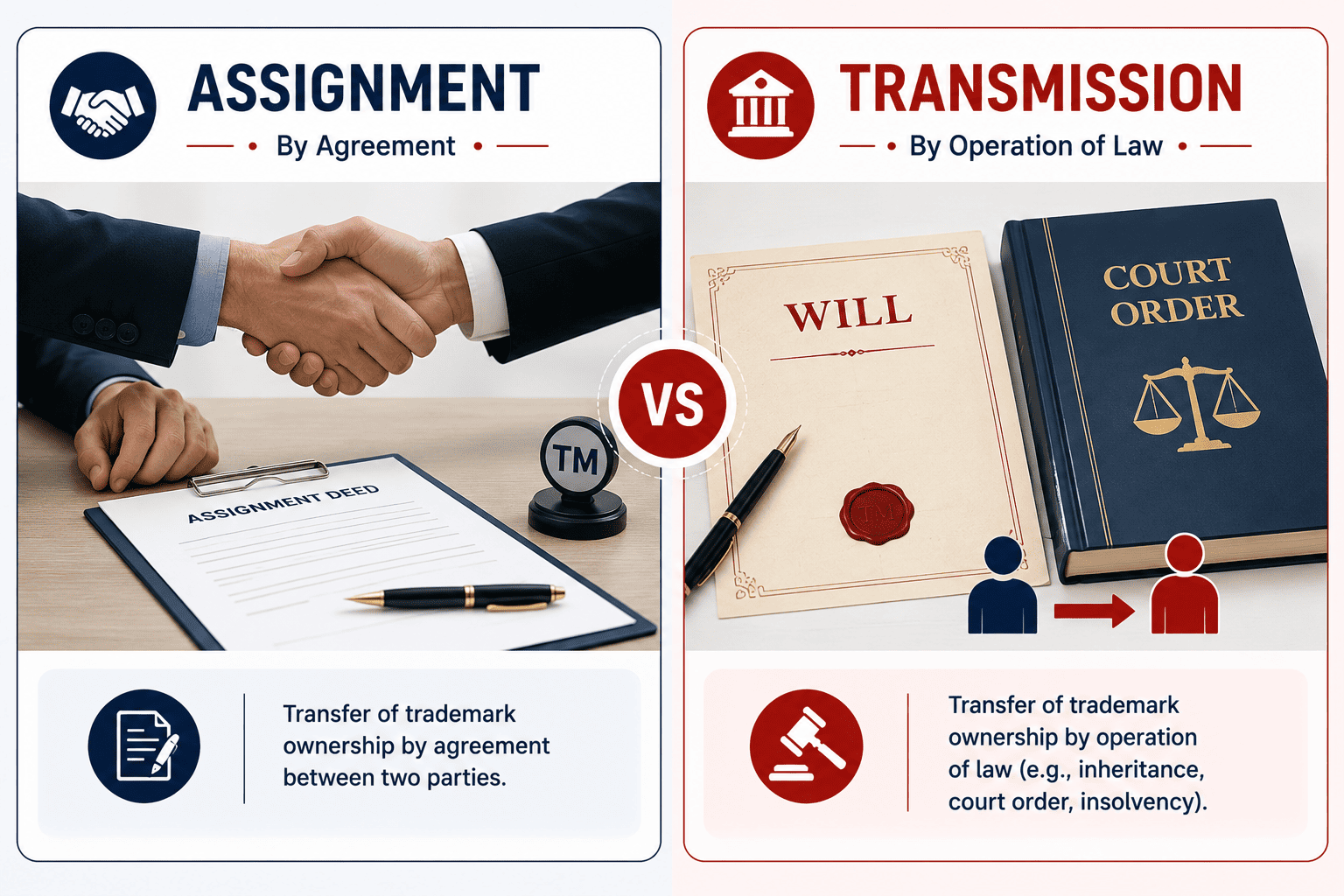
This is a distinction a lot of guides blur together, and it genuinely matters. Assignment is a transfer by agreement between two parties who both choose to be part of it. Transmission is a transfer by operation of law, where no agreement or negotiation happens at all.
Inheriting a trademark after the owner's death is transmission, not assignment, since nobody signed a deal for it; the law simply moves the rights to the heir. The same goes for a trademark passing to someone through insolvency proceedings or a court order. Sections 38 and 39 of the Trade Marks Act cover both situations under the same rules, which is likely why the distinction gets flattened so often in casual writing, but the documentation you actually need differs. A transmission relies on a succession certificate, a will, or a court order rather than a signed assignment deed.
Why Would You Transfer a Trademark?
Ownership changes hands for a range of reasons, and most fall into a handful of recurring situations.
-
Selling the whole business. The trademark usually moves along with everything else when a business changes hands entirely.
-
Selling just the mark. A business can sell a trademark on its own, letting someone else use it for specific goods or services while the seller keeps running everything else.
-
Restructuring or demerger. Splitting a company into separate entities often means splitting up which entity owns which mark.
-
A change of legal form. Moving from a sole proprietorship to a private limited company usually means updating who the registered proprietor actually is.
-
Succession after death. This is transmission rather than assignment, and it needs a different paper trail, as covered above.
-
A court order. Trademark disputes sometimes get resolved with a court directing that ownership move to a particular party.
What's the Difference Between Assignment With Goodwill and Without Goodwill?
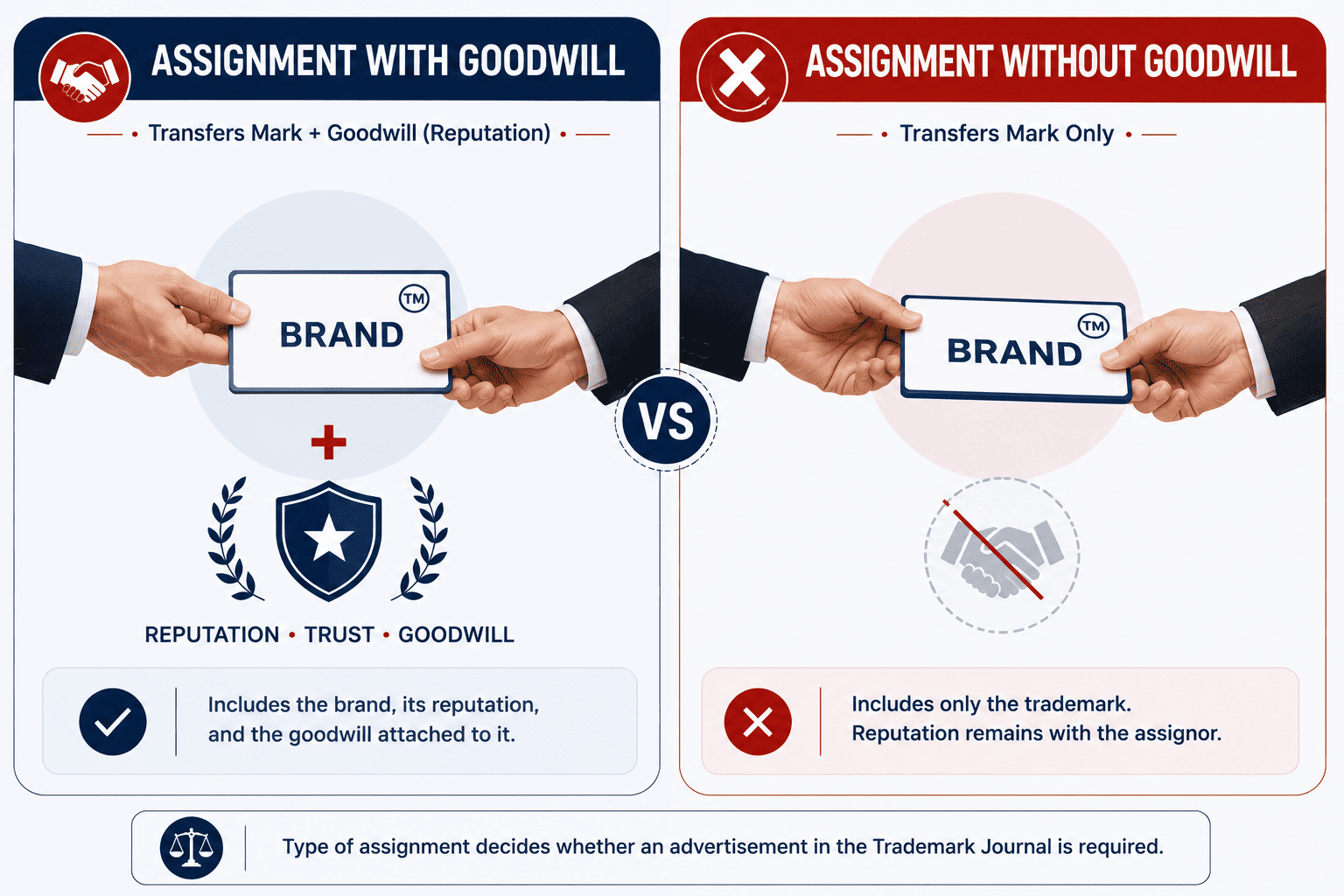
Every assignment falls into one of these two categories, and which one applies changes what you need to do next.
|
Point |
With Goodwill |
Without Goodwill |
|
What transfers |
The mark, plus the reputation and consumer trust built around it |
Only the mark itself; the reputation stays with the assignor |
|
Extra step required |
None beyond the standard Form TM-P filing |
Registrar-directed advertisement of the assignment (Section 42) |
|
Governing provision |
Sections 38 and 39 |
Section 42 |
|
Typical scenario |
Selling an entire brand or business |
Licensing out a name for use in an unrelated line of business |
A seller keeping the right to use a similar name on other products, while handing over just one specific mark, is the classic without-goodwill scenario. It is less common than a straightforward full sale, but it comes with an extra legal step that catches people off guard if they were not expecting it.
When Is a Trademark Transfer Not Allowed?
The Trade Marks Act blocks certain transfers outright, even if both parties are willing.
-
Section 40 restricts transfers that would create parallel exclusive rights. You cannot split a mark between two owners in a way that leaves both of them with exclusive rights to use an identical or deceptively similar mark on the same or related goods, since that would confuse the very customers trademarks are meant to protect.
-
Section 41 restricts transfers that fragment rights by geography. A transfer cannot hand one person exclusive rights in one part of India and another person exclusive rights elsewhere in India for the same mark and goods.
There is a workaround built into Section 40 itself. If a proposed transfer might technically fall foul of this restriction, the parties can apply to the Registrar in advance for a certificate confirming the transfer is still acceptable in the circumstances. Getting that certificate before finalising a complicated deal is far easier than discovering the problem after the paperwork is signed.
What Documents Do You Need for a Trademark Transfer?
-
Signed and properly stamped trademark assignment deed
-
No Objection Certificate (NOC) from the assignor
-
Copy of the trademark registration certificate
-
Identity and address proof for both the assignor and the assignee
-
Power of attorney (Form TM-48), if an agent is filing on your behalf
-
Registrar's advertisement direction and proof of advertisement, only if the transfer is without goodwill
Stamp duty on the assignment deed is not optional. Rates vary by state under the Indian Stamp Act, and an unstamped or under-stamped deed can run into trouble later if it ever needs to be produced as evidence, so it is worth getting the stamping right the first time rather than treating it as paperwork to sort out later.
How Do You Complete a Trademark Transfer?
-
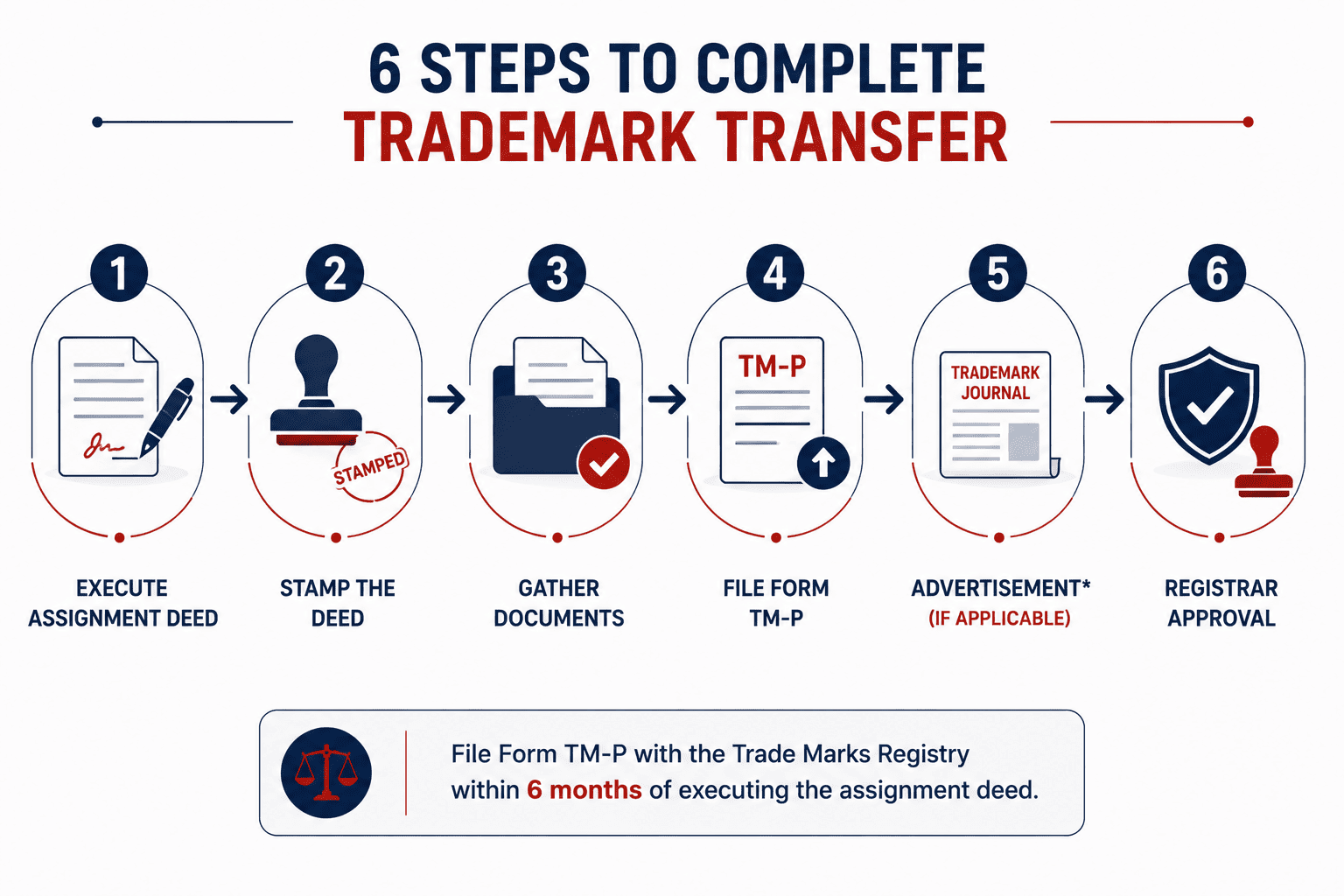
Draft and execute the assignment deed. Spell out exactly what is being transferred, all goods and services or just some of them, and whether goodwill goes with it, then have both parties sign.
-
Get the deed properly stamped. Pay the applicable state stamp duty before you rely on the document for anything official.
-
Gather your supporting documents. Pull together the NOC, the registration certificate copy, identity proof, and a power of attorney if you are using an agent.
-
File Form TM-P with the Trade Marks Registry. Do this within six months of the date the deed was signed.
-
Complete the advertisement step, if it applies. Assignments without goodwill need the Registrar's advertisement direction under Section 42, completed before registration can go through.
-
Respond to any queries from the Registrar. Address objections quickly, since the assignee is not officially recognised until the Registrar updates the register.
How Long Do You Have to File the Transfer With the Registry?
Six months from the date the assignment deed is signed, under Section 45 of the Trade Marks Act. This is the deadline that trips up more transfers than any other step in the process, mostly because people treat the signed deed as the finish line when it is really only the halfway point.
Filing later than six months is not automatically fatal, and the Registrar does have some discretion to allow late filings, generally with an additional fee attached. Waiting too long, though, risks the Registrar refusing the application outright, and until Form TM-P is actually filed and accepted, the assignee has real trouble enforcing the mark or licensing it to anyone else. The safest habit is to file the moment the deed is signed and stamped, rather than treating six months as a target to aim for.
Do You Need to Advertise the Transfer?
Only if the assignment is without goodwill. Section 42 makes the advertisement step compulsory in that specific case, and skipping it means the transfer never legally takes effect at all, regardless of what the signed deed says.
A transfer that includes goodwill does not need this step. The assignee simply files Form TM-P with the standard supporting documents and the Registrar processes it through the usual route. Confusing these two paths is one of the more common mistakes in DIY transfers, since a deal that felt like a normal sale of a brand can quietly fall into without-goodwill territory if the transfer documents are not worded carefully.
What Happens If Associated Trademarks Are Involved?
Section 44 requires associated trademarks, marks the Registrar has formally linked together because they are similar and held by the same owner, to move as a single group. You cannot sell one and keep the other if the Registry has them marked as associated.
This detail gets missed constantly, particularly by businesses that registered a word mark and a matching logo separately without realising the Registry treated them as linked. Checking your own trademark portfolio for associated marks before you sign any transfer deed saves an awkward conversation with the Registrar later.
What Happens After the Registrar Approves the Transfer?
Once the Registrar is satisfied, the register gets updated to show the assignee as the new proprietor. The next practical step is downloading an updated trademark certificate reflecting the new ownership details, since the certificate on file needs to match who legally holds the mark now.
From this point forward, the assignee also takes over responsibility for tracking the mark's renewal deadline, which still runs on the original 10-year cycle from the initial application date rather than resetting because ownership changed hands.
FAQS
FAQ’s on Trademark Transfer
-
What is a trademark transfer?
It is the transfer of ownership rights in a trademark from one person or business to another, legally called an assignment under the Trade Marks Act, 1999.
- Is trademark transfer the same as trademark assignment?
- What's the difference between assignment and transmission of a trademark?
- Can I transfer a trademark without transferring the whole business?
- What happens if I don't file Form TM-P within six months?
- Do I always need to advertise a trademark transfer?
- Can two trademarks be transferred separately if they're linked as associated marks?
- Is stamp duty compulsory on a trademark assignment deed?
- Can an unregistered trademark be transferred?
- Who becomes legally responsible for the trademark once the transfer is registered?


