
Carbon Credit Trading Scheme: Registry, Ratings & Rules
India's Carbon Credit Trading Scheme (CCTS) sets the framework for generating, issuing and trading carbon credit certificates. The Bureau of Energy Efficiency (BEE) administers the scheme, Grid Controller of India operates the registry, and Accredited Carbon Verification Agencies independently validate or verify eligible projects and emissions data. Carbon rating agencies may assess climate-related risks or performance, but their services do not automatically qualify a project for CCTS credits.
If your business plans to reduce emissions, develop a carbon project, verify emission reductions or trade carbon credits, you need to understand how the Carbon Credit Trading Scheme in India works. The scheme has defined rules for project eligibility, emissions data, verification and credit issuance. The right process depends on whether your organisation falls under the compliance mechanism or wants to develop a project under the offset mechanism.
This guide explains the Carbon Registry in India, the role of a Carbon Rating Agency, the requirements for an Accredited Carbon Verification Agency, and the rules that businesses should check before investing in carbon credits.
What Is the Carbon Credit Trading Scheme in India?
The Carbon Credit Trading Scheme (CCTS) is India's framework for reducing greenhouse gas emissions through a market-based system. It was notified in June 2023 under the Energy Conservation Act, 2001, and has since been developed through additional rules and procedures.
The scheme forms the basis of the Indian Carbon Market (ICM). It allows eligible entities to earn Carbon Credit Certificates (CCCs) when they meet the applicable requirements for emissions reduction, removal or avoidance. Eligible certificates can then be traded through approved market arrangements.
Under the scheme, one Carbon Credit Certificate represents one tonne of carbon dioxide equivalent (tCO₂e) of greenhouse gas emissions reduced, removed or avoided, subject to the scheme's applicable requirements.
The framework has two main mechanisms:
-
Compliance mechanism: Applies to designated industrial entities that must meet specified greenhouse gas emission intensity targets.
-
Offset mechanism: Allows eligible non-obligated entities to register qualifying projects that reduce, remove or avoid greenhouse gas emissions and seek carbon credit issuance under approved methodologies.
The official BEE Indian Carbon Market framework explains the institutional structure, while the Ministry of Power's CCTS notification provides the original scheme text. Always check the latest amendments and detailed procedures before acting.
Who should understand the CCTS framework?
The rules may matter to:
-
Industrial companies covered by notified emissions targets.
-
Businesses exploring carbon-credit projects.
-
Renewable energy, waste management, agriculture, forestry and industrial project developers, where the relevant methodology and eligibility requirements allow.
-
Companies seeking independent carbon project validation or emissions verification.
-
Organisations considering buying or selling Carbon Credit Certificates.
-
Consultants and service providers working with carbon accounting, climate disclosures or emissions data.
Practical point: A company that reduces emissions does not automatically receive tradable credits. It must follow the relevant mechanism, methodology, monitoring requirements and verification process.
How Does India's Carbon Market Work?
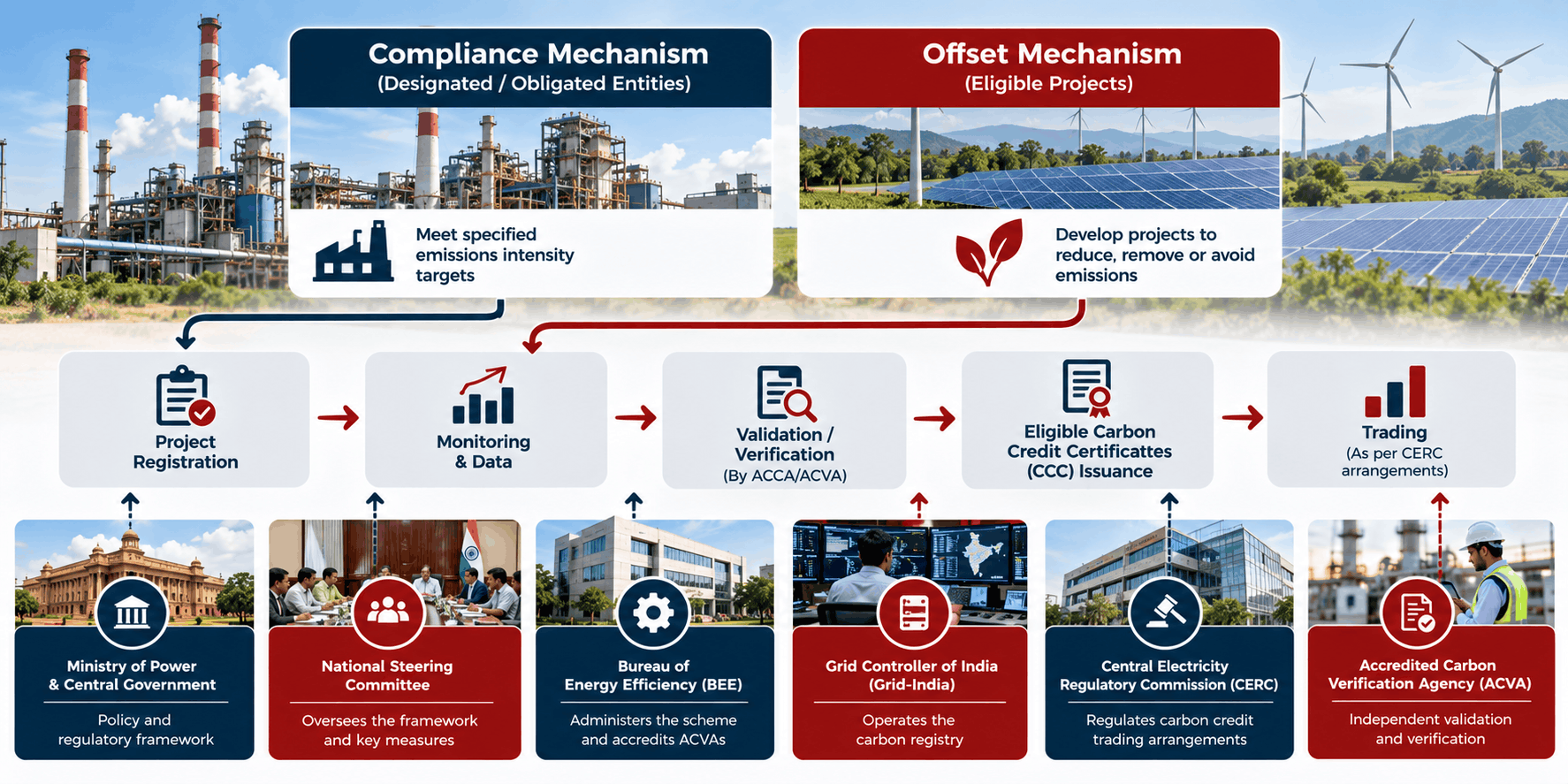
The Indian Carbon Market connects emissions targets, eligible reduction projects, independent verification, credit issuance and trading. Different institutions oversee different parts of this process.
Which authorities manage the Indian carbon market?
| Institution | Main role |
|---|---|
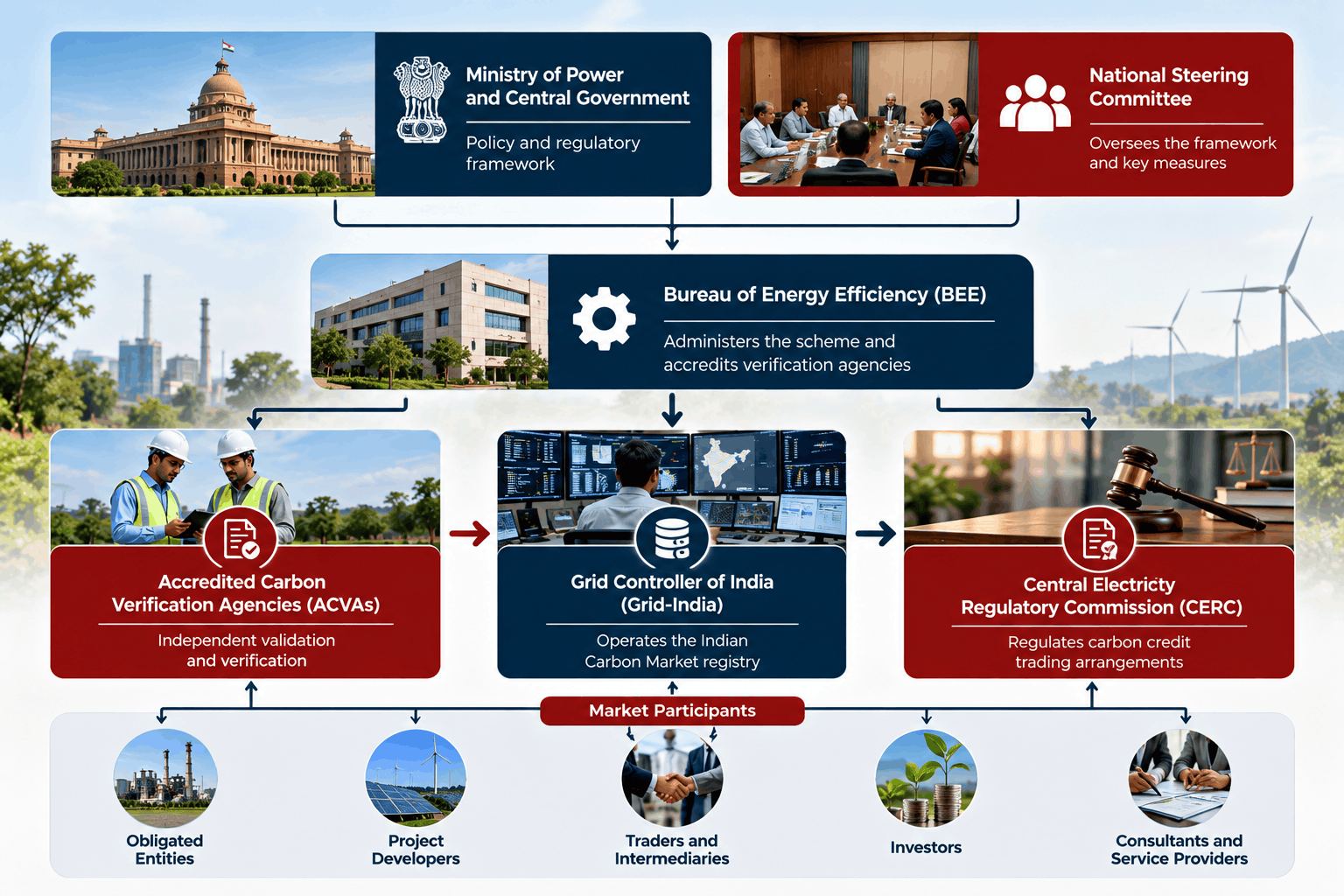
| Ministry of Power and the Central Government | Establish the policy and regulatory framework under applicable law. |
| National Steering Committee for Indian Carbon Market | Oversees the framework and recommends key measures under the scheme |
| Bureau of Energy Efficiency (BEE) | Administers the CCTS, develops procedures and accredits eligible verification agencies |
| Grid Controller of India (Grid-India) | Operates the Indian Carbon Market registry |
| Central Electricity Regulatory Commission (CERC) | Regulates carbon-credit trading arrangements within its jurisdiction |
| Accredited Carbon Verification Agency (ACVA) | Performs validation or verification activities within its approved scope |
| Eligible project or obligated entity | Supplies the required project, emissions, monitoring and compliance information |
These roles are not interchangeable. For example, an ACVA does not operate the national registry, and a carbon rating provider does not automatically have authority to verify a project under CCTS.
For current framework details, refer to the official BEE Carbon Market page and the Central Electricity Regulatory Commission.
What is the difference between the compliance and offset mechanisms?
The two mechanisms serve different purposes. Choosing the wrong pathway can lead to wasted time, incorrect documentation or unrealistic expectations about credit issuance.
| Feature | Compliance mechanism | Offset mechanism |
|---|---|---|
| Main purpose | Help designated entities meet notified emissions-intensity targets. | Encourage eligible projects that reduce, remove or avoid emissions. |
| Typical participant | An entity formally covered by the applicable compliance requirements | A non-obligated entity with a qualifying project |
| Main requirement | Meet applicable targets and submit the required emissions information. | Register and implement a project under an approved methodology. |
| Verification focus | Emissions and performance data required for compliance | Project eligibility, monitoring and claimed emission reductions or removals |
| Credit outcome | Eligible performance may lead to credit issuance under the applicable rules. | Eligible verified project outcomes may lead to credit issuance. |
| Key check | Confirm whether the entity and sector are covered by current notifications. | Confirm whether an approved methodology covers the proposed project. |
The compliance mechanism has included designated energy-intensive sectors such as aluminium, cement, chlor-alkali, petrochemicals, petroleum refineries, pulp and paper, and textiles under the notified framework. The exact obligations must be checked against current notifications and applicable target rules.
A business should not assume that its entire industry is covered simply because similar businesses appear in the scheme. Check the applicable notification and entity-specific requirements first.
What Is the Carbon Registry in India?
The Indian Carbon Market registry is the system used to record participating entities and manage carbon-credit accounts and transactions under the scheme.
Grid Controller of India operates the registry. Its stated functions include enabling entity registration, maintaining accounts of credits issued to entities, supporting credit transactions and maintaining the registry's secure database.
The registry is an important part of the chain that connects verified emissions outcomes to the issuance and tracking of certificates.
What does the carbon registry record?
Depending on the applicable mechanism and process, the registry supports functions such as:
-
Registration of eligible entities.
-
Maintenance of carbon-credit accounts.
-
Recording of issued carbon credit certificates.
-
Tracking of certificate transactions.
-
Supporting the integrity and traceability of the market.
The registry does not replace project monitoring or independent verification. A business must first meet the applicable requirements before it can obtain credits.
For official framework information, refer to the BEE Indian Carbon Market page.
How does Carbon Registry Registration work?
There is no single universal application checklist that applies to every participant. The process depends on whether the applicant is an obligated entity under the compliance mechanism or a project developer seeking to participate through the offset mechanism.
A practical preparation process is:
-
Identify the applicable mechanism. Determine whether your organisation is covered by compliance requirements or whether you are proposing an eligible offset project.
-
Check the current procedure. Read the latest CCTS rules, detailed procedures, approved methodologies and relevant sector notifications.
-
Confirm the registration route. Check the current instructions issued by BEE and the registry operator for the relevant type of participant.
-
Prepare entity information. Gather legal entity details, authorised representative information and other information required by the applicable registration process.
-
Prepare technical information. Offset project applicants should examine project boundaries, baseline assumptions, monitoring plans, emission-reduction calculations and methodology requirements.
-
Complete the required submission. Follow the current official procedure and respond to any requests for additional information.
-
Maintain records after registration. Keep monitoring data, supporting evidence, reports and other records needed for verification and continued compliance.
Important: These are preparation steps, not a substitute for the current official application procedure. Check the latest registry instructions before submitting an application. Do not rely on an old form, an unofficial checklist or a consultant's generic template.
What Is a Carbon Credit Certificate?
A Carbon Credit Certificate (CCC) is a certificate issued under the applicable Indian Carbon Market framework. Each certificate represents one tonne of carbon dioxide equivalent in emissions reduction, removal or avoidance, as recognised under the scheme.
A CCC is different from a general claim that a company has reduced its carbon footprint. A company may improve energy efficiency or install cleaner technology, but it must satisfy the applicable requirements before those results can support credit issuance under CCTS.
How does a project qualify for carbon credits?
The exact requirements depend on the mechanism and the approved methodology. For an offset project, the developer may need to establish:
-
Project eligibility: The activity must fall within the scope of an applicable approved methodology.
-
A suitable baseline: The project must establish a defensible basis for comparing emissions with the project outcome.
-
Monitoring arrangements: The developer must collect the data required by the methodology.
-
Emission calculations: The project must calculate the claimed reductions, removals or avoidance using the prescribed approach.
-
Supporting evidence: Records must support the data and assumptions used in the calculations.
-
Independent validation or verification: The required assessment must be conducted by an appropriately accredited agency.
-
Compliance with the issuance procedure: The project must follow the applicable approval and registry process.
Not every environmentally beneficial activity qualifies. A business should verify the relevant methodology before spending money on project design, equipment or third-party assessments.
Can a company sell its carbon credits directly?
Not simply because it has calculated an emissions reduction. The company must establish that it has eligible credits issued under the relevant system and then follow the applicable trading arrangements.
The treatment of a credit also depends on its source. A certificate issued under India's CCTS is not automatically equivalent to a credit issued under a voluntary international standard. Buyers should check the scheme, registry, methodology, ownership, status and permitted use of any credit they plan to acquire.
What Is an Accredited Carbon Verification Agency?
An Accredited Carbon Verification Agency (ACVA) is an agency accredited by BEE to perform the validation or verification activities permitted under the Carbon Credit Trading Scheme.
These agencies help assess whether project information, emissions data and claimed results meet the relevant requirements. Their work supports the credibility of the carbon market by providing an independent assessment rather than relying only on the project developer's own claims.
What does an ACVA do?
The work depends on the mechanism and the agency's approved scope. It may include:
-
Reviewing project documents and relevant technical information.
-
Assessing whether a proposed project meets the requirements for validation under the offset mechanism.
-
Examining monitoring data and calculations.
-
Checking emissions or project performance information against the applicable procedure.
-
Conducting verification activities and preparing the required report.
-
Recording findings and identifying information gaps or non-conformities that need attention.
Validation and verification are related but distinct activities. Validation generally examines a proposed project and its design before registration under the offset mechanism. Verification examines reported information and claimed outcomes in accordance with the applicable requirements.
How do you check whether a verification agency is accredited?
Do not rely only on an agency's website, brochure or claim that it is a carbon auditor. Use BEE's current official list of accredited agencies.
The BEE list of Accredited Carbon Verification Agencies provides information such as agency names, accreditation status, validity and the mechanisms or sectors covered. The list can change as agencies receive, amend or lose accreditation.
Before appointing an agency, check:
-
Whether the agency appears on the latest official list.
-
Whether its accreditation is current.
-
Whether it is accredited for the relevant mechanism.
-
Whether its approved sector scope covers the proposed activity.
-
Whether the required validation or verification service falls within that scope.
-
Whether the agency has the technical experience needed for your project's data and methodology.
For example, an agency listed for the compliance mechanism in certain industrial sectors may not be authorised to validate an offset project in an unrelated sector. Accreditation status alone is not enough; the scope must also match the work.
What are the requirements to become an ACVA?
An organisation that wants to become an ACVA must follow BEE's accreditation procedure and eligibility criteria. The requirements are technical and depend on the work for which the agency seeks accreditation.
Applicants should review the latest official ACV application information and guidelines and the accreditation procedure and eligibility criteria.
Before applying, an organisation should check the required expertise, relevant audit or verification experience, staff competence, impartiality safeguards, quality systems and supporting records specified in the current procedure. It should also confirm the application requirements for the intended mechanism.
Do not assume that a general ISO certificate or experience in environmental consulting automatically grants ACVA status. The agency must complete the applicable accreditation process and work within its approved scope.
What Is a Carbon Rating Agency?
A Carbon Rating Agency generally assesses an organisation, project, investment or carbon-related claim against a rating framework. Depending on the provider, the assessment may cover emissions performance, climate-related risk, environmental impact, transition plans, project quality or other sustainability factors.
The phrase can describe different commercial services. It should not be treated as a single official licence or accreditation category under India's CCTS without checking the specific legal and regulatory context.
This distinction matters when a company wants to obtain credits under the Indian Carbon Market.
Are carbon rating agencies and ACVAs the same?
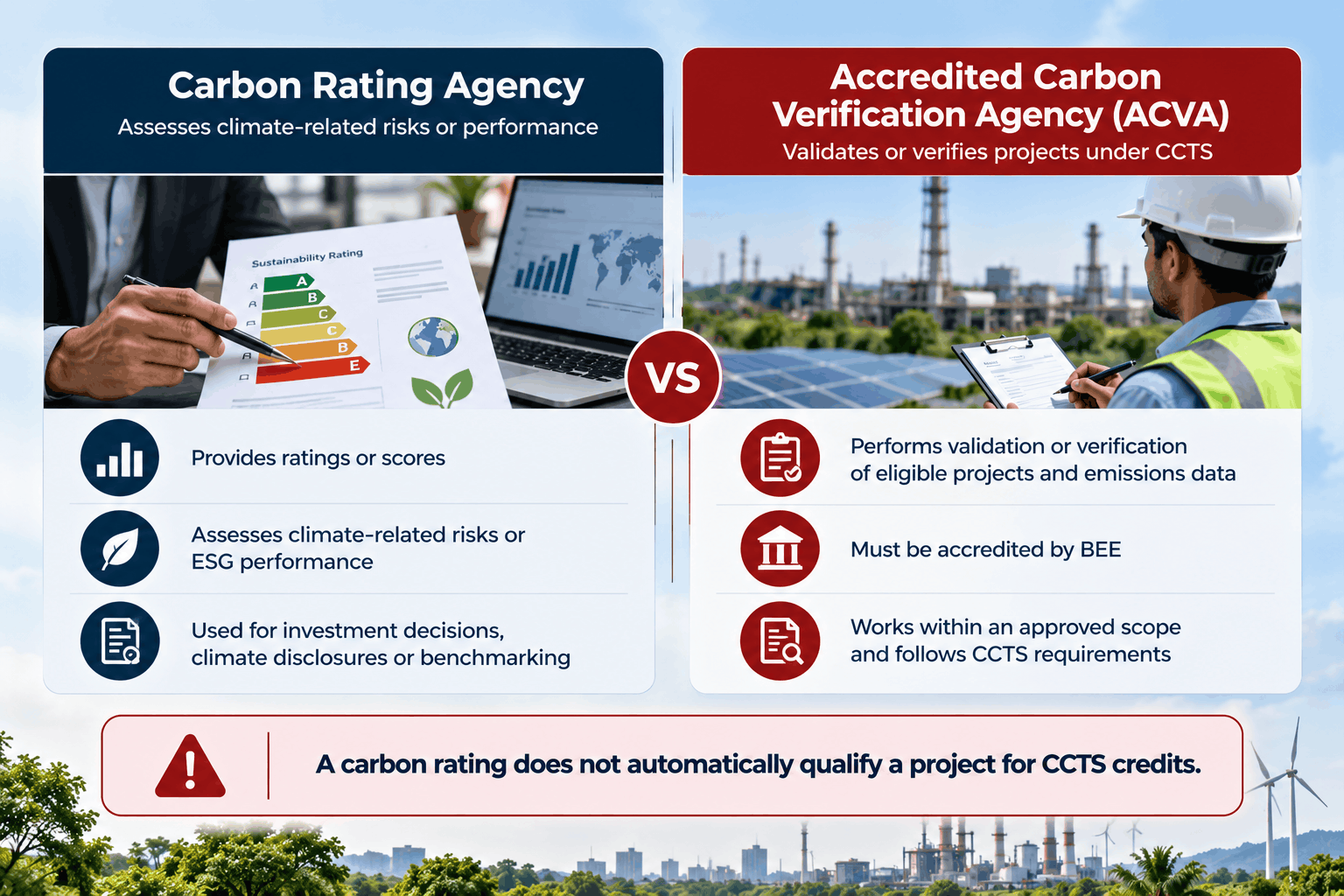
No. Their functions may overlap in climate-related work, but they are not interchangeable.
| Point | Carbon rating agency | Accredited Carbon Verification Agency |
|---|---|---|
| Main function | Rates or assesses an organisation, project, investment or carbon-related claim under its own or a specified rating framework | Conducts validation or verification activities under the CCTS framework |
| Governing basis | Depends on the rating product, standard, contract or applicable rules | BEE accreditation and the applicable CCTS procedure |
| Typical output | Rating, score, assessment or analytical report | Validation or verification report required by the applicable scheme process |
| Can its rating alone secure a CCTS certificate? | No | Verification is part of the process, but it does not by itself guarantee certificate issuance |
| What should a business check? | Methodology, scope, evidence, independence and intended use of the rating | Current BEE accreditation, mechanism and approved sector scope |
A rating may help a buyer, lender or investor understand a project's climate-related characteristics. However, a rating is not a substitute for the verification required under CCTS.
If a service provider says its rating will guarantee the issuance of Indian Carbon Credit Certificates, ask for the exact regulatory basis and confirm the claim against official CCTS procedures.
How should a business choose a carbon rating provider?
Start with the reason you need the rating. A company preparing for investment due diligence may need a different assessment from a project developer seeking carbon-credit issuance.
Ask the provider:
-
What exactly is being rated: the company, the project, the carbon credits or the climate-risk profile?
-
Which methodology or rating framework does it use?
-
What source data and supporting documents will it examine?
-
Does it conduct independent checks, or does it rely mainly on information supplied by the client?
-
Who will use the rating and for what decision?
-
Does the rating meet the requirements of the buyer, lender, investor or reporting framework?
-
Is the provider claiming formal recognition under CCTS? If so, can that claim be independently confirmed?
A credible assessment should explain its scope, assumptions, limitations and evidence. Be cautious of ratings that offer a favourable result without examining the underlying data.
What Documents Should a Carbon Project Prepare?
There is no single document list for every CCTS participant. An obligated industrial entity and a developer of a new offset project may need different records.
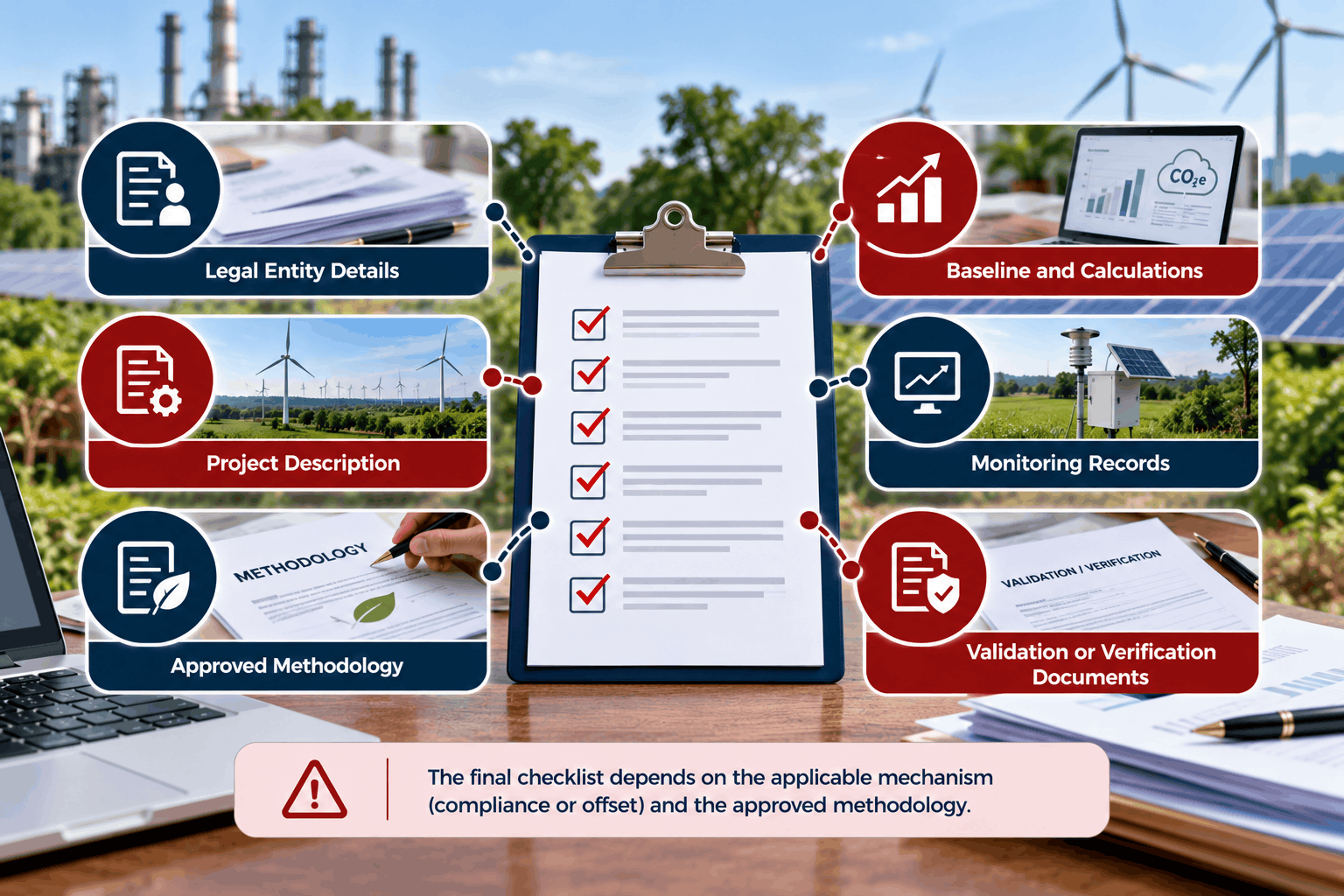
The following table is a planning checklist, not an official universal filing list. Confirm the exact documents in the current procedure for your mechanism and project type.
| Document or record | Why it may be needed |
|---|---|
| Entity registration and legal details | Establishes the identity of the company or project participant |
| Authorisation for the signatory | Shows who can submit information or act for the entity |
| Project description | Explains the activity, location, technology and expected outcome |
| Applicable methodology reference | Shows the methodology being used to assess the project's eligibility and reductions |
| Baseline data and assumptions | Supports the calculation of emissions without the project |
| Monitoring plan | Explains what data will be collected, how and how often |
| Energy, fuel or production records | Supports emissions calculations where relevant |
| Metering and measurement records | Helps substantiate activity data and performance |
| Emissions calculations and supporting evidence | Shows how the reported results were derived |
| Verification or validation documents | Records the independent assessment required by the applicable procedure |
| Previous reports and relevant approvals | Provides background where the rules or methodology require it |
A practical way to prepare is to create a document register with four columns: document name, reporting period, responsible person and evidence location. This makes it easier to identify missing data before an assessment begins.
For an existing industrial facility, preserve source records such as energy bills, fuel purchase data, production records, meter readings and calculation workbooks where relevant. For a new project, establish the monitoring system early rather than trying to reconstruct evidence after the reporting period.
What Are the Carbon Credit Trading Rules in India?
The CCTS framework includes rules for participation, emissions targets, monitoring, reporting, verification, credit issuance and trading. Additional procedures and regulations determine how those requirements operate in practice.
Businesses should use the latest official documents rather than relying on an old summary of the original 2023 notification.
Which rules should a business check first?
Review the documents relevant to your role:
-
The Carbon Credit Trading Scheme, 2023 and applicable amendments.
-
The current compliance mechanism procedure, if your entity is covered by emissions targets.
-
The current offset mechanism procedure and approved methodology, if you are developing a project.
-
The current accreditation procedure for verification agencies.
-
Relevant Greenhouse Gas Emission Intensity Target Rules and amendments.
-
The current trading regulations and approved exchange arrangements.
-
Current registry instructions and any applicable fees or submission requirements.
The original scheme is only one part of the framework. Later notifications and detailed procedures can affect eligibility, reporting requirements and how participants complete the process.
How does verification support compliance?
Verification provides an independent assessment of reported information against the applicable requirements. It helps identify errors, unsupported assumptions, gaps in records and inconsistencies in emissions calculations.
For an industrial entity, inaccurate production or energy data can affect its reported emissions intensity. For an offset project, weak baseline assumptions or incomplete monitoring can undermine the claimed reduction.
A useful internal control is to have someone other than the person who prepared the emissions calculations review the source data and formulae before formal verification. Keep a record of any changes so the project team can explain how it addressed discrepancies.
Can a company trade credits without understanding the registry rules?
That is risky. A buyer or seller should establish what type of credit is involved, how it was issued, where it is recorded and which trading arrangements apply.
Before a transaction, check:
-
The credit's scheme and issuing framework.
-
Its registry record and current status.
-
The seller's right to transfer it.
-
Any restrictions on transfer, use, banking or surrender.
-
The applicable exchange or trading requirements.
-
The documentation needed to record the transaction.
Avoid treating credits from different programmes as identical. Their eligibility, quality, permitted use and market value may differ.
What Does It Cost to Register or Verify a Carbon Project?
There is no single cost that applies to every business entering the Indian Carbon Market. The total depends on the applicable process, project complexity, data availability, technical work and services required.
Possible cost components include:
-
Internal staff time for collecting and maintaining data.
-
Technical studies and project documentation.
-
Equipment or systems needed for monitoring.
-
Validation or verification services.
-
Registry, administrative or other applicable charges.
-
Specialist support for methodology, emissions calculations or regulatory compliance.
Do not use a generic online estimate as an official CCTS fee. Check current government and registry documents for applicable charges, then request written quotations from service providers for the work they will perform.
When comparing quotations, check what the price covers. One provider may quote only for a verification visit, while another may include document review, data-gap analysis and a final report. Those services are not directly comparable.
What Common Mistakes Should Carbon Market Participants Avoid?
A business can lose time and money if it starts with the wrong assumptions. These are some of the most important risks to check before committing resources.
1. Assuming every emissions reduction earns credits
Reducing electricity use or installing efficient equipment may reduce emissions, but the activity must meet the applicable programme and methodology requirements before it can support CCTS credit issuance.
2. Hiring a provider without checking its accreditation
A consultant may offer carbon accounting or sustainability services without being accredited to validate or verify under CCTS. Confirm the official accreditation and scope before appointing an agency for a regulated verification task.
3. Confusing a rating with regulatory verification
A favourable score or carbon assessment does not establish that a project has completed the CCTS verification and issuance process. Ask what the report proves and what it does not prove.
4. Starting project work before checking the methodology
A project may appear environmentally beneficial but still fall outside the scope of an approved methodology. Check eligibility and the applicable methodology before making major investments.
5. Keeping incomplete monitoring records
Missing meter readings, fuel data, production records or calculation notes can make it difficult to substantiate reported results. Establish the monitoring process before collecting the data.
6. Assuming that all carbon credits have the same value
Credit quality and market value can depend on the scheme, methodology, project type, evidence, registry status and buyer requirements. Compare the actual attributes of the credits rather than relying on a generic price.
7. Treating a consultant's estimate as a government approval
A service provider can help prepare documents and explain the process, but it cannot guarantee a regulator's decision or promise that a project will receive credits. Get a clear written scope of work and distinguish advisory support from formal approval.
How Can Legal Babu Help With Carbon Market Compliance?
Businesses entering a regulated market often need to coordinate technical consultants, company records, regulatory documents and internal compliance processes. Legal Babu's consulting team provides business advisory and compliance-related services. For a carbon-market project, the first step is to clarify the support needed and confirm which parts fall within the team's scope.
Legal Babu can discuss your requirements and help you organise the relevant business and compliance work, subject to the agreed service scope.
What support can you discuss with Legal Babu?
1. Initial requirement assessment
Explain whether you are an industrial entity, an offset project developer, a prospective verification agency or a buyer or seller of carbon credits. This helps identify the regulatory questions that need attention.
2. Business and document readiness
Organise the legal entity details, authorisations, supporting records and business documents relevant to your proposed activity. The exact requirements depend on the applicable CCTS process.
3. Compliance coordination
Identify which issues need input from a technical carbon specialist, an accredited verification agency, a registry contact or another qualified professional. This can help prevent the business from treating all carbon-market work as a single service.
4. Related business consulting
Depending on your needs, Legal Babu may also discuss relevant services such as business advisory services, company registration, EHS audit services and project report preparation. These services address different business requirements and should not be treated as substitutes for CCTS-specific technical validation or verification.
5. Clear next steps
Before work begins, ask for confirmation of the proposed deliverables, documents required from you, applicable professional fees and any external specialists involved.
Important limitation: Legal Babu should not be presented as a BEE-accredited verification agency or as an issuer of Carbon Credit Certificates unless the relevant status is independently established. A carbon project may require a specialist or ACVA whose current accreditation and scope match the work.
To discuss your business requirements, visit the Legal Babu contact page and describe your proposed project or compliance need.
FAQS
FAQs about Carbon Credit Trading Scheme
-
1. Can a small business participate in India's Carbon Credit Trading Scheme?
Potentially, but eligibility depends on the mechanism, the activity and the applicable methodology or rules. A small business should first determine whether it is covered by compliance requirements or whether it has a qualifying project that could participate through the offset mechanism. It should not assume that business size alone establishes eligibility.
- 2. Can a farmer or farmer producer organisation generate carbon credits?
- 3. Do solar panels automatically qualify a business for carbon credits?
- 4. Can a company earn credits for emission reductions made in previous years?
- 5. Can a company use the same emission reduction to claim credits under two programmes?
- 6. How can a buyer check whether carbon credits are genuine?
- 7. Can an international carbon credit be used as an Indian CCTS certificate?
- 8. Does an ISO certification make a company eligible to become an ACVA?
- 9. What should a company include in a carbon-credit purchase agreement?
- 10. What should a business do if its verification report identifies data gaps?


