
An FMC License is not an Indian license. The United States Federal Maritime Commission issues it, and it decides whether your company can carry United States ocean cargo under its own name. If you searched for an FMC license in India, you most likely need foreign NVOCC registration, because a full licence requires an office in the United States.
This guide covers FMC license eligibility, the USD 150,000 bond, the tariff filing, verified official fees and the five steps to approval. It covers the three-year renewal cycle, the eight grounds on which the Commission terminates a registration, and the civil penalties that apply when an operator trades without approval. Order matters here, because each step depends on the filing before it. One limitation matters more than the rest. FMC approval covers United States ocean trades alone. It never replaces MTO registration, a Customs Broker License or any other Indian requirement.
No Indian Authority Issues an FMC License
Here is the confusion that costs Indian forwarders weeks of wasted effort. There is no Indian FMC licence, no FMC cell in any ministry and no port authority that can grant one.
The Federal Maritime Commission regulates United States international ocean transportation under the Shipping Act of 1984. Its rules for intermediaries sit in 46 CFR Part 515, and they apply to your business the moment you sell ocean freight into or out of a United States port under your own name.
Our NVOCC license guide for India sets out how the Indian approvals and the United States requirement sit alongside each other. What an Indian company holds at home is a set of domestic registrations. MTO registration covers multimodal carriage from India. A Customs Broker License covers clearing cargo for other people. An FMC status covers your conduct in United States ocean commerce and nothing else.
If you are still sorting out the Indian side, read our guide to registrations for a logistics business first. Then come back to the United States lane.
Do You Actually Need FMC Approval?
This is the question to settle before anyone touches a form. The trigger is not the paper you print. It is whether you provide transportation by water between the United States and a foreign country, for compensation, without operating the vessel.
A company that resells container space, collects freight from the customer and takes responsibility for the movement is providing NVOCC service. It is doing that whether or not it issues a house bill of lading.
|
Your activity in the United States trade |
FMC status you need |
|
Reselling ocean freight under your own name |
Foreign-based NVOCC registration |
|
Issuing your own house bill of lading to United States shippers |
Foreign-based NVOCC registration |
|
Doing all of that through a qualifying United States branch |
NVOCC licence |
|
Working only as the Indian agent of a registered NVOCC for a fee |
Confirm your position with the Commission in writing before you assume an exemption |
|
Booking with a registered NVOCC and never taking carrier responsibility |
Generally none in your own name |
A warning worth stating plainly. It is a violation of the Commission's regulations for a foreign-based unlicensed NVOCC to provide NVOCC services in United States foreign trade without a valid registration and an effective tariff. Licensed intermediaries and carriers are also barred from knowingly accepting cargo for the account of an unregistered NVOCC, which means a compliant partner can quietly refuse your bookings.
The Three FMC Statuses and What Each One Costs You
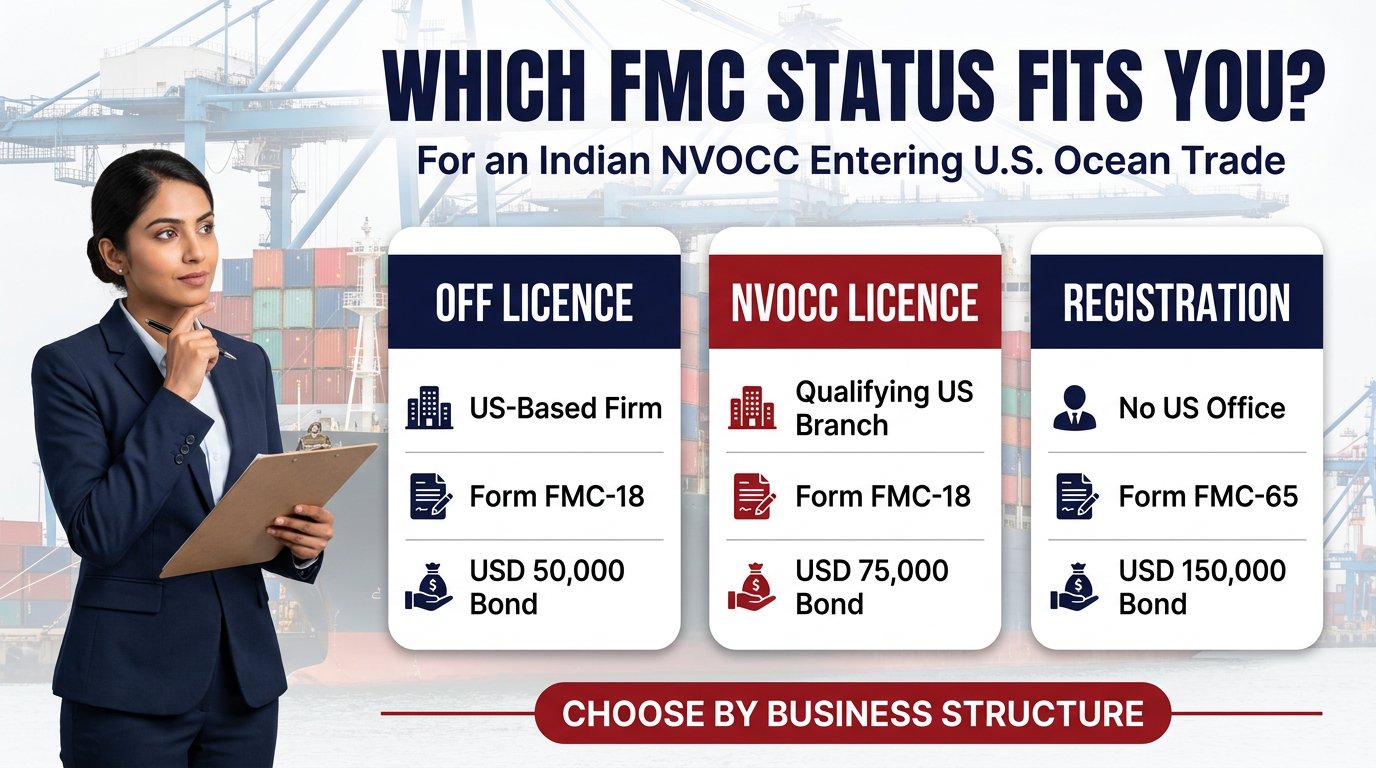
The Commission offers three statuses. One is the FMC ocean freight forwarder license, one is the NVOCC licence, and the third is a registration that most Indian companies actually take.
|
Status |
Open to an India-based company |
Proof of financial responsibility |
|
Ocean Freight Forwarder licence |
No. The applicant must be located in the United States |
USD 50,000 |
|
NVOCC licence for a non-US company |
Yes, but only with an unincorporated United States branch |
USD 75,000, with a bond rider naming the qualifying branch address |
|
Foreign-based unlicensed NVOCC registration |
Yes, with no United States office |
USD 150,000 |
So the real decision for an Indian forwarder is registration versus licence, and it comes down to this.
Registration is faster and needs no office abroad, no qualifying individual and no application fee. The licence halves your bond but asks for a branch, an officer with three years of intermediary experience and USD 1,304 in filing fees.
Registration also unlocks real commercial tools. A compliant NVOCC may enter into service contracts with vessel-operating common carriers as a shipper signatory, and it may use negotiated rate arrangements and NVOCC service arrangements instead of moving everything at published tariff rates.
There is one more catch that rarely gets mentioned. The Commission recommends that a registered NVOCC use a licensed United States intermediary for any intermediary work performed on its behalf inside the country. If you register, you still need a capable partner on the ground.
FMC License Eligibility: The Test Most Indian Applicants Miss
Below are the eligibilities:
Registration eligibility under 46 CFR 515.19
There is no experience test and no qualifying individual. What the Commission wants is this.
-
Form FMC-65 with the legal name written exactly as it appears on your official documents, punctuation included
-
A named legal agent in the United States who can receive judicial and administrative process, subpoenas included
-
Valid proof of financial responsibility for USD 150,000
-
A filed Form FMC-1 that identifies your tariff and the publisher maintaining it
-
A certification signed under penalties of perjury by a sole proprietor, all partners, a corporate officer or an LLC member
A registration that looks substantially incomplete can be rejected outright. The good news is that a rejected applicant may submit a fresh registration at any time.
Licence eligibility under 46 CFR 515.11
Take the licence route and the bar rises in three places.
You must open and maintain an unincorporated United States office that is resident in the country and qualified to do business by the Secretary of State or equivalent in that state. Your qualifying individual must be an active officer, sole proprietor, managing partner, or a member or manager of an LLC. And that person must show at least three years of ocean transportation intermediary experience.
Now the part that almost every guide gets wrong. For a foreign-based applicant, those three years may have been gained in the United States or in a foreign country, as long as the work relates to shipments in the United States oceanborne foreign commerce. The United States-only experience rule applies to applicants based there, not to you.
The character review nobody warns you about
The Commission does not stop at paperwork. Under the rules it may look at violations of shipping laws, operating as an intermediary without a licence or registration, state and federal felonies and misdemeanours, undischarged bankruptcies, outstanding tax liens and court judgments, immigration status compliance, and the denial or revocation of a customs broker licence.
Read that last one twice. A disciplinary history with another regulator, in another country, can surface in a United States licensing file.
The 5 Steps to FMC Approval as an Indian NVOCC
Below are the steps for FMC Approval as an Indian NVOCC:
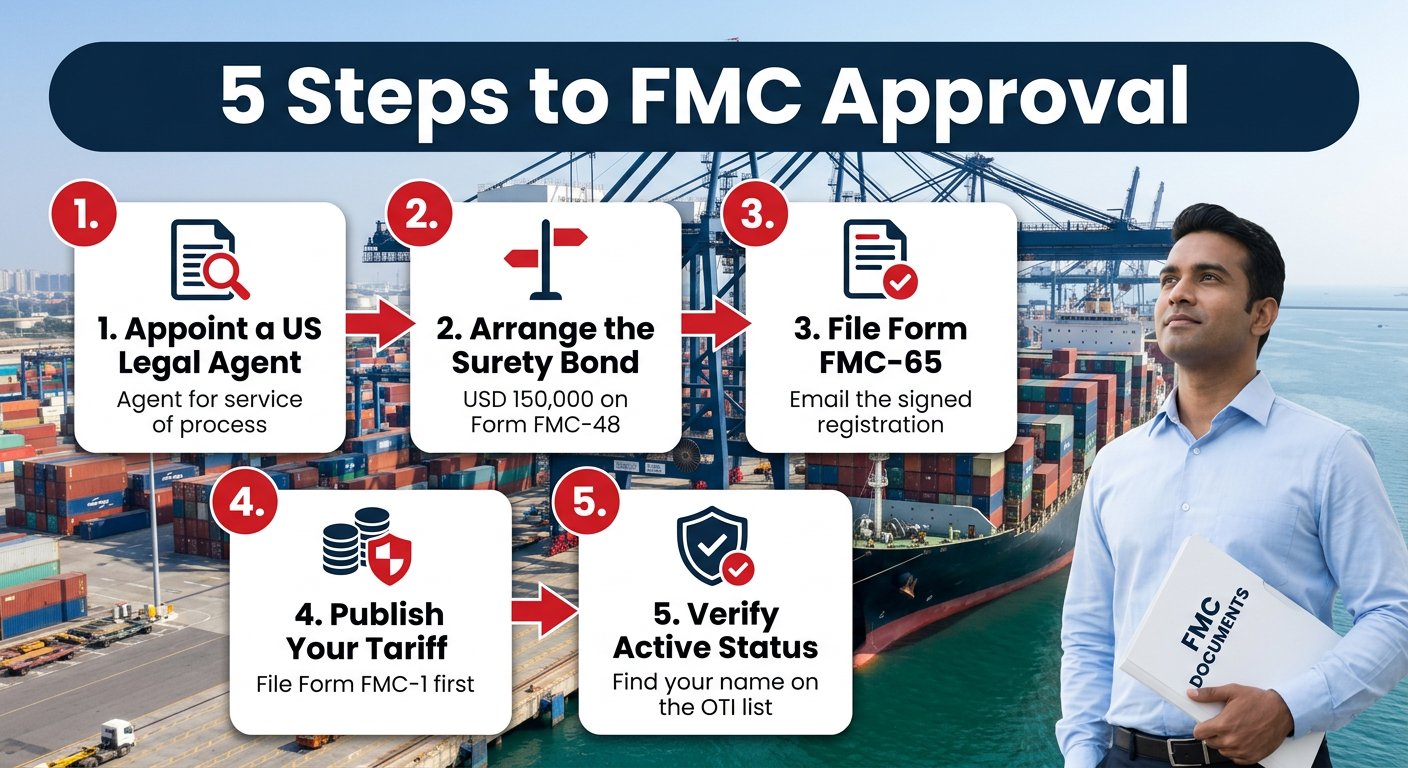
Step 1: Appoint a United States Legal Agent for Service of Process
Every foreign-based NVOCC must name someone in the United States who can accept legal process on its behalf. Form FMC-65 records that agent's name, street address, city, state, zip code, telephone, fax, contact person and email. Pick an agent with a stable address and a monitored inbox. A change of agent is a reportable change you must file within 30 days, and a registration with no valid agent can be terminated.
Step 2: Arrange the USD 150,000 Bond
Proof of financial responsibility has to reach the Bureau of Certification and Licensing before you operate. For a registered foreign NVOCC, the amount is USD 150,000, normally provided as a surety bond on Form FMC-48. Here is the detail people miss: the surety files the bond, not you. It goes to the Commission by email from the bond provider. Confirm in writing that the bond will be kept current, because a registration becomes automatically ineffective the moment valid proof of financial responsibility is no longer on file.
Step 3: Complete and Email Form FMC-65
Form FMC-65 is the Foreign-based Unlicensed NVOCC Registration form, and it runs to a single page. You give the legal name, trade names, principal place of business with country and postal codes, telephone and fax with country code, the contact person's name and email, and the full United States agent details. Then an authorised signatory certifies it under penalties of perjury. The completed form goes to the Commission's OTI bonds address published on its official application and foreign registration page.
Step 4: File Form FMC-1 and Get Your Tariff Published
Form FMC-1 records your organisation name, home office address, the firm's representative and telephone number, where the tariff lives and which publisher maintains it. Most registrants engage a tariff publisher to prepare and file it, and the Commission can supply a list of publishers on request. A non-US NVOCC must also name its United States agent for service of process inside the tariff itself. Any change to the Form FMC-1 details must be reported within 30 days.
Step 5: Verify Completion Before the First Booking
A registration is complete only when the Commission holds all three pieces together, namely the registration form, the evidence of financial responsibility and Form FMC-1. The rules are blunt about timing. No tariff may be published, and no NVOCC service may commence until the Commission has received valid proof of financial responsibility and the Form FMC-1. Before you take the first United States booking, find your company on the Commission's published list of licensed and bonded ocean transportation intermediaries and note the renewal date recorded against your name.
The Licence Route in Five Steps, if You Want the Lower Bond
Step 1: Open a Qualifying United States Branch
The office must be unincorporated, resident in the United States and qualified to do business by the Secretary of State or equivalent authority in that state or territory. An incorporated branch will not do, because incorporated entities must be separately licensed.
Step 2: Appoint the Qualifying Individual
This person must be an active officer and must document at least three years of ocean transportation intermediary experience. As a foreign applicant, you can count experience gained abroad on United States oceanborne foreign commerce. The application asks for the total years and months, plus references with first-hand knowledge of that work.
Step 3: File Form FMC-18 Electronically
Complete every part that applies to a new NVOCC licence and answer every question, writing N/A where something does not apply. Corporations attach their articles of incorporation, and a corporation older than one year must attach a certificate of good standing issued within six months of the application. The signed certification page gets uploaded too. The Commission does not process incomplete applications.
Step 4: Pay the Application Fee
The fee for an electronic application for an ocean transportation intermediary licence is USD 1,304, paid through the Commission's Pay.gov service. The Commission accepts electronic funds transfer only, which means Pay.gov or wire transfer, and paper cheques are not accepted. A status change or licence transfer carries a separate fee of USD 943.
Step 5: File the Bond and Publish the Tariff
A licensed non-US NVOCC posts USD 75,000, and the bond rider should list the qualifying branch address in the United States. Form FMC-1 follows, then the tariff, and only then does the first shipment move. Keep the legal name on the bond identical to the legal name on the application, right down to punctuation, since mismatches are a routine cause of delay.
Forms and Documents You Will Actually File
|
Form |
Who files it |
What it does |
|
FMC-65 |
The applicant, by email |
Registers a foreign-based unlicensed NVOCC and records its United States agent |
|
FMC-48 |
The surety company, by email |
Proves financial responsibility, USD 150,000 for registration and USD 75,000 for a foreign-based licence |
|
FMC-1 |
Usually the tariff publisher |
Records where your tariff is published and who maintains it |
|
FMC-18 |
The applicant, online |
Licence application, and also the form for a change of qualifying individual, name, structure or authority |
Keep a compliance file from day one. You will need the filed FMC-65, the bond confirmation, the Form FMC-1 acknowledgement, your published tariff reference and the signatory's authority. When the Commission writes to you, and it will, that file is what turns a two-week scramble into a same-day reply.
What an FMC License Really Costs
|
Payment |
When it falls due |
Verified amount or official position |
|
Foreign-based NVOCC registration, Form FMC-65 |
At registration |
The Commission charges no registration fee |
|
Registration renewal and licence renewal |
Every three years |
No fee for renewal |
|
Electronic application for an OTI licence |
With Form FMC-18 |
USD 1,304 |
|
Status change or licence transfer application |
With the amended Form FMC-18 |
USD 943 |
|
Surety bond premium |
Annually, payable to the surety |
Not published by the Commission. Get a written quotation |
|
Tariff publication and database charges |
Payable to the tariff publisher |
Not published by the Commission. Get a written quotation |
|
United States agent for service of process |
Payable to the agent |
Not published by the Commission. Get a written quotation |
The USD 150,000 is the bond amount, which is the value a surety guarantees. It is not a deposit you wire to the Commission, and nobody should describe it that way.
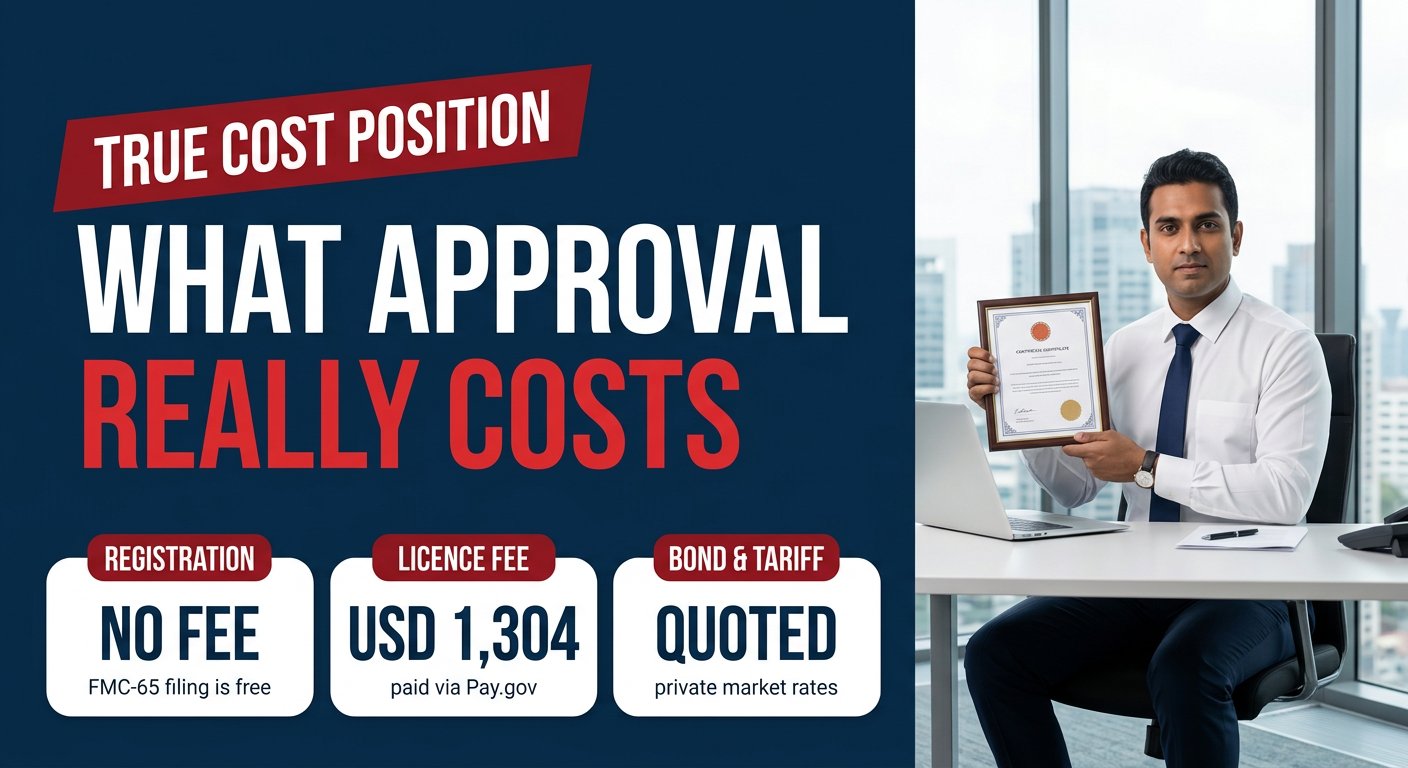
The other side of the ledger is set by private providers, so the Commission publishes no total cost and neither should any consultant. Ask each one for a written quotation that states the premium, how it is renewed, the cancellation terms and any refund position. Compare at least two sureties and two tariff publishers before you commit.
Fees were verified against the Commission's published schedule on 21 September 2026, and they can change. Recheck the figure on the official FMC Summary of Fees page before you pay.
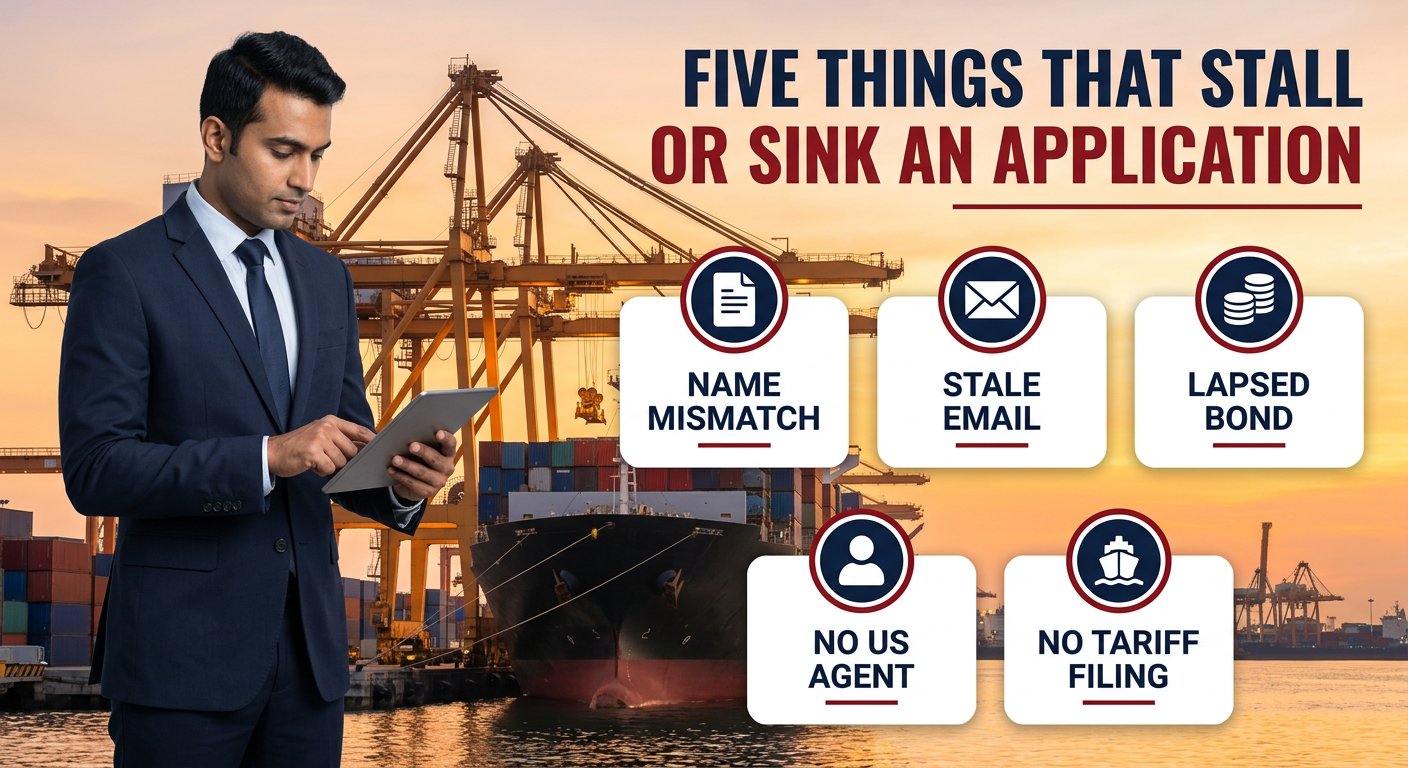
Five Things That Stall or Sink an Application
These are the failure points that show up in the regulations, not guesses.
-
A name mismatch: Your legal name must match official documentation exactly, punctuation included. The same name has to appear on the bond.
-
A bond that lapses: Proof of financial responsibility must stay on file. Let it lapse, and your registration becomes automatically ineffective, with no hearing required.
-
A stale email address: Renewal and change notices go to the contact email on record. An old address is the most common reason a deadline is missed.
-
An agent who disappears: Failing to designate and maintain a United States legal agent is a listed ground for termination or suspension.
-
Working with the wrong counterparties: Knowingly and willfully accepting cargo from, or transporting cargo for, an NVOCC with no published tariff and bond is itself a ground for losing your registration.
Renewal, Reporting Changes and Termination
Below are the renewal, reporting changes and termination details:
The renewal calendar
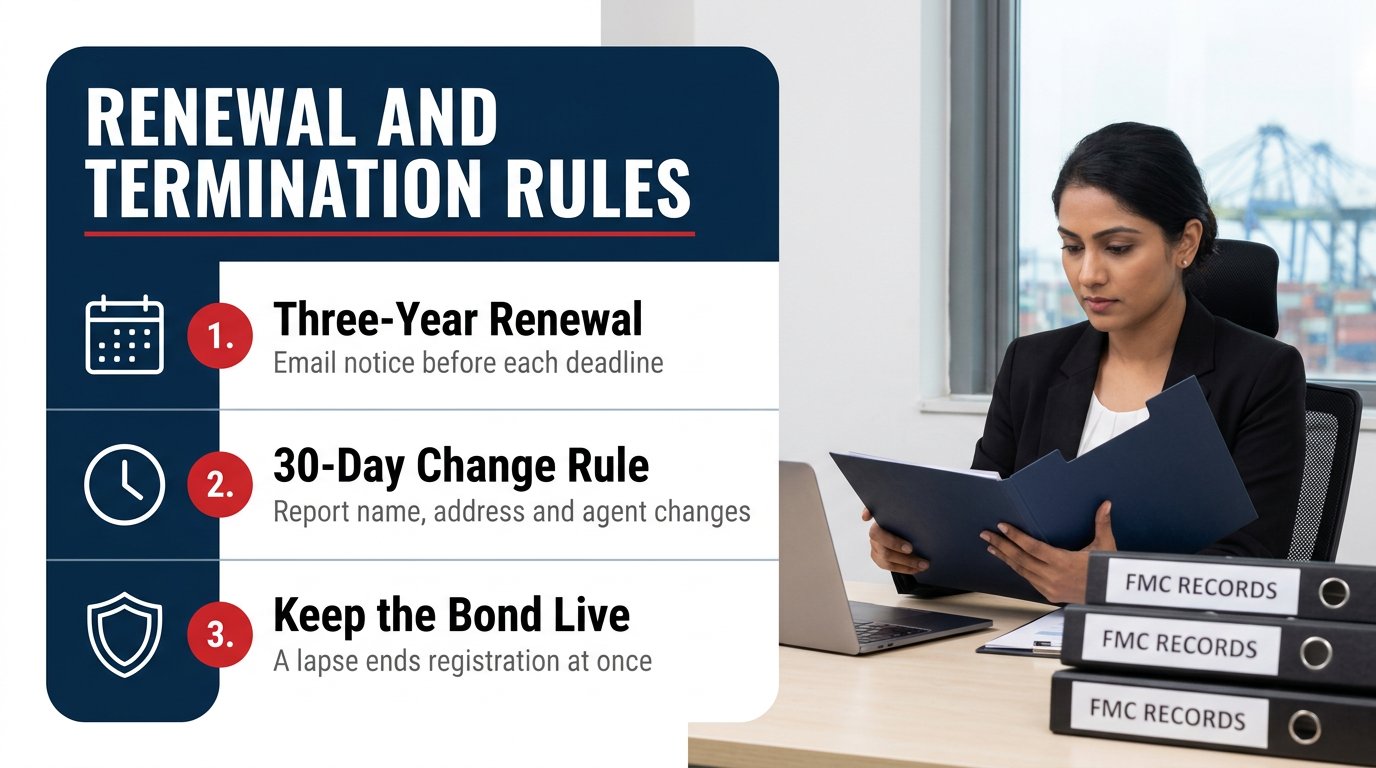
Registrations run for three years and are renewed for successive three-year periods on submission of an updated Form FMC-65. Registered NVOCCs get an email notice no more than 30 days before the renewal date, carrying login details for the online filing system.
Licences follow a different rhythm. The initial licence period is not less than 12 months and not more than 48 months from the effective date, set by the licence number, and subsequent renewals fall due every three years. Licence renewal notices go out 100 days in advance.
Both renewals are free. Both depend entirely on the Commission having a current email address for you.
If your Indian MTO licence is due around the same time, diarise them together. Our MTO licence renewal guide walks through that cycle separately.
Changes you must report within 30 days
Registered NVOCCs must write to the Bureau of Certification and Licensing whenever these change: legal or trade names, the principal place of business address including telephone and fax numbers, the contact person and email address, and the name and full contact details of the United States resident agent.
Licence holders go further. A change of qualifying individual, a company name change including trade name additions or removals, a business structure change, or the addition of NVOCC or forwarding authority all need a fresh Form FMC-18.
Grounds for termination or suspension
A registration becomes automatically ineffective if proof of financial responsibility is not maintained. Beyond that, the Commission may terminate or suspend a registration after notice and a hearing for any of these.
-
Violating the Act or any related Commission regulation or order
-
Failing to respond to a lawful order or inquiry
-
Making a materially false or misleading statement in a registration or renewal
-
Failing to honour financial obligations to the Commission
-
Failing to renew on time
-
Failing to maintain a compliant Form FMC-1 or tariff
-
Knowingly and willfully accepting cargo from, or carrying cargo for, an NVOCC with no tariff and bond, or a forwarder with no bond
-
Failing to designate and maintain a United States legal agent
And here is the part that hurts commercially. The Commission publishes notice of every termination and suspension on its own website. Your customers can read it.
What Happens if You Trade Without FMC Approval
Providing NVOCC services in United States foreign trade without a valid registration and an effective tariff is a regulatory violation, and the numbers are not small.
The civil monetary penalty ceiling for a knowing and willful violation of the Shipping Act or a Commission regulation is USD 74,943 per violation. Where the violation is neither knowing nor willful, the ceiling is USD 14,988. Operating in foreign commerce after a tariff suspension carries a ceiling of USD 149,887. These are the maximum amounts the Commission published for the 2026 calendar year.
In practice the commercial damage lands first. Vessel operators contract with parties whose status they can verify. United States counterparties screen the published intermediary list before accepting a booking. And a house bill of lading issued by an unregistered operator creates real trouble for your consignee at destination.
Before Your First Box Lands: The United States Filings That Run Beside the FMC
Approval from the Commission is only the entry ticket. Once cargo starts moving, United States Customs and Border Protection law rides on top of it.
If you issue house bills of lading, CBP treats you as an automated NVOCC for manifest purposes. Your house bill manifest data must reach the Automated Manifest System 24 hours before the cargo is laden on the vessel at the foreign port, under 19 CFR 4.7 and 4.7a. To transmit that manifest under your own name, you need a SCAC, the Standard Carrier Alpha Code issued by the National Motor Freight Traffic Association, because CBP's ACE and AMS systems are built around it.
The Importer Security Filing, known as the 10+2, runs in parallel. Your United States customer files it, but its data has to match your house bill of lading, and a mismatch between the ISF and the manifest is one of the classic causes of holds at the discharge port.
None of this is an FMC requirement, and the Commission's approval does not cover it. Budget for the filing software or a filing agent before you quote your first United States rate, so the 24-hour window never becomes your customer's problem.
Check Any Partner Before You Sign
This applies just as much to choosing an Indian agent as to becoming one.
Verify the operator on the Commission's published list of licensed and bonded ocean transportation intermediaries. That list shows status, licence or registration type and the renewal date. Then check the Indian side, because a clean United States record says nothing about domestic standing. Search the IndoSearch MTO directory for its multimodal licence number and expiry.
Two checks, a few minutes each, and they answer completely different questions.
What an Indian Operator Still Needs Alongside FMC Approval
FMC approval tells your United States customers that you are legitimate. It says nothing about your authority to operate out of India.
|
Your activity |
Indian requirement |
|
International multimodal transport from India under one contract using two or more modes |
MTO registration with the Directorate General of Maritime Administration |
|
Carrier liability and cargo cover behind that multimodal contract |
Transport and logistics liability cover, covered in MTO insurance essentials |
|
Clearing cargo for clients rather than for your own account |
Customs Broker License under the Customs Brokers Licensing Regulations |
|
Accredited air cargo agency work for the same customers |
IATA registration, which is a separate accreditation entirely |
|
Air cargo agency standing with the Indian trade body |
ACAAI membership, which is neither IATA nor MTO |
|
Sea cargo manifest filing |
The applicable ICEGATE and SCMTR role |
|
Import and export on your own account |
Trade facilitation status helps on the United States lane too. Our AEO registration guide explains the tiers and the document thresholds that decide which one you can hold.
One last boundary. If your business charters tonnage instead of buying container slots, chartering a foreign-flagged vessel needs separate permission from the Directorate General of Shipping. FMC status does not cover it.
After Approval: The Duties That Run With Your Number
Approval is not the finish line. The general duties in 46 CFR 515.31 and 515.31 attach to your registration from day one.
-
Your name and Commission registration number must be permanently imprinted on your office stationery and billing forms, and the number must appear on shipping documents whenever your name does.
-
You may carry on business only under the name in which you were registered, and only under the registration number the Commission assigned.
-
You cannot lend your registration. Nobody who is not your employee or agent may use your name, registration or registration number, and no advertisement or holding out as an OTI is allowed without a valid status.
-
You may not work with, assist, or share freight compensation with anyone whose licence has been revoked or whose registration has been terminated, unless the Commission gives prior written approval.
-
Your records and books of account must be kept current and correct, and produced promptly whenever an authorised Commission representative asks. If you use negotiated rate arrangements, keep every one of them for five years, in English or with a certified translation.
Treat that last item as the operational heart of the whole regime. The Commission does not inspect you every day. It inspects you when something goes wrong, and the file you kept is the evidence.
Conclusion
For an Indian company, an FMC License is usually a registration exercise rather than a licence application. Settle which of the three statuses your activity attracts, appoint a United States agent you can rely on, arrange the USD 150,000 bond, file Form FMC-65 and Form FMC-1, and only then take the first booking. Open a qualifying United States branch with a compliant officer, and the NVOCC FMC license route opens up at half the bond value.
The real work starts after approval. Renew every three years, report changes within 30 days, keep the bond live, keep the tariff accurate and keep your contact email current. Do that consistently and FMC approval becomes the thing that wins you United States cargo instead of the thing that costs you a customer.
FAQS
FAQs About FMC License
-
My company never issues its own house bill of lading, so do we still need an FMC registration?
The trigger is the service you provide, not the document you print. If you provide transportation by water between the United States and a foreign country for compensation without operating the vessel, you are providing NVOCC service, and that is true even when the shipping line's bill of lading is used. Reselling container space and collecting freight from the customer is enough to bring you within the rules. Describe your exact activity to the Commission's Office of Transportation Intermediaries in writing and keep the reply on file, because that clarification costs nothing and a penalty does not.
- Why does everyone say an FMC license is not required for foreign companies?
- Is the USD 150,000 bond a deposit we have to transfer?
- How long does FMC registration take from India?
- Can we name our own United States customer as the agent for service of process?
- What happens if our United States agent stops responding?
- We missed the three-year renewal email, can we still fix it?
- Can an Indian company qualify for the full FMC license instead of registering?
- Do we still have to publish a tariff if we sign negotiated rate arrangements with every customer?
- Does FMC registration replace MTO registration in India?


