
Trademark Hearing in India: What Happens and How to Prepare
A trademark hearing is a show cause hearing before the Registrar, held when your written reply to an objection does not resolve the examiner's concerns, or when you specifically ask for one. You or your agent argue the case in person or over video call, and the Registrar decides whether your mark gets registered.
What Is a Trademark Hearing?
A trademark hearing is a formal sitting where a Hearing Officer at the Trade Marks Registry listens to your case before deciding whether your application goes through. It is not a courtroom trial with witnesses cross-examined for hours. It is closer to a structured conversation where you defend your mark against whatever the Registrar has flagged.
This stage sits later in the same process that starts with an examination report and a trademark objection. Most applicants never reach a hearing at all, since a solid written reply resolves the objection on its own. A hearing becomes necessary only when paper alone was not enough to settle things.
Why Does the Registrar Call for a Trademark Hearing?
There are exactly two ways a hearing gets triggered, and understanding which one applies to you changes how you should prepare.
-
The Registrar is not satisfied with your written reply. If your response to the examination report does not fully address the objection, the Registrar schedules a hearing on their own initiative rather than rejecting you outright.
-
You asked for one. Applicants can request a hearing directly when filing their reply, usually because the argument is easier to make out loud, with examples and evidence in hand, than to lay out fully in writing.
Either way, your application status changes to something like "Ready for Show Cause Hearing" once this stage kicks in, which is the portal's way of telling you a hearing officer will decide the matter next rather than an examiner reviewing paperwork alone.
What Does "Ready for Show Cause Hearing" Mean on the Portal?
This status simply means your file has cleared the written-reply stage and is now waiting for a hearing date to be fixed. It is not a rejection, and it is not a guarantee of success either. Think of it as a queue marker rather than a verdict.
One thing worth knowing here: this status can sit unchanged for weeks or months before an actual hearing date gets allotted, since Registry offices work through a backlog rather than scheduling hearings the moment a file reaches this stage. Checking the status every couple of weeks, rather than assuming silence means nothing is happening, saves you from missing a notice once a date is finally set.
Which Trade Marks Registry Office Handles Your Hearing?
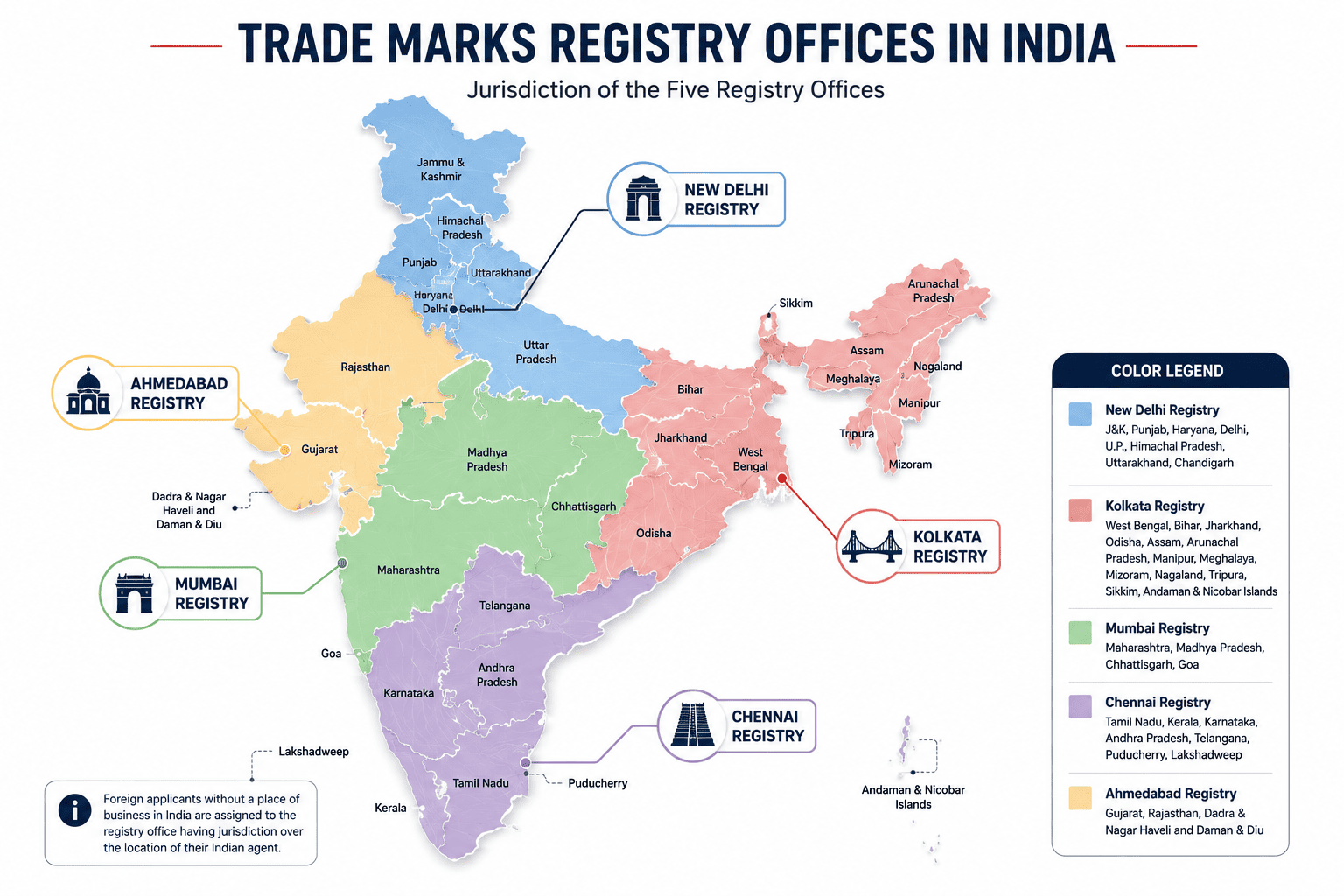
India runs five regional Trade Marks Registry offices, and your hearing gets handled by whichever one has jurisdiction over your principal place of business.
|
Registry Office |
States and Union Territories Covered |
|
Mumbai |
Maharashtra, Madhya Pradesh, Chhattisgarh, Goa |
|
New Delhi |
Jammu & Kashmir, Punjab, Haryana, Uttar Pradesh, Himachal Pradesh, Uttarakhand, Delhi, and the Union Territory of Chandigarh |
|
Kolkata |
West Bengal, Bihar, Jharkhand, Odisha, Assam, Arunachal Pradesh, Manipur, Meghalaya, Mizoram, Nagaland, Tripura, Sikkim, and the Union Territory of Andaman & Nicobar Islands |
|
Chennai |
Tamil Nadu, Kerala, Karnataka, Andhra Pradesh, Telangana, and the Union Territories of Puducherry and Lakshadweep |
|
Ahmedabad |
Gujarat, Rajasthan, and the Union Territories of Dadra & Nagar Haveli and Daman & Diu |
A foreign applicant without a business address in India gets assigned to whichever office covers their appointed Indian trademark agent's location instead, so the zone follows your representative rather than your home country.
How Do You Prepare for a Trademark Hearing?
-
Copy of the original examination report and your written reply to it
-
Power of attorney (Form TM-48), if an agent or attorney is representing you
-
Evidence of use: invoices, packaging photos, dated advertisements
-
A short list of similar marks already coexisting on the register, if you are arguing yours can too
-
Written arguments organised point by point against each objection raised
-
Confirmation of your hearing date, time, and mode (in person or video call), plus the link if it is virtual
Walking in with a one-page summary of your arguments, in the same order the examination report raised them, makes a real difference. Hearing officers sit through dozens of these in a day, and a reply that mirrors their own report's structure is simply easier to follow than one that jumps around.
What Happens During the Hearing?
-
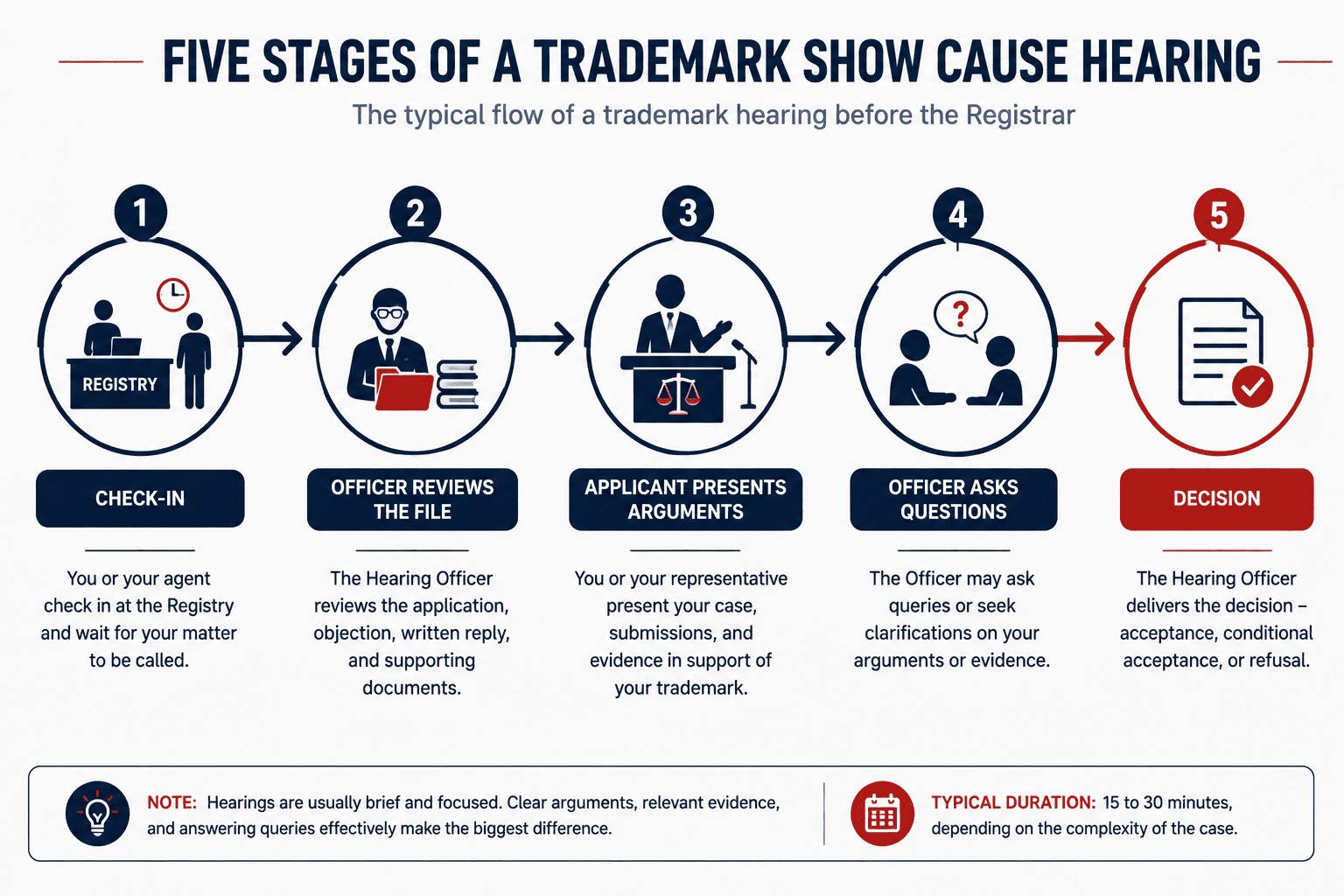
Check in at the start time. Confirm your attendance at the Registry counter, or join the virtual hearing room link if your hearing is over video call.
-
The officer reviews your file. The Hearing Officer goes through the examination report and your written reply before you speak.
-
You present your case. You or your agent argue each point directly, referring to your evidence and any similar marks you are relying on.
-
The officer may ask questions. Expect follow-up questions on specific objections rather than a free-form debate.
-
A decision follows, sometimes on the spot. Some hearings end with an immediate verbal decision. Others get reserved, with a written order following later through the portal.
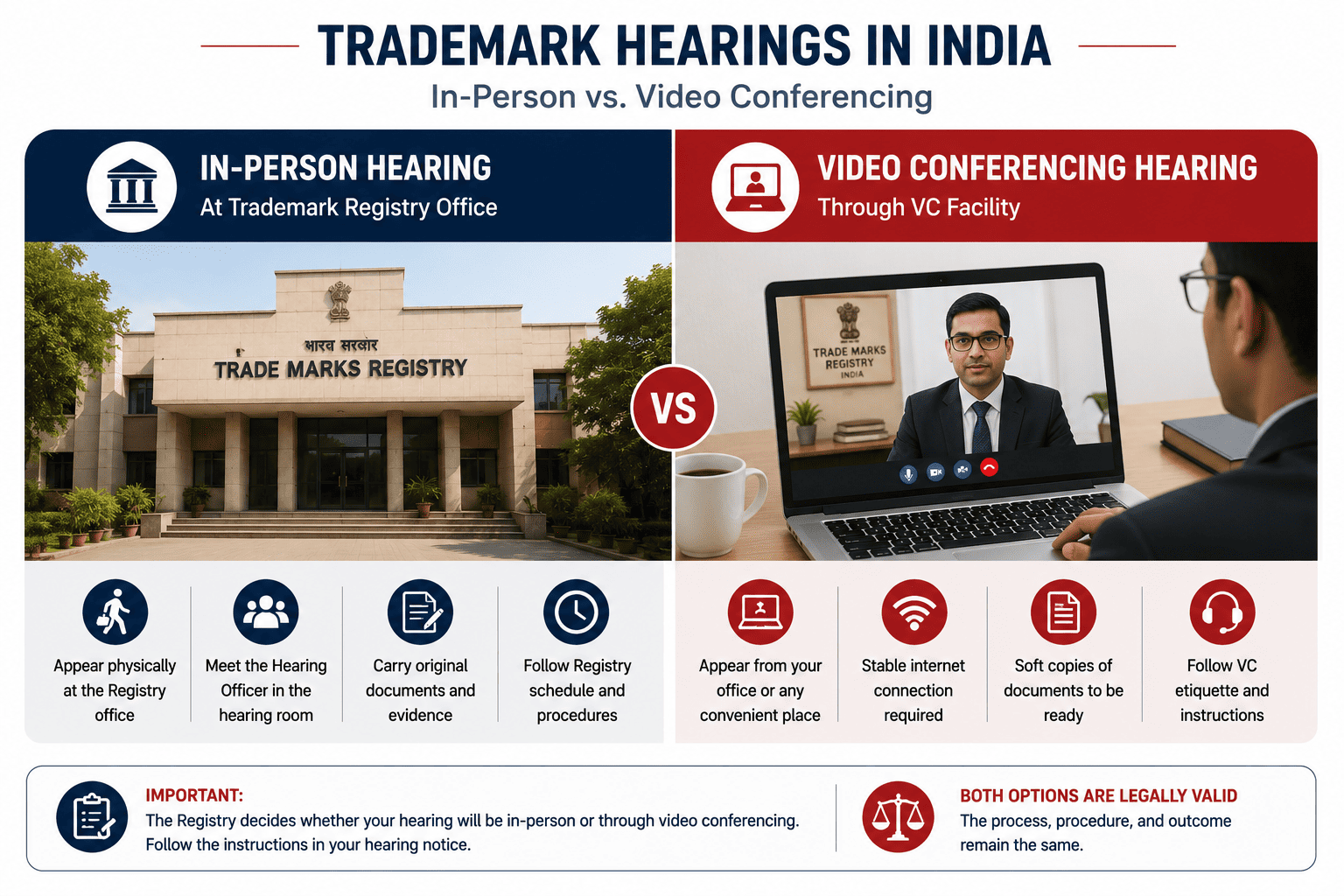
Video conferencing hearings, allowed under Rule 115 of the Trade Marks Rules, 2017, have become the default for most straightforward show cause hearings. In-person appearance still happens, particularly for more complex arguments, but it is no longer the only option.
|
Point |
In-Person Hearing |
Video Conferencing Hearing |
|
Where |
A physical Registry office in your zone |
IP India's virtual hearing rooms, from anywhere |
|
Legal basis |
Standard hearing procedure |
Rule 115, Trade Marks Rules, 2017 |
|
Travel needed |
Yes |
No |
|
Best suited for |
Complex arguments that benefit from an in-person presence |
Routine show cause hearings |
Can You Request an Adjournment?
Yes, though the rules keep this fairly tight. Under Rule 50 of the Trade Marks Rules, 2017, you can request an adjournment by filing Form TM-M along with the prescribed government fee of ₹900, at least three days before your scheduled hearing date.
The Registrar can refuse the request, and even when it is granted, there are hard limits. No party gets more than two adjournments in total, and each one can push the date back by a maximum of thirty days. Once you have used both, the hearing proceeds whether you feel ready or not, so treat those two chances as a genuine safety net rather than something to lean on casually.
What Happens If You Don't Show Up?
Skipping a hearing without requesting an adjournment carries real consequences. If you fail to appear on the scheduled date, and again on any adjourned date if one was granted, the Registrar can treat your application as abandoned.
That outcome is difficult to reverse. Getting your application reinstated after an abandonment is possible in limited circumstances, but it is far from guaranteed, and it depends heavily on showing a genuine, well-documented reason for missing the hearing rather than simple oversight.
What Are the Possible Outcomes of a Trademark Hearing?
A hearing generally ends in one of three ways.
-
Unconditional acceptance. Your arguments satisfy the officer, and your mark moves toward advertisement in the Trade Marks Journal.
-
Conditional acceptance. The officer accepts the mark, but only with conditions attached, such as a disclaimer on a non-distinctive part of the mark, or a narrower description of goods and services than you originally filed.
-
Refusal. The officer is not persuaded, and your application is refused outright.
Conditional acceptance surprises a lot of first-time applicants, since it feels like a partial win rather than a clean yes. In practice, accepting a reasonable disclaimer is often the faster path to registration compared to pushing back and risking an outright refusal over a minor point.
Can You Appeal If the Registrar Refuses Your Trademark?
Yes. If the Registrar refuses your application even after the hearing, you can appeal the decision, and this is one area where a lot of older guidance online is now out of date. Appeals used to go to the Intellectual Property Appellate Board, but the Tribunals Reforms Act, 2021 abolished that board and shifted its powers to the jurisdictional High Court.
Today, that means your appeal goes to the High Court that covers your Registry zone, and courts like Delhi and Madras now run dedicated Intellectual Property Divisions built specifically for these matters. If you come across older articles still pointing toward the IPAB, treat that as outdated rather than current guidance.
Do You Need a Lawyer for a Trademark Hearing, and What Does It Cost?
You are not legally required to hire anyone. You can attend and argue your own case, and plenty of individual applicants with straightforward Section 9 objections do exactly that.
Attending the hearing itself carries no government fee. The only hearing-related cost the government charges is the ₹900 fee if you file for an adjournment. What you might pay for, if you choose it, is professional representation, which tends to matter more once the objection involves a genuine Section 11 conflict with another registered mark, since arguing that kind of case well usually benefits from someone who has done it before.
If you are still at an earlier stage and want to reduce the odds of ever reaching a hearing in the first place, LegalBabu's Expert Trademark Review looks at your mark before filing, which is a far cheaper fix than untangling a conflict at the hearing stage. And once you do clear a hearing successfully, the next milestone worth tracking is your trademark certificate, which typically follows within days to a couple of weeks after the advertisement and opposition window close.
FAQS
FAQs About Trademark Hearing
-
What is a trademark hearing?
It is a show cause hearing before a Trade Marks Registry officer, held when your written reply to an objection needs further argument before a decision on your application.
- Why did my trademark application move to a hearing stage?
- What does
- Do I have to attend the hearing in person?
- Can I request to postpone my trademark hearing?
- What happens if I miss my trademark hearing?
- Will I get a decision on the same day as the hearing?
- What if the Registrar rejects my trademark after the hearing?
- Does attending a trademark hearing cost any government fee?
- Which Trade Marks Registry office will handle my hearing?


