NSQF accreditation is the process through which a training institute gets officially recognised to deliver courses aligned with India's National Skills Qualification Framework. Since NCVET recognises awarding bodies rather than individual institutes directly, most training providers get accredited by affiliating with an NCVET-recognised body such as NSDC, a sector skill council, or a state skill development mission.
That one detail trips up almost every institute owner researching this topic for the first time. You cannot walk up to the regulator and ask for accreditation directly. You go through a recognised gatekeeper. The rest of this guide walks through exactly how that works, who the gatekeepers are, what they expect, and how to get your paperwork in order.
What Is NSQF Accreditation?
The National Skills Qualification Framework, or NSQF, is a system that grades every skill qualification in India on a common scale, no matter which board, ministry, or company issued it. It was notified in December 2013 to fix a real problem. Before NSQF, an electrician's certificate from one state meant nothing to an employer in another state. A private diploma had no way of being compared to a government one. NSQF gave every qualification a level, so employers, colleges, and other countries could read it the same way.
Since December 2018, the National Council for Vocational Education and Training (NCVET) has anchored the whole system. NCVET replaced two older bodies, the National Skill Development Agency and the National Council of Vocational Training, and it now does three things that matter to you as an institute owner:
-
It recognises and regulates Awarding Bodies and Assessment Agencies.
-
It approves which qualifications get an NSQF level through a body called the National Skills Qualification Committee (NSQC).
-
It maintains the National Qualification Register, the official list of every NSQF-approved qualification.
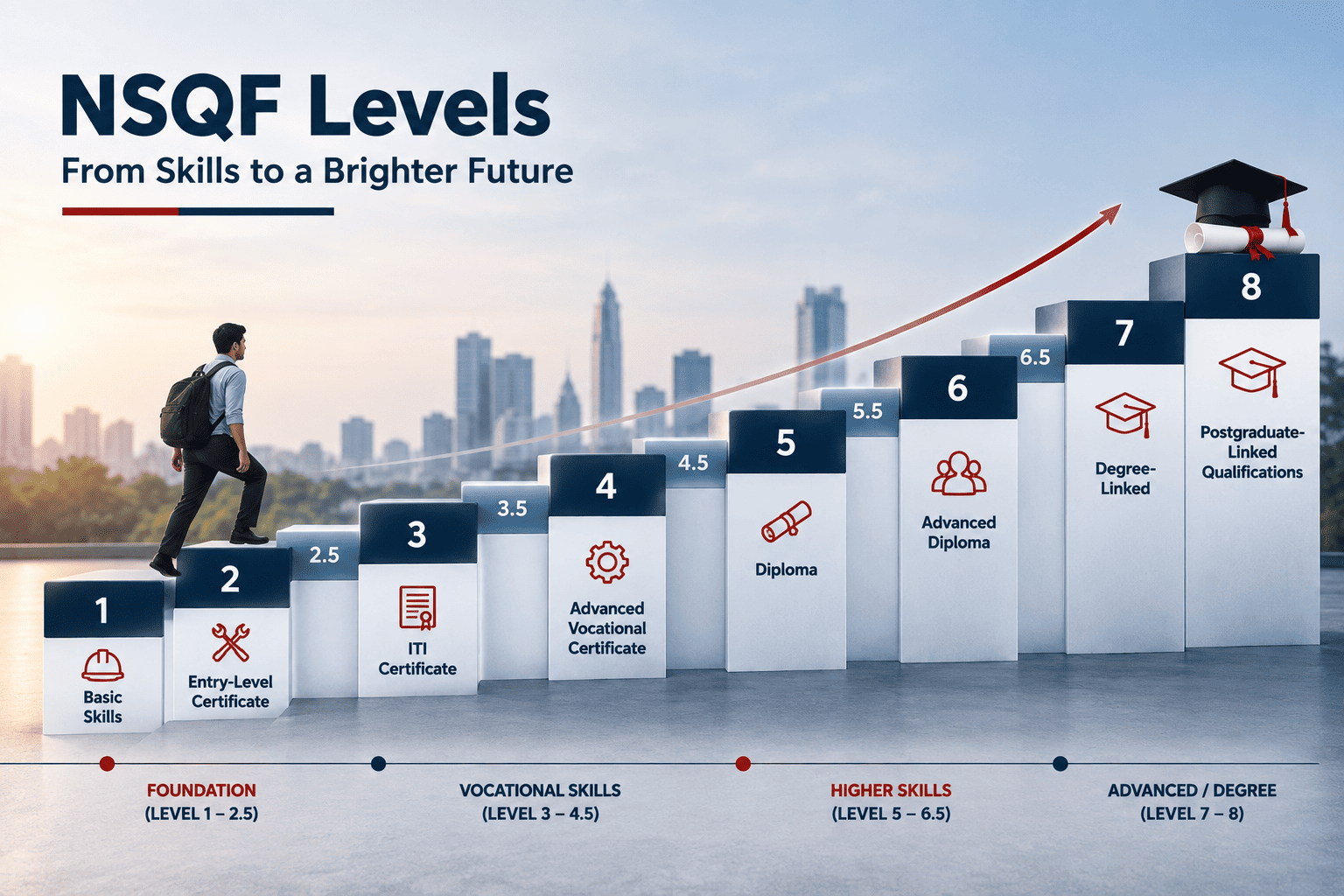
Here is the part most guides skip. The framework itself has changed shape recently. Older material (and a good chunk of what still ranks on Google) describes ten levels, from Level 1 to Level 10. NCVET's current notification places the framework at eight levels, Level 1 through Level 8, with half-levels such as 2.5, 3.5, and 4.5 built in for finer grading between the main levels. If you are cross-checking a Qualification Pack against an old PDF you downloaded years ago, this is worth double-checking against the live NCVET notification first.
|
NSQF Level Range |
Indicative Qualification Type |
Typical Setting |
|
Level 1 - 2.5 |
Basic/entry-level skill certificate |
Short-term vocational courses, RPL for informal workers |
|
Level 3 - 4.5 |
ITI certificate, advanced vocational certificate |
Industrial Training Institutes, Sector Skill Council courses |
|
Level 5 - 5.5 |
Diploma |
Polytechnics, skill universities |
|
Level 6 - 6.5 |
Advanced diploma, undergraduate-linked skill programme |
Skill universities, community colleges |
|
Level 7 - 8 |
Degree-linked and postgraduate-linked qualifications |
Universities offering NSQF-aligned degrees |
Treat this table as a rough map, not a rulebook. The exact level for any course is fixed case by case, when NCVET approves that specific Qualification Pack, not by a blanket rule tied to the type of institute.
Why Does NSQF Accreditation Matter for a Training Institute?
An unaccredited institute can still teach a skill. What it cannot do is issue a certificate that an employer, a government scheme, or another education board will automatically trust. Accreditation changes that in a few concrete ways.
-
Government scheme access. Only accredited training centres can enrol candidates under schemes like PMKVY, where the government pays for training and even covers a stipend for candidates.
-
Recognition of Prior Learning. Accredited centres can formally assess and certify workers who already have years of hands-on experience but no paper qualification, a route that opens up an entirely new candidate base for your institute.
-
Credit and mobility. Under the newer National Credit Framework, NSQF-aligned learning can convert into academic credits, so a candidate is not stuck choosing between a vocational path and a degree path forever.
-
Employer trust. A certificate tied to a National Occupational Standard tells an employer exactly what a candidate can do, not just that they attended a course.
-
Funding and grants. Several central and state skilling schemes restrict funding to accredited centres only, which shuts the door on non-accredited institutes entirely.
If you run a private coaching business today and none of this applies to you, accreditation may genuinely not be worth the paperwork. It matters most for institutes that want government-scheme candidates, corporate tie-ups, or graduates who need their certificate to mean something outside your own city.
Who Actually Grants NSQF Accreditation?
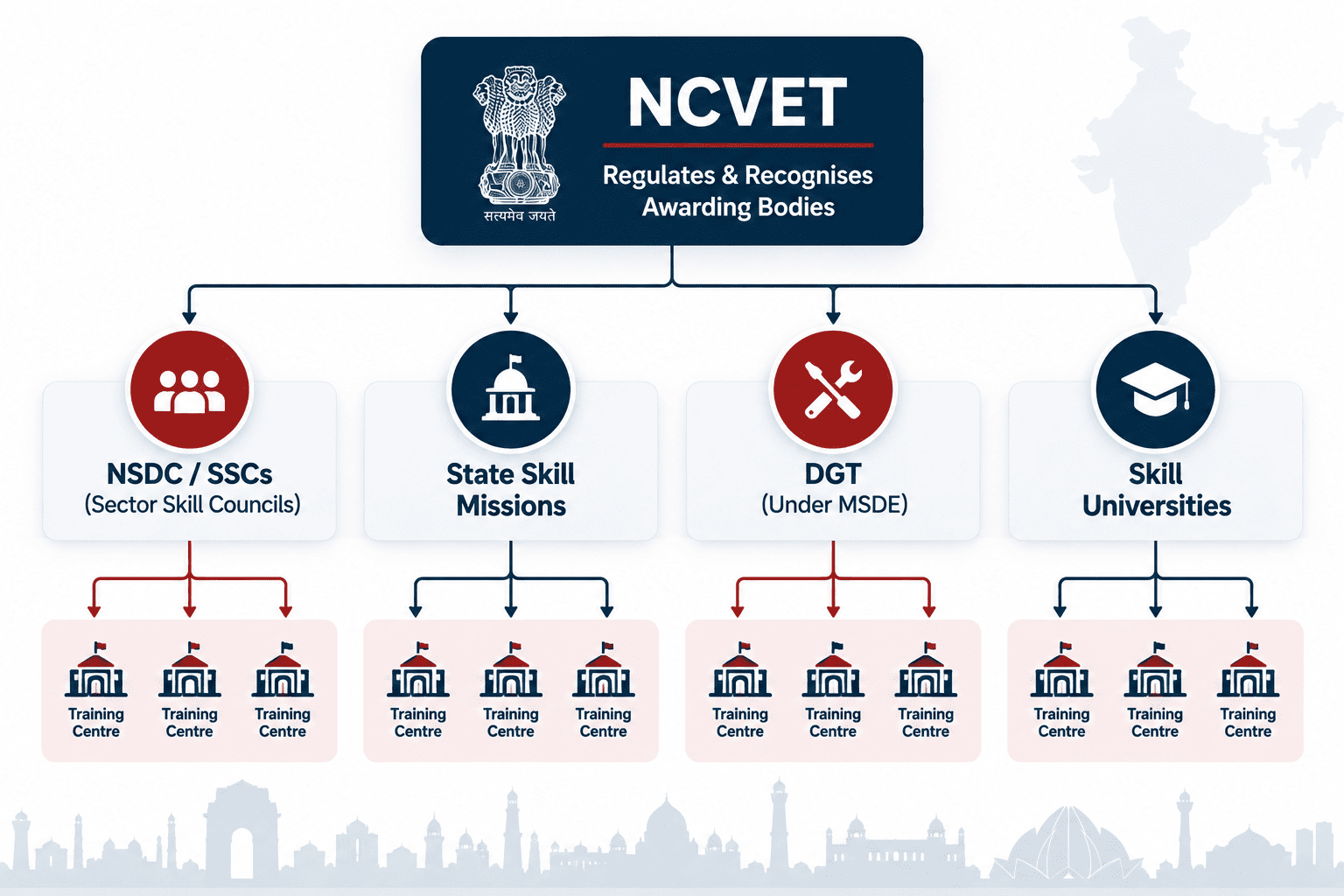
This is where most confusion starts. NCVET does not accredit training institutes one by one. It recognises Awarding Bodies and Assessment Agencies, and those Awarding Bodies then accredit or affiliate individual training centres under their own guidelines. Think of it as a three-tier structure.
-
NCVET sits at the top, setting the rules and recognising who gets to award NSQF-aligned certificates.
-
Awarding Bodies are the organisations NCVET has recognised, such as the National Skill Development Corporation (NSDC), individual Sector Skill Councils, State Skill Development Missions, Skill Universities, and government departments running their own training schemes.
-
Training Centres, meaning your institute, get accredited or affiliated by one of these Awarding Bodies, not by NCVET directly.
Which Accreditation Route Fits Your Institute?
Different Awarding Bodies suit different kinds of institutes. Here is a practical comparison to help you pick a starting point.
|
Route |
Best Suited For |
Approving Body |
Typical Timeline |
|
NSDC / Sector Skill Council |
Private training institutes, corporate training arms, NGOs |
NSDC and the relevant SSC |
Roughly 2 to 4 months |
|
State Skill Development Mission |
Institutes targeting state-funded schemes and local job roles |
State skill department or corporation |
Varies by state, often 2 to 6 months |
|
DGT / Craftsmen Training Scheme |
Formal ITIs offering long-duration trade courses |
Directorate General of Training |
Longer, given infrastructure and apprenticeship norms |
|
University / College embedding |
Colleges adding skill certificates or diplomas alongside degrees |
UGC, AICTE, or the relevant Skill University |
Depends on the institution's existing approval cycle |
For most private training institutes reading this, the NSDC and Sector Skill Council route is the practical starting point. It is also the route we have documented in full, step by step, in our NSDC Registration guide, which covers the exact portal workflow, fee schedule, and Centre Accreditation Application Form (CAAF) in detail.
If your institute already runs apprenticeship-linked training, it's also worth reading about the Third Party Aggregator (TPA) registration, a related MSDE initiative built to scale apprenticeship placements through industry aggregators.
Who Is Eligible for NSQF Accreditation?
Eligibility rules differ slightly between Awarding Bodies, but almost all of them check for the same core things.
-
A registered legal entity. You cannot apply as an unregistered individual or informal setup.
-
Some operational history. Most Awarding Bodies want to see at least a year of running education or training activity, though this varies.
-
Adequate infrastructure. Classrooms and labs sized and equipped according to the specific Qualification Pack you plan to teach.
-
Qualified trainers. Trainers whose qualifications match what the National Occupational Standard for that job role demands.
-
Sound financial standing. A positive net worth and clean financial records at the time of application.
-
A clean compliance record. No blacklisting or debarment by any government department.
Quick tip: Don't assume the criteria are identical everywhere. NSDC's exact numbers (classroom size, trainer qualifications, and so on) are laid out precisely in our NSDC Registration eligibility table. A State Skill Mission or a Sector Skill Council may set slightly different thresholds for the same job role.
What Documents Do You Need?
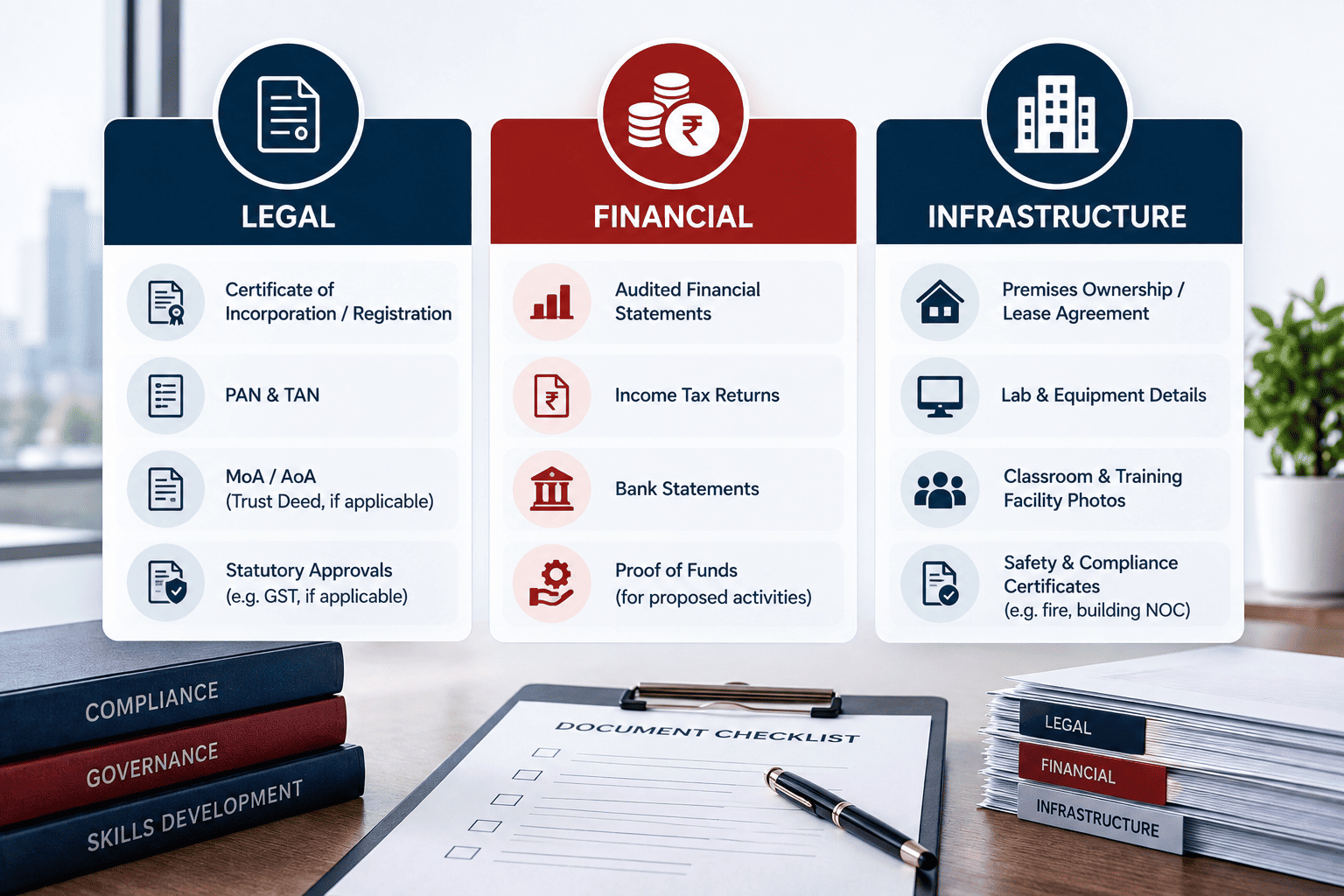
The exact list depends on which Awarding Body you approach, but nearly every application asks for documents in three buckets.
Legal and entity documents
-
Certificate of incorporation or registration (company, LLP, trust, society, or Section 8 company)
-
PAN card of the organisation
-
GST registration certificate, if applicable
-
12A and 80G registration, for NGOs seeking tax benefits alongside accreditation
Financial documents
-
Audited financial statements for the last two to three years
-
Income tax returns
-
Bank statements
Infrastructure and trainer documents
-
Ownership or lease proof for the training premises
-
Classroom and lab layout plan
-
Equipment list matching the relevant Qualification Pack
-
Trainer resumes and qualification proof
-
Proof of a biometric attendance system, where the Awarding Body requires one
How Does the Accreditation Process Work, Step by Step?
While every Awarding Body has its own portal and forms, the overall journey looks broadly similar across routes.
-
Pick your Awarding Body. Decide between NSDC/SSC, a State Skill Mission, DGT, or a university route based on the table above.
-
Register your entity, if you haven't already. You need a company, LLP, trust, society, or Section 8 company in place before you can apply.
-
Submit your application and initial documents. This is usually done on a dedicated online portal.
-
Go through a preliminary desktop review. The Awarding Body's inspection team checks your paperwork before anything physical happens.
-
Build out your infrastructure and trainer roster to match the specific Qualification Pack or job role you want to offer.
-
Submit your detailed centre application, covering classroom size, lab equipment, trainer profiles, and the exact job roles you plan to teach.
-
Host a physical inspection. An independent auditor visits your premises to confirm everything on paper actually exists on the ground.
-
Receive your grading or accreditation decision. Some awarding bodies grade centres (similar to a report card); others simply approve or reject.
-
Get your job role or qualification affiliated, and receive your accreditation certificate and unique centre ID.
For the NSDC/SSC route specifically, we've broken this down into an 11-step walkthrough with exact fee figures in our complete NSDC Registration guide.
What Do You Need to Do to Keep Your Accreditation Active?
Getting accredited is not a one-time task you can forget about. Every awarding body expects ongoing compliance, and slipping on it can cost you your accreditation.
-
Renew on time. Most accreditations run on a cycle, commonly one to three years, after which you need to reapply or go through a renewal review.
-
Pay continuous monitoring fees, where applicable, to keep your status active between renewal cycles.
-
Keep infrastructure and trainers current. If your Qualification Pack gets revised, your classroom setup and trainer qualifications need to keep pace.
-
Maintain attendance and record-keeping systems. Biometric attendance and batch records are commonly audited without notice.
-
Track and report outcomes, since some awarding bodies review placement or assessment results as part of ongoing monitoring.
-
Avoid compliance breaches. False reporting, admitting more students than your sanctioned capacity, or letting your trainer roster lapse can lead to suspension.
Is NSQF Accreditation the Same as ISO Certification or UGC/AICTE Approval?
No, and mixing these up is a common and costly mistake.
NSQF accreditation benchmarks the skill level and job-readiness of a specific course. ISO 9001 certification is a completely separate quality management system standard that looks at how consistently your institute runs its internal processes, from admissions to grievance handling. Many training institutes carry both because they serve different purposes, and some awarding bodies actually treat a valid ISO 9001 certificate as supporting evidence of good governance during accreditation review.
UGC and AICTE approval, on the other hand, governs whether a college or university can legally award a degree or diploma at all. NSQF accreditation doesn't replace that. A college can hold UGC recognition for its degree programmes and separately pursue NSQF alignment for a vocational certificate or add-on skill course running alongside those degrees.
What Legal Structure Should Your Institute Have Before You Apply?
Awarding bodies generally accept a wide range of legal structures, so you have flexibility here. The most common choices are:
-
Private Limited Company, for institutes planning to scale and raise investment
-
Section 8 Company, for non-profit skilling initiatives
-
Trust, a traditional structure for education and training NGOs
-
Society, another common non-profit route, especially for state-level skilling bodies
If you're setting up a non-profit institute, pairing your entity registration with 12A and 80G registration is worth doing early, since donors and CSR partners typically expect it, and some Awarding Bodies factor it into their review of NGO applicants.
Once your legal structure is in place and you've mapped out your accreditation route from the Certification services we cover, the documentation and application stage moves a lot faster.
FAQS
Have some questions about NSQF Accreditation?
We have got you covered:
-
Is NSQF accreditation compulsory for every training institute in India?
No. It is only required if you want your certificates recognised under government schemes, want access to funding, or want your qualification levels to carry weight with employers and other education bodies. A purely private coaching centre with no such ambitions can operate without it.
- Can a private coaching centre apply for NSQF accreditation directly with NCVET?
- How is NSQF accreditation different from NSDC Registration?
- Do schools and colleges need NSQF accreditation for their vocational subjects?
- How long does NSQF accreditation usually take to complete?
- Can an institute lose its NSQF accreditation after getting it?
- Is NSQF accreditation valid across all Indian states?
- What happens to students' certificates if an Awarding Body loses NCVET recognition?
- Can a foreign training provider or franchise get NSQF accreditation in India?
- Does NSQF accreditation guarantee student placement?


