
A National Operator Training License lets you legally operate GMDSS radio equipment on Indian ships. You train at a DGMA-approved maritime institute, then sit for a WPC exam under the Telecommunications GMDSS Rules, 2024. Pass it, and you get a GMDSS General Operator Certificate or Restricted Operator Certificate, valid for twenty years or for life.
What Is the National Operator Training License?
People use this phrase to describe one specific process: becoming a certified GMDSS radio operator on an Indian ship. GMDSS stands for Global Maritime Distress and Safety System. It is the emergency communication network every commercial vessel depends on when something goes wrong at sea.
You will also see this called a National Operator Licence, an Operator Training Certification, or simply a GMDSS certificate. They all point to the same underlying framework, built around two certificate types: a General Operator Certificate (GOC) and a Restricted Operator Certificate (ROC). Both sit under the Telecommunications (Commercial Radio Operator Certificate of Proficiency to Operate Global Maritime Distress and Safety System) Rules, 2024.
Two separate authorities share this system, and mixing them up causes real confusion. DGMA, the Directorate General of Maritime Administration, approves the maritime training institutes where you complete your practical GMDSS training. The WPC Wing of the Department of Telecommunications runs the actual exam and issues your certificate. Your training happens on one side of the system. Your license happens on the other.
Why Does This License Matter So Much at Sea?
Picture a cargo ship losing engine power forty miles off the coast, at night, in rough weather. The crew's first move is a distress call through GMDSS equipment, not a phone or a walkie-talkie. An operator who has never handled the equipment under pressure can fumble that call at the worst possible moment.
SOLAS Chapter IV made GMDSS mandatory for good reason. Search and rescue teams depend on a properly transmitted distress alert to even know a ship is in trouble. That is why India, like every IMO member state, requires a certified operator on GMDSS-fitted vessels instead of leaving the equipment to whoever happens to be on watch.
There is a career angle too. Shipping companies will not sign you on as an officer or GP rating without checking your GMDSS paperwork first. Manning agents holding an RPSL License verify this certificate before they place a candidate on a vessel. Skip it, and your sea career stalls before it starts.
GOC or ROC: Which One Do You Actually Need?
This is the question people ask us most often, and the honest answer depends on the kind of vessel you plan to sail on.
|
Feature |
GMDSS General Operator Certificate (GOC) |
GMDSS Restricted Operator Certificate (ROC) |
|
Best suited for |
Officers and crew on ships fitted with satellite and HF GMDSS equipment, sailing beyond coastal range |
Crew on vessels operating mainly within VHF and MF coastal coverage |
|
Minimum practical training |
2 continuous weeks (96 hours) |
1 week (40 hours) |
|
Fee |
₹10,000 for 20 years' validity, or ₹15,000 for lifetime |
₹5,000 for lifetime |
|
Typical career fit |
Deck officers, radio officers, deep-sea GP ratings |
Near-coastal crew, fishing vessel operators, smaller commercial craft |
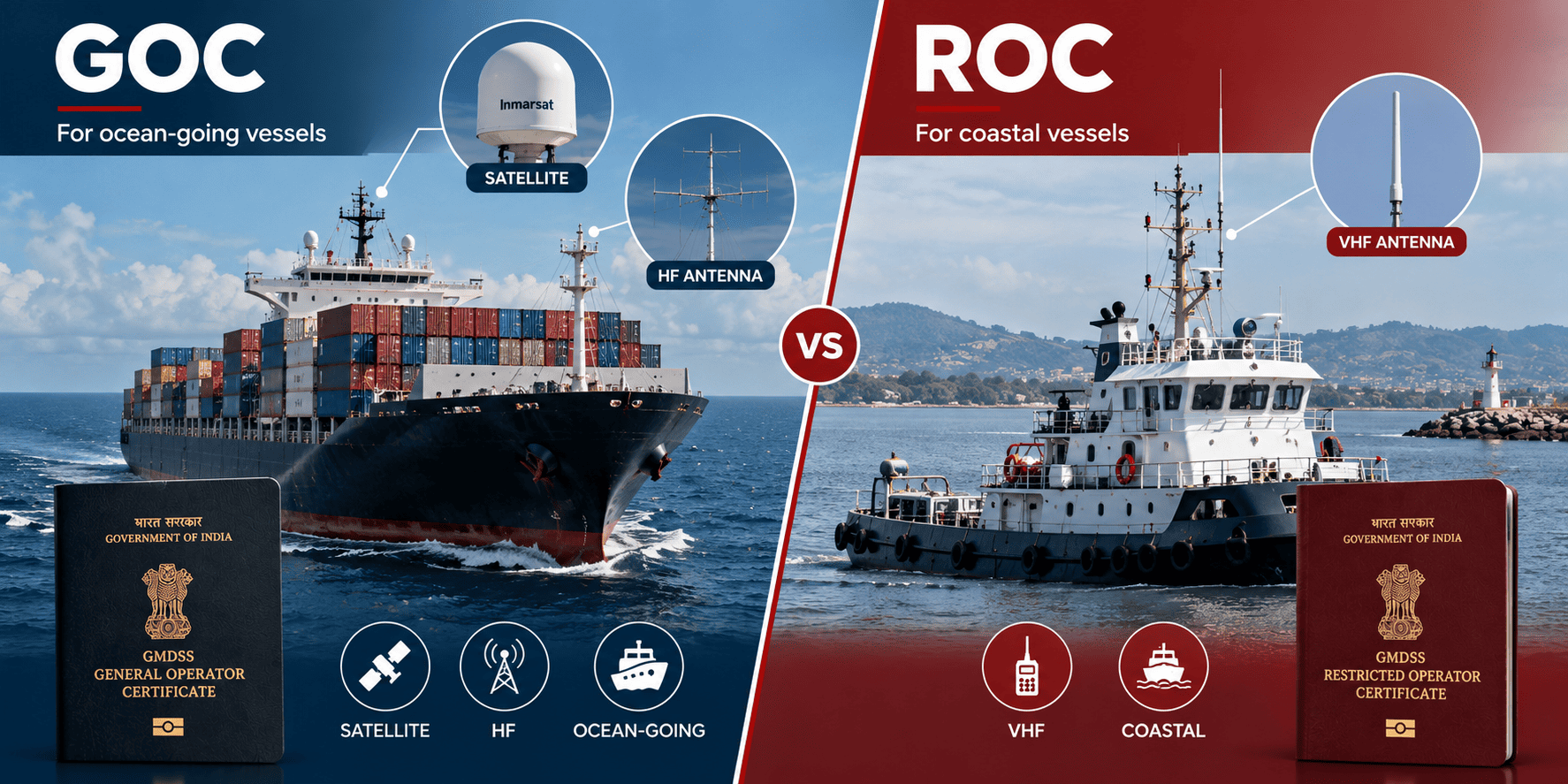
Here is a rough rule of thumb from the industry: if your ship's GMDSS fit-out includes an Inmarsat terminal or HF radio for ocean-going voyages, you need a GOC. If your vessel stays close to shore running on VHF and MF gear alone, a ROC usually covers you. Your Maritime Training Institute or your company's technical department can confirm exactly which category your vessel falls under, since the equipment fit-out decides the requirement, not your rank on paper.
Who Is Eligible for the National Operator Training License in India?
Eligibility splits cleanly by certificate type, and the operator license requirements run through three separate qualifying routes for each one.
|
Requirement |
GOC |
ROC |
|
Minimum age |
18 years, as on the exam date |
18 years, as on the exam date |
|
Route 1 |
Passed Class 12 with Mathematics and Physics |
Passed Class 10, or an equivalent maritime or fisheries department certificate |
|
Route 2 |
Holds a valid Certificate of Competency recognised by DGMA under the Merchant Shipping Act, 1958 |
Holds a valid Certificate of Competency recognised by DGMA under the Merchant Shipping Act, 1958 |
|
Route 3 |
Holds a valid certificate of proficiency already issued by the WPC Wing |
Holds a valid certificate of proficiency already issued by the WPC Wing |
|
Practical training |
Minimum 2 weeks (96 hours) at an approved institute |
Minimum 1 week (40 hours) at an approved institute |
You only need to satisfy one of the three routes, not all three together. Most fresh cadets qualify through Route 1, since it lines up naturally with finishing school before joining a pre-sea course. Working seafarers who already hold a Certificate of Competency usually qualify through Route 2 without redoing their basic education proof.
Foreign nationals can sit the exam too, but only with prior clearance from the Ministry of Home Affairs and the Ministry of External Affairs. This route mainly serves training partnerships and joint-venture crewing arrangements, not casual walk-in candidates.
Where Do You Complete the Required Practical Training?
You cannot walk into the WPC exam cold. The rules require hands-on training first, at an institute the government has actually approved for GMDSS instruction.
Most candidates complete this training at a DGMA-approved Maritime Training Institute, often bundled into a broader pre-sea course such as B.Sc Nautical Science, Diploma in Nautical Science, or GP Rating training. If you want to understand how these institutes earn their approval in the first place, our guide on starting a Maritime Training Institute in India walks through DGMA's approval process from the institute's side.
One word of caution here. Not every training centre advertising a "GMDSS course" holds valid, current DGMA approval. Ask to see the institute's approval status before you pay a single rupee. Training at an unapproved centre can leave you unable to sit the WPC exam at all, no matter how good the course felt.
What Documents Do You Need to Apply?
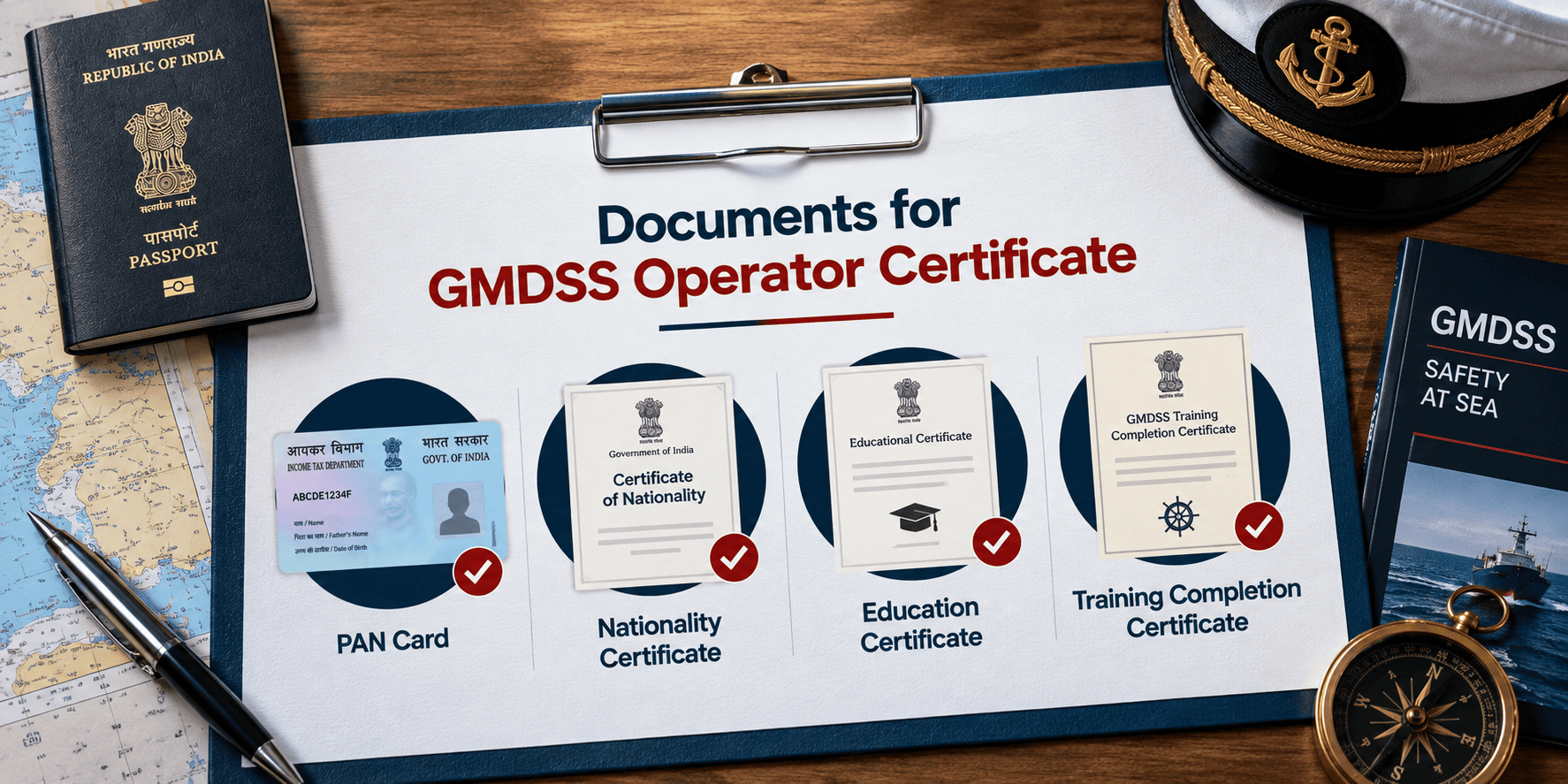
The WPC Wing keeps its official document list short. Officially, you need:
-
PAN card
-
Nationality certificate
-
Class 12 passing certificate
That last item can be a little misleading if you are applying for a ROC through the Class 10 route. Check with your regional WPC office about submitting your Class 10 certificate, or your maritime and fisheries department certificate, whichever matches your actual eligibility route.
In practice, most institutes and regional offices also expect:
-
Your practical training completion certificate from your approved institute
-
Recent passport-size photographs
-
Your Certificate of Competency, if you are applying through that route instead of the education route
-
A valid INDoS number, since DGMA-approved institutes generally will not enrol a candidate in a modular course without one
Keep scanned copies of everything ready before you start your online application. Missing documents are the single biggest reason applications sit unprocessed for weeks.
What Is the Operator Training License Application Process?
Here is how the process runs from start to finish.
-
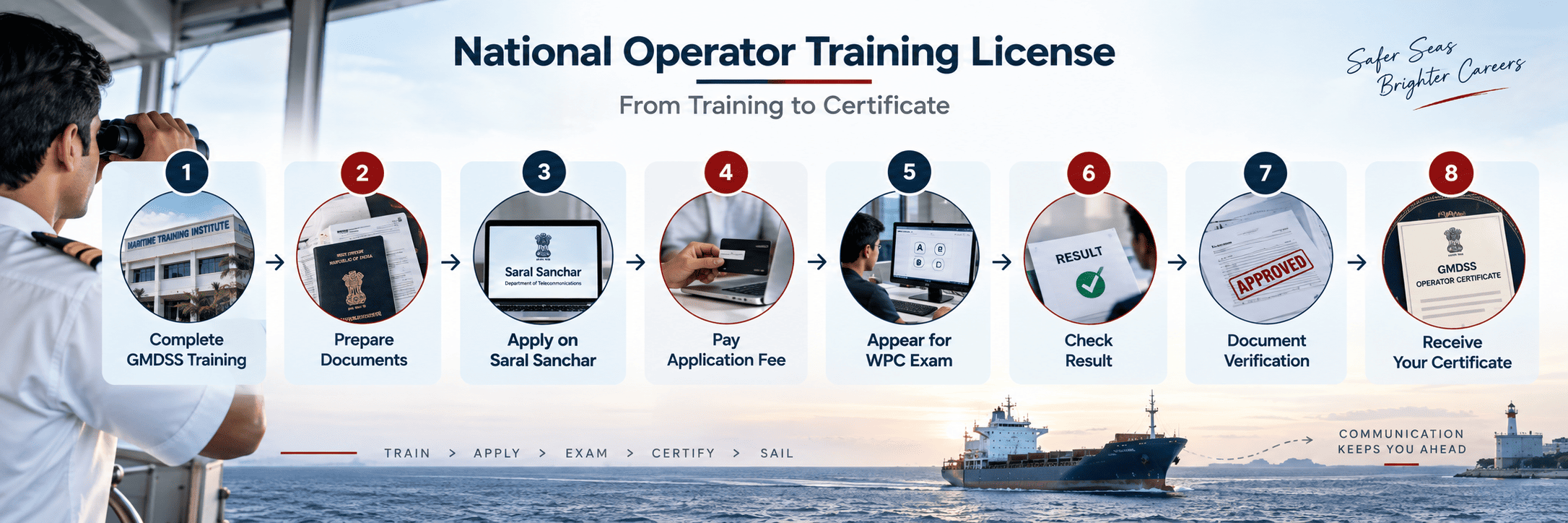
Decide whether you need a GOC or a ROC, based on the vessel type or career path you are targeting
-
Enrol in and complete your practical GMDSS training at a DGMA-approved institute
-
Collect your PAN card, nationality certificate, education or Certificate of Competency proof, and training completion certificate
-
Register on the Saral Sanchar portal
-
Upload your signed application along with every required document
-
Sit for the WPC examination, held under rule 7 of the 2024 Rules
-
Wait for your result, which the WPC Wing publishes after each exam cycle
-
Collect your GOC or ROC certificate from your regional WPC licensing office once you clear the exam
If you do not clear the exam on your first attempt, you can reapply for the next available cycle. The current rules do not cap the number of attempts.
How Much Does It Cost, and How Long Does It Last?
|
Certificate |
Fee |
Validity |
|
GMDSS General Operator Certificate |
₹10,000 |
20 years |
|
GMDSS General Operator Certificate |
₹15,000 |
Lifetime |
|
GMDSS Restricted Operator Certificate |
₹5,000 |
Lifetime |
"Lifetime" carries a specific legal meaning here. Under the 2024 Rules, it runs until the certificate holder turns eighty. That detail is worth knowing while you budget for your career, since paying the extra amount upfront for lifetime GOC validity saves you a renewal cycle and its paperwork twenty years down the line. Fee amounts and category-wise charges are occasionally revised, so confirm the current schedule with your regional WPC office before you pay.
Which WPC Regional Office Handles Your Application?
India splits GMDSS certificate processing across five regional licensing offices.
-
North: Ghitorni, New Delhi
-
East: Kolkata
-
West: Kandivali, Mumbai
-
South: Chennai
-
North East: Shillong
Your application routes to whichever regional office covers your location or your training institute's jurisdiction. If you are unsure which office applies to you, your training institute's administration office can usually confirm this before you register on the Saral Sanchar portal.
What Happens If You Sail Without a Valid Certificate?
Sailing as a radio operator without a valid GOC or ROC breaches SOLAS carriage requirements and India's Merchant Shipping framework at the same time. Treat this certificate as a hard operational requirement, not something you can circle back to once you are already on board.
Port State Control inspectors check crew certification during vessel inspections. A missing or invalid GMDSS certificate can trigger a deficiency notice, delay a ship's departure, or in serious cases, lead to detention. For the individual seafarer, sailing in a GMDSS-designated role without the right certificate can also affect your Continuous Discharge Certificate record and your future employability with RPSL-licensed manning agents.
Employers carry their own share of this risk. A shipping company that signs on uncertified radio operators exposes itself to the same kind of Port State Control and DGMA compliance findings we cover in our DDOC certification guide, where documented compliance gaps put the company's own certification at risk, not just the individual's career.
How Can LegalBabu Help You With Your Operator Training License?
Getting this license right on the first attempt saves you months of avoidable delay, and our maritime compliance team can help at every stage of the process.
We help individual candidates work out whether they need a GOC or a ROC based on their actual career track, then point them toward DGMA-approved training institutes that match their timeline and budget. Once you finish training, we handle the paperwork side: compiling your documents correctly, filing your Saral Sanchar application, and tracking your exam result through to certificate dispatch.
For shipping companies and manning agencies, we run compliance checks across your crew list to confirm every GMDSS-designated role actually holds a valid, current certificate, and we track twenty-year GOC renewals so nobody's paperwork lapses mid-contract.
FAQS
Have questions about National Operator Training License?
We have you covered:
-
Can I start my GMDSS training while I am still doing my B.Sc Nautical Science?
Yes. Most B.Sc Nautical Science and Diploma in Nautical Science programs at DGMA-approved institutes build GMDSS training directly into the course schedule, so you usually finish it well before your first sea phase begins.
- Do I need an INDoS number before I can enrol in a GMDSS course?
- Does my GMDSS certificate expire if I stop sailing for a few years?
- Can I upgrade from a ROC to a GOC later in my career?
- Is the WPC GMDSS exam difficult?
- Can I complete GMDSS training online instead of attending in person?
- What happens if I lose my GOC or ROC certificate?
- Is a GOC issued in India valid if I work on a foreign-flagged ship?
- How long after the WPC exam do I actually receive my certificate?
- Do GP ratings need this license, or is it only for officers?


