
Interim Maritime Labour Certificate: When Ships Can Get One
- by kapil
- Updated October 7, 2026
- 18 mins read
An interim maritime labour certificate can be issued for up to six months when a new ship is delivered, a ship changes flag, or a new shipowner takes responsibility for a ship. Before issuing it, the flag State or authorized RO must verify key MLC requirements, including shipboard conditions, owner procedures, master familiarity and information needed for the DMLC.
What is an Interim Maritime Labour Certificate?
An interim maritime labour certificate is a temporary MLC certification document that can help a ship operate while the full Maritime Labour Certificate process is completed.
Under Standard A5.1.3, an interim certificate may be issued by the competent authority or a recognised organisation that has been duly authorised for this purpose. Its validity cannot exceed six months.
The MLC 2006 does not require every flag state to issue interim certificates. The flag state has to choose whether to provide for them within its certification system.
The official ILO text sets out the interim certificate in Appendix A5-II and places the relevant requirements in Standard A5.1.3.
For the broader certification process, see LegalBabu’s MLC 2006 certification process.
When can an interim Maritime Labour Certificate be issued?

The MLC allows an interim certificate in three situations:
- A new ship is delivered.
- A ship changes flag.
- A shipowner takes responsibility for a ship that is new to that shipowner.
The ILO’s 2026 FAQ confirms all three situations.
| Situation | Why an interim certificate may be used |
| New ship on delivery | Gives the ship a temporary certification route while full certification is completed |
| Ship changes flag. | Allows certification arrangements to be established under the new flag |
| The new shipowner takes responsibility. | Covers a ship that is new to the incoming shipowner |
These cases are specific. A company should not assume that any temporary documentation problem qualifies for an interim MLC certificate.
Does the flag State have to issue one?
No. A flag State need not issue interim Maritime Labour Certificates. The ILO FAQ expressly states that the decision to issue them rests with the flag State’s certification system.
This is important for shipowners planning delivery, flag transfer or a change in ship management. The company should confirm the flag State’s process early rather than assuming an interim certificate will automatically be available.
Can a new ship get an interim MLC certificate on delivery?
Yes, a new ship on delivery is one of the three situations specifically recognised under Standard A5.1.3.
A newly delivered ship may need to begin operations before the full-term Maritime Labour Certificate has been issued.
The interim route gives the competent authority or authorized RO a way to verify the required matters and issue temporary certification for up to six months.
However, the shipowner still has to demonstrate that it has adequate procedures for complying with the MLC.
The interim certificate should therefore be treated as part of a controlled transition into full certification, rather than as a substitute for the full inspection.
Can a ship get an interim MLC certificate when it changes flag?
Yes. A change of flag is expressly listed as a situation in which an interim Maritime Labour Certificate may be issued.
This can be particularly important during a flag transfer because the ship’s certification has to align with the requirements of the new flag State.
A useful compliance step is to prepare the certification documents before the actual flag change. That gives the owner, master and authorized organization enough time to identify gaps.
The change of flag also matters to the existing Maritime Labour Certificate. Under Standard A5.1.3, a Maritime Labour Certificate ceases to be valid when a ship changes flag.
So the new flag cannot simply rely on the previous flag’s certificate as though nothing changed.
Can a new shipowner get an interim Maritime Labour Certificate?
Yes. The third permitted situation applies when a shipowner assumes responsibility for operating a ship that is new to that shipowner.
This can happen when a vessel moves into the management or operational responsibility of a different shipowner.
The important point is that the trigger concerns responsibility for the ship’s operation. The incoming shipowner must demonstrate that it has suitable procedures for complying with the MLC.
This is one reason a change of management should trigger a compliance review even when the ship itself has not changed.
How long is an interim Maritime Labour Certificate valid?
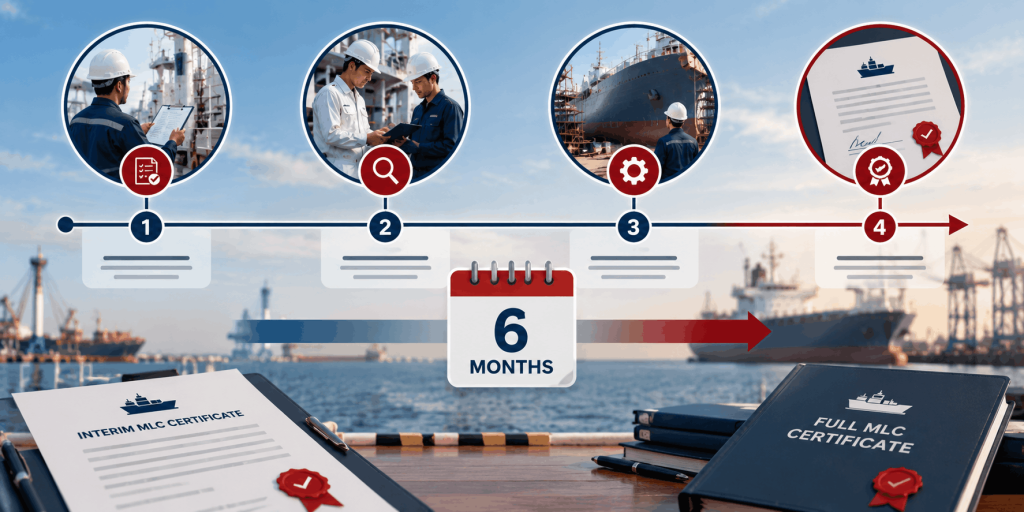
The maximum validity is six months. The MLC wording uses “not exceeding six months”, so six months is a maximum rather than an automatic period that every flag State must grant.
The certificate is intended to bridge the period before the full-term Maritime Labour Certificate can be issued.
A simple timeline looks like this:
Trigger event → Interim inspection and verification → Interim certificate → Maximum 6 months → Full inspection → Full Maritime Labour Certificate
The full inspection must take place before the interim certificate expires so that the full-term certificate can be issued.
Can the six-month period be extended?
The MLC does not provide for a routine extension of the interim certificate beyond its maximum six-month period.
The ILO FAQ states that no further interim certificate may be issued following the initial six months.
That makes the six-month period an important planning deadline.
Practical tip: Do not wait until the fifth or sixth month to start preparing for the full inspection. Any unresolved documentation, procedure or shipboard compliance gap can create unnecessary pressure.
Can an interim Maritime Labour Certificate be renewed?
No. The official ILO FAQ states that an interim Maritime Labour Certificate may be issued once to a ship for a period not exceeding six months, and no further interim certificate may be issued following the initial six months.
This means an owner cannot use repeated interim certificates as a rolling replacement for the full Maritime Labour Certificate.
The correct approach is to use the interim period to complete the requirements for full certification.
What must be verified before an interim MLC certificate is issued?

Four important areas must be verified.
1. Has the ship been inspected in the relevant MLC areas?
The ship must be inspected, as far as reasonable and practicable, for the matters listed in Appendix A5-I.
These are the 16 areas used in the MLC certification framework.
The inspection is therefore part of the interim certification process. The temporary nature of the certificate does not remove the need for meaningful verification.
2. Does the shipowner have adequate MLC procedures?
The shipowner must demonstrate to the competent authority or authorized RO that the ship has adequate procedures to comply with the Convention.
This is a key difference between simply having documents and having a working compliance system.
The owner should be able to show how it will manage MLC requirements during the interim period.
3. Is the master familiar with MLC requirements?
The master must be familiar with:
- The MLC requirements
- The master’s responsibilities
- The procedures used to implement those requirements onboard
This check has a practical purpose.
A ship may have a detailed compliance manual, but the master should still understand the key responsibilities without having to search through a large manual during an inspection.
4. Has the required information been submitted for the DMLC?
Relevant information must be submitted to the competent authority or authorized RO so that a Declaration of Maritime Labour Compliance can be produced.
This does not mean that a DMLC must be issued for the entire interim period.
The MLC specifically allows the DMLC not to be issued during the period of validity of the interim certificate.
Does an interim MLC certificate require a DMLC?
No, a DMLC does not have to be issued for the period covered by the interim certificate.
This is one of the most useful differences between interim and full certification. Under Standard A5.1.3, a DMLC need not be issued during the validity period of the interim certificate.
However, the shipowner still has to provide relevant information needed to produce a DMLC as part of the interim certification verification.
That means the absence of a DMLC during the interim period should not be interpreted as an absence of MLC compliance work. The company should already be preparing the information required for full certification.
What happens before the interim certificate expires?
A full inspection must be completed before the interim certificate expires so that the full-term Maritime Labour Certificate can be issued.
The ILO’s Guidelines for Flag State Inspections state that the inspection required for the full certificate should take place before the interim certificate expires.
A practical preparation sequence is:
- Review the applicable flag state requirements.
- Confirm the 16 MLC certification areas.
- Complete the interim verification.
- Obtain the interim certificate.
- Close documentation and shipboard gaps.
- Prepare the DMLC information.
- Arrange the full inspection.
- Complete the full certification process.
- Obtain the full-term Maritime Labour Certificate.
The exact process and timing can vary with the flag State and authorized RO.
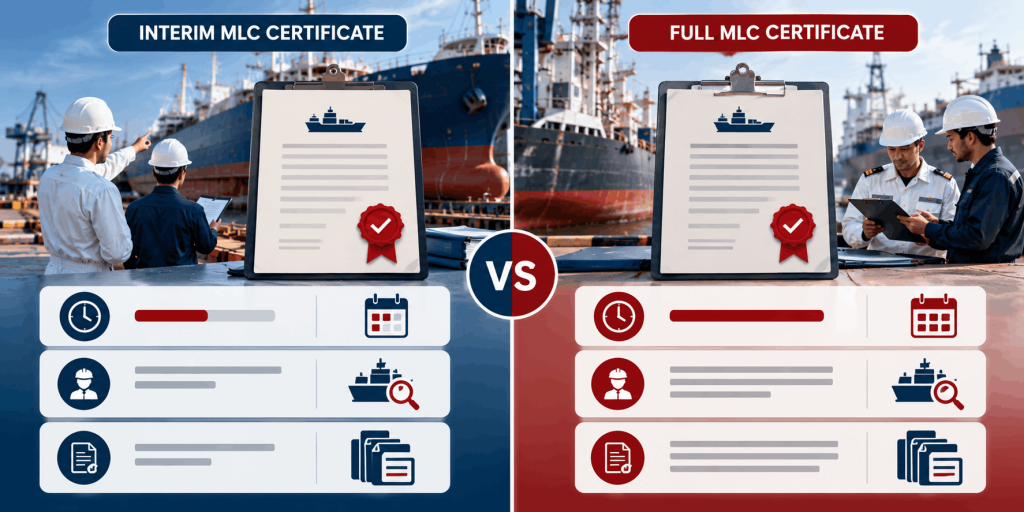
What is the difference between an interim and full Maritime Labour Certificate?
| Point | Interim Maritime Labour Certificate | Full Maritime Labour Certificate |
| Purpose | Temporary certification during specific transition situations | Full MLC certification |
| Maximum validity | 6 months | Up to 5 years, subject to MLC requirements |
| Permitted situations | New ship, change of flag, new shipowner responsibility | Following the required full certification process |
| DMLC | Need not be issued during interim period | DMLC is attached to the certificate |
| Inspection | Relevant matters inspected as far as reasonable and practicable | Full inspection of the national requirements in the 16 areas |
| Renewal | No further interim certificate after the initial six months | Subject to the normal certification and renewal system |
| Issued by | Competent authority or duly authorized RO | Competent authority or duly authorized RO |
The full Maritime Labour Certificate has a maximum validity of five years under Standard A5.1.3, subject to the applicable inspection and endorsement requirements.
For more information on the validity of the MLC certificate, see LegalBabu’s MLC certification guide.
Is an interim certificate the same as an MLC certificate?
No. An interim certificate is a temporary certification document issued under the specific conditions in Standard A5.1.3.
A full Maritime Labour Certificate follows the complete certification process.
The distinction matters because the interim certificate has:
- A specific purpose
- Three permitted triggering situations
- A maximum six-month period
- Specific verification requirements
- No renewal through another interim certificate
The full certificate follows the broader certification process and is subject to the inspection and endorsement requirements of the MLC.
The ILO’s official MLC materials contain separate model documents for the Maritime Labour Certificate, DMLC and Interim Maritime Labour Certificate.
What happens to an existing MLC certificate when a ship changes flag?
The existing Maritime Labour Certificate ceases to be valid when the ship changes flag. That makes flag transfer a significant certification event.
The new flag State will need to establish compliance under its own certification framework. Where its system provides for interim certificates, the ship may qualify for an interim certificate under the change-of-flag provision.
Shipowners should therefore coordinate:
- Flag change documentation
- Certification status
- Inspection arrangements
- DMLC information
- Shipboard procedures
- Master familiarization
- Supporting compliance records
Starting this work early can reduce the risk of a certification gap around the flag change.
What happens when a shipowner takes over an existing vessel?
The situation can be slightly different from a flag change. The ship may keep the same flag, but a new shipowner takes responsibility for its operation.
The MLC specifically recognises this situation as a possible basis for an interim certificate. The incoming shipowner should therefore review the vessel’s MLC arrangements before taking over operational responsibility.
Useful checks include:
- Existing Maritime Labour Certificate
- DMLC documentation
- Shipboard MLC procedures
- Crew employment documentation
- Hours of work and rest records
- Complaint procedures
- Accommodation and catering arrangements
- Medical care arrangements
- Wage records
- Financial security documentation
- Previous inspection findings
LegalBabu’s guide on RPSL company responsibilities is also useful when the change involves Indian seafarer recruitment and placement responsibilities.
What should shipowners prepare before applying for an interim certificate?
A practical preparation checklist can help prevent delays.
Interim MLC certification checklist
- Confirm that the situation falls within one of the three permitted cases.
- Confirm that the flag State provides for interim certificates.
- Identify the competent authority or authorized RO.
- Review the 16 MLC certification areas.
- Prepare relevant ship documents.
- Review MLC procedures.
- Confirm that the master understands MLC responsibilities.
- Prepare information needed for the DMLC.
- Review crew employment documentation.
- Check onboard complaint procedures.
- Review working and rest hour records where available.
- Check accommodation, food, medical and welfare arrangements.
- Record and close identified deficiencies.
- Plan the full inspection before the six-month deadline.
The most useful internal test is simple: Can the ship demonstrate the procedure, not just produce the procedure?
That distinction often becomes important during inspections.
What documents should be ready for interim MLC verification?
The exact document list depends on the flag State and the authorized organization. However, the shipowner should expect to provide information that allows the authority or RO to verify the relevant MLC arrangements.
Depending on the ship’s circumstances, this can include:
- Ship particulars
- Ownership or operational responsibility details
- Crew-related documents
- Employment agreements
- MLC procedures
- Working and rest hour records
- Wage records
- Complaint procedures
- Accommodation and catering arrangements
- Medical arrangements
- Safety and health procedures
- Financial security documents
- Existing certificates and inspection records
- Information needed to prepare the DMLC
The four verification requirements under Standard A5.1.3 remain the core test. A company should avoid creating a large document package that does not help demonstrate actual compliance.
What should the master know before an interim MLC inspection?
The master should understand the MLC requirements that apply onboard and the master’s role in implementing them.
The ILO specifically requires verification that the master is familiar with the Convention’s requirements and the responsibilities for implementation before an interim certificate can be issued.
In practical terms, the master should be ready to explain:
- How crew complaints are handled
- How work and rest hours are monitored
- How seafarers access their employment agreements
- How wages are documented
- How medical care is arranged
- How accommodation and food standards are monitored
- How deficiencies are reported and corrected
- Where key MLC documents are available onboard
This is why master familiarization should happen before the inspection, rather than immediately before the surveyor arrives.
Can an interim MLC certificate be issued without a full inspection?
The interim process does not require the same full certification inspection that precedes the full-term certificate.
However, the ship must still be inspected, as far as reasonable and practicable, for the matters listed in Appendix A5-I. The shipowner must also satisfy the other verification conditions.
So, an interim certificate still involves meaningful inspection and verification. It simply operates under the specific interim certification framework.
How does the interim certificate connect with the DMLC?
For full certification:
National requirements → DMLC Part I → Shipowner measures in DMLC Part II → Full inspection → Maritime Labour Certificate
During the interim period, the MLC allows the DMLC itself not to be issued. However, the shipowner must submit relevant information needed to produce the DMLC.
This creates an important practical deadline. The company should use the interim period to complete the DMLC preparation rather than starting from zero near expiry.
LegalBabu’s MLC certification page provides additional information on the certification process.
What happens if the interim certificate expires before full certification?
The six-month maximum should be treated as a hard planning deadline. The ILO FAQ states that the interim certificate cannot simply be followed by another interim certificate after the initial six months.
If the full certification process is not completed in time, the shipowner needs to work with the relevant flag State or authorized RO on the applicable certification position.
Do not assume that another temporary document will automatically solve the problem. The safest approach is to schedule the full inspection well before the interim certificate’s expiry date.
How can companies prepare for the full MLC certification after an interim certificate?
A structured review can make the transition easier.
1. Build a compliance matrix
Map each of the 16 certification areas against the applicable requirements and shipboard procedures.
2. Review the DMLC information
Make sure the information submitted to the authority or RO is complete and accurate.
3. Test the procedures onboard
Ask the master and crew how each important procedure works.
4. Review evidence
Check whether records support what the procedures say.
5. Correct deficiencies
Do not leave known gaps until the full inspection.
6. Conduct an internal readiness review
Use an independent compliance review where appropriate.
LegalBabu’s RPSL Annual Compliance Service covers documentation review and operational due diligence for RPSL companies and can be relevant where crew recruitment compliance forms part of the wider review.
For shipping companies also managing ISM requirements, LegalBabu’s Document of Compliance certification guide covers the separate DOC framework.
Does the interim certificate have to be carried onboard?
The ILO’s guidance requires the applicable Maritime Labour Certificate and DMLC to be carried onboard, with specific requirements for posting and access. The interim certificate is a separate model document under Appendix A5-II.
The exact onboard handling of the interim document should follow the requirements of the issuing flag State or authorized RO.
Shipowners should also ensure that the master and crew know where the current certification documents are kept and how they can be accessed.
Can an interim Maritime Labour Certificate be issued electronically?
The ILO FAQ states that the MLC does not prevent electronic Maritime Labour Certificates and DMLCs, provided the required onboard access and posting arrangements are maintained.
Whether an interim certificate can be handled electronically should be checked with the issuing authority or RO because the practical process depends on the applicable certification system.
What should shipowners remember about the six-month rule?
The six-month period creates a clear compliance clock. If an interim certificate is issued on 1 January, the company should work toward full certification well before the six-month maximum is reached.
A sensible internal schedule is:
| Period | Recommended action |
| Before interim issue | Close major gaps and prepare required information |
| Month 1 | Confirm onboard implementation |
| Months 2 to 3 | Review records and DMLC information |
| Months 3 to 4 | Conduct internal readiness review |
| Months 4 to 5 | Close remaining deficiencies |
| Before month 6 | Complete full inspection and certification process |
The exact schedule should be agreed with the flag State or authorized RO.
The key point is simple: the interim certificate buys time for full certification, not unlimited time for preparation.
FAQs
1. Can a ship operate with an interim Maritime Labour Certificate?
An interim certificate is designed to provide temporary MLC certification in the specific situations allowed by Standard A5.1.3. Whether the ship can operate in a particular situation also depends on the applicable flag State requirements and other required ship certificates.
2. What happens if a ship is sold but the flag does not change?
If the incoming shipowner assumes responsibility for the operation of a ship that is new to that shipowner, this is one of the three situations recognised for possible issuance of an interim certificate.
3. Can a ship receive an interim certificate twice from different flag States?
A ship may encounter a new certification event after a flag change, but the MLC does not create a general right to repeatedly use interim certificates. Each situation must satisfy the applicable requirements of the relevant flag State.
4. Does changing the ship manager automatically qualify for an interim certificate?
Not necessarily. The MLC provision refers to a shipowner assuming responsibility for the operation of a ship that is new to that shipowner. A management change should therefore be assessed against the actual allocation of operational responsibility and the applicable flag State rules.
5. Can an interim certificate be issued if the master is unfamiliar with MLC requirements?
The required verification includes confirmation that the master is familiar with the MLC requirements and the responsibilities for implementation. A failure to satisfy that condition can therefore prevent issuance until the requirement is addressed.
6. Does the six-month period start from the date of inspection or certificate issue?
The exact certification date and validity period are determined through the issuing authority’s certification process. Shipowners should use the validity dates shown on the issued certificate and plan the full inspection before expiry.
7. Does an interim certificate cover all MLC requirements?
The interim verification includes inspection, as far as reasonable and practicable, of the matters listed in Appendix A5-I. The ship remains subject to the broader requirements of the MLC that apply to it.
8. Is a DMLC Part II required during the interim period?
A DMLC does not have to be issued for the period covered by the interim certificate. However, relevant information must be submitted so the authority or authorized RO can produce a DMLC.
9. What should a shipowner do if the six-month deadline is approaching?
Contact the flag State or authorized RO immediately, confirm the status of the full inspection, identify outstanding deficiencies and complete the certification work. Another interim certificate should not be assumed to be available because the MLC does not allow a further interim certificate after the initial six-month period.
10. What is the main difference between an interim MLC certificate and a full MLC certificate?
An interim certificate provides temporary certification for one of three specified situations and can last no more than six months. The full Maritime Labour Certificate follows the full certification process and can have a maximum validity of five years, subject to the MLC’s inspection and endorsement requirements.
You may also like
Can BBB Accreditation Build More Trust in Your Business?
BBB Accreditation can strengthen trust when customers in the United States or C