
Is an MLC Certificate Mandatory for Crewing Agencies?
- by kapil
- Updated October 5, 2026
- 20 mins read
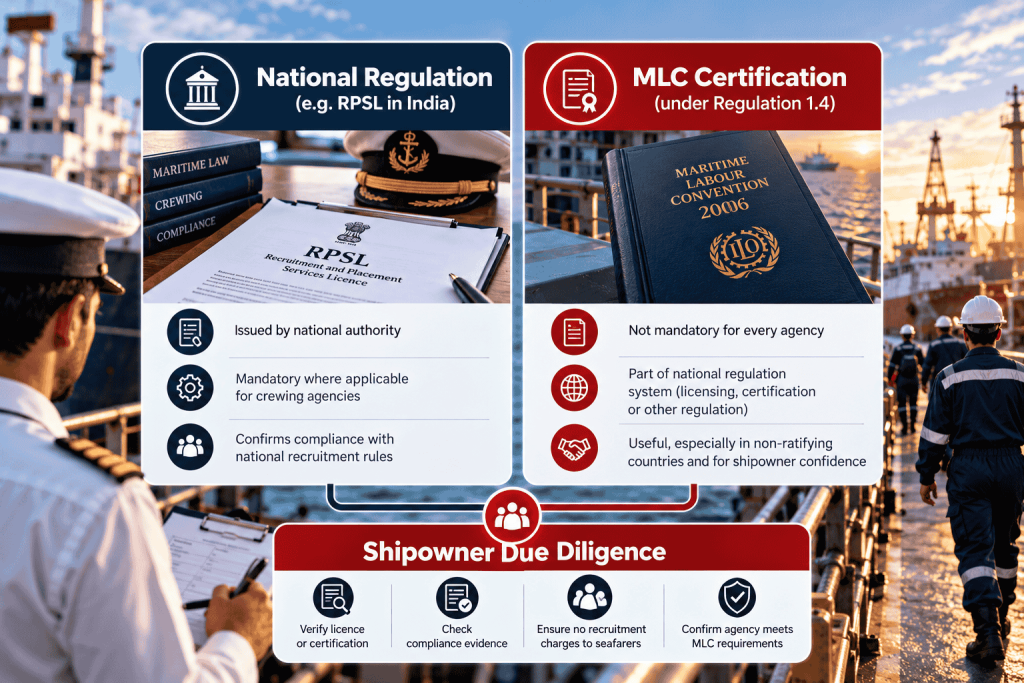
Is MLC certificate mandatory for crewing agency? No, the MLC 2006 does not require every private seafarer recruitment and placement service to hold a specific MLC certificate. Regulation 1.4 requires such services to be licensed, certified, or otherwise regulated under the applicable national system. Certification can be especially useful for agencies in countries that have not ratified the MLC, but the flag State decides whether a particular certificate is acceptable.
That distinction matters. An agency may have to comply with national recruitment rules without holding a document specifically called an “MLC certificate.” For a shipowner, the key question is whether the agency is properly licensed, certified, or regulated and whether it meets the requirements of Standard A1.4.
What does the MLC 2006 actually require from crewing agencies?
The MLC 2006 focuses on creating an efficient, adequate and accountable recruitment and placement system for seafarers.
Regulation 1.4 requires:
- Seafarers must have access to an appropriate recruitment and placement system.
- The system must allow seafarers to find employment without recruitment or placement charges being imposed on them.
- Recruitment and placement services operating in a Member’s territory must comply with the applicable requirements of the MLC Code.
- Shipowners using recruitment services located in countries where the MLC does not apply must take steps to ensure that those services meet the relevant requirements as far as practicable.
The important point is that Regulation 1.4 does not create one universal international certificate for every crewing agency.
Instead, Standard A1.4 allows a Member to establish a system of licensing, certification or another form of regulation for private recruitment and placement services.
The ILO’s 2026 FAQ makes this even clearer: the MLC provides for national regulation of private recruitment and placement services, not necessarily certification.
Why does Regulation 1.4 matter to a manning agency?
Regulation 1.4 is the part of the MLC that deals specifically with recruitment and placement.
It applies to private recruitment and placement services where their primary purpose is recruiting and placing seafarers or where they recruit and place a significant number of seafarers. If there is doubt about whether a particular service falls within the definition, the competent authority in the relevant country determines the issue after consultation with shipowners’ and seafarers’ organizations.
The MLC defines a seafarer recruitment and placement service broadly. It can include a person, company, institution, agency or other public or private organization that recruits seafarers for shipowners or places seafarers with shipowners.
Does every agency that helps a seafarer find work fall under Regulation 1.4?
Not necessarily. For example, a company that occasionally performs a recruitment-related activity may need to be assessed against the MLC definition and the applicable national rules.
Convention’s requirements for private recruitment and placement services apply where recruitment and placement is the service’s primary purpose or where it recruits and places a significant number of seafarers. Where there is doubt, the national competent authority decides.
That is why an agency should establish its regulatory status before assuming that an MLC certificate is either mandatory or unnecessary.
Is MLC certification mandatory under Regulation 1.4?
No, not as a universal MLC requirement. Standard A1.4 requires private recruitment and placement services to operate under a standardized system of licensing, certification or another form of regulation where the Convention’s conditions apply. The precise system comes from the relevant Member’s national framework.
The ILO FAQ specifically asks whether recruitment and placement services must be certified for MLC compliance. Its answer is that the MLC provides for different forms of national regulation and does not necessarily require certification.
This creates an important distinction:
| Question | Answer under the MLC framework |
| Must every crewing agency hold an MLC certificate? | No, not universally |
| Must applicable recruitment services be regulated? | Yes, under the relevant national system |
| Can that regulation take the form of certification? | Yes |
| Can it instead take the form of licensing or another regulation? | Yes |
| Is certification particularly useful in a non-ratifying country? | It may be |
| Who decides whether a particular certificate is acceptable? | The relevant flag State competent authority |
The last point is especially important for agencies working with international shipowners. A certificate issued by a recognized organization does not automatically become acceptable everywhere. The relevant flag State’s competent authority decides whether it meets its requirements.
What is the difference between MLC certification and national agency licensing?
This is where many agency owners get confused. MLC certification is one possible way of demonstrating that a recruitment and placement service meets the applicable requirements.
National licensing or regulation is the legal framework established by the country where the service operates.
These can overlap, but they are not automatically the same thing. For example, a crewing agency in a country with a national recruitment licensing system may need to maintain its national licence and comply with national requirements without possessing a separate document titled “MLC Certificate.”
The ILO FAQ therefore recommends looking at the national regulatory system, rather than assuming that the Convention itself creates a universal certification requirement.
For Indian agencies, the practical compliance picture also includes the applicable RPSL framework. LegalBabu’s current guidance on RPSL responsibilities covers licensing, records, employment agreements, recruitment costs, complaints, financial security and other ongoing duties.
You can also review the detailed RPSL License requirements and application process when assessing the national licensing side of your operation.
What are the shipowner’s responsibilities when using a crewing agency?
The responsibility does not stop with the agency.
Under Regulation 1.4, a shipowner can recruit seafarers directly. It does not have to use a private recruitment and placement service. However, if the shipowner uses one, it must take steps to ensure that the service is licensed, certified or regulated in accordance with the applicable requirements.
This is particularly important when the agency operates in a country that has not ratified the MLC.
A shipowner may therefore ask an agency for:
- Its national recruitment licence
- Evidence of regulatory approval
- MLC-related certification, where applicable
- Audit or inspection records
- Recruitment procedures
- Evidence of compliance with Standard A1.4
- Records showing how seafarer complaints are handled
- Evidence of financial protection against monetary loss
- Recruitment agreements and related documentation
This is one reason an agency may face a strong commercial expectation for MLC certification even when the Convention itself does not universally mandate a certificate.
LegalBabu’s article on how shipowners should conduct due diligence on crewing agencies is also relevant to this compliance relationship.
What happens if the crewing agency is in a non-ratifying country?
This is one of the most important situations covered by Regulation 1.4.
Suppose:
- A ship flies the flag of a country that has ratified the MLC.
- The shipowner wants to recruit seafarers.
- The shipowner uses a recruitment and placement service based in a country where the MLC does not apply.
In that case, Regulation 1.4 requires the shipowner to ensure, as far as practicable, that the recruitment service meets the requirements of Standard A1.4.
The agency does not become automatically “MLC-certified” simply because the shipowner uses it.
Instead, the shipowner needs a reasonable basis for showing that the service meets the required standards.
The ILO FAQ says the shipowner may consider information collected by the flag State as well as audits or certifications concerning the quality of services operating in countries that have not ratified the MLC.
Why can certification help in this situation?
Certification can provide documentary evidence that an agency has been assessed against relevant requirements.
It can make due diligence easier for:
- Shipowners
- Ship managers
- Flag State authorities
- Recognized organizations
- Commercial partners
- Seafarers
However, the certificate still needs to be acceptable to the relevant flag State competent authority. The ILO FAQ expressly places that decision with the competent authority of the flag State.
Practical example:
An agency located in a non-ratifying country wants to supply crew to vessels flying a ratifying flag. The shipowner may ask for evidence that the agency complies with Standard A1.4. An accepted audit or certification can help the shipowner document its due diligence, but the agency should not assume that every certificate will automatically satisfy every flag state.
What should a crewing agency comply with even without a separate MLC certificate?
The absence of a separate certificate does not mean the agency can ignore MLC-related recruitment requirements.
A compliant recruitment and placement operation should pay close attention to areas such as:
1. Recruitment and placement controls
The agency should operate an orderly recruitment and placement system that protects seafarers’ employment rights.
2. Recruitment fees
The MLC does not permit recruitment or placement fees to be charged directly or indirectly to seafarers, subject to the specific exceptions set out in Standard A1.4.
3. Visa costs
The ILO FAQ states that the cost of a necessary visa is to be borne by the shipowner. The FAQ also notes that the MLC does not settle every question about travel costs incurred to obtain a visa.
4. Financial protection against monetary loss
Private recruitment and placement services must establish a system of protection, through insurance or an equivalent appropriate measure, to compensate seafarers for monetary loss arising from failures by the recruitment service or relevant shipowner to meet obligations under the seafarer’s employment agreement.
5. Informing seafarers about their rights
The 2022 amendments specifically added a requirement for seafarers to be informed, before or during engagement, about their rights under this monetary-loss protection system.
For Indian agencies, these MLC-related requirements should be considered alongside the current RPSL compliance framework. LegalBabu’s RPSL annual compliance guide covers areas such as records, employment agreements, recruitment charges, inspections and ongoing compliance.
Can a shipowner accept an agency without an MLC certificate?
Yes, potentially. The MLC does not say that a shipowner must reject every agency that lacks a document called an MLC certificate.
The relevant question is whether the agency is licensed, certified or otherwise regulated in accordance with Regulation 1.4 and whether the shipowner has fulfilled its own due diligence obligations.
The answer can therefore depend on:
- The agency’s country
- The country’s national regulatory system
- The ship’s flag State
- The flag State’s acceptance requirements
- The shipowner’s internal compliance policy
- Whether the agency operates in a non-ratifying country
- The evidence available to demonstrate compliance
This explains why two shipowners may ask for different documents from the same recruitment agency.
One may accept national licensing and audit evidence. Another may require an MLC-related certification as part of its vendor approval process.
Why do shipowners often prefer certified or well-documented agencies?
A shipowner has responsibilities when it uses a recruitment and placement service. It therefore needs evidence that the agency is properly regulated and operates in line with applicable requirements.
A documented compliance system can make that assessment easier.
For an agency, useful evidence may include:
- Current national licence
- MLC-related certification, where applicable
- Recruitment and placement procedures
- Seafarer complaint procedure
- Fee policy
- Financial protection documentation
- Employment agreement procedures
- Audit reports
- Records of corrective actions
- Agreements with shipowners
- Staff training records
LegalBabu’s current RPSL responsibilities guide is useful for agencies reviewing these operational controls.

How does an agency know whether it needs MLC certification?
An agency should follow a simple decision process rather than assuming that certification is mandatory.
Step 1: Identify the services you provide
Confirm whether your business is a seafarer recruitment and placement service under the MLC definition.
Step 2: Check the national regulatory framework
Find out what licence, certification or other regulatory approval applies in the country where the agency operates.
Step 3: Check the ships and shipowners you serve
Identify the flag States of the vessels for which you provide crew.
Step 4: Check whether any client shipowner requires additional certification
A shipowner can have its own vendor approval or due diligence requirements.
Step 5: Check non-ratifying country issues
If the agency operates in a country where the MLC does not apply, the shipowner may need stronger documentary evidence that the agency meets Standard A1.4.
Step 6: Confirm acceptance with the relevant authority
If you intend to rely on an MLC compliance certificate, verify whether the relevant flag State competent authority accepts the certificate.
This last step prevents a common mistake: obtaining a certificate and assuming that every flag State will automatically recognize it.
What does MLC certification mean for a crewing agency in practice?
For an agency, certification can function as evidence of compliance, rather than as a universal licence created directly by the MLC.
That distinction is important when deciding whether to pursue certification.
An agency may find certification useful when:
- It supplies crew internationally.
- Its shipowner clients ask for MLC-related evidence.
- It operates in a country that has not ratified the MLC.
- It wants documented evidence of its recruitment procedures.
- Its clients conduct formal vendor due diligence.
- It wants to demonstrate that its systems have been independently assessed.
LegalBabu’s MLC 2006 certification process provides information on the certification route for agencies that choose to pursue this form of compliance evidence. The important qualification is that certification should be assessed against the requirements of the relevant national and flag State framework rather than treated as universally mandatory.
What documents should an agency keep ready for compliance checks?
A practical document file can make shipowner due diligence much easier.
Crewing agency compliance checklist
- Current national recruitment licence
- Applicable regulatory approvals
- MLC-related certificate, if obtained
- Recruitment and placement procedures
- Seafarer fee policy
- Financial protection or insurance evidence
- Seafarer complaint procedure
- Employment agreement procedures
- Shipowner agreements
- Recruitment records
- Audit reports
- Corrective action records
- Evidence of staff training
- Records showing seafarers were informed of relevant rights
The exact documents will depend on the agency’s jurisdiction and business model. The MLC itself does not prescribe one universal document pack for every recruitment service.
Does an RPSL licence replace MLC certification?
They should not be treated as automatically interchangeable. An RPSL licence is part of the applicable national framework for recruitment and placement operations in India. MLC certification is one possible form of evidence concerning compliance with MLC recruitment requirements.
For an Indian agency, the practical question is therefore broader than “Do I have an MLC certificate?”
It should ask:
Do I hold the required national licence, meet the applicable recruitment rules, comply with MLC Regulation 1.4 and have the evidence that my shipowner clients and relevant authorities may require?
LegalBabu’s RPSL License guide covers the licensing process, while its RPSL annual compliance service covers ongoing compliance considerations.
What should a crewing agency do if a shipowner asks for an MLC certificate?
Do not simply answer “the MLC does not require it.”
First, identify why the shipowner is asking for it.
The request may be connected to:
- The ship’s flag State requirements.
- The shipowner’s internal vendor approval process.
- Recruitment from a non-ratifying country.
- A previous audit finding.
- A commercial contract.
- The shipowner’s interpretation of its Regulation 1.4 obligations.
Ask the shipowner which authority or contractual requirement calls for the certificate.
Then provide the evidence you already have, such as your national licence, compliance records, audit reports and relevant financial protection documents.
If certification is appropriate, the agency can then explore the MLC 2006 certification process and confirm whether the resulting certificate will be accepted by the relevant flag state.
What are the biggest mistakes agencies make about MLC certification?
Mistake 1: Assuming every agency needs the same certificate
The MLC allows national systems based on licensing, certification or another form of regulation.
Mistake 2: Treating national licensing and MLC certification as identical
They may work together, but they serve different regulatory purposes.
Mistake 3: Ignoring the shipowner’s obligations
A shipowner using a private recruitment service has its own due diligence responsibilities under Regulation 1.4.
Mistake 4: Assuming a certificate is accepted everywhere
The relevant flag State competent authority decides whether a particular certificate is acceptable.
Mistake 5: Focusing on the certificate while ignoring actual recruitment practices
Certification does not replace good recruitment controls. Agencies still need appropriate procedures for fees, financial protection, seafarer information, records and complaints.
How can an agency prepare for an MLC-related audit?
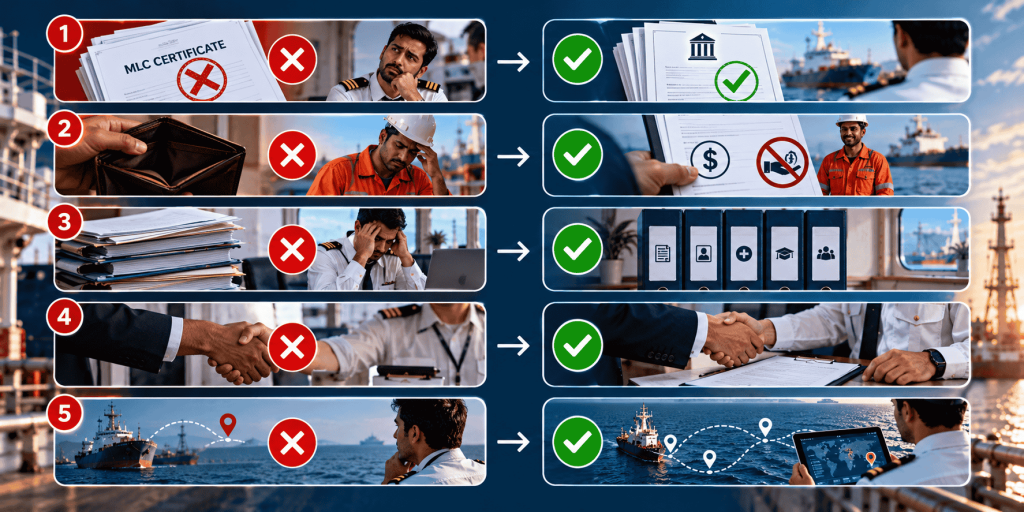
A useful approach is to test the actual recruitment process instead of checking certificates alone.
Audit preparation checklist
Recruitment
- Are seafarers recruited through a documented process?
- Are recruitment charges prohibited except for permitted costs?
- Are job terms clearly communicated?
Regulatory status
- Is the agency’s national licence current?
- Is the agency subject to a national licensing, certification or regulatory system?
- Does the shipowner require additional evidence?
Financial protection
- Is the required monetary-loss protection in place?
- Can the agency produce evidence of that protection?
- Are seafarers informed of their rights under the system?
Shipowner relationship
- Are shipowner agreements current?
- Can the agency demonstrate that it meets applicable requirements?
- Are documents available for flag State or shipowner review?
Records
- Can the agency produce recruitment records?
- Are complaints documented?
- Are corrective actions tracked?
For Indian agencies, these checks should also be aligned with current RPSL requirements and inspection expectations. LegalBabu’s RPSL annual compliance guide provides a useful starting point for that wider compliance review.
Is MLC certification useful even when it is not mandatory?
Yes, it can be. The strongest reason is evidence. An international shipowner may want a simple way to assess whether a recruitment agency has systems that meet the applicable requirements. A recognized certification or independent audit can help demonstrate that the agency has been assessed.
But the value of certification depends on the context. For an agency operating in a ratifying country with a strong national licensing system, the national licence and regulatory framework may already provide the core evidence required.
For an agency located in a non-ratifying country, certification or another credible audit may be particularly useful because the shipowner has to take steps to ensure the service meets Standard A1.4 as far as practicable.
The ILO FAQ specifically notes that certification may be of interest for recruitment services located in countries that have not ratified the MLC.
What should shipowners check before accepting a crewing agency?
A practical due diligence review can include:
| Area | What to verify |
| Legal status | Is the agency legally authorized to recruit or place seafarers? |
| National regulation | Is it licensed, certified or otherwise regulated? |
| MLC compliance | Does its system meet the applicable Standard A1.4 requirements? |
| Non-ratifying country | If applicable, has the shipowner documented its due diligence? |
| Recruitment fees | Are prohibited recruitment charges avoided? |
| Financial protection | Is monetary-loss protection in place? |
| Complaints | Is there a process for receiving and handling seafarer complaints? |
| Documentation | Can the agency provide relevant records and evidence? |
| Certification | If a certificate is provided, will the relevant flag State accept it? |
The ILO FAQ makes clear that shipowners using private recruitment services have responsibilities under Regulation 1.4, especially when the service operates in a country where the MLC does not apply.
Does the MLC apply when the shipowner recruits crew directly?
Generally, direct recruitment by the shipowner is treated differently from using a private recruitment and placement service.
The ILO FAQ explains that where seafarers are recruited directly by a shipowner to work on ships flying the flag of a country that has ratified the MLC, the situation does not prima facie fall within Regulation 1.4 and its related Code provisions. Where the relationship is unclear, the national competent authority should be consulted.
This distinction matters because Regulation 1.4 is specifically concerned with the recruitment and placement service framework.
Can a recruitment agency operate without an MLC certificate?
Potentially, yes. An agency can operate without a document specifically called an MLC certificate where the applicable national system regulates the service through another mechanism, such as licensing or another form of regulation.
However, the agency still needs to comply with the requirements that apply to it.
The safest approach is to verify:
- Whether the business falls within the MLC definition of a recruitment and placement service.
- Which national licensing or regulatory framework applies.
- What requirements the relevant flag States impose on shipowners using the agency.
- Whether any client shipowner requires additional certification.
- Whether the agency has evidence showing compliance with Standard A1.4.
The key distinction is simple: the MLC requires appropriate regulation of covered recruitment and placement services, but it does not impose one universal MLC certificate on every agency.
FAQs
1. Is an MLC certificate mandatory for every crewing agency?
No. The MLC 2006 does not require every private recruitment and placement service to hold a specific MLC certificate. Regulation 1.4 allows national systems based on licensing, certification or another form of regulation.
2. Does Regulation 1.4 require a recruitment agency to be certified?
Not necessarily. Standard A1.4 requires covered private recruitment and placement services to operate under a standardized system of licensing, certification or another form of regulation established by the relevant Member.
3. Can a shipowner refuse to work with an agency that has no MLC certificate?
A shipowner may have its own commercial or compliance policy requiring certification. However, the MLC itself does not say that every agency without an MLC certificate must be rejected. The shipowner must consider whether the service is appropriately licensed, certified or regulated.
4. Is certification more important for an agency in a non-ratifying country?
It can be. When a shipowner uses a recruitment service based in a country where the MLC does not apply, the shipowner must ensure, as far as practicable, that the service meets Standard A1.4. Certification or audit evidence can help document that due diligence.
5. Who decides whether an MLC compliance certificate is acceptable?
The relevant flag State competent authority decides whether a particular certificate issued by a recognized organization is acceptable for its purposes. An agency should therefore avoid assuming that one certificate will automatically satisfy every flag State.
6. Does an RPSL licence mean the agency automatically has MLC certification?
No. An RPSL licence and MLC-related certification should not be treated as identical documents. The RPSL framework forms part of India’s national regulation of recruitment and placement, while MLC certification is one possible form of evidence of compliance with applicable MLC requirements.
7. Can a shipowner recruit seafarers directly without using a manning agency?
Yes. The MLC does not require shipowners to use private recruitment and placement services. A shipowner may recruit seafarers directly, subject to the requirements applicable to its operations and the relevant flag State.
8. Can an agency charge a seafarer a recruitment fee if it does not have an MLC certificate?
No. The absence of an MLC certificate does not create an exception to the recruitment fee requirements. Standard A1.4 generally prohibits recruitment and placement fees or charges from being borne by the seafarer, subject to specified exceptions such as certain personal documents.
9. What financial protection must a private recruitment agency have?
Standard A1.4 requires an applicable private recruitment and placement service to establish protection, through insurance or an equivalent appropriate measure, against monetary loss that seafarers may suffer when the agency or relevant shipowner fails to meet obligations under the seafarer’s employment agreement.
10. What is the safest way for a crewing agency to determine whether it needs MLC certification?
Start with the agency’s national regulatory framework, then check the requirements of the flag States and shipowners it serves. If certification is being considered, confirm that the proposed certificate will be accepted by the relevant competent authority. For agencies operating in India, this review should also be made alongside the applicable RPSL licensing and ongoing compliance requirements.
You may also like


What Does Project Logistics Alliance Membership Offer?
Project Logistics Alliance membership offers an Indian project cargo business a