
How to Recover Money Lost in a Scam: Legal Options in India
- by kapil
- Updated September 14, 2026
- 22 mins read
To recover money lost in a scam, speed matters most. Call the 1930 cyber fraud helpline and file at cybercrime.gov.in within the first hour, then alert your bank. Business dues need MSME Samadhaan or NCLT instead. Police, consumer courts, and civil suits each fit different situations, and no single route guarantees a full refund.
Every year, lakhs of Indians open cybercrime.gov.in for the first time on the worst financial day of their lives. Ministry of Home Affairs data places cyber fraud losses at roughly ₹22,495 crore in 2025, spread across close to 21.77 lakh complaints. Investment scams alone made up about three-quarters of that money.
Job scams, task-based frauds, and unpaid business invoices add a separate, less-tracked pile of losses on top of that number. The good news is that India actually has more recovery machinery than most victims realise. The bad news is that almost nobody explains which piece of that machinery fits which situation, and using the wrong one wastes time you don’t have.
This guide walks through every route: cybercrime reporting, the 1930 helpline, bank account freezes, MSME Samadhaan, NCLT, consumer court, civil suits, police FIRs, and the informal route of political influence that a lot of people quietly try. Match the route to your facts, not to whatever your neighbour tried last year.
What Is the Difference Between Criminal Action and Civil Recovery in a Scam Case?
People often assume that once a scammer goes to jail, their money comes back automatically. It doesn’t work that way, and understanding this early saves a lot of wasted effort later.
Criminal action punishes the offender. An FIR, an arrest, and a conviction under the Bharatiya Nyaya Sanhita (BNS) or the Information Technology Act put a scammer behind bars, but a criminal court doesn’t usually hand your money back to you directly. A magistrate can order compensation or attachment of the accused’s property in some cases, but this isn’t automatic.
Civil recovery gets your money back. MSME Samadhaan, NCLT, consumer court, and an ordinary civil suit for recovery of money exist specifically to return your funds, with interest where applicable, whether or not the other side is ever criminally punished.
The strongest recoveries usually run both tracks together: a police complaint to freeze the money and build pressure, plus a civil or quasi-judicial claim aimed at an enforceable order for repayment.
What Should You Do in the First Hour to Recover Money Lost in a Scam?
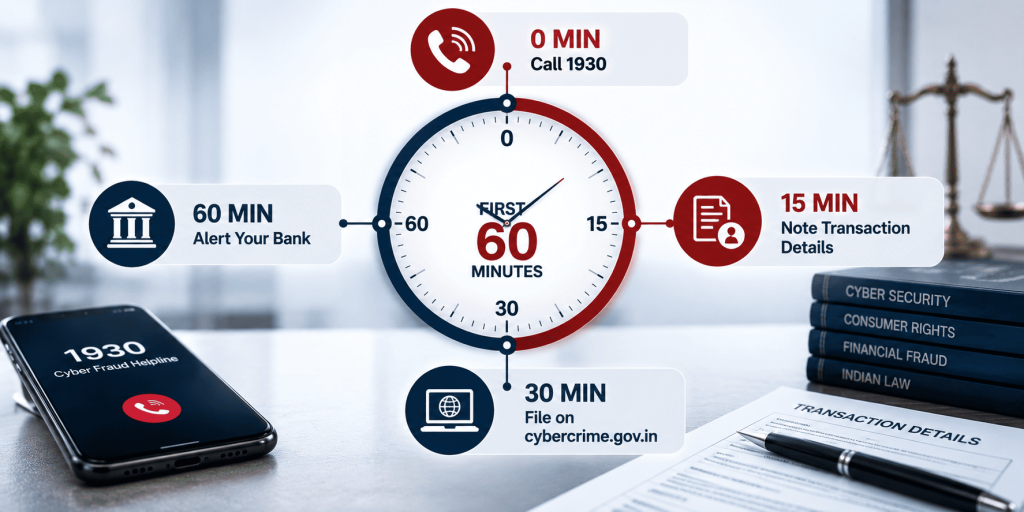
The first sixty minutes decide most of what happens next. Do these things in order, without waiting to “process” what happened first.
- Call 1930, the national cyber fraud helpline. It’s toll-free, runs 24×7, and is operated by the Indian Cyber Crime Coordination Centre (I4C) under the Ministry of Home Affairs.
- Have your transaction details ready: the UTR or transaction ID, the exact amount, the date and time, and the receiving UPI ID, account number, or wallet.
- File the same complaint at cybercrime.gov.in the same day, quoting the acknowledgement number the 1930 operator gave you.
- Call your own bank’s fraud helpline at the same time to ask for a block on further outgoing transactions from your account.
- Screenshot everything: the chat, the call log, the payment confirmation screen, the scammer’s profile or website, before any of it disappears.
- Don’t delete the scammer’s number, chat thread, or profile. You’ll need all of it for the FIR and the portal complaint.
Speed decides almost everything here. The 1930 call gets logged into the Citizen Financial Cyber Fraud Reporting and Management System (CFCFRMS), which pushes an alert down the chain to whichever bank or wallet is currently holding the money and asks it to freeze that amount before it moves again. I4C data shared with Parliament shows this system has frozen over ₹8,000 crore since it started operating.
The catch is that fraudsters usually route stolen money through several accounts within minutes. A report filed the same evening has a real shot. One filed three days later usually finds an empty account.
How Do You Report a Cyber Scam on cybercrime.gov.in?
The National Cyber Crime Reporting Portal is free to use and doesn’t need a lawyer for a standard complaint. Here’s the actual filing sequence.
- Go to cybercrime.gov.in and click “Report Cyber Crime.”
- Choose “Report Financial Fraud” if money moved through UPI, cards, net banking, or a wallet. Choose the general cybercrime category for scams without a direct money transfer, like a hacked social media account or online harassment.
- Register using your mobile number and the OTP sent to it.
- Enter the incident exactly as it happened: sender, receiver, amount, date, time, and the app or platform used.
- Upload every screenshot, payment receipt, and message you saved earlier.
- Submit the form and save the acknowledgement number somewhere safe. This number is your reference for every future follow-up and for checking status on the portal later.
- If you already called 1930, mention that acknowledgement number when the portal asks about a prior report, so the two records link up.
One genuinely useful thing most people don’t realise: the portal itself has no legal power to freeze anything. It’s a reporting and coordination system. The actual freeze always comes from a bank or a police cyber cell acting on the information the portal routes to them.
Why Did the Bank Freeze or Put a Lien on My Account After a Cyber Crime Complaint?
This question comes up in two very different situations, and the answer depends on which one you’re in.
If you’re the victim, the freeze works in your favour. It targets the disputed amount sitting in the scammer’s account, or wherever the money currently is in the trail, not your own account.
If you’re an innocent third party, this is where things get frustrating fast. Say you sold something on OLX or Facebook Marketplace, or you’re a freelancer who got paid for genuine work. If that payment happens to sit anywhere along a fraud trail that someone else reported, your bank can freeze or lien your account on a cyber cell’s instruction, even though you did nothing wrong. This happens more often than most people expect, since a single stolen amount can pass through five or six accounts before anyone notices.
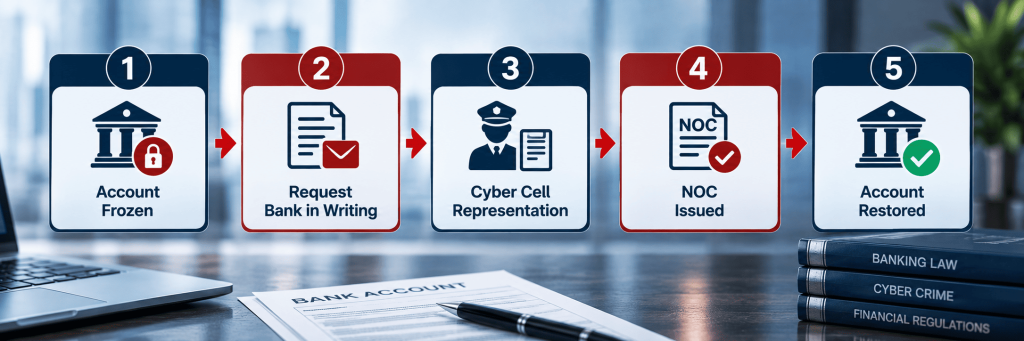
Here’s the step-by-step to get an innocent account unfrozen.
- Go to your bank in person and ask, in writing, for the reason behind the freeze: the complaint or FIR number, and the name of the investigating police station.
- Visit or write to that cyber cell with your bank statements, ID proof, and a clear written explanation of exactly how the money legitimately reached your account.
- Ask specifically for the lien to be restricted to only the disputed amount, not your entire account balance, if the freeze is broader than it needs to be.
- Request a No Objection Certificate (NOC) addressed to your bank once the cyber cell is satisfied you’re not involved.
- If there’s no movement for weeks and you’re facing real hardship (salary, EMIs, running a business), a lawyer can file an application before the jurisdictional magistrate under the Bharatiya Nagarik Suraksha Sanhita (BNSS), or a writ petition in the High Court, to get the freeze reviewed.
One warning worth repeating: do not pay anyone who contacts you claiming they can “clear” the complaint, remove the lien, or speed up an NOC for a fee. This has become its own scam that specifically targets people who are already dealing with one fraud.
Can You Report a Scammer’s Mobile Number?
Yes, and this is a separate action from getting your money back, worth doing even if you’ve already reported the financial loss.
The Department of Telecommunications runs Chakshu, a reporting feature inside the Sanchar Saathi portal, built specifically for suspected fraud calls, SMS, and WhatsApp messages. Reporting the scammer’s number here won’t recover a single rupee, that isn’t what it’s designed for, but it feeds into action against the SIM card and telecom connection behind repeat offenders.
- Go to sancharsaathi.gov.in and open the Chakshu section, labelled “Report Suspected Fraud Communication.”
- Enter the number that contacted you, or select it directly from your call or SMS log if you’re using the app.
- Pick the fraud category that matches what happened: fake KYC update, courier scam, digital arrest threat, fake job offer, or similar.
- Attach a screenshot of the call log or the message itself.
- Submit within 30 days of receiving the communication. Chakshu’s reporting window closes after that.
If you’ve already lost money, report to 1930 and cybercrime.gov.in first. Chakshu handles the phone number and the connection behind it. It has no visibility into your bank account and can’t touch a transaction.
What Are the Most Common Job Scams in India and How Do You Recover From Them?
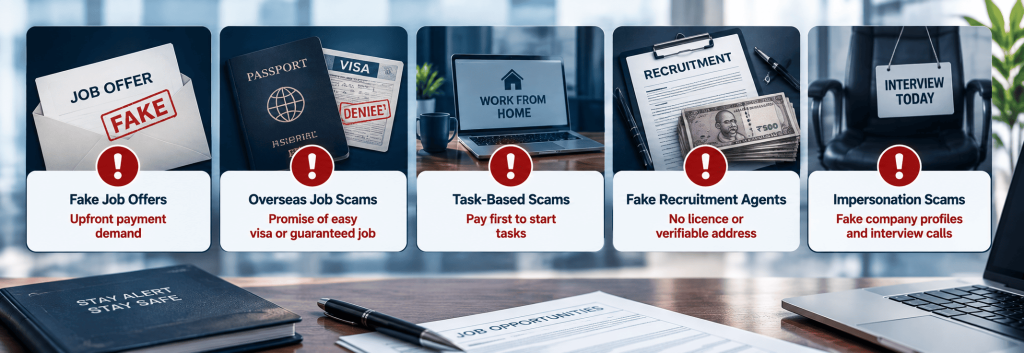
Job scams have a specific pattern: they ask for money before they hand you anything, on the promise that you’ll earn it back many times over.
| Job Scam Type | How It Works | Typical Loss Pattern |
| Task-based/part-time scam | A WhatsApp or Telegram “job” pays small commissions for rating products on a fake e-commerce interface, then asks for money to “unlock” bigger withdrawals | Starts at a few hundred rupees, escalates fast |
| Fake HR/recruitment scam | A fake offer letter arrives, followed by a demand for a “security deposit,” laptop fee, or training charge before joining | One-time upfront payment, often ₹5,000 to ₹50,000 |
| Overseas job or work visa scam | An unlicensed agent promises a foreign job or visa for a large advance fee, then goes silent once it’s paid | Often several lakh rupees |
| Fake government job scam | A fake selection letter or a promised “backdoor quota” comes with a demand for a bribe to confirm the post | Mid to large amounts, sometimes over ₹1 lakh |
| Data entry / work-from-home kit scam | An upfront fee is charged for a “starter kit” or mandatory registration, and the job never actually starts | Small to moderate amounts |
These aren’t hypothetical categories. A Karnataka BCA graduate lost over ₹1.2 lakh to a fake Meesho task-based scheme run through WhatsApp and Telegram, paying in phases before the promised “commission” ever came. In a separate case, a man from Udupi lost over ₹2 lakh over two months chasing a promised overseas job that never existed. Police registered both cases under Sections 66(C) and 66(D) of the IT Act alongside cheating provisions of the BNS, the standard combination for online job fraud.
Job scam money almost always moves through a personal bank account rather than a business one, which puts these squarely in cybercrime.gov.in and FIR territory rather than MSME Samadhaan or NCLT, neither of which apply here at all.
If an overseas job scam involved someone claiming to be a licensed recruiter, check whether they actually held a valid Recruiting Agent licence under the Emigration Act, 1983, before you paid them anything further. Our guide to RA license rules explains what a genuine licence actually looks like, and sticking only to a properly licensed overseas recruitment agent removes most of this risk before a single rupee changes hands. The Ministry’s own SOPs for safe and legal migration are worth reading before any first payment toward an overseas job.
Can MSME Samadhaan Help You Recover Unpaid Business Payments?
MSME Samadhaan applies to a completely different situation from a scam: a registered micro or small business that delivered goods or a service and simply isn’t getting paid by a buyer. There’s no criminal fraud angle here, just a payment default.
If you hold a valid Udyam Registration that predates the disputed invoice, and a buyer hasn’t paid within 45 days, you can file a reference on the MSME ODR portal at odr.msme.gov.in. It’s free, has no minimum claim amount, and doesn’t require a lawyer to get started. Our full MSME payment recovery walkthrough covers the document checklist and how the compound interest calculation actually works.
This route reaches almost any buyer type: private companies, government departments, and public sector units included, which makes it far broader in scope than NCLT.
When Does NCLT Make Sense for Recovering Money?
NCLT, the National Company Law Tribunal, only becomes relevant once two conditions are both true at the same time: your buyer is a company or an LLP, and the unpaid amount is at least ₹1 crore. Below that threshold, or against a proprietorship or an ordinary partnership firm, NCLT simply isn’t on the table, no matter how large the dispute feels to you.
Filing means sending a Section 8 demand notice under the Insolvency and Bankruptcy Code, waiting the mandatory 10 days, and then filing a Section 9 application if the buyer hasn’t paid or raised a genuine pre-existing dispute. If NCLT admits the petition, it starts a full insolvency process rather than issuing a straightforward payment order, and operational creditors have historically recovered only a modest share of what they were owed once that process runs its course.
We’ve covered this specific route in far more depth elsewhere, including a complete step-by-step guide to filing a case in NCLT and a detailed NCLT vs MSME payment recovery comparison, worth reading before you commit months to preparing a petition.
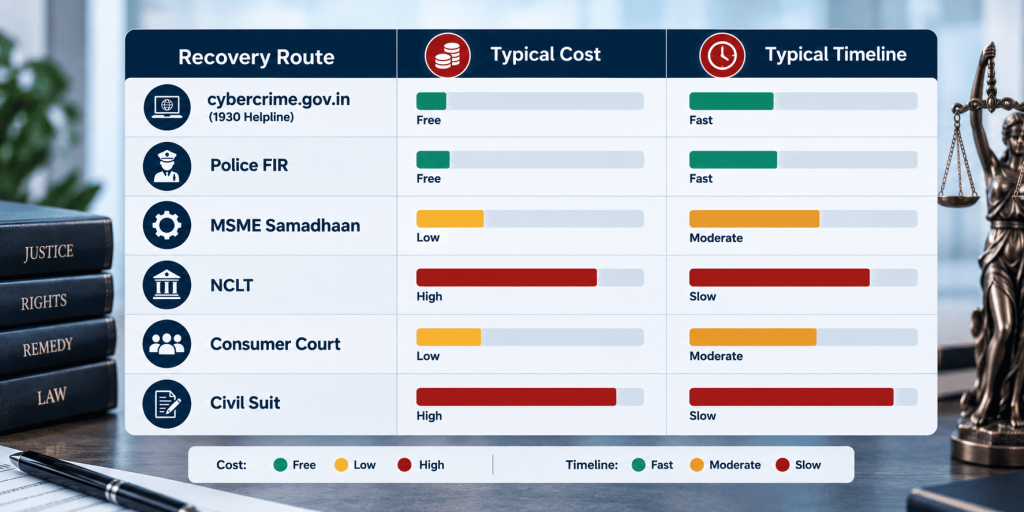
MSME Samadhaan vs NCLT vs Consumer Court vs Civil Suit vs Police FIR: Which One Fits?
Here’s the full picture, side by side.
| Route | Best For | Who You Can Proceed Against | Cost | Typical Timeline | What You Actually Get |
| MSME Samadhaan (ODR) | Unpaid B2B invoice from a registered small business | Any buyer type | Free | Usually months | Enforceable award plus interest |
| NCLT (Section 9, IBC) | ₹1 crore or more owed by a company or LLP | Company or LLP only | Tribunal fee plus legal costs | Often 600 or more days in practice | A resolution plan or liquidation share, not guaranteed |
| Consumer court | Deficient service or defective goods bought as a consumer | Any seller or service provider | Free or nominal | Months to a couple of years | Refund plus compensation order |
| Civil recovery suit | Money owed under a contract, loan, or promissory note | Any individual or entity | Court fee plus legal costs | Often runs into years | A money decree, enforceable through execution |
| Police FIR / cybercrime.gov.in | Actual fraud, cheating, or cyber crime | The scammer personally | Free | Depends on the investigation | Possible fund freeze plus a criminal case, compensation isn’t guaranteed |
| Political influence (informal) | Small, local disputes with a known local party | Individuals or local businesses | No legal cost, but no legal protection either | Immediate or nothing at all | No enforceable outcome, purely informal pressure |
Notice that the buyer type and the nature of the loss, a genuine payment default versus an actual fraud, decide the right column before cost or timeline even enter the picture.
Can You File a Case in Consumer Court to Get Your Money Back?
Consumer court fits when you paid for a good or a service and didn’t get what was promised: a fake investment advisory “service,” a deficient courier or shipping company, or a builder who took a booking amount and delivered nothing. It’s a weaker fit for a pure cheating scam with no underlying service contract at all. Consumer forums tend to redirect those cases toward the police and criminal courts instead.
Jurisdiction depends on how much you paid as consideration, not on how much compensation you’re claiming.
| Commission | Jurisdiction (Value of Consideration Paid) |
| District Commission | Up to ₹50 lakh |
| State Commission | Above ₹50 lakh, up to ₹2 crore |
| National Commission | Above ₹2 crore |
File within two years of the cause of action. You can represent yourself without a lawyer, and the process is designed to move faster and stay less formal than a regular civil suit.
Should You File a Police FIR, and What Actually Happens After?
For an actual scam, a police FIR isn’t optional. It’s the only route that can put the offender behind bars, and it’s usually needed later as supporting evidence for insurance claims, bank disputes, or tax purposes.
Most online scam FIRs today combine the Bharatiya Nyaya Sanhita (BNS), which replaced the Indian Penal Code from 1 July 2024, with the Information Technology Act, 2000. Cheating falls under BNS Section 318, cheating by personation under Section 319, and criminal breach of trust under Section 316. Where a scammer used a fake profile, fake website, or someone else’s stolen identity to pull off the fraud, Sections 66C (identity theft) and 66D (cheating by personation using a computer resource) of the IT Act usually get added on top.
You don’t need to hunt for the “right” police station first. Under Section 173 of the Bharatiya Nagarik Suraksha Sanhita (BNSS), any police station has to register a cognizable offence as a Zero FIR and transfer it to the station that actually has jurisdiction. They can’t turn you away for being in the wrong area. Several states also accept an e-FIR filed online, which you then sign in person within three days to complete the process.
Realistically, an FIR alone rarely returns your money on its own. Police can trace funds and sometimes freeze them, and in a handful of well-documented cases, courts have gone further. Jammu police, for instance, used property attachment powers under the new criminal law framework in a fake defence-job racket, seizing the accused’s assets and returning crores of rupees to a group of verified victims. Cases like that remain the exception rather than the rule, so treat the FIR as your accountability track, not your guaranteed refund.
Does Political Influence Actually Help You Recover Scammed Money?
It’s common in India, particularly outside the big metros, for scam victims to approach a local MLA, a corporator, or an influential community figure to pressure someone into returning money. It’s worth being honest about where this genuinely helps and where it does close to nothing.
It can occasionally work when the person who owes you money is local, identifiable, and still has something real to lose: reputation, a shop licence, standing in the community. Informal pressure sometimes moves faster in these narrow, local cases than a months-long formal process would.
It does almost nothing against an organised cyber fraud operation, especially one running out of another state or another country, since there’s no local relationship or reputation on the line to leverage in the first place. It also carries genuine risk. There’s no paperwork, no enforceable outcome, and no protection if the situation turns into extortion, or into a second scam dressed up as “a contact who can get your money back quickly.”
Use this route, if at all, as a supplement alongside a formal complaint, never as a replacement for one, and never pay anyone extra for access to the “influence” itself.
Which Recovery Route Fits Your Situation?
Use this as a starting point rather than a final answer, since every case carries its own specific facts.
| Your Situation | Best Starting Route |
| Lost money to a job scam or fake task-based scheme | 1930, cybercrime.gov.in, and an FIR |
| Paid an unlicensed agent for a fake overseas job | FIR plus IT Act complaint; verify any agent’s RA licence before paying anyone else |
| A registered buyer hasn’t paid your small business invoice | MSME Samadhaan through the ODR portal |
| A company or LLP owes you ₹1 crore or more and looks financially distressed | NCLT |
| You paid for a service or product that was defective or never delivered | Consumer court |
| Someone owes you money under a personal loan or written agreement | Civil recovery suit |
| Your own bank account got frozen because of someone else’s fraud | Bank plus cyber cell plus the NOC process covered above |
| The person who owes you money is a known local individual, not part of an organised ring | FIR first, informal local pressure only as a supplement |
What Mistakes Make Recovery Harder?
- Waiting days or weeks before reporting, letting the golden hour pass while the money moves through more accounts.
- Deleting chats, call logs, or the scammer’s number to “move on” emotionally, right when you need that evidence most.
- Paying a self-styled “recovery agent” who promises a guaranteed refund for an upfront fee. This is almost always a second scam layered on top of the first.
- Assuming cybercrime.gov.in itself froze the money or filed an FIR for you. It’s a reporting and coordination portal, not an investigating authority.
- Skipping a written complaint to your bank just because you already called 1930.
- Sending more money to “unlock,” “release,” or “unfreeze” funds that a stranger claims are stuck somewhere.
- Not checking whether your dispute even qualifies for NCLT before spending months preparing a petition that gets rejected on eligibility alone.
How Can You Avoid Getting Scammed Again?
- Verify any recruiter’s or migration agent’s licence before paying anything at all. Our guide to RA license rules shows what a genuine licence actually looks like.
- Run basic due diligence on a new buyer or employer before signing a contract or accepting an advance-fee job offer.
- Remember that no genuine employer, recruiter, or government scheme ever asks you to pay in order to “unlock” your own salary, prize, or winnings.
- If your business handles customer payments online, a periodic cyber security audit catches the gaps that scammers exploit before they turn into a crisis.
- Keep at least a few months of documented cash flow in hand so a delayed payment dispute doesn’t force you into a rushed, discounted settlement. A short-term working capital loan can bridge that gap if a genuine recovery case is still pending.
- Before extending credit to a new corporate buyer, understand whether you’re actually dealing with a company, an LLP, or a proprietorship, since that single fact decides whether NCLT is ever available to you later. Our guide comparing company, LLP, and partnership structures breaks this down clearly.
- For high-value or repeated disputes, a properly drafted demand notice carries far more weight than a WhatsApp message. Our legal notice drafting service can help you get the wording right before a dispute even reaches a tribunal.
FAQs
Can I get a refund if I paid a scammer through my credit card?
Sometimes, but it depends heavily on how the payment happened. If it was a genuinely unauthorised transaction, like a stolen card number used without your knowledge, RBI’s customer liability rules can protect you if you report it within a few days. If you willingly authorised the payment because you believed the scam story was real, that counts as an authorised transaction, and a chargeback becomes far harder to win. Report it anyway, both to your card issuer and on cybercrime.gov.in.
What if the scammer’s bank account is already empty by the time I report it?
Then there’s usually nothing left to freeze in that specific account, but the report still isn’t pointless. Investigators can trace where the money moved next, and repeated complaints against the same account or number build a pattern that helps freeze future transactions and eventually identify the people running the operation.
Will filing a cyber crime complaint affect my credit score or CIBIL report?
No. Filing a complaint as a victim doesn’t touch your CIBIL score in any way. Your credit score reacts only to loan and credit card repayment behaviour, not to police complaints or FIRs you file against someone else.
Is it safe to hire a private “money recovery agent” who promises a full refund?
Be very cautious here. Legitimate recovery only happens through banks, police, courts, and government portals, none of which charge an upfront “recovery fee” to a victim. Anyone guaranteeing a refund in exchange for a fee is very often running a second scam directly on top of the first one.
Can I recover money sent to a scammer’s Paytm or PhonePe wallet?
Report it through the same channels: 1930 and cybercrime.gov.in, and separately through the wallet provider’s own fraud or grievance reporting option. Wallets can freeze a receiving account just like banks can, but only if you report quickly, since wallet balances tend to move out even faster than bank transfers do.
What is the difference between filing an FIR and reporting on cybercrime.gov.in?
cybercrime.gov.in creates a digital record and can trigger a bank freeze through the CFCFRMS system, but it isn’t the same thing as an FIR. An FIR is a formal police document that opens a criminal investigation and is usually required for insurance claims, tax write-offs, or as evidence if the matter later reaches a court. Filing on the portal doesn’t automatically register an FIR, so follow up in person at your local cyber cell if the loss is significant.
Can NRIs report a scam that happened to a family member in India?
Yes. The portal doesn’t require the complainant to be physically present in India, though most reporting flows do need an Indian mobile number for OTP verification. If the victim is an elderly parent who can’t manage the online process themselves, it’s common and acceptable for a family member to file on their behalf using the victim’s documents and transaction details.
Can I recover money lost in a fake stock trading or investment app scam?
These are notoriously difficult to recover in full, since the money typically routes through several mule accounts within hours and often gets converted into cryptocurrency soon after. Still report immediately through 1930 and cybercrime.gov.in, since investment scams currently account for the largest single share of cyber fraud losses reported to I4C, and this category is being actively worked on at scale by law enforcement.
How long does the cybercrime.gov.in portal usually take to respond?
There’s no fixed statutory deadline for a response on the portal itself. The freeze action, when it happens, usually occurs within hours to a few days if you reported inside the golden hour. A full investigation and any eventual prosecution typically takes months at minimum, and often longer when accused persons are based outside India.
Can I sue someone in civil court even after the police close the FIR?
Yes. A criminal case and a civil recovery suit are legally independent of each other. Police closing an FIR, for lack of evidence to prosecute, for instance, doesn’t stop you from filing a civil suit to recover the money, since the standard of proof in a civil case is lower than what’s required for a criminal conviction.
You may also like

ACAAI Membership: Your Gateway to India’s Air Cargo Network
ACAAI Membership gives eligible air cargo businesses membership in the Air Carg