
NCLT vs MSME Payment Recovery: Which Is Better?
- by kapil
- Updated September 5, 2026
- 18 mins read
For most small suppliers, MSME payment recovery beats NCLT. It’s free, with no minimum claim, and works against almost any buyer. NCLT vs MSME payment recovery really depends on your buyer’s structure and claim size: NCLT only applies when a company or LLP owes at least ₹1 crore, and it triggers insolvency, not a payment order.
Unpaid invoices are a daily headache for Indian MSMEs. Government estimates put outstanding delayed payments to the sector in the range of several lakh crore rupees at any given point, and that cash sits in someone else’s bank account instead of yours. Two legal routes get talked about most often: filing with the Micro and Small Enterprise Facilitation Council (MSEFC) under the MSMED Act, or dragging a defaulting buyer to the National Company Law Tribunal (NCLT) under the Insolvency and Bankruptcy Code (IBC).
They are not interchangeable tools. One is a purpose-built payment recovery mechanism. The other is an insolvency trigger that happens to double up as recovery leverage in some cases. This guide walks through eligibility, process, cost, timelines and realistic outcomes for both, so you can pick the route that actually fits your situation instead of the one you heard about last.
What Is MSME Payment Recovery Under the MSMED Act?
MSME payment recovery refers to the dispute resolution mechanism built into the Micro, Small and Medium Enterprises Development (MSMED) Act, 2006. It exists specifically to help registered micro and small suppliers get paid on time, and to compensate them when a buyer delays.
Here’s how the underlying right works. A buyer must pay within 15 days if there’s no written agreement, or up to 45 days if there is one. Once that window lapses, the buyer automatically owes compound interest at three times the Reserve Bank of India’s bank rate, with monthly rests, whether or not you ever raise a dispute. At the RBI’s Bank Rate of 5.50% (as of the August 2026 policy review), that works out to roughly 16.5% a year, compounding monthly. This rate moves whenever the RBI changes its Bank Rate, so it’s worth rechecking before you calculate a claim.
If the buyer still doesn’t pay, you can approach your state’s MSEFC for conciliation and, if that fails, arbitration. There’s no lawyer required to start, no minimum claim size, and no government filing fee. You can read our detailed walkthrough of the MSME payment recovery service for the full document checklist.
One condition trips up a lot of applicants: your enterprise must hold a valid Udyam Registration that predates the disputed invoice. The Supreme Court and the Ministry’s own guidance are both clear that this protection is not retrospective. If you registered after raising the invoice, that particular invoice generally falls outside the Act’s delayed payment provisions, even though your registration itself remains valid for future transactions.
What Is NCLT and How Does It Help Recover Payments?
The National Company Law Tribunal is a quasi-judicial body set up under Section 408 of the Companies Act, 2013. It handles company law disputes and, more relevantly here, acts as the adjudicating authority under the IBC.
An unpaid supplier is what the IBC calls an “operational creditor.” Under Section 9, an operational creditor can ask NCLT to start the Corporate Insolvency Resolution Process (CIRP) against a company that owes it money. Legally, it’s a request to put the debtor company through a formal insolvency process, and the threat of losing control of the business often acts as pressure to pay, even before the process runs its full course.
Two restrictions matter more than anything else here. First, NCLT can only act against a “corporate debtor,” meaning a registered company or an LLP. A proprietorship or an ordinary partnership firm cannot be pursued this way, no matter how large the dues. If you’re unsure which structure your buyer actually is, our guide comparing a private limited company and a sole proprietorship explains the practical differences.
Second, and just as important, the default has to be at least ₹1 crore. This threshold was raised from ₹1 lakh in March 2020 and has stayed at ₹1 crore through 2026. A ₹40 lakh dispute, however genuine, simply cannot go to NCLT under Section 9.
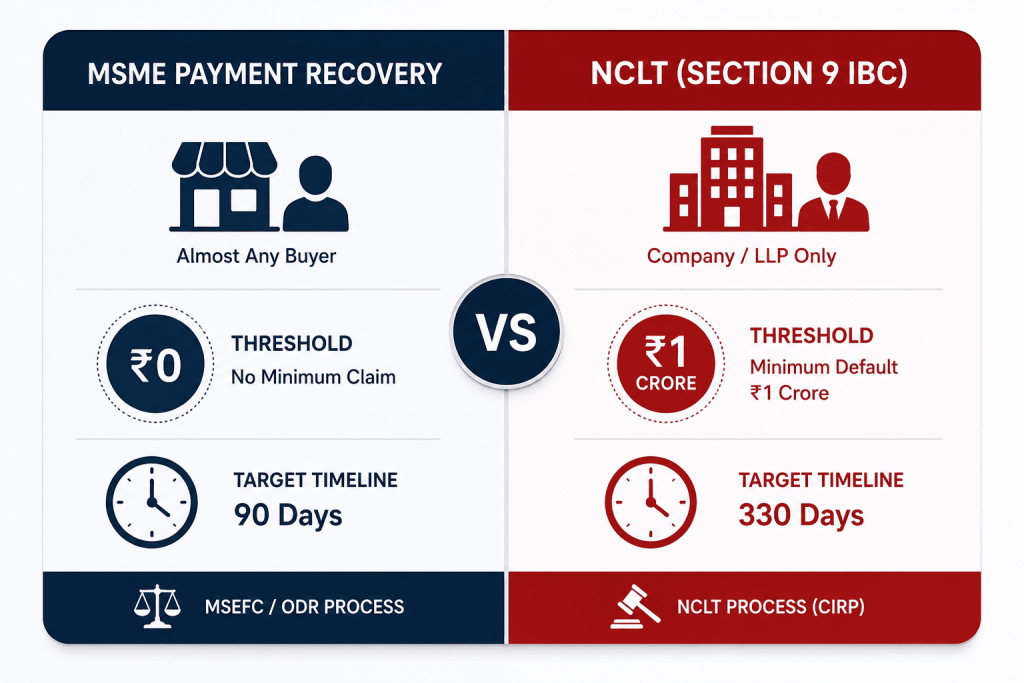
NCLT vs MSME Payment Recovery: Comparison at a Glance
Here’s the full picture side by side.
| Comparison Point | MSME Payment Recovery (MSEFC/ODR) | NCLT (Section 9, IBC) |
| Governing law | MSMED Act, 2006 (Sections 15 to 24) | Insolvency and Bankruptcy Code, 2016 (Section 9 with Section 8) |
| Main purpose | Recover a specific delayed payment, with interest | Start insolvency resolution against a defaulting company |
| Who can file | Micro or Small enterprise with Udyam Registration predating the invoice | Any operational creditor, MSME-registered or not |
| Who you can proceed against | Any buyer: proprietorship, partnership, company, LLP, government department, PSU | Only a company or an LLP |
| Minimum claim amount | None | ₹1 crore |
| Filing cost | Free | A modest tribunal fee, but legal costs add up |
| Where you file | MSME ODR portal, routed to the state Facilitation Council | NCLT bench with jurisdiction over the buyer’s registered office |
| Mandatory pre-filing step | Payment overdue past 15 or 45 days | Section 8 demand notice, with a 10-day waiting period |
| Target decision timeline | 90 days from the reference | 180 days, extendable to a 330-day outer limit |
| Real-world timeline | Usually slower than 90 days, still measured in months, not years | Resolution plans now take roughly 600 days on average |
| Interest on delay | Compound interest at 3x the RBI bank rate, monthly rests | No automatic statutory interest tied to the claim |
| What you get if you win | An arbitral award, enforceable like a court decree | A resolution plan or liquidation, not a guaranteed payout |
| Appeal route | Only after depositing 75% of the awarded amount | To the NCLAT, within 30 days |
| Effect on the buyer | Limited, aimed only at recovering your dues | Can suspend the board and hand the company to an IRP |
Notice the claim-size and buyer-type rows. For most small B2B disputes, they alone rule NCLT out before you even get to timelines or cost.
Who Can File, and Who Can You Recover From?
Eligibility runs on two separate tracks: who is allowed to file, and who can be pursued.
On the filing side, MSME payment recovery is reserved for micro and small enterprises. Medium enterprises don’t get access to the Facilitation Council’s delayed-payment mechanism, even though they can register on Udyam for other benefits. NCLT, by contrast, doesn’t care whether you’re MSME-registered at all. Any operational creditor, big or small, registered or not, can file a Section 9 application once the ₹1 crore threshold is met.
On the debtor side, the positions reverse. MSME payment recovery can reach almost anyone: a private company, a public company, an LLP, a proprietorship, a partnership firm, or a government department. NCLT reaches only companies and LLPs. If your buyer is a proprietor trading under a business name, or a traditional partnership firm, NCLT is not on the table regardless of how much they owe you.
This is exactly why understanding your buyer’s legal form matters before you sign a large order. Our overview of the differences between a company, an LLP, and a partnership firm is worth a read if you’re not sure what you’re dealing with, and running due diligence on a new buyer before extending credit can save you this entire headache later.
How Does the Recovery Process Work, Step by Step?
The two routes look nothing alike once you’re actually filing. Here’s what each involves.
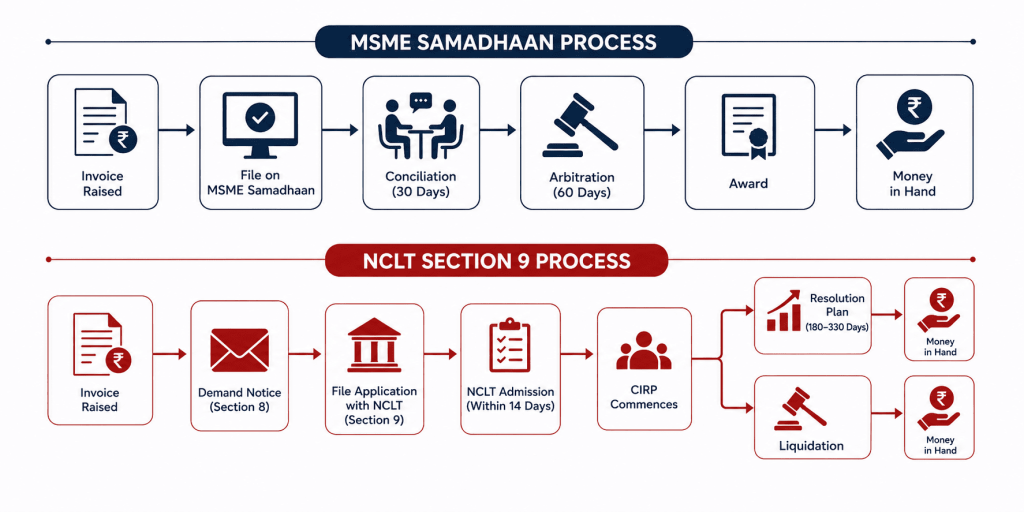
The MSME Samadhaan and ODR Process
- Confirm you hold a valid Udyam Registration from before the disputed invoice was raised.
- Let the payment window lapse: 15 days without a written agreement, or up to 45 days with one.
- Collect your paperwork: purchase order, invoice, delivery proof, and any payment reminders you sent.
- File your reference on the MSME ODR portal at odr.msme.gov.in. Since 15 October 2025, all new delayed-payment cases go through this portal instead of the older Samadhaan filing page.
- Go through the ODR portal’s automated pre-Council negotiation stage first.
- If negotiation fails, the case moves to your state’s MSEFC for conciliation.
- If conciliation also fails, the Council refers the matter to arbitration under the Arbitration and Conciliation Act, 1996.
- The Council targets a decision within 90 days of taking up the reference.
- Once you have an award, ask the buyer to pay. If they refuse, the award can be executed like a civil court decree, and it can now also be recovered as arrears of land revenue through the District Collector once that provision of the 2026 amendment is formally notified.
The NCLT Section 9 Process
- Confirm the buyer is a company or an LLP, and the unpaid amount is at least ₹1 crore.
- Send a demand notice under Section 8 of the IBC, using Form 3 or Form 4.
- Wait 10 days. If the buyer pays in full, or raises a genuine pre-existing dispute, you can’t move forward.
- File a Section 9 application at the NCLT bench that has jurisdiction over the buyer’s registered office.
- NCLT checks the application for completeness, proof of default, and evidence of a dispute.
- If satisfied, NCLT admits the petition, declares a moratorium under Section 14, and appoints an Interim Resolution Professional.
- The IRP takes over day-to-day control, invites claims from every creditor, and a Committee of Creditors is formed.
- The company goes through CIRP, working toward a resolution plan within 180 to 330 days, or liquidation if no plan is approved in time.
How Long Does Each Route Actually Take?
On paper, MSME payment recovery looks faster. The MSEFC is meant to decide within 90 days of taking up a reference. In practice, councils in busy states can take longer than that, but disputes still typically resolve in months, not years, especially now that the ODR portal’s first-stage negotiation settles a share of cases before they ever reach a formal hearing.
NCLT’s statutory clock reads 180 days, extendable by 90 more, with a 330-day outer limit set by the Supreme Court. Real numbers tell a different story. IBBI’s own data show resolution plans taking roughly 600 days on average to conclude, and liquidation orders taking around 518 days. Even the initial decision on whether to admit a petition can take well over 100 days at a busy bench. A parliamentary bill introduced in 2026 aims to speed things up, but until it’s fully implemented, plan for months of delay beyond the headline figures.
What Does Each Route Cost?
MSME payment recovery has no government filing fee. Your real cost is your own time gathering documents, plus optional professional fees if you’d rather not draft the reference and calculate interest yourself. Keeping clean, reconciled accounts throughout the year makes this step much faster when a dispute does come up.
NCLT’s tribunal fee for a Section 9 petition is modest, typically a few thousand rupees under the current fee schedule. The real cost sits elsewhere: drafting a legally sound demand notice, preparing the application to survive scrutiny, and representing you at hearings almost always requires an advocate familiar with IBC procedure. Our notice drafting service can help you get the Section 8 notice right the first time, since a poorly worded notice is one of the easier ways to see a petition rejected.
How Much Money Can You Actually Recover?
This is where the two routes diverge the most, and it’s worth being honest about it.
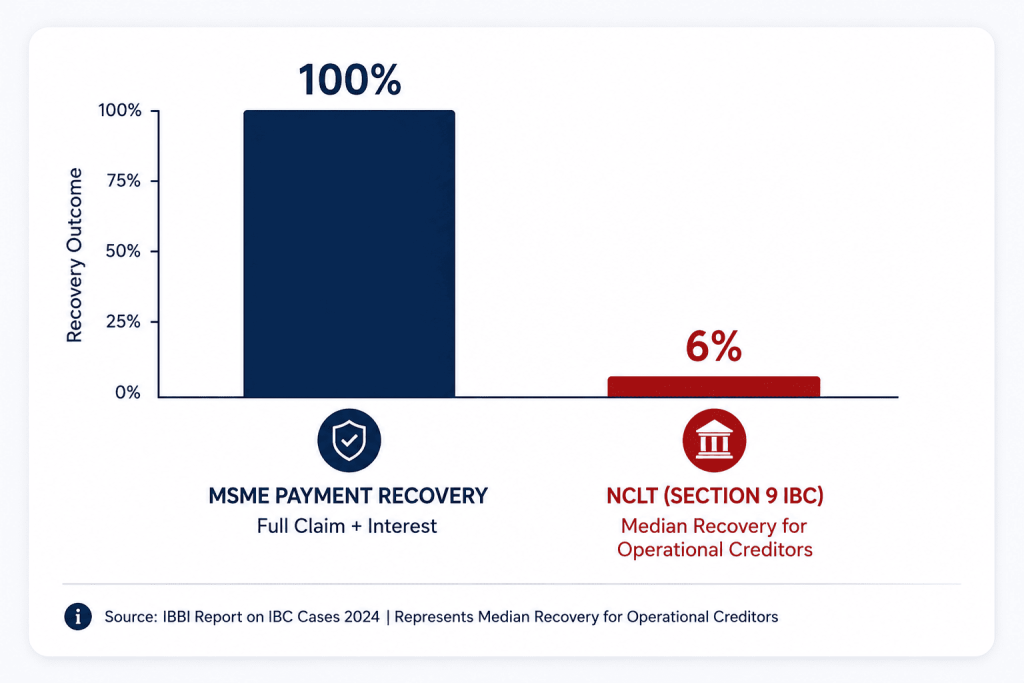
With MSME payment recovery, the arithmetic is straightforward. Say you’re owed ₹10,00,000 and the buyer pays six months late. At roughly 16.5% compound interest with monthly rests, you’d be looking at somewhere around ₹85,000 to ₹90,000 in additional interest on top of the principal, though the Council’s own calculation will use the exact number of days and the applicable bank rate at the time. You’re generally chasing the full amount you’re owed, plus interest, not a discounted share of it.
NCLT works differently, and this catches a lot of first-time filers off guard. Admission of a Section 9 petition doesn’t produce a payment order. It produces either a resolution plan (where a new investor takes over the company and pays creditors according to an approved distribution) or liquidation (where assets are sold and proceeds are divided under the Section 53 waterfall). Operational creditors sit behind resolution costs, secured lenders, and workmen’s dues in that waterfall. One widely cited analysis by the Insolvency Law Academy found the median recovery for operational creditors runs around 6% of their claim, well below the roughly 32% average realisation across all creditor types, a figure skewed upward by larger, better-secured financial creditors.
In practice, many suppliers use the mere filing of a Section 9 petition as pressure. Solvent companies often settle quickly rather than risk losing control of the business, which is a real and legitimate use of the process. But if the buyer is genuinely distressed, don’t assume admission means you’ll see your ₹1 crore back in full.
Recovery of any kind takes time, and your own cash flow doesn’t get to wait for it. If a big overdue invoice is squeezing your working capital while a case is pending, a short-term working capital loan can bridge the gap so you’re not tempted into a rushed, discounted settlement out of sheer cash pressure.
Which Option Fits Your Situation?
Use this as a starting point, not a final answer. Every case has its own facts.
| Your situation | Better starting route | Why |
| Buyer owes ₹80,000, buyer is a proprietorship | MSME payment recovery | No minimum claim; proprietorships fall outside NCLT’s reach entirely |
| Buyer is a partnership firm owing ₹40 lakh | MSME payment recovery | NCLT is unavailable against partnership firms, whatever the amount |
| Buyer is a private company, ₹1.5 crore overdue for 8 months, business looks solvent | MSME payment recovery first | Faster, cheaper, and doesn’t require pushing a paying customer toward insolvency |
| Buyer is a company, ₹3 crore overdue, other suppliers also unpaid, signs of real distress | NCLT may fit | Genuine insolvency risk; filing early protects your position among other creditors |
| You’re not Udyam-registered yet, buyer is a company owing ₹2 crore | Register on Udyam now for future protection; consider NCLT or a civil suit for this specific dispute | MSME protection isn’t retrospective, so this invoice needs a different route |
| Buyer is a government department, ₹25 lakh overdue | MSME payment recovery | A department isn’t a corporate debtor, so NCLT doesn’t apply |
| Buyer disputes the invoice amount in good faith | Civil court, arbitration, or continued conciliation | A genuine pre-existing dispute will usually get a Section 9 petition rejected outright |
Can You Use MSME Samadhaan and NCLT Together?
Not really, and not usually at the same time. If your buyer is a company and the ₹1 crore threshold is met, nothing in the IBC stops you from sending a Section 8 demand notice while an MSEFC reference is still pending. But once NCLT admits a petition, whether filed by you or by a different creditor entirely, the Section 14 moratorium freezes pending proceedings against that company. Your MSEFC case would typically pause too, and you’d instead need to file your claim with the Interim Resolution Professional as part of the wider insolvency process.
In other words, an NCLT admission can pull your carefully built MSEFC case out from under you and drop it into a shared pool with every other creditor. Think of the two routes as sequential options rather than parallel tracks you run at once. This is exactly the kind of strategic call where speaking with a professional before filing anything saves real money.
What’s Changing in 2026 for MSME Payment Recovery?
Two developments are worth knowing about right now.
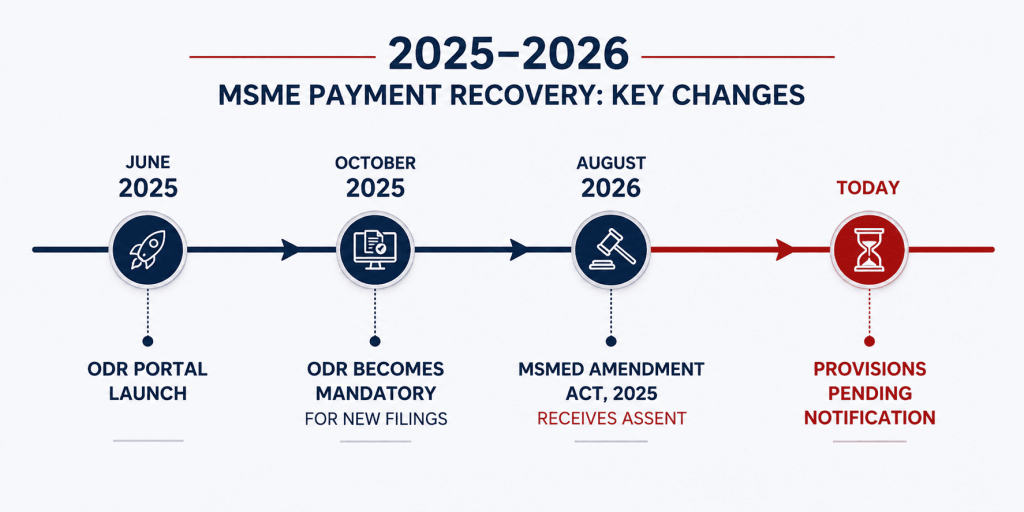
First, filing itself has moved. Since 27 June 2025, the government has run a dedicated MSME Online Dispute Resolution (ODR) Portal alongside the older Samadhaan system, and from 15 October 2025, every new delayed-payment reference goes through the ODR portal first, with an automated negotiation stage before a case ever reaches the Facilitation Council.
Second, and bigger, Parliament passed the Micro, Small and Medium Enterprises Development (Amendment) Act, 2026, which received Presidential assent on 13 August 2026. Once its provisions are formally notified and come into force, it’s set to tighten mediation and arbitration timelines, allow MSEFC awards to be recovered as arrears of land revenue through the District Collector, and let courts release part of a disputed award to the supplier while an appeal is still pending.
As of now, the Act has been notified in the Gazette, but its operative provisions come into effect only on dates the Central Government notifies separately, so treat these as upcoming improvements rather than tools you can use today. It’s worth checking the current commencement status before you rely on any of these specific changes for an active case.
What Mistakes Should You Avoid?
- Registering on Udyam after raising the invoice, then expecting MSME protection to apply. It won’t, for that particular transaction.
- Assuming NCLT is available just because the amount feels large. Below ₹1 crore, or against a non-corporate buyer, it simply isn’t an option.
- Filing a Section 9 petition to punish a solvent buyer over a genuine, documented dispute. NCLT will likely reject it, and you’ll have wasted months.
- Skipping the demand notice or getting it wrong. A defective Section 8 notice is a common, entirely avoidable reason petitions get rejected.
- Treating an admitted CIRP as a guaranteed payday. Operational creditors often recover far less than their claim; go in with realistic expectations.
- Letting invoices, purchase orders, and delivery proof pile up unsorted. Both forums move faster when your paperwork is already organised.
- Ignoring the three-year practical limitation on old, unpursued claims. Chase delayed payments while they’re recent rather than letting them go stale.
None of this replaces a conversation with someone who’s read your actual contract and buyer’s financials. Get that conversation in before you file, not after.
If delayed payments are also making it harder to raise fresh finance for your own business, our comparison of the CGTMSE and MCGS-MSME credit guarantee schemes covers collateral-free borrowing options worth exploring alongside your recovery case.
FAQs
Can I take a buyer to NCLT if the amount owed is less than ₹1 crore?
No. NCLT will not admit a Section 9 application unless the operational debt in default is at least ₹1 crore. This threshold has held steady since 2020. Below that amount, MSME payment recovery through the ODR portal, or a Commercial Court for larger commercial disputes, is the practical route.
Can NCLT be used to recover dues from a proprietorship or a partnership firm?
No. Section 9 of the IBC applies only to a “corporate debtor,” which means a registered company or an LLP. A proprietorship or an ordinary partnership firm cannot be taken to NCLT for unpaid dues, however large the amount. MSME payment recovery, by contrast, can be used against almost any buyer structure.
Does filing at MSME Samadhaan stop me from approaching NCLT for the same dues later?
Not automatically, but the two can collide. If your buyer is a company and NCLT later admits an insolvency petition against it, whether filed by you or another creditor, the resulting moratorium typically pauses your pending MSEFC case. You’d then pursue the dues as a claim within the insolvency process instead.
If NCLT admits my case, does that guarantee I’ll get paid in full?
No, and this is one of the biggest misconceptions about the route. Admission starts a resolution process, not a payment order. Operational creditors rank behind resolution costs, secured lenders, and workmen’s dues, and one widely cited study found their median recovery sits around 6% of the claimed amount, though outcomes vary a lot case by case.
Can I register on Udyam now and still claim interest on old invoices raised before registration?
No. Both the Ministry’s own guidance and Supreme Court rulings confirm that MSME registration is not retrospective. The delayed-payment protections under the MSMED Act apply only to invoices raised after your Udyam Registration date, not before it.
What happens if the buyer doesn’t respond to the Facilitation Council’s notice?
The Council isn’t required to wait indefinitely for a response. If the buyer doesn’t reply or fails to appear despite proper notice, the Council can proceed with conciliation and, if needed, arbitration based on the material already on record, and pass an award without further participation from the buyer.
Can a government department or a PSU be taken to NCLT for delayed MSME payments?
A government department itself isn’t a company or an LLP, so it falls outside NCLT’s Section 9 jurisdiction; MSME payment recovery remains the route there. A PSU incorporated as a company is generally treated as an ordinary corporate debtor, so it can in principle be taken to NCLT if the ₹1 crore threshold and other conditions are met.
Do I have to try MSME Samadhaan first before I can file a case at NCLT?
No. They’re separate legal mechanisms, and there’s no requirement to exhaust one before using the other, provided your buyer and claim amount actually qualify for NCLT in the first place. The only mandatory pre-filing step for NCLT is the Section 8 demand notice and its 10-day waiting period, which is unrelated to any MSEFC proceeding.
What happens to my MSME Samadhaan case if another creditor takes the same buyer company to NCLT?
Once NCLT admits any creditor’s petition against that company, the Section 14 moratorium freezes proceedings against it, including your pending MSEFC reference. You’d then need to file your claim with the Interim Resolution Professional so it’s counted as part of the company’s insolvency process.
Do I need a lawyer to file a claim on the MSME Samadhaan or ODR portal?
Not necessarily. The portal is built for a business owner to file directly, without mandatory legal representation, especially for straightforward, well-documented claims. That said, professional help is genuinely useful for calculating interest correctly and handling contested or higher-value cases, and it’s close to essential for NCLT filings given the procedural strictness involved.
You may also like
What Should Taxpayers Know About Income Tax Rules 2026?
The Income Tax Rules 2026 have changed the working language, form numbers and r