18 Essential Legal Documents Every Entrepreneur Needs in India
- by kapil
- Updated October 5, 2026
- 20 mins read
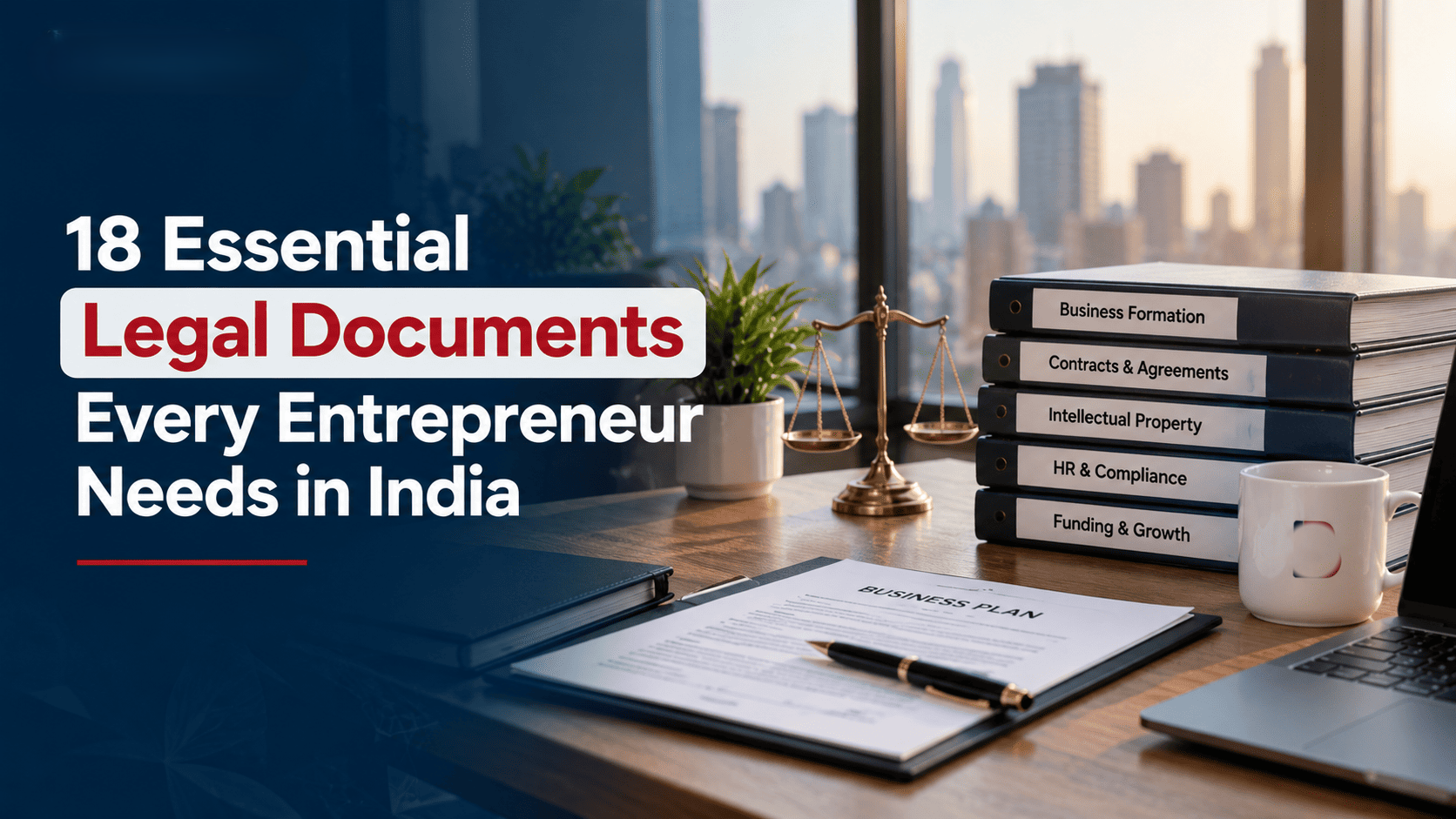
Legal documents for entrepreneurs include business registration papers, founders’ agreements, shareholder agreements, employment contracts, intellectual property agreements, privacy policies and financial records. Indian businesses also need applicable tax registrations, licences and statutory records. The exact documents depend on the business structure, industry, employees and funding plans.
Starting a business involves many decisions. You need to choose a business name, find customers, manage money and build a team. Legal paperwork often comes later.
That delay can create problems. A founder may leave without clear exit terms. A developer may claim ownership of software built for the company. A customer may dispute a payment because the service terms were unclear. The right documents help prevent these problems.
This guide explains 18 essential legal and business documents, why entrepreneurs need them, when to prepare them and what each should contain.
Important: This article focuses on Indian businesses. Some documents are statutory requirements, while others are recommended business practices. You do not need every document on this list from day one.
What Are Legal Documents for Entrepreneurs?
Legal documents for entrepreneurs are written records that establish a business’s legal identity, define relationships, protect assets and record important transactions.
They may include:
- Registration certificates and constitutional documents.
- Agreements between founders, shareholders, employees and business partners.
- Intellectual property ownership records.
- Tax registrations, licences and statutory records.
- Contracts with customers, vendors and investors.
For example, a private limited company needs incorporation documents and statutory records. A sole proprietor may not need those company documents but may still need tax registrations, business licences and commercial contracts.
The first step is to identify your business structure. Read our guide to different types of companies in India to understand the available options.
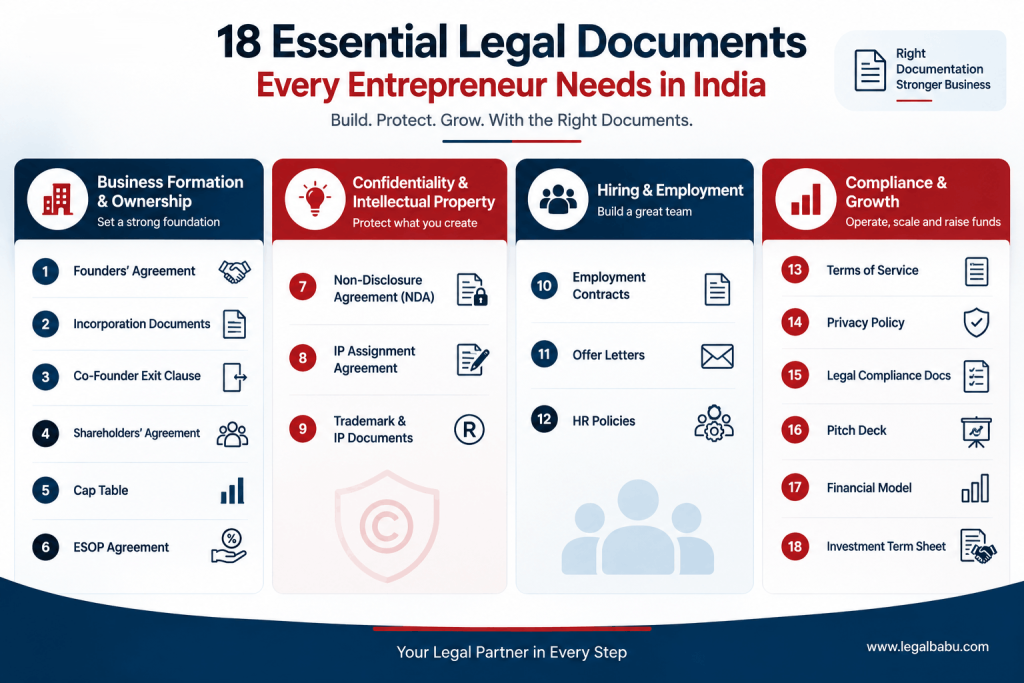
18 Essential Legal Documents Every Entrepreneur Needs
1. Founders’ Agreement
A founders’ agreement defines how the founders will work together and manage the business. It is especially useful when two or more people start a company.
Imagine two friends launch a software business. One develops the product, while the other handles sales. They agree to split ownership equally but never discuss what happens if one stops working.
A founders’ agreement can address that problem before it becomes a dispute.
What should a founders’ agreement include?
- Founders’ names and responsibilities.
- Equity ownership and capital contributions.
- Time commitment and compensation.
- Decision-making powers and deadlock resolution.
- Intellectual property ownership.
- Confidentiality obligations.
- Founder exit, share transfer and dispute resolution terms.
The agreement should also explain how it interacts with the company’s constitutional documents and shareholder arrangements.
A founders’ agreement is generally not a universal statutory requirement. However, it can provide valuable clarity from the beginning.
2. Business Incorporation Documents
Business incorporation documents establish the legal identity of a registered business.
In India, the documents depend on the structure you choose.
| Business structure | Important documents |
| Private limited company | Certificate of Incorporation, MoA, AoA |
| One Person Company | Certificate of Incorporation, MoA, AoA |
| LLP | Certificate of Incorporation, LLP Agreement |
| Partnership firm | Partnership Deed and applicable registration records |
| Sole proprietorship | Applicable business, tax and licence records |
A private limited company is governed by the Companies Act, 2013. Its Memorandum of Association (MoA) sets out key details, including its objects, while its Articles of Association (AoA) contain rules for its internal management.
You can read the Companies Act, 2013, on India Code for the statutory framework governing companies.
An LLP follows the Limited Liability Partnership Act, 2008, and its LLP Agreement sets out the partners’ rights and duties. You can find the relevant legislation through the India Code legislation database.
If you are deciding between business structures, read our guide on private limited companies vs. sole proprietorships.
For company formation, explore Legal Babu’s company registration services.
Practical tip: Keep your incorporation certificate, constitutional documents, PAN, applicable tax registrations and important approval records in one secure folder. Banks, investors and business partners may ask for them.
3. Co-Founder Exit Clause
A co-founder exit clause explains what happens when a founder leaves the business. It is usually included in a founders’ agreement or shareholders’ agreement.
Consider a startup with three founders. One founder leaves after six months but still holds a large share of the company. The remaining founders may struggle to raise funds or change the ownership structure.
A clear exit clause can address:
- Voluntary resignation.
- Removal or termination of a founder’s role.
- Death or permanent incapacity.
- Treatment of vested and unvested equity.
- Share transfer and buyout procedures.
- Confidentiality and return of company property.
- Dispute resolution.
The clause must follow the company’s constitutional documents and applicable law. A company cannot simply cancel a founder’s shares because the founder stops working.
4. Shareholders’ Agreement
A shareholders’ agreement governs the relationship between a company’s shareholders.
It becomes particularly useful when a business has multiple owners or outside investors.
The agreement may cover:
- Voting rights and shareholder decisions.
- Board representation.
- Reserved matters requiring special approval.
- Share transfers and restrictions.
- Rights of first refusal.
- Tag-along and drag-along rights.
- Dilution and future fundraising.
- Dispute resolution and exit arrangements.
For example, an investor may want approval rights over a major sale or a new share issue. The shareholders’ agreement can define those rights.
The agreement should also be checked against the company’s Articles of Association. A private agreement cannot automatically override the Companies Act or the company’s constitutional documents.
5. Capitalisation Table (Cap Table)
A capitalisation table records who owns the company’s equity and how much they own.
It helps founders understand the effect of issuing shares, granting stock options and bringing in investors.
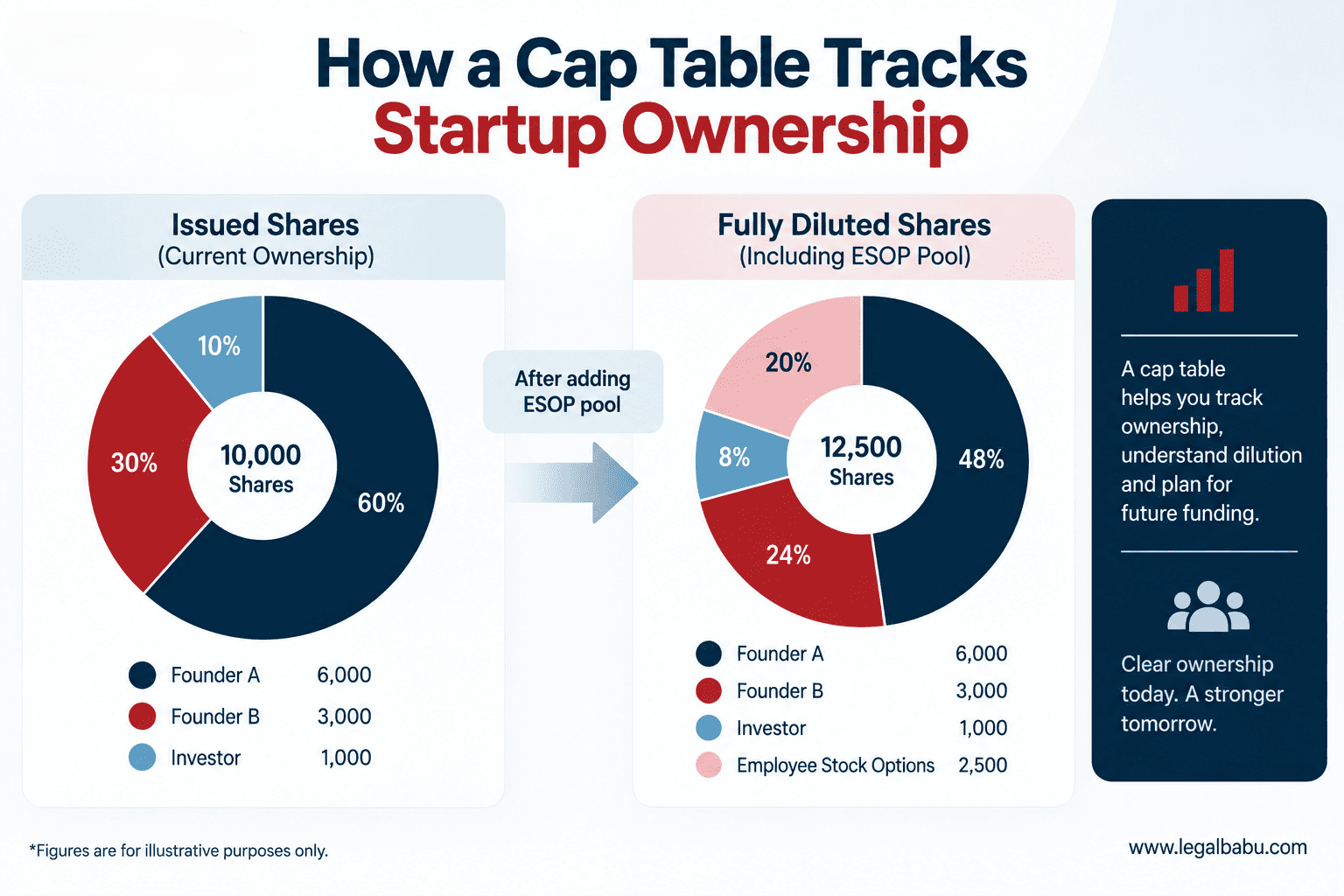
A basic cap table may look like this:
| Shareholder | Shares | Ownership |
| Founder A | 6,000 | 60% |
| Founder B | 3,000 | 30% |
| Investor | 1,000 | 10% |
| Total | 10,000 | 100% |
These figures are illustrative.
A cap table should clearly state whether it shows issued shares or fully diluted ownership. Fully diluted ownership may include options and other securities that could convert into shares.
A cap table is an internal ownership record. It does not replace the register of members, share certificates or other statutory records required under company law.
Practical tip: Update the cap table after every share issue, transfer, option grant or other ownership change. Reconcile it with the company’s actual records.
6. Employee Stock Option Plan (ESOP) Documents
An Employee Stock Option Plan allows eligible employees to receive options to acquire shares in a company under specified conditions.
Startups often use ESOPs to attract and retain employees.
An ESOP arrangement may involve:
- The ESOP scheme.
- Corporate approvals.
- Individual grant letters.
- Vesting schedules.
- Exercise price and exercise period.
- Rules for resignation or termination.
- Tax and reporting requirements.
For example, an employee may receive options that vest over four years. The employee earns the right to exercise those options according to the scheme’s terms.
An option is not the same as an issued share. The employee generally becomes a shareholder only after exercising the option and completing the required process.
Indian companies must follow the applicable Companies Act provisions and rules when implementing an ESOP scheme.
You can check the Ministry of Corporate Affairs website for company law rules and filing information.
7. Non-Disclosure Agreement (NDA)
A Non-Disclosure Agreement protects confidential information shared between parties.
Entrepreneurs may use NDAs when discussing a business opportunity, hiring a consultant or sharing sensitive information with a vendor.
A well-drafted NDA should define:
- What counts as confidential information.
- Why the receiving party may use that information.
- Who may access it.
- Exclusions from confidentiality.
- The duration of the obligations.
- Permitted disclosures.
- Return or destruction of confidential material.
- Remedies and dispute resolution.
For example, a company may share its product specifications with a software development agency. An NDA can restrict the agency from using that information for unrelated purposes.
However, an NDA does not automatically protect every business idea. It cannot replace proper intellectual property ownership arrangements.
8. Intellectual Property Assignment Agreement
An intellectual property assignment agreement transfers specified intellectual property rights from one party to another.
This is particularly relevant to startups that develop software, products, designs, inventions or original content.
Suppose a founder hires a freelancer to build an app. The freelancer writes the code, but the contract says nothing about ownership. The company may later face questions about its rights to use, modify or transfer that code.
An IP assignment agreement can clarify ownership.
It should identify:
- The intellectual property being transferred.
- The assignor and assignee.
- The rights being assigned.
- The territory and duration of the assignment.
- Consideration and payment terms.
- Existing third-party or open-source material.
- Further documentation or assistance required.
Under Indian copyright law, assignments should meet the applicable statutory requirements, including written terms identifying the work and the rights assigned.
Practical tip: Obtain appropriate IP assignments from founders, employees and contractors. Also identify any intellectual property created before the company was incorporated.
9. Trademark and Intellectual Property Documents
Trademark and intellectual property documents help businesses protect their brands, inventions, designs and creative work.
The relevant documents depend on the type of intellectual property.
| Intellectual property | Relevant documents |
| Trademark | Search reports, applications, registration certificates |
| Copyright | Ownership records, assignments and licences |
| Patent | Patent applications, specifications and granted patents |
| Industrial design | Design applications and registration certificates |
A trademark protects a distinctive sign used to identify goods or services. A patent protects an invention that meets the applicable legal requirements. Copyright protects qualifying original works.
For example, a business may register its brand name as a trademark while separately obtaining copyright protection for original website content or software.
Trademark registration is not the same as company name registration. Registering a company name does not automatically provide trademark protection.
Explore Legal Babu’s trademark registration services to learn more about protecting your brand.
You can also read our guide on trademark protection in India and use the trademark classes list to understand how goods and services are classified.
For official trademark information, visit Intellectual Property India.
10. Employment Contracts
An employment contract defines the terms of employment between a business and an employee.
It helps both parties understand their rights, duties and expectations.
An employment contract may include:
- Job title and responsibilities.
- Salary, benefits and payment terms.
- Working hours and workplace.
- Leave and attendance.
- Confidentiality obligations.
- Intellectual property provisions.
- Notice period and termination.
- Dispute resolution and applicable law.
For example, a startup hiring a software engineer should clearly define the employee’s role, compensation and ownership of work created during employment.
Employment terms must comply with applicable central and state laws. Requirements can vary by the type of establishment, employee category and location.
A contract should also avoid relying on broad post-employment restrictions without legal review. Certain restrictions, particularly those affecting an employee’s ability to work after employment ends, may be unenforceable under Indian law.
11. Offer Letters
An offer letter communicates the proposed terms of employment to a candidate.
It usually comes before the employee joins the company.
A typical offer letter includes:
- Candidate’s name and designation.
- Proposed joining date.
- Salary or CTC.
- Reporting manager.
- Work location.
- Conditions of employment.
- Deadline for accepting the offer.
An offer letter may also refer to a detailed employment agreement.
For example, a company may offer a candidate a position with a specified annual CTC and joining date. The employment agreement can then set out the detailed terms governing the relationship.
The offer letter and employment contract should not contain conflicting terms.
12. HR Policies and Employee Handbook
HR policies explain the workplace rules employees are expected to follow.
They help a business apply its employment practices consistently.
Common policies cover:
- Leave and attendance.
- Workplace conduct.
- Disciplinary procedures.
- Grievance redressal.
- Workplace harassment prevention.
- Information security.
- Remote work.
- Separation and exit procedures.
A company may maintain an employee handbook that brings these policies together.
Some workplace policies and procedures are legally required for certain establishments. For example, employers covered by the POSH Act must comply with its applicable requirements concerning sexual harassment prevention and redressal.
You can read the Sexual Harassment of Women at Workplace Act, 2013 on India Code for the statutory framework.
A handbook should reflect the company’s actual practices. A copied policy that employees and managers cannot follow may create more confusion than clarity.
13. Terms of Service
Terms of Service, also called Terms and Conditions or Terms of Use, define the rules for using a website, application or service.
They are especially relevant to online businesses, SaaS companies and digital platforms.
Terms of Service may cover:
- User eligibility and account responsibilities.
- Permitted and prohibited activities.
- Products and services offered.
- Pricing and payment.
- Cancellations and refunds.
- Intellectual property rights.
- Suspension or termination of accounts.
- Liability and dispute resolution.
For example, an online platform should explain what happens when a customer cancels a subscription or violates its usage rules.
Terms of Service should match the actual service and applicable Indian laws. A business should not assume that copying another company’s terms will protect it. For reference, see Legal Babu’s Terms of Use.
14. Privacy Policy
A privacy policy explains how a business collects, uses, stores and shares personal data.
It is relevant to businesses that collect personal information through websites, applications, customer forms or other systems.
A privacy policy may explain:
- What personal data the business collects.
- Why it collects the data.
- How it uses and shares the data.
- How long it retains the data.
- Security measures and safeguards.
- Applicable user rights.
- Contact and grievance mechanisms.
For example, an e-commerce business may collect names, addresses, phone numbers and payment-related information to process orders.
India’s Digital Personal Data Protection Act, 2023, establishes a framework for processing digital personal data. The applicable requirements depend on the law’s commencement, rules and the circumstances of processing.
You can read the Digital Personal Data Protection Act, 2023 on India Code.
A privacy policy alone does not establish compliance. Businesses must also follow the applicable requirements for collecting and handling personal data.
15. Legal and Regulatory Compliance Documents
Businesses must maintain the registrations, licences, records and approvals that apply to their operations.
These requirements vary by business structure, location and industry.
Common documents include:
- GST registration, where applicable.
- PAN and tax-related records.
- Trade licences and industry-specific permits.
- Accounting books and financial statements.
- Applicable statutory registers.
- Board resolutions and meeting records.
- Annual filings and tax returns.
- Employment and payroll records.
For example, a food business may need specific food safety registration or licensing. A company operating in a regulated industry may need additional approvals before it can begin operations.
A private limited company must follow the applicable Companies Act requirements. An LLP must comply with the relevant LLP Act and rules.
For tax-related requirements, visit the official GST portal. You can also explore Legal Babu’s GST registration services.
For company filings, refer to the Ministry of Corporate Affairs.
For startup-related guidance, visit the Startup India portal.
16. Pitch Deck
A pitch deck is a presentation used to explain a business to potential investors.
It helps investors understand the opportunity, the product and the company’s growth plans.
A strong pitch deck usually includes:
- The problem.
- The proposed solution.
- The target market.
- The product or service.
- The business model.
- Market competition.
- Traction and key achievements.
- The founding team.
- Financial projections.
- Funding requirements.
For example, a startup seeking seed funding may use its pitch deck to explain how it plans to acquire customers and use the proposed investment.
A pitch deck is a business presentation, not an investment agreement. It should also avoid unsupported claims about revenue, customers or market size.
17. Financial Model
A financial model estimates how a business may perform financially over time.
It helps founders plan expenses, estimate funding needs and assess different business scenarios.
A financial model commonly includes:
- Revenue assumptions.
- Sales forecasts.
- Operating expenses.
- Employee costs.
- Cash flow projections.
- Profit and loss estimates.
- Funding requirements.
- Break-even analysis.
For example, a startup may estimate how many customers it needs to cover its monthly operating costs.
A useful financial model should show the assumptions behind its projections. Founders should be able to explain why they expect revenue to grow or costs to change.
Investors may ask for a financial model during due diligence. However, the format and level of detail depend on the business and funding stage.
18. Investment Term Sheet
An investment term sheet records the proposed terms of an investment.
It helps founders and investors agree on the main commercial and governance points before preparing definitive legal documents.
A term sheet may include:
- Investment amount.
- Valuation and share price.
- Type of securities.
- Ownership and dilution.
- Board representation.
- Investor rights.
- Liquidation preference.
- Conditions for closing.
- Exclusivity and confidentiality.
- Proposed transaction timeline.
For example, an investor may propose investing ₹1 crore in exchange for a specified ownership percentage. The term sheet can record the proposed valuation and other investment terms.
Is a term sheet legally binding? Some provisions may be binding while others are intended to be non-binding. Its legal effect depends on the actual wording, the provisions involved and applicable law.
Before accepting an investment, founders should review the proposed terms and prepare for due diligence. Legal Babu provides due diligence services for businesses preparing for important transactions.s.
Which Legal Documents Are Mandatory for a Business in India?
The legal documents a business must maintain depend on its structure and activities.
A private limited company has different statutory obligations from a sole proprietorship. A business operating in a regulated industry may also need licences that other businesses do not.
The following table provides a general guide.
| Document | General requirement |
| Certificate of Incorporation | Required for an incorporated company or LLP |
| MoA and AoA | Required for a company |
| LLP Agreement | Required for an LLP |
| Partnership Deed | Strongly recommended for a partnership |
| GST registration | Required when applicable under GST law |
| Business licences | Required when applicable to the activity |
| Statutory company records | Required as prescribed by company law |
| Employment records | Depend on applicable employment laws |
| Privacy policy | Depends on applicable data protection and sectoral requirements |
| Founders’ agreement | Generally recommended, not universally mandatory |
| NDA | Situation-specific |
| Pitch deck | Optional |
| Financial model | Recommended |
| Investment term sheet | Relevant when negotiating investment |
This table is a general guide, not a complete compliance checklist. Businesses should check the rules that apply to their specific structure, location and industry.
For company-specific requirements, refer to the Ministry of Corporate Affairs. For applicable tax obligations, check the GST portal.
What Documents Should You Prepare at Each Business Stage?
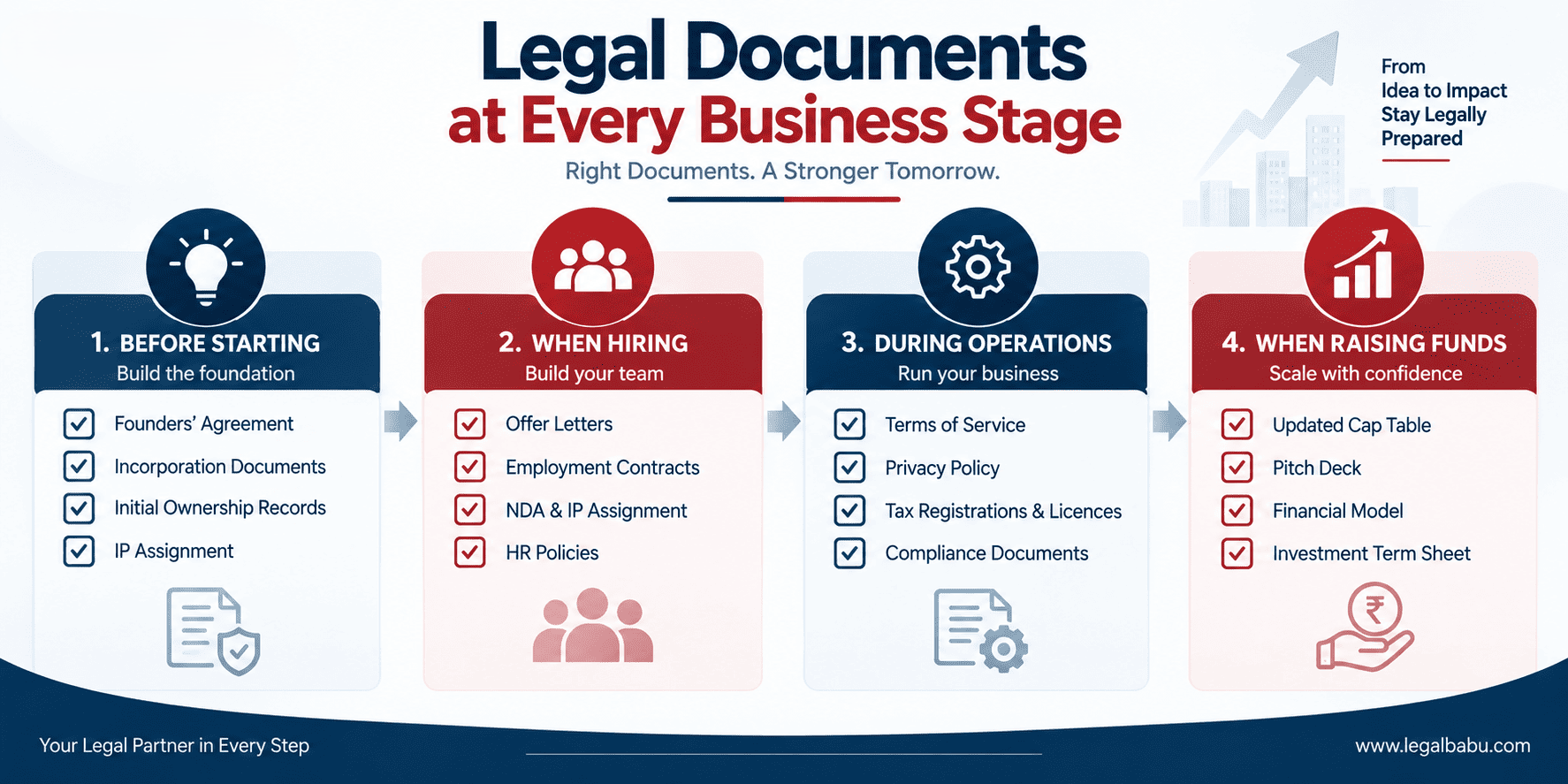
You do not need to prepare all 18 documents at once. Start with the documents that support your current business activity.
Before starting the business
Prepare or identify:
- Business structure and incorporation documents.
- Founders’ agreement, if you have co-founders.
- Initial ownership and capital contribution records.
- Intellectual property ownership arrangements.
When hiring employees
Prepare:
- Offer letters.
- Employment contracts.
- Confidentiality and IP assignment documents.
- Applicable HR policies and employment records.
When starting commercial operations
Prepare:
- Customer and vendor agreements.
- Terms of Service, where relevant.
- Privacy policy, where applicable.
- Tax registrations and required licences.
- Trademark and other IP protection documents.
When raising funds
Prepare:
- Updated cap table.
- Incorporation and statutory ownership records.
- Pitch deck.
- Financial model.
- Investment term sheet.
- Definitive investment and shareholder documents.
Practical observation: Investors often examine whether the company’s ownership records, financial information and legal agreements tell the same story. A discrepancy between the cap table and the actual share records can delay due diligence.
What Are the Most Common Legal Documentation Mistakes Entrepreneurs Make?
Entrepreneurs often focus on registering their business and postpone the agreements that govern its daily operations.
These mistakes can create avoidable disputes.
1. Using generic templates without reviewing them
A template may not fit your business structure, transaction or applicable law.
Use templates as a starting point. Review the clauses that affect ownership, payment, liability, termination and dispute resolution.
2. Failing to document founder ownership
An informal understanding about equity can create disputes when a founder leaves or a new investor joins.
Record the agreed ownership and ensure the company’s statutory records reflect the actual position.
3. Ignoring intellectual property ownership
A company may pay a developer or designer without securing the relevant IP rights.
Use suitable contracts and assignments to establish who owns the work.
4. Treating an offer letter as a complete employment contract
A short offer letter may omit confidentiality, intellectual property, termination and other employment terms.
Use a suitable employment agreement where the relationship requires one.
5. Copying website policies from another business
Terms of Service and privacy policies must reflect your actual business operations.
A copied policy may contain inaccurate statements about your services, data practices or refund rules.
6. Failing to update documents after a business change
Ownership, employees, products and business activities change over time.
Review the relevant agreements and records when you:
- Add a new founder or shareholder.
- Issue shares or stock options.
- Hire employees or contractors.
- Launch a new product.
- Enter a major commercial contract.
- Raise investment.
Where Can Entrepreneurs Find Legal Document Templates in India?
Entrepreneurs can begin with official resources and then adapt the documents to their business needs.
Useful starting points include:
- Startup India for startup guidance and resources.
- Ministry of Corporate Affairs for company registration and statutory filing information.
- India Code for central legislation.
- Intellectual Property India for trademark, patent and design information.
- GST portal for GST registration and compliance.
Startup India publishes resources that can help entrepreneurs understand common startup documentation. India Code provides access to central legislation.
A sample document should not be treated as a ready-to-sign agreement. Review it against your business structure, commercial arrangement and applicable law.
Frequently Asked Questions
Can I start a business in India without registering a private limited company?
Yes. Depending on your business, you may operate as a sole proprietor, partnership, LLP or company. Each structure has different legal, tax and compliance requirements.
Do two founders need a founders’ agreement before starting a startup?
A founders’ agreement is generally not a universal statutory requirement. However, it is strongly recommended when two or more people start a business together. It can clarify ownership, responsibilities, decision-making and exit terms.
What happens if a co-founder leaves without a written exit agreement?
The company may face disputes over ownership, responsibilities and access to business assets. The outcome depends on the existing agreements, company records and applicable law. A written exit mechanism can reduce uncertainty.
Can a freelancer own the software they develop for my startup?
The answer depends on the contract, the nature of the work and applicable intellectual property law. Do not assume that paying a freelancer automatically transfers every intellectual property right. Use a suitable written agreement that clearly addresses ownership.
Should a startup ask every investor to sign an NDA?
No. An NDA is not universally required for every investor discussion. Some investors may decline to sign one before reviewing a pitch. Share only the information needed for the discussion and protect sensitive information through suitable arrangements.
Can a company remove a founder’s shares if the founder stops working?
A company cannot automatically cancel a founder’s shares merely because the founder stops working. Any exit, transfer or buyback arrangement must follow the applicable law, company documents and relevant agreements.
Is a cap table enough to prove who owns a company?
No. A cap table is a useful ownership record, but it does not replace statutory company records, share certificates or other required documents. The cap table should match the company’s actual ownership records.
What documents should I prepare before raising startup funding?
Start with incorporation documents, ownership records, a cap table, financial information, relevant contracts and intellectual property records. Investors may also ask for a pitch deck, financial model, term sheet and definitive investment agreements.
Do small businesses need a privacy policy and Terms of Service?
It depends on the business and its activities. A website or app that collects personal data may have applicable privacy obligations. Terms of Service are particularly relevant when users access a product or service under defined conditions. The documents should reflect the actual operations.
Can I use free legal document templates for my business?
Yes, as a starting point. However, free templates may not cover your specific ownership structure, transaction or legal requirements. Review the document before signing, especially when it involves shares, intellectual property, employment or investment.
You may also like


What Does Project Logistics Alliance Membership Offer?
Project Logistics Alliance membership offers an Indian project cargo business a