
SIRE 2.0 Inspection: Complete Guide for Ship Managers
- by kapil
- Updated September 5, 2026
- 17 mins read
SIRE inspection is OCIMF’s Ship Inspection Report Programme, the vetting system oil majors and terminals use to check a tanker’s condition, procedures, and crew before chartering it. For ship managers, the report decides whether a vessel gets fixed on a good charter or quietly drops off a major’s approved list, so treating SIRE as routine paperwork is a costly mistake.
What Is SIRE Inspection?
SIRE stands for Ship Inspection Report Programme. It is run by OCIMF, the Oil Companies International Marine Forum, and it exists to give charterers, terminal operators, and government bodies a shared, up to date picture of a tanker’s condition before they do business with it.
OCIMF launched SIRE in 1993 to push back against substandard tanker operations. The programme is voluntary. No law forces a shipowner to take part, and no inspector hands out a pass or fail grade. Instead, a trained inspector boards the vessel, works through a structured questionnaire, and files a detailed report into a shared OCIMF database. Charterers then read that report and decide for themselves whether the ship meets their standard.
Over 180,000 SIRE inspection reports covering over 8,000 vessels sit in that database today. That scale is exactly why the programme carries weight. It is not one company’s private checklist. It is the industry’s shared memory of how a tanker actually performs.
A simple way to think about it: a DOC and a class certificate tell the world your ship is legally allowed to sail. A SIRE inspection tells commercial buyers whether they actually want to hire it.
Why Does SIRE Inspection Matter to Ship Managers?
Because it decides who will charter your ship. Most oil majors and large charterers will not fix a tanker without a recent, reasonably clean SIRE report sitting in the database. No report, or a report full of unresolved negative observations, and the ship simply does not get invited to bid on the good cargo runs.
The tricky part for a ship manager is that this rejection is usually silent. Nobody calls to say a vessel lost a fixture over its SIRE history. It just does not get the call in the first place. A manager who only reviews the report after an inspection, rather than treating the underlying data as a living record, tends to be the one caught off guard by this.
SIRE also does not stay contained to a single voyage or a single relationship. Because the report lives in a shared database, one poor inspection can affect chartering opportunities across the fleet, not just the ship that was boarded. A pattern of weak reports across several vessels under the same management starts to look like a management problem rather than a one-off hardware issue, and charterers read it that way.
The report itself does not go to the ship. It goes to whichever company holds legal accountability for the vessel’s safety management system, known as the Document of Compliance (DOC) holder. That is the entity a charterer expects to answer for what the inspector found, which is one more reason DOC and SIRE performance tend to move together in a charterer’s mind.
What Changed With SIRE 2.0, and How Is It Different From VIQ7?
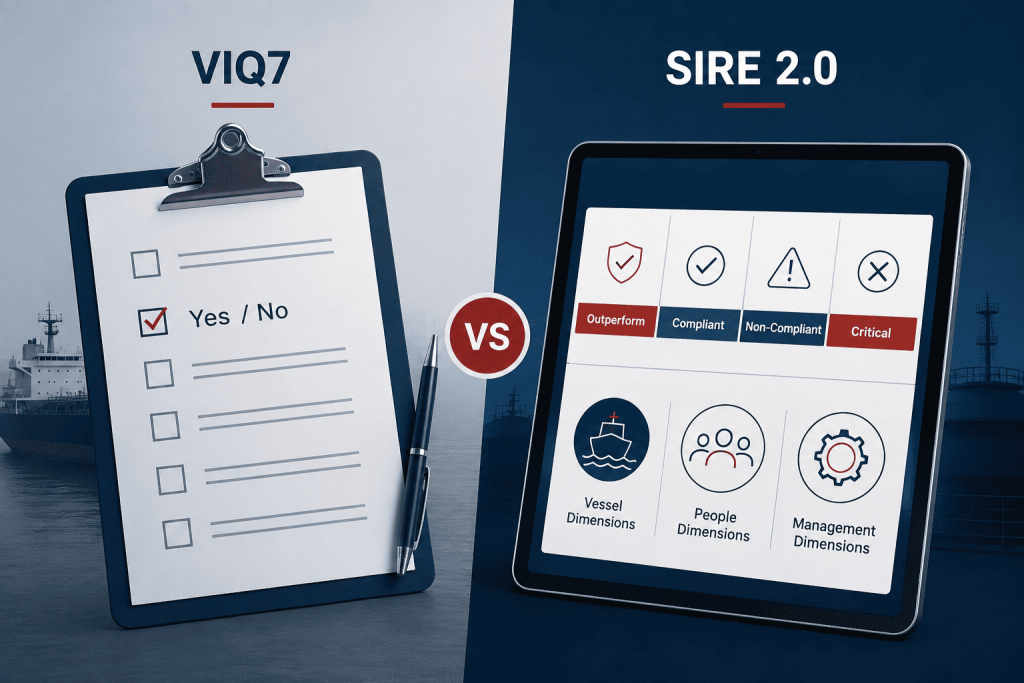
SIRE 2.0 permanently replaced the old VIQ7 questionnaire on September 2, 2024, and it is now the only tanker inspection tool OCIMF offers. The change was not cosmetic. It rebuilt how questions get chosen, how answers get scored, and how the human side of ship operations gets assessed.
Under VIQ7, every tanker faced the same fixed set of questions, answered with a simple yes or no. Under SIRE 2.0, an algorithm builds a bespoke Compiled Vessel Inspection Questionnaire, or CVIQ, for each inspection, drawing from a Question Library of around 100 questions tailored to that specific vessel. No two CVIQs look exactly alike, even for sister ships.
The CVIQ pulls from four question categories:
- Core questions cover safety critical risks and appear in roughly half of every inspection.
- Rotational questions rotate in and out across successive inspections so different areas get checked over time.
- Campaign questions address emerging, time limited industry concerns.
- Conditional questions get triggered by details the operator declares, such as vessel age, cargo type, or planned ship to ship transfers.
Answers are no longer binary. Inspectors now grade each question on a four level scale, from Not as Expected up to Exceeds Expectations, and every question gets assessed across three separate dimensions: Hardware, Procedures, and Human Factors. That last dimension is genuinely new. Inspectors interview crew and rate their competence using nine standard Performance Influencing Factors, checking what OCIMF calls work as done against work as imagined.
One detail worth knowing before your next inspection cycle: the CVIQ compiler does not look at a vessel’s past inspection performance when picking questions. A ship with three clean inspections behind it gets the same algorithmic treatment as one with a rough history. There is no reward for a good track record baked into question selection, so preparation has to stay consistent every single time.
| Feature | VIQ7 (retired) | SIRE 2.0 (current) |
| Questionnaire | Fixed, identical for every inspection | CVIQ, algorithm built, unique per inspection |
| Answer format | Yes or No | Four level grading, Not as Expected to Exceeds Expectations |
| What gets assessed | Mostly hardware and procedures | Hardware, Procedures, and Human Factors on every question |
| Crew assessment | No structured method | Nine PIFs, work as done vs work as imagined |
| Photo requirement | None | Standardised Photo Repository, refreshed every 6 months |
| Negative observations | Free text, inconsistent | Coded Subject of Concern (SOC) and Nature of Concern (NOC) |
| Recording method | Paper or basic digital forms | Tablet based, real time, GPS logged |
| Current scope | Tankers and barges | Tankers only for now (SIRE Category 1) |
Which Vessels Actually Need a SIRE Inspection?
SIRE 2.0 currently applies only to what OCIMF calls Category 1 vessels: oil tankers, chemical tankers, gas carriers, and LPG tankers. If you manage any of these, SIRE readiness is not optional in any practical, commercial sense.
Bulk carriers are not part of SIRE at all. They typically go through RightShip’s own inspection system instead, which uses a different questionnaire built for dry bulk risks. Barges have their own separate programme, BIRE, and offshore units and mobile drilling rigs fall under OVID. OCIMF has said it eventually wants to bring these other programmes onto the SIRE 2.0 style methodology, but no confirmed timeline exists for that yet.
For a ship manager running a mixed fleet, the practical insight here is simple but easy to miss: do not assume one vetting certificate or one readiness routine covers every vessel type in your portfolio. A crew and office team well drilled on SIRE 2.0 for the tanker fleet can still walk unprepared into a RightShip or CDI inspection on a different vessel class, because the question sets and scoring logic are not interchangeable.
How Does a SIRE 2.0 Inspection Actually Work?
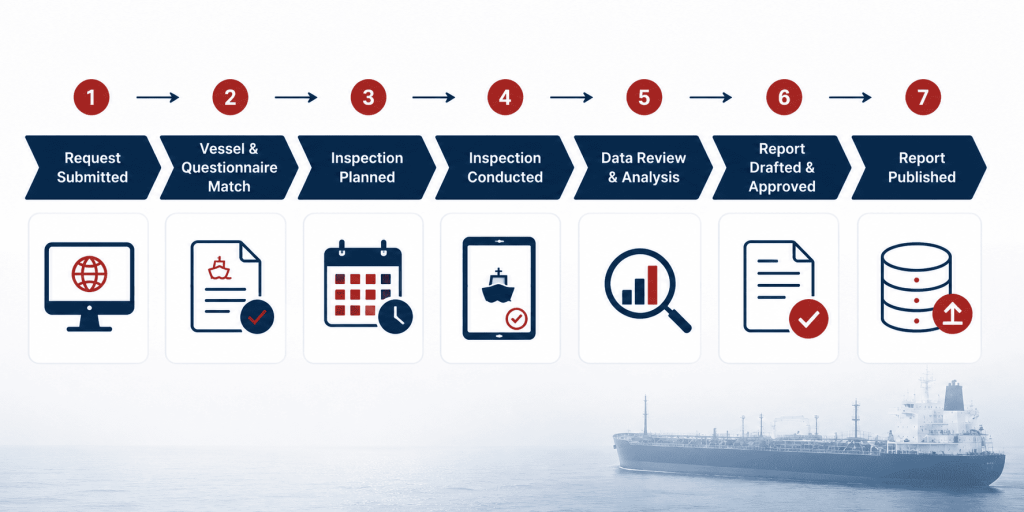
The process runs in a fairly fixed sequence, even though the questions themselves change every time.
- Request initiated. An OCIMF member company, usually a charterer or oil major, submits the inspection request through the OCIMF portal. The vessel operator cannot request its own SIRE inspection.
- Data updated. The operator refreshes the Harmonised Vessel Particulars Questionnaire (HVPQ) and the Pre-Inspection Questionnaire (PIQ), and checks that the Photo Repository is current within the last six months.
- Pre-Inspection Declaration completed. Only once this is done does the algorithm compile and release the CVIQ to the assigned inspector, so incomplete or inaccurate declarations can trigger conditional questions the crew never expected.
- Inspection day. The inspector works through the CVIQ on a tablet, reviewing documents, walking the vessel, and interviewing crew. A typical inspection runs the better part of a working day.
- Draft review. The submitting company’s own team checks the draft report internally before it goes further.
- Operator response. The vessel operator reviews the draft and can flag factual errors. Confirmed mistakes get corrected through a tracked resubmission process that leaves an audit trail.
- Report published. The finished report goes into the OCIMF database, where it becomes available to programme recipients, including charterers who never even ordered the original inspection.
Ship manager’s note: Steps 2 and 3 are where most avoidable problems start. An out of date PIQ or a Photo Repository past its six month window is not a paperwork technicality. It actively changes which questions the algorithm selects, sometimes for the worse.
How Is SIRE Different From Port State Control and CDI?
This is one of the most common points of confusion for anyone newer to tanker operations, and it matters because the three systems can produce completely different outcomes on the very same vessel.
Port State Control, or PSC, is a statutory enforcement system. National maritime authorities inspect foreign flagged ships calling at their ports to check compliance with conventions like SOLAS, MARPOL, STCW, and MLC. A PSC officer can detain a ship. SIRE cannot. That single distinction explains most of the practical difference.
SIRE, by contrast, is commercial risk assessment. Nobody gets detained over a SIRE finding. What happens instead is quieter and, in some ways, more expensive over time: a charterer simply chooses a different vessel.
CDI works on a similar commercial logic to SIRE but for a different vessel type. It is run by the Chemical Distribution Institute, a separate non-profit body, and it applies to chemical tankers and bulk liquid chemical carriers under the IBC Code framework. A chemical tanker manager may need to satisfy both SIRE and CDI, depending on cargo and charterer.
| Aspect | SIRE | Port State Control | CDI |
| Nature | Voluntary, commercial | Mandatory, statutory | Voluntary, commercial |
| Run by | OCIMF | National authorities under regional MoUs | Chemical Distribution Institute |
| Applies to | Oil, chemical, and gas/LPG tankers | Any foreign flagged ship in a member port | Chemical tankers and bulk chemical carriers |
| Worst outcome | Charter rejection, lost commercial options | Detention, fines, or regional restriction | Loss of chemical shipper approval |
| Can stop the ship sailing | No | Yes | No |
The insight worth remembering here: a vessel can hold a spotless PSC record and still lose a fixture over its SIRE history, because the two systems are testing different things for different audiences. Regulators care whether you meet the legal minimum. Charterers care whether you are better than the alternative sitting next to you on their shortlist.
Vetting is not the only inspection driven compliance regime a ship manager deals with in India either. DGMA, formerly DG Shipping, runs its own domestic inspection frameworks for other parts of the maritime sector, including the Comprehensive Inspection Programme for maritime training institutes. The underlying logic across all of these programmes is the same: documented evidence beats a good verbal explanation every time.
How Should Ship Managers Prepare a Vessel for SIRE 2.0?
Preparation under SIRE 2.0 works differently than it did under VIQ7, because you are no longer memorising one fixed question set.
- Keep HVPQ and PIQ genuinely current, not just accurate on the day you last touched them. These feed the algorithm directly.
- Refresh the Photo Repository inside the six month window, and make sure the photos actually match current conditions, since inspectors compare them against what they see on board.
- Close out old negative observations properly, with dated evidence and a named responsible officer, because SIRE 2.0 inspectors specifically re-check unresolved findings from earlier reports.
- Train crew for interviews, not scripts. Memorised answers tend to fail under SIRE 2.0, because inspectors are testing whether someone genuinely understands a procedure, not whether they can recite it.
- Track which rotational question categories you have already faced, so preparation effort goes toward areas not yet covered rather than repeating what was already tested.
- Line up SMS wording with how the Question Library frames each topic, covering the objective, the expected evidence, and the likely negative outcomes for each risk area.
Ship manager’s note: Crew competency is now a documented, coded part of every report through the PIF system. A confident, well prepared crew genuinely moves the needle on SIRE 2.0 outcomes in a way it never could under the old Yes/No format.
What Happens After a SIRE Inspection Finds a Negative Observation?
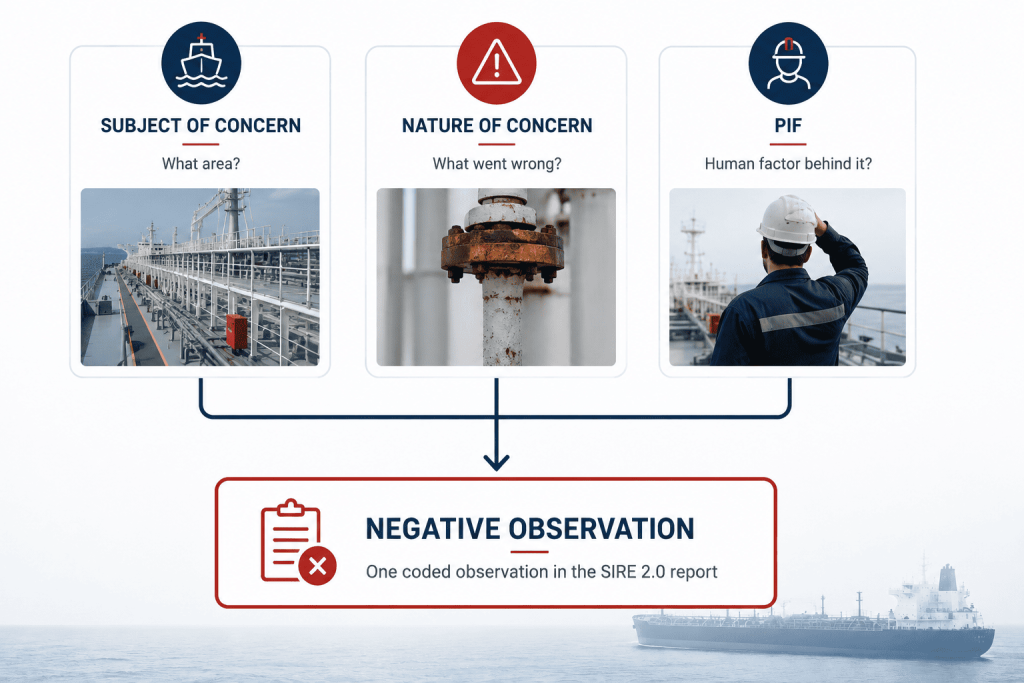
A “Not as Expected” rating automatically creates a negative observation, coded with a Subject of Concern, a Nature of Concern, and at least one linked PIF. This structured coding is new to SIRE 2.0, and it makes findings comparable and searchable across a vessel’s entire inspection history, not just readable as isolated free text.
From there, the job belongs to the ship manager’s office, not the inspector. Every negative observation needs a tracked corrective action with a deadline, supporting evidence, and a named responsible officer. The next inspection will check whether that action actually closed, and an observation that resurfaces unresolved reads far worse than a first time finding, because it signals the SMS is not doing what it claims to do on paper.
It works the other way too. “Exceeds Expectations” is the only route to a best practice notation on the report, and it needs the same PIF tagging discipline a negative finding does. Proactively documenting what went well, not just fixing what went wrong, is a low cost way to build a stronger vetting profile that a lot of operators simply skip.
How Long Does a SIRE Inspection Report Stay Valid?
There is a difference between how long a report technically stays in the database and how long charterers actually treat it as useful, and the gap between the two matters more than the strict rule.
Reports can remain accessible for a while after publication, but most major oil companies and large charterers want to see an inspection from within the last six months before they will fix a vessel. A report that is technically still “in the system” but eight or ten months old often gets treated as effectively stale by a commercial buyer, even if nothing formally expired.
The practical move for a ship manager is to treat six months, not any longer administrative window, as the internal deadline for scheduling the next SIRE inspection request. Waiting until a report is nearly out of favour with charterers, rather than planning ahead of that point, is how vessels end up with commercial gaps between fixtures.
Where Does SIRE Fit Into a Ship Manager’s Wider Compliance Picture?
SIRE rarely operates in isolation. It sits inside a wider web of documents and licenses, and inspectors increasingly treat that web as one continuous evidence trail rather than separate boxes to tick.
The DOC holder carries legal accountability for the SMS a SIRE inspector is really testing. Crew welfare standards under MLC 2006 certification feed directly into how confidently a crew performs in PIF based interviews, since a crew working under poor conditions rarely interviews well regardless of how good the procedures look on paper. Where that crew comes from matters too. Seafarers supplied through an RPSL licensed manning agency, and kept compliant through ongoing RPSL annual compliance work, form the human factor half of every SIRE 2.0 question.
Flag choice plays a role as well. Shipowners weighing whether to bring a tanker onto the Indian flag, effectively registering the vessel in India, are also choosing which PSC regime and manning framework the ship will operate under long term, which shapes the wider inspection picture alongside SIRE. Foreign flagged vessels trading into India carry their own separate paperwork too, including a chartering license for foreign flagged vessels, which sits next to vetting rather than replacing it.
Even financiers pay attention to this picture. Anyone reviewing ship finance in India knows a lender assessing a vessel as security cares about its ongoing chartering prospects, and a weak vetting history quietly affects how employable, and therefore how valuable, that security really is.
The genuinely useful insight here is an organisational one. DOC, MLC, RPSL, and SIRE readiness often sit with different departments or different people inside the same shipping company. An inspector does not see those departmental lines. They see one vessel and one crew, and any inconsistency between what one document says and what another team actually does tends to surface fastest in exactly the kind of interview SIRE 2.0 now runs.
Frequently Asked Questions
Is a SIRE inspection legally mandatory for tankers?
No. SIRE participation is voluntary, and no law forces a shipowner to submit to it. In practice, most oil majors and large charterers will not fix a tanker without a recent SIRE report, so it functions as a commercial requirement even without legal backing.
Who requests and pays for a SIRE inspection?
An OCIMF member company, usually an oil major, terminal operator, or another qualifying charterer, submits the request through the OCIMF portal. The vessel operator cannot request an inspection on its own. It can only keep the vessel’s data current so it is ready when a request comes in.
Can the shipowner or manager see the SIRE report before anyone else does?
The submitting company’s own team reviews the draft first, and the vessel operator then gets a chance to flag factual errors before the report is finalised. Once published, any OCIMF programme recipient, not just the company that ordered the inspection, can access it in the database.
What is the difference between SIRE and TMSA?
SIRE inspects the vessel itself, covering hardware, procedures, and crew. TMSA is a separate OCIMF programme that scores the shore based management company across stages of organisational maturity. Charterers often check both before deciding whether to fix a ship.
What actually happens if a vessel “fails” a SIRE inspection?
There is no formal pass or fail mark on the report itself. What happens instead is that a heavy list of negative observations, especially unresolved ones from earlier inspections, makes charterers cautious, and many will simply choose a cleaner vessel rather than take on the risk.
Do bulk carriers or barges get SIRE inspected?
Not under SIRE 2.0 in its current form. SIRE 2.0 covers tankers only, meaning oil, chemical, and gas or LPG carriers. Barges are assessed under OCIMF’s separate BIRE programme, and dry bulk carriers typically go through RightShip’s inspection system instead.
Is CDI the same as SIRE for chemical tankers?
No, they are different programmes run by different organisations, even though they serve a similar commercial purpose. CDI is run by the Chemical Distribution Institute under the IBC Code framework, while SIRE is OCIMF’s tool. A chemical tanker may need to satisfy both, depending on its trade.
Does a poor SIRE history affect P&I insurance?
SIRE reports are not insurance documents, but P&I clubs and hull underwriters do look at a vessel’s overall risk profile. A pattern of vetting rejections or unresolved deficiencies is exactly the kind of signal that shapes how an underwriter views a ship at renewal.
Can the same negative observation show up in the next inspection too?
Yes, and it usually will if the corrective action was not properly closed out. SIRE 2.0 inspectors specifically re-check prior negative observations, so a repeat finding reads worse than a first time one, since it signals the SMS is not fixing what it claims to fix.
Do older tankers face different questions than newer ones?
The CVIQ algorithm can add conditional questions based on a vessel’s age, trading pattern, or particulars, so an older tanker is not exempt from anything. It may simply face a different mix of questions than a newbuild would on the same inspection day.
Do they ask questions to the crew during SIRE 2.0?
Yes. Crew interviews are a significant part of SIRE 2.0. The exact questions vary according to the CVIQ and the crew member’s role. Officers may face questions on navigation, cargo operations, procedures and equipment, while ratings can be questioned about emergency response, PPE, safety equipment and operational tasks.
Does the inspector ask the same questions every time?
No. SIRE 2.0 uses a Compiled Vessel Inspection Questionnaire (CVIQ), so the question set is compiled for the individual inspection. Core questions recur, while rotational, campaign and conditional questions vary. Therefore, crews should prepare across the relevant Question Library rather than rely on a previous inspection’s questions.
What is the difference between SIRE and CDI?
They are separate commercial inspection/vetting programmes operated by different organisations. Chemical tankers may encounter both depending on their trade and charterers.
Do officers need to memorise company policies for SIRE 2.0?
No. They need to understand the policies relevant to their duties, know where to find them and demonstrate that they are actually following them.
You may also like


What Should Taxpayers Know About Income Tax Rules 2026?
The Income Tax Rules 2026 have changed the working language, form numbers and r