
India’s LNG Bunkering Guidelines 2025: What Shipowners, Ports and Bunker Suppliers Need to Know
- by kapil
- Updated October 5, 2026
- 16 mins read
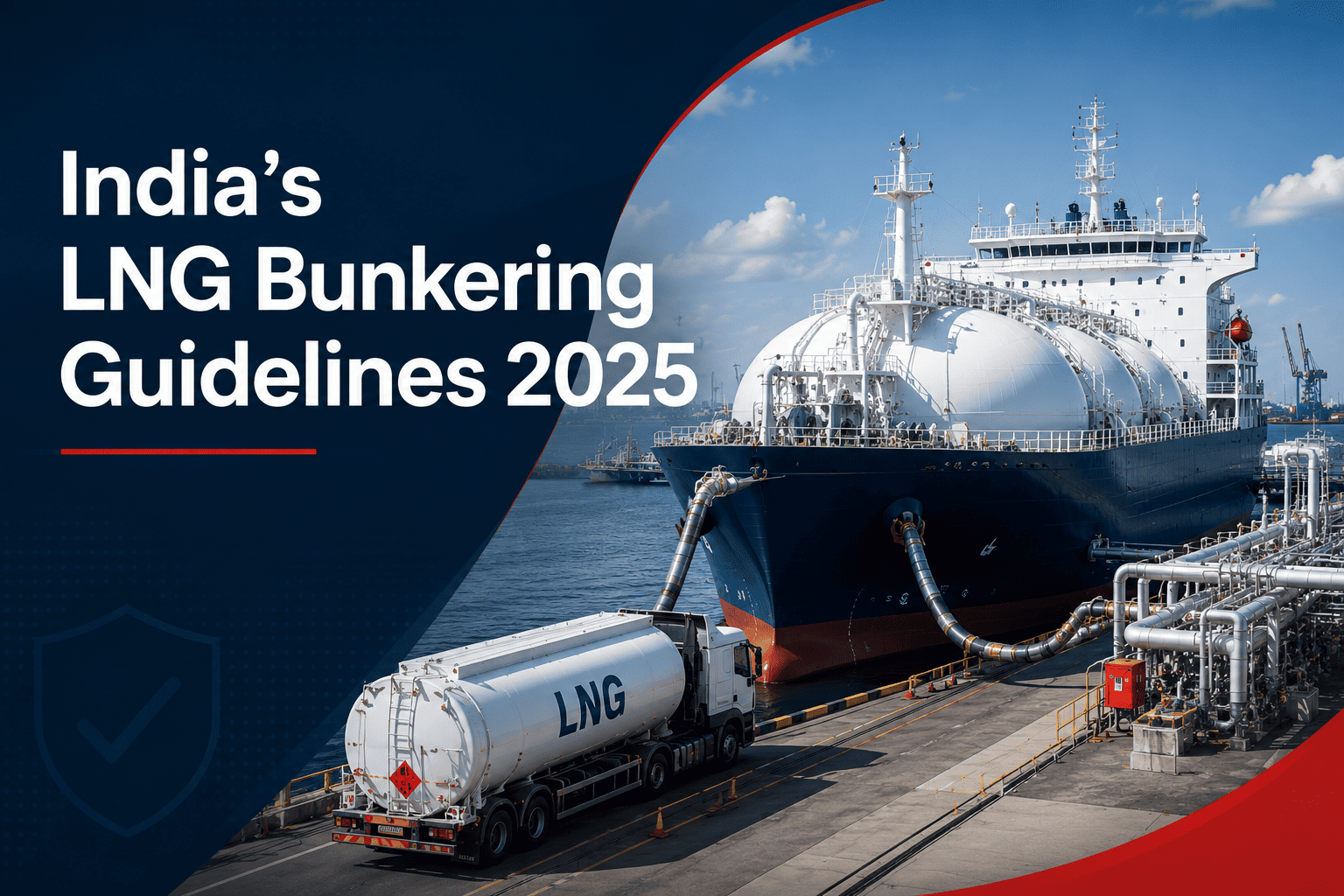
India’s LNG Bunkering Guidelines 2025, issued by DGMA as Circular No. 17 of 2025, set safety, registration and documentation rules for ship-to-ship, truck-to-ship and terminal-to-ship LNG bunkering. Shipowners need IGF Code compliance, bunker suppliers need DGMA registration, and every operation needs a QRA, a safety zone and a joint bunkering plan before fuel starts moving.
What Are India’s LNG Bunkering Guidelines 2025?
India’s LNG Bunkering Guidelines 2025 are a formal circular from the Directorate General of Maritime Administration (DGMA), numbered Circular No. 17 of 2025 and dated 5 May 2025. DGMA sits under the Ministry of Ports, Shipping and Waterways, and this circular is the first document to lay out a complete, India-specific rulebook for LNG bunkering, covering permitting, safety, environmental protection, workforce training and enforcement in one place.
Before this circular, India relied on general guidance such as Merchant Shipping Notice No. 3 of 2014 for bunker supplier registration and Merchant Shipping Notice No. 6 of 2024 for IGF Code applicability. Neither was written with LNG’s specific hazards in mind. Circular No. 17 of 2025 closes that gap and gives shipowners, ports and bunker suppliers one reference point instead of several scattered ones.
Why Did DGMA Bring In LNG Bunkering Rules Now?
LNG burns cleaner than conventional marine fuel. It cuts sulphur oxide, nitrogen oxide and particulate matter emissions, which is exactly what shipping needs as global rules on vessel emissions tighten. That much isn’t controversial.
The problem was India’s own framework hadn’t caught up. The circular itself admits LNG bunkering in India is still in an early stage of development, and that the lack of dedicated regulation created real uncertainty for shipowners, terminal operators and investors weighing whether to commit money to LNG infrastructure. High upfront costs for storage and transfer equipment, combined with safety and environmental questions nobody had formally answered, kept a lot of capital on the sidelines.
At the same time, LNG supply in India has improved and emission standards have tightened, so interest picked back up anyway. DGMA’s goal with this circular is straightforward: give the market a predictable rulebook so bunkering infrastructure investment actually happens instead of stalling on regulatory ambiguity. If you’ve watched how India’s biofuel bunkering license guidelines rolled out under a separate circular, you’ll notice the same pattern: regulate first, then let the market build with confidence.
Who Do the LNG Bunkering Guidelines 2025 Apply To?
The circular’s scope is broad on purpose. It applies to all ships calling at Indian ports irrespective of flag, along with every LNG bunker supplier and every port involved in LNG bunkering. In practice, that breaks down into six groups:
- Shipowners and ship managers operating any vessel, Indian-flagged or foreign, that takes on LNG fuel at an Indian port
- LNG Bunker Suppliers (LBS), the entity actually supplying the LNG, whatever the delivery method
- LNG Bunker Receivers (LBR), the vessel receiving the fuel
- Trucking companies handling truck-to-ship deliveries
- Terminal operators running shore-based pipeline infrastructure
- Port authorities, who receive documentation, approve bunkering locations and co-own risk decisions with DGMA
That “irrespective of flag” point matters more than it might look. A foreign-flagged container ship bunkering LNG at an Indian port follows the exact same rules as an Indian-flagged one. There’s no separate, lighter track for international traffic.
What Are the Three Modes of LNG Bunkering in India?
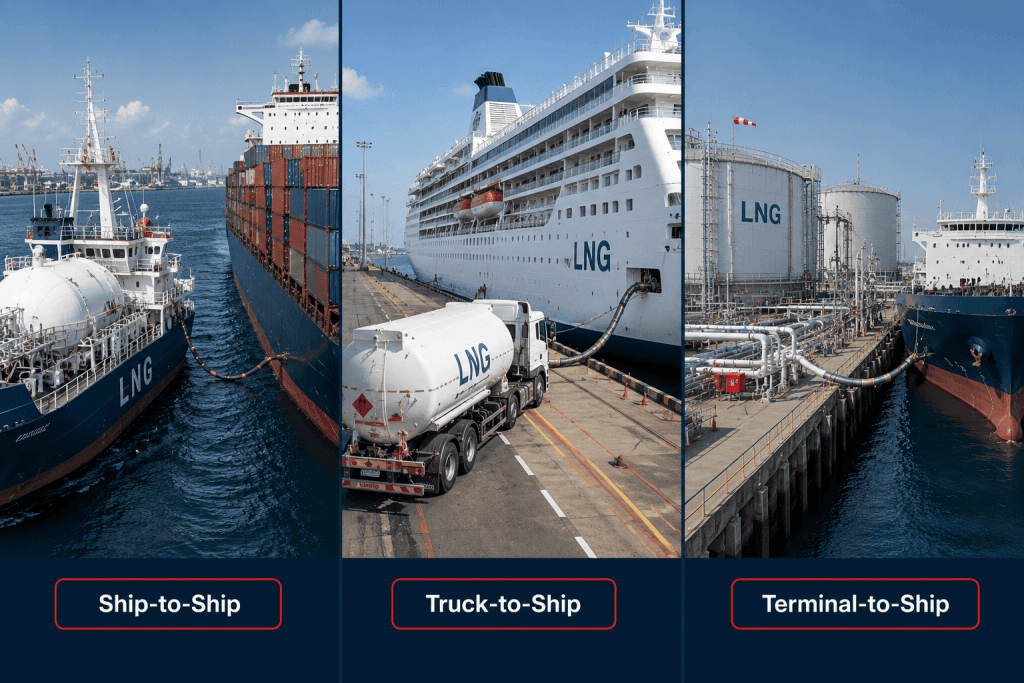
DGMA recognises three delivery methods, and the guidelines apply slightly different documentation to each:
- Ship-to-ship bunkering, where a dedicated LNG bunker vessel transfers fuel directly to the receiving ship, usually alongside at berth or anchorage
- Truck-to-ship bunkering, where a cryogenic road tanker delivers LNG to a vessel at the quayside
- Terminal-to-ship (shore-to-ship) bunkering, where LNG moves through a fixed pipeline from an onshore terminal straight into the vessel’s fuel tanks
Each mode carries its own operational envelope, and a bunker supplier’s registration certificate has to specify which modes it’s actually authorised for. A supplier approved for truck-to-ship only can’t suddenly run a ship-to-ship operation without amending their registration first.
How Do You Register as an LNG Bunker Supplier With DGMA?
This is usually the first practical question anyone building an LNG bunkering business asks, and it’s worth reading alongside our full breakdown of bunker supplier registration in India, which covers the eligibility criteria and required paperwork in more depth. At a high level, the process under Circular No. 17 of 2025 and Merchant Shipping Notice No. 3 of 2014 runs in seven stages:
- Submit an application to DGMA, including facility design, safety procedures and an emergency response plan, following IAPH guidelines. Suppliers also need an ISO 9001:2015 Quality Management System certification for the scope of LNG bunkering, issued by a body accredited under NABCB.
- Offer a practical demonstration of an actual bunkering operation. DGMA can authorise the Indian Register of Shipping (IRS) to witness this and file a verification report.
- Receive an Interim Bunker Supplier Registration Certificate, valid for six months, once DGMA has the IRS report and recommendation in hand.
- Apply for the Initial Audit at least 30 days before that interim certificate expires. By this point, the supplier needs demonstrable proof of at least two completed LNG bunkering operations.
- Pass the Initial Audit, which IRS conducts on DGMA’s authorisation. The audit checks operational compliance and confirms the supplier has picked up any amendments DGMA or other statutory bodies issued in the meantime.
- Get the full-term registration certificate, valid for five years, once IRS recommends it.
- Keep it valid through Annual Surveillance Audits, plus a repeat practical demonstration every alternate year. Skip either one and DGMA can suspend or withdraw the certificate.
One detail that trips people up: the six-month interim window isn’t very forgiving. If your QMS certification or your practical demonstration slips, you’re racing the clock on a full registration you haven’t earned yet.
What Role Do PNGRB and PESO Play in LNG Bunkering?
DGMA registration isn’t the only approval an LNG bunker supplier needs. Two other regulators sit alongside it, each covering a different piece of the physical infrastructure.
The Petroleum and Natural Gas Regulatory Board (PNGRB) gives a one-time approval for establishing and operating the LNG terminal itself. The Petroleum and Explosives Safety Organisation (PESO) approves everything on the shore-based transport side, including LNG tank trucks and related infrastructure. Both approvals stay valid indefinitely, unless the supplier makes a substantive change to how the operation actually runs, in which case fresh approval is needed based on the revised setup.
Think of it as three separate lenses on the same business: DGMA looks at the bunkering operation and the people running it, PNGRB looks at the terminal, and PESO looks at how LNG moves on land. A supplier needs all three sorted, not just one.
What Documents Does a Port Authority Need Before Bunkering Starts?
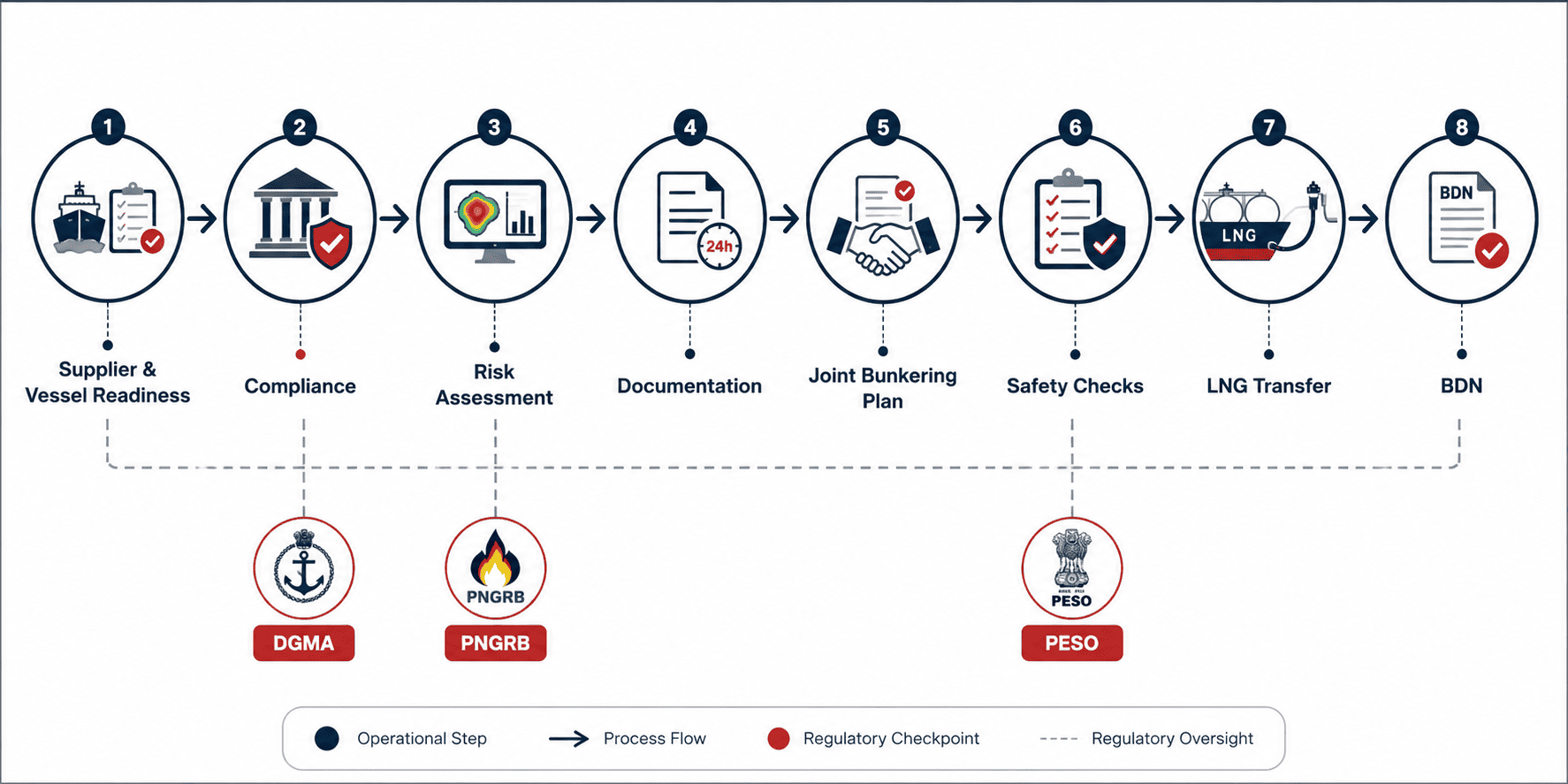
Every LNG Bunker Supplier has to submit documentation to the relevant port authority at least 24 hours before each bunkering operation. What’s required depends on the delivery mode:
| Delivery Mode | Certifications and Documents Needed |
| Ship-to-Ship | Certificate of Registry, Certificate of Fitness for Carriage of Dangerous Goods, IGC Code, IGF Code and ISM Code certificates, Classification Society certificate |
| Truck-to-Ship | PESO licence for road transport, BIS compliance certificates for cryogenic road tankers, driver training and certification records |
| Terminal-to-Ship | Authorisation to operate the LNG terminal and pipeline, safety standard compliance certificates for the terminal infrastructure |
On top of the mode-specific paperwork, every operation, regardless of delivery method, also needs:
- A Maritime Traffic Impact Assessment (MTIA) and a Quantitative Risk Assessment (QRA), prepared jointly by the supplier and the port authority
- An LNG Bunker Management Plan covering pre-bunkering, bunkering and post-bunkering procedures
- A Bunkering Compatibility Checklist, confirming the supplier’s and receiver’s systems can actually work together safely
- A Joint Bunkering Plan, endorsed by both the supplier and the receiving vessel
If a shipowner’s compliance team already handles a Document of Compliance certification under the ISM Code, a lot of this documentation flow will feel familiar. It’s the same discipline of pre-agreed, written procedures, applied to a fuel that behaves very differently from heavy fuel oil.
What Is the Difference Between a Safety Zone and a Security Zone?
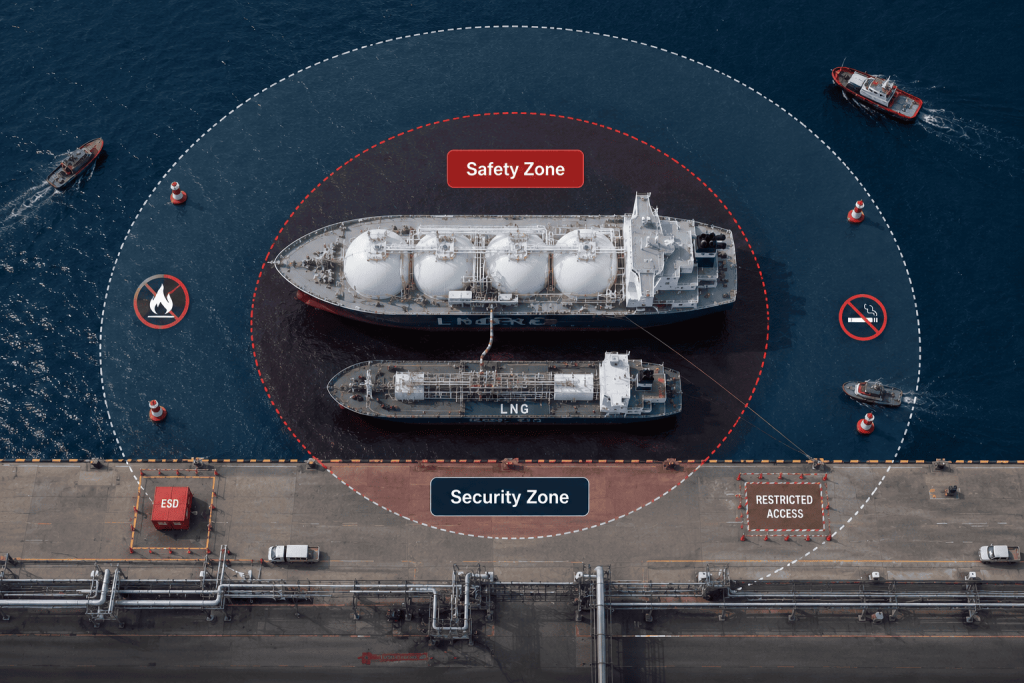
These two terms get mixed up constantly, and the guidelines treat them as genuinely different things with different jobs to do.
A safety zone exists to control ignition sources near the actual LNG transfer point. Only essential personnel and essential activities are allowed inside it, because that’s the area most exposed if there’s an accidental gas release. A security zone is a wider ring around the whole operation, meant to monitor outside activity like passing ships or vehicle movement that could interfere with the bunkering. It’s always larger than the safety zone, by definition.
| Criteria | Safety Zone | Security Zone |
| Purpose | Controls ignition sources near the LNG transfer point | Monitors ship movements, vehicles and other outside activity nearby |
| Who can enter | Essential personnel and activities only | Authorised personnel only |
| How size is set | Based on the QRA’s gas dispersion modelling and credible leak scenarios | Always larger than the safety zone |
| If breached | Bunkering must stop immediately | Communicated in advance to nearby vessels, installations and the port authority |
Good to know: if a passing vessel or a truck strays into the safety zone while LNG is being transferred, the operation has to stop immediately. There’s no judgement call involved. That’s a hard rule, not a guideline.
What Rules Apply While LNG Is Actually Being Transferred?
A handful of operational rules kick in the moment fuel starts moving:
- The bunker supply vessel, where applicable, has to participate in the local Vessel Traffic Service and keep a continuous VHF watch.
- The supplier’s operator and the receiving vessel’s crew must continuously monitor LNG pressure, flow rate and temperature throughout the transfer.
- A pre-bunkering checklist has to be completed within four hours of the planned operation, covering connections, safety equipment and communication systems.
- Emergency shutdown systems need to be tested and confirmed working before the operation starts, not just assumed to be fine.
- All lighting and cabling near the safety zone that isn’t explosion-proof has to be switched off completely, not just dimmed or on standby.
Good to know: you cannot bunker LNG and conventional fuel oil on the same vessel at the same time. Diesel oil, HFO, VLSFO, lubricating oil and other fuel grades are all off-limits during an active LNG bunkering operation. Double banking and other simultaneous ship-to-ship activities, like provisioning or garbage removal, are prohibited too.
If something goes wrong on the supplier’s side, whether it’s the terminal, the vessel or the truck, the supplier has to tell the receiving vessel immediately over VHF or another agreed channel, even if the receiving vessel’s own operations aren’t affected yet. And if an emergency means someone has to decide whether to abandon ship or leave berth, that call sits with the master or the harbour master, not the bunker supplier.
What Is a Bunker Delivery Note and Why Does It Matter?
A Bunker Delivery Note, or BDN, is the paper trail for every single LNG delivery. The supplier is responsible for providing one for each consignment, and it has to line up with IGF Code requirements rather than the general MARPOL Annex VI framework that governs conventional fuel oil BDNs.
The supplier keeps a copy of every BDN issued for three years. That retention period matters more than it sounds. If a dispute ever comes up over fuel quantity, quality or timing, the BDN is the primary evidence both sides fall back on, and port state control inspectors will ask for it directly.
What Training Do Crew, Truck Drivers and Terminal Staff Need?
Training requirements differ by role and by delivery mode:
- Ship-to-ship crew: the receiving vessel’s crew handling LNG bunkering duties need certification under the IGF Code. The bunker supply vessel’s crew needs STCW training specific to gas carriers.
- Truck drivers: anyone driving an LNG road tanker needs training and certification under PESO regulations and relevant BIS standards, with proven ability to handle cryogenic materials and operate emergency shutdown systems.
- Terminal operators: staff running shore-based LNG bunkering need training and certification against relevant safety standards, covering equipment operation, pipeline monitoring and emergency response.
None of this is optional paperwork. A receiving vessel with an uncertified crew, or a trucking company running drivers without PESO certification, is operating outside the guidelines even if every other document is in order.
Where Can Ships Bunker LNG in India Right Now?
Infrastructure is still catching up to the regulation, which is honestly typical for a new fuel pathway. A few developments worth knowing about:
Petronet LNG already runs terminal-to-ship LNG bunkering at its Kochi facility in Kerala, and the company has floated a tender for a dedicated LNG bunkering system there, covering engineering, supply, installation and commissioning. That makes Kochi the most established LNG bunkering point in India today.
On the ship-to-ship side, Adani Ports and Special Economic Zone (APSEZ) signed a memorandum of understanding with Bharat Petroleum Corporation Limited (BPCL) during India Maritime Week 2025 to build India’s first dedicated ship-to-ship LNG bunkering facility at Vizhinjam International Seaport in Kerala. The plan positions Vizhinjam as a refuelling hub for vessels on the East-West global shipping corridor, though it’s still at the development stage rather than operational.
There’s also movement on the vessel-building side. Cochin Shipyard has an order to build LNG-powered feeder container vessels for CMA CGM, the French shipping line, marking the first time an international carrier has ordered LNG-fuelled ships built in India. None of this changes the compliance picture for shipowners today, but it does signal where India’s LNG bunkering map is heading over the next few years.
What Happens If Someone Doesn’t Follow the Guidelines?
DGMA enforces Circular No. 17 of 2025, and non-compliance carries real consequences: fines, vessel detention, suspension of licences, or other action depending on the violation. This isn’t limited to bunker suppliers either. Vessels, trucking companies and terminal operators are all fair game for enforcement action if they fall short.
Beyond straightforward penalties, the port authority, DGMA, PNGRB and PESO jointly decide a set of risk-based questions for each port before bunkering is even allowed to happen, including:
- Whether the proposed risk acceptance criteria are sound
- Who holds overall responsibility for the bunkering framework at that port
- Whether an accreditation scheme should apply to operators there
- Which specific locations within the port are acceptable for bunkering
- What restrictions apply to simultaneous operations
- What shore-side contingency and emergency response plans look like
- How traffic control and restrictions should work
- Whether any additional requirements should apply on top of the baseline circular
That last point is worth flagging for anyone assuming the circular is the complete rulebook everywhere. It’s the floor, not necessarily the ceiling. Individual ports can layer on stricter local requirements.
How Should Shipowners and Bunker Suppliers Get Ready?
The steps look different depending on which side of the transaction you’re on.
If you’re setting up as a bunker supplier:
- Register your business as a proper legal entity, most commonly a private limited company, before you start the DGMA application
- Start your ISO 9001:2015 QMS certification early, since it’s a prerequisite for full registration, not something you can add later
- Line up your IRS demonstration well ahead of time, given how tight the six-month interim certificate window is
- Keep cryogenic hose pressure test certificates current; testing can’t lag more than a year behind the manufacturer’s specified interval
- Set up a proper Bunker Delivery Note filing system from day one, since you’ll need three years of clean records
If you’re a shipowner or ship manager:
- Confirm your crew’s IGF Code certification is current before scheduling a port call that involves LNG bunkering
- Build the 24-hour documentation window into your voyage planning, rather than treating it as a last-minute task
- Check which of the three delivery modes your intended port actually supports before you commit to a schedule
If you’re a port authority or terminal operator:
- Pre-agree safety and security zone boundaries with DGMA, PNGRB and PESO rather than working them out mid-operation
- Have a traffic management plan ready for truck-to-ship deliveries specifically, since that mode brings road traffic into a port environment not built for it
Businesses new to India’s maritime regulatory landscape often underestimate how many moving parts are involved here. If you’d rather have someone walk through the registration and compliance side with you, our maritime technical consultancy services cover exactly this kind of groundwork for new entrants.
Frequently Asked Questions
What is LNG bunkering?
LNG bunkering is the process of transferring liquefied natural gas into a ship’s fuel tanks so it can be used as marine fuel. In India, DGMA recognises three delivery modes: ship-to-ship, truck-to-ship and terminal-to-ship through a fixed pipeline.
Do foreign-flagged ships have to follow India’s LNG bunkering guidelines?
Yes. Circular No. 17 of 2025 applies to all ships calling at Indian ports irrespective of flag, along with every LNG bunker supplier and every port handling LNG bunkering.
How long is a full-term LNG bunker supplier registration certificate valid?
Five years, once the Indian Register of Shipping recommends it following the Initial Audit. Suppliers also need to pass Annual Surveillance Audits and repeat a practical demonstration every alternate year to keep the certificate active.
Can a ship bunker LNG and regular fuel oil at the same time?
No. The guidelines prohibit bunkering diesel oil, HFO, VLSFO or other fuel and lubricating oil at the same time as LNG. Double banking and other simultaneous ship-to-ship activities, such as provisioning, are also off-limits during LNG transfer.
How much notice does a port authority need before an LNG bunkering operation?
At least 24 hours. The LNG Bunker Supplier has to notify the port authority with the time, location, delivery method and a 24-hour contact number, and submit the required documentation within that same window.
What is the difference between an MTIA and a QRA?
A Maritime Traffic Impact Assessment (MTIA) looks at how the bunkering operation affects port traffic movement. A Quantitative Risk Assessment (QRA) studies leak and fire scenarios to determine how large the safety zone needs to be. Circular No. 17 of 2025 requires both before every LNG bunkering operation.
Who decides how big the safety zone should be?
The size comes out of the QRA, based on gas dispersion modelling and credible leak scenarios, and it has to be agreed between the bunker supplier, the receiving vessel and the port authority. The security zone around it is always larger.
How long must a Bunker Delivery Note be kept on record?
Three years. The LNG Bunker Supplier retains a copy of every Bunker Delivery Note issued to a vessel for that period, in line with IGF Code requirements.
Which standards apply to LNG bunkering equipment in India?
DGMA references a mix of international standards alongside Indian requirements, including ISO 20519 for bunkering specifications, ISO 28460 for ship-to-shore interfaces, IACS Recommendation 142, ISGOTT guidance and NFPA 59A, together with PESO and BIS requirements for road transport equipment.
You may also like

What Does Project Logistics Alliance Membership Offer?
Project Logistics Alliance membership offers an Indian project cargo business a