
SME IPO Listing Requirements in India: Everything You Need to Know Before Going Public
- by kapil
- Updated March 2, 2026
- 9 mins read
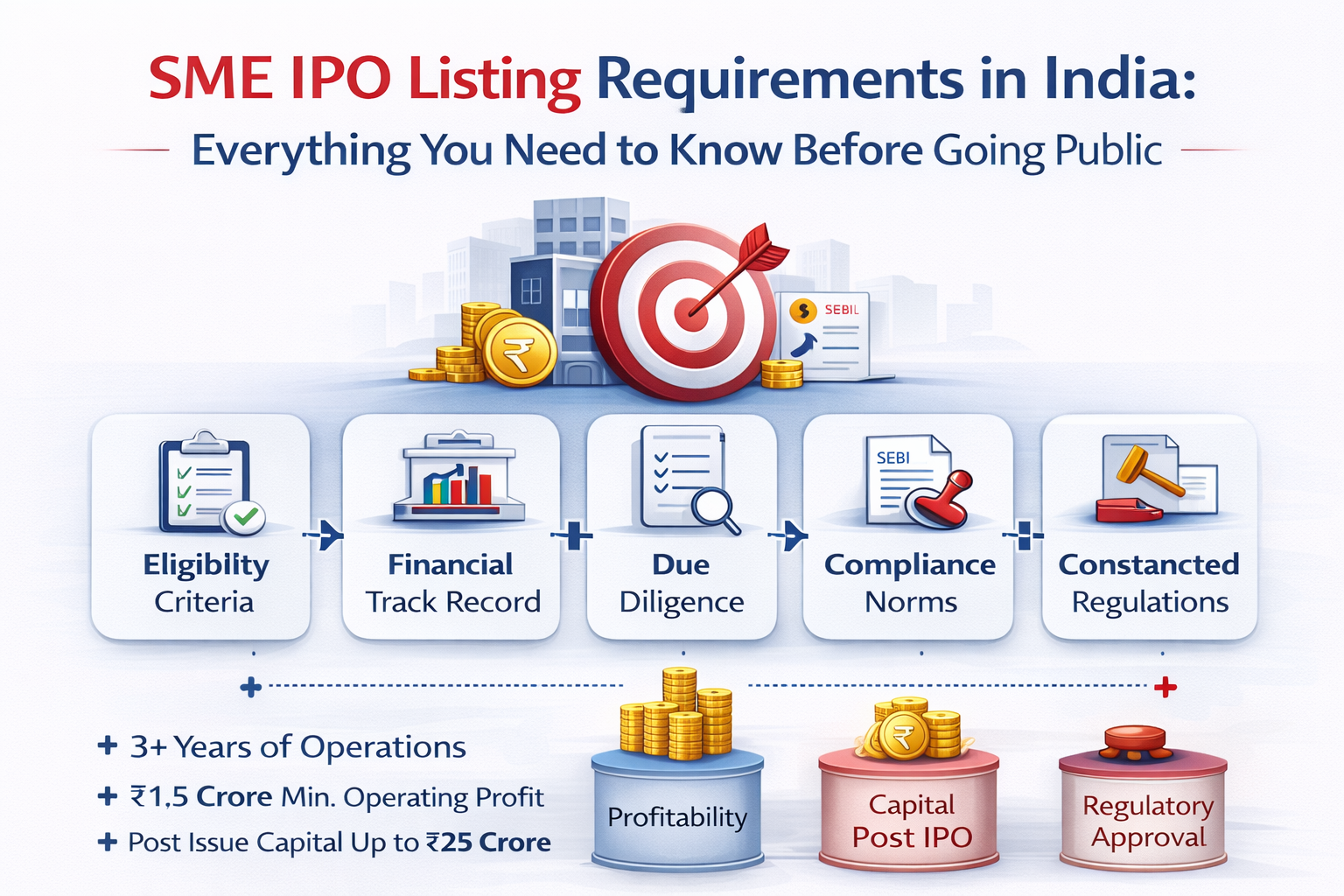
The Indian SME capital market is no longer experimental. In 2026, it is structured, active, and closely regulated. If you are evaluating SME IPO listing requirements, this guide will help you understand the financial thresholds, regulatory filters, documentation standards, and procedural checkpoints required to go public under the SME framework.
Over the last two years, the NSE Emerge platform has witnessed a steady rise in qualified listings. Companies are increasingly choosing the SME route rather than the mainboard because of lower capital thresholds, targeted investor participation, and calibrated compliance structures.
However, eligibility is not flexible. It is rule-driven and document-heavy. This is where structured legal advisory, such as LegalBabu’s end-to-end SME assistance, becomes critical.
What are the Core Eligibility Criteria for SME IPO Listing?
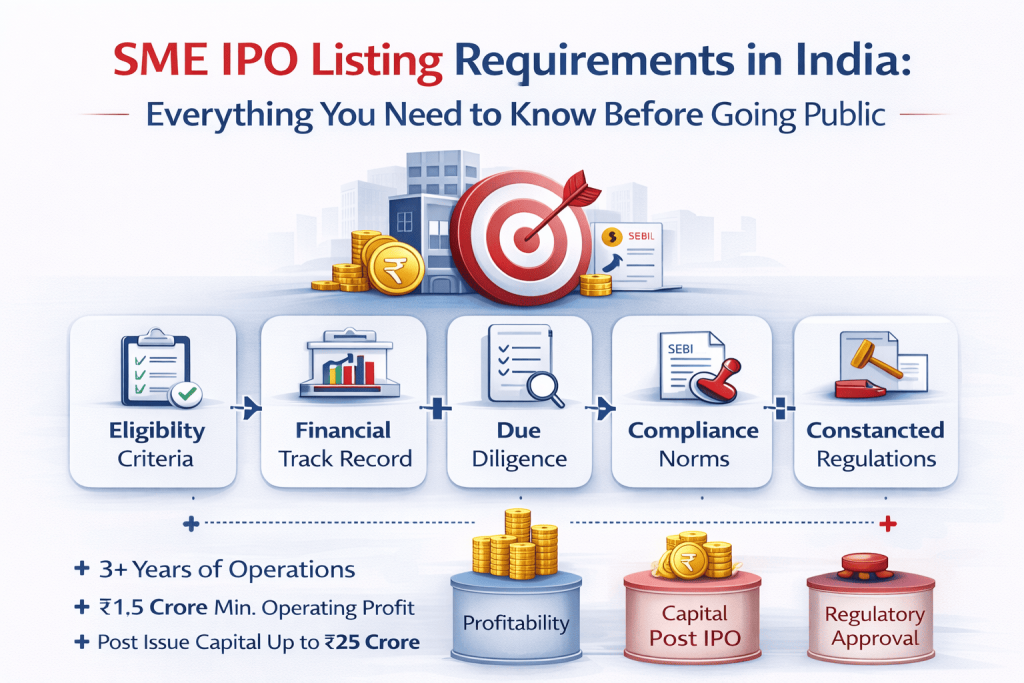
Understanding NSE Emerge eligibility criteria is central to complying with SME IPO listing requirements, which examine structural, financial, and promoter-level filters.
1. Incorporation Requirements
- The company must be incorporated under the Companies Act, 1956 or 2013
- Must be an Indian-domiciled public limited company
- Conversion from LLP, partnership, or proprietary firm is allowed (subject to track record continuity)
Strict compliance with the Companies Act compliance norms is mandatory before filing.
Looking to convert your business structure? Check Legal Babu’s registration and conversion services.
2. Post-Issue Capital Ceiling
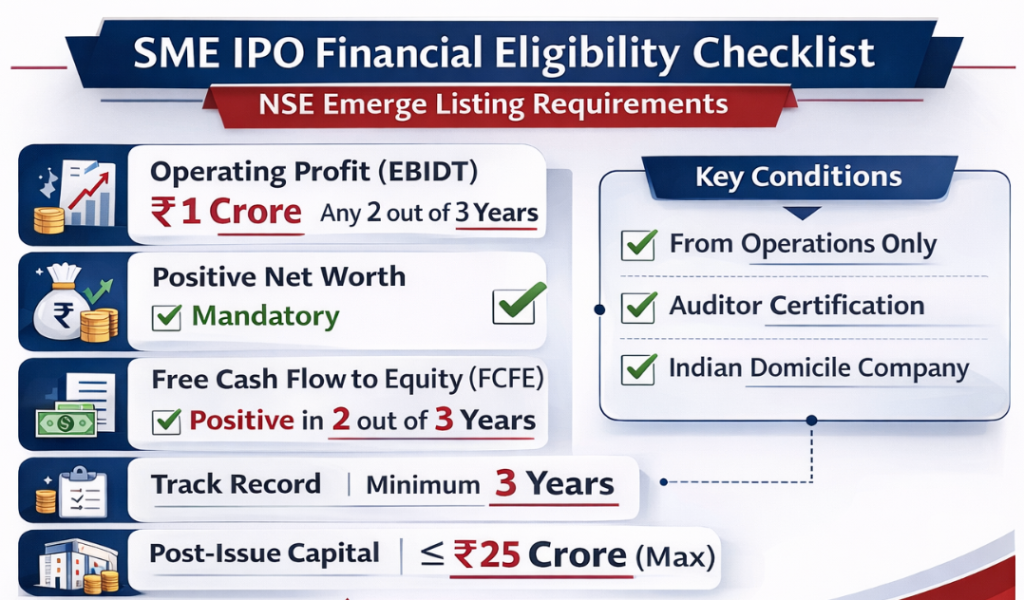
- Maximum post-issue paid-up capital: ₹25 crore (face value)
If projected capital exceeds this threshold, SME listing becomes ineligible. This rule preserves the SME character of the platform.
3. Track Record Mandate
| Entity Type | Track Record Required | Additional Notes |
| Applicant Company | Minimum 3 years | Direct operating history |
| Promoters / Promoting Company | 3 years | Same line of business + 20% post-issue equity |
| Converted Firm | 3 years | Pre-conversion history counts |
Promoters must demonstrate a minimum of three years’ experience in the same line of business to satisfy SME IPO listing requirements related to managerial continuity. This condition ensures managerial continuity and operational credibility.
4. Financial Thresholds
The financial eligibility SME framework is precise.
Operating Profit Criteria
- ₹1 crore EBIDT from operations
- Any 2 out of the last 3 financial years
- Other income excluded
Net Worth & Cash Flow
- Positive net worth mandatory
- Positive Free Cash Flow to Equity (FCFE) in 2 out of 3 years
- Auditor certification required
This ensures that only operationally sustainable businesses access public capital.
Which Companies Cannot Apply for SME Listing?
Certain disqualifications apply under SEBI SME regulations.
1. Insolvency or BIFR Proceedings
- No reference to the erstwhile BIFR
- No admitted proceedings under IBC
2. Winding Up Petitions
- No NCLT or court-admitted winding-up petition
3. Regulatory Actions
- No material disciplinary action by stock exchanges in the past 3 years
- No significant action by SEBI/RBI/MCA in the last 5 years (for ITP cases)
4. Merchant Banker Track Record
- A left lead merchant banker must have a clean due diligence history
- No returned draft offer document in the past 6 months
5. Prohibited Use of Proceeds
IPO funds cannot be used for:
- Repayment of promoter loans
- Indirect related-party settlements
Due diligence documentation becomes central at this stage.
What Mandatory Disclosures are Required in the Offer Document?
Transparency under SEBI ICDR norms is exhaustive and forms a critical component of SME IPO listing requirements.
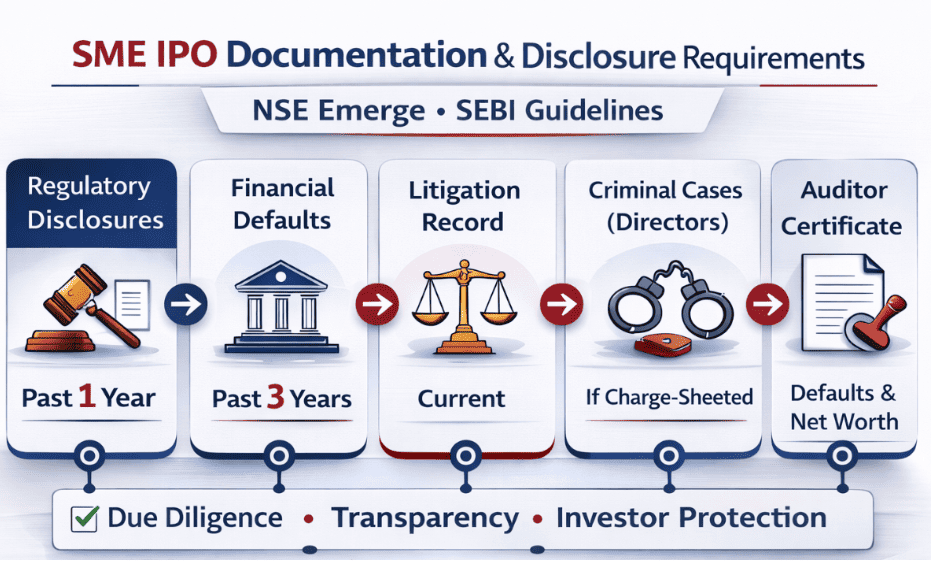
| Disclosure Area | Scope | Time Period |
| Regulatory Action | Company + Promoters + Group | Past 1 year |
| Defaults | Banks, FIs, Debentures | Past 3 years |
| Litigation | All entities | Current |
| Criminal Cases | Directors | If charge-sheeted |
Additional Documentation
- Auditor’s certificate on defaults
- Director background verification
- RBI wilful defaulter check
- Litigation impact analysis
These disclosures protect retail investors and maintain market integrity.
For the official exchange framework, refer to the NSE SME eligibility norms at the National Stock Exchange of India website.
How Does the SME IPO Application Process Work?
The SME listing process under the current SME IPO listing requirements typically spans 4–6 months.
1. Pre-Filing Preparation (4–6 Weeks)
- Audit completion
- Governance restructuring
- Due diligence documentation
- Appointment of merchant banker
2. Draft Offer Document Filing
Filed with:
- NSE
- SEBI
- Registrar of Companies
Simultaneous compliance checks begin.
3. Exchange Review
- NSE scrutiny
- Query rounds
- Clarification submissions
Returned drafts delay timelines. Merchant banker requirements are strict.
4. Issue Opening & Listing
- Marketing to anchor investors
- Subscription window
- Allotment
- Listing on the exchange
Common bottlenecks include disclosure inconsistencies and auditor qualification remarks.
What is the NSE Emerge ITP Platform for Tech Startups?
The Institutional Trading Platform (ITP) is structured for innovation-led enterprises.
Eligibility variations:
- Technology or IP-driven business
- 25% pre-issue capital by QIBs
OR - 50% pre-issue capital by QIBs (depending on route)
Revenue criteria:
- Minimum ₹10 crore annual revenue
- 20% annual growth
- Positive net worth
This accommodates new-age businesses that may not yet meet traditional operating profit criteria.
Apart from NSE Emerge, companies can also explore the BSE SME platform for listing opportunities.
What is the NSE Emerge SME Platform?
The NSE Emerge platform is the SME segment of the National Stock Exchange of India. It is designed for small and medium enterprises seeking public capital while maintaining proportionate regulatory requirements.
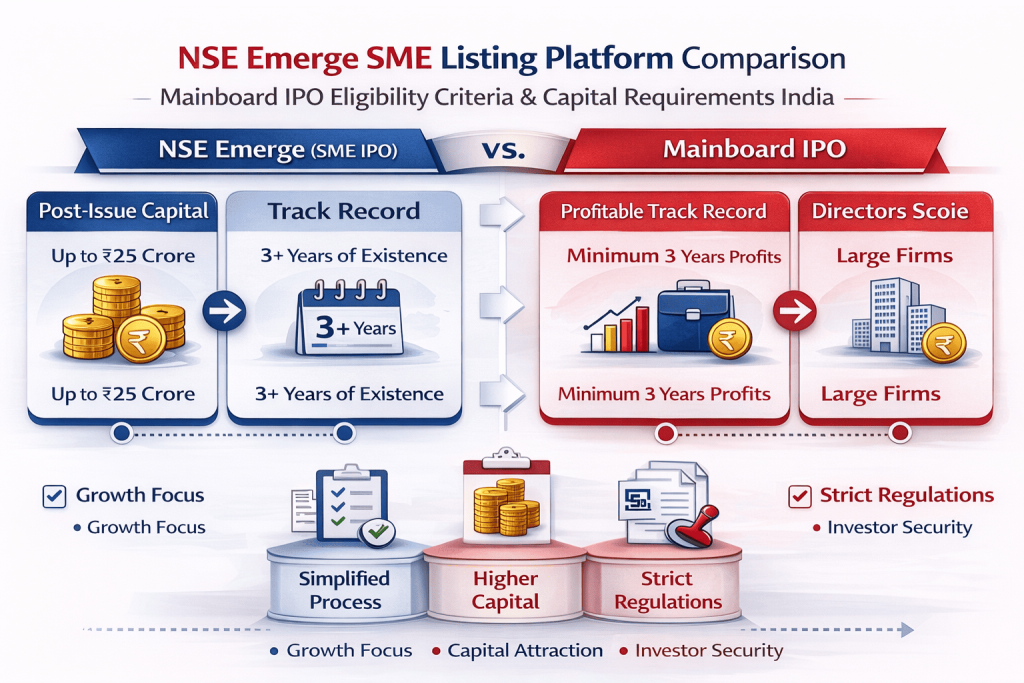
The key structural distinction from a mainboard IPO is the post-issue paid-up capital cap of ₹25 crore (face value). Companies exceeding this must migrate to the mainboard framework.
Unlike the mainboard, SME listing targets:
- Growing, operationally stable Indian companies
- Businesses with consistent revenue but moderate capital scale
- Promoter-led enterprises transitioning to institutional governance
Benefits include:
- Lower compliance burden relative to the mainboard
- Market-driven price discovery
- Institutional and HNI-focused participation
- Faster capital access
According to exchange data trends in 2025–26, SME listings have shown strong subscription ratios, reflecting investor appetite for growth-stage companies.
What are the Shareholding and Offer Restrictions?
Under the SME IPO Listing Requirements in India, SEBI has clearly defined shareholding and dilution norms to ensure promoter commitment and investor protection.
Offer for Sale (OFS) Limitations
As per SEBI SME regulations, the Offer for Sale (OFS) component is tightly controlled:
- OFS is capped at 20% of the total issue size
- Selling shareholders cannot offload more than 50% of their individual holdings
These SME IPO listing requirements prevent excessive promoter exit during the SME listing process. The regulatory intent is to ensure alignment between promoter interests and public shareholders post-listing.
Technology Startup Route
For innovation-driven businesses, the SME IPO listing India framework provides an alternative eligibility pathway.
Instead of traditional profitability-based track record requirements, companies can qualify if:
- 10% pre-issue capital held by QIBs
OR
- 10% held by angel investors / PE funds
Angel Network Eligibility Criteria
To qualify under this route:
- The angel network must have invested in 25+ startups
- It must maintain a minimum ₹50 crore aggregate investment portfolio
This special provision under the SME IPO requirements 2026 supports scalable technology ventures that may not yet meet conventional operating profit criteria but demonstrate strong institutional backing.
How Can LegalBabu Help You Secure SME IPO Listing?
SME IPO requirements 2026 are compliance-intensive. Fragmented advisory often results in delays. LegalBabu provides structured, end-to-end support.
1. Eligibility Assessment & Gap Analysis
- Pre-filing audit
- Operating profit verification
- Track record documentation review
- Promoter background checks
2. Regulatory Compliance Advisory
- Companies Act compliance mapping
- SEBI ICDR alignment
- SCRA adherence
- Corporate governance requirements set up
3. Documentation & Drafting
- Draft Offer Document preparation
- Due diligence documentation
- Disclosure schedule structuring
- Legal opinion coordination
4. Merchant Banker & Intermediary Coordination
- Lead manager shortlisting
- Registrar appointment
- Auditor liaison
- Merchant banker agreement drafting
5. Exchange Interaction
- Query handling
- Clarification submissions
- Filing status tracking
6. Post-Listing Compliance
- Annual compliance for listed companies
- Continuous disclosure systems
- Investor relations framework
LegalBabu has handled multiple corporate compliance matters and offers consolidated legal services under one structure, reducing overlap costs.
What are the Costs Involved in SME IPO Listing?
| Expense Head | Approximate Range |
| Merchant Banker Fees | ₹15–30 lakhs |
| Legal Fees | ₹5–10 lakhs |
| Auditor Fees | ₹3–7 lakhs |
| NSE Listing Fees | ₹5 lakhs |
| Marketing & PR | ₹5–15 lakhs |
| Total Estimated Cost | ₹35–70 lakhs |
Costs vary based on issue size, structuring complexity, and the extent of advisory support required to meet SME IPO listing requirements. Consolidated advisory can reduce duplication expenses.
Summary
SME IPO listing requirements in India are structured, numeric, and regulator-driven. The framework balances growth capital access with investor protection.
With SME markets gaining traction in 2026, companies that fully comply with SME IPO listing requirements have a strong opportunity to raise institutional capital, provided they meet financial eligibility, SME norms, and disclosure standards.
Professional guidance reduces rejection risk. LegalBabu’s corporate law experts can guide you through every stage of your SME IPO journey, from eligibility assessment to post-listing compliance, ensuring regulatory precision and smooth execution.
For consultation, visit LegalBabu’s advisory page and begin your SME listing process with clarity and confidence.
FAQs about SME IPO Listing Requirements
Can an SME voluntarily migrate from NSE Emerge to the mainboard?
Yes. After listing on the NSE Emerge platform, a company can migrate to the mainboard once it crosses the ₹25 crore post-issue capital threshold and fulfils mainboard eligibility norms. Shareholder approval and exchange compliance are mandatory.
Is a credit rating mandatory for SME IPO listing?
Unlike certain debt issuances, a formal credit rating is not mandatory for equity SME IPOs. However, institutional participation often improves when the company has an independent rating or strong audited financials.
What is the minimum application lot size in an SME IPO?
SME IPOs typically have larger lot sizes compared to mainboard IPOs. Retail investors must apply for at least one lot, which may range from ₹1 lakh to ₹2 lakh depending on pricing. This structure limits speculative retail participation.
Are SME IPO shares subject to market making?
Yes. SME listings require compulsory market-making for a minimum period (usually 3 years). The market maker provides two-way quotes to ensure liquidity on the SME platform.
Can a loss-making company apply under the regular SME route?
No. Under standard SME IPO listing requirements, operating profit criteria must be met. However, certain technology companies may explore the ITP route if they satisfy institutional holding and growth conditions.
Is underwriting mandatory for SME IPOs?
Yes. SME IPOs generally require 100% underwriting. The merchant banker ensures subscription commitments if the issue is undersubscribed, thereby reducing the risk of listing failure.
What happens if an SME IPO is undersubscribed?
If underwriting arrangements exist (which is mandatory in most SME issues), the underwriters must subscribe to the unsubscribed portion. If compliance conditions are not met, the issue may be withdrawn.
Are related-party transactions scrutinised before SME listing?
Yes. Exchanges closely review related-party transactions during due diligence. Excessive promoter-linked transactions may trigger additional disclosures or objections during scrutiny.
Is there a lock-in period for promoters after SME IPO listing?
Yes. Promoters are subject to lock-in requirements under SEBI regulations. Typically, minimum promoter contribution remains locked in for a specified period post listing to ensure long-term commitment.
Can foreign investors participate in SME IPOs?
Yes. Foreign Portfolio Investors (FPIs) and eligible foreign investors may participate, subject to FEMA regulations and sectoral caps. Compliance with RBI and SEBI guidelines remains mandatory.
You may also like


What Does Project Logistics Alliance Membership Offer?
Project Logistics Alliance membership offers an Indian project cargo business a