Design Objection in India: Grounds, Reply Process and Deadlines
Design objection in India happens when the Controller of Designs raises concerns during examination of your design application, usually about novelty, prior publication, or documentation. You get six months from your filing date, under Rule 18 of the Designs Rules, 2001, to file a reply before your application is treated as abandoned.
What Is a Design Objection in India?
A design objection is the examiner's way of saying "not yet" rather than "no." Every design application filed under the Designs Act, 2000 gets examined by the Patent Office in Kolkata, and if the examiner finds a problem, they issue an examination report instead of straight-up approving it.
Here's a real scenario that plays out often. Say you've designed a distinctive ridged cap for a beverage bottle and filed for design registration. A couple of months later, you get an objection stating your ridge pattern is "not significantly distinguishable" from an existing registered design in the same class. Your application isn't dead. You now have a defined window to argue your case, amend your representation, or narrow your claim, and plenty of design applications succeed after exactly this kind of back-and-forth.
Objections are a normal, expected part of the design registration timeline, not a sign that your design has failed.
What Is a "Design" Under the Designs Act, 2000?
It's worth pinning this down first, because a good chunk of objections trace back to applicants misunderstanding what's actually protectable.
Section 2(d) of the Designs Act, 2000 defines a design as the features of shape, configuration, pattern, ornament, or composition of lines or colours applied to an article, in two or three dimensions, judged solely by the eye in the finished product. That last part matters. Design law protects how something looks, not how it works.
The definition specifically excludes:
-
Any mode or principle of construction
-
Anything that is purely a mechanical device
-
Trademarks, as defined under trademark law
-
Property marks
-
Artistic works protected under copyright law
This is exactly why a design objection often turns into a functionality argument. If the shape of your product exists purely because it needs to work that way, and not because of how it looks, the Controller can refuse it under this exclusion.
What Are the Common Grounds for Design Objection?
Section 4 of the Act lays out the conditions a design has to meet, and objections almost always trace back to one of these.
-
Lack of novelty or originality, where the design isn't new, or isn't a genuinely original application of even an old idea to a new article
-
Prior publication, where the design (or something very close to it) was already published in India or anywhere else, including on your own website or social media before you filed
-
Not significantly distinguishable, where your design is too close to an existing registered design or a known combination of designs
-
Functionality, where the shape is dictated by the article's mechanical function rather than its appearance
-
Scandalous or obscene matter, which is rare but does come up
-
Classification errors, where the article or class claimed under the Locarno system doesn't match what's actually shown
-
Representation issues, such as unclear, inconsistent, or an insufficient number of views of the article
-
Missing or defective Power of Attorney, when an agent files on the applicant's behalf without the proper authorisation
Practitioner tip: Prior publication is the one that catches founders off guard the most. Posting product renders on Instagram or a crowdfunding page before you file counts as publication, even if you never intended it as a public launch. File first, post later, every time.
When Should You Reply to a Design Objection?
This is the part most guides get slightly wrong, so it's worth being precise here.
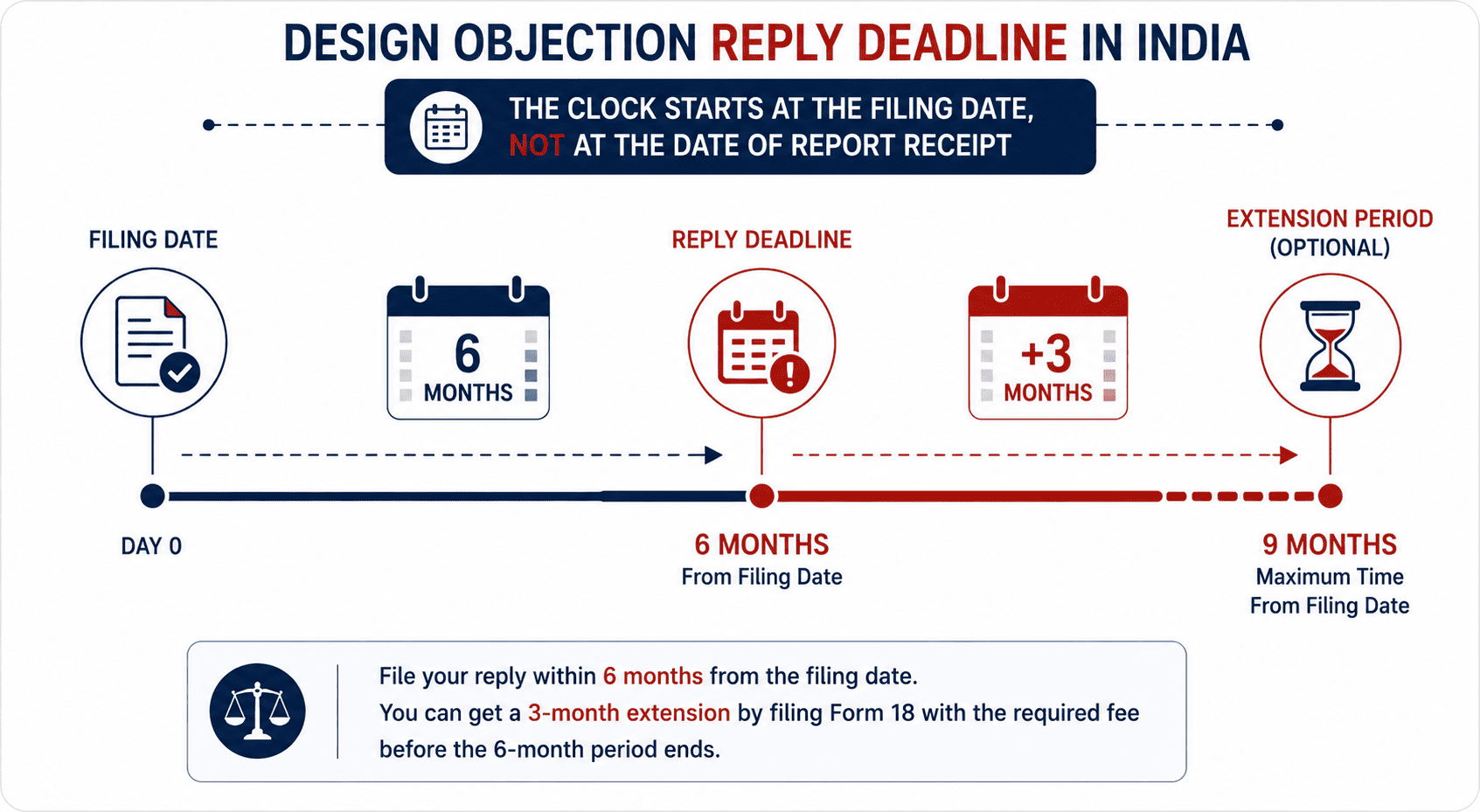
Rule 18 of the Designs Rules, 2001 gives you six months to remove the objection, but that clock starts from the date you filed your application, not from the date you receive the examination report. Since reports are usually issued within the first couple of months of filing, the practical gap often feels close to six months either way, but the legal starting point is your filing date.
You can extend this by a further three months, using Form 18 along with the prescribed fee, but you must request the extension before the original six-month period runs out. There's no provision to request an extension after the deadline has already passed.
If you'd rather argue your case in person, Rule 18(2) also lets you request a hearing before the Controller, generally within three months of the date the objection was communicated to you.
How Do You File a Reply to a Design Objection?
-
Read the examination report closely, and note every ground raised, not just the ones that seem easiest to answer.
-
Check your filing date, since that's what your six-month clock actually runs from.
-
Gather your evidence, such as design development records, dated sketches, or prior international filings that support novelty.
-
Draft a point-by-point response, addressing each objection individually rather than with a general statement.
-
Amend the representation if needed, for example by adding clearer views or narrowing the claimed features.
-
Submit your reply through the IP India online portal before the six-month window, or the extended nine-month window, closes.
-
Request a hearing if the objection is complex or the examiner's position seems unlikely to shift on paper alone.
Modifications are allowed at this stage, but only if they don't change the fundamental character of the design. If your product has genuinely evolved since filing, that usually calls for a fresh application rather than stretching the original one.
What Happens If You Don't Resolve a Design Objection?
If the objections stay unresolved and you haven't requested a hearing, the Controller can refuse the application. If you simply let the deadline pass without responding at all, Rule 21 treats the application as abandoned due to the applicant's own default, and there's no route to revive it through a late filing.
If a hearing does take place, the Controller decides afterward whether the application should proceed, get modified, or be refused outright. That decision is communicated in writing.
What Is the Design Objection and Registration Timeline?
|
Stage |
Typical Timing |
Governing Provision |
|
Filing of application |
Day 0 |
Section 5 |
|
First Examination Report (if objections arise) |
Often within 1 to 3 months of filing |
Section 5, Rule 18 |
|
Deadline to remove objections |
6 months from filing date |
Rule 18(1) |
|
Optional extension |
3 more months, requested before the 6-month deadline via Form 18 |
Rule 18(1) proviso |
|
Hearing request (if needed) |
Within 3 months of objection communication |
Rule 18(2) |
|
Registration and publication |
4 to 5 months from filing if unobjected; 8 to 10 months if objected |
Section 7 |
|
Appeal against refusal |
Within 3 months of the Controller's order |
Section 36 |
How Much Does It Cost to Reply to a Design Objection?
There's no separate government fee just to file your written reply to an examination report. The costs that do apply are the extension fee if you need the additional three months under Form 18, and any professional fees for drafting a strong response, especially one that involves amending representations or preparing for a hearing.
Compared to contesting a trademark objection, where the underlying government filing fee structure is similar in spirit, design objection replies tend to be quicker to resolve on paper, since most come down to documentation, classification, or novelty arguments rather than a full evidentiary fight.
Can You Appeal If Your Design Application Is Refused?
Yes. Section 5(4) of the Designs Act, 2000 allows any person aggrieved by the Controller's refusal to appeal, and Section 36 sets the deadline at three months from the date of the Controller's order.
This appeal goes straight to the jurisdictional High Court. Design refusals have always been appealable to the High Court under the Act itself, so unlike some trademark matters, this particular route wasn't affected by the abolition of the Intellectual Property Appellate Board in 2021. The High Court's decision on a design appeal is final under the Act.
Design Objection vs Trademark Objection: What Is the Difference?
Both objections happen at the examination stage, before the mark or design is published, and both can be resolved by the applicant if handled properly. That's roughly where the similarity ends.
|
Aspect |
Design Objection |
Trademark Objection |
|
Governing law |
Designs Act, 2000 and Designs Rules, 2001 |
Trade Marks Act, 1999 and Trade Marks Rules, 2017 |
|
Examining authority |
Controller of Designs, Patent Office, Kolkata |
Trademark Examiner, Trade Marks Registry |
|
Reply deadline |
6 months from the filing date, extendable by 3 months |
30 days from the examination report |
|
Common grounds |
Lack of novelty, prior publication, functionality, classification |
Descriptiveness, similarity to earlier marks, lack of distinctiveness |
|
What's protected |
How a product looks (shape, pattern, ornamentation) |
The brand identifier (word, logo, or symbol) |
|
Appeal forum |
High Court, under Section 36 |
High Court, under Section 91 |
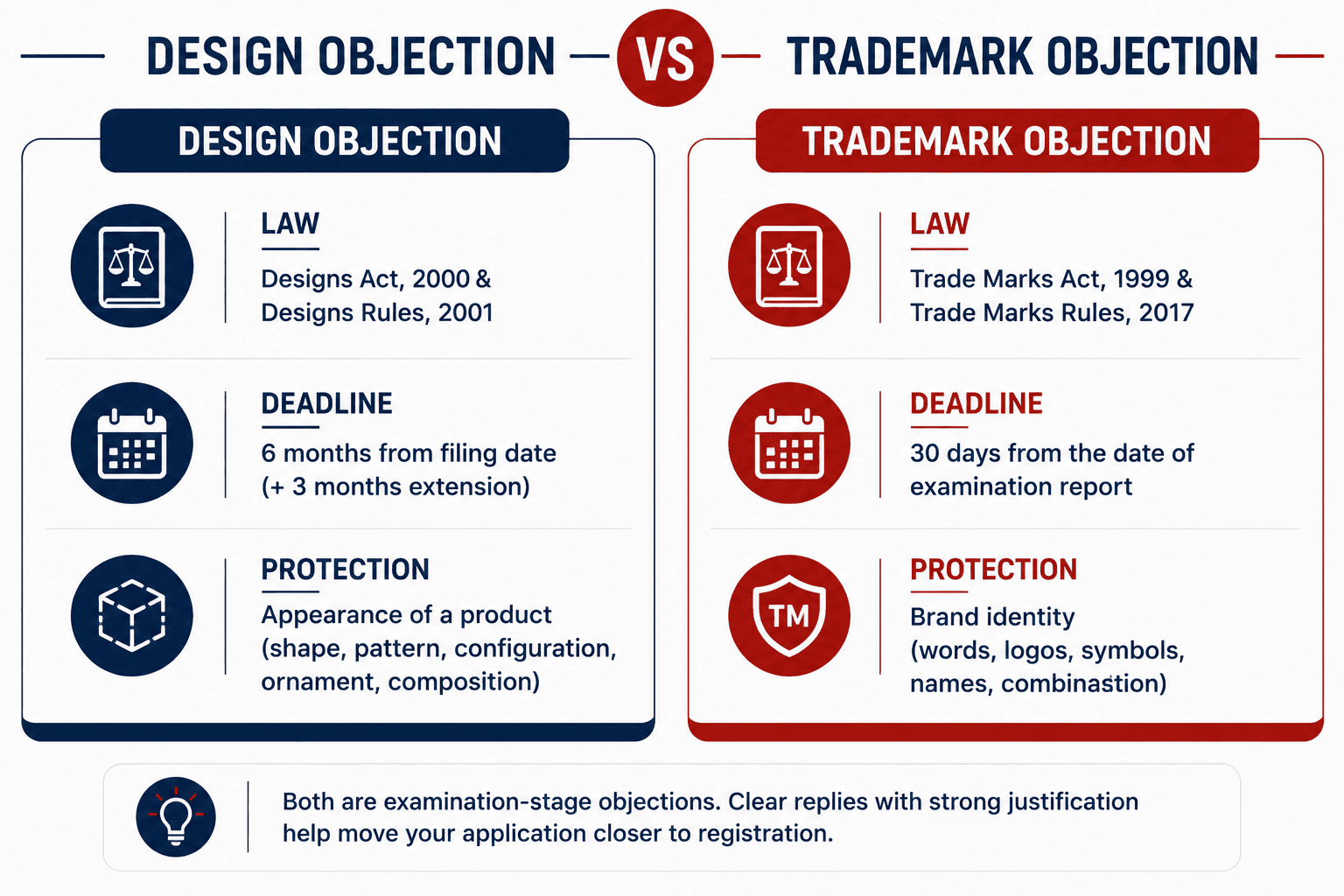
If you're registering both a product's appearance and its brand name, which is common for consumer goods and packaging, you'll likely encounter both processes at different points, and it helps to know which clock you're actually working against.
How Can You Avoid a Design Objection in the First Place?
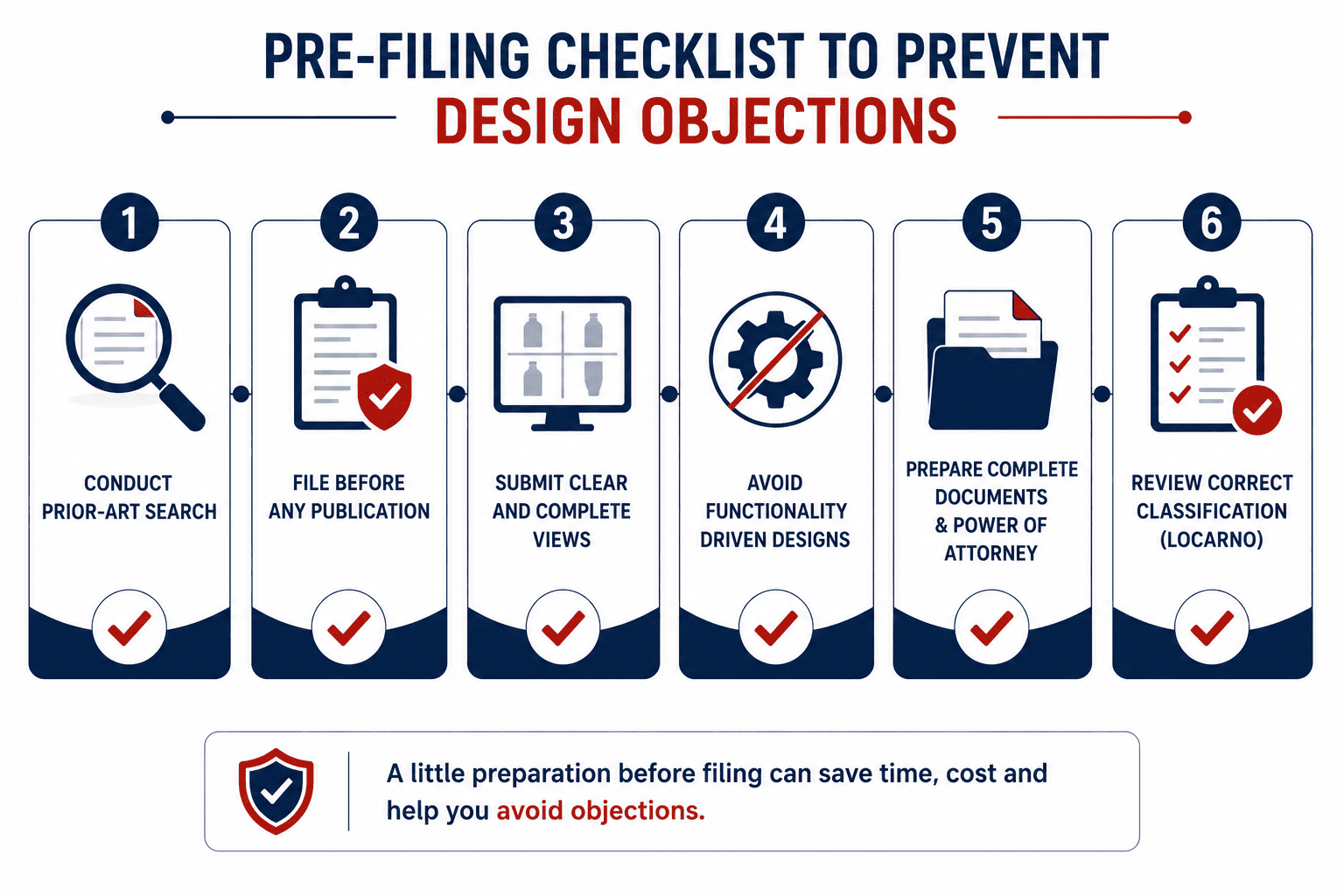
You can't eliminate the risk entirely, since examination is mandatory for every application, but a bit of preparation removes most of the avoidable objections.
-
Do a design search before filing, checking existing registrations in your Locarno class
-
Never publish, post, or launch your product publicly before your application is filed
-
Keep your representation sheets clean, consistent, and complete across all required views
-
Avoid relying on features that exist purely for function, and emphasise the ornamental or visual elements instead
-
Attach a properly executed Power of Attorney upfront if an agent is filing on your behalf
-
Double-check your Locarno classification matches the article you're actually claiming
Design protection and patent examination sit under the same Patent Office structure in India, so if your product also involves a technical innovation alongside its appearance, it's worth exploring patent application protection separately. And once your design clears objections and gets registered, it's protected for ten years, extendable by another five, so it's worth reviewing the broader types of intellectual property available if your brand involves a name, a logo, and a product shape all at once. Our intellectual property services cover design, trademark, patent, and copyright filings under one roof if you'd rather have the whole portfolio managed together.
FAQS
FAQ’s on Design Objection
-
What is a design objection in India?
It's a formal concern raised by the Controller of Designs during examination of a design application, typically about novelty, prior publication, functionality, or documentation.
- How long do I have to reply to a design objection?
- Does the six-month deadline start from the examination report or the filing date?
- What happens if I miss the deadline to respond to a design objection?
- What are the most common grounds for design objection?
- Is there a government fee to reply to a design objection?
- Can I request a personal hearing instead of just filing a written reply?
- Can I appeal if my design application is refused after objection?
- How is a design objection different from a trademark objection?
- Can I modify my design to overcome an objection?


