
APMC License in India: How to Apply, Documents and Fees
An APMC licence may be required if you want to buy and sell notified agricultural produce, operate as a commission agent, or carry out another regulated activity in a mandi. The application process depends on your state, licence category and market area. This guide explains how to identify the correct authority, prepare your documents, check the applicable fees and track your application.
How Do You Get an APMC License?
To apply for an APMC licence, first identify the state, market area, commodities and business activity involved. Then contact the relevant Agricultural Produce Market Committee or state agricultural marketing authority, obtain the correct application form, submit the required documents and pay the prescribed fee. Eligibility, fees, validity and application procedures differ by state, so verify the current rules before applying.
What Is an APMC License in India?
An APMC License is a licence or registration issued under the applicable agricultural marketing rules for carrying out certain activities involving agricultural produce. Depending on the state, these activities can include buying and selling crops, acting as a commission agent, processing produce, brokering transactions or operating a warehouse within a regulated market area.
APMC stands for Agricultural Produce Market Committee. State governments establish these committees under their agricultural marketing laws to regulate specified agricultural markets and related activities.
The exact rules vary across India. A trader in Maharashtra may follow a different procedure from a trader in Assam, Andhra Pradesh or another state. Some states provide a single licence for multiple market areas, while others have separate requirements for particular markets or activities.
The Indian Economic Service explains that agricultural marketing is largely governed by state legislation. This is why there is no single APMC application form, fee or licence that applies uniformly across India.
Before applying, answer three questions:
-
Which agricultural commodities will you trade?
-
Where will you conduct business?
-
Will you trade on your own account, act as an agent, process produce or provide another market service?
These details help you identify the correct licence and authority. If you choose the wrong category, you may need to submit a fresh application or change your registration before starting operations.
Who Needs an APMC Trader License?
You may need an APMC licence if your proposed activity falls within the licensing or registration requirements of the relevant state agricultural marketing law.
Common applicants include:
-
Agricultural produce traders: Businesses that purchase and resell notified crops, fruits, vegetables, grains, pulses or other covered commodities.
-
Commission agents: People or firms that arrange sales or purchases on behalf of farmers, traders or other permitted clients.
-
Brokers: Intermediaries who arrange agricultural produce transactions where the applicable rules recognise or regulate their role.
-
Processors: Businesses that process agricultural produce in a regulated market area, where a licence is required.
-
Warehouse operators: Businesses that store agricultural produce within a regulated market area and need the relevant authorisation.
-
Other market service providers: Depending on the state, this may include weighmen, measurers, surveyors and other market functionaries.
The exact categories depend on the applicable law. For example, Section 7 of Maharashtra's Agricultural Produce Marketing (Development and Regulation) Act, 1963 provides for licences covering activities such as trading, commission agency, brokering, processing and warehousing. Other states may use different categories or procedures. You can read the Maharashtra Act's licensing provisions.
Do all agricultural businesses need an APMC License?
No. You must check the law that applies to your location, commodity and business model.
For example, a person buying vegetables for personal household use is in a different position from a wholesaler purchasing large quantities for resale. Likewise, a farmer selling produce directly may follow different rules from a commission agent conducting transactions in a regulated market.
Some states permit specified forms of direct marketing, private markets or trading outside traditional market yards. Other activities may be exempt or subject to separate registration conditions.
Practical tip: Do not assume that every agricultural product is covered by the same APMC rules. Check the notified commodities, market boundaries and applicable exemptions with the relevant state authority.
What Are the Different Types of APMC Licences?
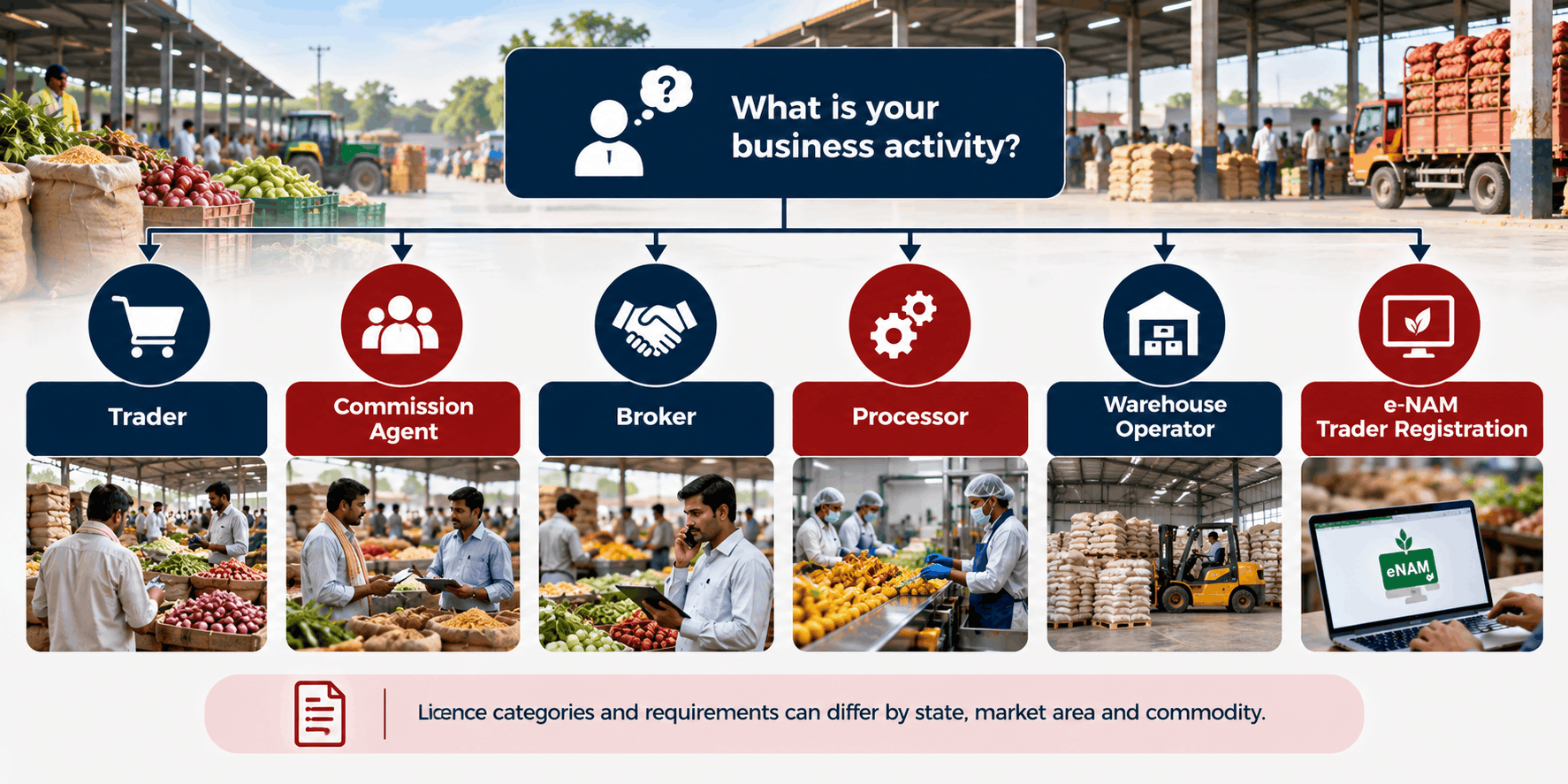
The licence category generally depends on the work you perform. A business that purchases produce for resale does not necessarily need the same authorisation as a commission agent or warehouse operator.
| Licence or registration category | Who may need it | What the activity involves |
|---|---|---|
| Trader licence | Businesses buying and selling covered agricultural produce | Purchasing produce on the business's own account and reselling it |
| Commission agent licence | Agents arranging transactions for permitted clients | Facilitating purchases or sales and earning an agreed commission where permitted |
| Broker licence | Intermediaries covered by the state's licensing framework | Connecting buyers and sellers or arranging transactions |
| Processor licence | Businesses processing agricultural produce where the law requires it | Cleaning, grading, processing or undertaking other permitted activities |
| Warehouse licence | Operators storing agricultural produce where authorisation is required | Operating a warehouse or storage facility |
| Market functionary licence | Other regulated service providers, where applicable | Activities such as weighing, measuring or surveying produce |
| Unified or state-level trader licence | Eligible traders in states that provide this facility | Trading across multiple approved market areas under the relevant state scheme |
| e-NAM trader registration | Traders who want to participate in the National Agriculture Market platform | Accessing the platform after meeting its registration and approval requirements |
Important: These categories are a general guide, not a list of licences available in every state. Some states combine activities, use different names or provide a unified licence. Check the relevant state law and application portal before choosing a category.
What is the difference between an APMC License and e-NAM registration?
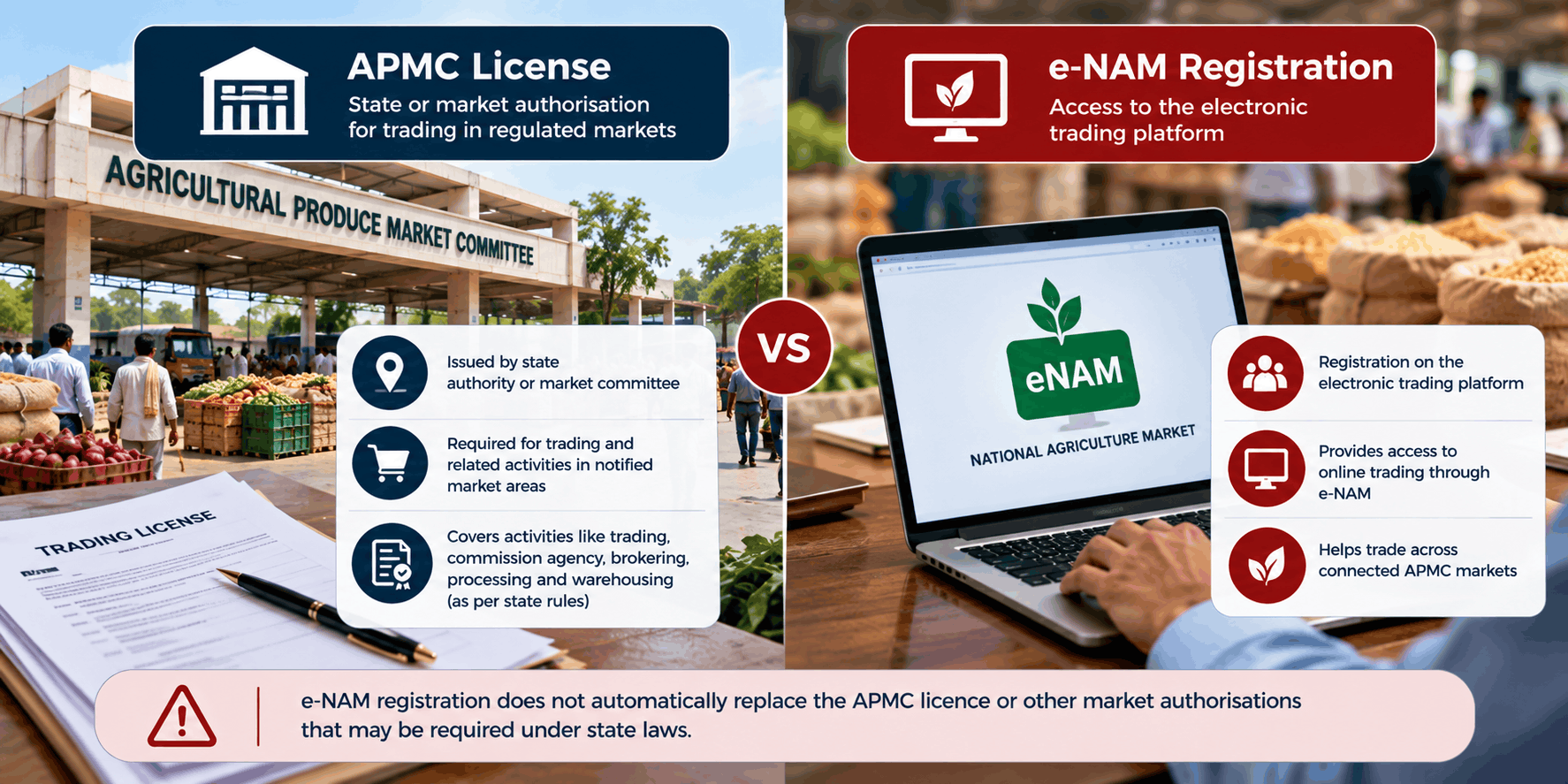
An APMC licence and e-NAM registration serve different purposes.
An APMC licence or other applicable market authorisation permits a business to carry out the activities covered by the relevant state rules. e-NAM is an electronic agricultural trading platform that allows eligible participants to access trading services through participating markets.
The official e-NAM registration guidelines explain that traders select an APMC or a state-level registration option, provide their details and submit the required licence and KYC information for approval.
This means that e-NAM registration should not be assumed to replace a licence required under state agricultural marketing law. Depending on the state and the applicant's activity, the underlying licence may need to be obtained or verified before the trader can participate in online trading.
Before registering, check the requirements of both the relevant market authority and the e-NAM platform.
What Are the Eligibility Requirements for an APMC License?
There is no single eligibility checklist for every APMC licence in India. The requirements depend on the state, market area, type of activity and licence category.
Before applying, check the following areas.
1. Applicant eligibility
The authority may require the applicant to provide identity details, contact information, business particulars and declarations. If a company, partnership or other entity applies, it may also need to provide its constitution and authorised signatory details.
Some states may prescribe conditions relating to financial standing, prior conduct, unpaid market dues or other eligibility factors. Check the relevant rules rather than relying on a general national checklist.
2. Business activity
You should clearly identify whether you intend to operate as a trader, commission agent, broker, processor, warehouse operator or another market functionary.
Your licence must cover the activity you actually conduct. If you intend to buy and resell produce while also acting as a commission agent, ask the market committee whether you need separate permissions or whether the applicable scheme allows both activities.
3. Market area
Identify the mandi or market areas where you plan to operate. A licence issued for one market may not automatically permit trading in every other market.
If you want to operate across multiple mandis, ask whether the state offers a unified or state-level licence. The availability and conditions of this facility vary.
4. Premises and facilities
If your business uses a shop, warehouse, processing unit or other premises, the authority may ask for its address and supporting documents. Additional permissions may apply to storage, processing, weighing equipment or other facilities.
5. Financial and operational readiness
Depending on the state and activity, you may need to provide bank details, security or fee payments, business records or other supporting information.
Before committing to a shop or warehouse, confirm that the location is suitable for the proposed activity. A premises document alone does not establish that you can trade in every commodity or operate throughout the state.
What Documents Are Required for an APMC License?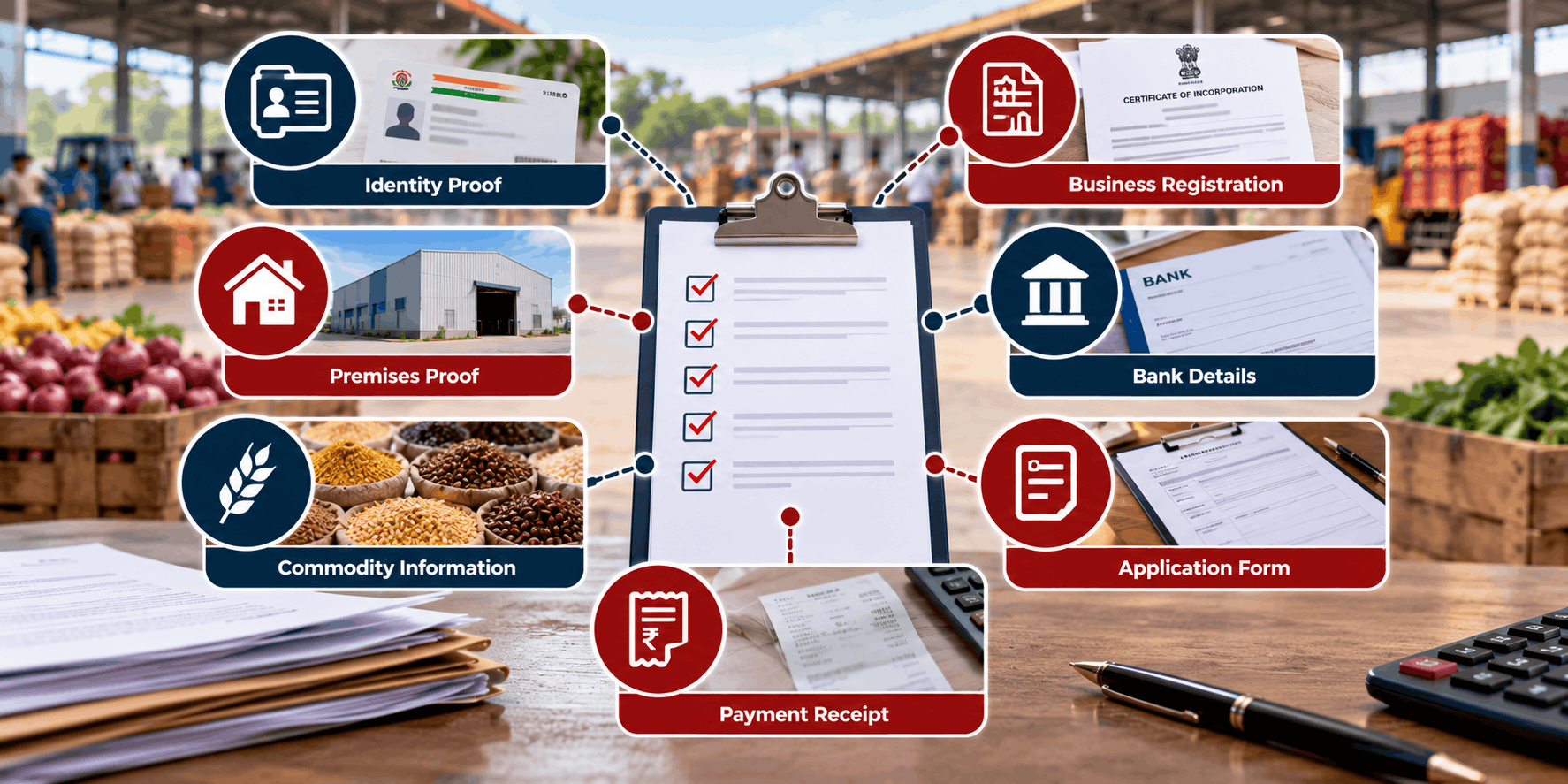
The exact APMC License documents depend on the state authority and the type of licence. The following checklist covers common preparation items, but the official application form takes priority.
| Document or detail | Why it may be required |
|---|---|
| Identity proof | To verify the applicant or authorised person |
| Address proof | To establish the applicant's contact or residential address |
| PAN details | For applicant or business identification, where required |
| Passport-size photograph | Where the form requests one |
| Business registration documents | To verify the legal identity of a company, partnership or other entity |
| Authorisation letter or board resolution | To establish who may submit the application on behalf of an entity |
| Business address or premises proof | To identify the proposed place of business |
| Bank account details | For verification, payments or settlement arrangements |
| Cancelled cheque or bank passbook copy | Where the authority requests bank evidence |
| GST registration details | Where applicable or requested |
| Details of commodities | To identify the agricultural produce the applicant intends to trade |
| Proposed activity and market details | To establish the licence category and operating area |
| Existing licence details | Where the application concerns renewal, transfer or platform registration |
| Affidavit or declaration | Where the prescribed form requires one |
| Fee or security deposit receipt | To demonstrate payment of the prescribed amount |
The official e-NAM trader guidance lists basic personal and bank details, a government identity document, a passbook or cancelled cheque, a trading licence and other relevant documents.
Do you need GST registration for an APMC License?
GST registration and APMC licensing serve different purposes. GST registration is governed by GST law, while APMC licensing follows the relevant agricultural marketing rules.
Whether GST registration is required depends on the business's circumstances and the applicable GST provisions. Do not assume that every applicant must register for GST solely because they apply for an APMC licence.
If your business needs GST registration, Legal Babu provides GST registration assistance.
The application process depends on the state and licence category. Use the following steps as a preparation checklist, then follow the procedure prescribed by the relevant authority.
Step 1: Define your business activity
Identify whether you will purchase and resell agricultural produce, act as a commission agent, broker transactions, process produce or operate a warehouse.
Your actual activity matters because different market functions may have different licensing requirements.
Step 2: Identify the relevant market area
Determine which market committee or agricultural marketing authority covers your intended business location.
If you plan to trade in multiple mandis, confirm whether a separate licence is required for each market or whether the state offers a unified licence for eligible applicants.
Step 3: Select the correct licence category
Read the official category descriptions before completing the application. If you intend to perform more than one activity, ask the authority whether one licence can cover both or whether separate permissions are needed.
Step 4: Obtain the current form and checklist
Use the official state portal or obtain the prescribed form from the designated office. Check the current document requirements, fees, validity period and submission method.
Avoid relying on an old form or a fee quoted for a different state or licence category.
Step 5: Prepare and review your documents
Collect the documents specified by the authority. Check that the applicant's name, business details, address and authorised signatory information are consistent.
If the application requires premises details, financial documents or a declaration, make sure these are included before submission.
Step 6: Submit the application and pay the fee
Submit the completed application through the official portal or designated office. Pay the prescribed amount using the authorised payment method.
Keep the application acknowledgement, payment receipt and a copy of the submitted documents.
Step 7: Track the application and respond to queries
Use the application number or acknowledgement to check the status, where a tracking facility is available. If the authority requests additional documents or clarification, respond within the stated deadline.
If your application is returned or rejected, read the reason carefully and follow the prescribed correction, resubmission or review procedure.
Step 8: Check the licence after approval
Once the licence is issued, verify the applicant's name, permitted activities, commodities, market area, validity period and any conditions.
If you plan to add a new activity or operate in another market area, confirm whether an amendment or additional licence is required before proceeding.
Remember: Submitting an application does not itself authorise you to carry out an activity for which a licence is mandatory. Wait for the required approval and comply with the conditions attached to it.
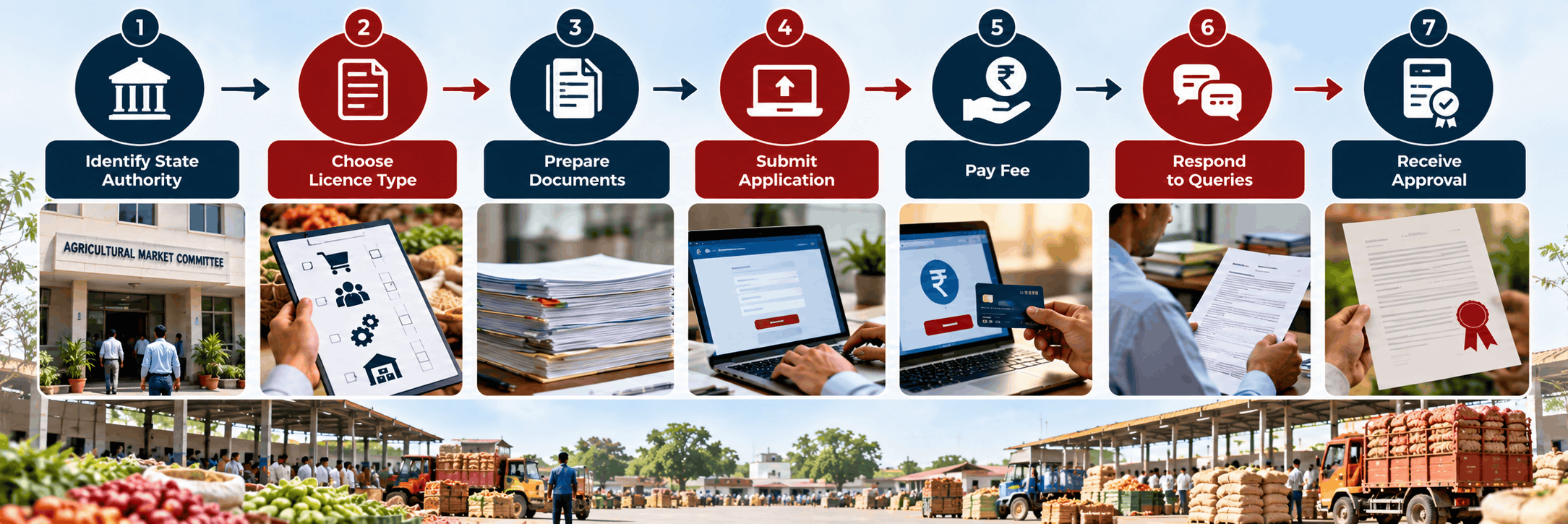
The APMC Registration Process differs by state. Some authorities accept online applications, while others may require an application through a market committee, marketing board or designated office.
Follow these steps to prepare your application.
Step 1: Identify the state and market authority
First, determine which APMC or agricultural marketing authority regulates the proposed activity. Check the official state agriculture marketing department or market board website.
If you intend to trade in more than one market area, confirm whether you must apply separately to each market committee or can apply for a unified licence.
Step 2: Choose the correct licence category
Decide whether you need a trader, commission agent, broker, processor, warehouse or other licence.
Read the category definitions carefully. For example, a trader generally buys and sells on their own account, while a commission agent acts for clients under the applicable rules. Your actual role, not just your business name, determines which category you should check.
Step 3: Review the current application form and checklist
Download the latest form or open the official application portal. Confirm the documents, fees, validity period and submission method.
Do not rely solely on a form shared by an agent or found on an old website. State rules and online procedures can change.
Step 4: Prepare the supporting documents
Collect the identity, business, premises, banking and activity details required for your category. Ensure that the names and addresses match across the application and supporting records.
If an authorised representative submits the form, prepare the required authorisation documents as well.
Step 5: Submit the application
Complete the prescribed form and submit it through the designated online portal or office. Upload or attach the required supporting documents in the specified format.
Keep a copy of the application, acknowledgement number and submitted documents. If the authority accepts applications through a market committee, ask for a receipt or acknowledgement.
Step 6: Pay the applicable fee
Pay the fee through the method specified by the authority. Some categories may involve a licence fee, renewal fee, security deposit or other prescribed charge.
Keep the payment receipt. Do not rely on a verbal fee quotation without confirming it against the current official schedule.
Step 7: Respond to queries or verification requests
The authority may review your documents, ask for additional information or conduct checks under the applicable rules.
Respond within the stated deadline. If your application is incomplete, correct the issue using the authority's instructions rather than submitting conflicting information in a second application.
Step 8: Receive the licence or registration approval
Once approved, review the licence details carefully. Check the applicant's name, permitted activity, market area, commodity scope, validity and any conditions.
If you plan to operate in another mandi or add another activity, confirm whether you need an amendment, extension or separate licence before doing so.
A successful application submission does not itself mean that the licence has been granted. Wait for the required approval before carrying out activities that need the licence.
Can You Apply for an APMC License Online?
Yes, in states that provide an online application facility. However, India does not have one universal online portal that handles every state and every APMC licence.
The application route may be available through a state agriculture marketing department, state marketing board, market committee portal or another designated system. Some applications may still involve physical verification or visits to the relevant office.
For example, the Assam State Agricultural Marketing Board publishes instructions for obtaining licences to trade agricultural commodities in the state. Its guidance describes submitting the prescribed application through the relevant market committee and paying the required fee.
Before applying online:
-
Confirm that the portal belongs to the relevant government authority.
-
Check whether your activity can be registered online.
-
Use the latest form and document list.
-
Save the acknowledgement and payment receipt.
-
Check how to track the application and respond to objections.
If your state provides only an offline route for your category, follow the official procedure instead of submitting documents to an unrelated portal.
What Are the APMC License Fees in India?
There is no single APMC licence fee for all of India. The amount depends on the state, licence category and applicable rules. Some categories may also involve renewal fees, security deposits or bank guarantees.
Before paying, verify these charges with the relevant market authority:
| Charge | What to confirm |
|---|---|
| Application fee | Whether a separate amount is payable when you submit the application |
| Licence fee | The prescribed fee for your specific category |
| Security deposit or bank guarantee | Whether the category requires financial security |
| Renewal fee | The amount and deadline for renewing the licence |
| Additional licence or market-area charges | Whether your intended activities in other market areas require further authorisation or payment |
Is the APMC licence fee the same as mandi charges?
No. A licence fee relates to obtaining or renewing an authorisation. Market fees and other transaction-related charges, where applicable, relate to the handling or trading of agricultural produce under the relevant rules.
The amounts, liable parties and calculation methods depend on the applicable state framework and transaction. Do not treat these charges as interchangeable.
How can you check the correct fee?
-
Open the official state market board or application portal.
-
Find the fee schedule for your licence category.
-
Check whether a security deposit or bank guarantee is required.
-
Confirm the licence validity period and renewal fee.
-
Verify the official payment method and retain the receipt.
If the current fee is not published clearly, ask the issuing authority for the applicable amount before paying. Avoid relying on a fee quoted for another state or an unrelated licence category.
How Long Does APMC Registration Take?
The processing time depends on the state, licence category, completeness of the application and any verification required by the authority.
Some state laws or rules may prescribe a time limit for a decision. You should not assume that the same deadline applies across India.
For example, Section 7 of Maharashtra's Agricultural Produce Marketing (Development and Regulation) Act, 1963 contains a provision addressing failure to grant, renew or refuse a licence within 60 days of receiving the application. That provision is part of Maharashtra's law and should not be treated as a nationwide processing guarantee. Review the Maharashtra licensing provision and confirm how it applies to your case.
To reduce avoidable delays:
-
Submit every required document.
-
Check that the selected licence category matches your activity.
-
Ensure the business name and address are consistent.
-
Pay the prescribed fee and retain proof.
-
Respond promptly to official queries.
-
Track the application through the designated portal or office.
If the authority raises an objection, read the reason carefully and provide the missing information in the required format.
What Is the Difference Between an APMC License and a Unified Trading License?
A regular APMC licence may be limited to a particular market area or activity, depending on the state's rules. A unified trading licence, where available, may allow an eligible trader to operate across several specified market areas under one state-level authorisation.
The scope and availability of unified licences depend on the relevant state legislation and implementation rules. Not every state offers the same arrangement, and a unified licence does not automatically remove every other requirement.
Before applying, check:
-
Whether the state offers a unified licence.
-
Which market areas it covers.
-
Whether it covers your commodity and trading activity.
-
Whether you must register with individual markets after obtaining it.
-
What fee and renewal rules apply.
The e-NAM programme identifies a single trading licence valid across a state as one of the market reforms that can support integrated electronic trading. However, the exact licence procedure still depends on the state's framework. Read the official e-NAM FAQs for background on how the platform works with state agricultural markets.
What Other Registrations May an Agricultural Trading Business Need?
An APMC licence does not automatically cover every legal and tax requirement for an agricultural trading business. Depending on your activity, you may need other registrations or approvals.
| Registration or approval | When to check it |
|---|---|
| Business entity registration | If you want to operate through a company, LLP or partnership |
| GST registration | When your business meets the applicable GST registration requirements |
| Udyam registration | If you qualify and want to register as a micro, small or medium enterprise |
| FSSAI licence or registration | If you conduct a food business that falls under FSSAI requirements |
| APEDA registration | If your export activity and products fall within APEDA's applicable scope |
| Spice Board registration | If you export spices and the relevant registration requirements apply |
| IEC | If you import or export goods where an Importer Exporter Code is required |
| Local trade or premises permissions | Where required by local rules or the nature of the premises |
| Weights and measures compliance | If your business uses weighing instruments or conducts activities covered by the applicable rules |
Do not apply for every registration in this table automatically. Identify the requirements that apply to your business and products.
Legal Babu provides support for several related services, including company registration, GST registration, Udyam registration, FSSAI licensing, APEDA registration, Spice Board registration and IEC registration.
What Mistakes Should You Avoid When Applying for an APMC License?
Small errors can delay an application or lead to problems after approval. Check these common mistakes before you submit the form.
Applying under the wrong category
A trader, commission agent and warehouse operator may have different obligations. Choose the category that matches your real activity.
Assuming one licence covers every mandi
A licence may have a limited territorial scope. Confirm whether it covers one market, several named markets or the entire state.
Using an outdated fee schedule
Fees and forms may change. Check the latest official instructions before making payment.
Ignoring commodity restrictions
The relevant rules may apply only to notified commodities or may treat certain commodities differently. Verify that your planned products fall within the licence's scope.
Confusing e-NAM registration with the underlying licence
Platform registration and the relevant market authorisation are separate questions. Check both before trading through e-NAM.
Submitting inconsistent documents
Differences in the applicant's name, business address, bank details or entity information may lead to queries. Review the application against the supporting records before submission.
Starting operations before approval
If your activity requires a licence, do not assume that filing the application gives you permission to operate. Wait for the required approval and follow any conditions attached to it.
How Can Legal Babu Help With Your APMC License Application?
Legal Babu helps businesses with registrations, licences, tax compliance and legal documentation. For an agricultural trading business, support can begin with understanding your business structure and identifying related registration needs.
Depending on the service required, Legal Babu can help with:
-
Business setup: Guidance on choosing a suitable business structure and assistance with company registration.
-
Document preparation: Helping organise business records and application documents based on the requirements you provide.
-
Tax registration: Assistance with GST registration where applicable.
-
MSME registration: Support with Udyam registration for eligible businesses.
-
Export-related registrations: Assistance with IEC registration and relevant export registrations, depending on your activity.
-
Compliance planning: Helping you identify related registrations that may apply to your business model.
The APMC or other competent state authority makes the statutory decision on an APMC licence. Before engaging a service provider, confirm whether it can assist with the specific state, market area and licence category you need.
To discuss your requirements, visit Legal Babu's licence and registration services or contact the team.
FAQS
FAQs about APMC License.
-
1. Is an APMC License mandatory for every agricultural trader in India?
No. The requirement depends on the state law, commodity, market area and type of activity. Check whether your proposed trade requires a licence or falls within an exemption before starting.
- 2. Can I get an APMC License without renting a shop inside the mandi?
- 3. Can a farmer sell produce directly to buyers without an APMC licence?
- 4. Can I use one APMC License to trade in two states?
- 5. Is an APMC License the same as a mandi licence?
- 6. Can a private limited company apply for an APMC Trader License?
- 7. Can I act as both a trader and a commission agent?
- 8. Do I need an APMC licence to sell agricultural produce online?
- 9. Can my APMC licence be rejected?
- 10. How can I check the status of my APMC licence application?


