
RERA approval is the registration your project needs from your state's Real Estate Regulatory Authority before you can advertise, book, or sell a single flat, plot, or shop. The Real Estate (Regulation and Development) Act, 2016 makes this compulsory for most residential and commercial projects above a fixed size. Skip it, and you're breaking the law before construction even reaches plinth level.
Most first-time promoters expect RERA approval to work like a trade license. Submit some papers, pay a fee, get a certificate in a week. It rarely plays out that simply. Your project size decides whether you need it at all. Your state decides the exact forms and fees. And once you have it, the compliance doesn't stop. It continues every quarter until you hand over the last flat. Here's what actually determines whether, and how, you need one.
What Is RERA Approval, and Why Does India Require It?
RERA approval is the certificate your state's Real Estate Regulatory Authority issues once your project clears its registration process. This process runs under the Real Estate (Regulation and Development) Act, 2016. Parliament passed this law in March 2016. It came into force in phases, with full enforcement across states from May 2017 onward.
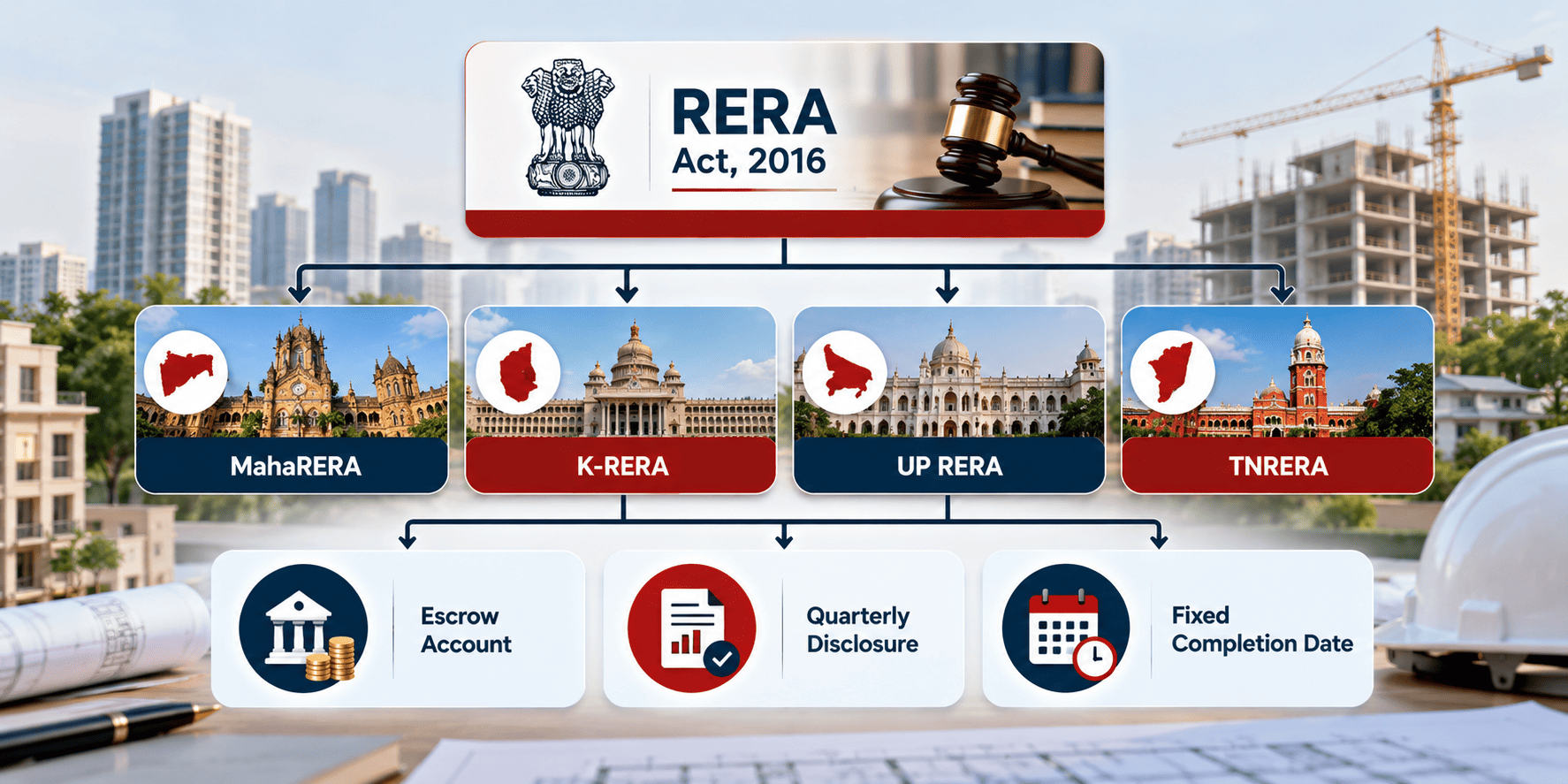
Before this law, homebuyers had little real protection. Developers changed floor plans after selling flats. Possession dates slipped by years with no real penalty attached. Advance payments collected for one project sometimes funded construction on a different site entirely. RERA approval closes these gaps. Every registered project must maintain a separate bank account for buyer money. It must also declare a fixed completion date and update its public disclosure page every quarter.
Each state runs its own Real Estate Regulatory Authority under this central law. Maharashtra has MahaRERA. Karnataka has K-RERA. Uttar Pradesh runs UP RERA, and so on. The underlying framework stays consistent nationwide. The forms, fees, and processing timelines differ from state to state.
Which Projects Actually Need RERA Approval?
Not every construction project needs to register. The Act sets a size threshold, and it trips up more applicants than it should.
Registration generally becomes mandatory once a project crosses either of these limits:
-
The land proposed for development is more than 500 square meters.
-
The project involves more than 8 apartments, counting all phases together.
Most state authorities and tribunals apply this as an either-or test: cross one limit and you register, even if you sit under the other. A 12-apartment building on a 300 square meter plot still needs approval under this reading. So does a single 600 square meter plot with only 6 units planned. A handful of state orders and clarifications, including one specific to MahaRERA, have applied the apartment-count limb differently. If your project sits close to either line, confirm the current position with your own state authority before you assume either way.
A few situations sit outside RERA's scope entirely:
-
Renovation, repair, or redevelopment work that doesn't involve marketing, advertising, selling, or new allotment of any plot, apartment, or building.
-
Projects where the promoter already held a completion certificate before the Act commenced in that state.
-
Land where the promoter isn't constructing anything meant for sale.
Redevelopment of a housing society is a common grey area. The flats going back to existing society members, with no sale involved, usually stay outside RERA. The moment the developer builds and sells additional flats to new buyers on the same plot, that sale portion needs full registration. Don't assume the entire project is exempt just because part of it is.
What Is the Difference Between RERA Project Registration and RERA Agent Registration?
This trips up a lot of people entering real estate for the first time. A promoter building and selling a project needs one kind of approval. A broker or channel partner selling flats on someone else's behalf needs a different one entirely.
|
Feature |
Project Registration (Promoter) |
Agent Registration (Broker) |
|
Who applies |
Developer, builder, or landowner selling the project |
Individual or firm facilitating sale or purchase |
|
Filed under |
Sections 3 and 4 of the RERA Act |
Section 9 of the RERA Act |
|
Core obligation |
Escrow account, disclosures, timelines, quarterly updates |
Deal only in RERA-registered projects, maintain transaction records |
|
Typical fee basis |
Calculated on land or carpet area |
Flat fee, varies by state and entity type |
|
Validity |
Tied to the declared project completion date |
Usually 5 years, renewable |
An agent who also develops a small project on the side needs both registrations. Holding one doesn't cover the other.
What Documents Do You Need for RERA Project Registration?
Keep this paperwork ready before you start the online application. Missing documents are the single biggest reason applications sit in query status for weeks.
-
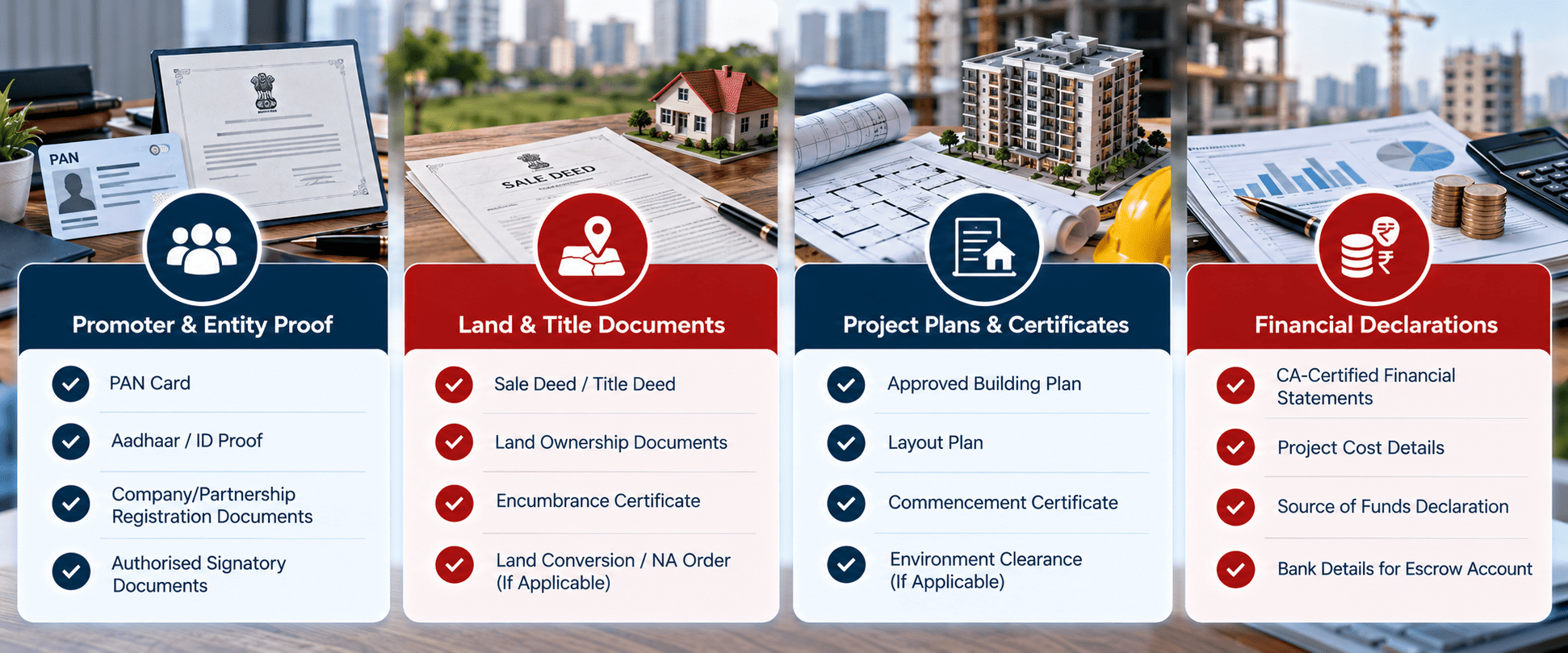
PAN card of the promoter, along with Certificate of Incorporation, partnership deed, or proprietorship proof, depending on the entity type.
-
Legal title report or title deed of the project land, confirming the promoter's legal right to develop it.
-
Encumbrance certificate for the land, along with details of any existing mortgage, charge, or pending litigation.
-
Sanctioned building plan, layout plan, and specifications approved by the competent planning authority.
-
Commencement certificate, where construction has already started.
-
Proforma of the allotment letter and agreement for sale, drafted in the state's prescribed format.
-
Details of the separate project bank account, since a minimum of 70 percent of buyer collections must sit in this dedicated escrow account under Section 4(2)(l)(D).
-
Chartered Accountant's certificate on project cost and permitted fund withdrawal, for ongoing projects.
-
Architect's and structural engineer's certificates confirming construction progress, for ongoing projects.
-
Details of the promoter's earlier projects, including any delays on previous developments.
-
Declaration of the proposed completion date, phase-wise where the project has multiple phases.
Some states also ask for income tax returns, board resolutions, or a fresh CERSAI report confirming no undisclosed charge on the property. Check your own state authority's checklist rather than assuming the list above covers every local requirement.
How Do You Apply for RERA Approval Online?
The exact portal and form numbers change by state. The underlying sequence stays fairly consistent everywhere.
1. Register on your state's RERA portal Create a promoter account on your state authority's website. Maharashtra developers use the MahaRERA portal. Other states run their own equivalent site.
2. Fill in the project application Enter promoter details, land and project details, and the declared completion date. This is usually Form A or its state-specific equivalent.
3. Upload the required documents Attach the title report, sanctioned plans, bank account declaration, and every other document your state's checklist demands.
4. Declare the separate escrow account Provide the bank account meant to hold buyer payments, along with the declaration format your state prescribes.
5. Pay the registration fee Fees are usually calculated on land or carpet area, subject to a state-specific minimum and maximum. Pay online through the portal.
6. Submit for review Your state authority reviews the application and can raise queries if any document looks incomplete or inconsistent with another.
7. Receive your registration number Once approved, you get a project-specific RERA registration number. This number has to appear on every advertisement, brochure, and agreement for sale from that point on.
How Does MahaRERA Approval Work in Maharashtra?
Maharashtra was the first state to operationalize RERA, and MahaRERA remains one of the more active authorities in the country. If your project sits anywhere in Maharashtra, this is the authority you're dealing with.
The process runs on the MahaRERA portal. You create a promoter account, then fill in Form A with project and land details. Form B is your declaration under the MahaRERA rules, covering the project completion date and your undertaking on the escrow account. For ongoing projects, you'll also need Form 1 through Form 5, covering architect certification, engineer certification, and CA certification on project cost and fund withdrawal.
MahaRERA's project registration fee is generally set at Rs. 10 per square meter of the land proposed for development, subject to a minimum of Rs. 10,000 and a maximum of Rs. 10 lakh, with plotted developments charged at a lower Rs. 5 per square meter. Agent registration is separate, at Rs. 10,000 for an individual and Rs. 1 lakh for companies and other entities. These figures have been revised before, so confirm the current rate on the MahaRERA portal before you budget for registration.
MahaRERA has also pushed hard on enforcement. It publishes project-wise complaint data, penalizes promoters for missed quarterly updates, and is tightening rules around redevelopment projects under the state's evolving housing policy. If you're a co-operative housing society going for redevelopment, get clarity on which part of your project needs registration before you sign a developer agreement.
How Much Does RERA Registration Cost Across States?
Every state fixes its own fee schedule under the Act, so costs vary more than most first-time applicants expect.
|
State |
Indicative Project Fee |
Individual Agent Fee |
|
Maharashtra (MahaRERA) |
Rs. 10 per sq. m of land, subject to a stated minimum and maximum |
Rs. 10,000 |
|
Karnataka (K-RERA) |
Rate per sq. m above a set threshold, subject to a cap |
Rs. 25,000 |
|
Gujarat (GujRERA) |
Varies by project category and area |
Rs. 10,000 |
|
Uttar Pradesh (UP RERA) |
Varies by project category and area |
Varies by entity type |
|
Most other states |
Typically Rs. 5 to Rs. 25 per sq. m of project area |
Typically Rs. 10,000 to Rs. 25,000 |
Multiple government notifications with different figures for the same state circulate online, and fee slabs get revised from time to time. Treat every number here, and anywhere else you read them, as a starting estimate. Confirm the current fee on your own state authority's portal before you finalize your budget.
Budget beyond the government fee too. Professional fees for a consultant or advocate handling your documentation and filing typically start around Rs. 5,000, more for larger or more complex projects.
How Long Does RERA Approval Take, and Can You Extend It?
Section 5 of the Act gives the Authority 30 days to grant or reject a complete application. If nobody responds within that window, the law treats the registration as deemed granted. In practice, most states process straightforward applications somewhere between 15 and 30 working days, assuming your documents are correct the first time.
Your RERA registration stays valid until the completion date you declared at registration. Projects run late more often than anyone likes to admit. Section 6 allows you to apply for an extension. Valid reasons are limited to genuine cases like force majeure, and the extension period is generally tied to the delay itself. Extensions need a fresh application, usually with a fee, and they aren't automatic.
Miss your declared date without applying for an extension, and buyers can approach the Authority directly for delay compensation or a refund with interest. That conversation costs far more than the extension fee ever would.
What Happens If You Sell Without RERA Approval?
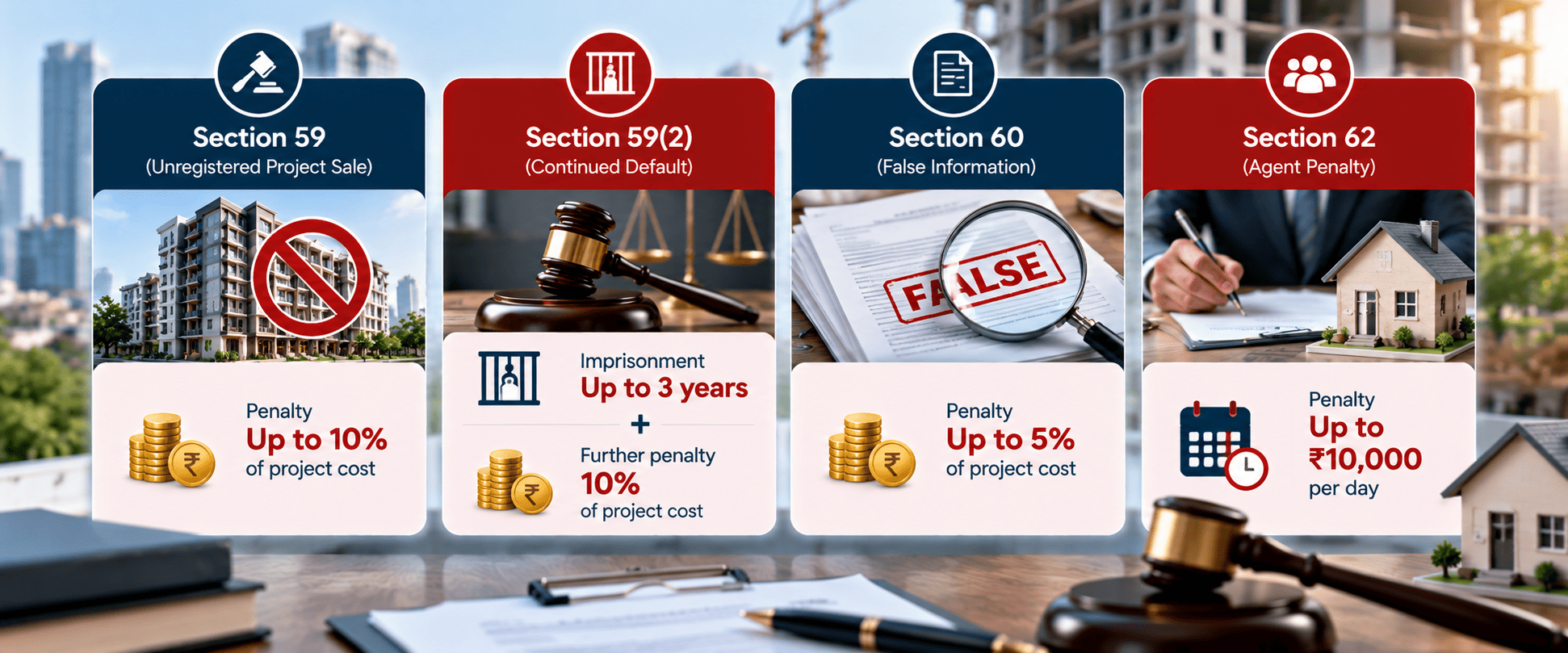
Section 59 of the Act treats unregistered sale of a project as a serious offence, not a paperwork oversight.
A first violation of Section 3 can draw a penalty of up to 10 percent of the estimated project cost. Suppose you keep advertising or selling after that order. Section 59(2) then allows imprisonment of up to 3 years. It also allows a further fine of up to 10 percent of project cost, or both together. Giving false information during registration draws a separate penalty under Section 60, up to 5 percent of project cost. Real estate agents dealing in unregistered projects face their own penalty under Section 62. That penalty runs up to Rs. 10,000 per day of default.
Beyond the legal exposure, an unregistered project usually can't get bank funding for buyers. Most home loan lenders now insist on a valid RERA registration number before disbursing a loan against a flat in your project. That alone slows sales momentum faster than any government notice.
What Compliance Continues After You Get RERA Approval?
Getting the registration number is the start, not the finish line. A handful of obligations run for the entire life of the project.
-
Maintain the separate escrow account, and use it strictly for construction and land cost of that specific project.
-
Update your project's public disclosure page every quarter, covering booking status, construction progress, and any change in approved plans.
-
Display your RERA registration number on every advertisement, brochure, and agreement for sale from that point onward.
-
Honour the 5-year structural defect liability under Section 14(3), repairing defects free of cost if they surface within that window.
-
Apply for an extension well before your declared completion date if the project is genuinely running late.
-
Get a fresh approval before making any major change to the sanctioned plan that affects allottees.
Promoters who treat the registration number as a one-time checkbox usually run into trouble at the first quarterly update they miss. MahaRERA and most other state authorities actively track this, and several have penalized developers publicly for lapses.
Do You Need Other Registrations Alongside RERA Approval?
RERA approval covers your project's regulatory compliance. Running the development business itself needs a few other pieces in place too.
-
Company or LLP registration, since most RERA authorities expect the promoter to be a formally registered company, LLP, or partnership, not an unregistered group of individuals.
-
GST registration, since sale of under-construction property attracts GST, and most states ask for your GST number as part of the RERA application itself.
-
Trademark registration for your project's brand name, especially useful if you're planning multiple phases or a township under one name.
-
Due diligence on the land title before you file, since a clean title report is one of the most scrutinized documents in the entire application.
-
Valuation report and project report preparation, both of which most banks expect before sanctioning project finance or a working capital loan for construction.
-
Accounting services and CFO services to keep the escrow account and CA certifications audit-ready every quarter.
-
Labour law compliance support once your site starts hiring construction labour across shifts and contractors.
If you're a housing society going the redevelopment route, your society registration status and your managing committee's resolutions also come under scrutiny during RERA filing.
What Mistakes Should Promoters Avoid During RERA Registration?
A handful of errors keep showing up in delayed or rejected applications, year after year.
-
Advertising or accepting token bookings before the registration number is actually issued, not just applied for.
-
Declaring an unrealistic completion date under pressure to look attractive to buyers, then scrambling for an extension later.
-
Mixing escrow account funds with other business accounts or diverting money toward a different project.
-
Skipping the quarterly disclosure update, on the assumption that nobody checks a small project closely.
-
Filing under the wrong entity name, when the land title sits with a different company or individual than the applicant.
-
Treating agent registration and project registration as interchangeable, and assuming one covers the other.
-
Copying a document checklist written for a different state's portal, instead of confirming the local format.
How Does LegalBabu Help With RERA Approval?
Most promoters lose time on the parts a generic checklist won't fix. Getting the title report format right. Matching the escrow declaration to the exact state format. Lining up architect, engineer, and CA certificates without repeated queries from the authority. LegalBabu reviews your documentation and prepares your application. We file it on the MahaRERA portal or your state's RERA portal. We also track your quarterly disclosure and extension deadlines, so a missed update doesn't turn into an avoidable penalty.
FAQS
Have questions about RERA Approval?
We have you covered:
-
Can I accept a token booking amount before my RERA registration number is issued?
No. Section 3 blocks any advertising, booking, or collection of money before registration, even a small token amount. Wait for the registration number before you take a rupee from a buyer.
- Does RERA approval apply if I'm building one bungalow for a specific client on their own land?
- What happens if my RERA registration expires before construction finishes?
- Can I sell a resale flat in a project that was never RERA registered?
- Do I need RERA approval to renovate an existing building without adding new units for sale?
- My state notified RERA rules years after the central Act. Which rules apply to my project?
- Can a homebuyer get a refund if a promoter cancels a registered project?
- Is a co-operative housing society redevelopment project covered under RERA?
- Can an NRI register as a promoter under RERA?
- Does RERA approval cover commercial shops built within a residential project?


