
RPSL Rules: Key Responsibilities of Crewing Agencies
- by kapil
- Updated September 27, 2026
- 13 mins read

RPSL company responsibilities of the Merchant Shipping (Recruitment and Placement of Seafarers) Rules, 2026 cover seafarer recordkeeping, informed consent before signing the employment agreement, correct cost allocation, prompt complaint handling, repatriation support, and welfare fund compliance. A RPSL licensed company must meet every one of these duties, not just the ones an inspector happens to ask about first.
The Merchant Shipping (Recruitment and Placement of Seafarers) Rules, 2026, sets out 36 separate duties, covering recordkeeping, employment agreements, cost allocation, repatriation, complaints, financial security, welfare and other compliance requirements. Most RPSL companies know the licensing steps and the bank guarantee table. Fewer can name what those responsibilities actually require once the license is in hand. That gap is exactly where DGMA inspectors spend most of their audit time.
What Are the Responsibilities of an RPSL Company?
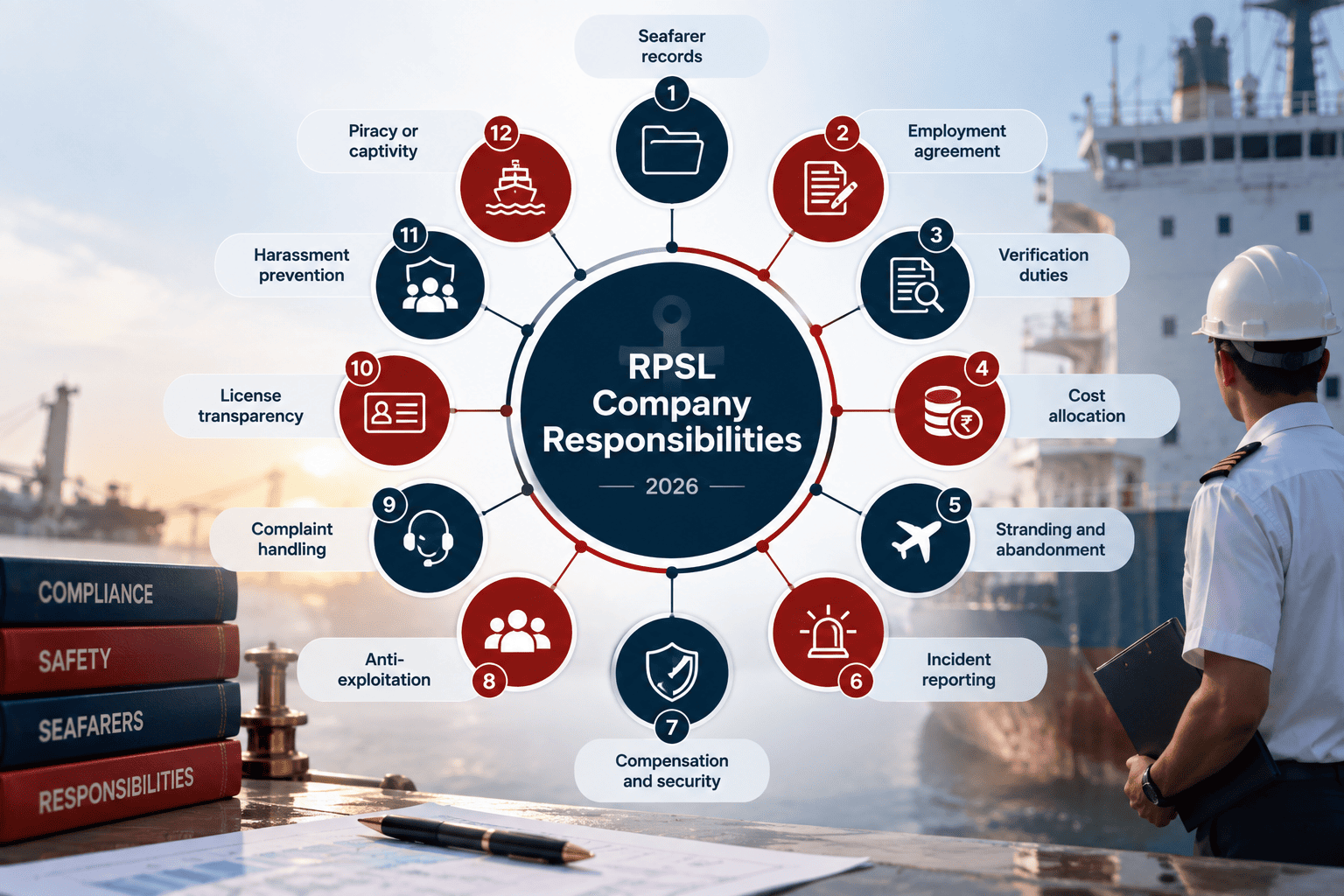
The responsibilities fall into a few practical buckets: recordkeeping, employment agreement handling, cost allocation, stranding and abandonment support, incident reporting, compensation and financial security, anti-exploitation measures, complaint handling, and license display rules.
| Responsibility Area | What It Covers |
| Seafarer records | Up-to-date recruitment, employment, medical and next-of-kin data |
| Employment agreement | SEA disclosure, review time, signed copies for the seafarer |
| Verification duties | Qualifications, documents, certificate authenticity |
| Cost allocation | Who pays visas, medicals, welfare fees versus seafarer-borne costs |
| Stranding and abandonment | Repatriation, maintenance, medical care, mortal remains |
| Incident reporting | 24-hour Form-X reporting for serious incidents |
| Compensation and security | Death and disability compensation timelines |
| Anti-exploitation | No blacklists, no exploitative joining advances |
| Complaint handling | Prompt response, escalation to DGMA |
| License transparency | Displaying license, quoting license number in ads |
| Harassment prevention | Measures against sexual harassment, bullying, assault |
| Piracy or captivity | Continued wages during captivity or detention abroad |
What Records Must Every RPSL Company Maintain on Seafarers?
An up-to-date record must be maintained for every seafarer recruited or placed. The record must include: qualifications, employment history, personal data tied to next of kin, and medical data relevant to employment.
This isn’t a “keep it if convenient” duty. Inspectors under Schedule IV pull a random sample, usually 10% of your total placements or 10 files, whichever is larger, and cross-check them against the government’s own e-Migrate entries. If your internal file and the government record don’t match, that’s a finding on your inspection report before the auditor even asks a follow-up question.
Retention matters too. The application declarations under Form II ask RPSL companies to keep recruitment records, contracts, and compensation registers for a minimum of five years. A seafarer’s contract ending doesn’t close the file. It just changes what you’re keeping the file for.
What Must Happen Before a Seafarer Signs the Employment Agreement?
The employment agreement process requires the seafarer to know the shipowner’s identity and the agreement’s terms before, or during, the engagement process, not after they’ve already boarded. They need real time to read the Seafarer Employment Agreement (SEA), not a form pushed at them at the gangway.
The SEA itself must carry every particular listed in Form-IX and be signed electronically. Skip the shipowner’s name on the agreement, and the applicable penalty provision is triggered: your RPSL company gets treated as the shipowner for the purposes of penalties under sections 281 and 282 of the Act. That’s a heavier liability than most agencies realize they’re carrying until it actually gets tested.
One practical habit worth building: give the seafarer a physical or digital copy of the signed SEA before they leave your office, not a promise that it will follow by email later.
Which Recruitment Costs Can an RPSL Company Charge to a Seafarer?
This is where a lot of confusion, and a lot of complaints, come from. The cost rules draw a clear line.
| Cost | Who Bears It |
| Visa charges | Shipowner |
| Pre-sign-on and post-sign-off medical examination (job-specific) | Shipowner |
| Seafarers’ welfare fees and welfare fund contribution | Shipowner (Indian ships) or the RPSL company for other ships |
| Fee for repatriation or replacement of seafarers | The RPSL company, for ships other than Indian ships |
| Cost of obtaining a personal medical certificate | Seafarer, or someone on their behalf |
| Continuous Discharge Certificate (CDC) or identity document | Seafarer |
| Passport or similar personal travel document | Seafarer |
| The recruitment or placement itself | Neither. It cannot be charged to the seafarer at all |

Notice the distinction in that fourth row. A seafarer can be asked to pay for their own general medical certificate, the one they’d need for any employer. But a medical exam that a specific shipowner requires before or after a specific voyage is a shipowner cost, full stop. RPSL companies that blur this line, charging seafarers for pre-joining medicals under the label of “processing fees,” are exactly the pattern DGMA’s grievance cell keeps flagging in enforcement orders.
What Must an RPSL Company Do for a Stranded or Abandoned Seafarer?
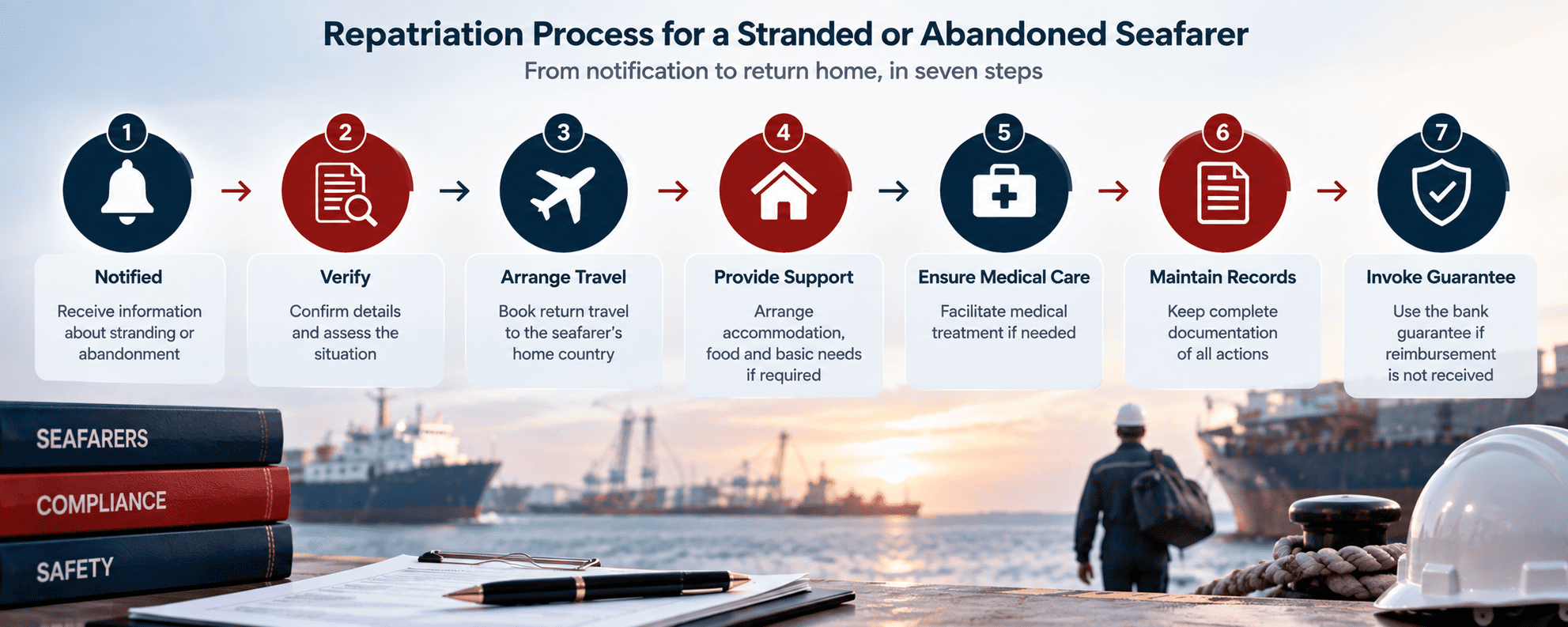
The requirements for stranded or abandoned seafarers create a clear practical sequence an RPSL company should follow:
- Confirm the seafarer’s situation and current location as soon as you’re notified.
- Coordinate with the shipowner to arrange repatriation, and step in yourself if the shipowner is unresponsive or unwilling.
- Ensure maintenance, food, accommodation, and emergency medical care continue until the seafarer reaches home.
- Arrange transport of the mortal remains, if the seafarer has died.
- Report the abandonment electronically to the Issuing Authority within 24 hours of receiving the information.
- Inform the seafarer’s next of kin and walk them through the welfare fund and provident fund claims available to them.
- Be ready to have your bank guarantee invoked if the shipowner’s own arrangements collapse.
The requirements for distressed seafarers add one more layer worth calling out on its own. Where a seafarer is kidnapped, abandoned, or in comparable distress, the RPSL company must respond to requests from the seafarer or their family promptly, sympathetically, and free of cost. That last part matters. Charging a distressed family for “processing” their query is its own compliance failure, separate from whatever caused the abandonment.
How Quickly Must Incidents, Deaths, or Disappearances Be Reported?
| Event | Required Action | Deadline |
| Serious injury (not minor), disappearance, death, loss overboard, or homicide | File Form-X with the Issuing Authority | Within 24 hours of receiving the information |
| Seafarer abandoned | Report electronically to the Issuing Authority | Within 24 hours of receiving the information |
| Death compensation | Shipowner pays compensation | Within 3 months of the incident |
| Long-term disability compensation | Shipowner pays compensation, as far as practicable | Within 12 months of the incident |
| Complaint about RPS activities | Examine and respond | Promptly; unresolved cases go to DGMA |
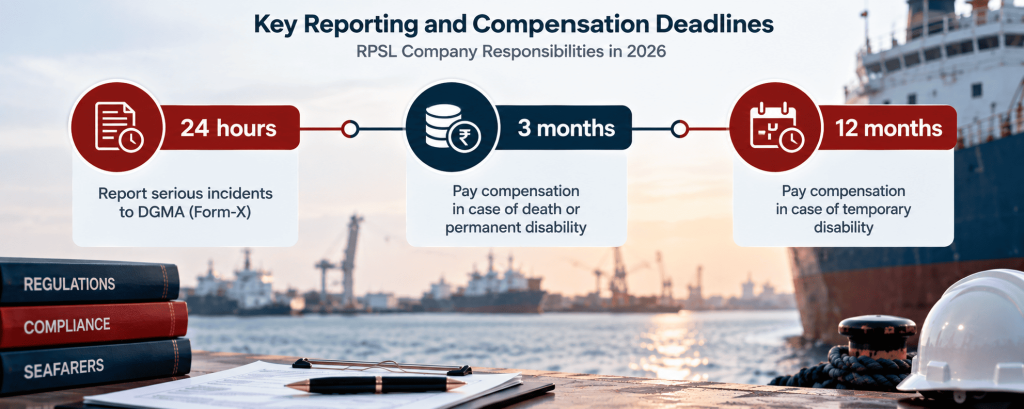
The 24-hour Form-X requirement specifically excludes minor injuries. That distinction gets missed often enough that it’s worth repeating on its own: a sprained wrist doesn’t trigger the same clock as a serious injury, a disappearance, or a death. Judgment calls on what counts as “minor” should be documented at the time, not reconstructed later if an inspector asks.
What Are an RPSL Company’s Compensation and Financial Security Duties?
The RPSL company must ensure the shipowner maintains adequate financial security so that death or long-term disability compensation actually gets paid when it is owed. The applicable provisions also establish the compensation timelines shown in the table above.
This duty connects directly to two other compliance pieces you’re probably already tracking. One is the bank guarantee requirement every RPSL company carries as part of its licensing requirements, which can be invoked to cover unpaid dues. The other is the P&I insurance side, covered under DGMA’s RPSL insurance rules. These requirements don’t create a third, separate insurance product. They create an obligation to verify that the existing financial security, on the shipowner’s side, actually holds up.
Ships that provide seafarers to your agency should also carry proper Document of Compliance (DOC) status and MLC certification. Verifying labour conditions is much easier when those two documents are already in order.
Are RPSL Companies Allowed to Blacklist Seafarers or Restrict Employment?
No. A mechanism or list cannot be used to prevent or deter a qualified seafarer from getting a job. The same principle applies to joining advances and other financial arrangements between the shipowner and seafarer that the RPSL company handles.
There’s a legitimate line here, and it’s worth drawing carefully. An RPSL company can decline to place a seafarer for job-related reasons, a missing certificate, a documented discipline issue, an expired medical. What it cannot do is maintain an informal list that quietly locks a seafarer out of future placements because they raised a complaint against a previous employer. That second pattern is what the anti-retaliation requirements are designed to prevent, and it’s exactly what DGMA’s grievance cell tends to dig into once a pattern of complaints against one agency starts to form.
How Should an RPSL Company Handle Seafarer Complaints?
The complaint-handling requirements set the standard: examine complaints promptly and adequately, respond to them, and tell the Director-General about anything that stays unresolved. The regulatory framework also gives the Issuing Authority its own three-year window to take up a seafarer’s grievance about ships other than Indian ships.
A complaint that sits untouched for weeks doesn’t just risk the individual seafarer’s trust. Schedule IV’s inspection checklist treats complaints unresolved for more than three months as simply not acceptable, regardless of the reason. If your RPSL company doesn’t already log every complaint with a date, a status, and a resolution note, that’s the single easiest fix to make before your next annual audit. Agencies already running a structured RPSL annual compliance service usually fold this straight into their existing tracker.
What Anti-Exploitation and Anti-Harassment Duties Apply?
RPSL companies must have measures to prevent and address violence and harassment, including sexual harassment, bullying, and sexual assault, in the recruitment and placement process itself. This sits alongside, not instead of, the shipboard protections under the Maritime Labour Convention.
Practically, this means your recruitment office needs its own complaint channel, separate from whatever channel exists once a seafarer is already on board. A seafarer facing harassment during the interview or documentation stage shouldn’t have to wait until they’re at sea to have somewhere to report it.
What Happens If Seafarers Are Captured by Pirates or Detained Abroad?
The requirements covering piracy, armed robbery, detention and imprisonment are among the more overlooked provisions, but they have significant consequences. If a seafarer is held captive due to piracy or armed robbery against ships, or detained or imprisoned, their wages and entitlements under the SEA or collective bargaining agreement must keep being paid throughout the captivity. If the seafarer dies in captivity, payment continues until the date of death.
This isn’t a discretionary gesture. It’s a continuing obligation that doesn’t pause just because the seafarer is unreachable or the situation is legally messy. RPSL companies operating in higher-risk trading routes should have this clause built into their standard operating procedure, not treated as a one-off crisis response the first time it actually happens.
What License Display and Advertising Rules Must an RPSL Company Follow?
The license display and advertising requirements are basic housekeeping, and inspectors check them first because they’re the fastest thing to verify. The license copy must be displayed prominently at your premises, somewhere the public can actually see it. Every advertisement you publish must state the license number, date of issue, and validity period. Every piece of official communication needs the license number too.
Small detail, easy to overlook, and one of the quickest findings an auditor can write down if it’s missing.
What Happens If an RPSL Company Fails to Meet These Responsibilities?
The Issuing Authority can issue a show-cause notice where an RPSL company’s activities contravene the Act, the Rules, or a seafarer’s interests. A failure to meet these responsibilities, unresolved complaints, missing records, or cost violations can be the trigger for that notice. From there, suspension or withdrawal follows if the response isn’t satisfactory, and the company’s top management gets barred from holding any license for five years.
We’ve covered the seven most common reasons licenses actually get pulled, and it’s worth reading if you want to see how these compliance gaps play out in real DGMA orders: why RPSL licenses get cancelled.
What Should Be on an RPSL Company’s Internal Compliance Checklist?
- Seafarer records updated and matched against e-Migrate entries
- Signed SEA copies handed to every seafarer before departure
- No medical, visa, or welfare fee costs wrongly passed to seafarers
- Abandonment and repatriation protocol documented and ready to trigger
- Form-X reporting process tested, with the 24-hour clock understood by staff
- Complaint log maintained with dates, status, and resolution notes
- License copy displayed at every office, including branch offices
- License number present on every advertisement and communication
- Anti-harassment channel available at the recruitment stage, not just onboard
- Bank guarantee and P&I insurance validity checked against current seafarer count
FAQs
Can an RPSL company charge a seafarer for a medical test before joining a ship?
It depends on which medical test. A job-specific pre-sign-on or post-sign-off medical examination is a shipowner cost. The cost of a seafarer’s own general medical fitness certificate, the one they’d need regardless of which company hires them, can be borne by the seafarer.
What happens if an RPSL company doesn’t give the seafarer a copy of the signed employment agreement?
That is a direct compliance breach. It can lead to a show-cause notice, and if the shipowner’s identity was also withheld, the RPSL company can end up treated as the shipowner for penalty purposes under sections 281 and 282 of the Act.
Is an RPSL company responsible if a foreign shipowner doesn’t pay a seafarer’s wages?
Not directly. The RPSL company isn’t the employer. But the complaint-handling requirements make the RPSL company responsible for examining the complaint promptly and escalating it to DGMA if it stays unresolved. If the shipowner still doesn’t pay, the seafarer can ask the Issuing Authority to invoke the RPSL company’s bank guarantee, once they’ve raised it through the ship’s own complaint procedure first.
Does an RPSL company have to report a minor injury on board within 24 hours?
No. The mandatory Form-X reporting requirement specifically excludes minor injuries. The 24-hour clock applies to serious injury, disappearance, death, loss overboard, or homicide.
Can an RPSL company recruit a seafarer who doesn’t have a valid medical certificate?
No. The RPSL company must verify that every seafarer it places holds the documents necessary for the job, including a valid medical certificate.
Who informs a seafarer’s family if the seafarer is abandoned or goes missing at sea?
The RPSL company must inform the family about claims available through the Seafarers Welfare Fund Society and the Seafarer’s Provident Fund Organisation. The shipowner and Issuing Authority also have parallel reporting duties.
Can an RPSL company refuse to place a seafarer because of a previous complaint against a shipowner?
Not on that basis alone. The rules prohibit any list or mechanism used to deter a qualified seafarer from gaining employment. An RPSL company can decline placement for genuine job-related reasons, an expired certificate or a documented discipline issue, but not as informal retaliation for a complaint the seafarer raised elsewhere.
Does an RPSL company have to keep records after a seafarer’s contract ends?
Yes. Recruitment records, signed contracts, and related documents must be retained for a minimum of five years, based on the declarations required under Form II. The contract ending doesn’t close the file.
What should a seafarer do if the RPS asks for money before confirming a job?
Recruitment and placement fees cannot legally be charged to a seafarer under these rules. A seafarer asked to pay for a job offer should get any request in writing and can raise a complaint electronically with the Issuing Authority.
Is an RPSL company responsible for a seafarer’s safety once they’re on board the ship?
Not directly for day-to-day shipboard safety, that sits with the shipowner and flag State under MLC and SOLAS. But the RPSL company still carries duties to verify that labour and accommodation conditions comply with applicable law, to confirm the shipowner’s financial security is in place, and to stay reachable for emergencies through updated ship contact lists.
You may also like

IP Reimbursement Schemes: Benefits, Eligibility & How to Apply
IP reimbursement schemes in India pay back part of the cost of filing a patent,