
NCLT Payment Recovery: Process, Eligibility & Costs
- by kapil
- Updated September 5, 2026
- 21 mins read
To file a case in NCLT for payment recovery, you need to be an operational creditor owed at least ₹1 crore by a company or LLP. Send a Section 8 demand notice first, wait 10 days, then file a Section 9 application with the NCLT bench where the debtor’s registered office sits.
That is the short version. The long version has a lot more nuance, and the nuance is exactly where most applications fall apart. Let’s walk through it properly.
What Is NCLT and How Does It Handle Payment Recovery Cases?
The National Company Law Tribunal, or NCLT, is a quasi-judicial body set up under the Companies Act, 2013. It hears company law disputes, mergers, oppression and mismanagement cases, and, most relevant here, insolvency matters under the Insolvency and Bankruptcy Code (IBC), 2016.
Here is the part most people searching for this topic don’t realise: there is no separate “NCLT payment recovery case.” What people actually mean, and what actually works, is filing an application under Section 9 of the IBC as an operational creditor. You are not suing for a decree the way you would in a civil court. You are asking the tribunal to start a Corporate Insolvency Resolution Process (CIRP) against a company that owes you money and hasn’t paid.
That distinction matters more than it sounds. A civil court gives you a money decree. NCLT, when it admits your case, puts the entire company into a resolution process, with an outside professional taking over management. The pressure this creates is often what gets you paid, but the tool itself was not built to be a recovery mechanism, and that shapes everything else in this guide.
Is NCLT Really a Debt Recovery Forum?
Not entirely, and being upfront about this will save you time and legal fees. The Supreme Court has said clearly, in Mobilox Innovations Pvt. Ltd. v. Kirusa Software Pvt. Ltd. (2018) and again in K. Kishan v. Vijay Nirman Company Pvt. Ltd., that the IBC exists to resolve genuine insolvency, not to give creditors a shortcut past the ordinary recovery process. Tribunals are told, repeatedly, to reject Section 9 applications that look like debt collection dressed up as insolvency.
In practice, this cuts both ways for a supplier who hasn’t been paid. On one hand, if the company genuinely disputes your invoice, even a fairly thin dispute can sink your case, because the law only asks whether a dispute is plausible, not whether it will win. On the other hand, if there is no real dispute and the company simply hasn’t paid, the threat of losing control of the business to an interim resolution professional is often enough to get an overdue invoice settled long before a final order is passed.
Our own experience advising suppliers is that NCLT works best as leverage against a company that can pay but won’t, and works badly against a company that genuinely cannot pay or has a real quarrel with your invoice. If your dispute is about quality, scope of work, or a contested figure, a notice reply drafted by someone who understands how tribunals read pre-existing disputes is often a better first move than jumping straight to a petition.
Who Can File a Case in NCLT for Payment Recovery?
You qualify as an operational creditor if you are owed money for goods supplied, services rendered, employment dues, or certain statutory dues, and the party that owes you is a company or a Limited Liability Partnership. A quick look at the different types of companies registered in India helps here, because NCLT’s insolvency jurisdiction does not extend to every kind of business.
Here is where it gets restrictive:
- The debtor must be a company or an LLP. Proprietorships and ordinary partnership firms cannot be dragged to NCLT this way, however large the unpaid amount. An LLP counts, a partnership firm does not.
- You must hold an operational debt. Loans and financial facilities belong to financial creditors under Section 7, a different route with its own rules.
- The default must cross the current threshold. More on that below.
- There must be no genuine pre-existing dispute over the debt.
One point that surprises a lot of first-time applicants: several smaller creditors cannot pool their invoices to cross the threshold together. Tribunals have repeatedly rejected joint Section 9 petitions where no single applicant individually owed ₹1 crore or more, even when the combined claim was well above it. Each creditor’s own claim has to clear the bar on its own.
What Is the Minimum Amount You Need to File at NCLT?
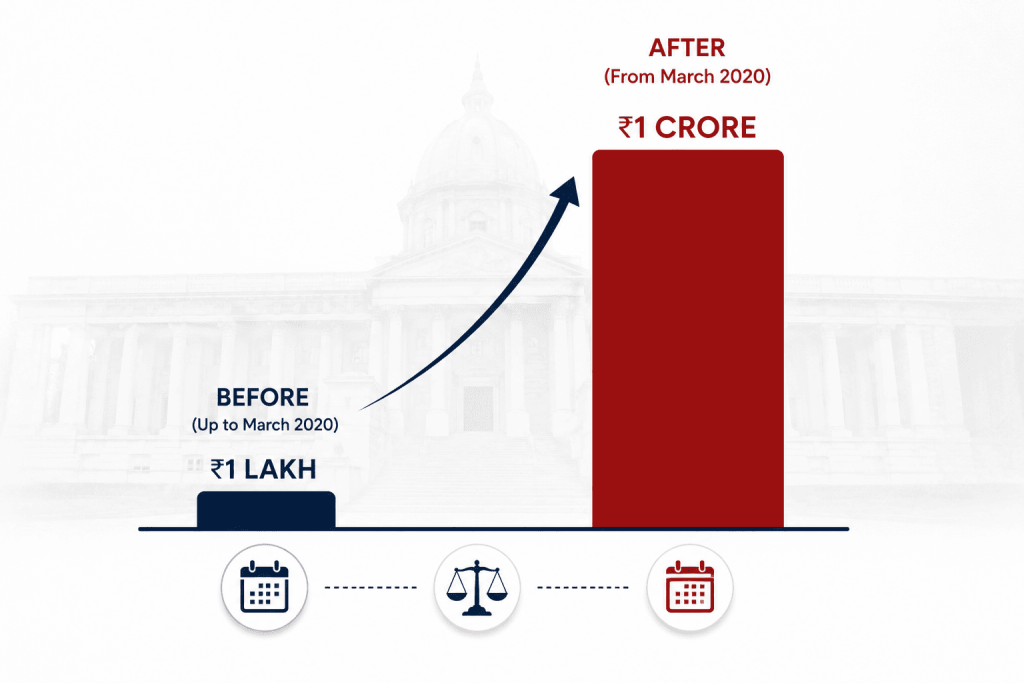
₹1 crore. This is the minimum default amount required to trigger a Section 9 application, and it has stayed at this level since the Ministry of Corporate Affairs raised it from ₹1 lakh through a notification dated 24 March 2020. The change was meant to protect smaller companies from being pushed into insolvency over relatively small dues during the pandemic, and it has never been rolled back since.
A genuinely useful, and often missed, detail: tribunals look at the default amount as it stands on the date you file your application, not on the date you sent your demand notice. If a part-payment comes in between your notice and your filing and it drops your outstanding dues below ₹1 crore, your application becomes vulnerable, even if the original invoice was well above the threshold.
If your outstanding dues sit below ₹1 crore, NCLT is not available to you as things stand, and chasing it anyway usually wastes months. A registered micro or small enterprise can use the MSME Samadhaan route instead, which we cover in the comparison table further down, since it has no minimum claim amount at all.
How Do You Send a Demand Notice Before Filing at NCLT?
You cannot walk into NCLT without doing this first. Section 8 of the IBC requires every operational creditor to put the corporate debtor on formal notice before filing, and skipping this step is one of the most common reasons applications get thrown out.
- Choose the right form. If you are relying on an unpaid invoice, use Form 4. If there is no invoice as such, for instance a claim based on a contract or work order, use Form 3.
- Attach the supporting record. Copies of the invoice, purchase order, delivery challan, or contract, whatever establishes the debt.
- Deliver it properly. Registered post with acknowledgement due, speed post, or hand delivery to the registered office of the corporate debtor, ideally backed up by email as well. Keep every proof of delivery. This single piece of paperwork gets challenged more often than any other part of the filing.
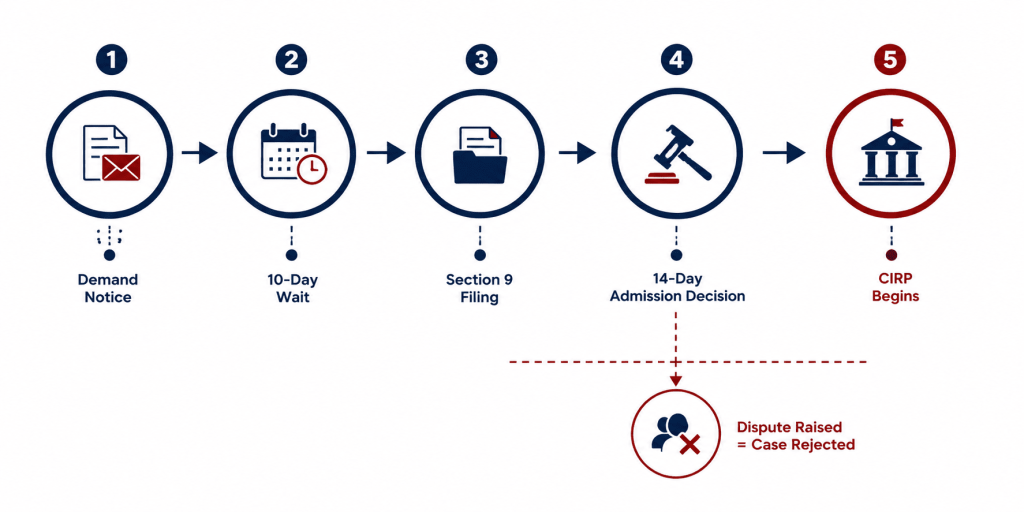
- Wait the full 10 days. The company now has 10 days from the date it receives your notice to either pay you or send a notice of dispute. File before this window closes and your application can be rejected on that ground alone.
- Track what comes back, if anything. Silence works in your favour. A genuine, well-documented dispute does not.
If drafting and serving this notice correctly feels like more than you want to handle alone, this is exactly the kind of document worth getting professionally drafted, since a defective notice can cost you the whole case months later.
What Counts as a Genuine Dispute That Can Defeat Your Case?
This is the single biggest reason well-founded claims still get rejected, so it deserves its own section rather than a footnote.
The test comes from the Supreme Court’s ruling in Mobilox Innovations v. Kirusa Software. The tribunal is not supposed to examine whether the company’s defence will actually succeed. It only has to check whether the dispute is plausible and supported by something more than a bare assertion made after your notice arrived. Emails about quality complaints, correspondence about short deliveries, or an ongoing arbitration over the same invoice, all raised before your demand notice, are usually enough to defeat a Section 9 application. A dispute invented the week after your notice lands, with no paper trail behind it, usually is not.
Recent tribunal orders keep applying this test strictly. In one 2026 case, a supplier’s claim for unpaid dues was dismissed after the corporate debtor produced an email exchange, predating the demand notice, that showed a real disagreement over the underlying liability. In another, the tribunal reversed an earlier rejection because the appellate bench had gone too far and tried to decide who was actually right on the merits, which is not its job at the admission stage.
The practical lesson: before you file, go back through your own inbox. If there is any prior email, letter, WhatsApp message, or meeting note where the company raised a quality issue, a short-supply complaint, or a billing disagreement, assume the company’s lawyer will find it too.
How Do You File the Section 9 Application at NCLT?
Once the 10 days pass with no payment and no genuine dispute, you move to the actual filing.
Step 1: Prepare Form 5
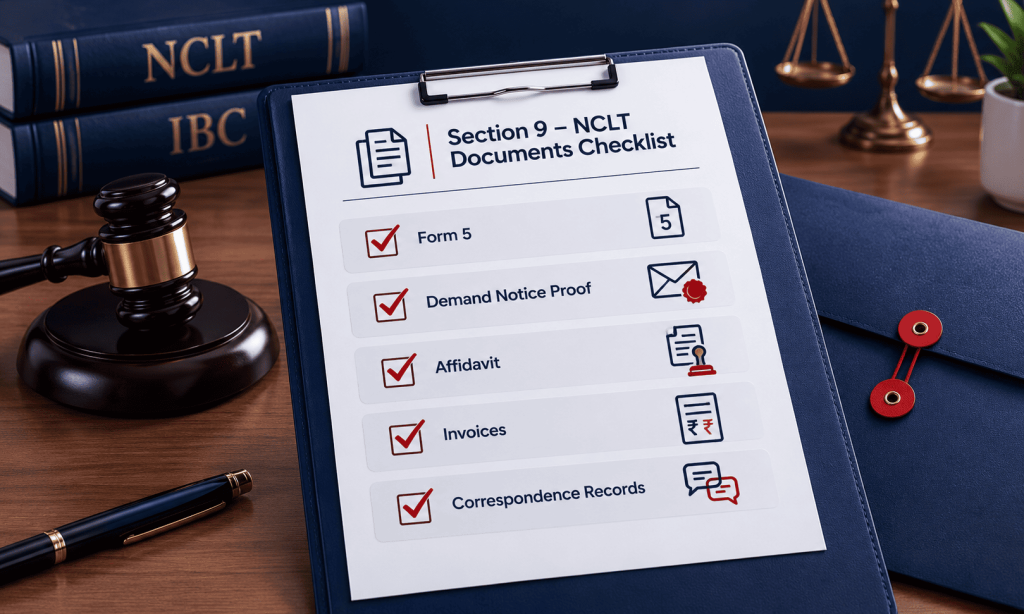
This is the operational creditor’s application form under the Insolvency and Bankruptcy (Application to Adjudicating Authority) Rules, 2016. It asks for your details, the corporate debtor’s details, the nature and amount of the debt, and the date of default.
Step 2: Attach the required annexures
Alongside Form 5, you file a copy of the demand notice with proof of service, an affidavit confirming that you have received no notice of dispute, and every document that establishes the debt: invoices, purchase orders, delivery challans, and any relevant communication.
Step 3: Decide on an Interim Resolution Professional
Unlike financial creditors, an operational creditor is not required to name a proposed Interim Resolution Professional (IRP). You may propose one if you already have someone in mind and have their written consent, but if you leave this blank, the tribunal will direct the Insolvency and Bankruptcy Board of India to recommend one.
Step 4: Pay the fee and file electronically
E-filing has been compulsory for NCLT since January 2024, through the tribunal’s own portal. The fee for a Section 9 application currently stands at ₹2,000, paid online through the Bharatkosh portal or by demand draft, separate from any professional fees you pay a lawyer or consultant.
Step 5: Clear the registry scrutiny
The registry checks your filing for formatting defects, missing pages, and incomplete annexures before it is listed. If something is missing, you typically get seven days to fix it. Miss that window and the registry can return the application altogether.
Step 6: Wait for the admission hearing
Once your papers are in order, the case gets listed. The tribunal is required by law to decide, within 14 days of receiving a complete application, whether to admit it or reject it. In practice, busier benches such as Delhi and Mumbai often take longer than 14 days simply to get a fresh matter listed, so treat that number as a legal outer limit rather than a promise of speed.
What Documents Do You Need to File a Case in NCLT?
| Document | Why It Matters |
| Form 5 application | The core application form under the Adjudicating Authority Rules |
| Section 8 demand notice (Form 3 or 4) with proof of delivery | Shows you completed the mandatory pre-filing step |
| Affidavit of no dispute received | A sworn statement that no notice of dispute reached you within 10 days |
| Invoices, purchase orders and delivery challans | Establish that the debt is real and quantifiable |
| Correspondence with the corporate debtor | Helps rule out any pre-existing dispute, or proves one doesn’t exist |
| Bank or financial institution certificate of non-payment, if available | Supports your claim that the amount remains unpaid; not treated as compulsory if you genuinely cannot obtain one |
| Interest calculation, if interest is claimed | Interest generally has to rest on an express agreement or invoice term to count toward the debt |
| Vakalatnama or authorisation letter | Confirms who is representing you before the tribunal |
| Proof of fee payment | Confirms the ₹2,000 application fee has been deposited |
| Corporate debtor’s CIN and registered office details | Establishes the tribunal’s jurisdiction over the case |
Keeping this paperwork organised from day one, well before a dispute even arises, is really an accounting habit more than a legal one. Businesses that maintain clean invoicing and ledger records rarely struggle to assemble this file quickly when they need to.
Which NCLT Bench Should You File In?
Jurisdiction follows the corporate debtor, not you. You file where the registered office of the company that owes you money is located, not where your own business sits, and not where the contract was signed.
NCLT currently operates through 16 benches across the country, including the Principal Bench and a separate bench at New Delhi, and further benches at Mumbai, Chennai, Kolkata, Bengaluru, Hyderabad, Ahmedabad, Chandigarh, Allahabad, Guwahati, Jaipur, Cuttack, Kochi, Amravati, and Indore. Before filing, check the registered office address on the company’s latest ROC annual return or MCA master data, since companies do sometimes shift their registered office, and filing at the wrong bench simply gets the matter returned.
One edge case worth knowing about: if the corporate debtor has already been struck off the register, you cannot proceed against it as things stand. It generally has to be revived first, whether by you, another creditor, or the Registrar, before an insolvency application against it can move forward. This happens more often than you would expect with smaller, dormant companies that quietly stop filing and eventually get struck off.
How Much Does It Cost to File a Case in NCLT for Payment Recovery?
The tribunal’s own fee is modest: ₹2,000 for a Section 9 application, paid at the time of filing. That figure alone, though, rarely reflects what the process actually costs.
Realistic costs to budget for include:
- Professional drafting and filing fees, which vary widely depending on the complexity of your claim and whether the company is expected to contest admission
- Court fee for the demand notice stage, usually nominal, but drafting it properly is worth paying for
- Costs of appearing at hearings, particularly if your bench is in a different city from your own
- Potential costs if the case drags on, since a contested admission can involve several hearings before a decision comes through
Weigh this against what you are actually owed. For a claim just over the ₹1 crore floor, the legal spend can start to look significant relative to the recovery, especially since admission doesn’t guarantee you get paid in full, a point worth sitting with before you commit.
What Happens After NCLT Admits Your Application?
This is the stage a lot of guides skate past, and it is the one that most affects whether you actually see your money.
Once the tribunal admits your case, a moratorium takes effect under Section 14. All pending suits, recovery actions, and enforcement steps against the company freeze. The company’s board is suspended, and an Interim Resolution Professional takes over management. A public announcement goes out inviting every creditor, not just you, to submit their claims.
From here, the process is no longer really about your invoice. It becomes about the company as a whole. A Committee of Creditors, generally dominated by lenders and financial institutions, decides whether to approve a resolution plan that keeps the company running under new terms, or to send it into liquidation. Operational creditors like most suppliers rank behind secured lenders in how sale proceeds get distributed, and it is common, honestly, for unsecured suppliers to recover only a portion of what they are owed once a resolution plan or liquidation plays out, unless the company settles with you directly before that stage.
That last point is worth repeating because it rarely gets said plainly enough: admission is not the end goal, it is a pressure point. Most operational creditors who actually get paid in full get paid because the company settled once its management realised what admission would trigger, not because the CIRP itself ran its full course.
The full process is designed to be completed within 330 days from admission, including any time spent on litigation along the way, under Section 12 of the IBC. In practice, cases involving asset disputes, multiple creditors, or an uncooperative management regularly run past this outer limit.
How Long Does the Whole Process Really Take?
Break it down stage by stage and the honest picture looks like this:
- Demand notice period: a fixed 10 days
- Filing to admission: a statutory 14 days, though contested or defective filings routinely take longer at busier benches
- CIRP itself, once admitted: up to 330 days, including appeals, though this limit is frequently exceeded in complex cases
- Settlement before admission: this is genuinely the fastest outcome, and it happens often enough that it is worth planning for from the start, since most companies would rather pay an overdue invoice than lose control of the business to an outside professional
If your priority is speed over principle, factor this into your decision from day one. NCLT is rarely the fast option; it is the option with the most leverage.
What Are Your Alternatives to Filing at NCLT?
NCLT is one route among several, and it is often not the right one, especially below the ₹1 crore mark or against a debtor that isn’t a company or LLP at all.
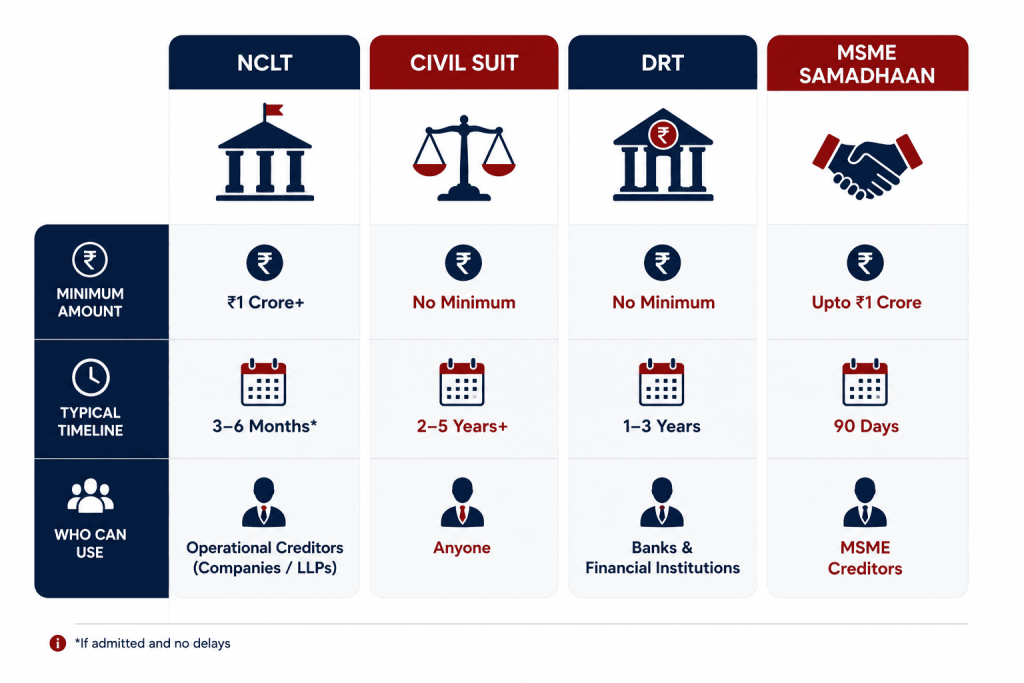
| Route | Best For | Minimum Amount | What You Actually Get | Typical Timeline |
| NCLT (Section 9, IBC) | Unpaid suppliers of companies and LLPs | ₹1 crore per creditor | An insolvency process against the company, not a money decree | 14 days to admit or reject; CIRP itself up to 330 days |
| Civil suit | Any debtor, any amount | None | A money decree, which still needs separate execution proceedings | Often several years |
| Summary suit (Order XXXVII CPC) | Written contracts, cheques, acknowledged debts | None | A faster decree, since the debtor needs the court’s permission to even contest it | Months to around a year if contested |
| Debt Recovery Tribunal (DRT) | Banks and notified financial institutions only | ₹20 lakh | A Recovery Certificate, executed like a decree | Statutory target around 180 days, often longer |
| MSME Samadhaan (MSEFC) | Udyam-registered micro and small suppliers | None | A Council order carrying compound interest on the delayed payment | Statutory 90 days |
| Section 138, Negotiable Instruments Act | Payment made through a bounced cheque | None | A criminal complaint and possible compensation, not a civil decree by itself | Often a year or more, case-dependent |
| Arbitration | Contracts with an arbitration clause | None | An arbitral award, enforceable like a court decree | Depends on the agreed procedure, often 6 to 18 months |
If you qualify as a registered micro or small enterprise, our detailed guide to payment recovery under the MSME Act is worth reading before you decide, since it carries no minimum claim size and moves on a statutory 90-day clock.
What Changed Under the IBC Amendment Act, 2026?
Insolvency law moves fast, and this article would be incomplete without flagging the most recent overhaul. The Insolvency and Bankruptcy Code (Amendment) Act, 2026 received presidential assent in April 2026, with several of its key provisions notified into force from 26 May 2026.
For an operational creditor filing under Section 9, the core process described above has not changed. What has changed:
- A new Creditor-Initiated Insolvency Resolution Process (CIIRP) now exists, but it is only available to specified financial creditors, essentially large banks and notified NBFCs, holding at least 51% of the debt by value. An ordinary supplier cannot use this route.
- The fast-track CIRP option for smaller companies has been removed altogether, so there is no longer a shortened timeline available for smaller corporate debtors.
- Admission has been made mandatory once default is proven, closing a gap that previously gave tribunals some discretion to refuse financial creditor petitions even where default was clear. This brings Section 7 in line with how Section 9 has generally worked already.
- Appeals before the NCLAT must now be disposed of within three months, which should, in theory, shorten the tail end of contested cases.
- New penalties apply to frivolous or vexatious filings, reinforcing the existing judicial position that Section 9 cannot be used purely as a pressure tactic without a genuine underlying claim.
Because this legislation is still fresh and its supporting regulations are still being finalised, treat this section as a starting point rather than the final word, and check current guidance before you rely on it for a live filing.
What Mistakes Should You Avoid When Filing at NCLT?
- Filing before the 10-day notice period has run out. This alone gets applications rejected outright.
- Ignoring old correspondence that could count as a dispute. If you argued about quality, quantity, or price months ago, that conversation does not disappear just because you would rather it did.
- Filing at the wrong bench, usually because the registered office on record has changed since you last checked it.
- Treating NCLT as a guaranteed payday. It is a resolution process for the whole company, not a court that hands you your money back.
- Skipping professional help on the demand notice. A notice with a defective delivery record or the wrong form can cost you the entire case later, regardless of how strong your underlying claim is.
- Filing well below the threshold and hoping it gets waived. It does not. ₹1 crore is a hard floor, checked on the date you file.
- Assuming interest automatically adds to your claim. Without a clear contractual basis for it, tribunals have declined to count interest toward the debt amount.
FAQs
Can I file a case in NCLT against a proprietorship or a partnership firm that owes me money?
No. NCLT’s insolvency jurisdiction under the IBC only reaches companies and LLPs. If you are owed money by a proprietorship or an ordinary partnership firm, you will need a civil suit, a summary suit under Order XXXVII if you have a written contract, or another applicable route, since Section 9 simply does not apply to these entity types.
Can several unpaid suppliers combine their invoices to reach the ₹1 crore threshold together?
No, and this trips up a surprising number of applicants. Tribunals have consistently held that each operational creditor’s own claim must independently cross ₹1 crore. Even a joint petition filed by multiple creditors gets rejected if no single one of them individually meets the threshold, regardless of what the combined total adds up to.
What happens to my case if the company pays me after I have already filed at NCLT?
Before your case is admitted, you can generally withdraw with the tribunal’s permission once payment is received. After admission, withdrawal gets more complicated, since it typically needs the Committee of Creditors’ approval once one has been formed, precisely because other creditors are by then also part of the same process.
Do I need a lawyer to file a Section 9 case, or can I file it myself?
There is no absolute legal requirement to hire a lawyer, and individuals can technically represent themselves. In practice, given how strictly tribunals apply the pre-existing dispute test and how easily a defective demand notice can sink an otherwise valid claim, most operational creditors are better served getting professional help, at least for the notice and the initial filing.
Can a foreign company or an NRI supplier file a case in NCLT against an Indian company?
Yes. The IBC does not restrict who can be an operational creditor based on nationality or residence. Foreign suppliers and NRIs have filed and pursued Section 9 applications successfully, though additional documentation, such as authenticated translations or apostilled papers, is often required for anything executed outside India.
Will taking a company to NCLT damage my chances of doing business with them again?
It can, and that is a genuine business call you need to make before filing, not after. An insolvency filing is a serious step, and companies often treat it as the end of a commercial relationship rather than a hiccup in one. Many suppliers keep this route as a last resort precisely for that reason, after direct follow-up and a formal notice have both failed.
Does interest on the delayed payment count toward the ₹1 crore threshold?
Only if it rests on a clear contractual basis, such as an interest clause in your purchase order or invoice terms. Tribunals have refused to add interest to the principal debt for threshold purposes where there was no express agreement covering it, so do not assume a smaller principal amount can be topped up with interest to clear the ₹1 crore mark.
What is the difference between filing a winding-up petition and filing a Section 9 case?
Winding up under the Companies Act, on the ground that a company cannot pay its debts, has largely been replaced by the IBC route since 2016 and is now considered a weak option for straightforward payment disputes above the ₹1 crore mark. Winding-up petitions today are mostly reserved for other grounds, such as fraud or situations where it is “just and equitable” to close the company, rather than ordinary non-payment.
Can I file a case in NCLT if my agreement with the company has an arbitration clause?
Generally, yes. An arbitration clause does not, by itself, stop you from filing under Section 9, since insolvency proceedings are treated differently from an ordinary contractual dispute. That said, if the same dispute is already genuinely contested in arbitration, that ongoing arbitration can itself count as evidence of a pre-existing dispute under the Mobilox test, which could work against your application.
What happens to my unpaid invoice if the company is already going through CIRP filed by someone else?
You cannot file a fresh Section 9 case once a moratorium is already in place against the same company. Instead, you submit your claim to the Interim Resolution Professional handling the existing process, along with your supporting invoices and documents, and your dues get considered alongside every other creditor’s claims as part of that single CIRP.
You may also like


What Should Taxpayers Know About Income Tax Rules 2026?
The Income Tax Rules 2026 have changed the working language, form numbers and r